



Abstract
Information literacy forms a key concept within Library and Information Science, where it forms the focus of scholarship, conferences, journals and teaching librarian practice, alike. However, little is known about how other fields and disciplines have employed these outputs within their own research and practice. This paper examines how the concept of information literacy has been leveraged into the discourses of non-Library and Information Science disciplinary landscapes. This is achieved through a qualitative mapping of five different fields and disciplines, including Higher Education, Management and Business, Public Health, Nursing and Psychology, to identify how information literacy terminology, definitions, theories and frameworks have travelled across scholarly and practice boundaries to become appropriated into other disciplinary landscapes. The aim of this collaborative work is to develop an indicative rather than an exhaustive understanding of what travels within information literacy research and practice and to strengthen the Library and Information Science narrative on the impact of information literacy activities.
Introduction
The concept of information literacy has been most comprehensively developed within the field of Library and Information Science (LIS). However, as a social practice that ‘acts as a catalyst for learning about context, its practices and processes’ (Lloyd, 2010: 29), information literacy is manifest within a range of disciplinary and vocational areas of study, including academic, workplace, every day and health-related fields. The aim of this collaborative work is to investigate and describe how information literacy has been leveraged and appropriated into the discourses of non-LIS disciplines via their own disciplinary literature. In this small exploratory study, the concept of information literacy will be qualitatively mapped across a range of discipline areas to identify how the concept has travelled and become appropriated into discourse. Developing an in-depth and nuanced understanding of the trajectory and appropriation of information literacy practice into other disciplines or fields will strengthen the LIS narrative on the importance of information literacy practice and extend claims for interdisciplinary impact. To this end, the research questions that this study will address are:
1. How has information literacy been leveraged by other disciplinary landscapes?
a. How have other disciplines and fields used their own terminology, definitions, theories and frameworks to talk about information literacy?
b. How have other disciplines and fields used LIS literature, terminology, definitions, theories and frameworks to talk about information literacy?
In examining these questions, this paper constitutes a small-scale qualitative mapping of information literacy research within several key disciplinary landscapes rather than an exhaustive and larger scale bibliometric study (e.g. Pinto et al., 2010, 2013)
Literature review
Information literacy forms a complex concept that has most prominently been developed from within the field of Library and Information Science. Originally conceived as a tool to improve workplace productivity (Zurkowski, 1974), information literacy was subsequently adopted by librarians, where it rapidly became repositioned as a key academic competence. This focus resulted in the development of early practice-led definitional work (e.g. American Library Association [ALA], 1999) as well as the establishing of higher education-focussed models (e.g. ALA, 1999; SCONUL Working Group on Information Literacy, 2011). Growing librarian interest meant this period also saw an increase in information literacy policymaking within international bodies (e.g. UNESCO, 2005) and information literacy research within the broader field of Library and Information Science. These developments led to the emergence of theoretical work, including Kuhlthau’s (1991) early process-based models of information literacy, as well as, more recently, the first theory of information literacy (Lloyd, 2017). They further led to a focus on information literacy outside the academic sector, including in workplace, health and everyday settings. Information literacy, which encompasses these professional, policymaking and research strands (Pilerot and Lindberg, 2011), is now considered to form a growth area within LIS research (Larivière et al., 2012), while the long-established roles of information literacy journals and conferences (Webber and Johnston, 2017) points to the increasing maturity of the field.
This interest means there has been growing emphasis on mapping the field and the use of bibliometric methods has formed one of the key ways in which this has been done. First appearing in the early 2000s, initial research in the area tended to perform basic exploratory analyses of relevant published literature, including examining key journals, language of publication and most prolific authors, amongst other markers (Bapte, 2020; Dudziak, 2010; Kolle, 2017; Majid et al., 2017; Nazim and Ahmad, 2007; Park and Kim, 2011; Singh and Yumnam, 2020; Sproles et al., 2013; Taşkın et al., 2013). Illuminating emerging publication trends, these studies also provided an indication of the wide variety of disciplinary contexts in which information literacy had been examined, including LIS, Education, Computer Science and Health, amongst other areas (e.g. Aharony, 2010; Pinto et al., 2010). Nonetheless, this research is often limited by the methods used to explore this literature, including restricting analysis to a narrow range of LIS databases (e.g. Nazim and Ahmad, 2007; Park and Kim, 2011) and a reliance on limited search terminology (e.g. Aharony, 2010; Chen et al., 2021; Majid et al., 2017; Taşkın et al., 2013). In contrast, Pinto et al. (2010) note the importance of employing both subject-specific and multidisciplinary databases such as Web of Science and Scopus within bibliometric research due to idiosyncratic metadata and indexing processes, as well as differences in search vocabulary.
Broader understandings about the important role that context plays within information literacy have subsequently led to a far more targeted approach to bibliometric analysis research. Later work, for example, has specifically centred on exploring publishing trends within disciplinary literature including in humanities, social science and health literature (Bhardwaj, 2017; Pinto et al., 2013), noting slight changes in emphasis between each body of literature. Research has also explored the outputs of specific journals in the field, including the Journal of Information Literacy (Panda et al., 2013; Tallolli and Mulla, 2016). Other authors focussed more specifically on the terminological issues that were raised within early research by examining digital literacy (Alagu and Thanuskodi, 2019; Kumar, 2014; Stopar and Bartol, 2019) and health literacy literature in more detail (Bankson, 2009; Kondilis et al., 2006; Massey et al., 2017; Shapiro, 2010). Whilst some of this research is marred by similar methodological issues that were found in earlier work, studies corroborate the interdisciplinary nature of information literacy, as well as growing interest in the field (Larivière et al., 2012). At the same time, Massey et al. (2017) draw attention to the insular nature of much research by illustrating how health literacy scholarship often uniquely references domain-specific citation networks.
It has not been until more recently that research has started to use bibliometric tools to examine the content of information literacy literature rather than its publication patterns. An early example of this approach came from Park and Kim (2011), who noted significant clusters of research related to educational settings and computer-assisted instruction. Pinto (2015) employed similar clustering techniques in their examinations of information literacy assessment and mobile information literacy literature (Pinto et al., 2019) where they, too, found an emphasis on computers, amongst other topics. In contrast, Chen et al. (2021) and Onyancha (2020) employed bibliometric techniques to examine the evolution of information literacy themes over time. This approach enabled Onyancha (2020) to characterise information literacy research as roughly marked by four major themes, which include: computers (1975–1990), the internet (1991–2000), educational theory (2001–2010) and context (2011–2018). It also allowed him to chart the ebb and flow of the various literacies associated with information literacy including the fall of computer literacy and the rise of financial and civic literacies, amongst other terms. These findings are further corroborated by Li et al. (2021), who note the current stability of learning and education topics within information literacy research compared to the relative growth of new digital technology topics, such as big data and AI.
The nuances that Onyancha (2020) and Li et al. (2019) were able to draw from the literature illustrate the impact that different methodological approaches have upon understandings of information literacy development. The initial focus on publication patterns, for example, meant that early research tended to be limited to descriptive statistical analysis of database metadata (e.g. Kolle, 2017; Pinto et al., 2010), although Aharony (2010) and Sproles et al. (2013) supplemented their investigation with basic content analysis. In contrast, later research has employed progressively more sophisticated quantitative research methods to analyse information literacy literature, including using Atlas.ti, VOSViewer and HistCite software to perform word co-occurrence analyses of title, descriptor and abstract data (e.g. Onyancha, 2020; Pinto, 2015), social network analysis (Baji et al., 2021), topic modelling (Li et al., 2019), visualisations of related concepts (e.g. Stopar and Bartol, 2019) and co-citation analyses (e.g. Massey et al., 2017; Taşkın et al., 2013). At the same time, each of these approaches has been impacted by decisions made about how to build the dataset that forms the basis of research, including whether to examine author-supplied metadata or not (such as keywords). In addition, the overwhelming use of quantitative research methods means that there have been few attempts to analyse information literacy literature itself, including tracing the impact of developments within the field, rather than just its publication or citation characteristics.
A rare example of a qualitative approach is found in the work of Pilerot (2016) who combined a bibliometric search of Web of Science with reference comparisons from selected policy documents and information literacy textbooks to map information literacy literature. This decision, which was driven by Pilerot’s recognition that information literacy does not form a homogenous field of study, facilitated a more nuanced analysis of assumptions in the field, including points of disconnection between research, policy and professional practice strands of information literacy literature. Other ways in which information literacy research has been qualitatively mapped is through literature review and systematic review techniques. Notable examples of this are Virkus (2003), who carries out a literature review of scholarly and non-scholarly sources to explore information literacy developments in Europe. This was updated 10 years later (Virkus, 2013) although this publication features personal reflections and only a small exploratory study to accompany the formal review of the literature. Another notable example comes from Stordy, who uses citation chaining in his 2015 examination of the field. Producing a ‘taxonomy’ of literacies, Stordy additionally reviewed each of the studies that were identified through using bibliometric techniques, which allowed him to provide useful insight into connections between related terms, such as digital literacy. Literature reviews have also been employed to analyse sub-sets of the information literacy literature, including teaching information literacy to international students (Houlihan et al., 2017) or to advance a particular conceptual view of IL. for example, ‘Information literacy 2.0’ (Spiranec and Zorica, 2010). Whilst these studies do not have the rigour of formal bibliometric studies, they do represent significant attempts to understand the breadth and nature of the discipline.
In summary, there have been a significant number of studies dedicated to mapping and visualising the information literacy research field. Whilst early literature focussed on statistical analysis of publication trends, later studies have adopted more complex quantitative analytical processes to draw out inferences from the content of the literature, including related to thematic strands as well as its multidisciplinary scope. However, research has also been limited methodologically, with several studies relying on a dataset with a 2010 cut-off date or restricted database integration. Research can also be critiqued for conceptual limitations, including a lack of differentiation between practical and theoretical understandings of information literacy. These methodological issues, as well as the need for qualitative methods that permit the integration of detailed disciplinary knowledge into the research design, form additional rationales for this study.
Methods
Overview
Five disciplinary landscapes were selected as the focus of examination for this study: Higher Education, Management and Business, Public Health, Nursing and Psychology. These landscapes were chosen to provide a broad range of data, as well as forming areas in which the concept of information literacy might be expected to play an important role, where each of the authors felt they had sufficient subject knowledge to be able to engage with the academic discourse. Each author subsequently performed a series of searches for references to information literacy within key databases in their respective landscape in September–October 2021. The study’s focus on contextual appropriation of information literacy concepts meant that it was impossible for all searches to be identical; as various authors have pointed out, it is extremely challenging to mimic searches across databases let alone disciplinary fields, due to idiosyncratic indexing and editorial policies, amongst other issues (Pinto et al., 2013). Consequently, each author supplemented the initial search for ‘information literacy’ by using related disciplinary terms (such as health literacy) to perform additional searches for relevant literature. See the following section for the specific ways in which each author complemented the initial search query. Additional language was selected through examination of alternative subject headings that was accorded to relevant literature as well as common author provided keywords. Similarly, the contextual shape of this research meant that it was impossible to establish a core set of databases for each author to search. This meant that each author performed a search in Web of Science, which represents a comprehensive general tool that is often used in bibliometric studies but supplemented this search in relevant disciplinary databases (see Appendix 1).
Consistent sampling criteria was applied to establish the data set. Literature was limited to academic or peer-reviewed articles, proceedings papers or reviews and was restricted in time from 2010 to 2020. Papers were further excluded if they were sole authored by a librarian or an LIS researcher, or if they were published in an LIS journal, to focus on the ways in which information literacy concepts have been leveraged in other fields. The remaining papers in each data set were subsequently ordered by citation count and the highest cited papers within each field were selected to review. Due to differences in the numbers of papers retrieved, highest cited papers referred to papers with over 30 citations or the top 10 papers cited within each field, whichever was the higher number. The sub-set of papers extracted for review were scanned and subjected to qualitative mapping analysis in response to the stated aims and objectives of the study. Close attention was paid to the way in which information literacy was represented in the paper, the terminology used, the definitions provided for information literacy, the nature of the literature cited to support discussion or presentation of IL and the extent to which LIS literature was cited, the roles of libraries and librarians, and the fields or concepts that were closely linked with information literacy in the discipline area.
Field-specific methods
Each author supplemented the initial search query to retrieve the most relevant results for their field of study, as outlined in Appendix 1. In the examination of the higher education landscape, literature searching was supplemented by a chaining approach, which was used to identify authors who had cited Bruce’s (2008) influential work ‘Informed Learning’. That publication was chosen because it specifically articulates the relationship between IL and learning. In the public health landscape, the author studied three representative subsections of this literature to take the measure of this vast field of study. Diabetes was chosen as representative of a chronic illness, heart failure was chosen as an example of an acute illness, and pregnancy was chosen as an example of a health-related event. The examination of public health and nursing excluded health literacy from the search parameters. This is due to the predominant focus within health literacy research on standardised literacy and numeracy tests (e.g. the Test of Functional Health Literacy in Adults) rather than the concept of information. For the field of psychology, three notable papers that had come to the author’s attention via other research projects were included in the analysis because of their specific focus on information literacy ideas.
Data visualisation
Each of the author’s Web of Science searches (but not the searches from disciplinary databases) were subsequently visualised through freely downloadable 1 VOSviewer software to provide an indicative visualisation of bibliometric data through the generation of cluster maps. These cluster maps illustrate the extent to which keywords appear together with other keywords in the chosen results set and help to identify patterns in citation networks or keyword co-occurrence. VOSviewer focuses on the distance-based approach, where relations between keywords (‘nodes’ in VOSviewer) are weighted according to their strength and the closer the terms appear together, the more related they are (Van Eck and Waltman, 2014). These clusters are allocated by the software and identifiable by colour variation. Noun-phrases that were used to establish the dataset were drawn from titles and abstracts in database results set outputs while frequencies of keywords were adjusted by the authors to clarify the resulting map. There was some data cleaning, which involved excluding unrelated terms, and merging near-duplicates. Whilst these adjustments were helpful in terms of exploring the set of results, it should be recalled that decisions were being made in terms of database, query, keyword frequency, cluster weighting, all of which can vary the output map, meaning it is dynamic and open to interpretation. The visualisations therefore provide a starting point illustration rather than a definitive view of the data and are not a replacement for analysing the content of the articles.
Limitations
The major limitation to this study was the lack of standardised language, which impacted on the capacity to search. To overcome this, all searches employed the keyword ‘information literacy’ and then employed additional field-specific keywords/subject headings that were relevant to the field searched. These issues were also compounded by variation in the ways that each author understands information literacy, which may have influenced the search and qualitative mapping analysis process. The research process described here is bound by each author’s own conception of information literacy, which is drawn from their professional and research practice, and is influenced by factors such as epistemology, worldview and the contextual nature of experience. Phenomenographic research into information literacy clearly establishes that variation in conception of information literacy is a widespread phenomenon (Boon et al., 2007; Bruce, 1997). This issue was partially, though not wholly, addressed by the conversations that took place between authors to share conceptions of IL.
The study was also limited in terms of the data set; the literature presented is a snapshot of the available literature at the time of search, and each author conducted their searches at different times over a 3-month period. In addition, searches were carried out using different institutional subscriptions to journal databases meaning that the exact journals covered through services such as Web of Science were not identical for each researcher. Although a great deal of discussion took place about the literature extracted and the qualitative mapping analysis, inevitably there are differences in approach between each author, as outlined in Appendix 1. This is exacerbated by the very different qualities of the literature in each disciplinary area. A further limitation is the use of citation counts, which were used to establish quality, but which differed by database used. Focussing on more highly cited papers may have privileged older material or excluded material that presents a more up-to-date picture of IL in the various disciplinary landscapes. Nevertheless, taking account of these limitations, the paper presents an indicative (although not exhaustive) mapping of the ways in which information literacy has been leveraged in other disciplinary landscapes.
Findings
Higher education
An initial search of Web of Science retrieved 1931 papers; a search of education specialist database ‘British Education Index’ retrieved 68 papers, and Proquest education database 2156. Sources had been published in a range of education-focussed journals, including journals that covered both subject-specific teaching in higher education (e.g. Nurse Education Today) and journals that covered ‘generic’ teaching and learning in higher education (e.g. Studies in Higher Education). The VOS viewer diagram (Figure 1) below, constructed from a search of the Web of Science data only, reveals the prominence of the related concept of digital literacy and the role of ICT in higher education, and it is possible also to see various other educational subjects represented.
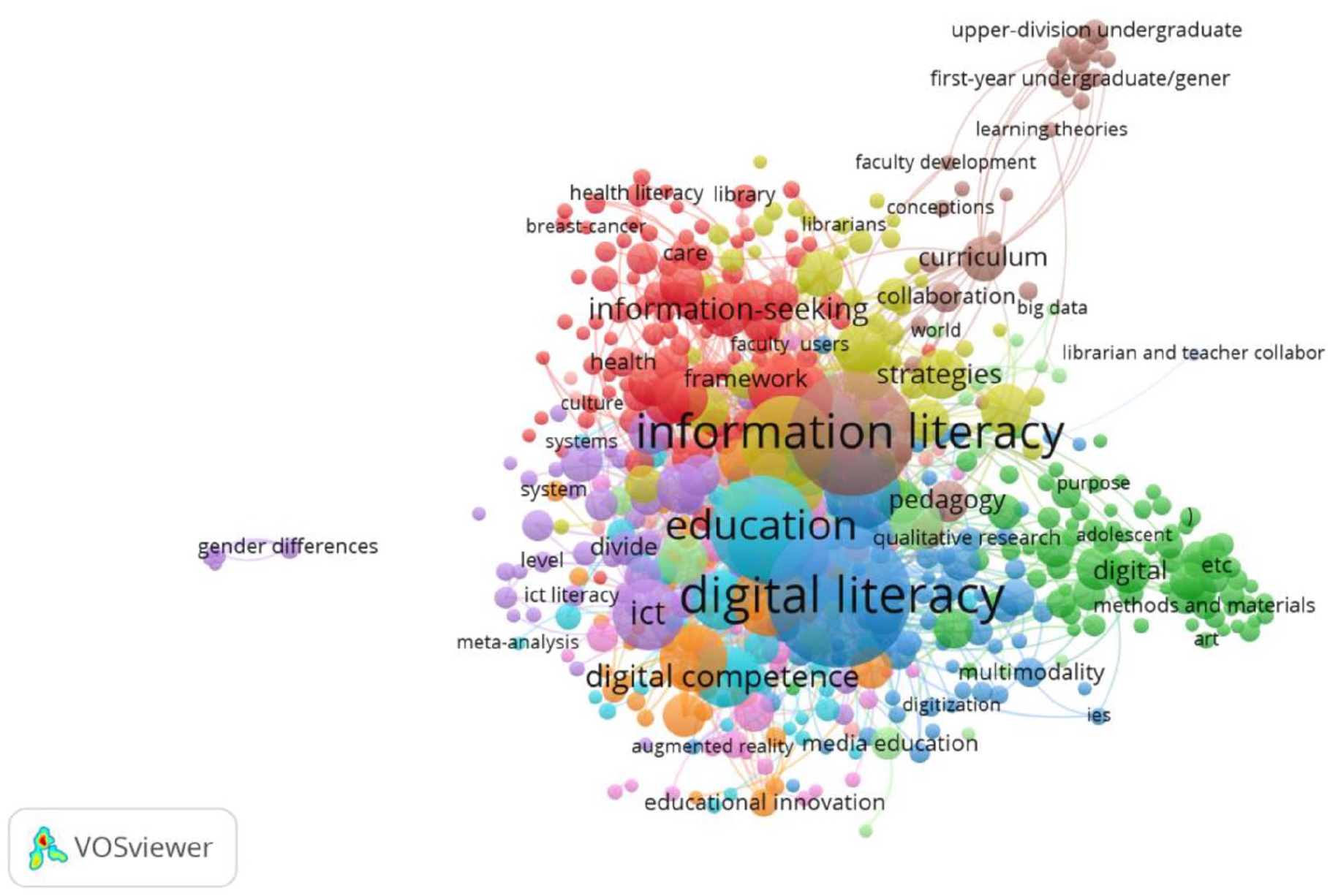
Higher Education, Web of Science: 567 keywords appearing 5 times or more.
Definitions of information literacy and literature cited
Whether or not papers provided a definition for IL, whose definition was selected, and whether IL was included as an author-defined keyword emerged as a key point of interest in the papers reviewed. A subset of the literature presents a well-developed conception of information literacy, where a definition was provided for the term from recognised LIS sources (the ALA definition was the most cited) and papers connect well with the LIS literature on IL. Examples of this are Guzmán-Simón et al. (2017), Kiliç-çakmak (2010) and Rosman et al. (2015, 2018). Some papers also feature teaching development activities or other interventions that involve librarians (Kingsley et al., 2011; Shane-Simpson et al., 2016), or at least articulate a relationship with the library for IL development; for example, Aglen’s (2016) literature review of evidence-based practice development for nurses in higher education notes: ‘These paedagogical interventions often involve librarians as co-teachers’. Some sources were less well-developed, but still present a good engagement with IL. For example, Van de Vord (2016) cites the ALA definition of IL and acknowledges the role of LIS research and librarians in the IL teaching space, although largely cities literature from the learning and teaching sphere rather than from LIS journals and publishers.
Eight papers included information literacy as an author-assigned keyword while the papers that did not include the term as an author assigned keyword must have had it assigned by indexers in Web of Science to be returned through the Topic search outlined in Appendix 1. Evering and Moorman (2012), for example, do not use the term ‘information literacy’ in the paper itself, but define commonly referenced elements of IL in their attempt to describe plagiarism, including ‘skills, knowledge, and expertise necessary to locate, navigate, and evaluate information in an ethical manner’. Other sources include a definition of IL, but not one commonly used in LIS-focussed research, including Aglen (2016), who cites Brettle and Raynor’s (2013) nursing definition of IL; Judd and Kennedy (2011), who cite the literature of educational studies or information-seeking in their definition of the term; and Shane-Simpson et al. (2016), who use a definition taken from psychology rather than LIS literature. Some sources refer to information literacy without providing any formal definition (Liu et al., 2017; Moch et al., 2010; Solomons and Spross, 2011), although often the importance and value of IL to academic study is carefully articulated. A second subset of papers seems broadly connected with the discourse around IL where it defines and discusses related terms (e.g. ICT self-efficacy; digital competence; 21st century skills) without privileging IL over these concepts (e.g. Hatlevik et al., 2018). A further sub-set of papers reviewed identified a stronger relationship with the concepts of digital or media literacy, including Choi (2016), who links media and information literacy with concepts of digital citizenship, which also features strongly in the Australian Library and Information Association (2001) and UNESCO (2005) definitions of IL. The second most highly cited paper, Selwyn and Gorard (2016), connects with the LIS literature on information behaviour, but not that of information literacy. There was no mention in any of the sources reviewed of popular models and frameworks of IL (e.g. Association of College & Research Libraries [ACRL], 2016; SCONUL Working Group on Information Literacy, 2011) that are often used to characterise librarians’ IL teaching in Higher Education.
Key concepts
Well-respected LIS researchers (e.g. Bruce, 2008) make close connections between IL and learning generally in HE, and this was picked up by some sources (Hammer and Green, 2011; Rosman et al., 2015). Others explicitly link conceptions of IL with constructivist educational practices, and the adoption of inquiry- and problem-based learning (Evering and Moorman, 2012; Judd and Kennedy, 2011), active learning (Aglen, 2016) and educational concepts such as Bloom’s taxonomy (Shane-Simpson et al., 2016). Other sources connect IL with broader concepts of academic literacies, critical thinking and lifelong learning (Guzmán-Simón et al., 2017; Hammer and Green, 2011; Judd and Kennedy, 2011; Kiliç-çakmak, 2010).
Despite the LIS-centric view that librarians are key stakeholders in IL teaching, several sources refrained from either mentioning librarians or acknowledging the role of the librarian within information literacy teaching (Evering and Moorman, 2012; Guzmán-Simón et al., 2017; Judd and Kennedy, 2011; Liu et al., 2017; Rosman et al., 2018; Solomons and Spross, 2011; Timmers and Veldkamp, 2011). Solomons and Spross (2011) review of evidence-based practice (EBP), which is the highest cited paper extracted for review, expresses disbelief that librarians and LIS researchers could be involved in the support and development of EBP, despite acknowledging the need to find and access research materials as a key aspect of EBP. Judd and Kennedy (2011) identify that ‘although there is evidence that these skills improved over time, a greater emphasis on information literacy skills training may be required to ensure that graduates are able to locate the best available evidence’ but fail to identify who would be providing this training. This is contrasted with Van De Vord (2010) and Shane-Simpson et al. (2016), who both openly acknowledge the role that librarians can and should play in IL teaching in higher education.
A couple of noticeable contexts for IL development in HE emerged from the analysis: information literacy as an aspect of EBP in education for nursing and allied health professionals (five papers) and IL in the context of the use of Wikipedia (three papers). In the EBP context, three papers (Aglen, 2016; Moch, et al., 2010; Solomons and Spross, 2011) perform systematic reviews of the literature. Aglen (2016) identifies multiple sources that explicitly link IL with EBP and concludes that ‘the main finding is that information literacy is considered the core competence needed for EBP’. Moch et al. (2010) similarly conclude that the ability to access information is a key aspect of EBP and discuss several sources that feature strong involvement from librarians. Solomons and Spross (2011) aim to define the barriers and facilitators to EBP and while they use IL as a search keyword, and frequently discuss capabilities that would be labelled IL by a librarian or information professional, they only use the term once in the abstract. Three papers extracted address the perceived problem of students using Wikipedia as an information source in HE and link improved IL with a more nuanced use of Wikipedia (Judd and Kennedy, 2011; Selwyn and Gorard, 2016; Shane-Simpson et al., 2016).
Management/business
An initial search of Web of Science using the query (Appendix 1) gave rise to a set of 592 results. Business literature within Web of Science is delineated by several parameters, but also strays across categories. The keywords from the results from the original search resulted in the diagram presented in Figure 2, where it can clearly be seen that the primary topic of this literature set is information seeking, while information literacy sits in a cluster with a focus on digital literacy, competence, skills and transformation.
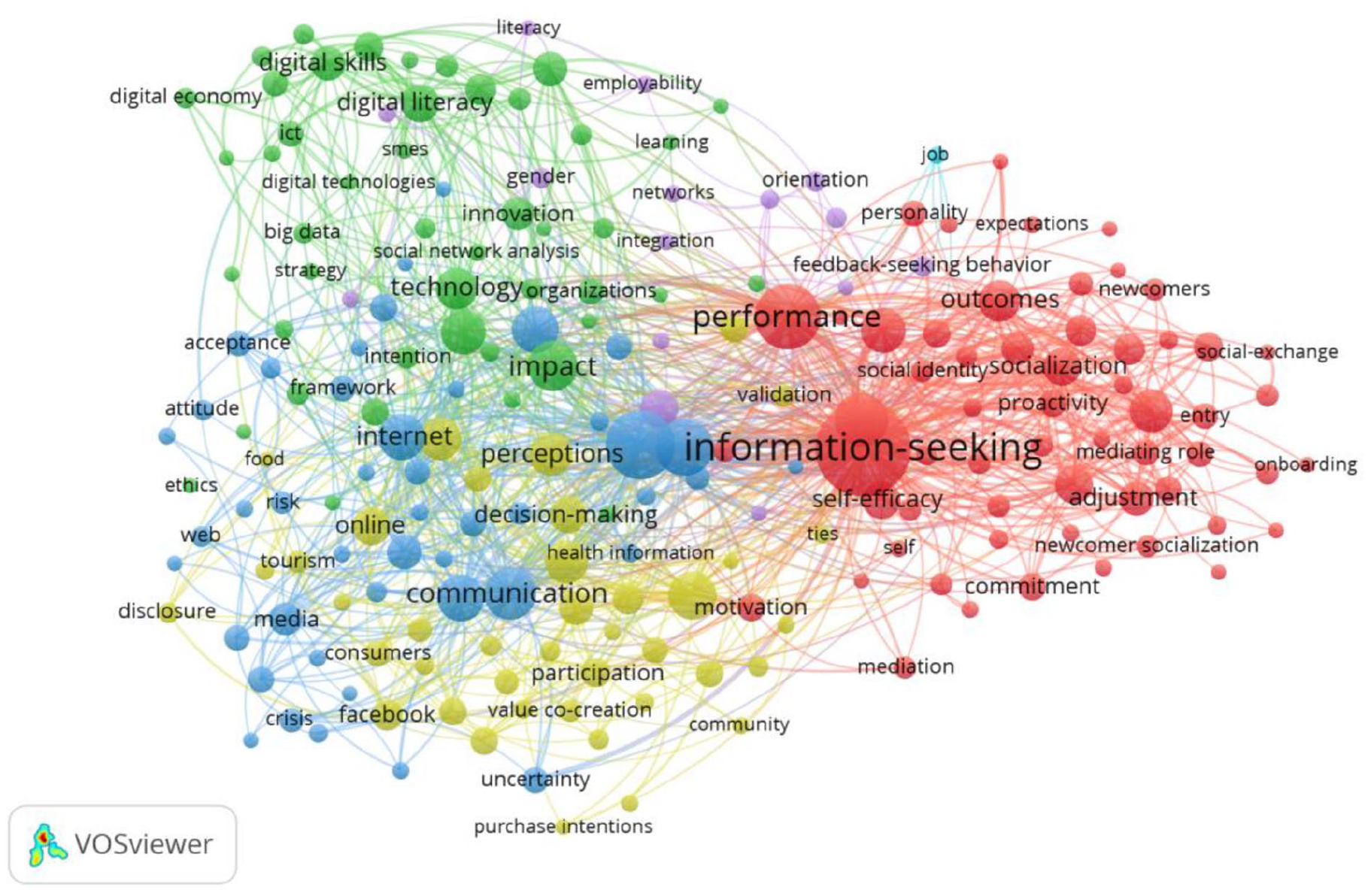
Management and business, Web of Science: 206 keywords appearing 5 times or more.
Definitions of information literacy and literature cited
The top ranked paper (Bhimani and Willcocks, 2014), which had 86 citations, mentioned ‘information literacy’ (in quotation marks) three times, where the article identifies ‘a range of “information literacy” challenges . . . for accounting information providers’ (Bhimani and Willcocks, 2014: 469). There is some subsequent discussion of data, information and knowledge concepts, knowledge management, information systems and the need for professionals in the accounting sector to be aware of rapid change. However, there is no definition of information literacy, and no reference to a source, despite the quotation marks. This suggests that the authors are either devaluing the concept as ‘so-called’ or introducing it as a new term, yet they undermine this by not providing any definition or references. In contrast, Chetty et al. (2018: 11) cite the work of the HE-focussed SCONUL Working Group on Information Literacy (2011) as well as the non-LIS focussed Rahanu et al. (2015) in their discussion of the digital divide in the economic context, recommending to G20 policy makers that ‘information literacy can simply be distilled to refer to the ability to search, retrieve, manipulate, evaluate, synthesise and create digital content’. Liu et al. (2012), who mention information literacy 18 times (mostly as ‘network information literacy’), similarly hedge their bets by citing Zurkowski (1974), who is well known within the LIS field, and Jones (1992), which is less canonical. This approach leads them to a definition where information literacy is seen to ‘. . .enable. . . people to search, evaluate, organise, and use information effectively’ (Liu et al., 2012: 1825). They conclude by suggesting that ‘consumers with high network information literacy express more positive attitudes toward technologies’ (Liu et al., 2012: 1832), an idea that reflects how, in the business context, information literacy is positioned as a consumer trait that is related to attitudes about technology.
Key concepts
While these examples demonstrate that information literacy does appear in this selected literature, references are infrequent, and citing sources are very low in number. More generally, supporting references relating to information seeking lean heavily on management and psychology literature (Bauer and Green, 1998; Madzar, 2001; Morrison, 1993a; Morrison and Vancouver, 2000) rather than established LIS sources, with Bawden’s (2001) highly cited LIS-focussed review of digital literacy making only one appearance. Information behaviour research stems from and centres around the organisational psychology work of Ashford and Cummings (1983) exploring uncertainty reduction and source credibility (Morrison and Vancouver, 2000). Looking at references in highly cited articles illustrate trends in this sector. The work of Morrison (1993a, 1993b) and Morrison and Vancouver (2000), who are authors from outside the LIS sector, is particularly notable for the frequency of its use within research on feedback-seeking and other consumer and staff behaviour (see, e.g. Anseel et al., 2015; Coff and Kryscynski, 2011; De Stobbeleir et al., 2016; Yi and Gong, 2013). Other frequent mentions are to be found of Bauer and Green (1998), Madzar (2001), Borgatti and Cross (2003) and Ashford and Cummings (1983). These big hitters (particularly Elizabeth Morrison, Jeffrey B. Vancouver, Talya N. Bauer, Stephen P. Borgatti, Rob Cross, Susan Ashford), who explore information seeking of consumers, managers, and staff, mostly draw from two disciplinary clusters: management, psychology, quality; and business, public relations, marketing rather than from LIS. Evidently, from the brief definitions identified by Chetty et al. (2018) and Liu et al. (2012) there is a link between information seeking work and what we know as information literacy in this context, but it is situated in a business psychology or marketing research context and rarely touches on the LIS literature.
Public health
The search process (see Appendix 1) resulted in a total of 235 papers related to pregnancy, 154 papers related to diabetes, and 21 related to heart failure. In terms of sources, most pregnancy articles were published in pregnancy journals (e.g. BMC Pregnancy and Childbirth), whereas diabetes and heart failure articles were published in more general health journals (e.g. BMC Health Services Research; Journal of Clinical Nursing). The VOS viewer diagram (Figure 3), constructed from a search of the three areas of public health in Web of Science only, confirms the relative lack of importance accorded to information literacy within these fields, with the focus of literature remaining firmly centred on the internet and information seeking, as in the business literature. In contrast, information literacy appears on the periphery of the dataset as merely one of several related information concepts.
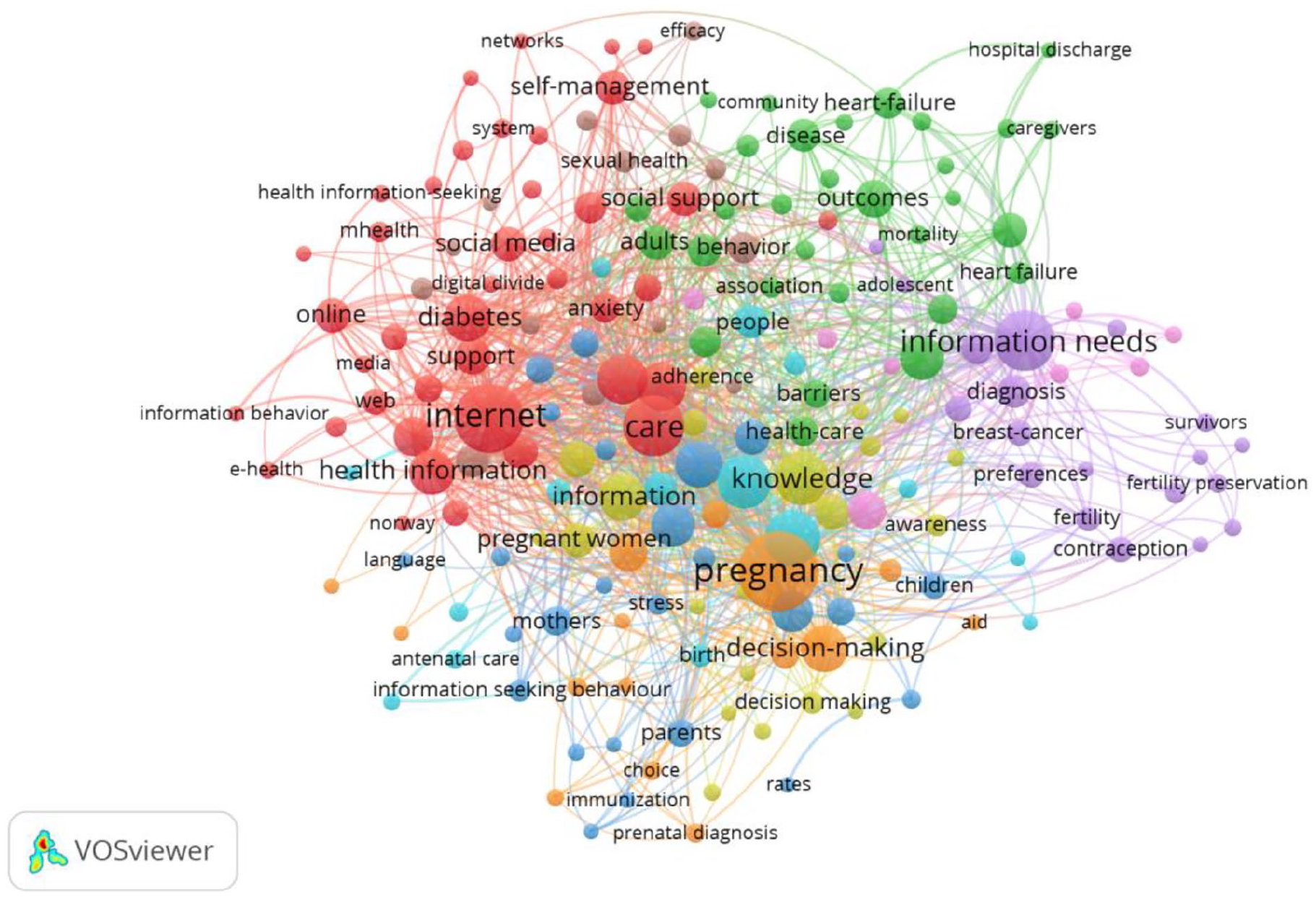
Pregnancy, Heart Failure and Diabetes, Web of Science: 190 keywords appearing 5 times or more.
Definitions and models of information literacy
The overarching finding from an examination of the three examined areas of health literature is that there is almost no perceptible integration of information literacy concepts into health research. When information related research does feature within the examined areas of study, concepts tend to only be mentioned cursorily within the literature review and rarely impact upon the study’s findings or discussion. The highest-ranking article related to pregnancy (Lagan et al., 2011), for example, states that the study’s conceptual design was underpinned by Kuhlthau’s (1991) work related to the information seeking process, a model that is used within both information literacy and information behaviour literature. However, key ideas from this research are untraceable within the study’s findings and it is unclear why this research was chosen or what purpose it served within either the research design or the analysis. Similarly, Wilson’s (1999) model of information behaviour, which was mentioned in both pregnancy and diabetes literature, was typically only ever mentioned in passing or as part of a long list of peripherally related research (e.g. Bianchi et al., 2016; Longo et al., 2010). An exception is found in the work of Kuske et al. (2017) who use ‘selected dimensions’ of Wilson’s (1999) model of information behaviour to structure the search results of their systematic review of information-seeking within diabetes literature, though it is unclear how these elements were chosen.
Information literacy research
Empirical research that emanates from the field of Library and Information Studies is similarly sidelined within health research. Where LIS research has been cited, it tends to be research that has been published within health studies rather than LIS literature or uses health literacy rather than information literacy terminology, for example Eriksson-Backa (2003), as cited in Grimes et al. (2014) and Subramaniam et al. (2015), as cited in Keselman et al. (2019). LIS research also tends to be referenced in relation to research about the same health and illness conditions; references to Lloyd et al.’s (2014) information literacy research with CKD patients within Black et al.’s (2017) study of diabetes prove to be one of the sole exceptions. In contrast, Papen’s literacy-focussed research tends to be far more represented within pregnancy literature (e.g. Bookari et al., 2017). The lack of attention that has been paid to information literacy is broadly in alignment with Massey et al.’s (2017) larger bibliometric research, which states that health literacy research often tends to rely on limited or narrow citation networks. While the lack of interaction between related fields is disappointing, it is, perhaps, not completely unexpected as information literacy has always had a tenuous foothold within health research. The concept of health literacy (Simonds, 1974), which emerged at a similar time as information literacy, for example, is far more commonly used within the field while information literacy research has often been perceived as restricted to teaching-focussed literature. However, as health research starts to move beyond its traditional reading and writing focus to engage with the concept of information, this lack of interaction represents both a challenge and an opportunity for both fields.
Nursing
A search for information literacy within the field of nursing indicated that the concept is closely associated with nurse education and EBP. A search in Web of Science produced a sample of 283 results while the same search in Proquest returned 295 results. The highest cited articles from this sample leveraged information literacy into nursing via occupational aspects related to information skills and competencies, teaching and nursing education and integration of information literacy skills into the curriculum. All the journals identified targeted nursing schools and nurse educators. The VOS Viewer diagram (Figure 4), which only draws from the Web of Science search, confirms the educational focus of this body of work, including the focus on preparatory or nurse readiness.
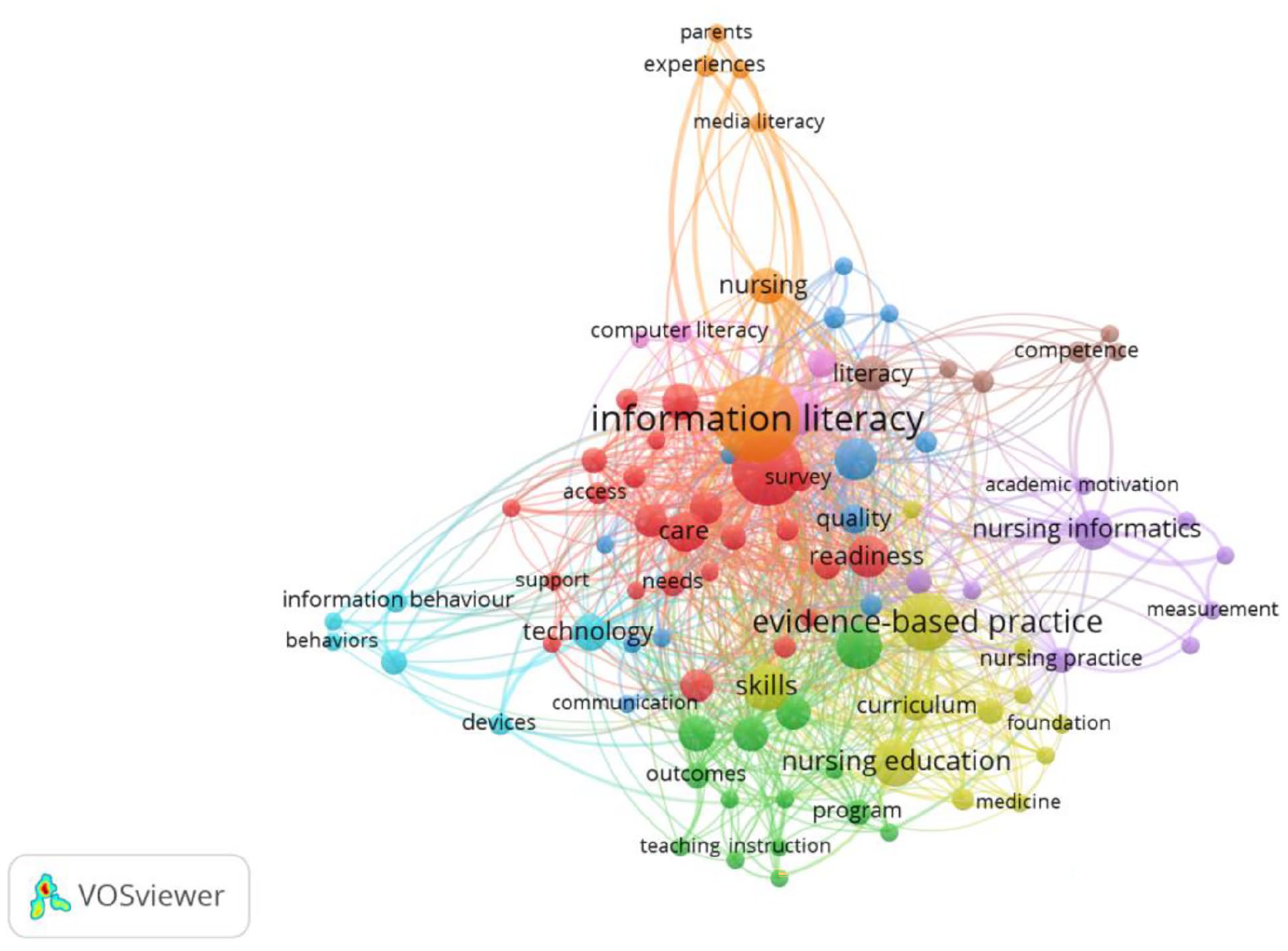
Nursing, Web of Science: 93 keywords appearing 2 times or more.
Definitions and models of information literacy
Reviewing the corpus of nursing literature indicates that within nursing, information literacy is contextualised within EBP, where it is viewed as a central skill-based competency. Definitions and lists of skills that were provided in the literature drew from two LIS-focussed documents, the now retired Information Literacy Standards for Higher Education (ALA, 1999) and the ACRL Information Literacy Competency Standards for Nursing (American Library Association, 2013). The common range of skills identified within this literature include information searching, evaluation, selection of appropriate search tools, knowledge of search strategies and the legal and ethical application of information. Reading indicates that there is minimal reference to LIS authors but a reliance on higher education-focussed standards and guidelines. Key themes identified in the literature include the operationalisation of information literacy in student nurse learning, the development and execution of information skills in relation to nursing practice and the measurement of information literacy as a skills-based literacy and competency. These themes were associated with occupational aspects related to nurses’ education and training, competency and skill development and as a constituent element of EBP.
Psychology
The initial search process (see Appendix 1) resulted in a total of 88 papers related to Psychology in the PsycINFO database and 145 in Web of Science. In terms of sources, articles were published in a range of journals such as Frontiers in Psychology, PLoS One and Psychological Science in the Public Interest. The VOS viewer diagram (Figure 5), constructed from a search of the Web of Science alone, confirms the relative lack of importance accorded to information literacy within these fields with the focus of literature centred on aspects of cognition and misinformation and fake news. In contrast, information literacy, in line with other subject areas, appears on the periphery of the dataset as merely one of several related information concepts. The sub-sections identified below are used to demonstrate the significant areas where information literacy is present in some form and are at some variance from other subject areas. The topic of misinformation is particularly interesting where cognitive psychologists have noted the importance of information literacy in combating misinformation.
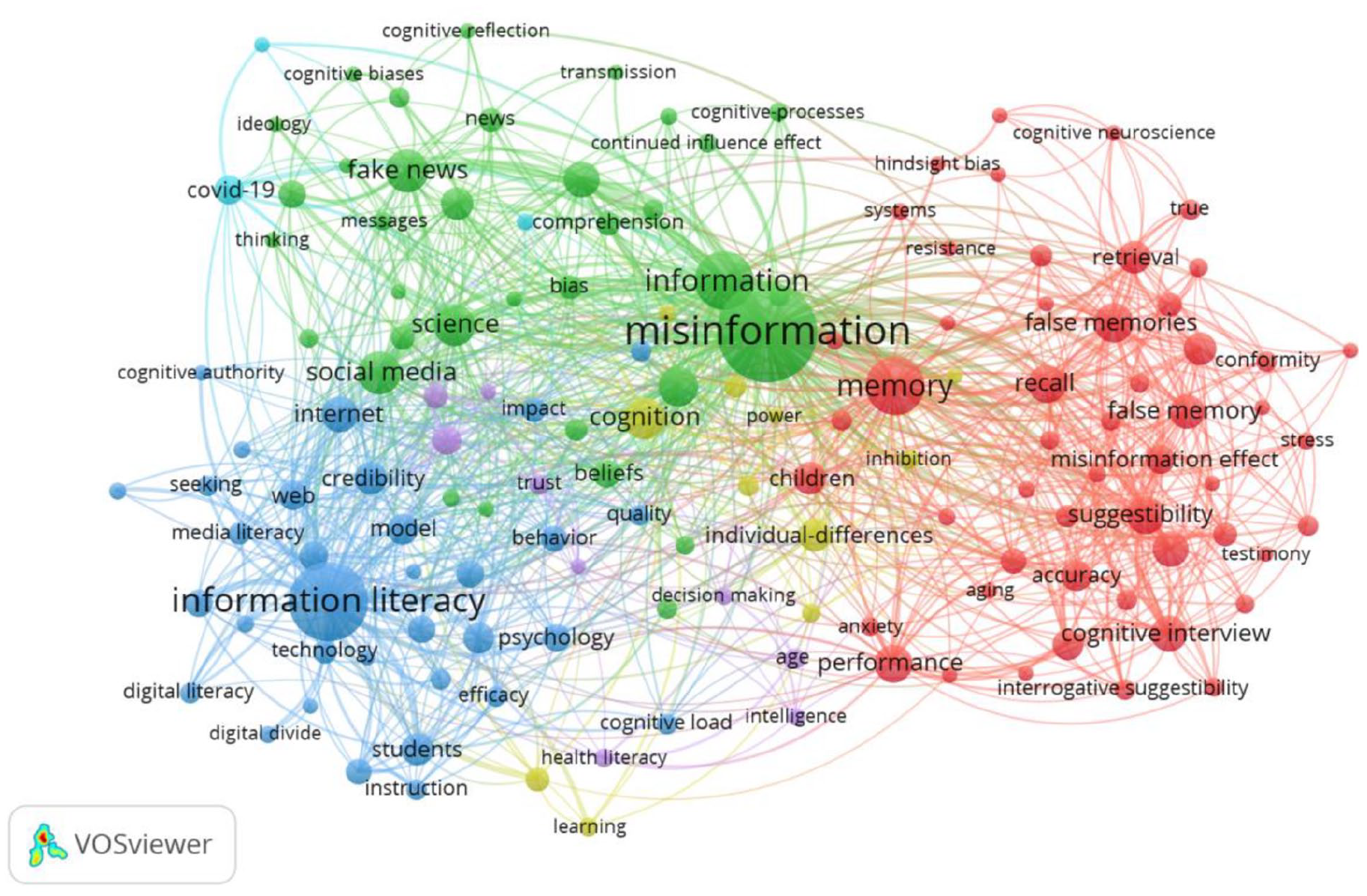
Psychology, Web of Science: 145 appearing 5 times or more.
Misinformation
Arguably the most interesting development within the field of psychology is in the emerging field of study focussed on misinformation. Lewandowsky et al. (2012) is the most highly cited article in this field (832 citations) and is relevant to the topic of information literacy as it centres on notions of trust and judgement. However, like most work in this area it does not cite the information literacy literature. Recent research is more promising, especially those that have begun to theorise the notion of techno-cognition which ‘uses findings from cognitive science to inform the design of information architectures that encourage the dissemination of high-quality information and that discourage the spread of misinformation’ (Lewandowsky, et al., 2017). This work also presents inoculation theory, which enables people to make well-calibrated judgements about information, as a possible solution to the problem of misinformation (Cook et al., 2017). Centring on how people engage with information, this work has recognised both the utility and limitations of information literacy as a tool to enable people to acknowledge and resist the seductive nature of misinformation. Lewandowsky et al. (2017: 363), which is cited 272 times, remark that ‘general training in information literacy is required so students learn which information to trust, particularly online. Recent efforts have yielded promising results (e.g. Walton and Hepworth, 2011)’. Related work in conspiracy theory research (Douglas et al., 2019) does not use the language of information literacy directly but does note the need for more work to investigate people’s ability to actively process information to promote analytical thinking. Douglas et al. (2019) is, arguably, referring to a component of information literacy without using the terminology from the field.
Teaching psychology
Another common area of study is the use of information literacy as a means for teaching research skills in psychology, although the citation count for these articles is quite low. These articles vary greatly in how they use information literacy in their studies. Digital literacy, information literacy and information skills are terms used interchangeably by Alkali and Amichai-Hamburger (2004), although the term information skills is reserved for evaluating information alone. They further recognise that digital literacy ‘includes a large variety of complex skills such as cognitive, motoric, sociological, and emotional that users need to have in order to use digital environments effectively’ (Alkali and Amichai-Hamburger, 2004: 421). Early information literacy work is cited although none could be considered prominent in the field. Shane-Simpson et al. (2016) draw upon the ALA (1999) definition. They regard information literacy to enable students to critique the quality of online information and write fluently and objectively with limited bias.
Professional bodies
It is of note that the field’s professional body, the American Psychological Association (APA), cites information literacy as a core set of competencies that psychologists should be taught (American Psychological Association [APA], 2009: 102) although it is characterised narrowly as ‘bibliographic technologies to identify and evaluate information relevant to your research’. Others mention the term information literacy but do not define or theorise what it means. Testers et al. (2020), for example, mention that information literacy is a generic set of competences applicable in various contexts and consists of complex higher order cognitive skills. However, these competencies all relate to psychology rather than information literacy research. Their information literacy theorisation is consequently rather superficial and, in a sense, used in name only.
Debt literacy
In a different area of psychology around debt literacy Porzak et al. (2021) demonstrate that they are well-versed in the topic and cite specific core authors in their literature review such as LIS authors, Webber and Johnston (2017). They subsequently build on this work to position information literacy in terms of numerical, graph and linguistic literacy, which they assess through short subjective assessment scales. Two standardised self-reported scales for numeracy and graph literacy were adapted from standard scales found in the psychology literature, and a new scale for assessing linguistic literacy was applied. The most interesting questions within this scale ask respondents to assess their linguistic ability in relation to information, including rating understanding of media sources and shades of meaning, amongst other components. These themes bear interesting similarities to later work on evaluating information and information discernment, especially comprehension and meaning making.
Discussion
Analysis of five different disciplinary and vocational landscapes demonstrate that the concept of information literacy has had a very mixed reception outside of LIS research. While all the areas that we examined refer to ideas and themes that we would recognise as information literacy, analysis demonstrated that references to key definitions, models and theories from the LIS field are largely either absent, under-developed or not sufficiently attributed. This seems to imply that despite almost 50 years of information literacy research, the concept remains poorly leveraged across and between disciplinary landscapes.
One of the major findings of this study is that information literacy is more commonly leveraged into professional fields of study, including higher education, nursing and psychology. This is, perhaps, unsurprising given the more prominent role that IL has played within the academic training of these professions in the last 10 years. Literature of teaching and learning within higher education, for example, tends to make extensive use of LIS literature with several studies additionally relying on and situating work in relation to LIS-authored definitions. Authors in the field also connect information literacy to evidence-based practice, an approach that was also seen in both the nursing literature and the higher education literature on nurse education. There is clearly an identified requirement within the evidence-based context for abilities to find, evaluate and apply academic literature to professional practice, which are generally seen as ‘core’ competencies in education-informed conceptions of information literacy. Interestingly, professional fields also tend to include information literacy in their educational models, which may explain the wider emphasis on information literacy within their disciplinary landscapes. The Royal College of Nursing (RCN, 2021), for example, includes information and digital literacies in their ‘e-health/e-nurse’ initiative, which is part of a suite of resources put together to support nursing practitioners. A similar professional focus is also noted in psychology, where the APA professional body positions information literacy as a core competency in the field. Working with professional bodies could consequently be seen as a potential model for leveraging IL into other subjects and professional areas, including the British Psychological Society (BPS), which has briefly recognised IL as an underdeveloped ‘transition skill’ from FE to HE.
The field of business, which also has connections to professional education, forms an obvious exception to professional interest in information literacy and it is unclear why connections to IL are less developed in this sector. One potential reason is the tendency in this field is to draw from management and psychology literature, possibly because the focus of these fields is on the organisation and markets, and consumers and staff rather than information. Perhaps less surprising is the lack of emphasis paid to IL within the public health field, which has some of the fewest connections to information literacy. The field’s traditional emphasis on reading and numeracy means that connections to information remain underdeveloped within the literature, even though it is often positioned as a central concept with health literacy definitions and models (Sørensen et al., 2013). The tendency for librarians to be less directly involved within public health education may be another contributing factor to the lack of engagement with information literacy research in this area.
Analysis also raises questions about which IL concepts are leveraged by other disciplinary landscapes. The rationale behind the use of the HE-focussed Webber and Johnston (2017) and SCONUL Working Group on Information Literacy (2011) definitions of information literacy in the fields of psychology and business, for example, does not seem immediately apparent. Similarly, it is unclear why so many authors prefer to establish their own definitions of information literacy, particularly when this work resembles more established definitions in so many ways. One potential reason for this finding is related to terminology, with the phrase ‘information literacy’ possibly constituting another barrier to its adoption. While LIS positions information literacy as present within every disciplinary and vocational field of study, the term is perhaps still seen as too vague by authors who are writing from outside LIS, who often seem to focus on specific components of information literacy, such as information-seeking or digital competence. The close association of literacy with reading may further constrain wider adoption of the term.
Appropriation of ‘information literacy’ as a term may be further muddied through the range of competing and contradictory models and definitions of various ‘literacies’ that are employed in the field (Stordy, 2015). The LIS-focussed ANCIL information literacy framework (Secker and Coonan, 2011), for example, presents information literacy as an overarching concept, with academic literacies, digital literacies, media literacies and new literacies listed as subsidiary concepts. In contrast the non-LIS-focussed JISC (2021) digital literacy framework presents digital literacy as the central concept, with information literacy relegated to a subsidiary. This tension is represented in the HE literature reviewed where the term Media and Information Literacy was often used. Authors also seemed to have varying conceptions of whether ‘IL’ or ‘MIL’ was the umbrella term, although many effectively articulated a nuanced relationship between digital tools, media and information in defining competencies required in the HE landscape.
Beyond confusion between information, digital and media literacy, there is a tendency outside of the LIS field, to place the term ‘literacy’ as a suffix to any subject or notion, which serves to render the term into a new metaphorical meaning, which is that of ‘competence’. Hence, for example, ‘scientific literacy’ is shorthand for being competent in the science domain. There is, arguably, a ‘jigsaw’ or plurality of ‘literacies’ (similar to Lloyd’s (2017: 95) ‘literacies of information’) which includes academic, digital, scientific, media, visual, IT and e-literacy amongst others and these bear some similarities and overlap with IL. However, findings from this study suggest that this kind of practice in writing about ‘other’ literacies may render information literacy as a redundant concept in the minds of scholars outside the LIS discipline.
Transferability – what travels?
A further theme emerging from this research is what travels within LIS-focussed information literacy research, which consistently positions information literacy as foundational to student learning, or as helping to develop ‘habits of mind’ that are necessary for lifelong learning. However, findings from this study demonstrate that the aspects of information literacy that appear to travel in the transfer of knowledge between disciplines and fields is a narrower, reduced and generically represented understanding of the practice. This is evidenced through the emphasis that the studied disciplinary areas place on information competency and skills (critical thinking, information seeking, search, evaluation, organisation, information use) rather than a more holistic understanding of information literacy as a social practice. These ideas are seen most clearly in the psychology literature, where the APA includes information literacy as a core competency but reduces this expression to bibliographic technologies and the evaluation of information rather than a more complex understanding of how information is operationalised within psychological work.
It is therefore equally important to ask what does not get leveraged across disciplines and fields of study. Information skills constitute a small aspect of information literacy practice and the value or emphasis placed on skills is dependent on the discourse through which the practice discursively emerges. What appears to fail to transfer is the conceptualisation of information literacy as a central practice in learning about ‘what happens’ in a specific context. This suggests a lack of focussed attention or understanding by LIS researchers and practitioners about the socio-cultural and discursively informed dimensions through which intersubjectivity, subjectivity and agency are enabled or constrained. Failing to understand transfer from a holistic perspective consequently leads to a simpler conception of information literacy that does not account for the complexity and richness of learning that is contextual, problem-based and reflexive. Instead, this view simply ties a skills-based view of information literacy to generic outcomes – an approach that impoverishes our understanding of what information literacy is and could be.
Conclusion
The study draws upon published research within five separate disciplines and fields to examine how LIS-focussed information literacy terminology, definitions, theories and frameworks have been leveraged outside their originating field. It also examines how the same disciplines and fields have treated what would be recognised as information literacy by LIS researchers and practitioners. Preliminary analysis indicates that information literacy has been most visibly leveraged into professional fields and disciplines, including in areas where librarians are more commonly working (e.g. higher education and nursing). These findings demonstrate that there is considerable recognition of the importance of information literacy within these areas, even if this research is not connected to information literacy literature that emerges from LIS. At the same time, it is a skills-based view of information literacy that has travelled, which indicates that considerable work needs to either introduce or re-focus attention on the substantial body of information literacy work that emphasises its situated and contextual shape. The nuances of these findings also demonstrate the importance of employing qualitative mapping techniques alongside more traditional bibliometric ones.
This study has several implications for information literacy researchers and practitioners. For researchers, this study demonstrates the importance of continuing to research and publish scholarship within non-LIS venues. If information literacy is to be sustainable (Hicks and Lloyd, 2021), then it is important that researchers examine and address impact outside of LIS rather than merely continuing to talk to ourselves. These findings also speak to the need for continued collaborative effort to extend the information literacy narrative, including the establishing of a funded research network as a further means through which to present a more nuanced interrogation of information literacy narratives outside of the LIS disciplinary landscape. For practitioners, this research highlights the importance of information literacy outreach with scholars and practitioners within allied fields, including the need for special librarians to recognise and extend an understanding of information literacy within their disciplinary landscapes or areas of professional practice. It also suggests the importance of continuing to work with professional bodies, such as the BPS, as one of the potentially more fruitful ways to ensure that the information literacy voice is heard. Although co-authored outputs were excluded from this review, this research also points to the need for librarians, who are immersed in IL literature, to contribute to collaborative information literacy research projects and publications with non-LIS academics and professionals.
Future research should build upon this initial study to examine how information literacy concepts have been leveraged in other fields of study outside the higher education landscape, for example refugees and migrant studies. Research should also continue to explore how qualitative mapping techniques can extend traditional bibliometric work, including adding nuance and expertise to future explorations of the ways in which information literacy continues to shape research and professional practice.
Footnotes
Appendix
Search terms.
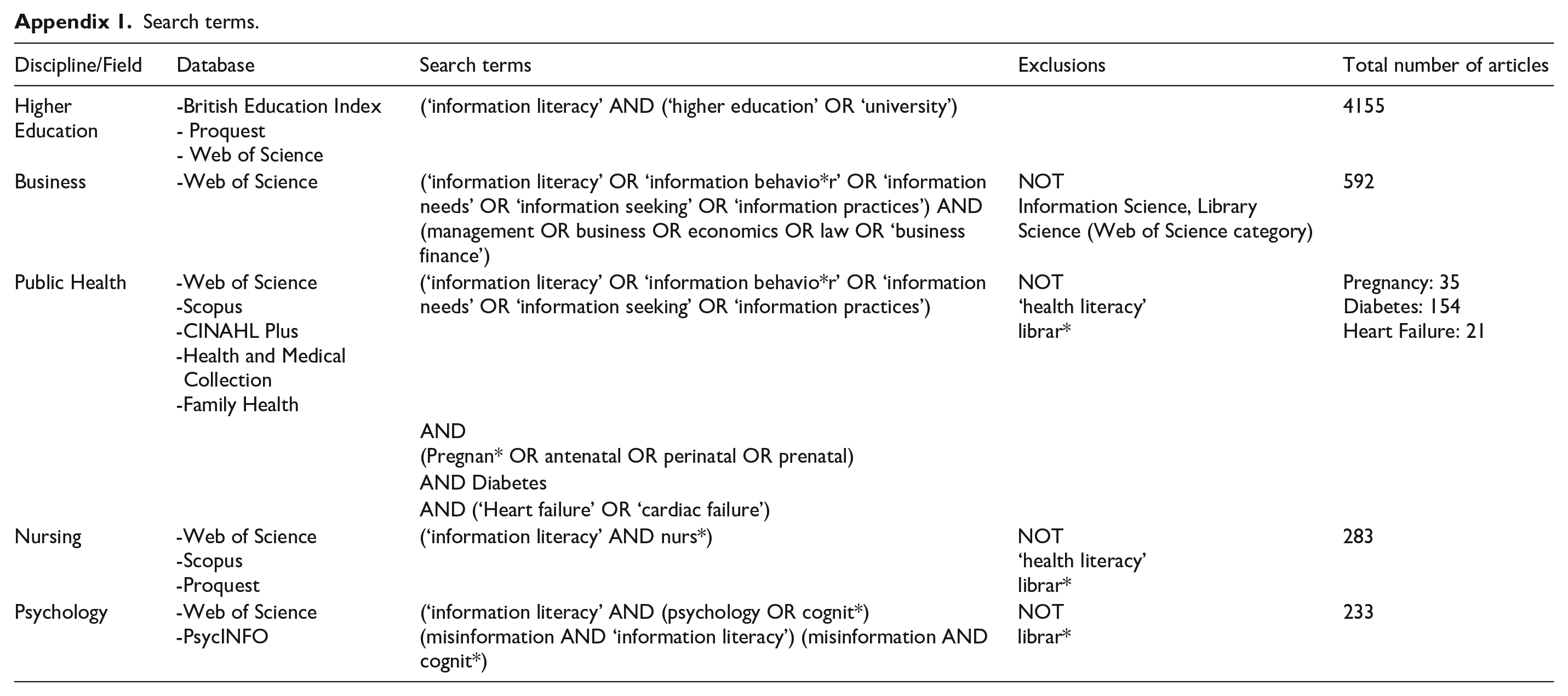
| Discipline/Field | Database | Search terms | Exclusions | Total number of articles |
|---|---|---|---|---|
| Higher Education | -British Education Index - Proquest - Web of Science |
(‘information literacy’ AND (‘higher education’ OR ‘university’) | 4155 | |
| Business | -Web of Science | (‘information literacy’ OR ‘information behavio*r’ OR ‘information needs’ OR ‘information seeking’ OR ‘information practices’) AND (management OR business OR economics OR law OR ‘business finance’) | NOT |
592 |
| Public Health | -Web of Science |
(‘information literacy’ OR ‘information behavio*r’ OR ‘information needs’ OR ‘information seeking’ OR ‘information practices’) | NOT |
Pregnancy: 35 |
| AND |
||||
| AND Diabetes | ||||
| AND (‘Heart failure’ OR ‘cardiac failure’) | ||||
| Nursing | -Web of Science |
(‘information literacy’ AND nurs*) | NOT |
283 |
| Psychology | -Web of Science |
(‘information literacy’ AND (psychology OR cognit*) (misinformation AND ‘information literacy’) (misinformation AND cognit*) | NOT |
233 |
Declaration of conflicting interests
The author(s) declared no potential conflicts of interest with respect to the research, authorship, and/or publication of this article.
Funding
The author(s) received no financial support for the research, authorship, and/or publication of this article.
