



Abstract
The concept of digital competences incorporates the effective use of constantly-changing digital tools and media for learning and performing digital tasks, digital behaviours (such as online communication, teamwork, ethical sharing of information), as well as digital mindsets that value lifelong digital learning and development. The current pandemic crisis has accelerated the need to diagnose and understand more systematically Higher Education students’ digital competences and the way in which they shape academic performance and outcomes. This empirical study explores the digital competences of students, studying in Law related courses, by means of a self-assessment survey tool, which has been previously tested with information and library science students, and was developed to study students’ technology mastery (i.e. the abilities, competences, capabilities and skills required for using digital technology, media and tools) and their digital citizenship mindsets (consisting of attitudes and behaviours necessary to develop as a critical, reflective and lifelong learners). The study found age demographic differences, which presented significant correlations pointing to the presence of diverse levels of competences in the student group. Correlation statistics of the survey data demonstrated that students’ prior everyday participation as a digital citizen was connected to a number of important academic skills, such as the ability to identify information in different contexts, students’ digital learning and development, their digital abilities to complete academic work, their information literacy skills and their skills around managing their digital wellbeing and identity. Focus groups data with academics revealed that they valued the development of students’ digital competences for the purposes of learning, while studying at university and placed less emphasis on digital citizenship skills. These academics also considered the value of digital platforms and tools (the focus on ‘ICT Proficiency’) to be more relevant for academic study than digital citizenship mindsets.
Introduction
The development of digital competences of Higher Education students has recently attracted significant research attention with an emphasis on student employability and the importance of digital proficiency (Joint Information Systems Committee [JISC], 2019a), addressing baseline, as well as advanced and specialised digital skills, required in particular subject disciplines and fields of work. Exploring the growing publication basis in this domain, it becomes clear that students’ digital competences are a contested domain of interest with diverse definitions, frameworks and directions (Ilomäki et al., 2011; Spante et al., 2018; UK Higher Education Academy, 2017); however, there is an overall consensus, which incorporates the effective use of changing digital tools for learning and performing digital tasks, digital behaviours (e.g. online communication, teamwork and ethical sharing of information) and digital mindsets (e.g. valuing lifelong digital learning and development), in a way that these are important for students’ current academic study and future professional careers.
In order to explore students’ use of digital tools, their behaviours and their mindsets, it is necessary first to understand how HE students interact with digital information and tools within their different interdisciplinary areas, as well as how their previous experiences in everyday life may influence how they do so. We begin with the simple proposition that, in an era of constant Internet connectivity, students enter the realm of university not as digital ‘tabula rasa’ (i.e. with digital experiences largely unformed), but with existing digital knowledge, digital behaviour and experiences that have been shaped by earlier encounters with the digital environment, and which are conditioned by different socio-cultural and environmental situations. These conditions may act as barriers or as enablers to further digital development and learning. Lack of digital connectivity and fewer opportunities for digital skills development, for example, within the continuum of one’s everyday life, work and educational interrelated contexts, may act as a trigger of digital inequalities, which may lay hidden or undiscovered in students’ educational journeys (Good Things Foundation, 2018; Moore et al., 2018; Ofcom, 2020; UK Department for Digital, Culture, Media & Sport, 2017).
The current pandemic crisis has accelerated the need to diagnose and understand more systematically students’ pre-existing knowledge, behaviour and experiences gained within these interrelated contexts, as well as their interplay in shaping academic performance and outcomes, identifying equally gaps and areas of strength in students. Identifying where digital competences gaps and strengths may lie, within the boundaries of specific disciplinary areas and future work-related expectations, can become a crucial step in helping students to develop further and collaboratively empower each other in certain digital areas, building new digital skills, where required and professional level expertise. Designing tailored digital skills support may also further accelerate this process and ameliorate student anxiety and confusion with using specific digital tools or adopting particular behaviours within the online environment.
This paper addresses the digital competences development of university students studying in law-related courses, and puts forward the case for a need to develop digital readiness in students within the educational and professional legal environment, mastering not only digital technologies, but also expected digital behaviours. Several authors have made the case for the need to develop digital competences in Law students around new technological tools that are essential for a new generation of legal practice. These digital competences support an era of change and transformation for the legal profession, which has arisen with digital globalisation and the need to upskill in such areas such as cybersecurity, electronic records management, electronic document circulation and online interaction (Bonkalo et al., 2021; Mironova et al., 2019; Thanaraj, 2017).
Thanaraj (2017), for example, introduced the concept of the digital lawyering framework in legal education, designed to prepare Law students for the delivery of digital legal services. The author makes a case for a number of legal services, which have already migrated to online environments or increasingly follow that route, demonstrating how education-based approaches can replicate these digital processes and help students develop hands-on expertise. For instance, the process of electronic disclosure, where documents are held and handled in electronic form (e.g. emails, text messages, word-processed documents, databases and documents stored on a server) could be simulated in an online learning environment. The concept of the ‘Virtual Law Clinic’ (VLC) describes replicating an online legal transactions process, where students can explore different forms of technology and develop diverse transferable skills, including online communication, client online interviewing and negotiation, scheduling and time management, online safety, privacy and ethical conduct. There is also emerging work on ‘Virtual Court Systems’ that could handle the management and resolution of legal cases entirely online (a concept that has been previously discussed, as part of the Ministry of Justice’s digital strategy in England and Wales and has been piloted between two magistrates’ courts and fifteen police stations in London and Kent) (Thanaraj, 2017: 7). Other digital skills expected of Law students as future professionals, particularly when working within the private sector, address delivering and managing online client services and requests, using automated processes, legal management software and digital tools (e.g. automated platforms for legal transactions and organising and managing cases, offering time tracking and scheduling of appointments and managing files) and using cloud services that are designed to make legal transaction processes faster and improve productivity and efficiency. Wang (2019) examined previous research to discuss the impact of technological innovations on legal work and observed that at least 13%–23% of Law-related jobs in Australia are now automated (Law Society of Western Australia, 2017) with additional predictions of future digital transformation, such as the application of Artificial Intelligence (AI) not only to automate basic legal processes, but also to establish more profound legal insights by exploiting big data.
In addition to utilising digital tools, safely preparing and sharing online legal documents, with attention to personal data protection and ethical guidelines, are part of the expected online professional code of practice and would need to be followed for online dispute resolution processes and the correct handling, online management and curation of court-related documents. Researching competitors and seeking online opportunities for upgrading legal knowledge also form an essential part of legal professional practice to ensure competitive advantage and currency with developments, legal requirements and innovative practices. Using social media to engage with customers and promote services, equally, contributes to an important aspect of private legal companies.
The above raise the importance of effectively preparing students in law-related curricula with digital competences that are required to perform diverse digital tasks to fulfil professional requirements, as well as demands for remote legal services, which are becoming increasingly more prominent. This is particularly the situation with new demands for virtual working practices, caused by the current pandemic-impacted working environment (European Commission, Science for Policy Briefs, 2020: 1–2). With the fast pace in which online practices can become the new professional standard, the question is who may be left behind on the basis of existing digital divides, both in the educational and the professional realm. A characteristic, although extreme, incident that took place in pandemic lockdown and captured the public imagination around the lack of basic digital professional skills, for instance, was the story of a Lawyer from Texas, who appeared in a Zoom meeting during a formal legal hearing, wearing the filter of a cat, as he was unable to remove it from his video settings (Gabbatt, 2021).
In addition, there is a need to turn to the skills required for learning online and achieving educational objectives in curricula which favour a collaborative approach to learning (e.g. using learning tools and technologies, communicating online with other students) (Bugden et al., 2018). Beltran (2017) also posits that we should ‘rethink the education of law students as information handlers’ (p. 3), on the basis of a digital literacy curriculum that addresses not only basic computer skills, but also social media and understanding the implications of digital footprint.
Literature review
Although previous studies address the need for a new approach to Higher Education legal education and training, there is limited empirical research to explore and understand law students’ digital skills development needs to foster a paedagogical environment that will effectively prepare future-proof digital legal professionals entering the field. Existing studies in the UK and internationally point to several gaps in students’ digital skills. In an empirical study of Russian law students, Bonkalo et al. (2021) found that the level of ‘professional information culture’ of future lawyers was insufficient on the basis of selecting required legal information, adequately interpreting it, and analysing emerging software products (p. 1327). In the new digital normal, students require skills and abilities that relate to not only performing digital tasks, but also understanding the implications of legal information security, personal data protection of clients, the overall ethical handling of information, as well as informed awareness of the constraints and opportunities that the online environment presents for others (co-workers, clients or professional groups), developing an inclusive attitude and understanding of digital divides.
Dagilyte (2016) engaged law students in legal blogging (as a marketing tool) to assess their digital communication skills and engage them in legal debate and peer evaluation. They found that students had digital skills gaps around how to use a wiki, reference hyperlinks and understand the ethics of sharing copyrighted images; they called for additional student-based empirical research in this domain. Killean and Summerville (2020) explored the potential for creative podcasting as a tool for sharing legal knowledge, communication and digital literacy skills development but found this area to be ‘under-researched’ (p. 33). Smith (2020) found that there is a need to incorporate into the law school curriculum ‘a broader range of technology-based pedagogical approaches’ and to ensure that graduates develop familiarity with different forms of communication, ranging from technology platforms for trial preparation in commercial law cases to legal/data analytics, for example, as used by judges for bail and sentencing decision-making (p. 220).
While the digital environment poses challenges for students in developing skills that increase their employability, the situation is equally challenging for Law schools: do staff have the digital competences themselves, in order to deliver these skills to students? Ryan (2020) noted the slow emergence of specific Legal Tech modules in the law curriculum to fill the existing gap. Few academics have experience and insight into the workings of a law firm, and this skills gap in teaching is often filled by law professionals who are versed not only on the impact of technology on work patterns, but also on legal challenges, particularly data protection law and cybercrime. This calls for robust investment as digital competences and skills percolate across the curriculum and pose paedagogical challenges and opportunities in equal measure.
Research aims
This research explored how Higher Education students, studying in Law-related degrees within a single institution and school, self-assess their digital competences. In addition, the study examined the perspectives and expectations of law academics around students’ development of digital competences, with recommendations for further steps that could be followed to address demands and gaps in this domain.
This work replicates, within the subject area of Law, the design of an earlier student-based survey that was originally conducted with Library and Information Science students from three Higher Education institutions in Scotland, Ireland and Greece, and tested the main theoretical propositions of the present study, drawing from students’ self-perceived digital competences for learning and for the everyday life digital context (Martzoukou et al., 2020). The survey was based on two conceptual directions, discussed within established theoretical frameworks, which may be summarised as follows:
technology mastery, that is, the abilities, competences, capabilities and skills required for using digital technology, media and tools;
digital citizenship mindset, which consists of attitudes and behaviours necessary to develop as a critical, reflective and lifelong learner.
Following on from the original design of that earlier study, which found a number of digital competence gaps in students, ranging from information literacy to digital creation, digital research and digital identity management skills (Martzoukou et al., 2020), the first strand of this research examined, via a questionnaire survey, Law students’ self-perceived digital competences in order to offer initial direction on existing gaps and areas of strength, as well as form a basis for creating dialogue with academics on digital skills training that could be further embedded into learning and teaching. In addition, the earlier study found an association between self-perceived digital competences for ‘everyday participation as digital citizen’ and other digital competences areas, which are important for academic activities (such as information identification in different contexts, digital learning and development and information literacy skills). To further explore this finding with Law students, a single working hypothesis was put forward:
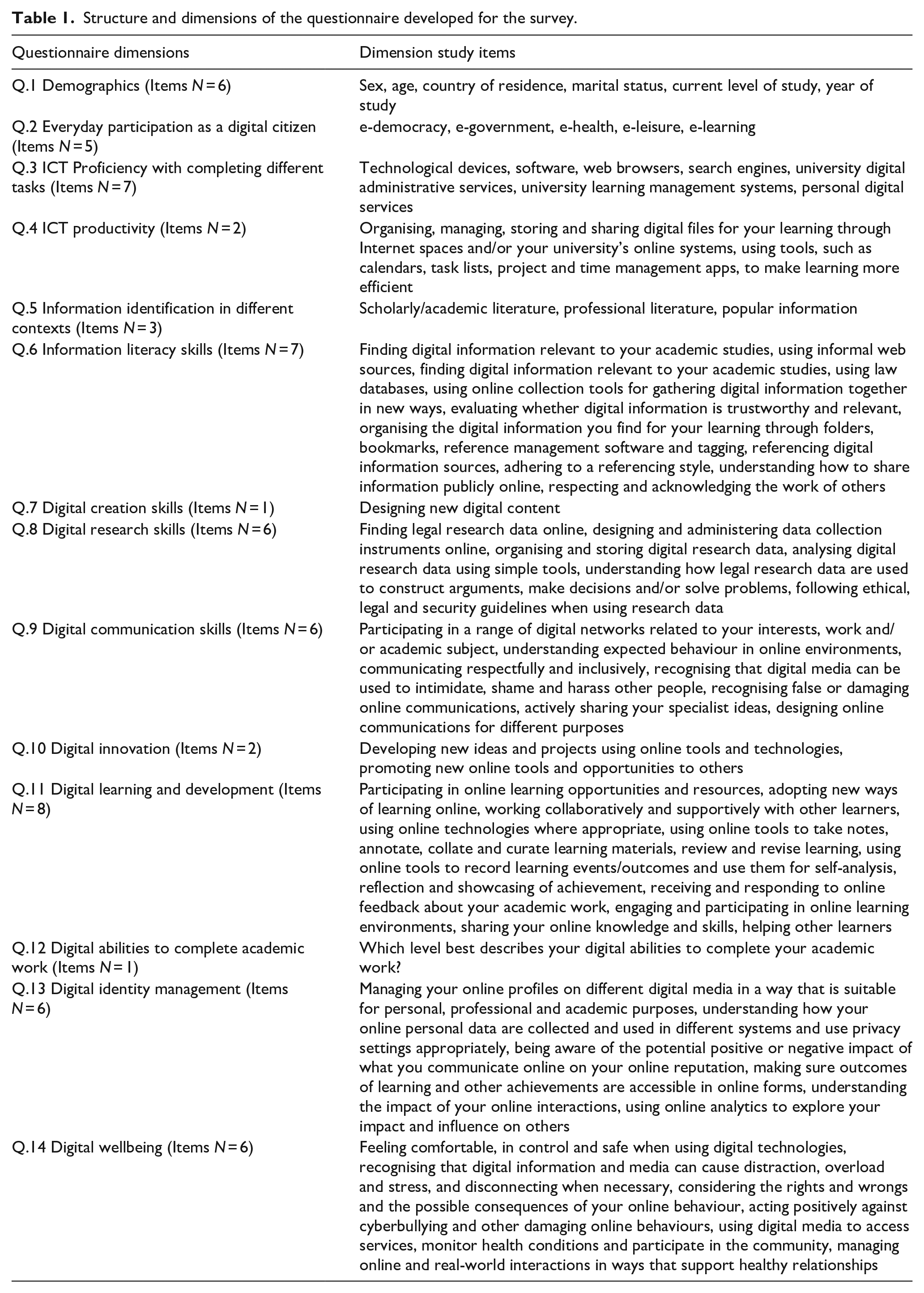
H: Self-assessed digital competences of Law students in areas of everyday participation as digital citizen will be correlated with self-perceived technical and higher-level digital competences important for completing academic work (a detailed explanation of these areas is offered in Table 1 below).
Structure and dimensions of the questionnaire developed for the survey.
Furthermore, we focussed on age demographics aiming to provide empirical evidence on any observed generational differences in students’ self-assessment of digital competences. Age is an important variable when considering the impact of the internet and different technologies on a generation’s learning and development (Oblinger et al., 2005) and according to the Pew Research Center (2015) it ‘is one of the most common predictors of differences in attitudes and behavior’ (p. 1). In the area of digital competences there is limited empirical research that examines the impact of generational differences (Khan and Vuopala, 2019) although the concept of the so-called ‘Net Generation’, ‘Digital Natives’ or ‘Millennials’ (born approximately between 1981 and 1996) has been explored repetitively in the literature (Bennett et al., 2008). In this study, student age groupings were described, following the Pew Research Centre categorisations as follows: (1) Generation Z (born 1997–2012); (2) Millennial generation (born 1981–1996); (3) Generation X (born 1965–1980); (4) Baby Boomer (born 1946–1964) (Dimock, 2019).
The second strand of the study explored, via a focus group, staff perspectives on the value of exploring students’ digital competences and aimed to understand whether there are particular areas that deserve or require greater focus, to examine views around support mechanisms and key players in the process of supporting students’ digital competences development, to identify further development needs of staff and to elaborate key results obtained from the student survey, particularly around low self-assessment areas.
Methods
Research design
The research followed a mixed methodological design, with a sequential, explanatory strategy of enquiry (Cresswell, 2003), which commenced with a survey of Law students in different courses within a single Higher Education institution, followed by a focus group with Law academics who had responsibility for different courses and modes of delivery (on-campus and online). The data collection strategy followed a process where data collected via the survey contributed to the data collected via the focus groups as they determined the direction of the questions, focussing particularly in areas where students reported lower-level digital competences. That approach helped to explore both the student and the staff perspective, interpret and further explain specific results obtained by the student population (Creswell and Plano Clark, 2017: 12) and offered a better understanding of the context in which students studied.
Survey framework
The theoretical perspective of the study is supported by two key frameworks: the European Digital Competence Framework for Citizens (Carretero et al., 2017), also known as ‘DigComp’ and The Digital Capabilities framework, developed by JISC (2012). The former captures a two-fold interpretation of digital competences with an added emphasis on diverse digital society contexts, focussing on the necessity to improve citizens’ digital competence for work and employability, learning, leisure, consumption and participation. The latter focuses on the Higher Education learning environment and explores both staff and students developing digital skills and confidence. Exploratory analysis strengthening the theoretical approach of JISC took place mapping specific items against other existing frameworks, within each thematic area. For example, the construct of ‘Information, media and data literacy’ appears in other frameworks, such as SCONUL ‘Seven Pillars of information Literacy’, UNESCO ‘Media and Information Literacy (MIL)’, ‘Open University Digital and Information Literacy (DIL)’ framework, ‘A New Curriculum for Information Literacy (ANCIL)’ and ‘Vitae RDF’ (information lens) among others (JISC, 2015). The survey was also informed by findings of previous academic research emphasising the impact of the everyday life context on the development of students’ information and digital literacy (Martzoukou and Sayyad Abdi, 2017) and several other key government level publications (e.g. UK Department for Business Innovation & Skills and Department for Culture Media & Sport, 2016; UK Department for Education, 2019).
The survey addressed digital competence items, based on a critical overview of the above frameworks and government reports which collectively addressed a total of 11 themes (Martzoukou et al., 2020), provided in Table 1. These were explored both from a technical (e.g. ICT competence, handling computers, devices) and a higher-level competence perspective (e.g. information and data literacy, communication and collaboration, safety and problem-solving). The survey measurement was based on a five-point Likert scale of digital competences, which represented different levels of competence in performing specific digital tasks, ranging from Level 1 Novice to level 5 Expert, which represented different levels of knowledge and self-sufficiency on the basis of performing specific digital tasks (Supplemental Appendix D) (Martzoukou et al., 2020: 1425–1426).
In addition, the survey included questions on students’ ‘Everyday participation as digital citizen’. This dimension aimed to capture the competence of students on the basis of two choice decision-making mechanisms, that is, hedonic and utilitarian alternatives (Khan et al., 2005). Hedonic digital competences address activities centred on emotions and feelings, including e-leisure (e.g. playing online games, socialising online) and/or e-learning (e.g. looking for new digital opportunities to grow as a person), while utilitarian digital competences relate to activities of ‘practical’ nature centred around a task (such as voting or finding information on health), consisting of the following subcategories: e-democracy (e.g. accessing political processes, such as voting online), e-government (e.g. accessing and using government online services, such as legal and financial information) and e-health (e.g. accessing and using health services online) (Martzoukou et al., 2020). Students’ hedonic and utilitarian behaviours have been extensively discussed within the academic learning environment (Huang, 2020). The everyday life dimensions relate to utilitarian and hedonic values of consumption in a broader educational sense (Holbrook and Hirschman, 1982). Utilitarian value is mostly associated with the functional and monetary elements of everyday life; while the hedonic aspect involves social and emotional everyday life dimensions (Prebensen and Rosengren, 2016).
Finally, a series of open questions were added to further explore the previous learning experiences of respondents around the development of digital competences in the context of everyday life learning and current education. These explored how respondents had developed digital skills needed to participate effectively in digital citizenship activities, and how they had developed ICT Proficiency skills for completing different digital tasks (e.g. at work, at home, via training, etc.).
Limitations
In self-assessment, it is possible that students may overestimate or underestimate their confidence and ability in certain areas. Although self-assessment of competences is not unproblematic, it has been successfully used in previous research and in different fields as a tool for conversation with students around their experiences, needs and activities they follow (JISC, 2019b). Self-assessments may not necessarily be accurate portrayals of actual skills, but they are ‘the most prevalent ways of measuring Internet skills’, and they can be ‘reused in many contexts’, especially if they have ‘carefully worded items’ and ‘appropriate scales’ for measuring skills (van Deursen et al., 2014).
Moreover, the survey was not aimed only as a basis for empirical data, but also as a point for initiating discussions with other academics, centred on the teaching of digital competences in the Law curriculum. It acted as a tool for critical conversation, reflection and dialogue, gauging baseline self-assessed digital competences with an emphasis on students’ everyday life environment as opposed to their education-based context alone. Both low and high competence self-assessed areas indicated via self-assessment, may be further explored by testing particular skills in a curriculum-embedded approach.
This study is restricted to a narrow group of students within the limited context of a single university, which may not present a similar picture in other universities around the world. The results may, therefore, not be able to be generalised to other institutions and countries. However, the data present ideas for learning interventions that could be followed by other universities that wish to explore students’ digital competences. In addition, the design of the study, which proposes a customised approach by discipline (in this case Law), presents a methodology that could be adopted in follow up research and institutional activities centred on the development of students’ digital competences, because it proposes that not all students are similar, nor they require the same types of skills. Skills needs and requirements may also differ by the demands of the instructional design and practice of a course (e.g. whether it has a high reliance on technological tools, demands for online skills development and expectations of online learning and collaboration), as well as the diverse expectations placed for developing professional-based digital skills.
Study site and subjects
The survey was conducted with students from a Law School within a UK university, which offers a range of undergraduate and postgraduate Law programmes. It took place during the 2019/20 academic year and was administered to full-time and part-time Law students in seven Law-related courses, which represented both UG and PG courses, on-campus and online. The survey distribution approach adopted for gathering data involved administering a questionnaire, which was rolled out online via JISC’s Online Surveys tool. An online survey offered an appropriate method, given that one of the courses was online, but also it afforded a faster survey distribution and flexibility with the on-campus students as well. A total of approximately 500 UG and PG students were invited to take the survey, from whom 59 valid questionnaires were collected for analysis. This total corresponds to a response rate of 11.8%, which is consistent for online surveys (Fan and Yan, 2010).
For this version of the survey, some questions were adjusted from the original version to offer examples related to the discipline of Law, for example, adding Law-specific databases, such as WestLaw, to the ICT Proficiency section and slightly amending the terminology used in some of the questions addressing scholarly and Web resources to align with the ways in which these sources were mentioned in Law related courses.
Focus group
A 1-hour focus group involving four members of academic staff (two female and two male), working in the subject area of Law was conducted online (due to COVID-19 restrictions) in May 2020 via Blackboard Collaborate Ultra, one of the approved conference tools of the university due to restrictions on face-to-face contact imposed by the pandemic.
The focus group was recorded using the in-built recording features of the software with the permission of participants. Two researchers moderated the focus groups, facilitating monitoring of the digital focus group environment, attention to participants’ responses and formulation of follow up questions to points of discussion raised by the interviewees. The focus group questions are given in Supplemental Appendix B.
Ethical considerations
The research project design was approved by the School of Law ethics committee of the participating institution. Further, the survey was administered using JISC’s ‘Online Surveys’, which is a General Data Protection Regulation (GDPR) approved data collection tool. Informed consent was sourced from both students and staff members consulting the Research Governance and Integrity Policy and the Research Ethics Policy of the university. During the focus groups, verbal informed consent was asked at the beginning of the group interview which was also captured in the recording.
Data analyses
Statistical analyses
The SPSS statistical package (version 25.0) was employed for the statistical analysis of the survey. Cronbach’s alpha reliability coefficient was used for the scale reliability internal consistency assessment of the constructs. The results were reported through descriptive statistical analysis (frequencies, valid percentages, median, mode, etc.) on students’ demographics and self-assessed digital competences. According to Kolmogorov-Smirnov and Shapiro-Wilk Normality tests (at Sig. <0.05 level), the study items of the questionnaire did not follow the normal distribution. Therefore, Mann-Whitney (U-test) and Kruskal-Wallis (H-test one-way analysis of variance by ranks) non-parametric statistical tests were performed for assessing statistically significant differences between two independent subgroups and for assessing differences among more than two independent subgroups respectively. Exploratory Factor Analysis (EFA) was employed through Principal Components Methods (PCA) and the Varimax orthogonal rotation method, grouping the variables for each of the questionnaire constructs. Finally, bivariate Pearson’s correlation statistics were reported for all grouped variables.
Focus group analysis
The focus group interviews were transcribed verbatim and de-identified. Template analysis (King, 2012) was used to analyse the focus group interview transcripts. This method of analysis required a priori themes, based on the research aim and objectives. Follow up questions, based on the responses of the participants, allowed the identification of additional themes. The analysis was done manually, initially coding the data, according to the following key themes reflected in the questions: digital competences value, digital competences priorities, digital competences involvement (internal: staff, students; external), digital competences staff training.
The further reworking of the initial template identified a number of subthemes, discussed in the data analysis below.
Results
Questionnaire data
Reporting scale internal consistency
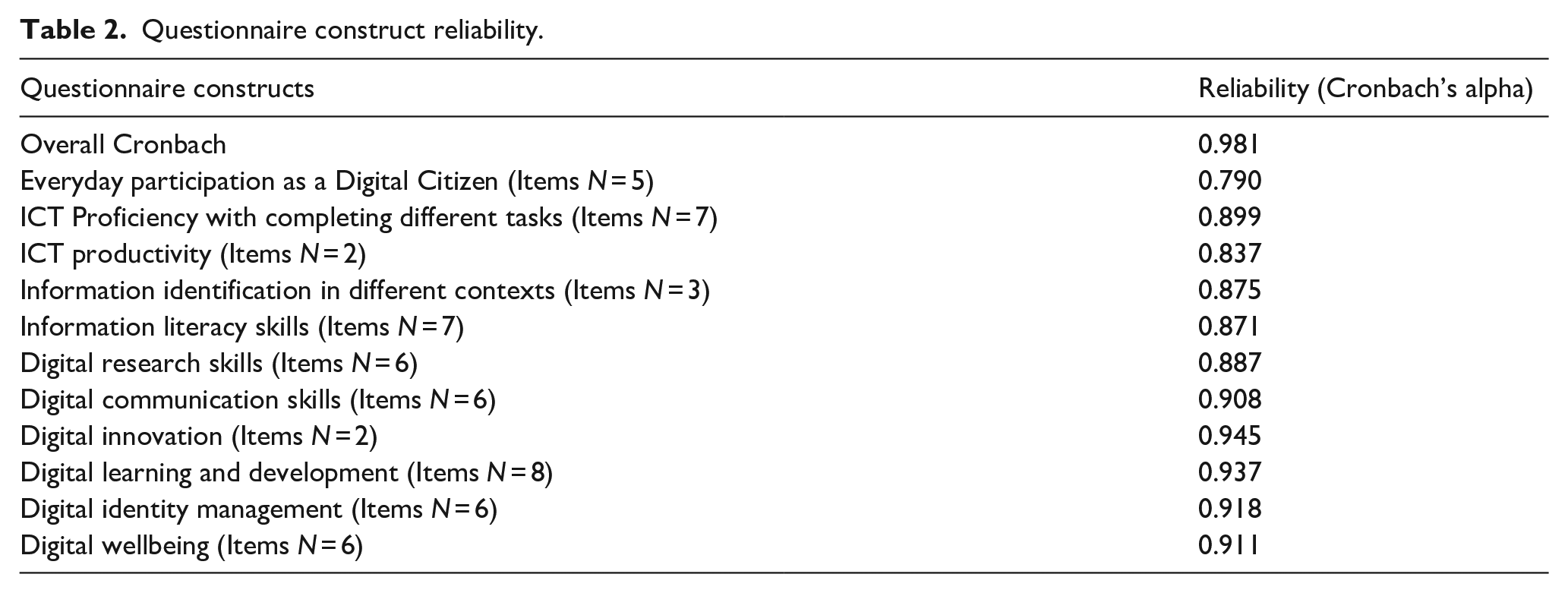
The questionnaire constructs’ reliability is reported in Table 2. The internal consistency expressed through Cronbach’s alpha reliability coefficient for all constructs was found to be quite adequate with no problematic variables identified through scale if an item deleted Cronbach’s alpha coefficient estimates.
Questionnaire construct reliability.
Demographic characteristics of survey respondents
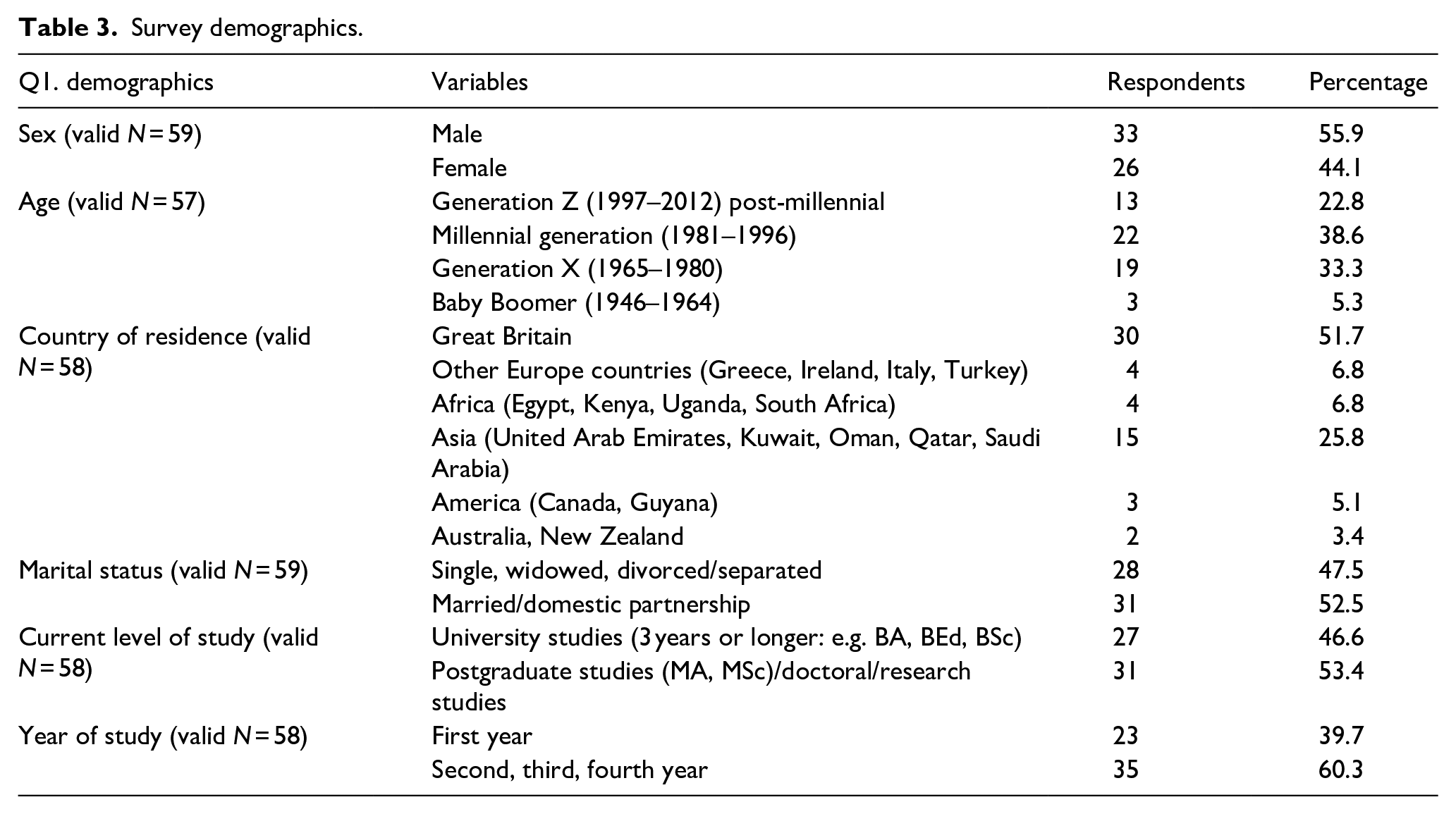
Table 3 summarises the demographic characteristics of the survey respondents, according to ‘sex’, ‘age’, ‘country of residence’, ‘marital status’, ‘current level of study’ and ‘year of study’. One questionnaire was removed after data screening of the survey responses, and 59 undergraduate and postgraduate students were included in the sample. Table 3 provides in detail the survey demographics which may be summarised as follows: 53.4% of the respondents were postgraduate and 46.6% were undergraduate students; 51.7% of the students were residing in Great Britain, while 47.9% were international students; 47.5% of the students were single and 55.9% were male; while 22.8% belonged to Generation Z (Post-millennials), 38.6% to Millennial Generation, 33.3% to Generation X and 5.3% were Baby Boomers.
Survey demographics.
Survey results of self-assessed competences
This section provides survey results for both closed and indicative open questions, which included students’ comments on the different ways in which they develop digital competences. Overall, 21 respondents (31.6%) answered one or more open questions.
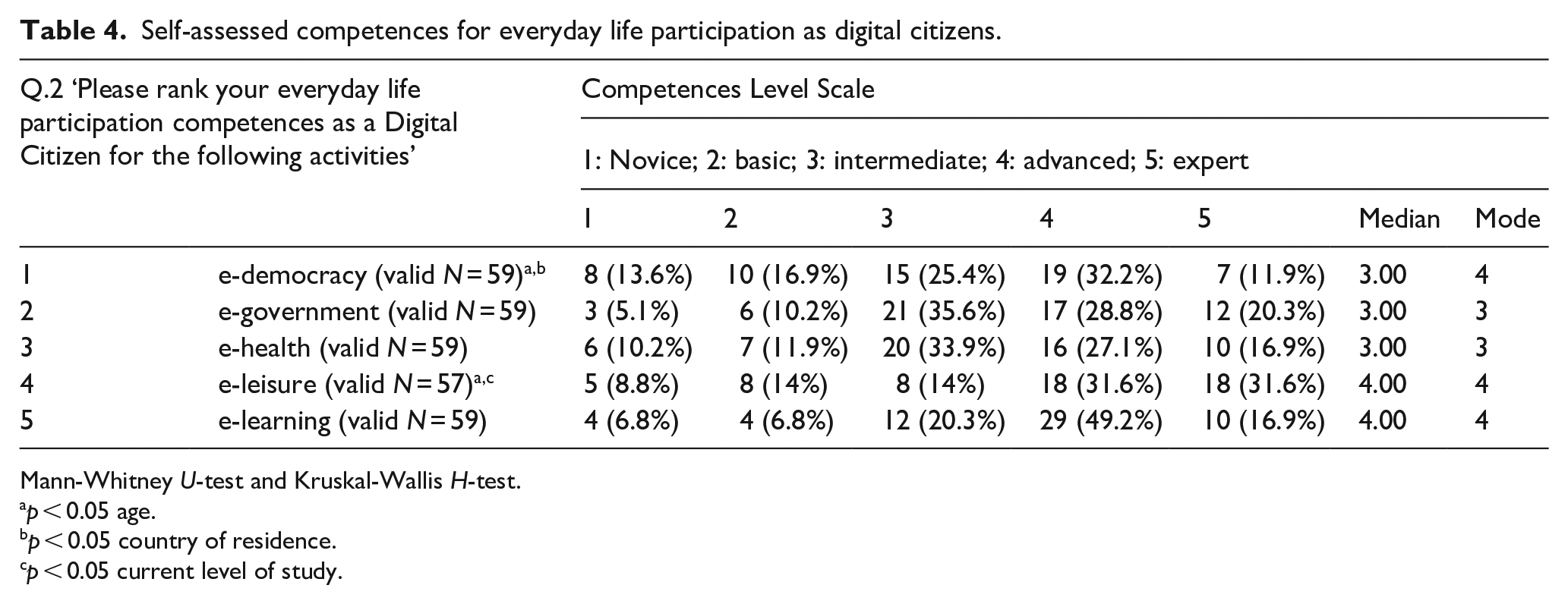
Table 4 summarises the results of the students’ self-assessed competences regarding ‘everyday participation as a digital citizen’. The survey respondents felt more competent concerning ‘e-leisure’ and ‘e-learning’ digital citizenship activities (median 4.00) and less competent on e-democracy, e-government and e-health activities (median 3.00).
Self-assessed competences for everyday life participation as digital citizens.
Mann-Whitney U-test and Kruskal-Wallis H-test.
p < 0.05 age.
p < 0.05 country of residence.
p < 0.05 current level of study.
Supplemental Appendix A summarises descriptive statistics in the remaining survey constructs. In this paper we only report on ‘intermediate’ and ‘basic’ self-perceived competences.
In the category of ‘Information literacy skills’, ‘intermediate’ competences were found in relation to ‘Using online collection tools for gathering digital information together in new ways’ and ‘Organizing the digital information you find for your learning through folders, bookmarks, reference management software, and tagging’ (median = 3.00).
‘Digital creation skills’ were reported to be at a ‘basic’ level (median = 2.00), while ‘Digital research skills’ were ‘intermediate’ in most of the sub areas in that category, namely ‘Designing and administering data collection instruments online’, ‘Organising and storing digital research data’, ‘Analysing digital research data using simple tools’, ‘Understanding how legal research data are used to construct arguments, make decisions, and/or solve problems’, and ‘Following ethical, legal, and security guidelines when using research data’ (median = 3.00).
‘Digital communication skills’, were reported at an ‘intermediate’ level for two constructs: ‘Participating in a range of digital networks related to your interests, work, and/or academic subject’ and ‘Understanding expected behaviour in online environments’ (median = 3.00). One area in this category, ‘Designing online communications for different purposes’, was identified at ‘basic’ competence level (median = 2.00).
‘Digital Innovation’ was reported by the participants to be at ‘basic’ level in the area of: ‘Developing new ideas and projects using online tools and technologies’ (median = 2.00) and at ‘intermediate’ level in the area of ‘Promoting new online tools and opportunities to others’ (median = 3.00).
In the case of ‘Digital learning and development’, there were two areas where students assessed themselves as ‘intermediate’: ‘Engaging and participating in online learning environments’ and ‘Sharing your online knowledge and skills and helping other learners’, (median = 3.00). Students reported ‘basic’ competences in ‘Using online tools to record learning events/outcomes and using them for self-analysis, reflection, and showcasing of achievement’ (median = 2.00).
In the ‘Digital identity management’ category, half of the constructs were found to be at ‘intermediate’ level: ‘Understanding how your online personal data are collected and used in different systems and use privacy settings appropriately’, ‘Making sure outcomes of learning and other achievements are accessible in online forms’ and ‘Using online analytics to explore your impact and influence on others’ (median = 3.00).
On the basis of ‘Digital wellbeing’, half of the areas were, similarly, found to be at ‘intermediate’ level: ‘Feeling comfortable, in control, and safe when using digital technologies’, ‘Managing online and real-world interactions in ways that support healthy relationships’ and ‘Acting positively against cyberbullying and other damaging online behaviours’ (median 3:00).
Although students self-assessed at ‘advanced’ level in many categories, they, interestingly, indicated, in an overarching question, that their overall ‘Level of digital abilities’ to complete their academic work was at ‘intermediate’ level, verifying a need for development and intervention.
Responses to open questions
An open question focussed on examples of how students’ digital/online skills helped them to address challenges in their academic work. From the open comments, it is interesting to note that students referred not only to the academic context but also to examples beyond the requirements of the academic environment, indicating that the digital skills they gained will be useful to other contexts: ‘I can manage distributed teams and collaborate in multifunctional and multicultural environments’, ‘Knowing how to find information online allows you to find out information about anything and everything’.
Additional open questions asked respondents how they acquire the digital skills needed to participate effectively in the abovementioned activities and how they developed their ICT skills. Students provided evidence of transferring skills into the learning environment from everyday life personal information learning and interpersonal learning via workplace contexts. Indicatively, some of the answers of respondents were as follows: ‘Initially learned from trying on and gained skills at work’, ‘Practice and self-learning’, ‘Through education and social interactions with others’, ‘Both through university and self-learning’, ‘Self-learning/taught and by asking others if need be’, ‘Internet search’ and ‘Picked up via peers/colleagues’, ‘I learned of my own initiative and from work/school’, ‘A mixture of being self-taught, using YouTube videos to learn things, and also being taught through traditional teaching’, ‘Some I learned on my own, some I have picked up from others or from school/uni’, ‘I learned alone through daily use of computer and the Internet’ and ‘I learned to use additional software via internal training at work’.
Age demographics correlations
Supplemental Appendix A summarises statistically significant differences for all group demographics based on Mann-Whitney U-test and Kruskal-Wallis H-test. Bellow we delve into differences of only age demographics, although the data indicate that there may also be other demographic areas which could be further explored (e.g. sex, country of residence, current level of study). The results indicate that, in most cases, the self-perceived competences of Generation Z respondents were higher than those perceived by other age groups.
In relation to ‘everyday participation as a digital citizen’, the indices explained in the last row of Table 4, indicate statistically significant differences with sample demographics subgroups for the items: (a) ‘e-democracy’, p < 0.05, with a mean rank score of 42.46 for Generation Z, 22.66 for Millennial Generation, 25.24 for Generation X and 41.00 for Baby Boomers and (b) ‘e-leisure’, p < 0.05, with a mean everyday life participation competence as a digital citizen rank score of 39.58 for Generation Z, 28.14 for Millennial Generation, 21.86 for Generation X and 13.67 for Baby Boomers.
In the case of the other survey constructs statistical significance differences were found in relation to age group categories in two areas of ‘ICT proficiency’: (a) ‘Search engines’, p < 0.05, with a mean rank score of 24.77 for Generation Z, 33.64 for Millennial Generation, 26.37 for Generation X and 30.00 for Baby Boomers (an area where Millennials self-assessed higher than Generation Z), and (b) ‘Personal digital services’, p < 0.05, with a mean rank score of 36.88 for Generation Z, 31.11 for Millennial Generation, 21.71 for Generation X and 25.50 for Baby Boomers.
In relation to ‘Digital Communication Skills’ in the area of ‘Understanding expected behaviour in online environments’, demographic differences were identified, p < 0.05, with a mean rank score of 40.08 for Generation Z, 27.09 for Millennial Generation, 23.68 for Generation X and 28.67 for Baby Boomers.
Age demographic differences were also identified in relation to ‘Digital Identity Management’ in the area of ‘Managing your online profiles on different digital media in a way that is suitable for personal, professional, and academic purposes’ p < 0.05, with a mean rank score of 37.42 for Generation Z, 29.59 for Millennial Generation, 20.82 for Generation X and 33.50 for Baby Boomers.
In ‘Digital wellbeing’, age demographic differences were reported in the areas of: (a) ‘Managing online and real-world interactions in ways that support healthy relationships’ at p < 0.05, with a mean rank score of 38.92 for Generation Z, 28.89 for Millennial Generation, 22.50 for Generation X and 22.00 for Baby Boomers, (b) ‘Acting positively against cyberbullying and other damaging online behaviours’ at p < 0.05, with a mean rank score of 40.17 for Generation Z, 27.84 for Millennial Generation, 22.84 for Generation X and 22.50 for Baby Boomers and (c) ‘Considering the rights and wrongs and the possible consequences of your online behavior’ at p < 0.05, with a mean rank score of 39.83 for Generation Z, 24.98 for Millennial Generation, 25.18 for Generation X and 30.00 for Baby Boomers.
Grouping variables
Exploratory factor analysis (EFA) and principal components analysis (PCA) were employed for the reduction of the variable numbers that were used in the questionnaire, as well as for assessing whether all the variables initially included in the questionnaire are representative of each of the underlying constructs (Table 5). PCA with Varimax rotation was employed for grouping the digital competence constructs, transforming all the groups of variables into smaller sets. KMO and Bartlett Test of Sphericity were employed and indicated that it was possible to proceed with principal components factor analysis. The output of this process is presented in Supplemental Appendix C. Each of the survey constructs were grouped to a single component, while the single-item factor loadings were quite high.
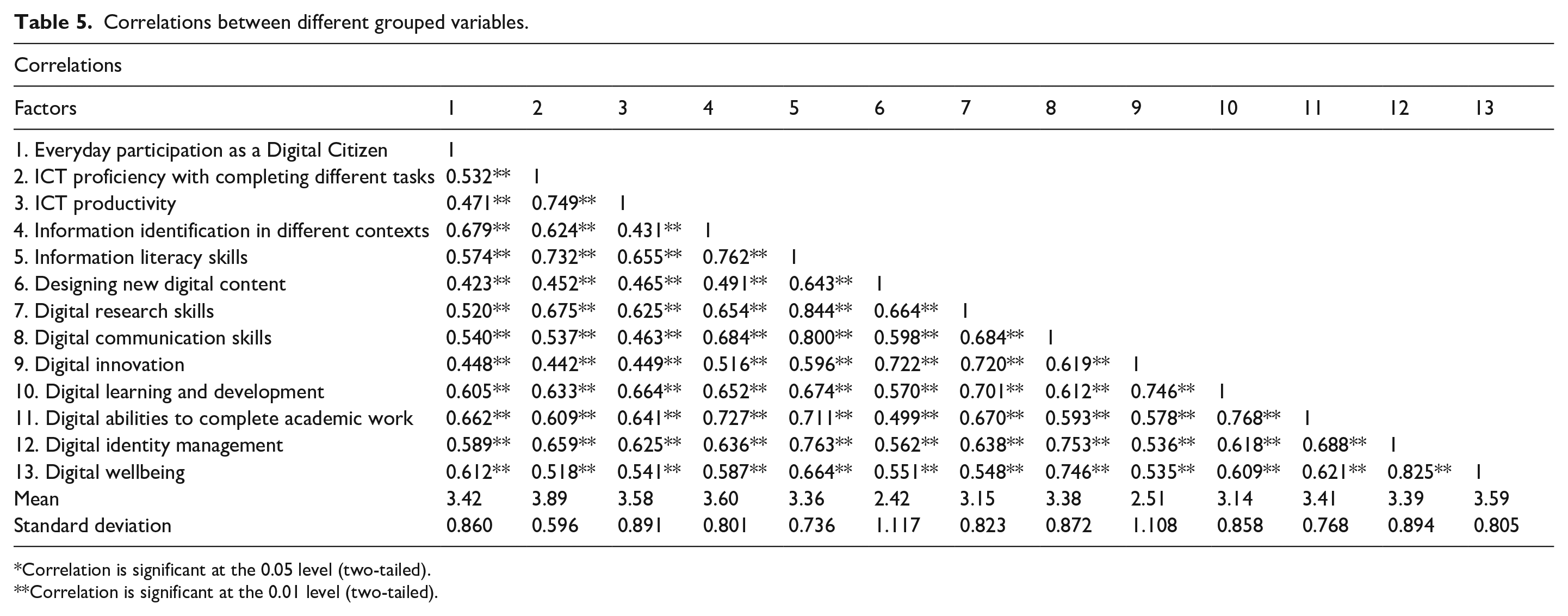
Correlations between different grouped variables.
Correlation is significant at the 0.05 level (two-tailed).
Correlation is significant at the 0.01 level (two-tailed).
‘Everyday participation as digital citizen’: Correlation statistics
Table 5 presents Pearson correlation coefficients and the corresponding significance levels for all the construct components, with Pearson’s test (two-tailed) at significance level p < 0.05(*) and significance level p < 0.01(**). The last two rows of Table 5 present descriptive statistics (mean and standard deviation) of the examined constructs for the entire sample, with the lowest mean values in ‘Designing new digital content’ (mean = 2.42) and ‘Digital innovation’ (mean = 2.51), ‘Digital research skills’ (mean = 3.15) and ‘Digital learning and development’ (mean = 3.14).
Overall, the results support our initial hypothesis that digital citizenship skills have a positive impact on the development of different technical and higher-level digital competences. Moderate and strong statistically significant correlations were identified between self-reported competences for ‘Everyday Participation as a Digital Citizen’ with all of the remaining survey components. Strong (r-value above 0.6) positive correlations included ‘Information identification in different contexts’ (r = 0.679, p < 0.01), ‘Digital learning and development’ (r = 0.605, p < 0.01), ‘Digital abilities to complete academic work’ (r = 0.662, p < 0.01) and ‘Digital wellbeing’ (r = 0.612, p < 0.01).
Other significant strong positive correlations (r-value above 0.7) were identified for self-reported competences, notably ‘Information Literacy skills’ with many dimensions of students’ digital competences (Table 5). Although these are beyond the scope of the present study, they point to the importance of the interdependence of some of these skills and the significance of supporting their development holistically.
Focus group results
Background characteristics
A total of four Law academics with experience of teaching undergraduate and postgraduate students took part in a focus group. Table 6 presents the background characteristics of focus group participants.
Characteristics of focus group participants.

Value of digital competences development
All four participants agreed that students should develop digital competences to be able to participate in their studies, especially when courses are delivered online, so that they can use different digital platforms and tools. There was also consensus that students should be ‘more digitally aware and have the skills to transfer to their workplace or part of it or their communication with others to the digital world’. Staff believed that students should not only be ‘looking to leverage their knowledge of eLearning to study. . .but also to deploy that in their workplace’. Digital skills development was perceived as an important area for students but also one that requires to be continuously upgraded and enhanced. Focus group participants placed emphasis on the transferability of these skills and the need to learn continuously, using different tools, technologies and platforms as ‘a bigger criterion in terms of employability’ than acquiring static skills as part of an academic study alone. In addition, the need to place digital skills at a higher than basic level was highlighted with staff emphasising ‘how we can help the students see the range of activities they can undertake using digital media which will enhance their learning but also enhance employability’. However, before further upskilling could be made possible, staff proposed that priority should be given to understanding and addressing ‘at strategic level’ the skills that are important for learning, before students enter university. As one staff member observed:
‘We need to get a baseline for students each year to know just how much they are capable of because they all come in and they go ‘it’s dead easy’, but they might be good at playing computer games but not when they are having to format spreadsheets or convert a document into a pdf, or annotate a pdf, or the kind of things that they all need to be able to do’.
Another staff member referred to new skills young students need in their education beyond those developed in their everyday life environment:
‘Looking at undergrads, while we know that they are polished as digital citizens and may make high use of technology in their social lives, i.e., in social media, and for gaming. . .some of this is new and they maybe haven’t had the training yet. . .It’s new stuff. Most of it’.
Staff referred to many barriers such as the everyday life circumstances of students to balance work, study and family which may encourage them to develop only minimum digital skills required of them on a programme (e.g. how to access lecture notes, or how to post responses). Additionally, a course may offer few opportunities to explore new digital tools as part of learning, especially when academic staff lack confidence with their digital competences:
‘It’s possibly partly generational, because we were used to chalk and whiteboards when I was a student, and I think perhaps just not having enough chance to use them ourselves. . .It’s new. We are not confident. Therefore, we don’t want to give it a go’.
The delivery of digital competences appeared to be an issue which involved some complexity. While digital skills could be incorporated into different elements of a course with diverse directions, not all digital competences areas were deemed to be suitable to address in academic study. For example, staff observed that transferability of skills to the workplace was more important for student learning than focussing on ‘how the students engage with e-democracy, e-government, e-health’. Staff proposed that ‘We can maybe signpost, we can maybe encourage, we can maybe equip them to do that but that’s up to them as private citizens’. Staff were concerned that further involvement would ‘interfere’ in students’ private lives.
Digital competences key priorities
Focus group participants were asked if they considered particular digital competences (addressed in the survey) to be more important than others for Law students to develop. Staff were divided between advocating that all digital competences covered by the survey were important for student learning and selecting among the digital competences for the higher learning environment. Those who considered all areas of digital competences significant for university learners focussed on the transferability of skills and the usefulness of a higher level of knowledge of skills for successful online learning. A member of staff suggested that there was an introductory foundational course already providing training across digital competences, with the exception of ‘digital identify management’. However, other staff suggested that additional, credit bearing microlearning courses would be valuable and proposed that these might be delivered by support services, the employability unit of the university or the teaching and learning department.
Staff also connected digital skills training to digital wellbeing. In particular, they named the ethics of legal practice, legal system skills including etiquette and ethical conduct when using digital technology and the consequences of online behaviour and its impact on others, describing this as ‘reflex use’ that would apply in the professional environment. Further, digital communication skills, for example, appropriate email and negotiation skills, could be transferred to the legal workplace environment. As one staff member reported:
‘I would say every working day, I see one email or the other or a post on Moodle where somebody is demanding or suggesting that they are entitled to something and their language suggests that we probably, we’ve not transferred the skills we’ve been teaching when it comes to letter writing on to the digital space’.
Involvement in developing digital competences
Focus group participants were asked to indicate who should be involved in the students’ development of digital competences. They named a collaborative role for multiple units in the university, including the library and teaching and learning, where training with micro-credentials could be delivered at university level, rather than repeated in schools throughout the university. However, for this approach to be successful, consideration of support staff time, often already oversubscribed, as well as positioning the training to attract student participation was essential. The positioning of digital competences training at university level would alleviate pressure on staff to cover generic skills training and allow staff to concentrate on subject-specific learning needs. The training could also be rolled out to academic staff.
Discussion of findings
The survey and focus group data revealed a number of areas which require further support and development for the Law students. Interestingly, none of the students perceived themselves as ‘experts’ in any of the digital competence areas. Students assessed themselves as ‘intermediate’ in most individual areas and in their overall self-perceived digital competences to complete their academic work.
Survey respondents reported instances of low competences (‘basic’), in categories related to ‘Designing new digital content’, ‘Promoting new online tools and opportunities to others’ and ‘Using online tools to record learning events/outcomes and use them for self-analysis, reflection, and showcasing of achievement’. The further grouping of variables verified some of the above results with the lowest mean values obtained in ‘Digital creation’ and ‘Digital innovation’, while ‘Digital research skills’ and ‘Digital learning and development’ had the lowest ‘intermediate’ scores.
When it comes to addressing skills for the digital enabled legal professional, it is important to consider the use of digital technologies in creative and innovative ways beyond the immediate context of the educational environment and look into the professional realm. According to Legg (2018) ‘Technology is a tool that the practicing lawyer needs to be able to use. . .As technology improves, more and more components of the legal service will have a technological aspect, such as legal research and risk or outcome prediction’. This does not necessarily mean directly creating a solution using technology or programming skills but being in a position to understand the uses of technological tools (Legg, 2018) and develop a basic aptitude for technology and its impact on the legal profession. In that way consideration needs to be given on whether certain aspects of technology should be included in core subjects, regularly following and mapping new requirements for skills via reviewing of professional posts and identifying existing gaps in curricula, where learning could incorporate new opportunities for digital creation and innovation. One way to enhance digital creation, innovation and communication skills, as Legg (2018) suggests, is by means of ‘law apps’ courses and ‘hackathons’. The former is an elective course where students in teams work with a legal organisation to develop practical skills in using law related software, while the latter involves interdisciplinary communication and collaboration with experts in different fields (e.g. software programmers, lawyers) around a work-based solution to a problem.
In addition, the above lack of skills points to the need for students to be more actively engaged with digital research. Students assessed themselves at lower ‘intermediate’ level in digital research skills in the areas of designing and administering data collection instruments online, organising and storing digital research data, analysing digital research data using simple tools, understanding how legal research data are used to construct arguments, make decisions and/or solve problems, and following ethical, legal and security guidelines when using research data. Further consideration may be required to developing students’ statistical skills and their ability to analyse, apply and use data in legal decision-making. These skills are also important when considering the use of data via artificial intelligence and legal analytics (Ashley, 2017), and the evaluation of provided via automated data analysis processes, such as ‘technology assisted review for discovery in litigation’. These require data and statistical literacy and quantitative data analysis skills, ‘the ability to understand, apply and infer from data’, to recognise bias in data outputs, the ethical sourcing of data and the lack of reliable and complete datasets (Legg, 2018).
In addition, the survey results demonstrated that more emphasis may be required to helping law students develop a proactive approach to recording and critically reflecting on their learning and development. Students assessed themselves as ‘intermediate’ in areas that addressed engaging and participating in online learning environments and sharing online knowledge and skills, helping other learners (which revolved around working collaboratively) and ‘basic’ in using online tools to record learning events/outcomes and use them for self-analysis, reflection and showcasing of achievement. This result revealed that students required additional support for continuous learning and development for understanding how engagement with others online and using online curation tools to reflect back on learning experiences can improve their academic performance as well as their personal and employability skills. There are different models that could be followed to enrich law students’ critical reflection skills. For example, Blaustone (2006) describes a ‘feedback model’ that aims to engage students in ‘routinized analysis of lawyering performance’ which is connected to theories of active learning and conditioned by the presence of structured feedback. In addition, other methods involve the inclusion of e-portfolio assessments and engaging students in innovative teaching methods that encourage critical reflection using technology (Thanaraj, 2012). These could take the form of digital reflective diaries reporting on learning and further development, and promoting a positive engagement with the value of reflective practice.
It is also worth discussing one additional ‘intermediate’ skills area which may be directly linked to work related outcomes. While law students were confident in the use of online resources to access legal content using online resources, they reported ‘Intermediate’ competences in relation to information literacy skills, which address the use of online curation tools and organising digital information. Law students are exposed to a variety of legal content in electronic format, and as part of their academic study are expected to use reference management tools, organise folders and bookmark appropriate resources. Earlier research within the legal working environment has reported on the difficulty that lawyers encounter in filtering an overwhelming amount of legal information from electronic sources and following effective and efficient ways to manage internal work files, and store, organise and reuse material, although accessing and sharing information is critical for the success of their work (e.g. to the progress of cases) (Kuhlthau and Tama, 2001). In another study that focussed on law students, Jones (2006) found that more support was required to facilitate the sharing, annotation and tagging of documents so that they could be located more easily and when required. Students who train for law careers need to develop skills in tagging, organising, filing and archiving information which are useful for different professional tasks that involve advocacy, drafting of documents, counselling clients and managerial tasks (Leckie et al., 1996: 173). This is also verified by additional evidence which comes from Makri et al. (2008). They conducted research with academic lawyers and identified ‘collating and editing’, as a subset of information-seeking behaviour in legal professionals and called for increasing awareness of the importance of these processes in legal professional practice with more support in creating notes, document outlines and documents.
Everyday participation as a digital citizen
Correlation statistics of the survey data with digital citizenship skills demonstrated that students’ prior everyday participation as a digital citizen was connected to a number of important academic skills, such as the ability to identify information in different contexts, digital learning and development, digital abilities to complete academic work, information literacy skills, as well as skills around managing digital wellbeing and identity.
This is, overall, an interesting result when viewed in conjunction with the focus group data. Whereas digital skills for the academic environment was mentioned as one of the key areas of focus, digital citizenship skills (such as e-democracy, e-government, e-health, e-learning) were not deemed to be by all focus group participants within the limits of academic responsibility and more a matter of interest within the realm of the private life of students. Previous research that has explored law students’ digital citizenship skills reports, however that more academic interventions may be required when students have low engagement with e-democracy (Petr Balog and Siber, 2014). In addition, low participation in online university wellbeing programmes (Little et al., 2021) may have an effect on law students’ already increased anxiety, especially after the first year of study (Larcombe et al., 2013; O’Brien et al., 2011; Skead et al., 2020). These appear to be areas of concern when we, overall, consider law students’ academic progress and achievement. In addition, the student transition to e-learning due to the pandemic has caused challenges imposed to students by new methods of teaching and online participation. Previous research has found that student preparedness to be an online learner has an impact on students’ experiences in online courses. Students who lack past experiences of virtual learning may require more guidance and assistance in engaging with distance learning courses (Huss and Eastep, 2013).
Despite the less emphasis on the importance of digital citizenship skills, when broad skills such digital resilience and wellbeing were approached from the angle of digital communication skills, their importance in the professional sphere was highlighted by all the focus group participants, addressing their importance and value in developing students’ graduate employability skills. Given this direction, academics acknowledged the importance of these particular digital skills on the basis of their connection with the workplace, highlighting their transferability and the need for students to continuously learn, making clear that the process of understanding the skills students arrived with and upskilling them for the demands of their study and later work is a strategic priority for universities.
Age demographics
The study found that age demographics played a role in the level of self-perceived digital competences of students. Overall, the age demographic significant correlations point to the presence of diverse levels of competences in the student group which could be taken into consideration when designing digital competences support and tuition for students.
For example, Generation Z perceived themselves as better skilled in handling personal digital services than the other age groupings which may be connected to the greater reliance on younger people on multitasking with different apps and digital tools in everyday life (Carrier et al., 2009) although research reports that this can equally cause ‘digital distractions’ in the classroom (McCoy, 2020). Identifying popular information online was also deemed to be a stronger skill among Generation Z students who have grown up exposed to social media, social media influencers and the phenomenon of instant online popularity. Social media studies report differences between Generation Z and earlier generations on the basis of how the former are immersed into social media, shape their social identities online and ‘have grown up with instant global connectivity, facilitated by smartphones, tablets, wearable devices, social media platforms’ (IPSOS MORI, 2018; Vitelar, 2013).
Interestingly, the Millennial Generation, offered higher self-reported scores than others in skills related to using Internet search engines, which could be explained as they were they first generation who started integrating technology and search engines into their everyday lives (Taylor and Keeter, 2010).
Generation Z demonstrated more advanced confidence when compared to the other groups in relation to specific constructs/subdivisions within managing online profiles on different digital media in a way that is suitable for personal, professional and academic purposes, understanding expected behaviour in online environments, considering the rights and wrongs and the possible consequences of your online behaviour, acting positively against cyberbullying and other damaging online behaviours and managing online and real-world interactions in ways that support healthy relationships. On the other hand, Baby Boomers were the second strongest group in the first three areas above, but less in the latter two and this result may be attributed to them being overall less active on social media and therefore able to manage better fewer social media profiles than other younger groups or perhaps not too exposed to the same cyberbullying situations, revealing more passive behaviours.
These generational differences may be indicative of the need for additional support aimed at older or mature students, especially given the recent emphasis on digital teaching and learning or blended provision as an outcome of the pandemic. Further research, however, is required to explore the reasons behind these differences more analytically, especially as the number of Baby Boomers in this study was comparatively low.
Conclusions and further research
The outbreak of the pandemic has created an important emphasis in the education leading agenda to implement a systematic plan for developing HE students’ digital competences in a fast-changing online learning and digital professional environment. The questions that emerge, and still remain unanswered in HE however, is about what programmes could be developed to further accelerate students’ skills but most importantly, before any programmes are implemented what digital competences students are already mastering and what other important digital skills that are lacking focus need to be developed. The present study, although confined to the data of a single institution, presented a method for exploring law students’ digital competences in a way that could transferable to other institutions, highlighting the importance of creating more awareness of students’ skills’ levels and exploring them in a more holistic way, focussing not only on technical skills for the modern education environment but also digital navigation and social skills that are necessary for the professional sphere. In our single study of Law students’ digital competences, a number of areas of strength but also of further development were highlighted, including, in particular information literacy and digital research skills which Grant-Cement (2017) emphasises as ‘digital navigation skills’, juxtaposing them with ‘digital technical skills’:
Digital skills are technical skills required to use digital technologies, whereas digital navigation skills are a wider set of skills needed to succeed in the digital world. These include finding information, prioritising information and assessing the quality and reliability of information.
In addition, the study found age demographic differences in different areas, which presented significant correlations pointing to the presence of diverse levels of competences in the student group. Acknowledging the limitations of the study, created by the small sample involved, the intention, however, is to not make any generalisations to the wider population of Law students. It is likely that if the same study is repeated with a different group of students the results could point to a different direction.
Following this line of considerations, a number of broader issues for further research can be raised. Avenues of further study might include addressing the following interesting questions:
Whose responsibility is it to provide this training for students?
The notion of ‘responsibility’ is crucial and has many dimensions reflecting the different aspects of the academic and everyday life spheres. One may contemplate if students, within a modern academic environment, experience or should experience two different digital ‘realities’, the academic and the everyday life. Students express themselves, communicate, learn and produce all kinds of creative outputs in a unified digital environment, which includes their academic and everyday life inspirations. Future research may identify a model of ‘collective responsibility’ for students’ everyday life digital competences heavily involving the academic environment. Perhaps, responsibilities for enhancing the different students’ digital competences should be identified by considering the different roles students assume in modern societies – above all in their future modern workplace.
What might the willingness of staff/comfort to integrate these digital skills into their academic courses?
We live in an academic environment in which staff are required to be endlessly flexible. The academics’ roles and responsibilities are continuously changing and challenged. Further consideration for broadening the roles of academics is required. Further research may reveal and clarify the abilities of staff (their level of digital competences) and willingness to assume this role by embedding students’ digital skills into their courses (syllabus and learning outcomes, grading, learning technologies adopted, etc.).
How might law-specific training differ from other programmes (e.g. is digital identity very much a part of an attorney’s life)?
Although law students share with many other social scientists an absolute need to stay current with published literature relevant to their work (Case and Givens, 2016), they require a unique set of digital competences to adapt to legal education, research and reasoning. Further research could examine the specific and crucial digital competences for legal expertise as well as for certain areas of the law (e.g. taxation, health and safety regulation). Then again, developing digital competences for everyday life might be a useful/preparatory step prior to students’ educational pathway.
How can we actually investigate the gap between a student’s self-assessed competences and their actual competences?
Further research may correlate practical evidence (e.g. objective criteria) for the level of students’ competences and compare it with self-assessed competences (subjective criteria) in order to identify a potential gap. This might further allow including in the analysis individual characteristics such as students’ personality traits and attributes towards technology (e.g. technophobia).
How has the COVID-19 pandemic had an impact on the level of students’ digital competences for everyday life?
The COVID-19 pandemic has rather violently forced academia to transform, adopting synchronous and asynchronous technologies in the everyday activities. Moreover, the digital transformation imposed by the COVID-19 pandemic to the everyday life of students was also crucial. Both aspects had a profound impact on people’s digital practices and behaviours. It would be interesting to further identify, understand and capitalise possible positive outcomes on students’ everyday life digital competences.
The contribution of this study and its results lie with approaching the development of digital competences in such a way that a fundamental question in HE should be how to understand and relate to students’ different levels of digital experiences and competences within diverse online subject contexts but also how to empower students (and subsequently staff as well) to develop a proactive engagement with developing their own digital competences for life. In order to help students succeed in their studies and in their professional careers, it is necessary to identify ways in which digital skills tuition can be incorporated into the curriculum and programmes. The pandemic situation has undoubtedly reinforced the need for academics and academic support services to help students develop digital competences. The question, however, still remains: Do we know and do we understand the existing diversity of skills present in our students and should we be approaching them as a homogeneous group, expecting that they all arrive with a baseline set of skills?
Supplemental Material
sj-docx-1-lis-10.1177_09610006211048004 – Supplemental material for A study of university law students’ self-perceived digital competences
Supplemental material, sj-docx-1-lis-10.1177_09610006211048004 for A study of university law students’ self-perceived digital competences by Konstantina Martzoukou, Petros Kostagiolas, Charilaos Lavranos, Thorsten Lauterbach and Crystal Fulton in Journal of Librarianship and Information Science
Supplemental Material
sj-docx-2-lis-10.1177_09610006211048004 – Supplemental material for A study of university law students’ self-perceived digital competences
Supplemental material, sj-docx-2-lis-10.1177_09610006211048004 for A study of university law students’ self-perceived digital competences by Konstantina Martzoukou, Petros Kostagiolas, Charilaos Lavranos, Thorsten Lauterbach and Crystal Fulton in Journal of Librarianship and Information Science
Supplemental Material
sj-docx-3-lis-10.1177_09610006211048004 – Supplemental material for A study of university law students’ self-perceived digital competences
Supplemental material, sj-docx-3-lis-10.1177_09610006211048004 for A study of university law students’ self-perceived digital competences by Konstantina Martzoukou, Petros Kostagiolas, Charilaos Lavranos, Thorsten Lauterbach and Crystal Fulton in Journal of Librarianship and Information Science
Supplemental Material
sj-docx-4-lis-10.1177_09610006211048004 – Supplemental material for A study of university law students’ self-perceived digital competences
Supplemental material, sj-docx-4-lis-10.1177_09610006211048004 for A study of university law students’ self-perceived digital competences by Konstantina Martzoukou, Petros Kostagiolas, Charilaos Lavranos, Thorsten Lauterbach and Crystal Fulton in Journal of Librarianship and Information Science
Footnotes
Declaration of conflicting interests
The author(s) declared no potential conflicts of interest with respect to the research, authorship, and/or publication of this article.
Funding
The author(s) received no financial support for the research, authorship, and/or publication of this article.

Supplemental material
Supplemental material for this article is available online.
Author biographies
References
Supplementary Material
Please find the following supplemental material available below.
For Open Access articles published under a Creative Commons License, all supplemental material carries the same license as the article it is associated with.
For non-Open Access articles published, all supplemental material carries a non-exclusive license, and permission requests for re-use of supplemental material or any part of supplemental material shall be sent directly to the copyright owner as specified in the copyright notice associated with the article.
