



Abstract
The Internet has enabled efficient electronic publishing of scholarly journals and Open Access business models. Recent studies have shown that adoption of Open Access journals has been uneven across scholarly disciplines, where the business and economics disciplines in particular seem to lag behind all other fields of research. Through bibliometric analysis of journals indexed in Scopus, we find the share of articles in Open Access journals in business, management, and accounting to be only 6%. We further studied the Open Access availability of articles published during 2014–2019 in journals included in the Financial Times 50 journal list (19,969 articles in total). None of the journals are full Open Access, but 8% of the articles are individually open and for a further 35% earlier manuscript versions are available openly on the web. The results suggest that the low adoption rate of Open Access journals in the business fields is a side-effect of evaluation practices emphasizing publishing in journals included, in particular, ranking lists, creating disincentives for business model innovation, and barriers for new entrants among journals. Currently, most business school research has to be made Open Access through other ways than through full Open Access journals, and libraries play an important role in facilitating this in a sustainable way.
Introduction
Since the early 1990s, researchers have utilized the potential of the open web for disseminating scholarly publications. It started as a grassroots movement with individual academics and groups of academics setting up preprint servers and electronic journals (Moore, 2020). Examples from the 1990s included the arXiv repository, as well as journals like the Journal of Electronic Publishing. After the millennium shift professional Open Access (OA) publishers emerged, such as Public Library of Science and BioMedCentral, basing the scalability and funding of their operations on a reversed business model of selling dissemination services to authors, instead of charging subscribers for accessing the content (for a succinct overview of the history, see, for example, Johnson et al., 2018). Gradually also established subscription-based publishers have started to experiment with OA, though slowly as most journals in 2021 are still subscription-based.
The large leading scholarly journal publishers have been able to guard their competitive position by selling subscription packages that contain more or less all their titles, pushing university libraries into all-or-nothing lock-in situations. This is also a field of business where new entrants have had great difficulty entering the market due to the entrenched prestige attached to established journals, further strengthened by highly selective indexes like Web of Science, which issues the annually updated journal impact factors. So strong is the oligopolistic power of the leading publishers that the operating profit levels before taxes of Elsevier, Springer, Wiley-Blackwell, and Taylor & Francis were in the range 32%–42% in 2010–2012 (The Economist, 2013). It is, thus, understandable that they have been slow in adopting OA-based business models.
OA to scholarly journals can be achieved in a variety of ways (Taubert et al., 2019; Willinsky, 2006), where a key distinction is made between direct and indirect access provision. The most straightforward path is that OA is provided directly by the journals making all content of a journal freely available on the web immediately at time of publication, which is often referred to by the term gold OA or full OA journals. In addition to such full OA journals, most major publishers also offer authors the option of paying a fee to open up their individual articles within otherwise subscription content, something that has become referred to as hybrid OA. Full OA journal and hybrid OA articles are usually accompanied by Creative Commons licenses which explicitly regulate reuse and redistribution. In addition, articles can become available OA by journals delaying the opening by a period of typically 1 year (Laakso and Björk, 2013), and some journals also offer free access to a limited number of articles for promotional purposes, often one issue per volume. This category of miscellaneous OA articles that publishers make open either temporarily or permanently has become referred to as bronze OA (Piwowar et al., 2018).
As an alternative OA can also be provided by authors posting manuscript versions of their articles on the web, commonly in either subject-based or institutional repositories. In the terminology, this is referred to as green OA. Just after the millennium shift green OA was envisioned as a solution to provide comprehensive OA to all published scholarly journal literature, providing a parallel path to in addition to publisher-controlled paywalled access (see, for example, Harnad, 2003). Indirect distribution of published articles also happens on academic social networks (ASNs) like ResearchGate and Academia.edu (Jordan, 2019). A primary reason for this is the ease of doing so, compared to the more closely curated institutional repositories, which usually check that copyright and embargo rules stipulated by journals are followed. It is very common for authors to simply post the publishers’ PDF to such networks (Jamali, 2017). This also means that ASNs are vulnerable locations for long-term storage of articles, since they can and have been threatened with legal repercussions by publishers. Due to the uncertainty of long-term access, many studies on the prevalence of green OA only include repository deposit counts, excluding copies on ASNs.
Two important factors influencing the uptake of gold and green OA are OA mandates of the universities that authors work in or of research project funders, and the availability of subject or institutional repositories where manuscript copies can be uploaded. Mandates requiring grantees to either publish in gold OA journals or to post green OA copies have been issued by both private and government research funders (ERC, NIH, Wellcome Trust, RCUK, Academy of Finland) and by individual universities.
Ever since the first bibliometric studies on OA uptake among journals in the social sciences and the arts and humanities has been found to be lagging behind the life sciences (McVeigh, 2004). What is a more recent discovery is that the business disciplines have the lowest uptake even within the social sciences, thus lagging behind all other research disciplines (e.g. Björk and Korkeamäki, 2020; Erfanmanesh, 2017). This is an interesting observation that merits a closer look in order to understand the circumstances that have contributed to the situation.
This study has the following aims:
Review existing studies focusing on OA publishing from the viewpoint of a disruptive innovation;
Review studies of the longitudinal development of OA uptake;
Connect OA to the broader context of publishing activities in business schools;
Collect and analyze data on the status of OA journal publishing in the research disciplines typically represented at business schools, and seek answers to the following questions: (a) How do business school disciplines differ in OA uptake compared to other disciplines, and in the characteristics of OA journals? (b) What is the coverage of institutional OA policies and repositories for the 50 highest ranking universities from the Quacquarelli Symonds (QS) ranking (according to the performance of business and managements studies)? (c) What are the shares of different types of OA for articles published in Financial Times list of 50 top journals. What are the hybrid OA policies for these journals and their pricing, and what kind of green OA do these journals allow?
Literature review
OA as a disruptive innovation and the resistance to changes from incumbents
A number of authors have looked at OA as a form of disruptive innovation or technology, using the concept first described by Christensen (1997). Lewis (2012) analyzes the growth of full OA journals using Christensen’s theory and notes specifically that such journals first emerged in the low prestige tiers of the scholarly journal market, for instance, in Latin American countries. The evolution of full OA journals in 2000–2009 resembled a linear growth pattern resulting in a 9% market share in 2009. Lewis (2012) viewed that as the early linear part of the S-curve typical for the adoption of a disruptive innovation, and predicted that the development would subsequently experience a rapid acceleration so that full OA journals would publish 50% of all articles in 2017 and 90% in 2020. In hindsight, growth has failed to materialize to such a degree and has instead continued to grow linearly.
In his review of literature concerning OA publishing as a form of disruptive innovation, Allahar (2017) discusses its implications for major stakeholders in the scholarly publishing lifecycle: authors, readers, university libraries, traditional publishers, scholarly societies, and so on. He concludes that the proliferation of OA will be slow in the medium term, as established publishers will be able to retain their strong positions. Among the strategies to maintain their power position, established publishers acquire journals and embrace risk-free variations of the OA model, such as hybrid OA. For publishers who sell content, electronic delivery has offered great advantages both for bundling content into large license packages (so-called big deals) and for selling or even renting individual articles (“pay per view”), aspects that have furthered technology-driven economies of scale in the industry.
The model of five competitive forces by Porter (1980) has been applied to analyze the reasons behind the incumbent subscription publishers’ success in resisting the disruptive force of OA. McGuigan and Russell (2008) discuss the threat of new entrants, threat of substitutes, and the bargaining power of suppliers and customers in the academic publishing industry. Suppliers are, in this context, the scientists who essentially donate for free their work as authors, editors, and reviewers to the publishers. In particular, for established high-prestige journals, the negotiating power of the academics who supply the content is virtually non-existent. High-prestige journals receive a lot of submissions from authors and can, thus, be very exclusive in what they accept to publish, turning down a lot of content and only retaining the most promising manuscripts. On the customer side, major publishers hold university libraries in a strong lock-in position. Readers need access to virtually all leading journals, to be found in the big deal licenses of different publishers. Access to other journals can thus be seen as supplementary rather than substitutional. Hence, there has been weak competition between publishers concerning subscription prices.
Through mergers and acquisitions, the leading publishers have, in fact, increased their market share so that, in 2013, the five biggest publishers accounted for more than 50% of all scholarly journal articles, effectively creating an oligopoly (Larivière et al., 2015). In addition to the five original forces of Porter (1980; threat of new entrants, bargaining power of suppliers, threat of substitutes, bargaining power of buyers, competitive rivalry), two additional ones that apply in the specific context of OA publishing have been proposed—bibliometric indicators and OA mandates (Björk, 2017). While the original forces are useful in their capability to be applied to any industry and produce a succinct analysis of competitive landscape, the unique environment of scholarly journals (where the concepts of demand, customers, and products) are all very unique due to the two-sided nature of the market where researchers are both the providers and consumers of published content but usually not the paying customer. The importance put on journal metrics produced by highly selective indexing services, such as Web of Science and Scopus, make it difficult for newly started journals, especially from less known publishers, to attract good manuscripts. Working in the opposite direction are OA mandates from leading research funders (including the EU), which require that articles stemming from their funding are either published in OA journals or available rapidly through green OA. Björk (2017) suggests that the uneven development of OA journal publishing across scholarly disciplines is partly a result of how these seven forces play out in different setting, influencing the willingness of established publishers to start converting to and founding OA journals as well as the interest of new start-up publishers.
Longitudinal development of OA over its major forms
Already 20 years ago, Kling and McKim (2000), using a social shaping of technology perspective, noted that different research disciplines are likely to adopt electronic communication in different ways and at different paces. Awareness of OA can differ between research areas, due to differing research cultures. Academics, in particular, fields of science tend to have a little publishing and reviewing experience in other fields and might assume that the peer review and publishing modalities look the same also in other fields. This perspective was also adopted for an analysis based on five analytical dimensions by Severin et al. (2020): Author behavior and attitudes, publisher behavior and policies, infrastructures of scholarly communication channels, structural and institutional factors, and OA mandates and policies. The authors compared the differences that could be perceived in these dimensions for the medical sciences, the natural and technical sciences, the social sciences, the humanities, and law. In particular, they conclude that historically rooted publishing practices differ in terms of their compatibility with OA, which is the reason why OA can be assumed to be a natural continuation of publishing cultures in some disciplines, whereas in other disciplines, the implementation of OA faces major barriers and would require a change of research culture. (Severin et al., 2018)
For the social sciences, the authors find that key journals often remain closed, awareness for OA publishing has been found low among authors, and publication repositories have had a stronger presence for providing OA than within other disciplines.
The growth of the number of OA journals and the number of articles published in them has, as predicted, been uneven across scholarly disciplines (Severin et al., 2018). In some fields of the natural sciences, the share of full OA journals is almost 30%, but the social sciences are lagging far behind (Erfanmanesh, 2017). One important aspect of OA, both gold and green, is how the adoption process has proceeded. In the case of gold OA, the growth in uptake has for the past 20 years been rather linear, and the development of green OA was for a while more rapid as universities introduced institutional repositories, but seems to have leveled off (ec.europa.eu, 2020). In this section, we will attempt to summarize previous research about the longitudinal quantitative development of OA.
Over the past 20 years, there have been numerous studies of the number of OA journals and the articles published in them. One of the earliest studies found that 2.7% of the journals indexed in Web of Science in 2002 were OA, and that these journals contributed 3.0% of all articles (McVeigh, 2004). Studies since then have used slightly different methodologies which found a steadily increasing share of all scholarly articles of roughly 1% point per year (Piwowar et al., 2018). Jubb et al. (2017) found the OA share of Scopus-indexed journals in 2016 to be 15.2%, with approximately the same concerning article share. In the early years, journals which did not charge authors dominated among OA journals, but since around 2005, an increasing share have been journals by newly founded OA publishers which tend to charge article processing charges (APCs). For 2017, Crawford (2019) reported a 30% share of full OA journals charging APCs publishing a 58% share of all full OA journal articles.
Hybrid OA was launched by Springer, in 2003, but had a sluggish start. Already by around 2012, the major subscription publishers offered the hybrid option for most of their journals, but the uptake within such journals was still only around 1%–2% of published articles (Laakso and Björk, 2016). In the last couple of years, uptake has started to accelerate, in particular, for authors from a number of European countries (the United Kingdom, Netherlands, Germany, Nordic countries). This is largely due to two reasons. First, earmarked central funds for paying APCs also in hybrid journals were introduced in the United Kingdom following the government Finch Report (Finch, 2012), and have also been in use in some other European countries. Second, national university library consortia have started to require so-called “transformative” licensing deals, where major publishers bundle subscription access to all their journals with free or discounted hybrid OA for corresponding authors from the same countries (Geschuhn, 2019).
Institutional repositories have become very common but the extent to which authors deposit OA copies in them has been limited (ec.europa.eu, 2020; Salo, 2008). Around 11.5% of recent articles in subscription journals can be found in either subject-based or institutional repositories (Piwowar et al., 2018). Publishers have introduced increasingly strict publishing licenses, which, for instance, impose long delays for when the copies can be made OA (Gadd and Troll Covey, 2017; Laakso, 2014). In the last few years, one reason for the lack of success for international relations (IRs) can be seen to be related to the emergence of Academic Social Networks (i.e. Research Gate), where members have been able to easily post even the published PDFs with no effective controls of licensing regulations and embargoes.
The context of publishing activities and OA in business schools
Lyons and Booth (2011) studied the OA availability of a sample of articles published in 2009 from 60 business and management journals. The sample was stratified and included the 20 highest ranking journals in the field according to impact factors, the 20 lowest ranking, as well as 20 business journals that are not indexed at all in the Web of Science. They found an overall OA prevalence of 36%, but skewed so that the articles in top 20 journals had 49%, while the non-Web of Science (WoS) journals only had 16%. Only 1% of the articles were in full OA journals. They also checked where the green OA manuscript copies could be found, with 44% of them were on author websites, 43% in subject repositories, 15% in institutional repositories, and 12% in working paper websites.
Björk et al. (2011) focused on the OA availability of Information Systems scholarship. They used a stratified sample of 44 Information Systems (IS) journals indexed in Scopus, which included eight leading IS journals identified in a number of rankings and a sample of 36 journals from the IS world list. The overall OA availability 1 year after publishing was 21.3% with essentially no difference between the top eight journals and the other journals. Only 0.6% were in gold OA journals, to be found in the second journal category. The split between sites for the green OA copies was 8% in subject repositories, 33% in institutional repositories, and 59% on other web sites (including author webpages).
Hahn and Wyatt (2014) studied the attitudes of US business school faculty toward OA, disciplinary and institutional repositories. A central finding of the survey was that 70% of the respondents were unaware of any institutional repository at their university. Also 32% of respondents had deposited work in subject repositories compared to 15% in an institutional repository.
Two studies that have provided bibliometric disciplinary comparisons of OA publishing based on data from the Scopus index are Erfanmanesh (2017) and Björk and Korkeamäki (2020). Erfanmanesh (2017) bases the disciplinary comparison of Scopus publication data from 2015, finding that the category of “Business, management, and accounting” has the lowest share of OA journals with only 5.5%, with “Economics, econometrics and finance” coming in with the second lowest at 8.2%. Björk and Korkeamäki (2020) utilized publication data from 2017 and found the business disciplines to have the lowest share of OA journals compared to any other Scopus category at 7.6%. The study also looked at the international distribution of OA journals, where the share of business OA journals published in the United States, the United Kingdom, Netherlands or Germany was only 2%, while the share for the rest of the world was 31%. This pattern was also visible for other disciplines but particularly pronounced for business-related disciplines. Both of these studies are good indicators for there likely being something unique and worthwhile to take a closer look at in these disciplines.
These earlier studies indicate a situation where green OA is quite common in the business disciplines, especially for articles published in leading journals, but where full OA journals are almost non-existent, at least among highly ranked journals.
Journal rankings and university accreditations in the business disciplines
Performance-based university funding, based partly on publication activity, has been increasing over the years, particularly in European countries. This is facilitated by bibliometric data being more readily available and processable, and also by requirements for universities to report their publication activities in standardized formats (using so-called CRIS systems). In the United Kingdom, the Research Excellence Framework panels periodically assess and weigh selected contributed works individually, while in many other countries journal ranking schemes are used to weigh various publication outlets (i.e. journals, book publishers) in the channeling of funding. Such predefined journal lists contribute to cementing certain established journals at the top, making it hard for newly founded OA journals to recruit authors, reviewers and editors. Journal lists and rankings also influence younger academics seeking positions and tenure in their submission decisions (Niles et al., 2020).
Business schools are in a special position compared to many other academic organizations and faculties due to their competition for international accreditations, such as the one issued by the American Association of Advance Collegiate Schools of Business (AACSB), the European EQUIS (EFMD Quality Improvement System), and AMBA (the Association of MBAs). The pursuit of such accreditations trickle-down expectations on researcher publication performance in terms of quantity and quality. Accreditations also strongly influence publication outlet choices among faculty. Prasad et al. (2019) draw on interviews with faculty around pressures for meeting scholarly demands for AACSB accreditation. It could be argued that these forces work toward faculty playing it safe when it comes to venue choice, and where OA of outputs has not mattered.
One of the most comprehensive journal ranking lists used by business schools is the Academic Journal Guide (AJG) which is produced by the UK Chartered Association of Business Schools. AJG places journals into one of five ranks (charteredabs.org, 2020). Tadajewski (2016) describes many of the problematic aspects related to the role the AJG has gained in the politics of knowledge production, facilitating game-playing, and monoculture of research.
There are also more exclusive lists that impact the submission decisions of many academics. The Financial Times 50 journal list (FTcom, 2020) illustrates well the intertwined dynamics of journal ranking lists and their connection to organizational prestige, which trickles down to researcher expectations or incentives. FT50 publications count as part of the annual ranking the Financial Times conducts of various business school MBA programs around the world. Having publications in these outlets can make or break careers since organizational goals are usually converted into personal goals through tenure and promotion committees. Many universities also directly reward researchers for publishing in the “right” journals, for instance, researchers at the Wienna University of Economics and Business receive a €3000 bonus for each article in journal list that includes 34 journals (wu.ac.at, 2016). The UT Dallas ranking is similarly short, with inclusion of only 24 journals that count toward scores in ranking institutions on top 100 list (jindal.utdallas.edu, 2020). Within certain subdisciplines of business-related research, there are also examples such as the “Senior Scholars’ Basket of Journals” which has been around since 2007 and consists of eight journals within information systems research stating that the “. . . list is intended to provide more consistency and meaningfulness to tenure and promotion cases” (aisnet.org, 2020).
A number of studies have discussed the negative side-effects of the strong dominance of journal ranking lists in business research such as FT50 or AJG. Vogel et al. (2017) provide a comprehensive analysis of over 85,000 papers included in 168 management and business journals appearing in 18 popular journal rankings. The authors could establish that, for example, these journals have a preference for quantitative research based on large datasets. Adler and Harzing (2009) discuss such negative effects based on data from the International business field, while Willmott (2011) discusses the “shoehorning” of research into topics, perspective and formats favored by the leading journals. Alvesson and Sandberg (2013) state that “the use of such journal lists is likely to encourage researchers to concentrate on publishing articles in particular journals rather than trying to develop more original knowledge by identifying and challenging the assumptions underlying existing literature.” Rafols et al. (2012) point out how journal ranking based assessment systems favor monodisciplinary research at the expense of inter-disciplinary research. McKinnon (2017) focuses on how journals in certain sub-specialties of business research, in his case Logistics or Supply Chain Management, have difficulties getting high ranking. And Segalla (2008) discussed the situation of having a small group of top ranked journals within general management as a market failure, an oligarchy of journals, noting that new high-quality journals have become established but have failed to challenge the oligarchy.
Methods
This study is focused on situating the business field in relation to what is happening in other scholarly disciplines and scholarly publishing overall. The broader study component of full OA journal publishing, looking at the relative share of OA journals and articles in different scholarly fields builds upon data collected for a recently published article (Björk and Korkeamäki, 2020). The study used data for 2017 originating from the Scopus bibliographic database (through the freely accessible Scimago website; SCImago, n.d.). Scopus was used rather than the Directory of Open Access Journals (DOAJ), since it allowed the systematic comparison of both OA journals and articles within subscription ones. The overall results as well as the details of the methodology have been reported on in Björk and Korkeamäki (2020), to which readers are referred. The results reported in this article provide further unreported details for the business and economics field. Additional follow-up investigations have been conducted for this study, the methodologies of which are documented in detail here.
In order to identify OA journals in the business fields, the three-tier disciplinary classification structure of Scopus can be used. The second tier is particularly useful, since its categories include “Business, management and Accounting (BMA)” as well as “Economics, Econometrics and Finance (EEF).” These two are further split into a total of 13 sub-specialties on the third tier. First, the data for the OA journals in the two subject areas were downloaded (93 + 111 journals). Since Scopus classifies journals into multiple subject categories, any duplicate journal entries were removed. Some humanities and technology journals which were clearly out of scope were also removed. This resulted in a final selection of 156 OA journals, which could be studied for further characteristics such as country of origin and language. In addition to the data included in Scopus, the websites of the journals were also inspected, in particular, to ascertain if the journals were born OA or have converted to the OA model at some later point.
For the part of the study looking into mandates and institutional repositories of leading business schools, we focused on the 50 highest ranking universities (according to the performance of business and managements studies) from the QS ranking. We checked the existence of OA mandates at these institutions using the ROARMAP registry of Open Access Mandates, Registry of Open Access Repositories (ROAR) and Directory of Open Access Repositories (openDOAR). For some of the universities, a google search using “name of the university” + “open access policy” + “Institutional repository” was used, since it was evident that the indexes were not necessarily up to date.
For the closer look at the Financial Times list of 50 journals (FT50), and the shares of different types of OA (gold, hybrid, green, etc.) for articles published in them, Scopus was searched for articles, reviews, notes, short surveys, and letters published in the journals during the 6 years spanning 2014–2019. The records of these were exported to a spreadsheet file. The Unpaywall database makes it possible to query the OA status of individual scholarly articles, making automated large-scale analysis possible. This requires that each publication has a DOI which is queried, something which 19,969 of the FT50 journal articles had. While some journals had a few individual items missing a DOI, Harvard Business Review and MIT Sloan Management Review have not assigned DOIs to any of their publications, respectively. These two were thus excluded from the analysis. The Unpaywall REST API (https://unpaywall.org/products/api) was queried for each individual DOI during 17–18 January 2020 using OpenRefine (https://openrefine.org/). From the retrieved data, it was possible to determine what articles are available on the open web along with a classification of the type of OA and URL information for one or several of the locations of the copies. Unpaywall does not harvest OA copies from sources that they deem as dubious such as ResearchGate and Sci-Hub (https://unpaywall.org/faq). In order to provide a point of comparison to OA availability of Scopus-indexed journal articles in general from, the OA status was also checked with the same Unpaywall methodology for a set of 1000 randomly picked Scopus-indexed articles from all scholarly fields and published in 2014. The set was randomly picked from the almost 2.5 million articles indexed that year, and hence, articles in higher volume journals (e.g. the megajournal PLOS ONE) have a proportionally bigger probability of being included. The publication year of 2014 was chosen as the point of comparison since all publisher embargoes for green OA would have expired within 5 years.
For data on hybrid OA policies and APCs of the FT50 journals, as well as what kind of green OA they allow data was manually collected from journal websites. For green OA policies there is a directory that maintains such information (Sherpa/Romeo) but the information is not very transparent and up to date. Such information had to be searched by hand from the journal websites and could be done with a reasonable effort for the FT50 journals.
Results
How do the business school disciplines differ in OA uptake compared to other disciplines?
Of the 24,358 journals indexed in Scopus in 2017, 18.4% were full OA ones and of the 2,388,152 indexed articles, 18.8% were in these full OA journals. Figure 1 presents the OA shares for the 17 largest disciplines, ordered according to the relative OA journal shares within the disciplines. The multidisciplinary category includes the two OA megajournals PLOS ONE and Scientific Reports, which together published around 50,000 articles in 2017, which explains the exceptionally high article share (75%) in that category in comparison to the journal share (24%). Particularly noteworthy is that the disciplines typically represented in business schools (economics, econometrics and finance, and business) are at the low end both in article and journal shares.
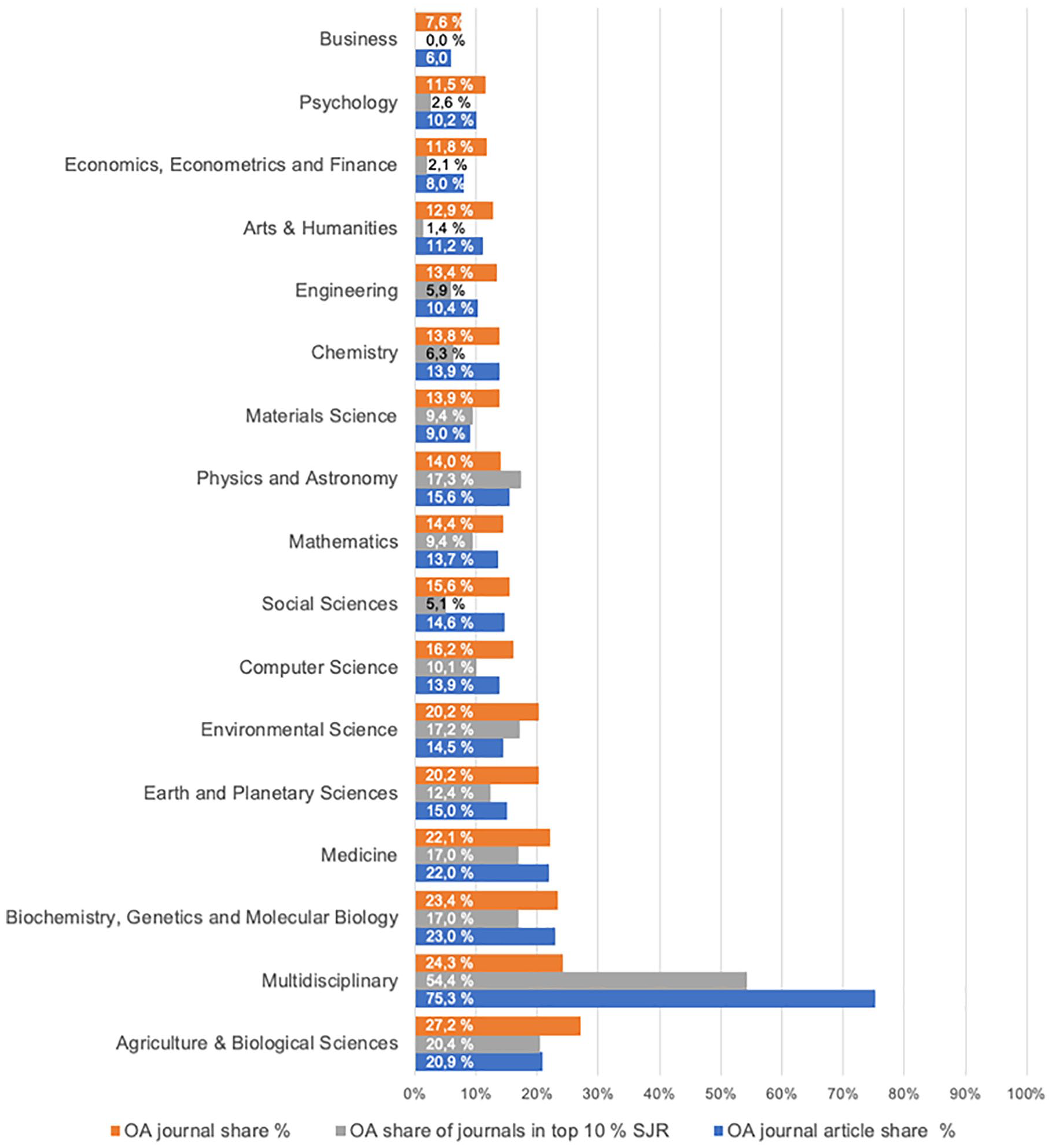
Shares of OA articles and OA journals in Scopus discipline categories. Also visualized is the proportion of OA journals included in the top 10% of journals in each Scopus discipline category as per their SCImago Journal Rank (SJR) score.
Using citation statistics based on Scopus data, it is also possible to calculate what share of journals in the top tier of journals in each discipline is OA. The Scimago site enables searching for journals in different categories according to their SCImago Journal Rank (SJR), which accounts for the number of citations received by a journal by weighting the citations by how much of the fields’ relative citations are received by the citing journal. OA journal shares in the top decile of journals when the journals are ordered according to the SJR citation ranking are also provided in Figure 1. This is a proxy for the relative scholarly impact of the OA journals compared to all journals. “Business, management and accounting” is again the lowest scoring of all areas with 0.0% of journals and “Economics, econometrics and finance” third lowest with 2.1%.
Scopus also includes a more fine-grained breakdown of its disciplines where “Economics, Econometrics & Finance” as well as “Business” are further divided into 13 subfields. The OA journal shares for these are shown in Table 1. Five other selected fields on the same third Scopus level are shown for comparative purposes. These were picked from over 200 Scopus subdisciplines as fields that could be argued to be thematically related to business and economics specialties and used for support as part of teaching and research purposes in business schools. All other related subfields have higher percentage of OA journals in comparison with the exception of Economics, Econometrics and Finance (Miscellaneous). This perspective further highlights the unique nature of these disciplines in context of OA also at the level of subdisciplines.
OA journal shares for different business and economics subdisciplines as well as some related fields.

HRM: human resource management; OA: open access.
Relative impact of OA journals compared to subscription journals
Especially in the early days of OA publishing, there was a wide-spread belief among academics that OA journals almost by necessity were of lower quality and impact. Later research has shown that, on average, OA journals are not lagging far behind subscription journals in terms of article citations and impact factors (Björk and Solomon 2012; Piwowar et al., 2018).
A way to assess the scientific impact of OA journals is to look at the relative number of citations received by OA journals and articles, compared to all journals. For all sciences together, the average share of OA journals was 18.4%, the share of articles published in OA journals 18.4% and the share of total Scopus citations pointing to articles in such journals just slightly lower at 16.2%. For Medicine, the citation numbers to OA articles are at 21.8%, with an OA journal share of 24.2% and article share of 22.1%. But for two business fields, the numbers drop markedly. For “BMA”, OA journals are at 7.6%, articles at 6.0% and citations at only 2.3%. The corresponding figures for “Economics, econometrics and finance” are 11.8%, 8.0%, and 4.1%. These figures are a result of the fact that OA journals in medicine from a scientific viewpoint on average are more or less on the same level as subscription journals, as reflected in citations, whereas the same is not true for the business fields.
Shares of born OA and converted journals and charging of article processing charges
We could establish that on average, 44% of the OA journals in Scopus were born OA, whereas 56% were subscription journals that had converted to OA. Computer Science (65%), Biochemistry (61%), and Medicine (49%) had the highest shares of born OA journals. Business had 39% and Economics had 34%. Perhaps, more importantly, while the former three disciplines had a high share of journals charging APCs, 48%, 64%, and 52%, respectively, only 20% of business and 10% of economics, OA journals charged for publishing. The average APCs for these latter categories were US$601 and US$424, compared to an overall average of US$1183.
Publisher countries for OA or non-OA journals
Four countries totally dominate the global scholarly journal scene (a market of roughly US$10 billion), in particular, for English-language STM (Science, Technology, and Medicine) subject fields. The United States and the United Kingdom house both the leading scholarly society publishers and University Presses, and also several of the big commercial publishers. The Netherlands and Germany are the home of the two leading commercial publishers, Elsevier and SpringerNature. In fact, 63% of the 24,385 journals indexed in Scopus come from these four countries.
All journals in Scopus have information about the country location of the publisher. The OA journal shares are much lower in the Big four countries (the United States, the United Kingdom, Netherlands, and Germany), with only 9%. This is because OA publishing is less common among the leading subscription publishers, which are located in these four countries. For the group consisting of all other countries, the share is 34%, with a staggering 80% for Latin America. Also, in the other countries, the differences between disciplines are much less pronounced (for a more detailed analysis, see Björk and Korkeamäki, 2020). The explanation for the outlier OA share of 21.1% for the category Economics, Econometrics, and Finance (Miscellaneous), as seen in Table 1, is also that there are clearly more journals published in the other countries (with a higher OA propensity) for that category (37%), compared to the other business and economics subdisciplines (11%–24%).
More than half (54%) of the 156 OA journals in BMA and EEF were published in three world regions (Latin America, Spain, and Eastern Europe and Russia), which have strong publicly supported OA portals, which have helped existing journals convert to OA. A majority (109) of the journals publish in English but both Spanish (25) and Portuguese journals (13) have a strong representation. Most of the other languages are Slavic languages. The median number of articles per year for the OA journals was 24.54% of the journals are published by universities and 10% by scholarly societies, with the rest being published by commercial publishers. But these latter are, in many cases, nevertheless, published on behalf of scholarly societies.
Institutional policies and repositories for the top 50 business universities from the QS ranking
This part of the study is based on a web search in ROAR, ROARMAP, openDOAR, and the open web. Of the top 50 business universities in the QS ranking, all but two could be verified to have their own repositories, and OA mandates or policies could also easily be identified for 30 of them.
OA prevalence for FT50 journal articles and OA policies of the journals
Harvard Business Review and MIT Sloan Management Review were excluded from this analysis as is not possible to check the OA status of their articles with the Unpaywall data, due to a lack of DOI identifiers. The two journals also have quite different types of content profiles from classical peer review journals. Figure 2 presents the analysis of OA article shares for articles published in 2014–2019 by the remaining 48 of the FT 50 journals. Exact counts and detailed percentages are provided in Table 2. The “bronze” category that the Unpaywall system recognizes contains individual articles that the publisher has made open at their discretion, often for promotional reasons.
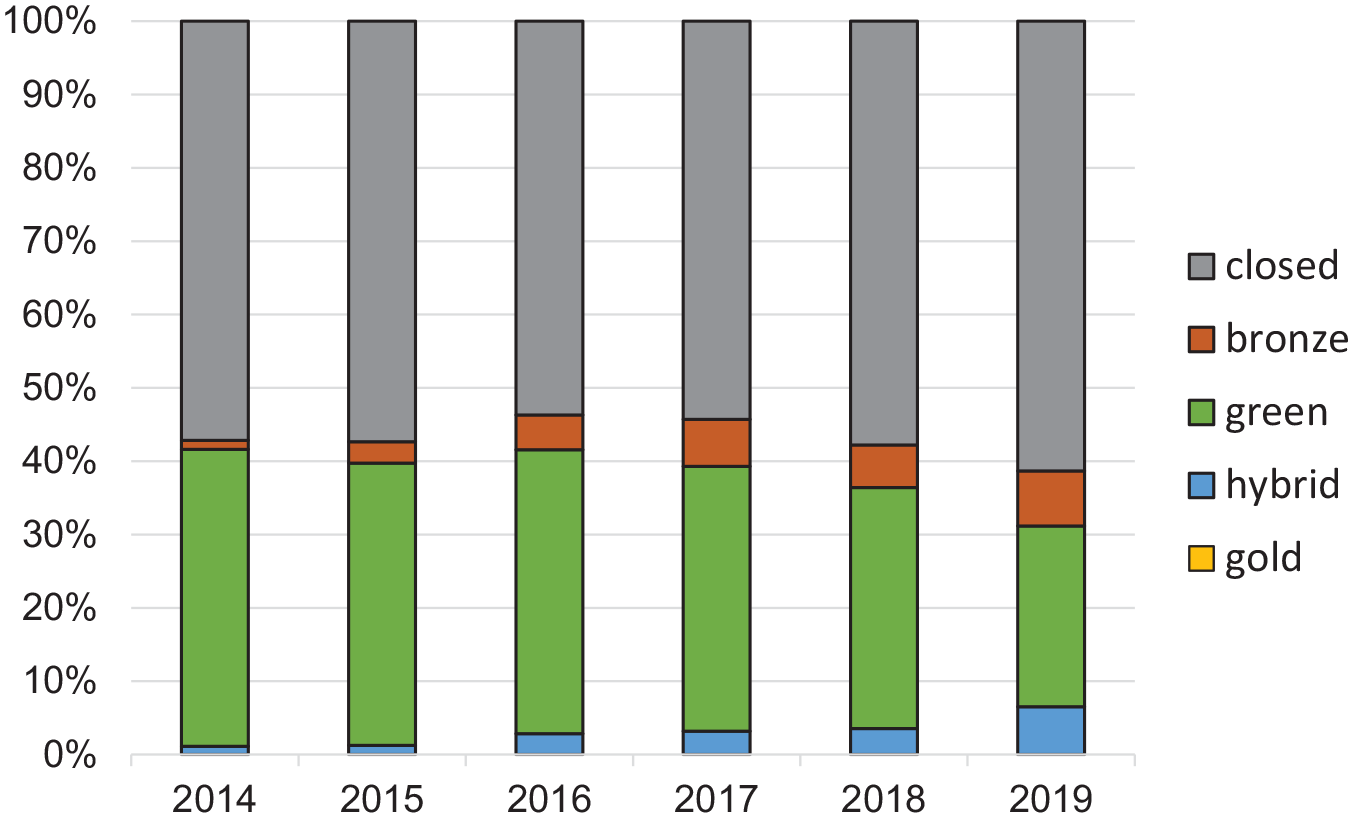
Open access status of articles published 2014–2019 in journals included in the Financial Times 50 list (as of January 2020, only articles assigned a DOI, n = 19,969 articles).
Open access status of articles published 2014–2019 in journals included in the Financial Times 50 list (as of January 2020, only articles assigned a DOI, n = 19,969 articles).

The most noticeable trends here are the increases in the shares of hybrid and bronze OA articles in more recent years. The share of hybrid OA articles in the FT50 journals has been increasing since 2014 and reached 6.5% in 2019. This is influenced both by the hybrid policies and pricing of the journals. A clear majority of the journals offer a hybrid option (38/48). Since most journals are published directly or on behalf of societies by major commercial publishers the information is easily findable (Wiley’s OnlineOpen, Springer’s Open Choice, OUP’s Oxford Open). The price range is between US$1800 and US$6000 with 70% of the APCs between US$2700 and US$3300. The increase of green OA as time from publication grows is also a typical pattern (European Commission 2021; Piwowar et al., 2018), likely driven both by publisher-imposed embargoes as well as there just being more time allowed for authors to upload versions of their article to the web.
As can be seen in Table 3, Hybrid was more common for Scopus articles, in general, in 2014. Also, the difference in bronze OA is substantial. This is likely to be the result of hundreds of journals in the life sciences making all their articles systematically freely available after a delay of typically 1 year (Laakso and Björk, 2013), while no journals among the FT50 do so and only open up free access to individual articles sporadically. Green OA is much more common for FT50 than for the Scopus set. Part of the explanation is that if Unpaywall has located multiple OA copies of an article, the publisher’s own versions take precedence over green OA manuscript versions. Thus, it is possible that there are more manuscript copies in repositories of general Scopus articles than just the 13.5% shown in the table. There are two more aspects of the high green OA percentages for the FT50 journals. For the FT50 journals, we found explicit specified embargo periods ranging from 0 to 60 months for 41/48 journals. The two most popular periods were allowing open deposit directly after publication or earliest 24 months after. This is reflected in the fact that the green OA percentage decreases clearly for articles recently published in 2018 and 2019 in Table 3. The second aspect is what some researchers have dubbed a “selection bias” in what articles academics choose to post manuscript copies of in repositories (Davis, 2011). Given that there is a certain amount of extra work involved in reformatting and so on, researchers are more prone to do so for their best articles, such as the ones published in FT50 journals.
OA status of article published in 2014 in FT50 journals and in a random set of 1000 Scopus-indexed articles.

OA: open access.
The Unpaywall data also provide the locations of the green OA copies found. The frequencies for these locations for the FT50 journals are shown in descending order in Table 4, covering the top 30 locations. Most of them are institutional repositories, but the two with the highest number of manuscripts are subject-based repositories (Econstor for economics papers and CiteSeer for computer and information science).
The most frequently appearing locations of the green OA copies of FT50 articles based on Unpaywall data.

Discussion and conclusions
Our results confirm that the Business and Economics disciplines lag behind other fields of science in taking journal-driven gold OA into use. The combination of being a relatively small field of research, in terms of annual article volume, with a strong pressure on academics to publish in a small subset of established journals has not facilitated a transition away from subscription-based access, which has been financially lucrative for established publishers. Nevertheless, several studies have indicated a demand and interest from authors (or their institutions or funders) for universal OA to produced research outputs. This demand is also supported by increasingly common OA mandates from funders and universities. In our investigation of the journals included in the exclusive FT50 journal list, the lack of full OA journals is nevertheless to a large extent compensated by green OA copies, so that the overall OA availability approaches 40%. Green OA copies are, however, not perfect substitutes for the published article, because of minor differences in content and layout and, in particular, because of common delays in OA availability due to embargoes.
The key issues concerning full gold OA are how reluctant leading publishers have been to roll out OA publishing models for existing journals and how big the hurdles are for new journals from start-up publishers to establish a footing. The key reasons are on the supply side, the lack of pressure for changing currently very comfortable and profitable business practices. On the demand side, the lack of strong funder OA mandate pressure, compared to fields like biomedicine, and lacking author willingness to submit to such journals as well as to pay high APCs. Because of such reasons, business-related disciplines have not been judged by publishers as offering a good potential for launching OA journals or converting subscription journals to OA funded by APCs.
Such differences in supply and demand can well explain the differences between biomedicine and the natural sciences on one hand, and the social sciences and humanities on the other hand. But it does not explain why economics and, in particular, business have such a low uptake, even comparing to other fields of social sciences and humanities. Severin et al. (2018) concluded that research cultures have largely shaped the uptake patterns within various disciplines, and suggested that change should be happening at that level if changes to publication behavior are desired. But for as long as rankings and exclusive accreditations remain important for the competitiveness of business schools, and their evaluation criteria only re-affirming existing publishing hierarchies and incentives, there will likely not be rapid change in the near future.
One partial explanation of why journals in business have been reluctant to change business model from subscription income to APC-based models is that APCs of accepted manuscripts have to cover all the costs of the journal, including also the review and management cost of rejected papers. In biomedicine, the acceptance rates are generally higher than in the social sciences. For instance, the leading OA megajournals, which typically charge around US$1500 for publishing, have acceptance rates in the range 50%–60% (Björk, 2018). Sugimoto et al. (2013) found that business discipline journals had average acceptance rates of around 25%, the lowest of the five social fields included in the study.
We suggest that the opportunities for journal business model changes (i.e. open access) have been particularly weak in the business and economics disciplines due to the strong effects of journals ranking lists. We further suggest that the extremely strong position of a few, mainly US-based scholarly societies in the publishing of the FT50 journals (both as formal publishers and as partners with commercial publishers) has further limited attempts to experimentation with OA. Of the 48 journals we studied, 27 are published either directly by scholarly societies or universities, or in partnership with commercial publishers. Also, in the latter cases, the societies nevertheless have a strong say in dictating the policies of the journals. For many societies, journal publishing is, in addition to being a key mission, also an important source of revenue for subsidizing other activities. The dilemma they face is succinctly stated in the title of Jan Velterop (2003) article “Should scholarly societies embrace open access (or is it the kiss of death)?”
We do not as such advocate that publishers in the business disciplines should rapidly convert their journals to OA. But researchers, research funders, libraries, and their host institutions can through their attitudes, mandates, and recently through so-called transformative e-licensing deals with publishers create the demand which would help trigger the conversion of journals and the founding of new OA journals. Particularly important are the attitudes of senior researchers who act as editors and editorial board members of leading journals. There are several cases where the whole editorial boards of top journals have resigned in protest at the pricing and OA policies of the journals that they add so much value to with their unpaid work and founded new OA journals instead (Jaschik, 2015; McKenzie, 2017, 2019). For now, there has been no indication of a similar demand, or at least coordinated actions, for OA in the business disciplines.
Footnotes
Declaration of conflicting interests
The author(s) declared no potential conflicts of interest with respect to the research, authorship, and/or publication of this article.
Funding
The author(s) received no financial support for the research, authorship, and/or publication of this article.
