




Abstract
This paper focuses on the move by some academic libraries to replace subject-based organisational structures with new functional structures, introducing functional specialists instead of subject librarians. It reports 11 in-depth semi-structured interviews with senior managers in UK libraries discussing their attitudes to this change. Key drivers for change included the desire to align the library more closely with institutional strategy and provide enhanced research support. However, there were also major concerns, particularly the loss of close relationships with academic departments. Little consensus emerged apart from agreement that this is a major current debate impacting significantly on the future positioning of libraries in their institutions.
Keywords
Introduction
In 2012, the University of Manchester Library (UML) in the UK completed what has been described as a radical and ambitious restructuring exercise, where the traditional subject-based organisational structure was effectively abandoned in favour of a structure based on functional teams (Bains, 2013). Figure 1 illustrates how the five subject teams, corresponding to the disciplinary coverage of the University, were replaced by functional teams, responsible for research support, teaching and learning support, and marketing and relationship management.
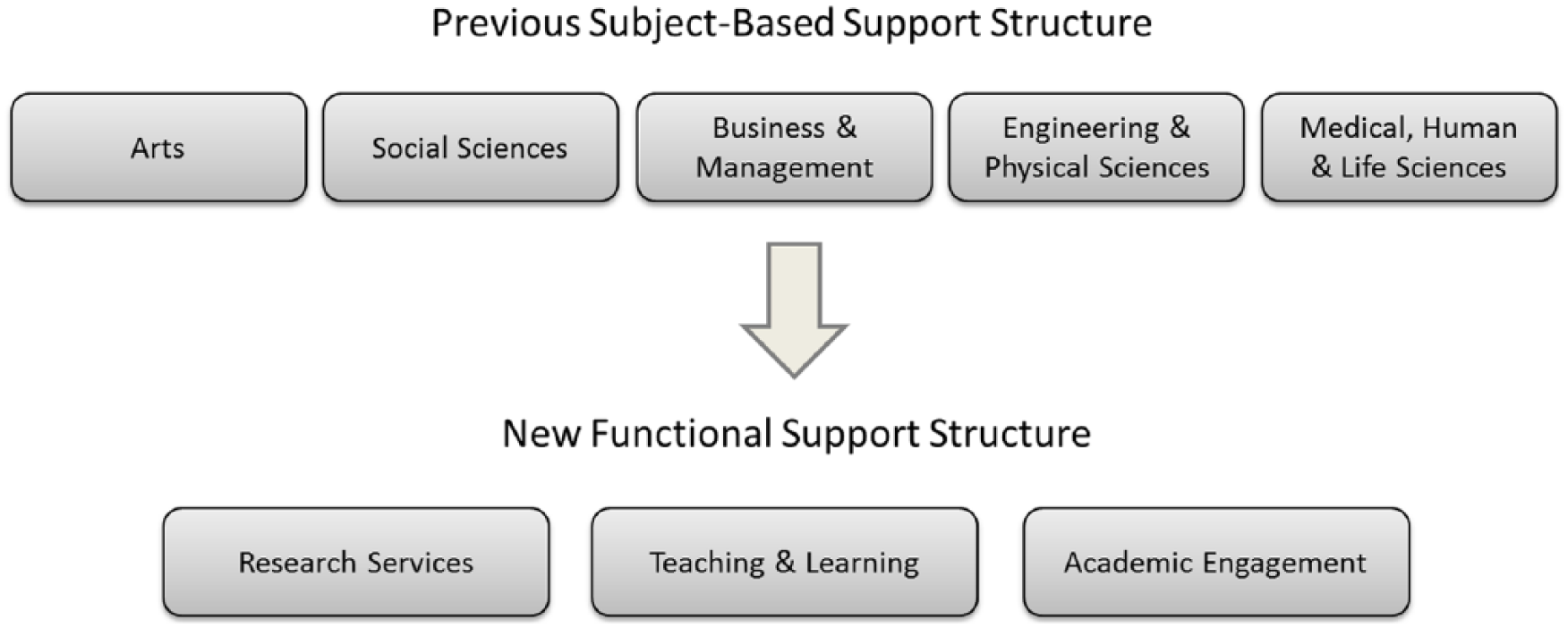
Comparison of the old and new structures of the University of Manchester Library (based on Bains, 2014).
Subject roles have been a constant feature of academic libraries in the UK and elsewhere for some time (Corrall, 2014; Martin, 1996; Woodhead and Martin, 1982), typically focusing on delivery of a range of services to particular academic departments of the institution, often including involvement in academic liaison, collection management and information literacy teaching for those departments (Brewerton, 2012; Crawford, 2012; Hardy and Corrall, 2007; Pinfield, 2001). To dispense with these roles in favour of those focused on performing particular functions across different disciplines (including specialised information literacy education or research data management) may be seen as a radical departure. For some time, there has been an expectation that academic libraries would radically reshape their organisational structures in response to rapid changes in the information environment and the shifting focus of academic libraries away from managing print collections towards providing user-focused services (Biddiscombe, 2002; Corrall, 2014; East, 2007; Franklin, 2009; Jantz, 2012; Jeal, 2014; Moran, 2001: Stueart and Moran, 2007). However, until now this has not occurred, and instead libraries have arguably ‘reorganised around the edges instead of completely discarding their old structure and beginning anew’ (Stueart and Moran, 2007: 188). The changes to the organisational structure of the UML could be seen as one of the first truly radical restructures of a UK academic library, which had been predicted for so long. With this development, it is timely to investigate if other university libraries have been influenced by the UML’s new structure or by the drivers that lay behind it, and if there is wide engagement in the academic library sector with the possibility of replacing traditional structures which incorporate significant subject-based components with ones built around functional teams, or if functional teams are in fact already in use.
This study investigates how functional teams (normally specifically designed to focus on research support, and teaching and learning support) are being used by university libraries in the UK as an alternative to subject-based teams. It aims to establish the reasons why functional teams are being introduced and determine how successfully they are perceived to be performing. In particular, the study aims to establish whether functional structures are replacing the traditional subject-based library structures, or if they could do so in the future.
Literature review
Corrall (2014) identifies that most university libraries in recent decades have used a ‘mixed structure’, where technical, back-office operations (such as acquisitions and cataloguing) and generic front-of-house services (such as circulation) are organised into functional teams, and in addition there are individuals or teams deployed to support specific subjects. This appears to corroborate Martin’s (1996) findings which report the most common model in UK university libraries to be a ‘dual’ structure, where some librarians have subject-based roles and others functional roles. This ‘dual’ structure had replaced as the most common model a ‘hybrid’ structure (where there are librarians who perform both subject and functional roles) identified by a previous survey (Woodhead and Martin, 1982). Whilst this transition from hybrid to dual structures shows a certain degree of flexibility amongst university libraries (Doskatsch, 2007), it also demonstrates the longevity of the subject-based approach. Carpenter (2007) and Corrall (2014) in their more recent investigations both found that organisation by subject was still an important element of most university library structures.
However, the literature also signals that with the rapidly changing information environment, there needs to be a shift away from libraries focusing on collections to becoming more user oriented, and developing organisational structures to reflect this. In particular, there is support for flatter library structures, with fewer layers of management and increased use of self-managed teams, in order to create more flexible organisations that are quickly adaptable to change (Andrade and Zaghloul, 2010; Jeal, 2014; Moran, 2001; Pugh, 2005). There is also additional emphasis in the literature on the importance of the library reflecting more closely the mission of its parent institution and of its structure being redesigned accordingly (Moran, 2001). The idea of a functional rather than subject organisational approach has developed in this context.
Nevertheless, the notion of an academic library being based solely on functional teams, rather than having a significant subject-based component, is not a new one. Heseltine (1995) argued that functional teams provided a more cost effective, consistent, measurable and accountable level of service, and predicted that subject librarianship would become irrelevant as focus shifted from contributing subject knowledge to teaching skills and competencies to students. Similar arguments have been attributed to Dennis Dickinson from the late 1970s in the USA (Gaston, 2001). Nevertheless, such views have until recently regarded as exceptional (Gaston, 2001; Martin, 1996). However, there is now evidence in practice of such views becoming more widely accepted. UML is not the first academic library to decide to restructure around functional teams and abandon its subject-based model: the University of Arizona Libraries (Andrade and Zaghloul, 2010), the library of the University of South Australia (Doskatsch, 2007) and the library of the University of Guelph (Jaguszewski and Williams, 2013) have all restructured along similar lines.
Specific drivers for such changes have, however, varied. Andrade and Zaghloul (2010) cite budget cuts for changes at Arizona, whereas both the UML and the University of South Australia Library identify the main driver for structural change as being the need to ensure full alignment with their respective university’s overall teaching, learning and research environment and strategies (Doskatsch, 2007; Jeal, 2014). In fact, for UML financial savings appear to not have been a motive for the restructure at all, since the library successfully bid for additional funding for investment in staff development and training to ensure the new roles in the structure could be carried out as effectively as possible (Bains, 2013). The drivers identified by the University of Guelph for their restructure around functional teams are different again; in this case the subject-based model was abandoned because of an insufficient number of subject librarians (Jaguszewski and Williams, 2013). A complex picture, therefore, is evident in the literature with regard to the drivers for restructuring around functional teams.
Since most of the literature on the topic of using functional teams largely consists of case studies focusing on the actual process of restructuring the libraries, there is little reported evidence concerning the effectiveness of using functional teams over subject-based teams. However, some potential problems with functional teams have been identified: for example Doskatsch (2007) states that academic staff often fear librarians will no longer have the subject-specific knowledge and skills required and consequently there will be a decline in the quality of library services.
The role of subject librarians partly for this reason has been widely supported in the literature, and the inclusion of a subject approach remains the dominant structural model in university libraries (Corrall, 2014). It is, nevertheless, often acknowledged that more needs to be done to promote the services offered by subject librarians and to demonstrate their value to the rest of the university, both to academic staff and university managers (Cooke et al., 2011; Corrall, 2015). This is particularly the case as the role has changed. Gaston (2001: 21) states: ‘the role that subject librarians perform has evolved from subject-based collection development into subject-based user support’. This change has featured two prominent themes which emerge from the literature: academic liaison and information literacy teaching. The former has often been reflected in the move to replace the job title of ‘subject librarian’ with such titles as ‘academic liaison librarian’ (Brewerton, 2011; Gaston, 2001; Pinfield, 2001; Rodwell and Fairbairn, 2008). Subject librarians are now expected to have an outward-facing orientation, to build strong relationships and collaborate with staff and students in order to ensure that library services remain relevant, with the intent that the subject librarian becomes ‘an equal partner in the research, teaching and learning functions’ (Rodwell and Fairbairn, 2008: 120). This has led to the development of concepts such as ‘blended librarianship’ (Shank and Bell; 2011), ‘embedded librarianship’ (Shumaker, 2009) and ‘librarian as consultant’ (Donham and Green, 2004; Frank et al., 2001). Similarly, the subject librarian role in information literacy is often seen in job descriptions where applicants are required to have pedagogic skills, information expertise, IT skills, knowledge of virtual learning environments and the ability to design courses of instructional material (Biddiscombe, 2002; Doskatsch, 2003; Gaston, 2001; Hepworth, 2000).
However, the expanded roles of subject librarians are not confined to academic liaison or information literacy: a wide array of new responsibilities including advocacy, marketing, publicity and promotion of resources, project work, quality monitoring, systems development, and e-resource management have been identified, to name only a few (Brewerton, 2012; Crawford, 2012; Pinfield, 2001). Pinfield (2001: 34) observed that subject librarians increasingly had to ‘do all of the old job plus a lot more on top’.
It is perhaps unsurprising then that as well as the predictions by Woodhead and Martin (1982) and Heseltine (1995) about the demise of the subject librarian role, more recently Rodwell and Fairbairn (2008) have questioned its sustainability, when new responsibilities keep being added on to the role without any others being removed. In addition, the growing importance of interdisciplinary approaches has also led to some questioning of the need for subject-specific experts in the library (Bradbury and Weightman, 2010; Miller, 2014).
More recently, there has been an increased focus on providing research services, which again has impacted on the responsibilities of academic librarians and the skills they require. The Research Information network (RIN) (2007) called for ‘new ways of working’ in libraries to support research, and identified ‘an urgent need for librarians and the research community to work together to clarify the roles and responsibilities of key players’ (RIN, 2007: 3). Partly arising from this work, Research Libraries UK (RLUK) funded a report to investigate the tasks researchers might require subject librarians to undertake which resulted in the identification of 32 new potential skills and knowledge areas university librarians may be expected to have to support researchers. These included, but were not limited to, knowledge of the ‘research life cycle’, data mining, funder requirements and policies, data sources, data management, open access support, publication methods, bibliometrics, as well as knowledge of local research interests (Auckland, 2012). There is now a growing literature on many of these different aspects of the library role, often discussing how subject librarians can contribute (Corrall et al., 2013; Cox and Pinfield, 2014; Delserone et al., 2010; Drummond and Wartho, 2009; Herther, 2009; Jain, 2011; Mamtora, 2013; Potvin, 2013; Walters, 2007).
Despite these discussions on the role of subject librarians providing research support, a key theme that emerges in all the examples of universities that have restructured around functional teams is the need to provide better and clearer support for researchers (Andrade and Zaghloul, 2010; Bains, 2014; Doskatsch, 2007; Jaguszewski and Williams, 2013). Interestingly, there does not seem to have been such a concern about teaching and learning support, although the need to improve the student experience (particularly in the UK with the rise of student tuition fees) has been an important theme of professional discussions (Bryant et al., 2009; Sykes, 2007). Nevertheless, undergoing a full library restructuring which foregoes the traditional subject-based structure and establishes functional teams around teaching and learning support and research support, is not the only structural response to this challenge. As Jaguszewski and Williams (2013) state, many libraries have implemented a hybrid or matrix model with, for example, the subject approach remaining but each librarian also devoting a proportion of their time to a functional area of expertise (such as open access), and liaising across disciplinary areas regarding this function. Other institutions have decided to create specialist functional roles or teams in addition to the subject librarian role, which are predominantly dedicated to research support, but not exclusively, and include roles such as ‘research support librarian’, ‘systems librarian’, ‘research data managers’, ‘information literacy educators’, and ‘repository managers’ (Bradbury and Weightman, 2010; Brewerton, 2011; Corrall, 2014; Cox and Corrall, 2013; Mamtora, 2013; Young and Lund, 2008). These may also involve some kind of matrix management. As stated by Stueart and Moran (2007: 200), there is not just one ‘successful’ model for university library structures.
Methods
Since this study was designed to identify the major reasons why senior managers have chosen certain organisational structures for their university libraries, it is suited to an interpretivist research paradigm which seeks to establish a rich picture of the phenomenon in question and in particular to ‘provide an understanding of the intention behind the action’ (Pickard, 2013: 13), including where intentions and perceptions differ amongst stakeholders. An inductive, qualitative approach was adopted to support this. The topic of this research relates to a relatively new phenomenon about which very little previous research has been carried out. It, therefore, lends itself to a qualitative approach where the aim is to carry out an early, provisional study aiming to establish hypotheses or theories, which might subsequently be tested quantitatively (Bryman, 2012).
The data collected for this research derives from 11 semi-structured interviews with senior library managers from different universities in the North and Midlands of England. Senior library managers were ideally placed to provide detailed insights into the structures used in their libraries and were able to offer a strategic overview that was essential for this investigation. Interviews focused on the reasons why certain library structures had been chosen. Semi-structured interviews provided sufficient flexibility to enable issues raised by interviewees to be explored in more detail without the constraint of a rigid set of questions (Bryman, 2012; Pickard, 2013), whilst at the same time providing sufficient consistency to allow cross-interview comparisons to be drawn (Bryman, 2012: 472).
Purposive sampling was used to identify the senior library managers to be interviewed, specifically, ‘maximum variation sampling’ (Palys, 2008), aiming to cover a wide range of positions and perspectives in relation to the phenomenon being studied. Therefore, a sample was chosen that covered a range of different institutions (from large, research-intensive universities to smaller, teaching-led universities), in order to see if themes emerged within or across universities from different ‘mission groups’. The sample was also chosen to include university libraries that have adopted a functional structure as well as those who currently still use the more traditional subject-based model. Heads of Service at 14 university libraries in the North and Midlands of England were invited by email to participate in the research, with 11 responding positively. The Head of Service in the majority of cases volunteered to be interviewed, but in two cases, another senior library manager (who had been heavily involved in a recent restructuring process) was identified to take part. The final sample consisted of:
four Russell Group universities (large research-intensive institutions)
three ‘Pre-92’ universities (other research-led institutions)
four ‘Post-92’ universities (teaching-led institutions)
Of this sample, four libraries had completed a restructuring replacing subject teams with functional ones, one was currently undergoing such a process, and six had reviewed the options but decided to retain subject teams within their structure.
Following piloting of the interview format, the interviews took place between 22 June and 16 July 2015. Interviews were conducted face to face, and lasted between 25 and 60 minutes. A single semi-structured interview schedule was followed in all cases (Appendix 1), with interviews recorded as well as the interviewer keeping contemporaneous and post-interview reflective notes. The approach taken was approved by the University of Sheffield ethics approval process involving principles of informed consent, and personal and organisational anonymity.
The interviews were transcribed in full and the data was subjected to inductive thematic analysis (Braun and Clarke, 2006; Bryman, 2012). NVivo was used for the analysis with thematic coding being adopted in order to segment and categorise the data (Ayres, 2008). The stages set out by Braun and Clarke (2006) for conducting the thematic coding and the subsequent analysis were observed: the interviews were transcribed, then initial coding of the data was undertaken, these codes were then sorted into themes, and finally these themes were reviewed and refined (including the identification of any sub-themes), before the results were written up.
Results
Increasing levels of adoption of functional teams in university libraries
All the participants, whether they worked in a library that had adopted the functional-based approach or not, acknowledged that there were an increasing number of libraries replacing subject teams with functional teams. It was clearly a topic currently being discussed and debated widely in the sector, with most participants recognising that it was the high profile restructure of the UML that had sparked this interest from the professional community in the UK.
However, even though all of the participants acknowledged the currency of the issue, there were considerable differences in how it was perceived. One participant even stated that ‘two schools of thought’ had emerged on the issue of functional-based structures. The views of participants themselves were divided on the topic. One group of participants managed university libraries that had adopted, or were in the process of adopting, the functional-based approach, and viewed the use of functional teams as the way forward. The rest of the participants came from university libraries that had decided to retain the subject-based model and were unconvinced of the effectiveness of functional teams. Some who had retained the subject-based model had also established functional roles or even teams to support subject librarians, but since this had not required a full restructure and subject librarians remained the key role, these structures were still perceived by participants to be subject based. Interestingly, there was no clear link between University mission group and structure. There were examples from Russell Group, Post-92 and Pre-92 universities having adopted, or being in the process of adopting, a functional approach to library structures, and conversely examples from all three university mission groups of the subject-based approach being retained.
Drivers for introducing functional teams
Of those participants who worked in university libraries that had restructured around functional teams, a number of key drivers behind the decision to do so were identified in the interviews:
Ensuring consistency: particularly a consistent level of service across the library;
Acquiring new expertise: particularly in the research area e.g. research data management;
Improving efficiency and focus: focusing on key institutional priorities;
Instigating cultural change: promoting change within the library and perceptions of the library;
Aligning with the university strategy: particularly in relation to supporting the dual university aims of research, and learning and teaching;
Responding to budgetary constraints: including budget cuts;
Contingent factors: such as senior staff retirements or departmental convergence prompting a review of structures.
Some of these drivers are evident in the literature, and were confirmed by the responses given by the participants. However, driver 7 emerged from analysis of the interviews, and whilst not explicitly given as a reason for implementing the functional approach could be inferred from some of the comments made. However, it should be noted that in each individual case of the functional approach being adopted by a university library it cannot be said that all of the drivers stated above played an equal part in the decision. Drivers 1 to 5 were often given as the main reasons, with drivers 6 and 7 only being identified in some cases, and often implicitly. Significantly, participants from university libraries who had not implemented a functional structure perceived the importance of these drivers differently to those participants who had restructured around functional teams. The main characteristics of these different perspectives are discussed below.
Participants who had implemented a functional approach generally agreed that ensuring a level of consistency of service was a key driver. Those who had adopted the functional approach had generally done so because there had been a perceived level of inconsistency in the services offered to the different academic departments when a subject-based structure had been in place:
One of the things that I found when I came here is that actually [the subject librarians] were pretty ineffective … there were pockets of excellence, you know, some very good liaison librarians who had very good relationship with their individual departments … but equally there were departments that were regarded as almost no-go areas that couldn’t be talked to, that couldn’t be related to, and I was absolutely keen to make sure that we had more consistency across the board because if you want excellence the first thing you have to get is consistency. (Russell Group participant)
What emerged clearly from the interviews was that when the functional approach had been adopted it was because there was seen to be a fundamental problem with the established subject-based model. Concerns were expressed that too much was expected of subject librarians for them to be fully effective and this contributed to the inconsistent approach to services which had been identified. Functional teams were, therefore, implemented to ensure that sufficient focus was given to every aspect of the library service, and for all academic departments. In particular, all participants acknowledged a need for increased focus and expertise in research support, with research data management, open access, citation analysis and copyright being highlighted as key areas for development. Participants viewed functional teams as way of enabling this expertise to develop within the service. In fact, it was clear from many of the interviews that the need for a team of experts dedicated to providing research services was a more important driver than the need to create a team of teaching and learning specialists:
…really the thinking was that the needs and requirements of researchers were becoming in some ways more specialised, in some ways demanding a different kind of expertise than we were able to supply from the traditional academic liaison route. So knowledge of all of the issues, and they’re sometimes quite complex issues, around open scholarship, open access … just require, we thought, a bit more focus and a bit more concentration. (Pre-92 participant)
However, it was suggested by some participants that restructuring around functional teams had occurred, not just because the expanding roles and responsibilities of the library meant subject librarians could not be expected to have in-depth knowledge of all aspects of the service, but more specifically because of underlying problems with the staff members themselves:
…quite frankly, under performing staff can hide within a subject team, and there isn’t necessarily the accountability there … you can’t afford to have highly paid staff hiding behind a publisher’s catalogue these days. I’m not saying that many do but there are some. (Post-92 participant)
Interestingly, participants from university libraries who had not restructured around functional teams often believed that institutions who had decided to restructure in this way did so because they had problems with their subject librarians, with a significant number referring to issues with subject librarians ‘going native’. They often implied that they believed this was the main driver behind many restructures elsewhere.
Closely related to this, it was clear from many of the interviews that the university libraries that had gone through a major restructure around functional teams, or were doing so, aimed in particular to instigate cultural change and signify to their staff a complete break from ‘how things have always been done’.
So part of this was about theory of change. That in order to make people do something different you need to make it quite significant, you need to break it so they can’t go back to the old style and I think if we’d introduced a matrix model the danger for me was people would have drifted back to the things they are most comfortable doing and would have ignored the things they were less comfortable doing. So by completely breaking the model, they couldn’t do that. (Russell Group participant)
Often it was expressed that the intention was not just to instigate cultural change within the library but also to change how the library was viewed by the rest of the university. One participant identified that their library was traditionally associated with teaching and learning, and therefore by restructuring around functional teams the aim was to change the profile of the library and unmistakably present to the rest of the university the services offered, especially around the expanding research services. A different participant implied their restructure outwardly demonstrated to stakeholders how they were ‘really moving beyond the traditional notion of what a library is’, with the role of the subject librarian being abandoned because of its perceived connection to the ‘traditional’ library. In many cases, this was also stated to be an attempt to demonstrate how the library’s activities align with the university’s overall strategic aims, which one participant argued was essential if libraries were to ‘survive’. Creating a clear link to the overall university strategy, a strategy based around the dual aims of research, and learning and teaching, by setting up a functional structure explicitly providing research support, and learning and teaching support, was stated to be an attempt to ‘future proof’ the library:
So the university focuses on certain subjects but they will always change over time … by having subject teams, every time the university reorganised its subject structure or decided to get rid of a subject and bring in a new one, we would have had to mess around trying to catch up … So it feels like we’ve aligned ourselves with a top level strategy which won’t change unless this university decides to do something completely different … It will remain focused on teaching, learning and research and so will we. (Russell Group participant)
Significantly, budget cuts were not explicitly mentioned in any of the interviews as being a main driver in the adoption of the functional approach; however, in some financial constraints were definitely a factor in the decision:
…you’re forever looking for efficiencies elsewhere and eventually that comes to staffing when you’ve cut everything else out. So you can’t underestimate budgetary constraints as being a factor influencing changes. (Post-92 participant)
In addition to these drivers, there were some participants who identified contingent factors which created the ideal opportunity to instigate a restructure, such as a senior manager retiring or the convergence of the library with other university departments. As well as these local contingent factors, it was widely recognised by participants that library structures go ‘in and out of fashion’ across the sector. Implicit in the views expressed by many participants was the understanding that the fact that other libraries had undergone change in a particular direction was in itself a driver to at least consider change locally.
Factors contributing to the continuation of the subject model
Significantly, all participants interviewed acknowledged that the possibility of restructuring around functional teams had been discussed within their institutions, even if ultimately the subject approach had been retained. Of the participants from libraries that have kept the subject model, a number of factors were identified in the interviews as having influenced this decision:
Connecting with academic departments: particularly the risk of losing the strong connections if the subject-based approach was abandoned;
Tailoring services: taking into account the specific needs of individual academic departments;
Maintaining the integration of services supporting teaching and research: providing an integrated service for each academic department;
Taking account of institutional size: with functional approaches perceived to be more appropriate for larger, research-intensive universities;
Perceiving there to be insufficient staff: where a functional approach is seen as requiring additional staff;
Anticipating resistance from staff: who support the subject approach;
Maintaining established professional practice: of providing subject expertise and subject-based structures.
The main reason participants gave for deciding to retain a subject-based approach was that they saw no reason to change the structure because it was perceived to be working. In particular, they often emphasised how feedback from academic staff showed subject librarians were valued by the users in their university, and they did not want to risk losing the strong connections their subject librarians had developed with the academic departments.
I don’t see that [the benefits of functional teams] override the real advantages you get from having subject experts who know the staff in the faculties, who have very easy access to them because they know their names, they know what their areas of interest are, they know the curriculum well, as well as what research they’re working on. (Post-92 participant)
It was often perceived that they would experience resistance from academic staff if the library was restructured around functional teams and the subject librarian role was lost. Participants from university libraries who had decided to retain the subject-based model often praised their subject librarians and stressed the important role they played in the library, especially relating to building strong relationships with academic departments. Rather than expressing concerns around ineffective subject librarians who tended to focus on the more traditional aspects of the role, these participants emphasised how their subject librarians were adapting:
I think the subject librarians here on the learning and teaching side have moved with the times and they have got involved in curriculum development, in e-learning, in podcasting, in careers and employability … If they hadn’t moved with the times I think they would have been eased out a while ago. (Post-92 participant)
Another major theme which emerged from the interviews was the perception that teaching and learning and research are not entirely separate activities and, therefore, some participants felt it would be retrogressive to adopt a functional structure which implied this was the case:
So we don’t have a number of people who are responsible for teaching, or a number of people who are responsible for research, or responsible for engagement. We tend to work in a much more cross cutting way. So for example, in working with the schools we would prefer to have a joined up conversation about teaching, research and engagement wherever possible, with either one person or small groups of people carrying the whole of the conversation … I think it would go against the spirit of the university to try and unpick them and separate them out. (Post-92 participant)
Therefore, these participants whose libraries had retained subject-based structures feared losing this joined-up conversation with academic staff, and even saw the potential for this to have a negative effect on how the library was viewed:
I mean that’s what university is about … it’s about deep engagement with the content of research and teaching. It’s almost perverse of us to set our face against that and sort of regard ourselves as a functional support. (Russell Group participant)
In addition, many participants expressed concerns about the use of functional teams, particularly that they could not as effectively take into account disciplinary differences, with academic departments requiring a more tailored approach to services; whereas subject librarians were ideally positioned to facilitate this. Emerging from this concern, further doubts were expressed regarding the effectiveness of teams of staff, such as the Academic Engagement team at UML, at replicating this strong relationship subject librarians have developed with academic departments:
I think that’s an unnecessary layer really because actually why wouldn’t you just send the person who is actually going to be doing the support, so they really understand first-hand what the need is. (Post-92 participant)
Despite expressing reservations about the functional approach in general, many participants whose libraries had retained subject teams did acknowledge that there were advantages to a functional structure but that it did not suit their institution. There was, however, disagreement about whether a functional approach was best suited to larger or smaller institutions. In some cases, participants from institutions who had retained subject-based structures stated that to establish effective functional teams would require more staff than were currently working in their libraries and was, therefore, more suitable for larger institutions. Sometimes the implicit assumption was that if they had more staff then maybe they would consider adopting a more functional approach; however, it was recognised that this was unlikely to happen due to financial constraints. It is interesting that this is diametrically opposed to views expressed by others that a functional approach was actually more efficient.
Essentially though, there was evidence from some of the interviews that tradition played a part in the decision to keep the subject-based model, with some participants stressing how long the library had used this approach, one commenting that there had been subject librarians ‘since we were set up as a university’ (Pre-92 participant). Many of the participants who argued in favour of subject-based structures openly stated that they had started their own careers as subject librarians and, therefore, understood the value of this role to the library:
I’m a subject librarian by background … and so I don’t see the need to … do away with subject librarians completely. (Post-92 participant)
Resistance to the adoption of the functional approach, from both senior library managers and current subject librarians, was evident in many cases since it was seen as potentially restricting to career development and job satisfaction if librarians were only responsible for a narrow function:
My subject team tell me that … it’s quite a range of activities that they have … I think they appreciate that … and there was a very strong feeling that their preference was to retain this structure if we could …. (Pre-92 participant)
Despite the reservations many participants expressed in the interviews around the use of the functional approach rather than the subject approach, there was the underlying suggestion that even though some planned to keep the subject approach for the foreseeable future, they were closely observing how effectively functional teams were working in other university libraries.
Effectiveness of the functional approach
Those who had adopted functional structures in their libraries perhaps predictably reported positively on the effectiveness of the model in comparison to the previous subject-based structures. They all reported challenging issues associated with managing change both within the library and in terms of academic departments’ reactions – but these were being managed. However, in general one theme running through the interviews was the extent to which the new approach had positively impacted on the library’s profile in the institution, especially with regard to research services:
Well, all I would do is emphasise how successful it’s been … I think we are doing things now we could not possibly have done with the subject model. I’m convinced of that. The citation analysis work we do now is hugely well regarded and has informed some very high profile work … We just implemented the new structure when the Finch Report came out in Open Access and all exploded around us, and I think we were perfectly positioned to do that … we turned the university’s panic into confidence very quickly in our ability to run the service for them. (Russell Group participant)
Functional teams were actually seen as allowing easier links to be made with other non-academic units within the university. Whilst this was not expressed as a driver in the adoption of the functional approach, from the interviews it emerged as a significant perceived advantage. For example, by having a functional team dedicated to teaching and learning it was stated how this facilitated links to be made with training carried out by other services (e.g. IT services, student services, etc.) to coordinate a more consolidated skills training programme for students. Similarly, by having a dedicated functional team focusing on research services, this made it much easier to build good relationships with research offices and research directors. One participant even stated that this might blur currently distinctive boundaries around different services, including the library:
I can foresee a time in the not too distant future actually where you take those pockets of expertise and service, which at the moment are distributed across the university, and you kind of bring them together as a team … I would expect there to be more of a move to functional teams and I would expect there to be more of a move to teams coming together across different services boundaries. (Pre-92 participant)
However, despite the stated effectiveness of the functional approach, there was concern expressed by those who had adopted the structure around relationships with academic units:
I think [an issue with functional teams is] maintaining that connection with schools and faculties. So at an individual level we may feel more distant to them … it’s about having the mechanism in place to keep the communication channels open at the appropriate level. (Russell Group participant)
This was identified by participants who had restructured around functional teams as the main challenge when adopting this type of structure, and significant efforts were being made to deal with this challenge.
Combining subject and functional approaches
Despite the fact that most participants identified their institutions as having either adopted the functional approach or maintained the subject-based model, the interviews revealed that all of the library structures had both functional and subject elements. Significantly, all participants recognised the importance of incorporating both elements in their structures, all be it in differing ways. One participant even saw university library structures as being on a subject-functional spectrum, with different structures at different points on the scale. Another acknowledged that university library structures might not be as ‘distinct and different’ as they outwardly appear. In fact, similarities could be seen when participants gave descriptions of their library structures in the interviews.
Participants from institutions with functional structures all recognised the need to retain some staff with subject responsibilities since they acknowledged the importance of having a relationship-management role to enable connections to be made with academic departments, although where this role sat within functional structures varied:
The piece that has helped us make this work, given our size, is that we’ve retained a sort of subject librarian in that [there is a team who] are still the liaison contacts with our schools, but … it’s not the traditional subject librarian role where they order stock and they answer enquiries and all those things. (Russell Group participant)
One participant argued that even though the functional approach had been adopted in their library, it was still important for the rest of the institution to be able to see ‘clear market links into a service organisation’. Therefore, since the university was structured around subjects, it was argued that there needs to be clear points of contact in the library reflecting the academic departments. Conversely, libraries that had maintained subject-based structures recognised the need for functional roles and actually had either a matrix structure, whereby subject librarians had functional responsibilities, or a hybrid structure where individual staff or teams with functional roles work in the background to support the work of the subject librarians in order to avoid overloading subject librarians:
…there are two alternatives … throwing everything at the subject librarian and growing more of them and trying to make them wholly multi-skilled, experts in subject disciplines, teaching and learning, pedagogy, research data management, open access publication, you’re on to a loser. That’s just too much. The other way of thinking about it I suppose is the functional team way, is that you break those things down and you put them into boxes. And I think actually that is more valid. But if you throw the baby out with the bath water and get rid of the liaison librarian as the main point of subject-based contact with the academics then we’re taking a step backwards … I think there is a third way … and get the best out of both models but think about liaison librarians as relationship managers with subject expertise. And then they manage the relationship between the functional responsibilities and the academic community. (Russell Group participant)
Significantly, it was often reported by participants who had retained subject librarians in their structures that they expected the number staff members with purely functional responsibilities, particularly concerning research support, to increase in the near future sometimes with the prospect of a small functional research team developing.
Two themes clearly emerged in all of the interviews regardless of the overall library structure adopted: the importance of building relationships and connections with academic departments, and the need to avoid overloading subject librarians with new roles and responsibilities, especially with regards to research support. However, despite these common influencing factors, all participants agreed that library structures have to be developed in ways consistent with distinct institutional contexts, and, therefore, recognised that there is no single, ideal structure for all university libraries:
But you’ll find that a lot of structures, and whether people go for functional structures or subject librarian structures or a mixture of the two, is actually based on the people you’ve got and the particular context that you’re operating in. (Post-92 participant)
Structures were not seen as static, but instead constantly in flux and evolving in order to adapt to the ever changing environments in which university libraries are operating.
Discussion
Drivers for change
A complex picture has emerged from this research, with some libraries following the UML model of restructuring to set up a functional-based structure, whilst others have made decisions to retain a subject-based approach within their structure. These findings would suggest the situation has changed since Corrall’s (2014) survey of UK library structures which found that the UML structure was unique, although more quantitative data would be required to confirm this and might usefully be provided by future research.
A number of common drivers for undergoing a full library restructure around functional teams emerged from the interviews. However, in all cases, the different combinations of these drivers were seen as dependent on the individual institutional context. Some of the common drivers reflected Heseltine’s (1995) views on the strength of functional teams being around providing a consistent, measurable and accountable level of service that both Heseltine and some of the participants of this study felt the traditional subject librarian model did not allow. However, this study shows there are now many more drivers to restructuring around functional teams than Heseltine originally identified, most being products of the changing nature of academic libraries and the environment in which they operate.
A UK study undertaken by Cooke et al. (2011) identified that academic staff lacked full awareness of all the services subject librarians had to offer. The approach of removing subject librarians and restructuring around functional teams might, therefore, be viewed as a radical way of addressing this problem, and setting up what is seen by some as an unambiguous picture of the services and support the library has to offer. At the same time, the library can bring on board new levels of expertise in specialist functional areas. This was seen as being particularly the case in technical areas such as data management skills. These themes of improving visibility and increasing expertise as drivers for restructuring around functional teams emerged from many of the comments of participants. Participants whose libraries had gone down a functional route perceived the restructuring to have been successful but future studies would be needed to develop and test measures of success. The current study might usefully give rise to such future work, including taking into account the views and experiences of those outside the library in other support functions and academic departments.
There was a particular emphasis on research support. This could be because, as identified by Brown and Tucker (2013), libraries have already developed the skills to support teaching and learning and demonstrated their value in this area, whereas research support is an area in which they still need to establish themselves as effective and skilled collaborators. RIN (2007: 68) reported ‘that while the teaching community regards the library as a partner, the research community tends to “do things by itself”’. This, it has been suggested, may mean that researchers do not value the library and, therefore, do not provide support (including at high levels) for the library within the institution. This is detrimental to the library at a time of budgetary restraint and proving value and worth to university management is essential (ACRL Research Planning and Review Committee, 2014; RIN, 2010). Significantly, the interviews revealed that developing support for research is a key issue for all libraries, teaching-led as well as research-led institutions. This could explain why it is not just research-led universities that are implementing functional-based structures.
However, restructuring around functional teams is not the only way libraries have responded to the need to improve research support. Another response has been to implement a matrix structure involving subject librarians taking on functional research responsibilities, although it could be argued this is not as effective at making the expertise visible to the rest of the university. The need to develop expertise in research cannot, therefore, be seen as the only driver towards restructuring around functional teams. There are other factors influencing the decision. These could include drivers that result from individual institutional circumstances, such as budget cuts, and there was some indication from some participants this was a factor. However, a more significant driver which emerged from the interviews appears to be the use of a restructure around functional teams as a means of rebranding the library and effecting cultural change.
Giesecke (2010: 54) states that:
Libraries face two challenges in implementing change in today’s world. First, libraries need to change how they are viewed by their constituencies so they are seen as indispensable. Second, and equally challenging, libraries need to help librarians and staff change their own mental models of their roles to remain relevant in these turbulent times.
Some participants indicated that in many ways completing a radical restructure around functional teams was an attempt to address both of these challenges. Some implied they had used the restructuring of their university library to signal both internally to library staff and externally to users, the changing nature of the library and the new services it offers. Jantz (2012) and Deiss (2004) advocate the need for libraries to take risks and innovate in order to stay user orientated and, therefore, relevant in the future. To an extent, by implementing a full restructure around functional teams, this is what the interviews indicated senior managers were trying to achieve. Deiss (2004) discusses the ‘symbiotic relationship’ between innovation and strategy, and identifies how in order that innovation can be effective it has to be coordinated and aligned with a clear strategy to ensure the new structure leads to the development of innovative services that add value. It is unsurprising then that aligning the library structure with the library’s strategy, which in itself is aligned with the university’s overall strategic objectives of providing high-quality research and teaching, was also identified as a main driver towards the use of the functional approach by participants.
Reservations about the functional approach
Since the full restructuring of university libraries around functional teams can be viewed as an innovation, and innovation necessarily comes with risk, it is unsurprising that some participants in the interviews saw it as too risky to abandon the subject-based in favour of the functional approach. As stated by Deiss (2004: 22), mature organisations such as libraries may find it more difficult to take risks and experiment with innovation, and come to rely on practices that have worked in the past: ‘the tension between innovation and the status quo is such that innovation is often seen as disruption’. An element of this tension came through in the interviews with some senior managers not wanting to completely break away from the traditional subject-based library structure that had worked for them for so long, as well as experiencing resistance to doing so from library staff.
In particular, participants discussed the risks involved in losing the strong relationships subject librarians had developed with their academic departments, and of any restructuring creating a backlash from academic staff. This is clearly an issue that needs to be taken seriously; Deiss (2004) discusses how innovations can fail when the individuals in the organisation served do not understand the benefits of the change. At the very least, such a risk points to the need for a robust communication strategy to accompany any change, something emphasised by some who had undergone a major restructuring. However, for others, due to the perceived risks, it had been decided to retain the subject-based approach and respond to new challenges by making more incremental changes. Such ‘incremental innovation’ (Jantz, 2012), occurring alongside existing systems and process, was perceived as less risky and disruptive, and ultimately more successful.
It is perhaps unsurprising that fear of undermining relationships with academic departments was seen as a primary reason to retain a subject structure when the amount of literature arguing for the importance of the liaison element of the subject librarianship role is taken into consideration (Hahn, 2009; Jaguszewski and Williams, 2013; Pinfield, 2001; Rodwell and Fairbairn, 2008). Gaston (2001: 33) states that: ‘the liaison role may explain why subject librarians have survived a multitude of changes in both their working practices (such as IT) and the environment in which they work (such as changes in higher education)’. Relationship management was identified by participants as a key area of importance for academic libraries. Therefore, if senior library managers deem the relationships between the library and faculties to be effective, they tend to not want to disrupt that by introducing a functional-only model.
Some participants did not regard the subject-based approach as incompatible with giving specific functional responsibilities to subject staff or creating additional functional positions to support subject librarians. These participants echoed the view of Bradbury and Weightman (2010), that the subject librarian role was in fact central to ensuring successful integration of research support. They also argued subject librarians ensure that research and teaching and learning remained interconnected activities, and that services are tailored to the needs of the individual academic departments. Until there is sufficient evidence that the strong relationship with academic staff that exists in the subject-based structures of some university libraries can be replicated in a functional structure, it is unlikely that some participants would shift to a functional structure for their libraries.
Balancing subject and functional approaches in individual institutional contexts
Despite participants being aware of the distinction between subject and functional approaches and structures, the key theme emerging from this research is that such a distinction is in fact an over-simplification. Most library structures consist of a balance between both functional and subject-based elements. All participants in this study acknowledged the need to have some functional elements since subject librarians cannot be expected to have in-depth knowledge of all services, especially related to research specialisms. Yet, all participants also acknowledged the need for a subject-based element in order to develop effective relationships with the academic communities and shape services according to user needs. Whether a library structure is predominantly built around functional teams with subject-based elements, or combines subject-based teams with functional elements, depends on the priorities of the individual institution and their senior library managers. At the same time, there was also acknowledgement that there had been a move recently in some libraries towards a greater emphasis on function rather than subject, and that the weighting given to each in the structure did matter. Figure 2 illustrates the opposing factors that are operating when senior managers are considering a suitable structure for their libraries, which have emerged from this research.
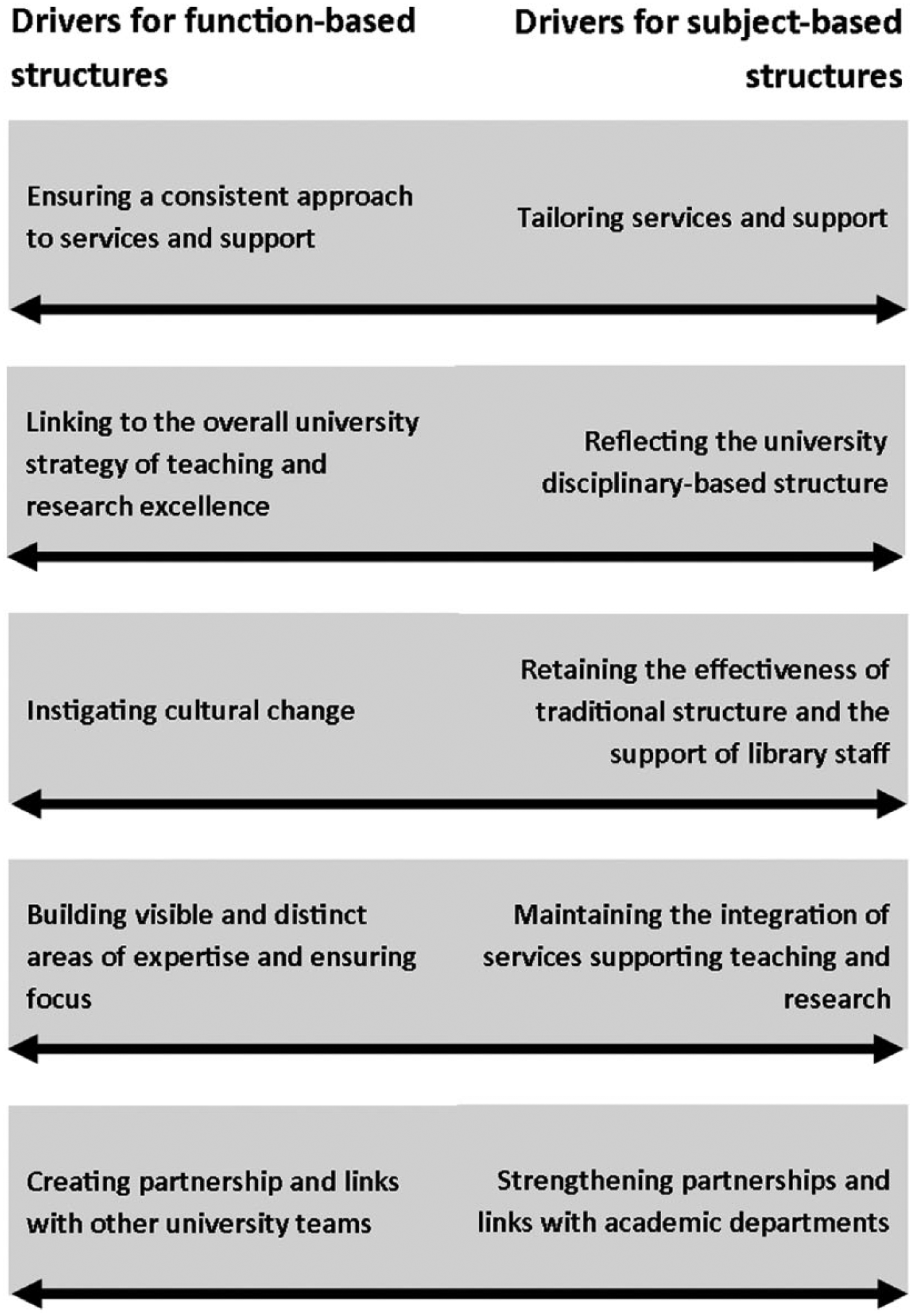
Opposing drivers for both functional and subject-based library structures.
Whether the library structure is predominantly functional or incorporates significant subject-based elements depends on the institutional context and what senior managers deem to be the most appropriate for the institution. For the first two drivers of both functional and subject-based structures shown in Figure 2, participants of this research tended to fall on either one side or the other. However, with regard to the rest of the drivers there were more divergent views about how important different issues were, which perhaps goes some way to accounting for why library structures have both functional and subject-based elements in different combinations. Some participants, for example, who had maintained the subject-based structure in their libraries, recognised the advantage of having functional teams for creating visible expertise and focus, and have, therefore, incorporated functional elements into their structures to support subject librarians.
Collaboration and partnerships between the library and other professional services and non-academic university teams in order to provide joined-up services and initiatives is becoming increasingly important (Corrall, 2014; Jaguszewski and Williams, 2013; Mamtora, 2013). The results of this research show that restructuring around functional teams actually may facilitate the development of these types of boundary-spanning partnerships. Nevertheless, such improvements are seen by some as coming at a potential cost of weakening relationships with academic departments. Therefore, participants who have adopted the functional approach still recognised the need to have some roles that have subject liaison responsibilities to maintain a link with academic departments and try to coordinate a joined-up approach to teaching and learning and research.
However, all of these common factors influencing the decisions made regarding university library structures and the importance senior library managers place on each factor, should be viewed in the context of the individual institutional environment. The sentiments of the participants echoed the views of Hahn (2009) that organisations will develop different strategies and structures to address their individual circumstances. This is where drivers such as budget cuts, institutional catalysts and the attitudes of individual staff members, identified in the interviews, fit in. There were also more personal elements to the decision-making, with a senior manager’s own experience, and views of the future of the profession and that of libraries impacting on decision-making. This illustrates how complex the issues surrounding library structures are and how different issues achieve different levels of prominence in different institutional contexts.
Conclusion
Traditional structures with significant subject-based components are in some UK academic libraries now being replaced by new functional approaches. Drivers for change identified by this research include: ensuring consistency of service provision, acquiring new expertise, improving efficiency and focus, instigating cultural change, aligning with the University strategy, and responding to budgetary constraints. Local contingent factors (such as senior staff retirements) were also often important, as was the view that there was a problem with subject librarians that needed fixing. A particular emphasis in restructurings around research support was evident from participants. Depending on the ways in which these factors are perceived to be important in the future, this approach has the potential to replace the predominantly subject approach in academic libraries.
However, there was no consensus about this in the professional library community. Many senior library managers remain sceptical of the predominantly functional approach and have retained subject librarians. This study has highlighted key factors influencing the thinking of these managers including: maintaining connections with academic departments, providing tailored services, allowing for the integration of teaching and research requirements, taking account of the size and capacity of the institution, anticipating resistance from library staff and users, maintaining strong professional ‘traditions’ of subject services. In these cases, subject librarians were seen as doing a good job and adapting to the requirements of the contemporary information and university environment. The subject approach was perceived to be working.
A particular potential strength of functional teams is their perceived ability to address the need to improve library support for research. In fact, in many ways, based on the research reported here, this might be seen as the ultimate test of their success. The early judgement of those who have implemented such teams is that they are succeeding, and also helping to establish collaborative initiatives and boundary-spanning activities which benefit users. However, there is a fear they are less effective than subject-based teams in creating strong relationships with academic departments. This is seen as the main challenge of restructuring around functional teams and significant effort and attention is acknowledged to be required to resolve this.
A functional-based approach is, however, not the only way libraries are choosing to improve research support. Many are doing so by retaining subject librarians whose role is perceived as being essential in building and maintaining relationships with academic departments, something vital for university libraries. Furthermore, it is important to note that even in libraries where a functional structure has been adopted an element of subject-based approach still usually exists, although the form it takes varies and differs significantly from the traditional subject librarian role.
In reality, library structures consist of a balance between functional and subject-based approaches, but the balance is changing, at least for some. Local circumstances and particular institutional requirements mean that there is no ‘one best way’ of structuring a library service. However, it remains to be seen and tested whether the changes identified here will continue to make further inroads in the sector and how they will impact on the ongoing role of library services in higher education.
Footnotes
Appendix 1: Interview schedule
Declaration of Conflicting Interests
The author(s) declared no potential conflicts of interest with respect to the research, authorship, and/or publication of this article.
Funding
The author(s) received no financial support for the research, authorship, and/or publication of this article.