



Abstract

A visionary scientist
Paul Geladi, born in Belgium in 1951, was a renowned analytical chemist and an emblematic figure in the field of chemometrics. He obtained his bachelor's degree in chemistry in 1974 and his doctorate in analytical chemistry from the University of Antwerp in 1979. With an innovative approach combining analytical chemistry, statistics and computer programming, he was one of the pioneers in exploring the applications of chemometrics in the analytical sciences.
In the early 1980s, he moved to the University of Umeå, Sweden, at the invitation of Professor Svante Wold. This move marked the start of an outstanding international career. In 2007, he was appointed Professor of Chemometrics at the Swedish University of Agricultural Sciences in Umeå, a position he held until his retirement in 2016. As Emeritus Professor, he has continued to supervise researchers and actively contribute to research projects.
An exceptional scientific contribution
Paul has played a central role in the development and use of chemometrics. His research has focused on the use of near-infrared spectroscopy for the analysis of complex samples, and multivariate calibration challenges. If you consult the Scopus database, you can see his scientific publications have been cited nearly 25,000 times, with the article on principal component analysis (PCA), published with Svante Wold and Kim Esbensen, alone cited more than 9600 times. This testifies to his exceptional contribution to our international near-infrared spectroscopy and chemometrics community. He has also written several books on multivariate analysis and multi-dimensional imaging, which have been standard references for several decades. His works with Svante Wold and Bruce Kowalski on PCA and partial least squares are pillars of the field. Paul was recognised not only for his scientific excellence, but also for his ability to make science accessible and collaborative. He trained and inspired several generations of students and researchers.
But Paul was not only an extraordinary scientist in the field of chemometrics; he was also, together with one of his pupils, James Burger, an excellent visionary and was one of the first to propose one of the analytical techniques that is currently used by many research groups in the world: hyperspectral imaging. It was in the early 2000s that the possibility of creating a research group in this area began to be considered and EASIM (European Association of Hyperspectral Imaging) was born, organising its first international conference in Umeå in 2006 by Paul. This group, now called IASIM (International Association of Hyperspectral Imaging), is still going strong and 10 conferences have been organized, the last one in Bilbao, Spain in 2024 with a special edition dedicated to Paul.
International collaborations
He was a high-level scientist who established an extensive network of collaborations with universities and research institutes around the world. These collaborations have strengthened and extended the use of chemometrics tools to meet various scientific and industrial challenges. Just to illustrate, here are some memories of colleagues.
By Johan Linderholm and Paul Williams
Most people knew Paul as a renowned Chemometrician and Spectroscopist, but he was also one of the pioneers of Imaging and NIR imaging, with a legacy of several publications and books in the subject matter. We have two different but much shared stories to tell about Paul G.
Johan met Paul G the first time in 1988, as a student of analytical chemistry and had his first encounter with Imaging in chemistry. It is safe to say that the student group was struggling to follow Paul’s lecture and ideas and were not ready for this, at the time.
Paul W encountered imaging when he met Paul G in Stellenbosch, where Paul G was an extraordinary professor and researcher. Between 2007–2013, Paul G made several visits to the department of Food Science at Stellenbosch University, where he served as Paul W’s co-supervisor for both his MSc and PhD studies. In 2011, the 15th ICNIRS conference was held in Cape Town under the leadership of Marena Manley, (this is where Paul W and Johan met the first time, and we owe this to Paul G).
Johan and Paul G started to cooperate in 2008, resulting in several research projects over the years, with focus on NIR Imaging and field operability. And the core subject for this was Archaeology which took Paul some 6 years to grasp. But after having taking part in several field campaigns (proper fieldwork was not his strongest side), he slowly made it to a discipline added to his already broad curriculum. Our field studies on the walls of Carcassonne being one of the more well known, and during this project conditions in the field was harsh and wintery cold, yet he stoically endured this ordeal and insisted on having heated scientific discussions during the evenings. From 2014, he was engaged as an assisting supervisor for several PhD students in Archaeology and was much appreciated for his contributions.
Paul G and Johan tried to develop and work with different approaches to Imaging, from using modified digital cameras to high end hyperspectral cameras. In 2014 this was not self-evident but ten years later the technological development has reached the need we had 10 years ago. Paul Geladi’s legacy will remain for quite some time. We owe him a lot and he is greatly missed.
By Marena Manley
In 2001, Paul was the first person to invite me to do an international invited talk – this time at NIR NORD in Umeå (Figure 1). This was the beginning of a long collaboration and Paul visited Stellenbosch University and South Africa often (Figure 2). Paul enjoyed teaching, but most important he enjoyed life. In addition to flying planes and making electronic music, he enjoyed photography, theatre, traveling, and experiencing other cultures (Figure 3 and Figure 4).
I remember …. how he often answered emails only with a ‘yes’; the picture he sent me after he painted his MacBook blue (as he did not like the white computer); how proud he was when he got the letter that he was to receive an Honorary Doctorate in Technology (and that he had to wear a hat and a sword), from the University of Vaasa, Finland in 2011; and when he sent me pictures of his desk that could move up and down. He did not like driving, he would rather cycle … wind, rain or snow.
There are many more such memories … also to Paul Williams whom he supervised during his MSc and PhD. Paul G also invited Paul W to do his first international talk in Sweden. They continued to collaborate till the day Paul Geladi passed away. Paul is missed as a colleague and friend, but mostly for being the kind and unique person he was.

Marena visiting Paul mid-winter in Umeå.

Paul and Paul ‘number crunching’ in Stellenbosch.
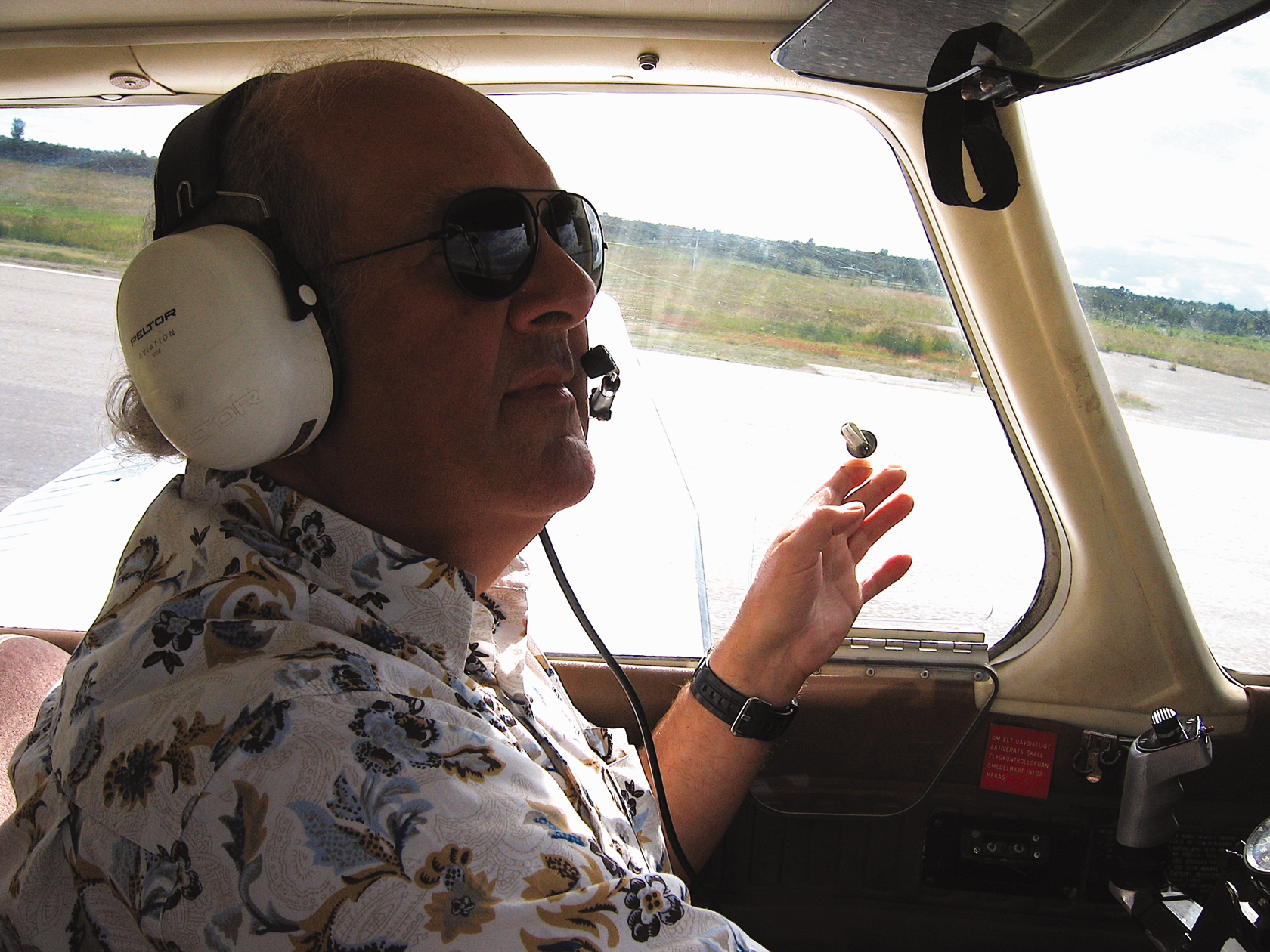
Paul taking Marena and Paul for an aerial view of Umeå.

How I remember Paul, often with a camera in hand.
Footnotes
Declaration of conflicting interests
The author(s) declared no potential conflicts of interest with respect to the research, authorship, and/or publication of this article.
Funding
The author(s) received no financial support for the research, authorship, and/or publication of this article.