




Abstract
Between 18 and 21 October 2021, the 20th International Conference on NIR spectroscopy in Beijing took place. Despite this time being held as a virtual event, it was a highly successful symposium met with high interest from the wide audience – as evidenced by many excellent presentations, around which numerous vivid discussions developed. During the conference, four workshops were offered, focused at discussing few areas essential for NIR spectroscopy and its applications. Excellent workshops were provided by Professors Heinz Siesler, Hui Yan, Dolores Pérez-Marín and Tom Fearn, in which invaluable knowledge was shared with the participants of the conference. Among these renowned experts, I had the honour to offer my contribution with the workshop aimed at the physicochemical foundations of NIR spectroscopy, an area that seldom is exhaustively presented in the textbooks. The workshop aimed at shedding light on the complex world of overtone and combination bands and was met with a considerable interest from the participants. As many questions have been asked both during the dedicated Q&A session, as well as through other channels and private correspondence, I would like to provide a short recapitulation of the workshop in the form of this brief article. Some of the most essential ‘take home messages’, such as the origin of the intensity variation of the overtone bands and the famous ‘selection rule’ of the harmonic oscillator, among others will be briefly outlined here.
The workshop suite at NIR-2021 Conference
The 20th International Conference on NIR Spectroscopy was held this year in Beijing on 18–21 October. Although this time the circumstances necessitated a virtual event, it was a very successful symposium met with great enthusiasm from the community of NIR spectroscopy. Many excellent talks stimulated vigorous discussions among the audience in the dedicated chat and beyond. Noteworthy, the workshop suite organized as the part of the symposium constituted four training courses, available for the participants in the form of videos. These workshops focused on discussing some key areas related to NIR spectroscopy, instrumentation and applications. 1
Professors Heinz Siesler and Hui Yan offered the training and practical knowledge related to miniaturized, portable NIR spectrometers with their workshop ‘Handheld Near-Infrared Spectroscopy: Quality Control and Protection against Product Counterfeiting’. Owing to the contribution from Prof. Dolores Pérez-Marín, one could get essential understanding of the NIR spectroscopy in agrifood sector (‘NIRS for the Assessment and Authentication of Agrifood Products: from Lab to On-Site Applications’). On the other hand, invaluable knowledge on the backbone tool of NIR spectroscopy was shared by Tom Fearn in his ‘Chemometrics Workshop’.
Among these excellent experts, I have had the honour of contributing with a workshop aimed at the foundational physics of NIR spectroscopy, a field that is rarely presented in most textbooks in sufficiently exhaustive manner. The workshop was designed to guide the participants through the complexity of NIR spectra and clarify on the issues critically important for a successful interpretation of overtones and combinations bands. The interest from the attendees expressed during the dedicated Q&A session and afterwards, convinced me to summarize the major premises of the workshop and share them here, in the form of an NIR news article.
Overview of the major points discussed in the workshop
Fundamental consideration essential for good understanding of NIR spectra
It is probably most important to mention that the background for some of the well-known concepts, such as the harmonic approximation of molecular oscillations, normal modes, or the intensity of the overtones, are most often not explained thoroughly in the textbooks. For instance, the famous ‘selection rule’ for infrared spectroscopy, stating that only the transitions between the adjacent vibrational levels (Δn = ±1) is ‘permitted’ in the harmonic oscillator cannot be explained without invoking the behaviour of the dipole moment function (which is, in this case, approximated by a linear function). In a similar manner, the example of a diatomic molecule, beyond which the textbooks seldom extend, is entirely unsuitable to explain the appearance of the combination bands. These features, among many others (e.g. the normal vs. internal coordinates describing vibrational motion), have been clarified in detail during the workshop.
It is, unfortunately, not possible to provide in-brief a good basis for the listed characteristics of vibrational spectroscopy. However, an interested reader should find comprehensive introductions to these essential topics in our recently published textbook chapters2,3 and review articles.4–6
Simulation and interpretation of NIR spectra
Recent progress in theoretical NIR spectroscopy largely improved our understanding of NIR spectra, e.g. it is currently possible to accurately simulate NIR absorption lineshape of various molecules and assign in full detail the measured bands to the corresponding vibrational modes.2,4,5 The example demonstrating the complex structure of overtones and combination bands, in this case in the NIR spectrum of thymol, is shown in Figure 1. Thymol is an interesting molecule, a simple terpene compound that is very popular in medicinal plants and it is responsible for the antioxidant potential of the plant and the medicinal products derived from it. 7 It is, therefore, a molecule of a quite simple structure but still very relevant to one of the typical applications of NIR spectroscopy – phytopharmaceutical analysis. 8 Despite the structural simplicity, the NIR spectrum of thymol isolated in a fairly inert solvent (carbon tetrachloride), which largely eliminates any interfering matrix effects, still presents a considerable complexity with multiple overlapping peaks.
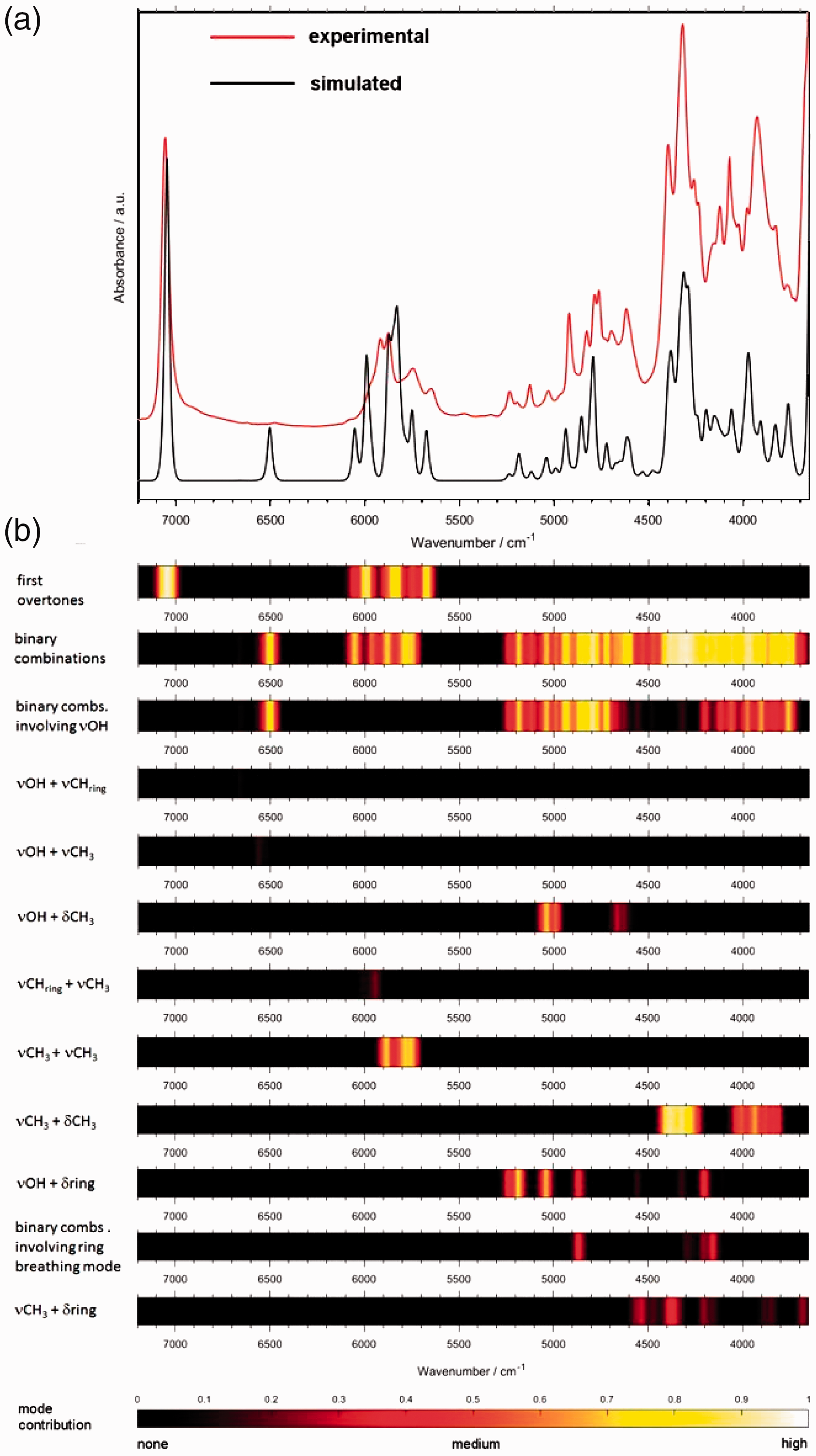
Complexity of NIR spectrum depicted on the example of thymol molecule. Reproduced from Beć et al. 7 with permission by Elsevier, 2018.
The opportunity to accurately reconstruct NIR lineshape brings a new perspective on NIR spectroscopy, which was thoroughly discussed during this workshop. 4 The workshop aimed to debunk several myths as well. For example, it is often said that NIR spectroscopy is the spectroscopy of overtones, but in fact, it is the spectroscopy of combination bands – and the example of thymol recapitulated here should illustrate it very well. That example also demonstrated how much different the concept of ‘band assignments’ in NIR spectroscopy should be approached, in contrast to the fairly straightforward one routinely used in mid-IR or Raman spectroscopy. In contrast to pinpointing the peaks visible in IR spectrum, we observe ‘diffused’ contributions that reflect the convoluted (i.e. overlapping) nature of the absorption regions in NIR spectra, exactly as demonstrated in the case of thymol (Figure 1).
The molecules with more complex structure, e.g. nucleic acid bases (i.e. nucleobases: adenine, guanine, cytosine, thymine), 9 short-, medium- and long-chain fatty acids,10–13 or polymers, 14 reveal understandably more convoluted NIR spectra. These cases were discussed in detail in the workshop, while here I provide the example of the NIR spectrum of PVC polymer for illustrative purposes – in Figure 2. As one should notice, the numerous individual simulated bands are ‘hidden’ beneath the observable NIR lineshape (Figure 2). The following part of the workshop aimed to demonstrate how and when the structural fingerprint appears and can be identified in NIR spectra, with examples of e.g. six-membered aromatic ring giving rise to a clearly identifiable absorption feature clearly visible, for instance, in the spectra of polymers. 14
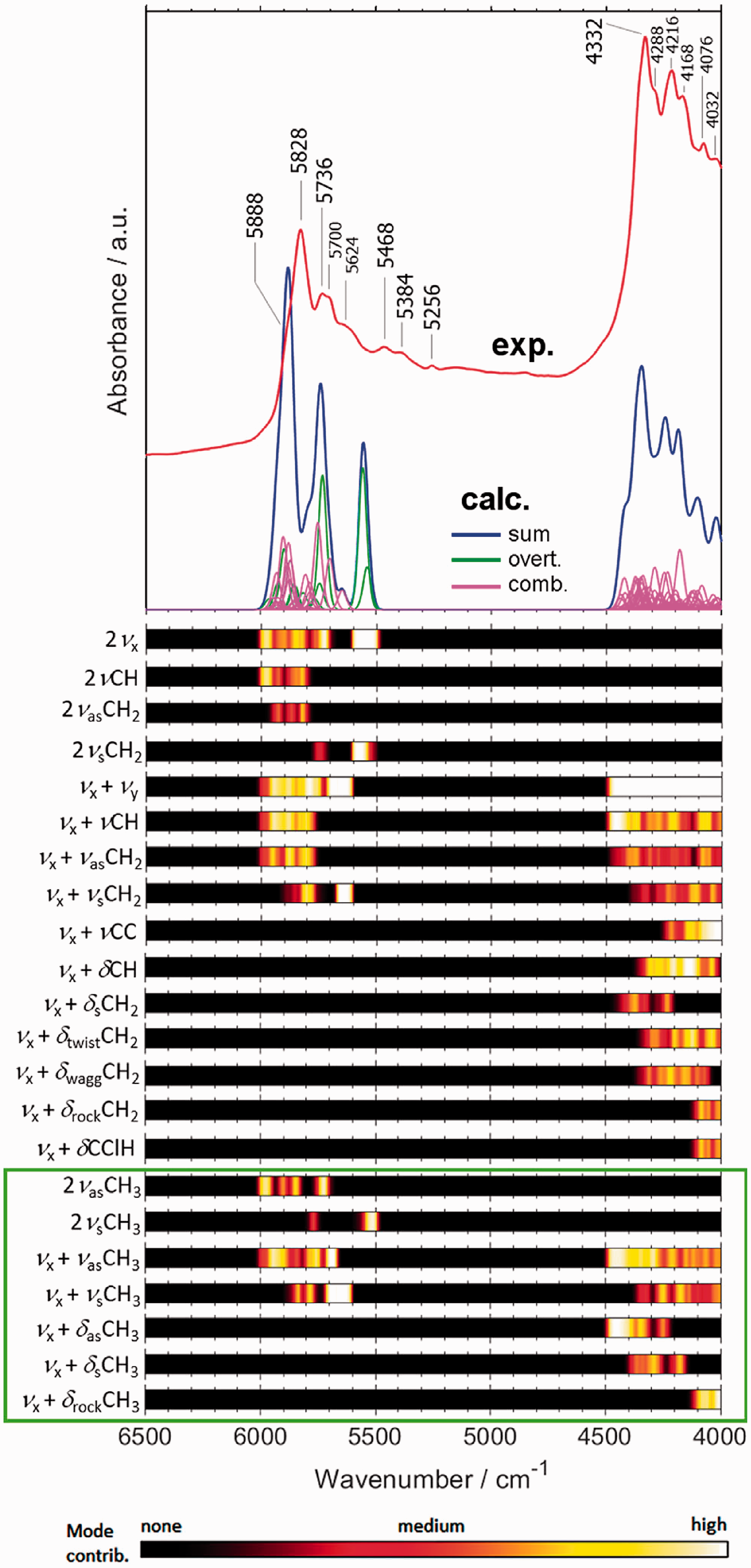
Experimental and simulated (B3LYP/6-311+G(df,pd)) NIR spectrum of PVC. Reproduced from Beć et al. 14 with permission (CC-BY 4.0 license).
Bridging the fundamental investigation with analytical applications of NIR spectroscopy
Finally, the majority of the third video workshop was devoted to demonstrating how the ability to accurately predict NIR spectra can be used for the benefit of the analytical applications of NIR spectroscopy. The most basic examples, obviously, showed that a detailed interpretation of the spectra of analysed constituents becomes available. The benefit of performing a more conscious analysis, with the understanding of the ‘signal’ that is sought for in the analysed spectra should not be underestimated. 15 However, even more direct applications become viable with this knowledge. The interpretation of the meaningful variables determined in the calibration models should be mentioned first.16–19 What follows, is the ability to elucidate the contribution of the chemical information to the performance profile of different spectrometers and the instrumental difference in general. This becomes particularly essential for miniaturized sensors, given their often very limited (i.e. narrow) operational spectral region. 20 This information cannot be easily deducted from the typically emphasized purely technical parameters of a given instrument.21,22 This, in turn, offers the ability to perform ‘smart design’ of the analysis by selecting the most suitable sensor without prior necessity to perform any standard measurements. Finally, a light is shed on the differences in analytical performance of competing vibrational techniques, e.g. mid-IR vs NIR spectroscopy, in performing exactly same analysis. Here, the example may be served by the case of melamine content in milk powder quantification. 23 The analysis of the meaningful variables showed that entirely different vibrational modes of melamine matter for the regression models describing melamine content for mid-IR and NIR spectra. 23 Such knowledge gives an even broader perspective on the applicability of different techniques to a certain analytical scenario and opens pathway for a smart design of future analyses.
Summary
Remarkable advancements in the applications of the tools of computational chemistry to NIR spectroscopy made it a particularly promising tool in recent few years.4,5 These gains offer a formidable assistance when searching for solutions to diverse real-world problems as well as provide fundamental knowledge on a variety of applications of NIR spectroscopy.
The workshop ‘A Simple Guide to Complex World of Overtone and Combination Bands. Theoretical Simulation and Interpretation of NIR spectra’ was prepared with aim to demonstrate the immense potential stemming from those advancements. It comprised a total of nearly 4 h of video material divided into three sessions. It focused on clarifying the background theory and chemical physics lying at the foundations of NIR spectroscopy, which are often not presented in an exhaustive manner in popular textbooks. Combined with a set of examples of how the simulated NIR spectra can substantially aid the analytical applications of NIR spectroscopy, the workshop was designed to offer a complete overview of the current state of the art in this area. The workshop has been met with a considerable interest and it is my sincere hope that – in the end – it will reach its intended ultimate goal of making it easier for the NIRS community members to enter this fascinating field.
Footnotes
Declaration of conflicting interests
The author(s) declared no potential conflicts of interest with respect to the research, authorship, and/or publication of this article.
Funding
The author(s) received no financial support for the research, authorship, and/or publication of this article.