




Abstract
During NIR 2019 conference, Gold Coast, Australia, a presentation upon a critical review of instrumentation and applications of handheld spectrometers was delivered during the plenary session held on Thursday morning, 19 September. Following the conference presentation, a vivid discussion flared up among the audience that equally involved academic scholars, industry representatives, as well as professionals who carry out every day in-the-field applications. Various aspects were raised connected with the emerged new generation of near-infrared instrumentation, with many individuals expressing their point-of-view on the merits and pitfalls of the miniaturized spectrometers. This vigorous dispute and exchange of impressions indicated that the community remains concerned about the applicability of such devices. That concern reflects the still relatively shallowly explored miniaturization versus performance factor, which can only be dismissed by focused feasibility studies with comparative analyses carried out on scientific-grade benchtop spectrometers. It is the aim of the present manuscript to summarize the discussed scientific content and to share the developed point-of-view with addition of our remarks.
Keywords
Introduction
It is commonly accepted to divide the fieldable spectrometers (i.e. deployable in-the-field, in contrast to benchtop instrumentation, that is only applicable in a laboratory setting) into transportable (e.g. deployable on field while mounted in a car), portable in ‘suitcase’ format (>4 kg of total equipment weight) and handheld (<1 kg) ones. 1 These criteria suit the broadly understood spectroscopy and spectrometry, including e.g. elemental (atomic) techniques such as X-ray fluorescence or laser-induced breakdown spectroscopy, and even mass spectrometry (MS) or nuclear magnetic resonance. When considering purely this sole factor, NIR spectroscopy enjoys a fair advantage over several other techniques in its compact technology. The most recent years have brought ultra-miniaturized NIR spectrometers to reality; such devices are either USB powered or have own built-in battery, weigh less than 50 g and can be operated by an application installed on a smartphone. The progress in miniaturization is accompanied by software development aimed at ease of use and suitability for operation by a non-expert consumer community. Qualitative differences in the level of sensor miniaturization achieved over the past few decades in different fields of spectroscopy and spectrometry are demonstrated in Figure 1.
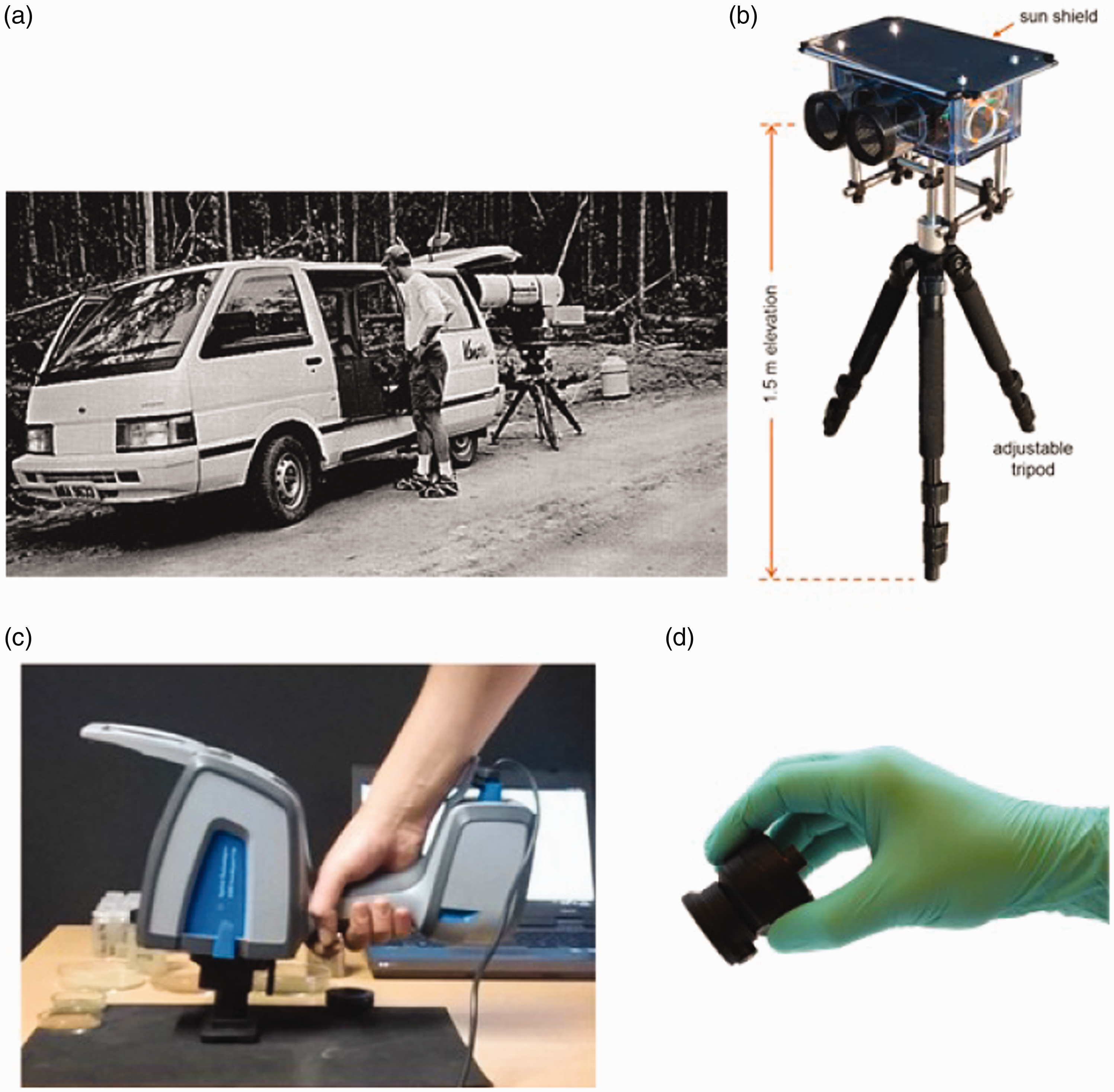
Various level of transportability of spectrometers. (a) Car-transportable GC–MS and long-path reflective FT-IR instrumentation, (b) portable tunable diode-laser absorption spectroscopy (TDLAS) sensor mounted on a height-adjustable tripod, (c) Agilent 4300 Handheld FT-IR spectrometer and (d) miniaturized USB-powered NIR spectrometer Viavi MicroNIR Pro ES 1700. Source: Panel (a) reproduced from Eckenrode 2 with permission under Elsevier Open Access license. Panel (b) reproduced from Zhang et al. 3 under CC-BY 4.0 license. Panel (c) reproduced from Hutengs et al. 4 under CC-BY 4.0 license.
While some other physicochemical methods of analysis reached similarly impressive levels of miniaturization (e.g. fluorescence), NIR spectroscopy still offers superior chemical specificity and applicability to a broad range of sample types.
Searching for ‘portable near-infrared spectroscopy’ in ISI Web of Science database (https://apps.webofknowledge.com) results in 239 publications since 2005 with increasing tendency (Figure 2(a)). The total number of citations since 2005 is 2512 and from the graph depicted in Figure 2(b) the highly increasing number on a yearly basis can be deduced. From this statistics, it is obvious that portable NIR spectroscopy is an efficient and popular analytical chemistry technique. Current technological progress enables new advance in miniaturization and there is no doubt that handheld NIR spectrometers belong to the next generation of analytical instrumentation. More and more they are suitable to become a technology of choice not only in industry but also in everyday life applications.
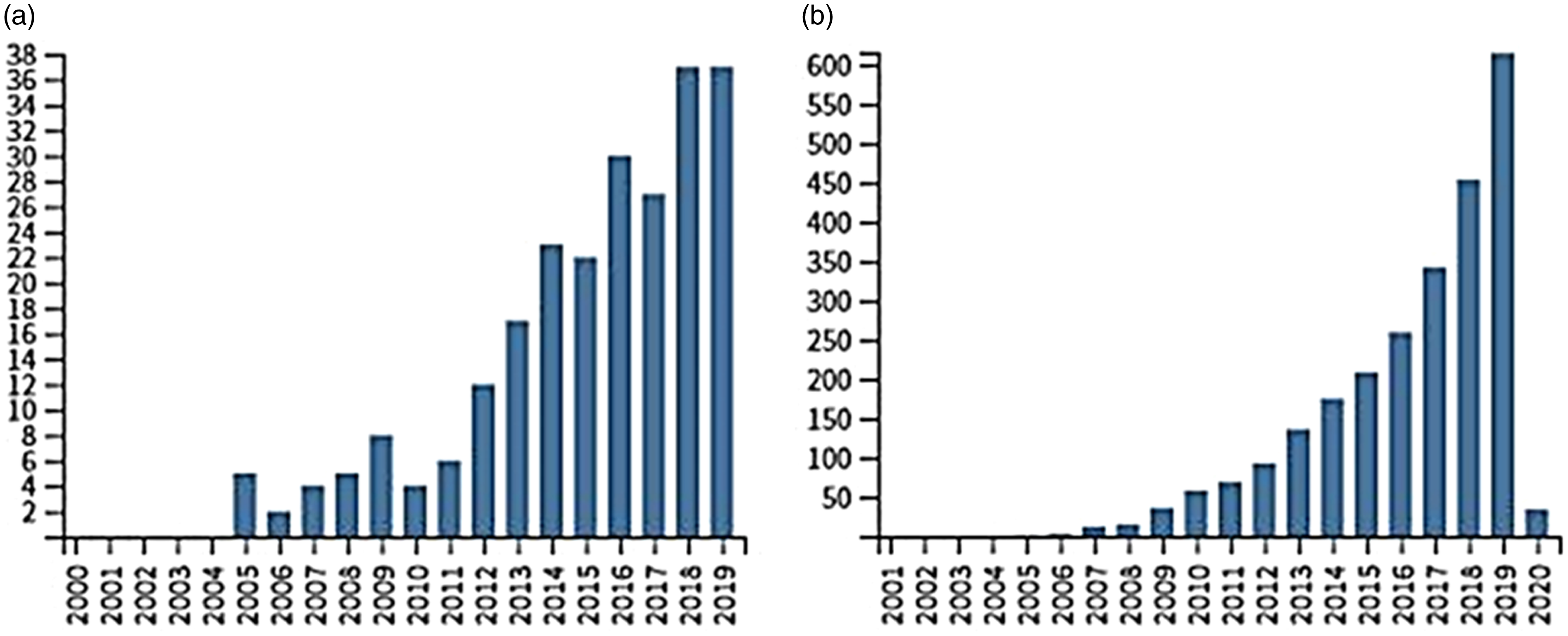
Number of (a) publications and (b) citations of ‘portable near-infrared spectroscopy’ since 2005 according to Web of Knowledge database.
There are several fields of application, which strongly depend on maturing miniaturized spectroscopy as a robust analytical tool – one of such fields is the agro-food sector. European Commission stresses the prime importance of food analysis for the public safety. 5 In 2015, the European Union opened a challenge on ‘health, demographic chance and wellbeing’ to reward solutions, intended for the general public, that allow to analyse and secure food quality including allergen recognition. Thus, in 2017 at the CeBIT Exhibition in Hannover, Germany, three companies were awarded and shared 1 million €: 800,000 € for the winner, Spectral Engines (Spectral Engines Oy, Helsinki, Finland), and 100,000 €, each, for the two runners-up, SCiO (Consumer Physics, Tel Aviv, Israel) and Tellspec (Tellspec Inc., Toronto, Canada). These three instruments have in common that they are (i) cheap, (ii) portable, (iii) handheld, (iv) applicable to fulfil the requested aim and (v) rely on internet-of-things and cloud computing to enable communication and to facilitate their use. At this point, it must be noted that these companies are not the only ones at the market, which will be discussed later.
It is a natural course to promote new technologies capable of improving everyone’s life. Miniaturized NIRS is one of the first methods of analytical chemistry that reached out to the level of ordinary consumers. There is of course a great and unique potential in such a trend. However, it becomes apparent that some attempts to take shortcuts appeared. The community gathered at the International NIR 2019 conference has become well aware of the hazard resulting from rapidly increasing use of NIR sensors in general public, which we will outline at the end of this article. However, first it is necessary to summarize the essentials of portable NIR spectroscopy, the instrumental basis and the applicability of the latest generation of handheld NIR spectrometers. Only on such background, the major point of the community’s concern can be expressed comprehensively.
The principles of the technology leading to miniaturized NIR spectroscopy
Best strategy for discussing the design of handheld NIR spectrometers is to divide up the optical spectrum by detector technology. 1
Detectors
In the silicon detector region, we have low cost 1D and 2D array sensors, and therefore multichannel techniques are dominating. Complementary metal–oxide–semiconductor (CMOS) technology has been gaining steadily on charge-coupled device, mainly driven by developments in smartphones and cameras, with CMOS requiring lower power consumption. 1 At wavelengths longer than approximately 1050 nm, indium–gallium–arsenide (InGaAs) detectors dominate and have substituted both Germanium (Ge) and lead salt detectors (lead sulphide (PbS) and lead selenide (PbSe)), with lead salt single point detectors being still available on the market. For miniaturized NIR spectrometers, cost and power consumption are major drivers. Therefore, single element detectors are preferred showing the disadvantage of being noisier than standard InGaAs (1700 nm cut-off) and require cooling.
Wavelength selectors
Micro-electro-mechanical systems (MEMSs; if combined with micro-optics then referred to as micro-opto-electro-mechanical systems, i.e. optical MEMS or MOEMS) enable constructing micro-scaled complex mechanical devices directly in-silicon using various techniques established in semiconductor industry for chip manufacturing. MEMS-based spectrometers have been proposed almost 20 years ago, including Fourier transform (FT) spectrometers. In the case of the latter, the key component is a resonantly driven micro-mirror, suspended on two long springs, and driven by interlocking comb-structured electrodes. About a decade ago, it was expected that MEMS spectrometers would be rapidly commercialized, but this fact did not become true. 1 A key issue in this context is the size of the optics and the ability of an MEMS comb actuator to drive the moving mirror. The commercially successful handheld FT-IR spectrometer from Thermo Fisher Scientific uses a voice-coil and piston-bearing scheme, with a 1.2 cm diameter moving mirror, which is essentially a scaled-down version of conventional laboratory interferometers. Compared to mid-IR, NIR sources are brighter and detectors have a higher specific detectivity D*, so that the issue of mirror size is mitigated in NIR instruments. Between 2017 and 2020, NeoSpectra, the commercial arm of Si-Ware Systems, has launched several MEMS FT-NIR sensors/scanners that are based on the same optical principle (the first and the latest product are shown in Figure 3(e)).
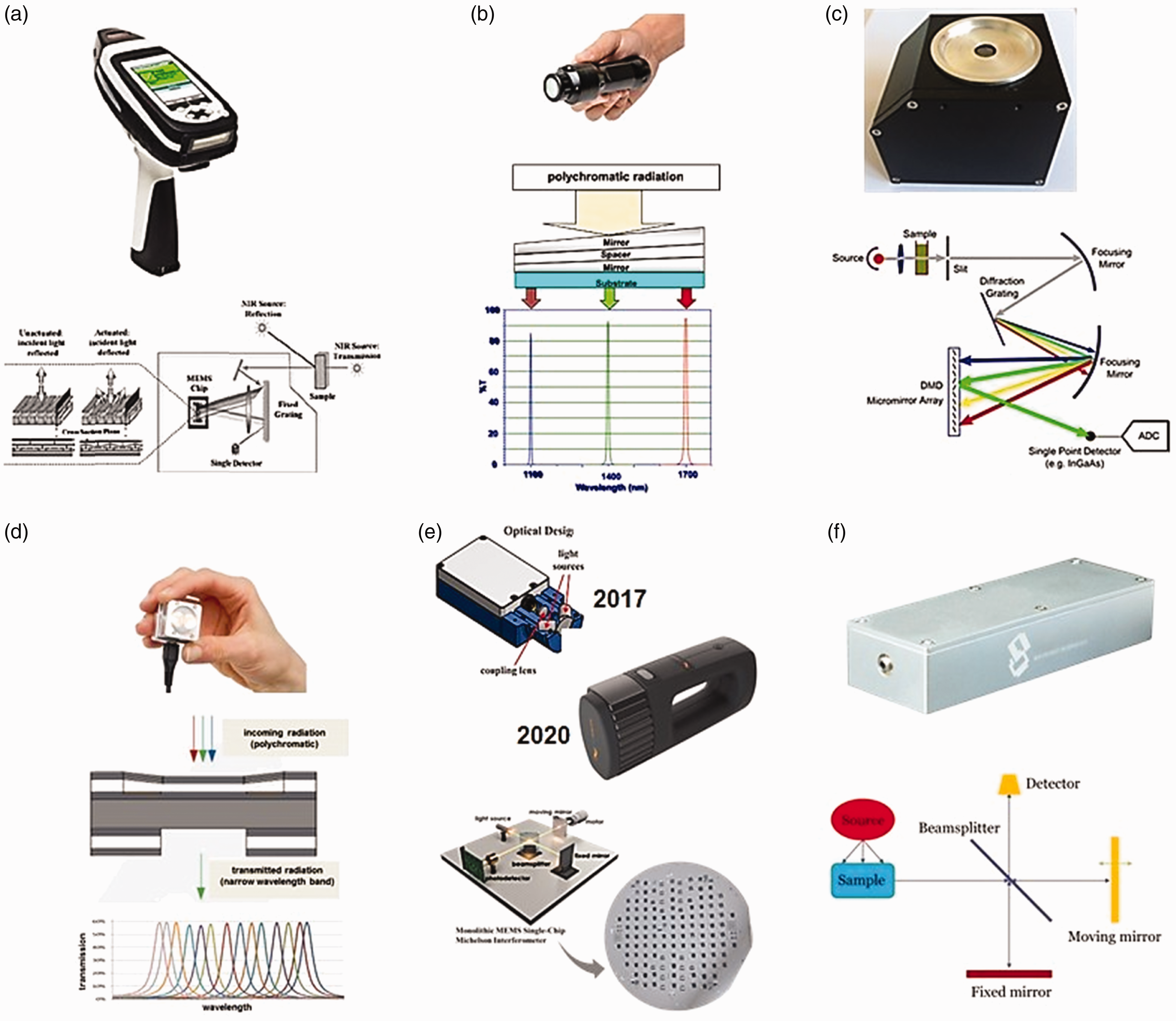
Principles of wavelengths selectors built into different handheld NIR spectrometers: (a) MEMS Hadamard mask – microPHAZIR, Thermo Fisher Scientific, Waltham, USA; (b) LVF –MicroNIR Pro ES 1700, VIAVI, Santa Rosa, USA; (c) MEMS DMD – implementation of DLP NIRscan module, Texas Instruments, Dallas, USA; (d) MEMS Fabry–Perot interferometer – NIRONE Sensor S, Spectral Engines, Helsinki, Finland; (e) MEMS Michelson interferometer – NeoSpectra, Si-Ware, Cairo, Egypt; (f) MEMS Michelson interferometer with a large mirror – nanoFTIR NIR, SouthNest Technology, Hefei, China. ADC: analog-to-digital converter; InGaAs: indium–gallium–arsenide; MEMS: micro-electro-mechanical system.
A Hadamard spectrometer is a multiplex device that observes more than one wavelength at a time using one or two masks instead of slits. This spectrometer offers both a Jacquinot and a multiplex advantage. In a single mask design spectrometer, light passes from the source through a sample and onto the entrance slit of a spectrograph; it is dispersed by a grating. Then, the encoding mask selects 50% of the resolution elements and passes that light onto a single element detector. A typical mask is an array of zeros and ones. The position of the zeros and ones on the mask changes and the detector is read out for each of these positions. Typically, the mask uses a cyclic S-matrix sequence, in which each row is obtained by shifting the previous row one position to the left. At the end of data collection, a simple matrix transform recovers the spectrum from the collected data. A handheld NIR spectrometer, using an MEMS chip as the Hadamard encoding device, has been commercially available since 2007 (Figure 3(a)). The Hadamard mask is a programmable MEMS diffraction grating, originally developed as key element in a programmable correlation spectrometer for remote detection and is included in a spectrometer for NASA to determine water content on the surface of the moon.
Almost 20 years ago, the use of a digital light projector as a Hadamard mask was described. Texas Instruments’ DLP is probably the most common MEMS device. Texas instruments offers two NIR engines: DLP NIRscan and DLP NIRscan Nano, as evaluation modules (EVMs) (Figure 3(c)). To achieve a micro-scaled programmable Hadamard mask, the DLP devices use MEMS-based digital micromirror device (DMD), while Thermo Fischer design microPHAZIR employs MEMS piano-like diffraction grating in its implementation of the Hadamard principle. Application of Hadamard transformation enables constructing compact cost-effective spectrometers with a single-pixel photodetector operating at any wavelength. An MEMS-driven moving mask is used to encode the light intensity at its imaging slit, which is then collected by a single-pixel detector. Afterwards, the spectrum is obtained through an inverse Hadamard transform. 6
Fabry–Perot interferometers are playing a dominant role as a wavelength separation technique since about 25 years. A Fabry–Perot filter consists of two mirrors, either plane or curved, facing each other and separated by a distance d. There are two basic versions: an interferometer, where d is variable, and an etalon, where d is fixed. The condition for constructive interference with a Fabry–Perot interferometer is that the light forms a standing wave between the two mirrors, in which case the optical distance between the two mirrors must equal an integral number of half wavelengths of the incident light. A Fabry–Perot interferometer may be also implemented through MEMS-technology, e.g. as it is used in NIRONE Sensor S device. Thus, MEMS technology enables to implement as a fully programmable optical filter in the form of a micro-scale module.
Linear variable filters (LVFs) are optical bandpass filters that have been wedged in one direction; the thickness of the coating is not constant across the filters. The transmitted wavelength varies linearly across the filter. A LVF can be thought of as a scanning Fabry–Perot filter which scans the position across the filter. The typical range is one octave. Ocean Optics mid-infrared spectrometer has a nine-reflection ATR interface and covers the wavenumber range 1818–909 cm−1 at 75 cm−1 resolution, with a nominal S/N ratio of 300:1. For NIR spectroscopy, the LVF technology is of interest for the following reasons: It is low cost, very compact, rugged, satisfying spectral resolution for real applications, and low power consumption. For example, VIAVI has a line of handheld and process spectrometers based on LVF and InGaAs array (Figure 3(b)).
In the silicon detector region, a number of filter technologies compete: LVFs and mosaic, patterned, and discrete filters. Consumer Physics released a spectroscopic product called SCiO, with dimensions of 67.7 mm ×40.2 mm × 18.8 mm and weight of 35 g. It consists of a 4 × 3 photodiode array, with optical filters over the individual pixels. The device has only 12 resolution elements resulting in a rather poor spectral resolution of ca. 28 nm across its working spectral region of 740–1070 nm (13,514–9346 cm−1). The absorption properties of numerous samples in the visible/short-wave NIR should also be considered as a limiting factor here. It becomes apparent that this design accepted a number of compromises in order to achieve its compact factor and low cost.
The instrumental development continues, and almost every year new concepts and products are introduced to the market of miniaturized NIRS. Some of the engineering principles are being refined as well. As a good example serves here the concept of Michelson interferometer implemented in MEMS technology. The difficulties with maintaining stable operation of the MEMS elements and the optical throughput could have been challenged recently. This technology was introduced as the final products in NIRONE sensors from Spectral Engines and nanoFTIR NIR spectrometer from SouthNest Technology. The latter is one of the most recent miniaturized NIR sensors; it implements an MEMS Michelson interferometer with a large mirror (in relation to MEMS chip) in order to improve the light output. This device operates over the entire NIR wavelength region (12,500–3846 cm−1; 800–2600 nm), which stands in contrast to most other handheld spectrometers including the earlier MEMS-based portable NIR sensors (Table 1). According to the information provided by the vendor, in addition to a very broad working spectral region, the sensor offers higher (although still inferior to benchtops) spectral resolution of 6 nm at 1600 nm, high SNR and rapid scanning, while being far more compact (143 mm × 49 mm × 28 mm dimensions and 220 g weight) than early MEMS spectrometers. However, how these promising data-sheet entries translate into the real-world analytical performance remains to be evaluated through peer-reviewed research.
Spectral regions and spectral resolution in which the discussed handheld NIR spectrometers operate.
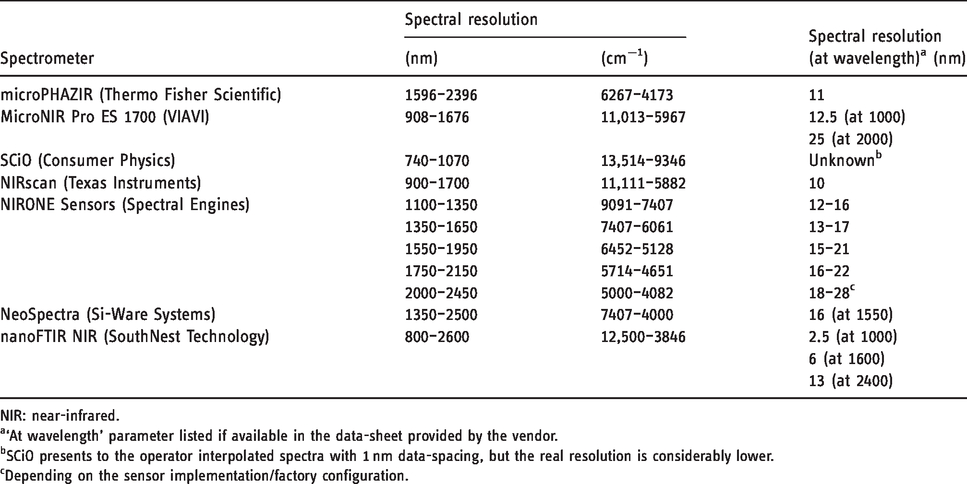
NIR: near-infrared.
a‘At wavelength’ parameter listed if available in the data-sheet provided by the vendor.
bSCiO presents to the operator interpolated spectra with 1 nm data-spacing, but the real resolution is considerably lower.
cDepending on the sensor implementation/factory configuration.
Application and in-depth evaluation of performance characteristics of portable NIR spectrometers
The contemporary benchtop spectrometers implement a long-matured technology and over the past decades those devices converged almost to a generic FT-NIR design differing mostly by subtle nuances, at least from the application point-of-view. In sharp contrast, various technology concepts have been implemented into portable NIR instrumentation in its vigorous development over the last 10 years, as briefly outlined in the ‘The principles of the technology leading to miniaturized NIR spectroscopy’ section. Through adoption of innovative approaches and overcoming engineering challenges, various handheld NIR sensors have been brought into the market. However, the progressing miniaturization unavoidably influenced the working characteristics (e.g. sensitivity and S/N, spectral region, spectral resolution) and the resulting analytical performance of such spectrometers in relation to the benchtop ones. Furthermore, the vendors often took upon completely different engineering directions when designing their portable instruments. Therefore, several research groups recognized the need for performing comprehensive research studies aimed at establishing the applicability limits of handheld NIR spectroscopy. As a good example, Hoffman et al. 7 explored the transferability of spectral sets, as well as qualitative and quantitative calibrations that have been developed thereof, between NIR spectroscopy in benchtop and portable scenario. Miniaturized spectrometers demonstrate a particular potential for the analysis of natural products outside laboratories. In 2017, for instance, Kirchler et al. 8 investigated the feasibility of using portable NIRS to determine the content of the anti-oxidative active ingredients (rosmarinic acid and closely related polyphenols) in medicinal plants. They compared the working characteristics and the final analytical performance of two handheld spectrometers exemplifying distinctly different design philosophies and levels of miniaturization. The study was based on the comparison with a reference benchtop NIR spectrometer (high-performance Büchi NIRFlex N-500) and supported by exhaustive data-analytical tools, including hetero-correlated 2D plots that highlighted the differences between the NIR spectra measured on the three spectrometers. Further exploration of the potential of miniaturized NIR sensors in quantitative assessment of the antioxidant capacity of natural-borne products was demonstrated by Wiedemair and Huck. 9 In that case, the total of three different miniaturized NIR devices was evaluated towards their performance in assessing gluten-free grains. Performance comparisons of different handheld near-infrared spectrometers have been performed in the demanding scenario of quantitative analysis of a pharmaceutical formulation as well, e.g. by Yan and Siesler. 10
However, the discussed problem is essential in various other fields of research and analysis. Yan and Siesler 11 studied the identification performance of different types of handheld NIR spectrometers for the recycling of polymer commodities, including polyethylene (PE), polypropylene, polyethylene terephthalate, polyvinyl chloride (PVC) and polystyrene. Four different handheld spectrometers based on different monochromator principles were investigated: Si-Ware systems, Spectral Engines NR 2.0 W; DLP NIRscan Nano EVM, and Viavi MicroNIR Pro ES 1700. The investigation clearly demonstrated that the spectra of the most common polymer commodities provide suitable analytical measurement parameters for the correct classification of unknown test samples. Upon performing principal component analysis (PCA), all polymer classes could be sufficiently separated, excepting PE and PVC measured by the Spectral Engines NR 2.0W spectrometer (Figure 4).
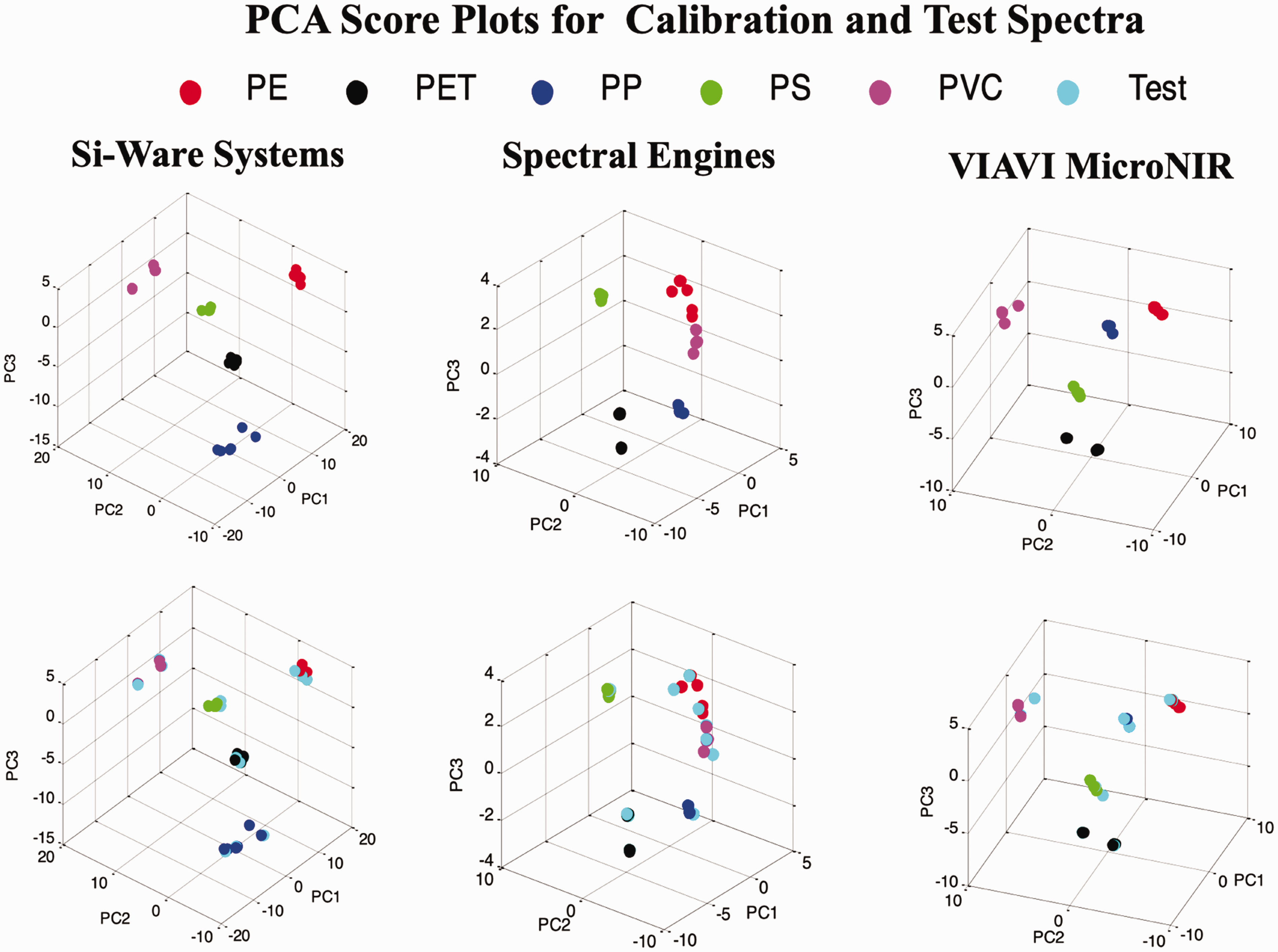
Identification performance of different types of handheld NIR spectrometers for the recycling of polymer commodities. Top row: 3D score plots of the PCA calibration. Bottom row: fit of test samples (•) into calibration plots. PE: polyethylene; PET: polyethylene terephthalate; PP: polypropylene; PS: polystyrene; PVC: polyvinyl chloride. Reproduced from Ref. 11.
Wiedemair et al.12,13 have tested the performance of SCiO in comparison with Büchi NIRFLex N-500 for the analysis of protein content in millet samples and the fat content in cheese samples. As can be deduced from Tables 2 and 3 they found that the analytical performance of portable devices may considerably vary between different scenarios. Although clearly inferior in the former analytical problem (Table 2), in the determination of fat content in cheese (Table 3), the inexpensive SCiO sensor delivered the performance, evaluated by statistical values, comparable to the high-performing benchtop instrument. Several other examples may be mentioned that clearly demonstrate the interest that portable NIRS attracts for a variety of applications, e.g. identification/authentication of textiles as a measure against counterfeit. 14 This gives prospects for future evolution of applications of miniaturized NIRS. However, the scientific and professional community understands that the performance evaluation of miniaturized spectrometers in different scenarios needs to remain a continuously explored direction, as new devices keep appearing on the market.
Performance of benchtop versus ultra-portable NIR spectrometer in millet analysis. Parameters of the established PLS-R models for protein content (7–14% w/w in this sample set).

CV: cross-validated regressions; GAE: gallic acid equivalents; NIR: near-infrared; PC: principal component; PLS-R: Partial Least Squares Regression; RMSECV: Root Mean Square Error of Cross Validation; RMSEP: Root Mean Square Error of Prediction; TV: test set-validated regressions.
Performance of benchtop versus ultra-portable NIR spectrometer in cheese analysis. Parameters of the established PLS-R models for fat content (9–36% w/w in this sample set).

CV: cross-validated regressions; GAE: gallic acid equivalents; NIR: near-infrared; PC: principal component; PLS-R: Partial Least Squares Regression; RMSECV: Root Mean Square Error of Cross Validation; RMSEP: Root Mean Square Error of Prediction; TV: test set-validated regressions.
The conclusions from the community discussion at NIR 2019 concerning portable NIRS
The continuous instrumental developments and applications observed over the last few years have launched NIR spectroscopy into a new era of on-site and in-the-field analysis. Generally, popularization of handheld instruments brings a reasonable prospect for enabling truly wide scale applications and high volume NIR spectroscopic analyses in a wide spectrum of scenarios. Seen through these lenses, a major transformation is occurring that brings this tool closer to general public in everyday use. Vendors have succeeded in considerably reducing manufacturing costs of handheld NIR spectrometers and made great efforts to make these instruments suitable for everyday life applications by a non-expert user community. However, caution should be applied with the instruments advertised by direct-to-consumer-companies.
The major gathering of the global NIR community in Gold Coast, Australia in 2019 reflected that awareness. The primary concern expressed by the experts in the field was the following: miniaturized equipment still requires comprehensive validation studies performed in well-equipped laboratories. The need for closer cooperation between the vendors and these laboratories would be beneficial for the adoption of new technology.
Opportune conditions of the contemporary market promote overly optimistic and aggressive marketing strategies, which may bring the opposite effect. At some point, the customers are likely to attempt to use NIR spectroscopy in unrealistic scenarios and fail therein. The resulting crisis of public trust in this technology may severely harm sales, and thus future development. Such scheme can, however, be avoided if a close cooperation between the vendor companies and research laboratories is maintained. This summarizes the ‘take home message’ from the NIRS community, as resulted from the discussion upon the current state and future path of miniaturized spectrometers at NIR 2019 conference (Gold Coast, Australia).
Footnotes
Declaration of conflicting interests
The author(s) declared no potential conflicts of interest with respect to the research, authorship, and/or publication of this article.
Funding
The author(s) disclosed receipt of the following financial support for the research, authorship, and/or publication of this article: This work was funded by the Austrian Science Fund (FWF): M2729-N28.