




Abstract
Contemporary analytical methods meet variety of demands originating from a magnitude of directions. This article reviews the current challenges and development trends unfolding at the frontier of analytical chemistry. A magnitude of research articles, conference meetings, and disseminations at scientific symposia take place nowadays. These figures rapidly increase on a year-to-year basis and the analytical strategies become increasingly diverse. Consequently, further advance depends on progressive improvements in the exchange of knowledge and boundary-crossing research. This fact highlights the fundamental role of multidisciplinary research laboratories in pushing the horizon in capabilities of novel methods of analysis. The advances in developing advanced analytical strategies at that accommodate a number of approaches and the resulting integrated analytical strategies are overviewed here.
Introduction
Recent two decades have witnessed an unparalleled increase in importance of modern analytical methods in scientific research and industrial applications.1 A number of factors contributed to this occurrence. The world has seen a rapid growth in the global trade volume and the production rate of merchandise of all kinds. The diversification of markets, multifariousness of suppliers, and elongation of the supply chains has increased the risk of compromising the quality of the intermediate and final products. Food industry may serve as a good example here, as one could witness a number of major food safety incidents resulting from intentional and accidental quality compromises. Under these circumstances, the need for efficient, capable and widely applicable analytical tools has been further promoted.
The response to this demand has been a rapidly increasing research activity throughout various fields connected to analytical chemistry. This may be well evidenced by analysing the number of research articles oriented at chemical analysis, quality control, method development and applications. According to Web of Science, over the last two decades the per annum amount of scientific disseminations concerned with analytical approaches and quality control has doubled. Such rapid expansion unequivocally leads to a progressing division of the scientific communities, and hence, the essential role of knowledge exchange is promoted. The stimulus for further evolution of analytical methods originates equally from the research institution and the industry. This fact further supplements the encapsulation of already designed approaches, and hinders development of new ones. Therefore, an increasing role of community gatherings should be highlighted, in particular scientific conferences where the researchers from academia come together with the professionals from industry. These activities are essential in providing the measures for successful dissemination of the most recent accomplishments, the exchange of knowledge, and the access to feedback channels reaching directly to the applications.
In a similar manner, these circumstances intensify the importance of the major academic laboratories that combine numerous approaches and develop integrated analytical strategies fitting the needs of scientific, institutional, and industrial applications. These development centres have the capabilities, human resources and cooperation networks to achieve a broader perspective and essential insights necessary for bringing the final solutions in analytical chemistry.
This short review article aims for presenting a general perspective on the accelerating growth of analytical methods and their applications. Unlike other reviews, the present one aims to unveil the driving forces that are directing the development of the contemporary analytical approaches that incorporate spectroscopic methods.
NIR spectroscopy – The workhorse in service of analytical laboratories
The importance of analytical vibrational spectroscopy in present science and industry may not be stressed enough. Straightforward and universal applicability to wide range of samples, on-site capability, sensitivity and specificity, combined with low cost and low time-to-result ratio, make it a tool of choice in a magnitude of applications.
While near-infrared (NIR) spectroscopy excels in the above advantages, its practical value often makes it superior to its relatives – infrared (IR) and Raman spectroscopy.
2
The design principles of the instrumentation (optics, spectrometers, cells, sample handling) guarantee a wide area of expansion. High sample volume, fiber probe compatibility, and unmatched potential for the miniaturization of the instrumentation contribute here as well. Thus, NIR spectroscopy becomes the most widely adopted and reaches consumer level nowadays. This is well-evidenced by the appearance of extremely inexpensive ultra-portable spectrometers and even smartphone attachable units (Figure 1).
3
The contemporary development direction of NIR spectroscopy.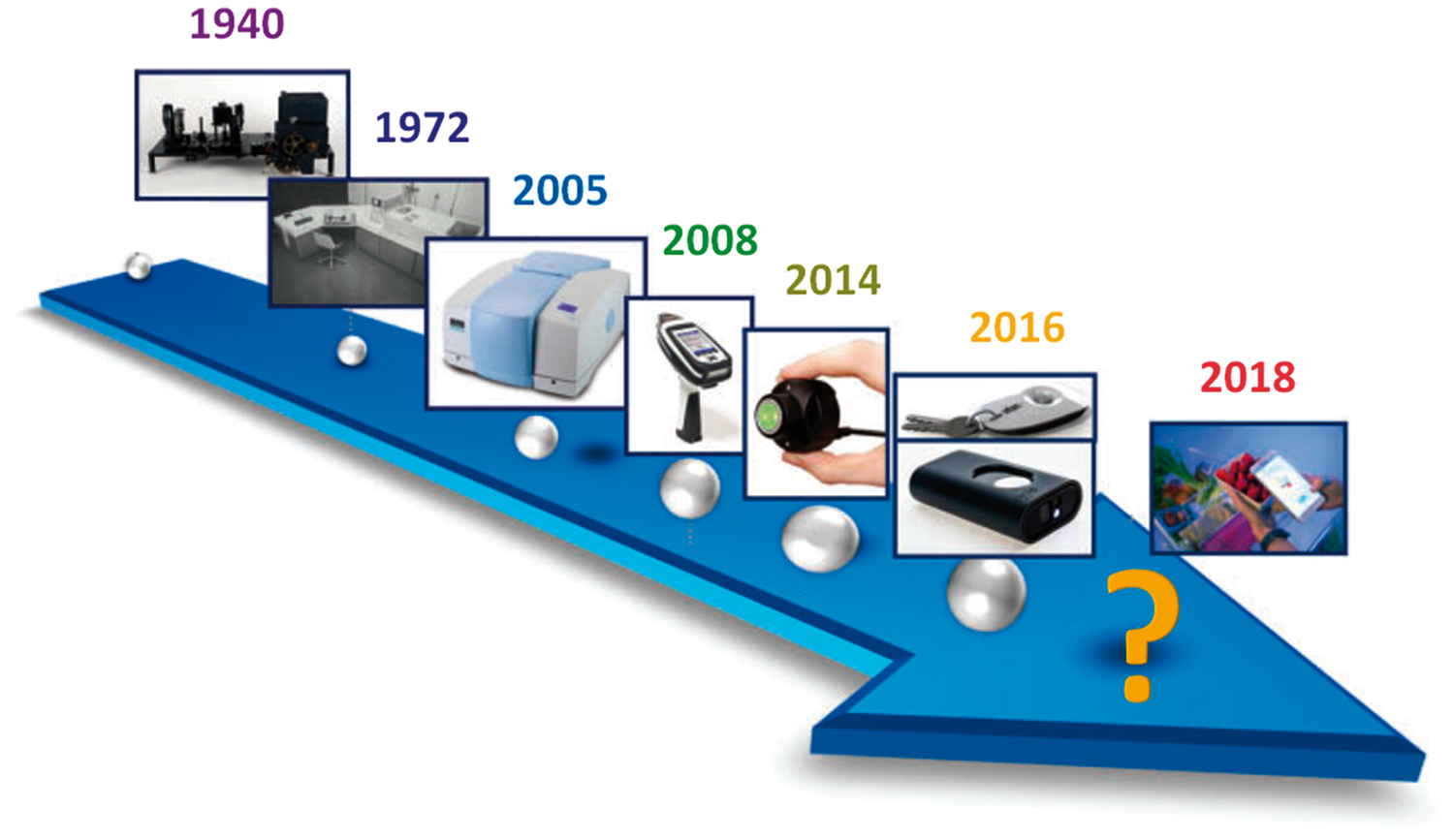
The motivation for the wide adoption of NIR spectroscopy originates from a number of major fields. At this point, one should notice that it is virtually impossible to give a complete overview of this topic, and it is only viable to highlight the most essential points while also pointing the reader to the more focused review articles and book chapters that appear in current literature. Recent years have repeatedly brought numerous food safety incidents, causing severe concerns among the highest authorities and increasing the feel of powerlessness among consumers (e.g. fipronil egg contamination in 2017, Punjab sweet poisoning in 2016, horse meat scandal in 2013, or milk adulteration with melamine in 2008). With accelerating increase in the world trade, emerging new markets and thriving internationality of food supplies, the safety concerns become one of the most commonplace and urging contexts to which analytical methods are expected to be able to respond to. Multi-staged food supply chain, and the particular vulnerability of comestible intermediate and final products, make the miniaturized NIR spectroscopy particularly potent quality control tool therein.4,5 A properly conducted design-of-experiment based on miniaturized NIR sensors delivers a potent instrument in countering food fraud. 6 This is further evidenced by the similar development trends among the other kinds of vibrational spectroscopy. 7 Comprehensive reviews of this topic have been published by Crocombe 8 and by Yan and Siesler. 9 Comparable advantages in applying NIR spectroscopy in agricultural sector may be achieved, e.g. for maintaining a proper control of the growing conditions or optimization of the crop harvest time. 10 This field has been overviewed in detail by Cozzolino. 11
A similar specificity may be assigned to the area of natural products: a relative non-uniformness of the raw materials and processed commodities, e.g. medicinal plants, the extracted/enriched materials, and final natural drug product. A critical examination of the potential and limitations of vibrational spectroscopic methods in applications to medicinal plant research have been provided recently, e.g. by Türker-Kaya and Huck 12 and by Huck. 13
NIR spectroscopy finds an extensive use in bioanalytical applications as well. Qualitative analysis is being enhanced by the potential of imaging/mapping techniques. 14 Medical diagnosis may be considered a separate field, sharing the benefits of the principal advantages of the underlying spectroscopic approaches. The cancer diagnosis should be highlighted here, 15 but also NIR spectroscopy has been long applied in blood analysis, e.g. being able to quickly and non-invasively quantify the glucose content in blood. Basic NIR research is an essential support, service as the backbone for specialized applications. 16 Functional NIR spectroscopy also appears as an extensively developed field. This context has been overviewed, e.g. by Mihara and Miyai. 17
Huck et al. demonstrated the feasibility of NIR spectroscopy in edge nanotechnology, state-of-the-art material analysis. 18 Physicochemical properties of nanomaterials (particle size, specific surface area, pore diameter, pore porosity, pore volume and total porosity at the nano-scale level) can be elucidated with high specificity and differentiation between silica materials can be achieved. Spectroscopic approach proved superior to the well-established reference (Brunnauer Emmett Teller method, BET; size-exclusion chromatography).
The synergy of NIR spectroscopy with other methods in accomplishing state-of-the-art analytical approaches
However, this seemingly dazzling triumph may not cover the limitations, which are faced in other essential applications. Miniaturized NIR spectrometers resort to different working principles, which impose specific constraints compared to benchtop devices (e.g. literature5–10,13,19). This has a negative impact on the corresponding spectral range, resolution, signal-to-noise ratio, respectively. Consequently, their analytical performance still are being extensively evaluated and disputed.19,20 The calibration models require additional efforts to be transferrable between different spectrometers and be accountable to varying experimental conditions. So far, no standardized approach to this problem exists. NIR spectra are immensely complex and their direct physicochemical interpretation is usually unavailable. 21 The potential for quantitative analysis is retained through the advanced method of data analysis (chemometrics) that correlates the spectra with sample content and properties. However, the qualitative capability and the structural specificity of the method, values that are esteemed e.g., in bioanalytical applications or material design and characterization, are compromised. In certain applications, the need for a golden standard reference method is unavoidable and this introduces a steep penalty in the general affordability of the approach.
These circumstances still form a hindrance for NIR spectroscopy to spread over a number of potential application fields. Further development of the spectroscopic instrumentation and methodologies is needed. What is equally important, NIR spectroscopy – and in wider context, vibrational spectroscopy – still requires to be used in hyphenation with other tools of analytical chemistry. 22 The powerful methods such as chromatography (gas, liquid, also coupled to the ultra-sensitive detectors), mass spectrometry and their combined usage provide the reference analyses without which spectroscopic methods would not be successful. However, the mentioned methods often remain prohibitively expensive and unfeasible for many of potential uses. This highlights the need to design and implement integrated analytical strategies, in which the particular benefits of each of the components can be used. These methods require a considerable effort aimed at their optimization.
The need for comprehensive research and development
To successfully develop and implement such novel integrated analytical strategies, research units with a multi-disciplinary oriented research activity are necessary. The need for diverse analytical instrumentation and know-how reaching chromatography and mass-spectrometry (HPLC, LC, micro-LC and LC-ESI-MS/MS, MALDI-TOF/MS, ESI, TQMS, GC), spectroscopy (IR, NIR, Raman), including access to high-performance benchtop and also novel miniaturized devices, and other potent techniques (e.g. capillary electrophoresis, CE; solid-phase extraction, SPE), are essential. Experienced scientific good knowledge of the analytical routines, but also having good understanding of the underlying phenomena, physical chemistry and method development are highly beneficial. Internal exchange of knowledge is further enhanced by dense external scientific collaborative research networks, which allow acquiring and selecting the best of new ideas that appear in the field and adapting them quickly. The key element of this set-up is the direct connection to the industry granting the value feedback from routine applications and helping in establishment of the most needed development directions.
A good example of a capable research unit is the Institute of Analytical Chemistry and Radiochemistry at Leopold-Franzens University of Innsbruck, Austria. It is leading laboratory in the field of analytical chemistry with strong focus on separation science and molecular spectroscopy. The applications that remain in the centre of its attention range from food analysis and quality control,4–7,11,20 through natural medicines and plant specimen,10,12,13,19,23 nanomaterials and material science in general, 18 development of the stationary phases for chromatographic use,22,24 through bioanalytical science, 14 biomedical research, 15 leading to the development of integrated analytical strategies. Strong emphasis is being put there on the method development and optimization.23,25 What is rather unique, this unit puts a fair share of its attention into physicochemical and theoretical support of its analytical activity.26,27 This is an essential aid securing a broader and deeper perspective, and providing an unmatched balance in the available scientific resource. It features a wide and highly productive professional network in both academic and industrial sector with focus on analytical chemistry. The international network of collaboration, among others include Prof Y Ozaki (Kwansei Gakuin University, Japan), Prof H Siesler (Universität Duisburg Essen, Germany), Prof C Lau and Prof PC Leung (University of Hongkong, China), Prof R Ohmacht (University Pecs, Hungary), Dr D Corradini (CNR, Italy), Prof R Tsenkova (Kobe University, Japan), Prof O Piot (University of Reims, France), Prof Y Bin (China Academy of Medical Sciences, China) as well as industrial cooperators (Bionorica SE and Sandoz). Therefore, highly effective mutual transfer of ideas, experiences, and knowledge is being accomplished through the cooperative networks. This also ensures that the research and development accomplishments are noticed in the scientific and professional environment.
Community events – The exchange of ideas, knowledge and the source of scientific inspiration
The next key element for maximizing the progress of analytical chemistry is the community gatherings. As explained in the introduction, the rapid expansion of analytical methods, and in particular vibrational spectroscopy, diversified the field considerably. However, this also divided the research directions and created hindrances in the exchange of knowledge and introduced difficulties in the communication between the different target audiences. The primary means of counterbalancing this negative effect are conferences and symposia that gather scientific/academic researchers, non-academic professionals, and business representatives. A number of international conferences are being organized, e.g. Analytical Chemistry, EuroAnalysis, ICNIRS. However, these international events are being held only every few years. In the United States, more frequent and focused symposia are organized, e.g. International Diffuse Reflectance Conference (IDRC). One could anticipate from this overview that an introduction of an annual European conference with broad aims and no predefined limitations in its scientific scope, as long as it serves the progression of analytical chemistry, could potentially attract a considerable attention among the scientific and industrial community.
Summary
The challenges faced by contemporary analytical chemistry and future development of the corresponding strategies will increasingly depend on multi-disciplinary research and transfer of knowledge. Scientific events and community gatherings may be expected to become particularly significant in establishing the most fitting directions along which the research efforts should bring the most sizable gains. Boundary-crossing method development, integrating different methods, combining their advantages and optimizing their performance will become increasingly important. Multi-disciplinary oriented research institutions, sharing resources and receiving feedback through with well-organized cooperative networks are anticipated to be the key element of the future progress.
Footnotes
Declaration of conflicting interests
The author(s) declared no potential conflicts of interest with respect to the research, authorship, and/or publication of this article.
Funding
The author(s) received no financial support for the research, authorship, and/or publication of this article.