



Abstract
Styrene is widely used in industrial applications. Inhalation exposure occurs in the industry. Some studies indicated that serum prolactin concentrations increased after exposure to styrene, while other studies found no change. In this systematic review, the search was done with the keywords styrene and prolactin in the PubMed, Science Direct, Web of Science and Scopus databases, regardless of the publication period. 118 studies were obtained and only seven articles were finally selected according to exclusion and inclusion criteria. The effect of styrene on prolactin secretion was selected in both human and animal studies. The increased response was seen in inhalation exposures. Subcutaneous exposure has no significant effect on prolactin levels. The observed responses were both dose-dependent and gender-dependent. Changes in serum prolactin were more frequent in women compared to exposed men. Dopamine depletion was not observed in all studies, so more tests on laboratory animals are necessary to clarify the possible mechanism.

Introduction
Styrene is a solvent used in various industries around the world. 1 It is used in the manufacture of polystyrene packaging, resin, building material, toys, fiberglass, rubber and plastic .2-7 One of the most widely used food packages is produced from polystyrene.8–10 Polystyrene is made up of styrene. Workers involved in the construction of fiberglass boats are exposed to styrene cumulatively. 11 Furthermore, workers in rubber factories have also high exposure to styrene monomer. 12 Styrene monomer is one of the main components of rubber. 12 High amounts of styrene are found in the air of plastics industry. 13 Styrene has been detected in cigarette smoke. 14 There is even styrene in hand sanitizers. 15 It is also naturally found in several spices, including cinnamon. 16 Humans are exposed to styrene through the oral cavity, lung and skin. 10 Styrene has evaporative properties with a sweet odor. Styrene has a high respiratory absorption. 6 This compound is carcinogenic. Respiratory exposure to styrene raises the risk of respiratory cancer.16,17 Lung cancer in women with 160 ppm exposure was significantly higher than in the control group. 16 Styrene is a neurotoxic compound that leads to decrease in memory, attention, irritability, and hearing impairment.18–22
There is evidence that styrene interferes with tuberoinfundibular dopaminergic system. Prolactin secretion is controlled by dopaminergic tuberoinfundibular neurons. 23 Some reports suggested that styrene increases prolactin secretion. 24 Styrene reduces dopamine secretion and subsequent increases prolactin secretion. Dopamine has inhibitory effects on prolactin.16,24 Prolactin is a hormone secreted by the pituitary gland that controls milk.25–28 This hormone was identified in the 1970s. 29 Prolactin has effects on the body issues like breast, brain, liver, bone, body weight, pancreas, skin and hair follicles, and effect on the adrenal response to stress, the control of lactotroph cell homeostasis and maternal behavior.26,30–36 Prolactin plays a major role in lactation and fertility.37–39 Young women who are exposed to styrene may have fertility concerns. High prolactin causes menstrual irregularities, decreased libido, infertility and galactorrhea in women. 40 It also plays a role in men’s physiology. Prolactin has synergistic effects with testosterone in male. 41 Prolactin promotes both breast and possibly prostate cancers.42–45 Workers are usually exposed to 25 ppm for 8 h a day. 46 Some documents consider a threshold limit value of 20 ppm and some 50 ppm in the workplace. 25 According to previous research in Sweden, observed exposure to concentrations of 10–25 ppm causes neurotoxicity. 47 Contrarily, in some occupational exposure to styrene neurotoxic symptoms were not seen at doses below 100 ppm. 25 Also, in animal studies, a study found that exposure to polystyrene particles did not significantly alter prolactin levels in zebrafish. 48 Another study has shown that subacute exposure in rabbits leads to dopamine depletion. 49 Therefore, controversial results were reported in these studies. The purpose of this systematic review was to investigate the association between exposure to styrene and prolactin secretion.
Method
This systematic review was written on PRISMA checklist. Two authors (P.S and G.M) performed all stages including inclusion and exclusion criteria, and data extraction to prevent bias.
Search strategy
The articles in the English language were searched on 4 August 2021. The chosen databases were PubMed, Science Direct, Scopus, and Web of science. The keywords for searching were set: (Styrene OR Polystyrene) AND (prolactin).
Inclusion and exclusion criteria
The two reviewers (P.S and A.A) searched the keywords in databases independently. Inclusion criteria included articles that served the effect of styrene in both animal and human studies on prolactin secretion. Review articles and abstracts of congressional articles were excluded.
Data extraction
First author, year of publication, place of research, type of study (animal or human), gender, species, received dose, days of receiving dose, amount of prolactin was extracted from the articles and displayed in the table.
Results
The search processes
17
One hundred eighteen articles were searched for important databases, including PubMed, Scopus, Science direct, and web of science. 66 duplicate articles were removed. The initial screening of the articles was done by reading the title and the abstract. Review and conference papers, other solvents and monomers, and cell culture studies were excluded in the initial screening. 23 of the full-text articles were selected. The quality assessment was performed for full-text articles. The quality assessment cohort and cross-sectional was performed based on the STROBE checklist (Figure 1). The diagram of the study.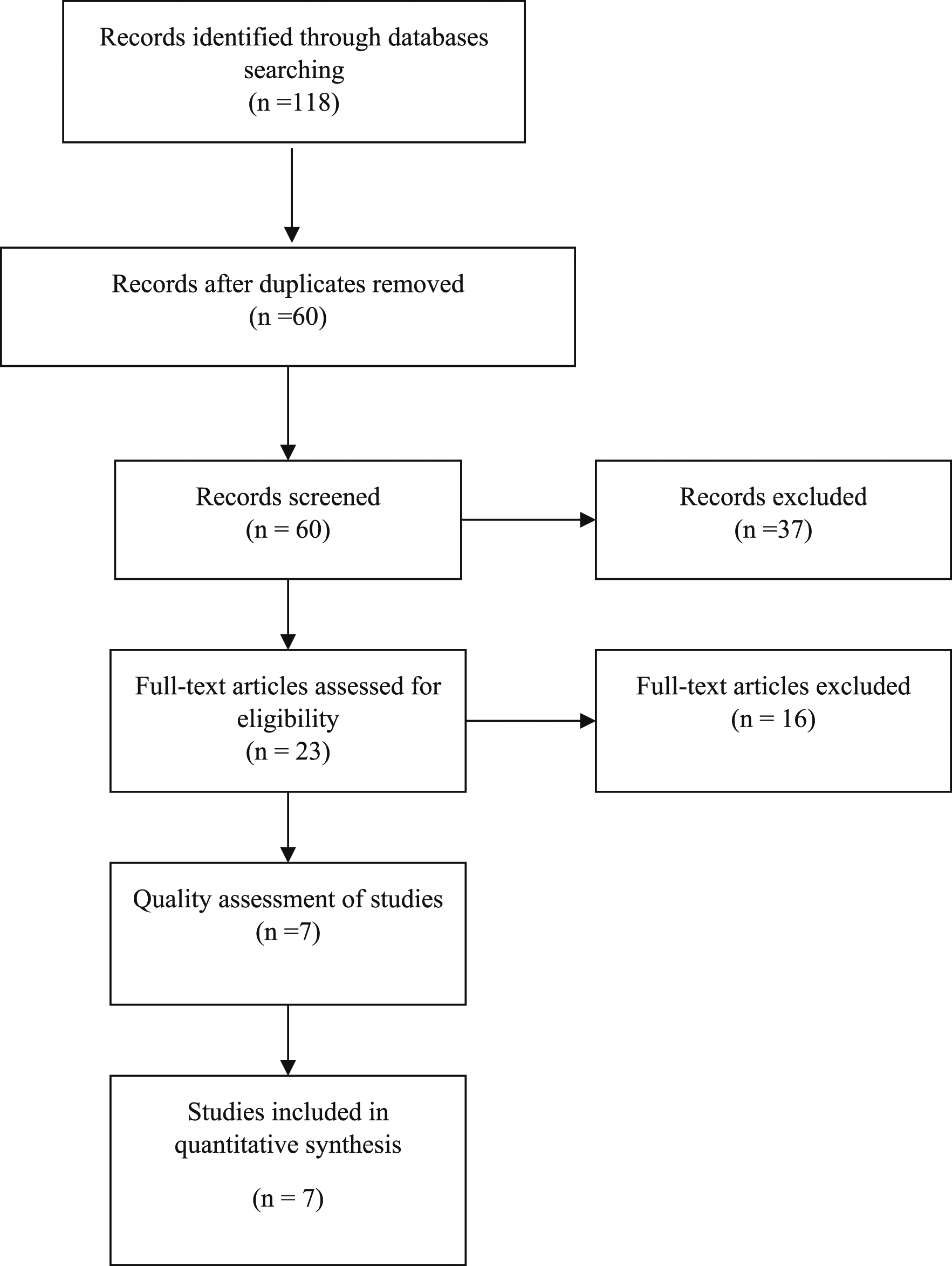
The descriptive results of screened manuscript
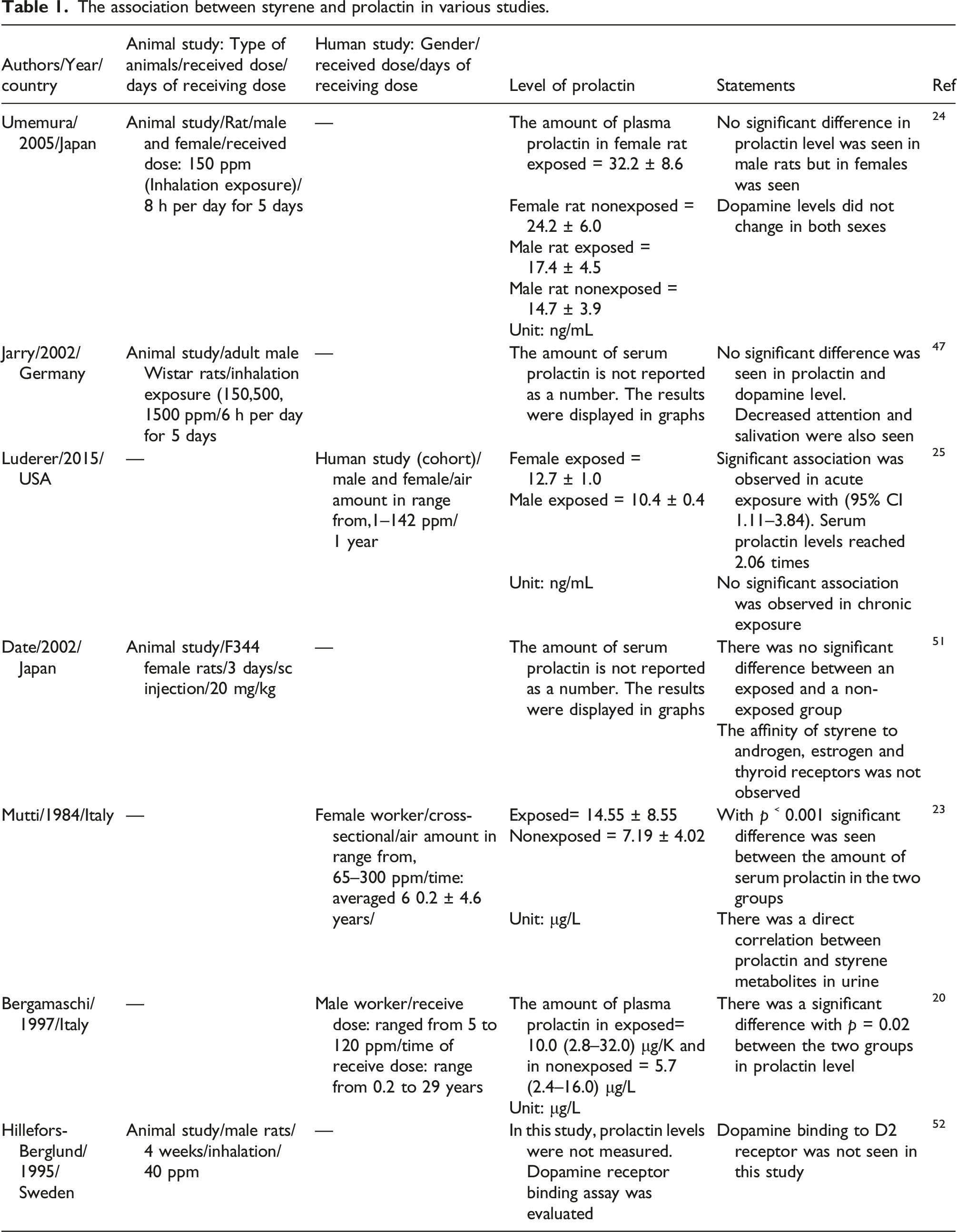
The association between styrene and prolactin in various studies.
Discussion
Table 1 shows the relationship between styrene and prolactin in human and animal studies. The optimum prolactin level is 10–25 for women and 10–20 ng/mL for men.
52
In women, the amount increases during pregnancy and lactation.
52
In the Bergamaschi survey, which was a cross-sectional study, workers were divided into exposed and non-exposed groups. Prolactin levels were compared between the two groups. The concentration of styrene in the exposed group was between 5 and 120 ppm. Prolactin levels were significantly higher in the exposed group in comparison with the non-exposed group (p = 0.02). This study suggested that the increase in prolactin secretion occurred through the suppression of the dopaminergic system.
20
As shown in Figure 2, dopamine holds a major impact on the regulation of prolactin secretion. The dopamine receptors are members of the superfamily of G protein-coupled receptors. There are five types, which include D1 to D5. All receptors have different functions. The five different dopamine receptors can be dived into two categories depending on the action of the G protein.53,54 When dopamine binds to the D2 receptor, it leads to the expression of certain genes and the reduction of prolactin exocytosis.55–59 Impact of Styrene, TRH and Dopamine on the release of the Prolactin.
As with these findings, in previous studies, subacute exposure to styrene led to dopamine depletion in rabbits. 49 But, in the study of Date, female rats were exposed to styrene monomers by subcutaneous injection. The injection dose of styrene was 20 mg/kg. There was no significant difference between serum prolactin levels in the exposed and non-exposed rats. Therefore, the exposure dose was probably not high, which could cause significant changes in serum prolactin levels. It is also possible that the absorption rate will be lower in subcutaneous exposure. 50 In this study, the binding rate of styrene receptor for estrogen and androgen receptors and thyroid hormone receptor was also investigated. No affinity for binding to these receptors was observed.
In the study, rats were exposed to three concentrations of 150,500 and 1500 ppm styrene for 5 days. The study was performed on male rats and no significant differences were observed between the groups in prolactin and dopamine level. Only a brief weight loss was seen. There was also a response to the irritation. (Table 1). Similar results were found in the Umemura study. This study was performed on male and female rats. Rats were exposed to styrene through inhalation. Significant differences were observed between female rats exposed to the control group, while no significant difference was observed in male rats. 24 The results of these studies indicate the role of gender in the response rate. In most studies, more sensitivity is emphasized in females.24,25
Furthermore, the amount of dopamine and 5-hydroxytryptamine did not change in both sexes. Therefore, the results of this research indicate that neurotransmitters are not affected in both sexes. 24
In a cohort study, workers employed in a plastic plant were selected. 25 The amount of styrene in the breathing air blood of these workers was evaluated. Changes in serum prolactin levels occur following the acute exposure to high concentrations of styrene in humans. 50 Serum prolactin levels were 2.06-fold higher in exposed individuals compared to none-exposed ones. However, no significant changes were observed in chronic exposure. As it has been observed in previous studies, it probably indicates the body’s tolerance to chronic exposure. 49 The effect of styrene on prolactin in two groups of women workers exposed to styrene and non-exposed was evaluated in Mutti’s study. 23 There was a significant difference in the secretion of prolactin between the two groups. Increased prolactin secretion due to dopamine depletion was demonstrated in this study. The exposure dose was relatively high (Table 1). The result was due to the high dose and the type of exposure, which was inhaling. The rate of absorption in respiratory exposure is high.
In Hillefors-Berglund’s study, male rats were chronically exposed to styrene by inhalation. The Dopamine D2 binding assay was evaluated. In this study, prolactin level was not evaluated. Furthermore, the affinity of dopamine D2 agonist binding was not seen. 51 Therefore, there was no inhibitory effect on prolactin secretion. Of course, the amount of prolactin was not measured in this study, so it is not possible to comment with certainty.
Oral exposure has not been evaluated in any of these studies, so it is necessary to plan for oral exposure assessment for future studies. However, in the study, it was stated that the rate of oral exposure is below concern. 16 Furthermore, in one study, Polystyrene nanoparticles were evaluated orally. 60 There were changes in the intestinal microflora, but no significant changes in oxidative stress in the liver, lung and intestine and no behavioral changes.
Conclusion
Overall, styrene is a dose-dependent neurotoxic compound. Inhalation and occupational exposure can affect prolactin levels. Inhalation exposure in both animal and human studies leads to increased serum prolactin concentration. This finding confirms that the level of absorption in the respiratory tract is much higher than other exposure. There were no major changes in subcutaneous exposure, although the number of studies in this area was limited, thereby, more researches are required to investigate the effect of various exposures of styrene on prolactin levels. The intensity of responses was higher in females than males. Therefore, women who work in industrial facilities should take the necessary precautions to minimize the styrene exposure. In some studies, dopamine depletion is mentioned as one of the proposed mechanisms of prolactin increase in exposure to styrene, and in some studies, no changes in dopamine levels were seen at all. Therefore, it is recommended to investigate the possible mechanism in laboratory animals for future research.
Footnotes
Declaration of conflicting interests
The author(s) declared no potential conflicts of interest with respect to the research, authorship, and/or publication of this article.
Funding
The author(s) received no financial support for the research, authorship, and/or publication of this article.
