




Abstract
Acute kidney injury (AKI) is a common life-threatening complication. In this study, β-amyrin is hypothesized to exert a potential nephroprotective effect against glycerol-induced nephrotoxicity in rats. Thirty-two female Sprague-Dawley rats were divided into four groups: normal control, β-amyrin treated (50 mg kg−1 body weight) for 14 days, glycerol 25% (10 ml kg−1 BW volume/volume in sterile saline, intramuscular), and β-amyrin + glycerol-treated rats. Assessing kidney function was done through the measurement of serum urea and creatinine (SCr). Real-time quantitative polymerase chain reaction analysis was done to measure the changes in the gap junction protein and intermediate filament proteins (IFPs) messenger RNA (mRNA) levels. Renal tissue histopathology was also observed. Glycerol exhibited significant elevation in the SCr and urea with significant upregulation of connexin43, vimentin, and nestin. The levels of all disrupted parameters were improved by the pre-administration of β-amyrin. The β-amyrin exerts significant improvement of the biochemical parameters with a restoration of the renal tissue histopathological picture. Significant downregulation of the expression levels of the gap junction protein and IFPs mRNA was also seen. Collectively, the administration of β-amyrin showed a promising effect for a protection against glycerol-induced AKI in rats.
Introduction
Acute kidney injury (AKI) is considered a critical clinical syndrome that occurs after the acute renal tissue injury. It is identified after its occurrence by the onset of progressive azotemia, leading to high mortality rate. 1 The primary causes of AKI are hypoxia, ischemia, or nephrotoxicity. Inflammation represents an important component of AKI. It is responsible for the extension phase of the injury which might be associated with insensitivity to vasodilator therapy. It is suggested that targeting the extension phase represents a potential area of treatment with the greatest possible impact. The underlying basis of the renal tissue injury appears to be through the impairment of the highly metabolically active nephron segments (i.e. proximal tubules and thick ascending limb) in the renal outer medulla, which can trigger conversion from transient hypoxia to intrinsic renal failure. 2
Cynara (Asteraceae) is a small genus that includes almost 11 species of tall thistle-like perennials. The artichoke, Cynara scolymus and the cardoon, Cynara cardunculus L are two well-known species of Cynara. 3 The plant is well distributed in the Mediterranean countries and the Canaries islands, 4 it is cultivated because of their edible root, thickened leafstalks, and sometimes for its ornamental purposes. The C. cardunculus L. is considered important for its medicinal and dietary purposes in different countries, 5 for example, it is a major constituent of the Mediterranean region diet. The C. cardunculus L extracts have a potential hepatoprotective, diuretic, anti-inflammatory, antioxidant, antimicrobial, antimutagenic, and antiproliferative effects. 6 It is considered an important source of several compounds, such as flavonoids, caffeoylquinic acids polysaccharide, fatty acids, triterpenes, and sesquiterpenes. 5
Intermediate filaments (IFs) are abundant and dynamic cytoskeletal components in eukaryotic cells. 7 All intermediate filament proteins (IFPs) have the ability to form homopolymer or heteropolymers and their physical properties which result in a large number of IFPs partnerships. 8 The expression of IFPs occurs in the cell and the tissue, where they developed by a specific manner to create a “cytoskeletal fingerprint” to provide an insight into the cellular dynamics. Vimentin (Vim) and nestin (Nes) maintain the autoregulatory mechanisms via the integration of podocytes in the kidney. 9 Connexin43 (Cx43), a gap junction protein plays an important role in the cell connection and communication. Cx43 is a gap junction protein that is shown to be co-localized with some IFPs such as Nes in a variety of renal diseases. 10 It is also considered a potential approach in the case of AKI. 11 It is necessary for keeping the normal function of the kidney, playing an important role in the exchanging of small molecules found in the tubular cells and renal glomerular apparatus. 12 It also has important roles in maintaining the glomerular filtration and coordinating the responses of renal circulation in case of damage. 13 Vim is IFPs type III that is able to interact with a very large number of proteins and thus considered as a potential regulator for various physiological functions. It is a member from the family of the IFPs with significant importance in the nephropathy 14 as it is a marker of the tubular injury. 15 Nes is expressed in dividing cells during the early stages of development. Nes is downregulated upon differentiation and the expression is re-induced in adults during the pathological conditions. 16
The current work describes the possible control measures utilizing β-amyrin as a natural herbal extract to protect against glycerol-induced nephrotoxicity. Significant alteration of the expression levels of the gap junction protein (Cx43) and IFPs genes such as Vim and Nes are considered as a hallmark of regeneration after renal injury and would provide a useful target for AKI. For this purpose, different biochemical, molecular, and histopathological assays are utilized to evaluate its potency. This study also showed the molecular expression pattern of gap junction protein and IFPs through the evaluation of the transcription of Cx43, Vim, and Nes, which are implicated in the AKI-associated renal injury and the evaluation of serum urea, creatinine (SCr), real-time quantitative polymerase chain reaction (qPCR), and the histopathological examination.
Materials and methods
Experimental animals
Thirty-two female Sprague-Dawley rats were purchased from the Laboratory Animal Unit, Faculty of Medicine, Zagazig University. The initial weight of the rats was 100–120 g. No more than five rats per cage were housed in stainless steel cages. They were acclimated to the surrounding environment for 14 days prior to use. Rats were maintained with controlled temperature (21–24°C) and were given a standard diet and water ad libitum throughout the study. All ethical considerations related to the animal study were considered carefully, the guides for the use and care of laboratory animals of the National Institutes of Health were followed (NIH Publication No. 85-23, revised 1996). All the local institute instructions provided by Zagazig University Animal Care and Use Committee were also strictly and fully considered in this study.
Experimental materials and dosage
Glycerol
Glycerol 25% (volume/volume) was used for the induction of AKI, which was purchased from SIGMA Chemicals Company for Pharmaceutical Industries. Single intramuscular (i.m.) injection of 10 ml kg−1 BW was used. 17
Plant material
Cynara cardunculus L. was collected in the flowering stage “March 2015” from the medicinal plants garden of the Faculty of Pharmacy, Zagazig University, Egypt. The plant identification was performed at the Department of Botany, Faculty of Science, Zagazig University, Zagazig, Egypt. A voucher specimen is deposited to the Department of Pharmacognosy, Faculty of Pharmacy, Zagazig University, Egypt. The plant was shade dried and ground by the electric mill to a moderately fine powder and isolation of β-amyrin was done.
Isolation of β-amyrin from C. cardunculus L light petroleum fraction
Several steps were followed for the isolation of β-amyrin. Light petroleum extract (30 g) was subjected to silica gel column (2.5 × 150 cm2, 500 g). Light petroleum was used to start the elution where the polarity was gradually increased with benzene, chloroform, and then methanol. Some collected fractions (250 ml) were concentrated under reduced pressure and monitored by thin-layer chromatography (TLC). The visualization was done using (anisaldehyde/sulfuric acid) and similar fractions were combined together. Solvent system of petroleum ether:ethyl acetate (8.5:1.5) was used for TLC investigation of fractions (28–44) and indicates the presence of one purplish violet spot with R
f 0.51. A yield of 900 mg of white residue was obtained by the evaporation of these combined fractions. Hot chloroform-methanol was formed on recrystallization which yield 800 mg white needle crystals with melting point 196–197°C. The identity of β-amyrin was established by direct comparison (co-TLC, mp, infrared radiation (IR), mass spectrometry) with authentic samples. IR:
Experimental design
The potential effect of the extracted active component β-amyrin is expected to be achieved at a dose of 50 mg kg−1 BW. 18,19 Rats were divided into four groups and acclimatized for 14 days before starting the experiment. Group I (n = 8), normal control, rats were orally received 1 ml 2% gum acacia, as a vehicle, every day for 14 days. Group II (n = 8), β-amyrin treated, orally received β-amyrin 50 mg kg−1 BW for 14 days dissolved in 2% gum acacia. Group III (n = 8), glycerol 25% treated, rats were i.m. injected a single dose of glycerol 25% and also they were orally administered 1 ml 2% gum acacia, as a vehicle on the 10th day. Group IV (n = 8), β-amyrin pretreated group (β-amyrin + glycerol), rats were orally received β-amyrin (50 mg kg−1 BW) daily for 14 days dissolved in 2% gum acacia and also treated with a single i.m. injection of glycerol 25% on the 10th day. All rats were killed on the 15th day.
Blood sampling
Two to three milliliters of blood was collected from the retro-orbital venous plexus of rats under sterile septic conditions on the 15th day. Blood was allowed to flow smoothly into the tubes without anticoagulant, left to clot for 2 h at room temperature, and then centrifuged at 3000 r min−1 for 10 min. The clear supernatant serum was collected using sterile disposable Pasteur pipettes. The collected serum was transferred to 1.5 ml dry, sterile microtubes (Eppendorf, Germany) for chemical analysis.
Estimation of serum renal biochemical parameters
The levels of serum urea and SCr were calorimetrically measured using commercial kits provided by BioM erieux (Marcy, L’Etoile, France). All analyses were done using spectrophotometer 5010 v5+, Berlin, Germany, for biochemical serum analysis. Estimation of serum urea 20 and SCr 21 was done.
Transcription of Cx43, Vim, and Nes by qPCR
Extraction of total RNA was done from the kidneys of the normal control and the treated rats using the RNeasy Mini Kit (Qiagen, Germany). QuantiTect Reverse Transcription kit (Qiagen, Germany) used for the reverse-transcription from total RNA. Real-time qPCR was done using Rotor-Gene Q cycler (Qiagen, Hilden, Germany) and QuantiTect SYBR Green PCR kits (Qiagen, Germany). Primers sequences used in the qPCR measurements for the glyceraldehyde 3-phosphate dehydrogenase (GAPDH), Cx43, Vim (Vim), and Nes are listed in Table 1. 22–24
Primers sequences used in the quantitative PCR measurements for the GAPDH; connexin43 (Cx43); vimentin (Vim) and nestin (Nes).

GAPDH: glyceraldehyde 3-phosphate dehydrogenase; Cx43: connexin43; Vim: vimentin; Nes: nestin.
The qPCR reaction mixture consisted of the following: 12.5 μl 2× SYBR Green PCR Master Mix, 1 μl of each primer (10 pmol ml−1), 2 μl complementary DNA, and 8.5 μl RNase-free water in a total volume of 25 μl. The amplification conditions were: initial activation 95°C/15 min followed by 40 cycles of denaturation 94°C/15 s, annealing at 60°C/15 s, and elongation at 72°C/15 s. Melting curves were produced after real-time PCR to demonstrate the specific amplification of each gene product of interest. A standard curve assay was performed to determine the amplification efficiency of the used primers. Three independent samples were assessed for each group.
Relative fold changes in the expression of the target genes were estimated by the comparative 2−ΔΔC t (C t: cycle threshold) method. 25 The GAPDH gene was used as an internal control to normalize the target gene expression levels. GAPDH is considered one of the commonly used housekeeping genes in the gene expression reactions. 26 It is reported that GAPDH is one of the reference genes that has been used for qPCR in the kidney. 27 The difference between the mean ΔC t of the treated group and the normal control group is called ΔΔC t, where ΔC t referred to the difference between the mean C t gene of the interest and the internal control gene. Logarithmic transformation was performed on fold-change values before they were statistically analyzed, and the fold-change values of three replicates for each gene were measured.
Histopathological assays
A portion of kidney tissue from all groups was collected and immediately prepared for histopathological examination. 28 Simply, the specimen was labeled and fixed in 10% neutral buffered formalin solution, specimens were processed impeded in paraffin waxes, and dehydrated in a series of graded concentrations of ethyl alcohol, cleared in xylene, impeded in melted paraffin at 55–60°C, and sectioned at 4–5 µm thickness. These sections were routinely stained with hematoxylin and eosin and examined with the light microscope. Images were taken for each stained specimen.
Statistical analysis
Statistical Analysis System software package, SPSS version 20 was used to analyze the data by one-way analysis of variance (ANOVA). Further analysis was carried out. All data showed a normal distribution and passed equal variance testing. Significant differences between means were determined at a level of p < 0.05 by Tukey’s test.
Results
Biochemical estimation
Serum urea and SCr levels showed a significant increase in the glycerol-treated rats (group III) when compared with the normal control. Nonsignificant change in the levels of serum urea and SCr was observed when comparing the β-amyrin treated (group II) and the β-amyrin pretreated (group VI) and with the normal control (group I). The levels of serum urea and SCr showed a significant decrease (p = 0.0022 and 0.0018, respectively) in the β-amyrin pretreated and β-amyrin-treated groups when compared with the glycerol-tr3eated one (Figure 1).
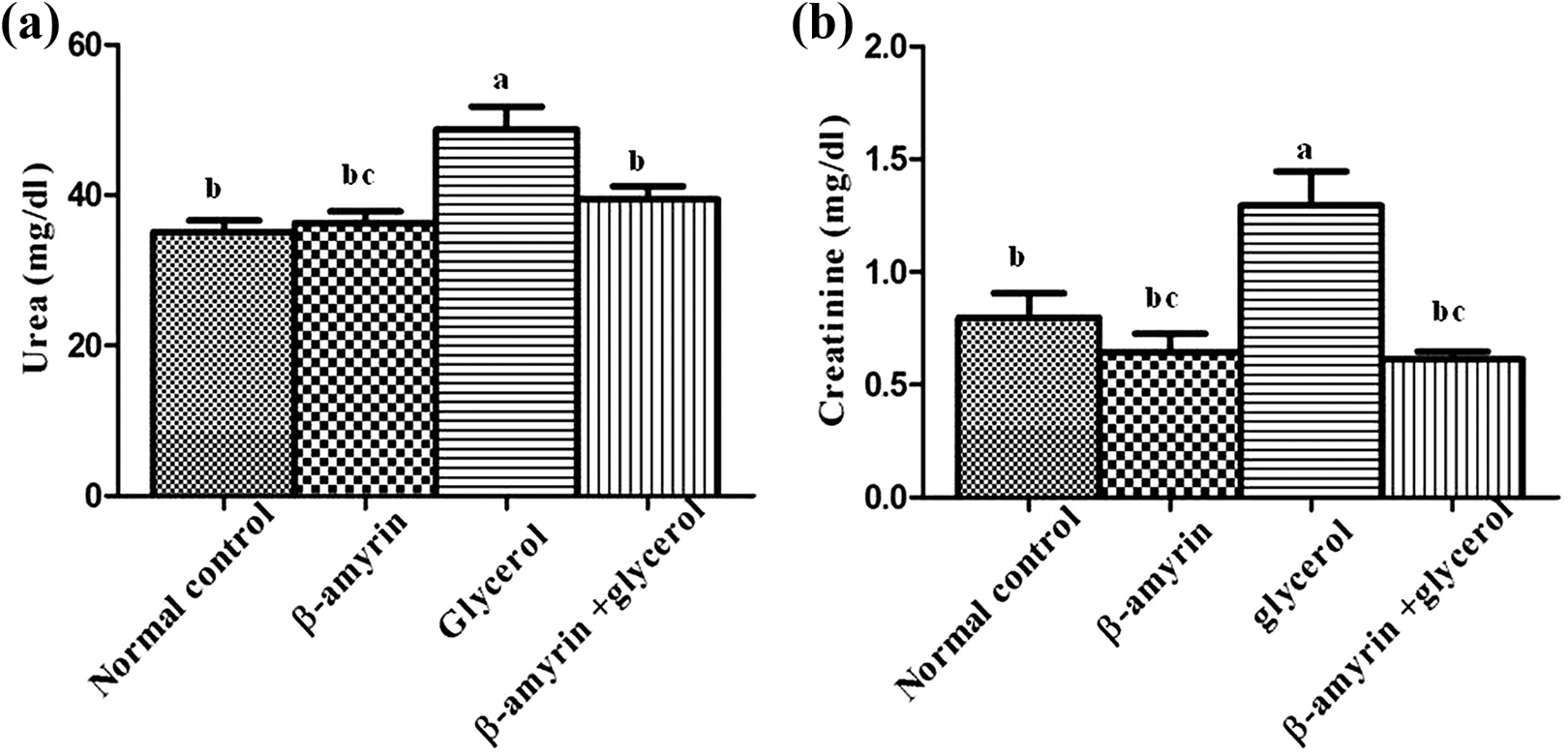
Levels of (a) urea and (b) SCr in the serum of the normal control and treated groups. The mean values are expressed as mean ± SE. Mean values including different superscript symbol letters a,b,c are different statistically at p < 0.05. SCr: serum creatinine; SE: standard error.
Real-time qPCR analysis
The qPCR was performed to estimate the relative levels of gap junction protein and IFPs genes expression. The level of messenger RNA (mRNA) expression of Cx43, Vim, and Nes genes is shown in Figure 2. There is a significant (p = 0.0006, 0.0146, and 0.00004, respectively) upregulation of all genes in the glycerol-treated group when compared with the normal control one. There were no significant changes in the mRNA expression levels of Cx43, Vim, and Nes genes in β-amyrin treated (group II) and β-amyrin pretreated (group VI) comparing with the normal control (group I). While β-amyrin-treated and β-amyrin pretreated groups revealed downregulation of Cx43, Vim, and Nes gene expression when compared with the glycerol-treated one.

Effect on relative mRNA expression levels of (a) Cx43, (b) Nes, and (c) Vim genes in the renal tissue of the normal control and other treated groups. The mean values are expressed as mean ± SE. Mean values including different superscript symbol letters a,b,c are different statistically at p < 0.05. mRNA: messenger RNA; Cx43: connexin43; Nes: nestin; Vim: vimentin; SE: standard error.
Histopathological observations
Kidneys of the normal control (group I) showed normal renal tissue (renal glomeruli surrounded by proximal and distal renal tubules) (Figure 3(a)). Group II, β-amyrin treated showed normal renal glomeruli and tubules (Figure 3(b)). Group III which was exposed to glycerol 25% showed proximal and distal renal tubules lined by swollen epithelial cells with severe vacuolar degeneration of the cytoplasm (Figure 3(c)). Group III which was exposed to glycerol 25% showed some degenerated podocytes at the circumference of the glomeruli (Figure 3(d)). Group VI, β-amyrin pretreated then exposed to glycerol 25% showed normal renal glomeruli and mild vacuolar degeneration of the renal tubular epithelial cell of the proximal and distal convoluted tubules (Figure 3(e)).

Renal tissue was stained with H&E. (a) Normal control observed renal glomeruli (arrows) surrounded by proximal and distal renal tubules (stars). (b) The β-amyrin treated revealed normal renal glomeruli (arrows) surrounded by normal proximal and distal renal tubules (stars). (c) Glycerol-treated rats showed proximal and distal renal tubules (stars) lined by swollen epithelial cells with severe vacuolar degeneration of the cytoplasm (arrows). (d) Glycerol-treated rats showed some degenerated podocytes (arrows) at the circumference of the glomeruli. (e) The β-amyrin + glycerol-treated group showed normal renal glomeruli and mild vacuolar degeneration of the renal tubular epithelial cell (arrows) of the proximal and distal convoluted tubules. H&E: hematoxylin and eosin.
Discussion
The diagnosis of AKI depends mainly on the measurements of both serum urea and SCr. Significant increase in the levels of urea and SCr in a glycerol-treated group is related to the expected alterations in the kidney functions. This means that the kidney is unable to excrete these products and an indication of the kidney functions impairment. These effects may be due to the changes in the tubular reabsorption threshold or the renal blood flow or the rate of the glomerular infiltration. The AKI associated with the administration of glycerol 25% resulted in a significant and rapid decrease in the rate of the glomerular filtration rate which leads to the retention of the nitrogenous wastes, mainly the SCr. 1 The oral administration of β-amyrin alone did not change the levels of serum urea and SCr which indicate a safe use of β-amyrin on kidneys. The β-amyrin showed a protective effect against glycerol-induced AKI. The pretreated group with β-amyrin showed a significant decrease in the parameters of kidney function assays when compared with glycerol-treated one. This suggests protective effect revealed by the adminstration of β-amyrin against glycerol 25%. This result was also confirmed by the histopathological findings in the renal tissue.
While the evaluation of AKI via the estimation of urea and SCr might not consider the only specific marker for the AKI diagnosis since there are some other nonrenal and renal factors that might independently cause renal injury or indirectly cause the alteration in the kidney function. So that the mRNA expression of Cx43, Vim, and Nes genes would be an effective approach to evaluate the renal biomarkers and confirm our results. In the present study, the expression of Cx43 was markedly increased due to glycerol administration. The Cx43 is a major vascular connexin, its upregulation has been observed in the renal inflammation in rodents and humans. 29 The β-amyrin pretreated and β-amyrin-treated rats reported downregulation of Cx43. This indicates that β-amyrin plays a potent role in the case of the alteration of Cx43 expression and the clear protective effect of β-amyrin against the toxicity induced by glycerol. This suggests that β-amyrin could play an important role in the protection of renal tissue in case of glycerol toxicity and Cx43 expression upregulation.
The response of AKI due to the toxic injury of glycerol is noticed by the upregulation of Vim in addition to the tubular dedifferentiated, flattening, and loss of the epithelial morphology. Pretreated rats with β-amyrin were able to protect the renal tubules in the injured kidney. The tubular epithelial cells undergo cell death due to the toxic injury in response to AKI. Various shapes of regulated cell death might occur such as autophagic cell death, anoikis, and pyroptosis. 30,31 The remaining viable tubular epithelial cells undergo flattening and dedifferentiated which are accompanied by the upregulation of Vim gene expression. 32 The expressing Vim results in a transition from the epithelial form to a mesenchymal state. It is suggested that there are differences between cell types in the postnatal kidney and the development cells which propose the idea that the kidney is able to reinitiate developmental processes after exposed to injury. 32 Then the protective effect is expected to be due to the proliferation of the tubular epithelial cells to attenuate the induced damage.
Nes is found to be upregulated in glycerol-treated rats as a result of AKI. Generally, Nes plays an important role in both cell division and cell dynamics by integrating with IFs, microfilaments, and microtubules. 16 During the progression of the tubulointerstitial injury, tubulointerstitial myofibroblasts, and peritubular endothelial cells, the Nes is expressed in association with various deterioration of the renal function. 33 The increased expression of Nes increases the mechanical stability of the cells and enables the podocytes to undergo morphological changes on the glomerular capillary wall. It is reported that Nes might be involved in the regulation or coordination of the cellular structural proteins. 33 The present study supports the hypothesis which stated that the Nes might be a new marker for tubulointerstitial fibrosis and peritubular endothelial cell injury. 34 The β-amyrin pretreated group and β-amyrin-treated rats downregulated the expression of Nes.
Glycerol-intoxicated rats showed upregulation in the Vim, Cx43, and Nes expression, reflecting the altered podocyte function in response to their injury. 35 Where β-amyrin decreased their expression to maintain podocyte stability and normal renal barrier. Several studies reported that glomerular injury can undergo regeneration. 36,37 This has been supported by our histopathological examination.
In conclusion, biochemical, histopathological, and molecular assays collectively could be a potential tool in the evaluation of nephrotoxicity. Expression pattern of Cx43, Vim, and Nes genes was an indicator for glycerol nephrotoxicity assessment. Gene expression is shown to be upregulated in a rat model of AKI, and the downregulation was accompanied with β-amyrin treatment which indicates a regeneration process. The gap junction protein (Cx43) and IFPs (Vim and Nes) are then considered important markers for the kidney function as well as a tool for the evaluation of the nephrotoxicity. Taken together, the oral administration of β-amyrin could be used as a potential preventive agent for nephrotoxicity in rats.
Footnotes
Acknowledgments
The authors would like to thank Prof. Hussain Abdel Baset, Professor of Plant Taxonomy, Faculty of Science, Zagazig University, Zagazig, Egypt, for helping in the identification of the plant. Also, the authors would like to thank the Scientific and Medical Research Center (ZSMRC) of the Faculty of Medicine, Zagazig University for their support. The authors also would like to thank Prof. Kamal Elkashishy, the head of the Pathology Department, Faculty of Medicine, Zagazig University, Egypt for the help in the histopathological examination.
Author contributions
All the authors have accepted responsibility for the entire content of this submitted manuscript and approved submission.
Declaration of conflicting interests
The author(s) declared no potential conflicts of interest with respect to the research, authorship, and/or publication of this article.
Funding
The author(s) received no financial support for the research, authorship, and/or publication of this article.
