




Abstract
Genomic instability is a risk to organism health detected by methods such as the comet assay (CA). It is a highly sensitive and versatile method to detect low levels of DNA damage in a wide range of cells from humans as well as from other species as compared to other methods with the same proposal. CA is a powerful DNA damage analysis tool and its applicability extends to the genotoxicity analysis of, that is, drugs and carcinogenic substances. This study analyzed papers employing CA in the Scopus database in order to assess its scientific importance, employability, and trends by evaluating: number of articles per year, total citations and per year, country of publication and their clusters, clusters of authors, most frequently abstracts terms, name of journal, affiliations, country of publication, subject area, relevant keywords compared to citation clusters, and impact factor (IF) CiteScore. It was retrieved 13,828 articles from 1990 to 2018, with a peak in 2014 and a decline from 2015 to 2018. Four author clusters from China, United States, India, and Brazil were identified, countries presenting the greatest number of publications. China presented the most recent scientific advances in the field. It was also detected nine clusters of themes, and a positive correlation between publications, citations, and the IF. There are full employability and versatility in the use of the method. Currently, there is an advance in Chinese scientific production on the subject, and there is greater use of the method on oxidative damage researches.
Introduction
DNA damage is a constant risk to organism health, and it may occur due to exposure to exogenous and endogenous deleterious factors which are the primary cause of the oxidative process. 1,2
The unrepaired DNA damage leads to mutations, genetic recombination, premature apoptosis, chromosomal aberrations, and cell death, 2,3 thus constituting the pathological basis of several life-threatening diseases like cancer and degenerative diseases, 4 thus reinforcing the importance of assays detecting DNA damage and repair.
Among the various methods employed in the estimation of DNA damage, the comet assay (CA) also known as single-cell gel electrophoresis (SCGE) is a highly sensitive and versatile method to detect low levels of DNA damage as compared to other methods with the same proposal. Also, in a relatively short period, this method can assess damage in both proliferating and nonproliferating cells and differentiate viable, apoptotic, and necrotic cells. 4
CA versatility lays down on the applicability to detect DNA damage and repair efficiency in a wide range of cells, such as peripheral blood mononuclear cells (PBMCs), buccal epithelial cells, nasal epithelial cells, lens epithelium, tear duct epithelial cells, spermatozoa, and biopsy tissues. 5,6 It is essential to mention that it turns possible to evaluate not only human samples but also vertebrates, insects, and plants. 7,8 However, CA has certain limitations, such as the number of cells analyzed and non-apoptotic or necrotic cell samples. The assay does not provide accurate information about the size of fragments nor which contaminants can aggravate DNA breakdown and overestimate the results. 9
Ostling and Johanson 10 developed the method, and subsequently, the protocol was changed by Singh et al. 11 with the use of the alkaline medium, unlike the neutral medium initially used. The use of alkaline pH is due to the possibility of DNA double-stranded denaturation, thus allowing an increase of the experiment sensitivity. 12 The principle of the technique consists of detergent lysis, soaked in agarose, and use of electrophoresis for tail formation due to electrophoretic running. 13,14 From the electrophoresis, using fluorescence and analysis software, the experiment demonstrates a correlation between the contaminant and the degree of tail moment, that is, the number of fragments and the drag caused by electrophoresis at levels from 0 to 4. 13
The CA has several applicability, for example, in the analysis of genotoxicity by the use of new drugs, cosmetics, and other substances with carcinogenic potential 15 –18 ; DNA damage and repair mechanisms research 7,11,19 ; biomonitoring studies and analysis of dosage effect from environmental exposure 8 ; dietary and nutrigenomic supplementation test 20 –22 ; and DNA oxidative damage analysis using specific enzyme. 23
Besides, CA also has applicability in the analysis of ecogenotoxicology in aquatic organisms, 24 molecular epidemiology, 25 and evaluation of mesenchymal stem cell integrity, 26 as well as integrity of spermatozoa. 27 –29 Still, the method leads to bacteriophage detection in bacteriophage-mediated cell lysis. 30 Thus, the employability of the CA is very wide, demonstrating that the methodology is still present in mutagenesis and ecogenotoxicity studies. The variety of studies involving this method allows us considering it as an essential methodology in the areas of biochemistry, genetics, molecular biology, pharmacology, toxicology, and pharmaceutics. Because in this regard, deepening the bibliometric studies about the experiment is justified.
The present study analyzed papers using CA in the Scopus database trying to verify the importance of such a methodology.
Methodology
Data source and search strategy
For the scientometric study, it was used the bibliographic database Scopus®, which is a registered trademark of Elsevier BV Scopus and is the largest abstract and citation database of peer-reviewed literature: scientific journals, books, and conference proceedings (www.elsevier.com). The search terms used were the same as previously used in a bibliometric study by Neri et al., 31 they are as follows: “comet assay” OR “comet assays” OR “tail moment” OR “tail moments” OR “single cell gel electrophoresis” OR “SCGE” OR “comet test” OR “comet tests.” Articles were the form picked to evaluation, excluding papers classified as reviews, conference papers, letters, and others. The present study comprised the years 1990–2018. Studies in the initial period of the CA development and use (1984–1989) were not included as they were relatively few and showed in their title or abstract obvious and unambiguous identifiers. 31
Database analysis
The following parameters were evaluated from the Scopus database: number of articles by year of publication, number of total citations and by year, country of publication (by first author’s affiliation) and their clusters, clusters of authors, most frequently found abstracts terms, name of journal, affiliations, country of publication, subject area, relevant keywords compared to citation clusters, and impact factor (IF) CiteScore of the periodic. For coauthoring analysis and analysis of standard terms in the abstract, it was used Leiden University’s VOSviewer program (http://www.vosviewer.com/). For the present study, it was considered terms above 1000 occurrences.
Data analysis
Among the tests, a χ 2 adjustment test was performed on the number of publications and citations per year, to verify uniformities or differences regarding these data. Besides, a normality test and a correlation test between publications and citations were performed, as well as between IF and number of citations per journal. We applied the R software (version 3.6.1), 32 with a p value of 5% and a confidence interval of 95%.
Results
There were 13,828 articles published from January 1, 1990, to December 31, 2018. Based on the data obtained and illustrated in Figure 1, it was observed an increase in the number of publications until 2014, which stood out for the most significant number of publications with 1066 articles. After this period, the number of publications declined to 912 articles published in 2018. The Shapiro–Wilk normality test was significant for non-normal distribution (p value ≤ 0.001). The χ 2 test showed the significance of the nonuniformity of the number of publications throughout the study period (χ 2 = 8039.4, p ≤ 0.001).

Increase in the number of publications per year related to CA, significant for nonuniformity in χ 2 test (p ≤ 0.001). CA: comet assay.
Figure 1 shows an increase in the number of publications per year related to CA, significant for nonuniformity in χ 2 test (p ≤ 0.001).
From 1990 to 2014, there was an average growth of 31.6%; after this period, there was an average decline of 3.7%. Regarding the distribution between citations per year, there were a total of 334,145 citations in the period studied, with emphasis on the articles from 2009 and 2006, which received 23,588 and 21,270 citations, respectively, representing a total of 13.43% of the total citations (Figure 2).

Citation distribution by year of publication (χ 2 = 138,120, p ≤ 0.001).
Among these publications, the countries with the most significant number of publications were the United States, with 1763 publications, followed by China (1845), India (1442), Brazil (1197), Germany (954), United Kingdom (887), Italy (816), France (563), Poland (521), and Japan (510). These 10 countries account for more than half of comet-related publications. The rest of the publications were from countries other than those mentioned and together accounted for 6952 publications (Figure 3).

The number of publications by country of the first author in publications related to CA. CA: comet assay.
When analyzing the relationship between the coauthorships and countries, we noticed a relationship between four clusters (Figure 4). In clusters of authors, there is the most predominant coauthoring relationship between Brazil and European countries, such as Germany, Italy, Spain, France, Portugal, and the United Kingdom; in the cluster, countries, such as the United States, India, and South Korea; in the oriental cluster, countries, such as China, Egypt, and Saudi Arabia; and in the other cluster, Canada, which has a relation to both the Europe and America countries.

List of coauthoring clusters by country, presenting four clusters, with reference countries—cluster n.1: Brazil and Europe, cluster n.2: the United States and India, cluster n.3: China, and cluster n.4: Canada.
The authors with the most significant number of publications as the first author were Speit, G (104), Ribeiro, DA (82), and Anderson, D (80), from the University of Ulm (Germany), Federal University of São Paulo (Brazil), and University of Bradford (England), respectively. Also, the most significant number of publications by affiliation was São Paulo State University (UNESP) with 262 publications related to the theme, followed by Federal University of Rio Grande do Sul (UFRGS) with 225 publications, and the University of São Paulo (USP) with 203 publications, all of these are affiliations of Brazil. The areas most addressed were biochemistry, genetics, and molecular biology with 6185 publications, followed by medicine with 4988 publications, pharmacology, toxicology, and pharmaceutics with 4165 publications, and environmental science with 4127 publications.
Using the software VOSviewer by Van Eck and Waltman, 33 correlation maps were created for authorship. Figure 5(a) showed a total of eight clusters of different publications from publications, represented by authors with the most significant number of publications. It was observed that these clusters were distributed among authors from Western Europe (Speit, G and Collins, AR), Eastern Europe (Filipič, M, and Kopjar, N), Northern Europe (Loft, S and Wallin, H), South America (Picada, JN and Da Silva, J), Asian (Sasaki, YF and Park, E), and highlight Chinese Asian authors (Zhang, Z, Zhang, X, Liu, Y, Wang, J, and Zhu, L) with greater agglutination.
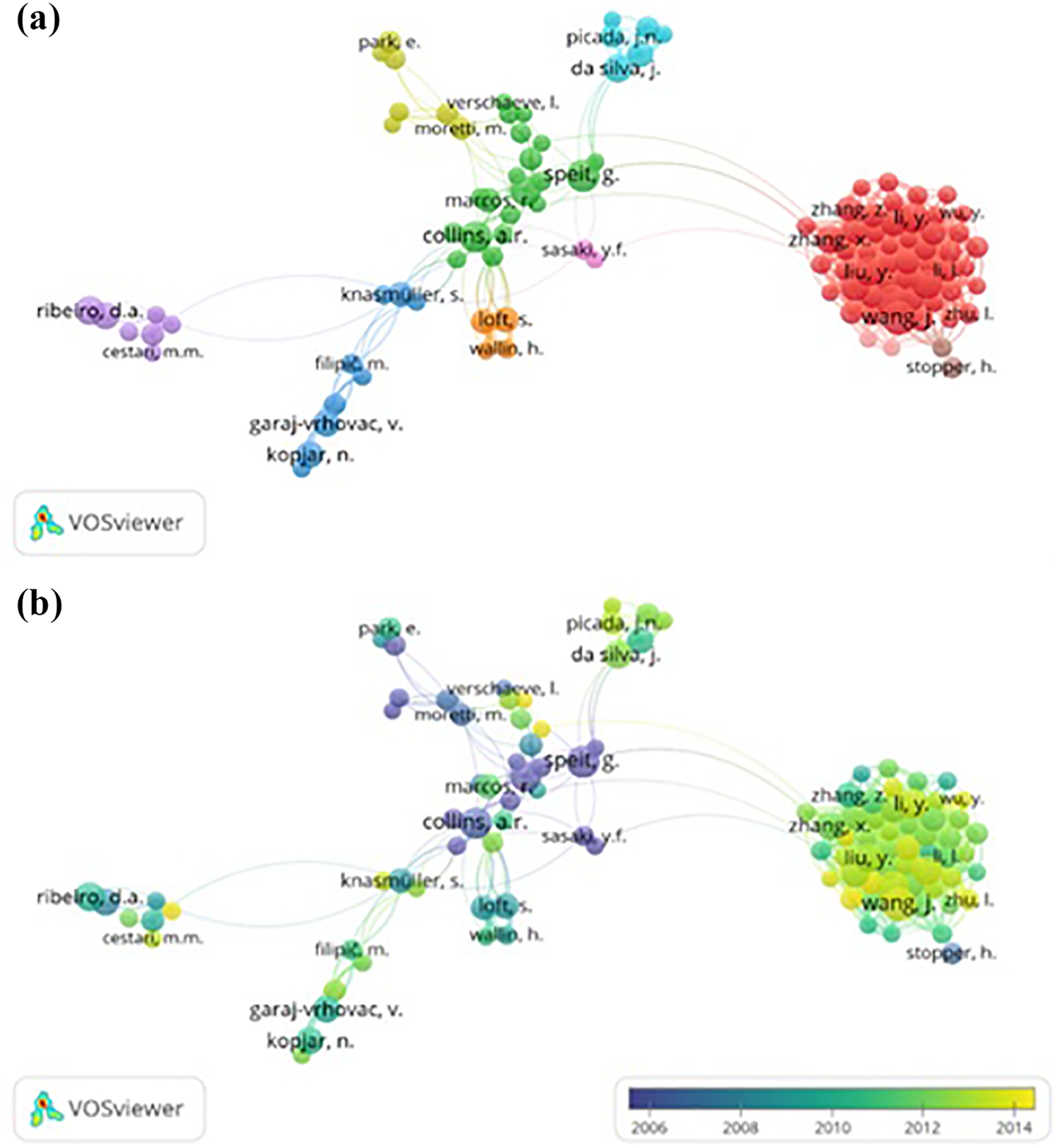
(a) Authorship clusters, representing eight clusters with greater agglutination among Chinese authors and (b) clusters authored by year of publication, Chinese cluster with newer publications than centralized clusters.
Figure 5(b) shows author clusters by year of publication, with older publications in the central clusters of Western European authors being highlighted, and, on the right, the most recent publications of Chinese authors.
In addition, it was analyzed the most frequently found terms in the abstracts of the articles and observed three large clusters with terms present (Figure 6(a)), being the most frequently occurring terms: “Genotoxicity,” “Group,” “Control,” “Lymphocyte,” “Mechanism,” “Cytotoxicity,” “Apoptosis,” “Oxidative Stress,” and “Oxidative Damage.” Among these, it realizes that terms like “catalase,” “ROS,” and “caspase” have more recent occurrences, unlike terms like “lymphocyte” and “radiation” present in publications before 2009 (Figure 6(b)).

(a) Cluster chart of most frequently occurring terms and (b) graph of the relationship between the most frequently occurring terms concerning the year of publication.
The publication with the highest number of citations was AshaRani et al. 34 with 1977 citations, followed by Fairbairn et al. 12 with 1365 citations, and Olive et al. 14 with 1006 citations. In the analysis of the relationship between citations of the 200 most relevant articles, 73 results were found with 58 connected publications, establishing a total of 9 publications clusters (Figure 7). Among the articles connected from Figure 7, the most relevant themes were analyzed through the keyword analysis of each article and the comparison between clusters (Table 1). Most clusters have been found to have similar keyword patterns as DNA damage, DNA repair, and apoptosis. Some clusters have particular characteristics, such as cluster 1 with the predominance of nanoparticle-related articles, cluster 3 with the predominance of articles related to infertility and sperm genetic damage, and cluster 5 with articles related to DNA damage from ionizing radiation.
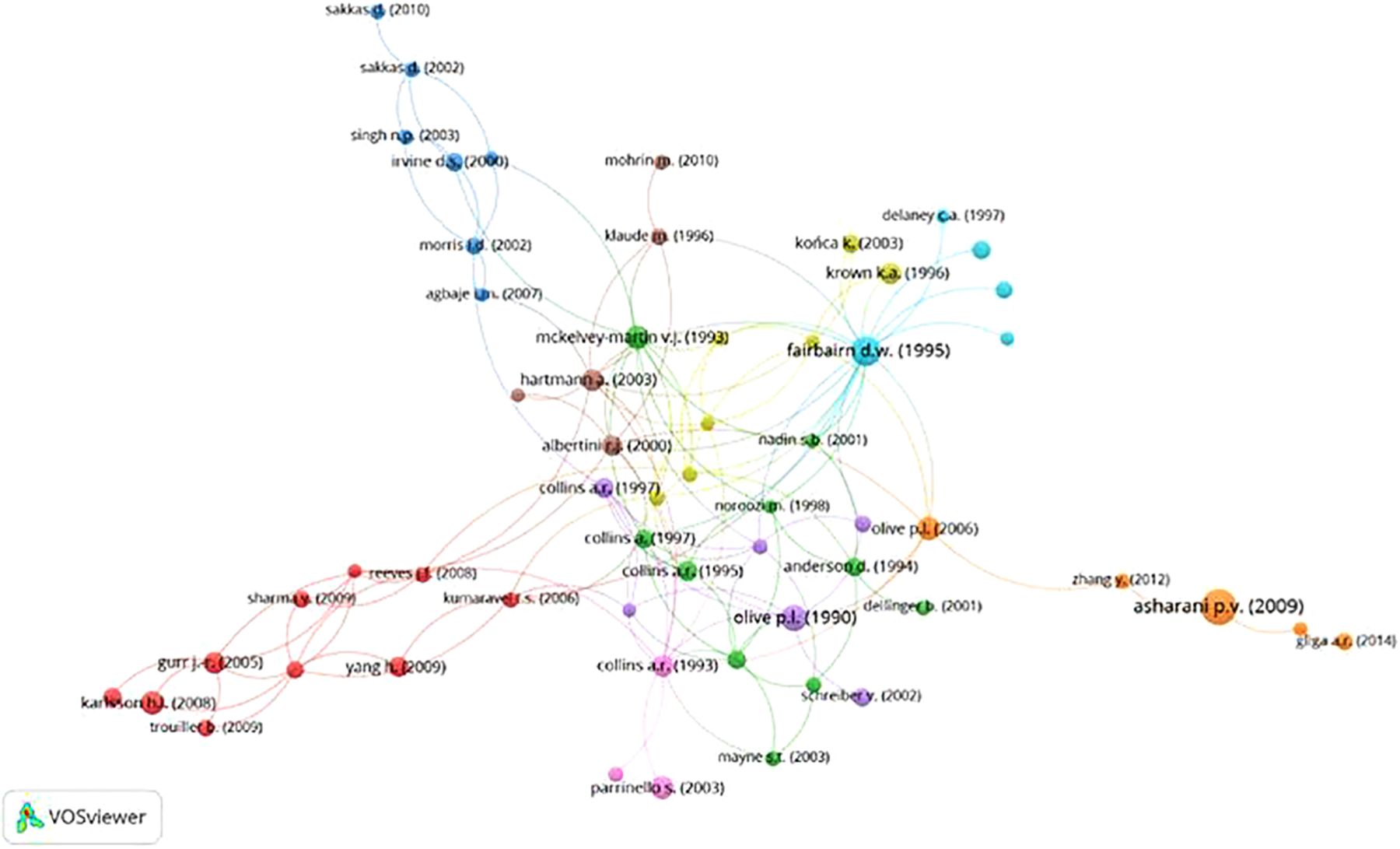
Clusters on citations between authors from the 200 most-cited articles with a minimum of 250 citations. Found 73 results with 58 items connected.
Relevant keywords compared to citation clusters (complete table in Supplemental Material).a

Cit/pub: citations/publications; IF: impact factor.
a A positive correlation was observed when analyzing the total indexes of publications and citations (r = 0.695, p ≤ 0.001). Analysis of the calculation of cit/pub in absolute values and the CiteScore IF also allowed to observe significant value for positive correlation (r = 0.516, p ≤ 0.001; Table 2).
Discussion
Elsevier® Scopus database was employed in this study due to its better coverage of articles related to the subject in question. Mongeon and Paul-Hus 35 point out that both Scopus and the Web of Science present extensive research in biomedical research and natural sciences publications concerning publications in other areas. Also, Falagas et al. 36 also demonstrated better coverage of medical articles on the database.
This assay has called researchers interest, as it was retrieved 13,828 articles from 117 different countries all over 5 continents between the years of 1990 and 2018, 127 articles were presented with undefined countries. In the United States, Japan, and European countries, the scientific production of the CA is more distributed and boosted in BRICS countries such as China, India, and Brazil, countries with a large contingent of studies published in scientific journals.
The present study showed significant growth of publications up to 2014, thus corroborating the findings of Neri et al. 31 who used bibliometric analyses in another database, PubMed, in the period 1990 and 2013. At the time, the authors did not verify a decline in the growth of publications from 2015, because the data occurred in a period after the study. The observations indicated that, among all the evaluated years, the peak in the number of publications occurred in 2014, which coincides with the 30th anniversary of the experiment, in which several journals made room for publications involving the experiment.
Another reason contributing to the most significant number of researches, between 2013 and 2015, is related to changes in the protocol of the experiment, as Collins and Azqueta 37 demonstrated modifications in the protocol to ensure higher sensitivity to the method, or even projects like ComNet for sharing datasets and protocols for the method. 8 Regarding citations, data showed that the articles with the most substantial quantity appeared after the 2000s, a fact that coincides with the consensus of the term “comet assay” to name the method. 31 The data collection period of the present study was stipulated between 1990 and 2018 because it was initially labeled by Olive et al., 14 and a few occurrences before this were unrelated to the method or not indexed in the Scopus database.
It is essential to highlight that the two original articles about the method were not indexed in the search for the Scopus database. The original article on the method described by Ostling and Johanson 10 was cited in 1162 articles and the study by Singh et al. 11 cited by 7597 articles, so if they were indexed in the Scopus database with the tag “comet assay” or any of the search terms, would rank fourth and first in the ranking of the most-cited articles on the method, respectively.
Another observation was that eight clusters of authors are predominant of 13,828 articles. The cluster of Chinese authors demonstrated agglutination, differing from the remaining seven clusters. Several factors may explain this occurrence, such as the exponential growth of the scientific development of the country observed in several areas. This significant Chinese scientific advance in recent years can also be demonstrated by the relationship between the clusters and the year of publication, which shows a higher quantity of recent articles in this group compared to the other groups, thus signifying China’s advance in research using the CA.
There were three significant clusters of terms present in the abstract and, as expected, terms such as “genotoxicity,” “mechanism,” “group,” and “cytotoxicity” were the most common. Some terms such as “ROS” and “caspase” were relatively ROS that refers to “Reactive Oxygen Species,” chemically reactive substances that increase and can cause cellular structural damage. “Caspase” refers to a group of proteases that are associated with cellular apoptosis. The presence of these terms in the most recent articles demonstrates the tendency of the CA scientific production toward genotoxicity. 38,39
The term “lymphocytes” was also highlighted, considering the preferential use over the period evaluated, articles by Collins et al., 40 Anderson et al., 41 Duthie et al., 21 and Mass et al. 42 are articles with a high number of citations that have a preference for lymphocyte analysis. Azqueta and Collins 7 showed that CA utilizes PBMCs, several scientists have gained advantages using other biological fluids such as saliva, sperm, and epithelial cells. 18 It was possible to observe these terms when looking at the citation clusters (Figure 7 and Table 2). Considered as expected behavior, authors cite articles that are related to their themes, thus determining these clusters. Even though in this study, most of these had universal terms in any groups, clusters 1 and 3 had specific terms.
Number of publications and IF of the first 100 journals according to the citation ranking.

IF: impact factor.
a Cit/pub: relationship between number of citations divided the number of publications in absolute values.
b IF: CiteScore IF released by Scopus database (Elsevier Group).
When it was observed the top 100 most cited articles and related to the number of publications, there is a positive correlation between citations and publications, demonstrating that a significant number of relevant articles also shows a higher number of citations. By observing the themes, it is noticed a broad distribution of studies related to the CA, Collins 43 demonstrates in a systematic review that studies related to environmental exposure showed significant results as workers exposed to traffic smoke, ozone, butadiene, radiation, cobalt, mercury, and especially those related to pesticides.
These data corroborate Araldi et al. 18 who found in a review of CA studies for toxicology, biomonitoring, ecogenotoxicity, molecular epidemiology, nutrigenomics, DNA repair studies, nanoparticle genotoxicity assessment, and integrity analysis of mesenchymal stem cells and sperm. Its versatility can be verified unanimously, demonstrated between the themes of scientific productions and the diversity of journals (Table 1).
Concerning IF, Garfield 44 demonstrated a methodology used worldwide to determine the relevance of journals from citations from two previous years. In this case, it is being the data collected by the Scopus database, the IF used by the CiteScore method provided by the Scopus database itself, differing in the number of years of citations, from 2 years to 3 years. Teixeira da Silva and Memon 45 state that CiteScore is a powerful bibliometric tool, more robust, consistent, and unbiased by editorial policies.
The CiteScore has a positive correlation (p ≤ 0.001) with the simple citations/publications (cit/pub) averages, showing that publications on CA are relevant to the IF of journals. The positive correlation between citations and publications, and between the ratio of cit/pub with the CiteScore, demonstrated the importance of this type of research in the IF, a metric assessing the relevance of journals by the number of citations. In addition, it is essential to note that the magazine with the most significant number of publications was Mutation Research—Genetic Toxicology and Environmental Mutagenesis with 821 publications and 27,967 citations, also showing high averages of 28.3 publications and 964.4 citations per year. However, observing values from 1990 to 2018, the journal has a total of 34 citations paper, smaller than many other journals such as Mutagenesis (37 cit/pub), Mutation Research—Fundamental and Molecular Mechanisms of Mutagenesis (47.9 cit/pub), and Carcinogenesis (71 cit/pub).
Conclusion
For over 30 years, CA has been one of the leading methodologies for DNA damage analysis and repair, biomonitoring studies, eco-genotoxic effects, nutrigenomic analysis, and oxidative damage analysis. Its versatility, speed, low cost, and reliability allowed the assay to show a vertiginous growth in scientific production. Although there is a slight decline in publications since 2015, there is vast employability and versatility in the use of the study. Currently, there has been an advance in Chinese scientific production on the subject, most of them having more recent articles than other countries, and there is greater use of the method on oxidative damage researches.
Supplemental material
MATERIAL_SUPLEMENTAR - Evaluation of DNA damage and toxicological methodology development: A bibliometric study
MATERIAL_SUPLEMENTAR for Evaluation of DNA damage and toxicological methodology development: A bibliometric study by FA Nascimento, D de Melo e Silva, HF Nunes and MR Parise in Human & Experimental Toxicology
Footnotes
Declaration of conflicting interests
The author(s) declared no potential conflicts of interest with respect to the research, authorship, and/or publication of this article.
Funding
The author(s) received no financial support for the research, authorship, and/or publication of this article.

Supplemental material
Supplemental material for this article is available online.
References
Supplementary Material
Please find the following supplemental material available below.
For Open Access articles published under a Creative Commons License, all supplemental material carries the same license as the article it is associated with.
For non-Open Access articles published, all supplemental material carries a non-exclusive license, and permission requests for re-use of supplemental material or any part of supplemental material shall be sent directly to the copyright owner as specified in the copyright notice associated with the article.
