




Abstract
The topic of hormesis research funding has been a focus of deliberation within the scientific community for several decades. A common assumption/belief is that most hormesis research is funded by the private sector. With this assumption may emerge questions revolving around potential bias of such research. To provide some clarification to this issue, all hormesis research articles were obtained through online databases for 5-year increments starting with 1995 and ending with 2015 and were subsequently categorized by their funding source. A total of 710 articles were found for those years and 383 of those reported information on funding sources. Reporting funding is not required by law and until more recently was not encouraged or required by funders, research institutions, and/or scientific publishers. The analysis revealed that the assumption that the majority of hormesis research has been privately funded was not supported, with the public sector (i.e. federal and state governmental agencies) exclusively contributing to 78% of the reported research funding. Going forward, funding transparency for scientific research as a whole is essential within the scientific community as it may affect how research may be perceived, accepted, and applied.
Introduction
The hormetic dose–response concept has had considerable scutiny since its discovery in the late 1880s by Hugo Schulz, who reported that a large number of chemical disenfectants enhanced the metabolism and survival of yeast at low doses, while being inhibitory/toxic at high doses. Figure 1 provides a general description of the hormetic dose–response. Several references for background and historical information on the hormetic dose–response are provided. 1 –4 Initially, the hormetic model was caught in a type of cross fire between traditional medicine and homeopathy in the early 1900s and would become collateral damage in their disputes. 1 –3 The hormetic-biphasic dose–response model was used by Hugo Schulz, a professor at the Univesity of Greiswald, Germany, to provide the explanatory principle of homeopathy, thereby enhancing legitamacy to homeopathy as a therapeutic modality. However, the entity that would become traditional medicine attempted to discredit homeopathy, their medical and economic rival. By the early 20th century, traditional medicine had become enormously successful, severely damaging the credibility and acceptance of homeopathy, and by extension, biphasic dose–responses (i.e. then called the Arndt–Schulz Law, and later renamed hormesis 5 ). The threshold dose–response model gradually became adopted by the medical community, being integrated into the fields of pharmacology, and toxicology by leaders within pharmacology such as Alfred J Clark. 6 It became the most widely used dose–response model for government mandated risk assesments for noncarcinogens to the present. In the early 1980s, a resurgence of the biphasic dose–response hormesis model occurred with the first detailed book on radiation hormesis 7 and the first conference on the topic hosted by electric power industries in the United States and Japan in 1985. Also during this time published research in various fields revealed biphasic dose–responses under various terms including hormesis, U- and J-shaped, biphasic, bimodal, and others. The renewal of interest in biphasic dose–responses suggested potential risk assessment applications of this model. Various industries and their trade associations became interested in potentially exploring whether the hormetic model could challenge the legitamacy of the linear-no-threshold (LNT) model for carcinogen risk assessment. Prior attempts to challenge the LNT via the threshold model had been unsuccessful since most animals studies use only a few very high doses and that biostatistical modeling at low doses could not differentiate between the two models. Thus, regulatory agenies would invariably default to the more conservative model (i.e. LNT). The hormetic model offered the potential to challenge LNT due to its being more divergent than the LNT model in the low dose zone than the threshold model. While this generated interest in the hormesis concept, it also brought with it suspicion and apparent opposition from regulatory agencies and certain public interest groups. This historical framework lead to a common belief that hormetic research is funded and influenced most by the regulated private sector. This has the potential to affect how the research community, regulatory agencies, and the public view the legitamacy of the hormesis concept thereby providing the motivation for the present research which sought to assess the sources of hormesis research funding.

Dose–response curve depicting the quantitative features of hormesis. 2
Methodology
To obtain articles published on hormesis, the search term “hormesis or hormetic” was used on both the Web of Science and PubMed databases for five specific years 1995, 2000, 2005, 2010, and 2015. An Excel database was created with information on each obtained article, including the article’s year published, article title, first author, and the journal or publication where it was published. Each article was categorized by the biological model and agent used, as well as its funding source (if any) and what country the funders originated from. If the funding was private (i.e. nongovernmental), what type of private organization (e.g. foundation, commercial) funded the research/article then would be defined and categorized. Articles that could not be translated or obtained were noted. The funding source types include NONE, Public (i.e. federal, state, and other governmental entities, such as state/public universities), Private (e.g. commercial organizations, trade organizations, highly regulated companies such as power companies, hospitals, professional societies, private colleges/universities, and anonymous donors), or Unknown (if the article could not be translated or found). If categorized as NONE, the article did not acknowledge any funding source. Unknown funding source articles were not included in calculations and charts due to not being able to gather pertinent information. Across all years, 12 articles could not be translated and/or found. Charts were then made for the individual years and all the year totals regarding the total count and percent of each type of article. The categories of ‘unknown’ and ‘none’ were not included in comparing between years. Also, each private funding source was characterized by a specific subcategory as noted above.
Results
A total of 710 articles were retrieved with 383 citing funding sources. Figure 2 summarized the proportion of papers showing no funding source, private, public, or combined private and public. These findings indicate a strong trend toward a greater proportion of papers identifying funding sources for hormesis from 2000 to 2015. This was reflected in the trends for public sector funding.The overall most frequent funding source was public with 78% of the reported articles being solely publically funded (Figure 3). The second most frequent category was the combined public and private grouping funded at 16%, then lastly private at 6% of the reported articles. The private sources of funding were principally from nonprofits including foundations and charities, making up 54% of the private funders. The next most frequent grouping was pharmaceutical manufacturing companies comprising 13% (Figure 4). Other types of private funding came from chemical manufacturers (2%), staffing agencies (1%), lobby groups (2%), private universities, colleges, hospitals and professional societies (4%), trade association (3%), power companies (7%), commodity checkoff programs (1%), federal crown corporations (1%), independent research facilities (8%), animal feed manufacturers (1%), cooperative governmental frameworks (1%), and anonymous donors (1%).
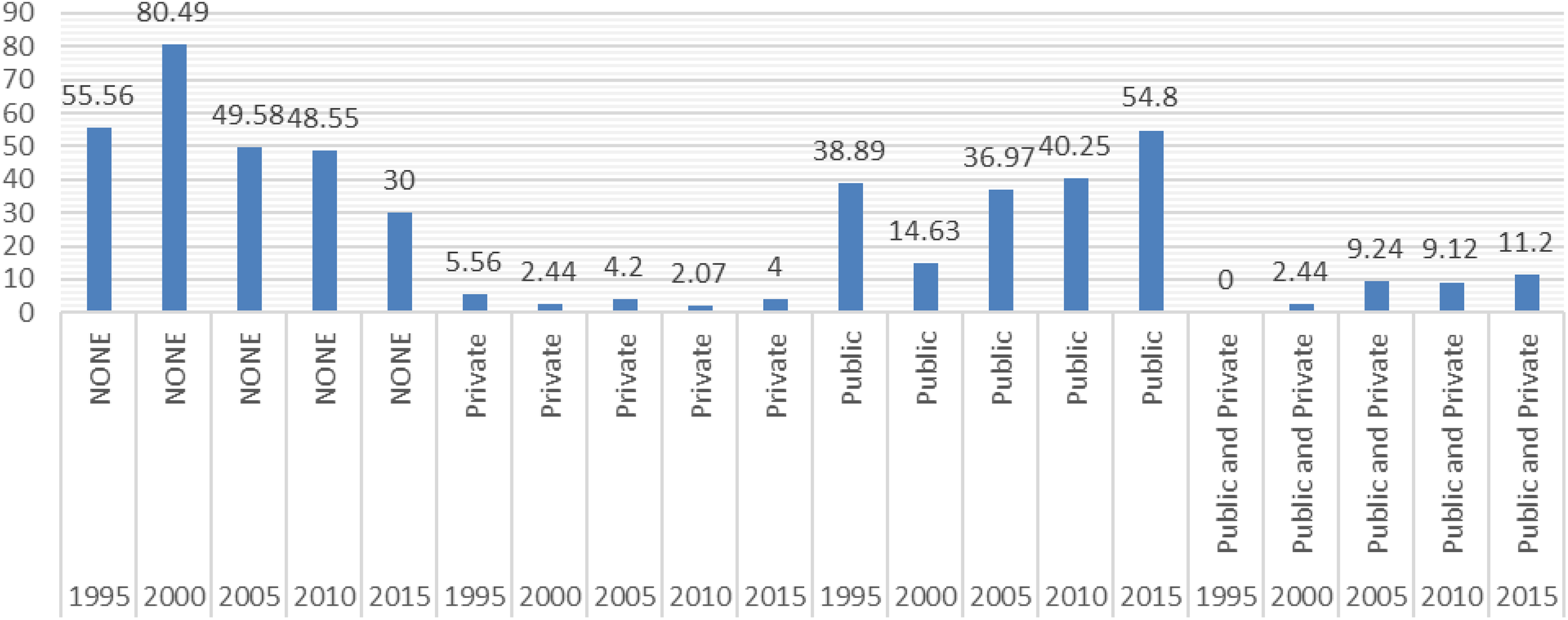
Percent of studies over time. Starting with 1995 and ending with 2015, trends by type of funding source over time are shown. Disclosing funding sources in hormetic research articles overall increased over the 20-year time period. Over time, the private sector has provided between 2% and 6% of hormetic funding. Public funding has overall increased. The percent of articles that received public and private funding also increased over the 20-year time period.

Percent of articles by type. Articles were categorized as being solely publicly funded, solely privately funded, or having had received both public and private funding. The solely publicly funded articles made up 78% of the articles that disclosed funding. The solely privately funded articles made up 6% of the articles that disclosed funding. Sixteen percent of articles that disclosed their funding sources had both private and public funding.

Count of private funding sources by type. Private funding sources were classified by their type and the number in each category was calculated. The most common funding source category was charities, foundations, and nonprofit funding.
Discussion
The present findings reveal that nearly 80% of the published research identified by the key words hormesis or hormetic in the peer-reviewed literature as given in PubMed and the Web of Science was funded by public sector sources. This trend was consistent over the 20 years of evalution. These findings were unexpected since it was assumed that the funding sources for the hormesis research would have been principally from private sources. This raises the question of why would the idea that most hormesis-related research be funded by private organziations be apparently incorrect? We speculate that most of the published hormetic dose–response findings were the result of unexpected findings and now were interpreted within an hormetic context, using the hormesis or hormetic terms.
There was much research published during this same period that showed hormetic findings but where authors used other descriptive terms (e.g. biphasic, U-shaped). These papers would not have been detected and classified in the present study. In fact, previous assessments of the hormetic database 8 estimate that nearly 80% of articles that show hormetic dose–responses did not use the terms hormesis or hormetic as key words. The present paper has not evaluated the funding sources of published papers that reported findings consistant with an hormetic interpretation but where the hormetic or hormesis terms were not used. Despite these limiting factors, the present research provides insight into which groups have been funding hormesis research. Furthermore, these findings do not provide evidence that private sector organizations have been very active in supporting hormesis research with a direct linkage to the term hormesis. Thus, it appears that supporting hormesis research does not appear to have been a broad and active strategy by the private sector to influence regulatory processes. If one were to assume that most hormetic-like biphasic dose research which did not use the term hormesis or hormetic were probably not funded by private sources intent on promoting hormesis, then it suggests the proportion of hormesis research intentionally funded by the private sector overall is far less than 10%.
Finally, funding transparency is very important in terms of placing research in context. By knowing what entities fund research, it permits potential insight into the nature of the hypotheses selected for evaluation. Hypothesis selection is critical as it clearly can reflect the interests of the research sponsor and therefore providing a broader and deeper research framework.
Conclusions
The public sector provides the most funding for hormetic research (78%).
The most common funding sources in the private sector are charities, foundations, and nonprofits at 55% of all disclosed private funding sources.
Footnotes
Authors’ note
The views and conclusions contained herein are those of the authors and should not be interpreted as necessarily representing policies or endorsement, either expressed or implied. Sponsors had no involvement in study design, collection, analysis, interpretation, writing and decision to and where to submit for publication consideration.
Acknowledgement
EJC acknowledges longtime support from the US Air Force and ExxonMobil Foundation.
Declaration of Conflicting Interests
The author(s) declared no potential conflicts of interest with respect to the research, authorship, and/or publication of this article.
Funding
The author(s) disclosed receipt of the following financial support for the research, authorship, and/or publication of this article: This work was financially supported by the US Air Force (AFOSR FA9550-13-1-0047) and ExxonMobil Foundation (S18200000000256).
