




Abstract
Lung cancer is responsible for increase in mortality due to cancer-related deaths, and new approaches are being explored for the betterment of the situation. In the present study, chemopreventive efficacy of curcumin and quercetin was investigated against benzo(a)pyrene (BP)-induced lung carcinogenesis. The mice were segregated into five groups, which included normal control, BP-treated, BP + curcumin-treated, BP + quercetin-treated, and BP + curcumin + quercetin-treated groups. The morphological and histological analyses of tumor nodules confirmed lung carcinogenesis22 weeks after weeks single intraperitoneal injection of BP at a dose of 100 mg/kg body weight to mice. Curcumin and quercetin when administered individually as well as in combination significantly elevated the expression of acetylated-p53, which was otherwise depressed due to BP treatment. Also, both the phytochemicals significantly reduced the BP-inflicted increased levels of phosphorylated-p53. Furthermore, observed increase in the number of apoptotic cells by terminal deoxynucleotidyl transferase dUTP nick end labeling (TUNEL), assay and increased activities of caspase 3 and 9 confirmed the induction of apoptosis by curcumin and quercetin. Moreover, the histological slides also showed noticeable improvement in the histoarchitecture of lungs by phytochemicals. The present study concludes that prophylactic treatment with curcumin and quercetin induces apoptosis in the lungs by modulation of p53 posttranslational modifications.
Introduction
Lung cancer is the major cause of cancer mortality worldwide. 1 Further, cigarette smoking is the prime cause in 90% of lung cancer cases. 2 The important symptoms of lung cancer progression includes chronic cough with bloody sputum, repeated respiratory infections, and difficulty in breathing. 3
p53 is the most common gene that undergoes mutation during cancer and is responsible for playing important roles in cell cycle check points, apoptosis, and genomic stability. 4 P53 with mutation act as an oncogene that further confers proliferative advantage to cells sustaining genetic damage. 5 Abrogation of p53 function is an essential requirement for the development of lung tumor. Apart from being mutated, p53 could undergo several posttranslational modifications such as phosphorylation of serines, threonines, acetylation, ubiquitylation, and sumoylation of lysine residues. 6 While the normal p53 is apparently stabilized by the modifications in order to carry out its basic functions, the modifications in the mutated form of p53 often leads to harm. 7 The main thrust of our study was to explore phosphorylation and acetylation of p53 involved in the progression of lung carcinogenesis. Phosphorylation of normal p53 allows the p53 to carry out its primary functions with enhanced stability. However, phosphorylation of mutated form of p53 could lead to its accumulation as well as acquisition of functions that actually promote tumor development and metastasis. 8 On the other hand, phosphorylation of normal p53 at serine 15 residues signified its prospective role in carcinogenesis. 9 Acetylation of p53 has been shown to augment p53 DNA binding and to stimulate p53-mediated transactivation of target genes through the recruitment of coactivators. 10 Moreover, acetylation of p53 at carboxy-terminal lysine residues resulted in enhanced transcriptional activity associated with cell cycle arrest and apoptosis. 11
Cancer chemoprevention uses natural, synthetic, or biological chemical agents to prevent carcinogenic progression. In the present study, curcumin and quercetin are the phytochemicals of prime interest. Curcumin has been accounted for exhibiting its antitumor role in cancer cells by altering the deregulated cell cycle via cyclin-dependent, p53-dependent, and p53-independent pathways. 12 On the other hand, quercetin is an established anticancer compound and has displayed antiproliferative properties in numerous cancer cell lines and animal models. 13 Quercetin has been reported to stabilize p53. 14 So, in light of abovementioned facts, we evaluated the response of curcumin and quercetin individually as well as in combination, in modulation of the posttranslational modifications of p53 during lung carcinogenesis.
Materials and methods
Animals
Male laka mice weighing of 18–20 g were procured from the central animal house, The Affiliated XuZhou Hospital of Medical College of Southeast University, Xuzhou, Jiangsu Province, China, strictly in accordance with the ethics approval outlined by the institutional ethical committee. The animals were housed in polypropylene cages under hygienic conditions in the departmental animal house.
Experimental design
Animals were segregated equally and randomly into five treatment groups. Animals in group I served as normal control and were administered corn oil intraperitoneally, which was used as a vehicle for the benzo(a)pyrene (BP)-treated animals. Animals in group II were given a single intraperitoneal injection of BP in corn oil at a dose level of 100mg/kg body weight. 15 Group III animals were given curcumin orally in drinking water at a dose level of 60 mg/kg/body weight, thrice a week. 15 Animals in group IV were given quercetin orally at a dose level of 40mg/kg/body weight in drinking water, thrice a week. 16 Both the phytochemicals were given to animals using intubation gavage technique. Animals in group V were given a combined treatment of both curcumin and quercetin at similar dose rates. The animals were subjected to treatment with phytochemicals, 10 days prior to single BP injection. All the animals had free access to the diet and water. Treatment with phytochemicals was continued for a total duration of 22 weeks.
Analyses of lung tumor incidence
After the terminal sacrifice following 22 weeks, lungs were excised from the mice, blot dried, and examined for the visible macroscopic lesions and tumor incidence calculation.
Western transfer analyses
The modulation of p53 and regulation of apoptosis by curcumin and quercetin was studied by analyzing the protein expressions of various genes, namely, p53, phosphor-P53, acetylated-P53, P21, Bcl2, and Bax 22 weeks after all treatments. Densitometric analyses of the bands were performed by Image J software (NIH).
Caspase 3 and Caspase 9 assay
Enzyme activities of caspase 3 and caspase 9 were assayed using Biovision Colorimetric Assay Kit.
TUNEL assay
The procedure was carried out according to the instructions given in the Trevigen (Gaithersburg, MD, USA) TACS-XL-blue label in situ apoptosis detection kit.
Histo-pathological studies
For the histo-pathological observations at a light microscopic level, fresh tissue pieces of mice were fixed in formalin. Following an overnight fixation, the specimens were dehydrated in ascending grades of alcohol, cleared in benzene, and embedded in paraffin wax. Blocks were made and 5–7-μm-thick sections were stained with H and E staining.
Statistical analyses
The statistical significance was determined using one-way analysis of variance (ANOVA) followed by a multiple post hoc least significant difference test. The results were represented as means ± SD.
Results
Body weight changes and Lung weights changes
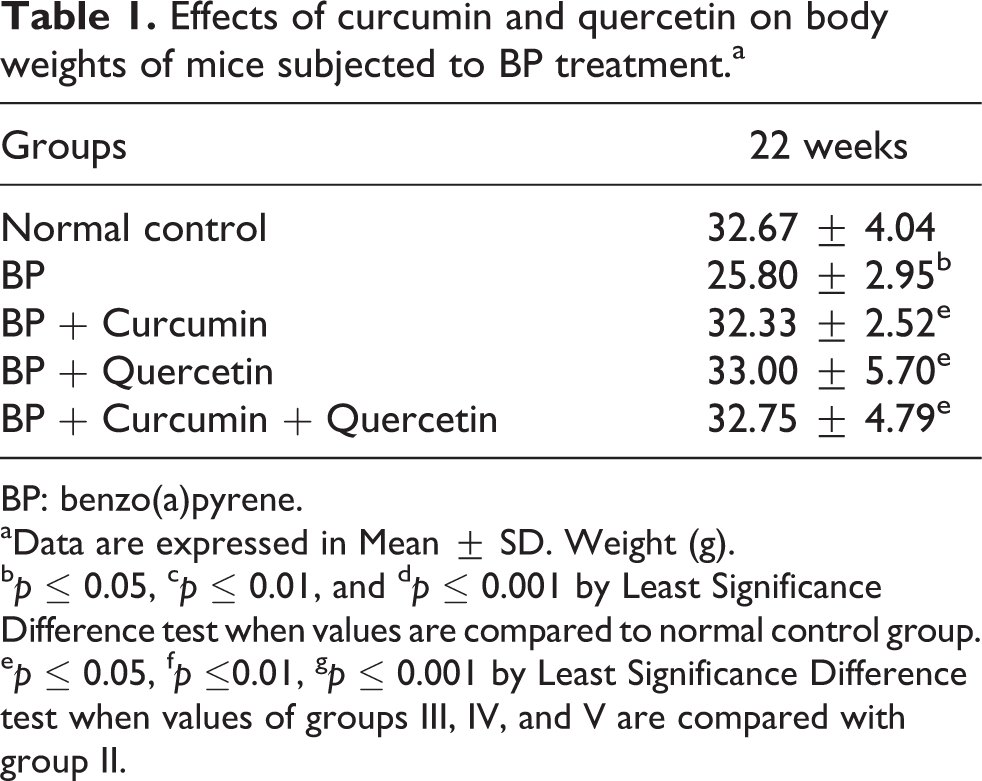
BP treatment resulted in a significant decrease in the body weights in comparison to the normal control rats (Table 1). Supplementation of BP-treated mice with curcumin and quercetin separately as well as in combination improved the body weight growth. However, no significant changes in food and water consumption were observed among various groups of animals. Further, BP treatment significantly increased (Table 2) the lung weights of animals when compared with normal controls. Further, an appreciable moderation was noticed in lung weights following treatments with curcumin and quercetin both separately as well as in combination.
Effects of curcumin and quercetin on body weights of mice subjected to BP treatment.a
BP: benzo(a)pyrene.
aData are expressed in Mean ± SD. Weight (g).
b
p
e
p
Effects of curcumin and quercetin on lung weights of mice subjected to BP treatment.a

BP: benzo(a)pyrene.
aData are expressed in Mean ± SD. Weight (mg).
b
p
e
p
Macroscopic view of tumors
Figure 1(a) shows lung lobes from normal mice. Tumor nodules along with inflammation were observed in the lungs of mice treated with BP (Figures 1(b) to 1(d)). Curcumin and quercetin supplementation separately as well as in combination to BP- treated mice showed a marked decrease in the number of tumor nodules (Figures 1(e) to 1(g)). However, signs of mild inflammation were still visible in Figures 1(e) and 1(f), though the inflammation was appreciably less in BP-treated mice given combined treatment (Figure 1(g)). This observation enlightened the benefit of combination treatment in chemoprevention.

Effects of curcumin and quercetin on macroscopic view of lungs during BP-induced lung carcinogenesis. BP: benzo(a)pyrene.
Lung tumor incidence analyses:
The lung tumor incidence of about 95% was observed in the mice subjected to BP treatment (Table 3). When curcumin and quercetin were administered separately to BP-treated mice, an appreciable decrease in the tumor incidence was observed in both the groups 3 and 4. Interestingly, combined treatment with these two phytochemicals showed maximum reduction.
Effects of 22 weeks of curcumin and quercetin treatments on the tumor incidence of mice subjected to BP treatment.

BP: benzo(a)pyrene.
Western transfer studies
Western transfer studies revealed an increased expression of p53 as well as phosphorylated-p53 in all the BP-treated groups (Figure 2) in comparison to control group. Supplementation with phytochemicals individually, as well in combination, did not bring about any significant change in p53 expression. However, supplementation with phytochemicals to BP-treated animals showed a significant decrease in the protein expression of phosphorylated p53. Moreover, combined phytochemicals treatment group showed additional decrease in the expression of phosphorylated p53. On the contrary, a significant decrease in the acetylation of p53 in the lungs of BP-treated group was noticed. However, synergistic as well as individual supplementation with curcumin and quercetin to BP-treated mice affected a significant increase in the protein expression of acetylated p53. Here again, combination treatment seemed to be more beneficial. Further, a significant increase in the protein expression of bcl2 and significant decreases in the protein expressions of p21 as well as bax were noticed in the lungs of mice treated with BP. On the other hand, supplementation with phytochemicals separately as well in combined form resulted in a significant decrease in the expression of bcl2. Moreover, significant improvements in protein expressions of both p21 as well as bax were observed upon phytochemicals supplementation.

Effects of curcumin and quercetin treatment for 22 weeks on epigenetic changes in p53 and regulation of apoptosis by Western transfer analyses of p53, phosphor-p-53, acetylated-p53, p21, bcl2, and bax during BP-induced lung carcinogenesis. BP: benzo(a)pyrene.
Caspase 3 and 9 activities
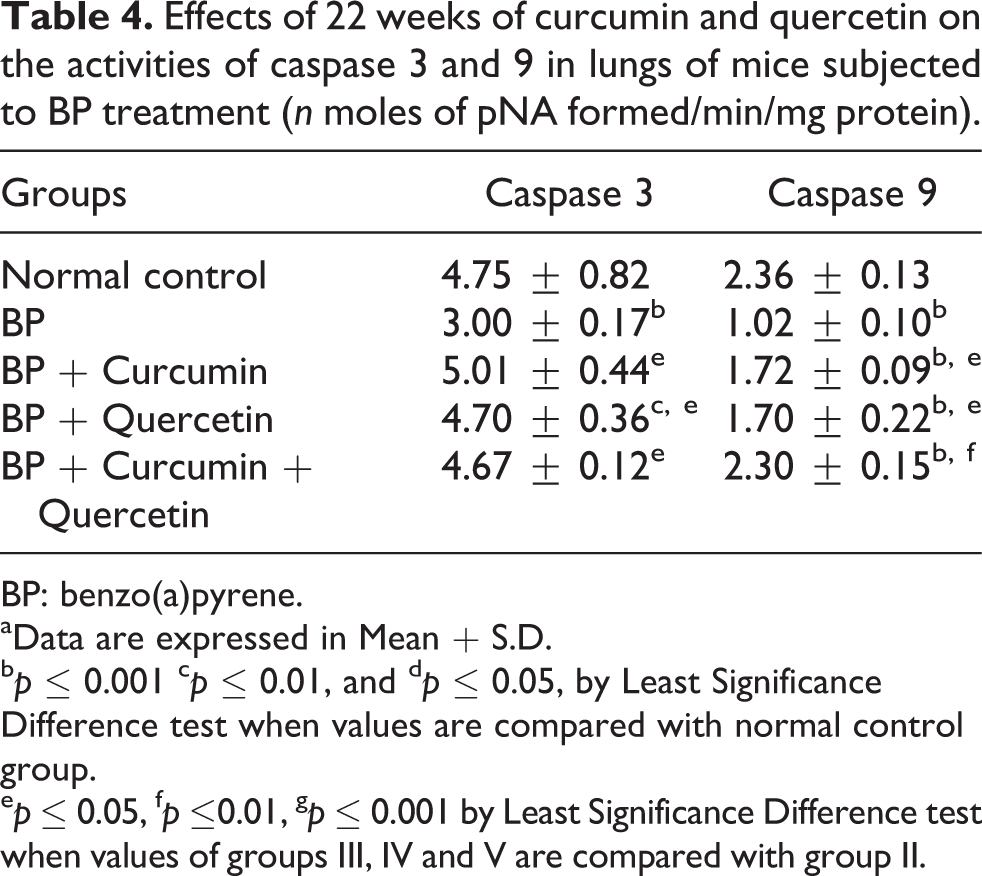
Activities of caspase 3 and 9 were significantly reduced in the lungs of mice treated with BP when compared with the normal controls (Table 4). Supplementation with curcumin and quercetin separately as well as in combination to BP-treated animals was able to significantly increase the activities of caspase 9 as well as caspase 3.
Effects of 22 weeks of curcumin and quercetin on the activities of caspase 3 and 9 in lungs of mice subjected to BP treatment (n moles of pNA formed/min/mg protein).
BP: benzo(a)pyrene.
aData are expressed in Mean
b
p
e
p
Terminal deoxynucleotidyl transferase dUTP nick end labeling (TUNEL) assay
A significant decrease in the number of apoptotic cells (stained blue) was seen in the lungs of mice treated with BP after performing TUNEL assay (Figure 3). Further, treatment with curcumin as well as quercetin separately as well as in combination significantly induced apoptosis in the BP-treated mice as substantiated by an appreciable increase in apoptotic cells. Moreover, combination treatment with curcumin and quercetin showed an edge in inducing apoptosis when compared to individual treatment groups.

Effects of curcumin and quercetin on apoptosis in lungs by terminal deoxynucleotidyl transferase dUTP nick end labeling (TUNEL) assay (magnification = 40×) in lungs during BP-induced lung carcinogenesis. BP: benzo(a)pyrene.
Histopathology
Tissue sections of group I animals displayed normal lung architecture (Figure 4; LMG 1). In the BP-treated group II animals (Figure 4; LMG 2), well-differentiated signs of lung carcinogenesis were observed. Nuclei got enlarged and the thickening of epithelium was visible. Structure-less masses of cells were visible all over. Nuclear pleomorphism and decreased cytoplasmic contents were also observed in BP-treated mice. Squamous epithelial metaplasia, severe epithelial thickening, and alveolar vacuolization in distal airways indicative of lung carcinogenesis were also observed. Also, cells were hyperchromatic and showed increased mitotic activity (Figure 4, LMG 2). When curcumin and quercetin were given separately to BP-treated animals (Figure 4, LMG 3 & 4), histoarchitecture revealed mild improvements. The epithelial linings significantly reduced in thickness. The size and shape of the cells appeared near normal (Figure 4, LMG 4). Hyperchromatic nuclei were present occasionally. Moreover, tissue from BP-treated animals given combined treatment of quercetin and curcumin (Figure 4, LMG 5) showed noticeable improvement in the histoarchitecture of lungs.

Effects of 22 weeks of curcumin and quercetin treatments on histoarchitectural changes in lungs during BP-induced lung carcinogenesis (magnification = ×40). BP: benzo(a)pyrene.
Discussion
In the present study, phytochemicals curcumin and quercetin, when administered separately as well as in combined form, were able to modulate the posttranslational modifications of p53, apoptosis as well as the histoarchitecture of the lungs of mice treated with BP. The body weights of BP-treated mice showed significant decrease. This decrease in body weights might be due to cachexia in which the tumor induces metabolic changes in the host leading to loss of adipose tissue and skeletal muscle mass. 17 Further, the lung weights of BP-treated rats were found to be significantly higher than those of normal controls. The increase in the lung weights might be due to inflammation. 18 Furthermore, significant reduction in lung weights upon supplementation with phytochemicals confirmed their anti-inflammatory potential. 19–20
In the present study, BP treatment resulted in a significant increase in p53 protein expression which could be due to chemical damage imposed by BP. 21 Although this is a defense mechanism to ward off untoward changes in the system but due to DNA damage, p53 is mutated and hence not able to function normally. Also, significant increase in the phosphorylation was noticed in p53 which might be have helped the stabilization of the inactive p53 protein. 22 Supplementation with curcumin and quercetin individually as well as in combination brought a significant decrease in the expressions of phosphorylated p53 in lungs of BP-treated mice. The observed decrease in the phosphorylation of p53 might be the result of synergistic modulatory effects of phytochemicals on p53 so as to improve its tumor suppression activity. Acetylation of p53 prevents its degradation, thereby prolonging its life and enhancing its ability to bind target genes. 10 In our study, lungs of BP-treated mice have shown decreased levels of acetylated p53 (lysine 382). On the other hand, administration of curcumin and quercetin in combined form to BP-treated mice had significantly enhanced the levels of acetylated p53. This might be due to the property of curcumin by virtue of which it possesses the HDAC inhibitor function, which in turn enhanced the levels of acetylated p53. 23 So, curcumin and quercetin might have acted collectively in the combined treatment group in order to steady the p53 protein.
The expression of p21 showed a significant decrease in the BP treatment. The low expression of p21 might be due to the altered expression of p53, as p53 regulates the expression of p21. The improved expression of p21 in the combined treated group might be due to synergistic effects of curcumin and quercetin. 24,25 Further, combination of phytochemicals resulted in a significant rise in the apoptosis as evident by TUNEL assay. Moreover, curcumin and quercetin were able to increase the activities of caspase 3 and 9 enzymes which otherwise were found to be decreased in BP-treated mice. Also, apoptosis favoring protein expressions of both bcl2 and bax were recorded in the present study. The significant improvement in the abovementioned factors might be due to improved stability of p53 by phytochemical-induced acetylation. Also, curcumin and quercetin has been reported in earlier studies to induce apoptosis. 26,27 Further, histological changes correlated well with the molecular alterations as described previously. When curcumin and quercetin were administered to BP-treated mice separately as well as in combination, an improvement was seen in the histoarchitecture of the lungs.
Conclusions
From these observations, it could be concluded that both curcumin and quercetin have ability to modulate p53 posttranslational modifications which in turn make p53 more efficient as well as stable to efficiently fight against cancer.
Footnotes
Declaration of Conflicting Interests
The author(s) declared no potential conflicts of interest with respect to the research, authorship, and/or publication of this article.
Funding
The author(s) received no financial support for the research, authorship, and/or publication of this article.