



Abstract
The present study was undertaken to evaluate the effect of diallylsulphide (DAS) against mercuric chloride (HgCl2)-induced oxidative stress in rat livers. Rats were randomly divided into four groups of six rats each and exposed to HgCl2 (50 mg/kg/body weight (b.w.)) intraperitoneally and/or DAS (200 mg/kg/b.w.) by gavage. HgCl2 administration enhanced alanine aminotransferase (AST) and aspartate aminotransferase (ALT) levels (p < 0.05) with reduction in the levels of superoxide dismutase (SOD), catalase (CAT) and glutathione peroxidase (GSH-Px). However, treatment with DAS markedly attenuated HgCl2-induced biochemical alterations in liver and serum transaminases (AST and ALT; p < 0.05). Further, biochemical results were confirmed by histopathological changes as compared to HgCl2-intoxicated rats. Histopathology of liver also showed that administration of DAS significantly reduced the damage generated by HgCl2. The present study suggests that DAS shows antioxidant activity and plays a protective role against mercury-induced oxidative damage in the rat livers.
Introduction
It has been reported earlier that mercury (Hg) is a widespread environmental and industrial pollutant, which induces severe alterations in the tissues of both animals and men. 1,2 Mercuric chloride (HgCl2) from industries when released in water causes morbidity and mortality in humans consuming seafood including fish. Although strict regulations now limit the discharge of HgCl2 directly into bodies of water, indirect contamination continues.
Many environmental contaminants have been reported to disturb the pro-oxidant or antioxidant balance of the cells thereby inducing oxidative stress. 3 Oxidative stress in biological systems originates as the result of an imbalance between the generation of oxidizing species and cellular antioxidant defence. 3,4 Toxicity of HgCl2 can lead to lipid peroxidation in the kidney, liver and other tissues of the rats and mice following parenteral administration of HgCl2. 1,5 Previous studies showed that the mechanism of toxicity of Hg could be via binding to thiol groups. 6
Fruits, vitamins, spices and other several herbs have been shown to be rich sources of cancer chemopreventive agents with diversified pharmacological properties. 7,8 Many such agents possess antioxidant and free radical scavenging properties. 9 –13 Garlic and its organosulphur compounds have earlier been shown to be protective against chemically induced toxicity and carcinogenesis. 14 –16
The Allium genus of vegetables includes garlic, onion, leeks, scallions, chives and shallots. These vegetables are characterized by a composition that is high in flavonols and organosulphur compounds. Furthermore, in vitro and in vivo experimental investigations have provided evidences that organosulphur compounds, present in high amount in Allium vegetables, account for their anticarcinogenic activity. 13,17 –21 Fresh and grounded garlic has been shown to inhibit cancer, caused by polycyclic aromatic hydrocarbons and nitrosoamines. 22 Garlic has been thought to metabolize into diallylsulphide (DAS) and allyl methyl sulphide and show protection through a number of mechanisms such as increasing glutathione levels, increasing the activities of enzymes such as glutathione-S-transferase, catalase, inhibition of cytochrome P4502E1, DNA repair mechanisms, prevention of chromosomal damage and so on. 18,23,24
Since DAS is a major component of garlic, which is known to possess antioxidant properties, 25,26 the aim of the present study is to determine the effect of DAS on HgCl2-induced oxidative stress and toxicity in rats.
Materials and methods
Chemicals
HgCl2, DAS, alanine aminotransferase (AST) and aspartate aminotransferase (ALT) kits and all other necessary reagents of analytical grade were bought from Sigma-Aldrich Chemicals Co., (St Louis, Missouri, USA).
Maintenance of animals
Male Wistar rats weighing approximately 180–200 g were obtained from the Animal Breeding Laboratory, and kept in the Central Animal House Facility of the Institute. Different groups of animals were used to study the effects of DAS on Hg-induced oxidative stress. The animals were acclimatized for a month prior to experiments. The institutional ethics committee approved the experimental protocols. All the animals used in this study were placed in cages in an air-conditioned room maintained at 22–23°C with 12-h light/12-h dark cycle.
Experimental protocol
Twenty-four Wistar rats were randomly divided into four groups (six rats in each group). Group I received saline injection intraperitoneally (0.85% sodium chloride) at a dose of 10 mL/kg bodyweight. Group II received a single intraperitoneal injection of HgCl2 at a dose of 50 mg/kg bodyweight. The last two groups (III and IV) were treated with DAS once a day for a period of 1 week administered through gavage at a dose of 200 mg/kg body weight. Twenty-four hours after the last treatment of DAS, the animals of groups IV received a single intraperitoneal injection of HgCl2 at a dose level of 50 mg/kg body weight. The animals were euthanized under mild ether anesthesia after 24 h of administration of HgCl2.
Blood samples were collected in tubes for biochemical analysis by the cardiac puncture method. Blood samples were centrifuged for 10 min at 3000 r/min to separate the serum. After blood collection, the animals were killed using ether anesthesia, and the liver tissue was harvested for biochemical and histopathological studies.
Livers were carefully removed, washed in ice-cold 50 mM Tris-hydrochloride (HCl), pH 7.4 and homogenized immediately to give 10% (w/v) homogenate in ice-cold medium that contained 50 mM Tris-HCl, pH 7.4. The homogenates were centrifuged at 3000 r/min for 10 min at 4°C. The supernatants were used for the various biochemical determinations. The total protein content of the homogenized livers was determined by Lowry’s method 27 using bovine serum albumin as a standard.
Serum biochemical assays
For enzymatic antioxidant status, liver homogenates were used for the determination of SOD activity. 28 SOD enzyme had the ability to inhibit the phenazine methosulphate-mediated reduction of nitroblue tetrazolium dye then absorbance was measured at 560 nm for 5 min at 25°C. Before determination of the CAT activity, liver homogenates were diluted 1:9 with 1% (v/v) Triton X-100. CAT activity was measured according to the method described by Aebi 29 by assaying the hydrolysis of hydrogen peroxide (H2O2) and the resulting decrease in absorbance at 240 nm over a 3-min period at 25°C. CAT activity is expressed as IU/mg protein. GPx activity was measured using H2O2 as substrate according to the method described by Paglia and Valentine. 30 The reaction was monitored indirectly as the oxidation rate of nicotinamide adenine dinucleotide phosphate at 240 nm for 3 min. Enzyme activity was expressed as U/mg protein. The activities of ALT and AST were determined by commercial kits using spectrophotometer (Shimadzu UV-160U, Japan).
Histological examinations
Small pieces of liver tissue were used for histopathological studies. Sections of 5 µm thickness were cut using rotary microtome (Leica Microsystems, Germany), stained with haematoxylin–eosin and examined under light microscope (Nikon Eclipse E600, Japan).
Statistical analysis
Results were analysed using SPSS software (version 22) and expressed as the mean ± standard error of the mean (SEM). One-way analysis of variance was applied to test the significance of biochemical data of the different groups. Significance is set at p < 0.05.
Results
Determination of hepatic toxicity markers AST and ALT
In the present study, the activities of AST and ALT were significantly increased in serum of rats treated with HgCl2 compared to their respective control group (I) (p < 0.5; Table 1). Pretreatment of the rats with DAS in Hg-treated group (III) caused a significant reduction in the levels of AST and ALT (p < 0.5) as compared to group II. However, the activities of AST and ALT did not show any change in group III rats (DAS-treated only) as compared to control group (I).
Effect of DAS on Hg-induced on serum alanine AST and ALT levels.a

AST: aminotransferase; ALT: aspartate aminotransferase; HgCl2: mercuric chloride; DAS: diallylsulphide.
aAll values are mean ± SEM, n = 6.
bp < 0.05: group I versus group II.
cp < 0.05: group II versus group IV
DAS-mitigated Hg-induced hepatotoxicity by modulating the antioxidant defence system
Effect of HgCl2 in liver of rats was examined by measuring the activities of SOD, CAT and GPx enzymes. As shown in Table 2, HgCl2 administration (group II) led to modulation of antioxidant enzymes relative to the control rats. HgCl2 administration led to decrease in SOD, CAT and GPx activities in the liver homogenates significantly (p < 0.05) compared with the control (group II). On the other hand, DAS pretreatment (group IV) elevated the activities of SOD, CAT and GPx significantly (p < 0.05) compared with the HgCl2 group II. No change in the activities of enzymes was observed in DAS-pretreated group IV versus control group I and group III.
Effect of DAS on Hg-induced SOD, CAT, and GSH-Px levels.a
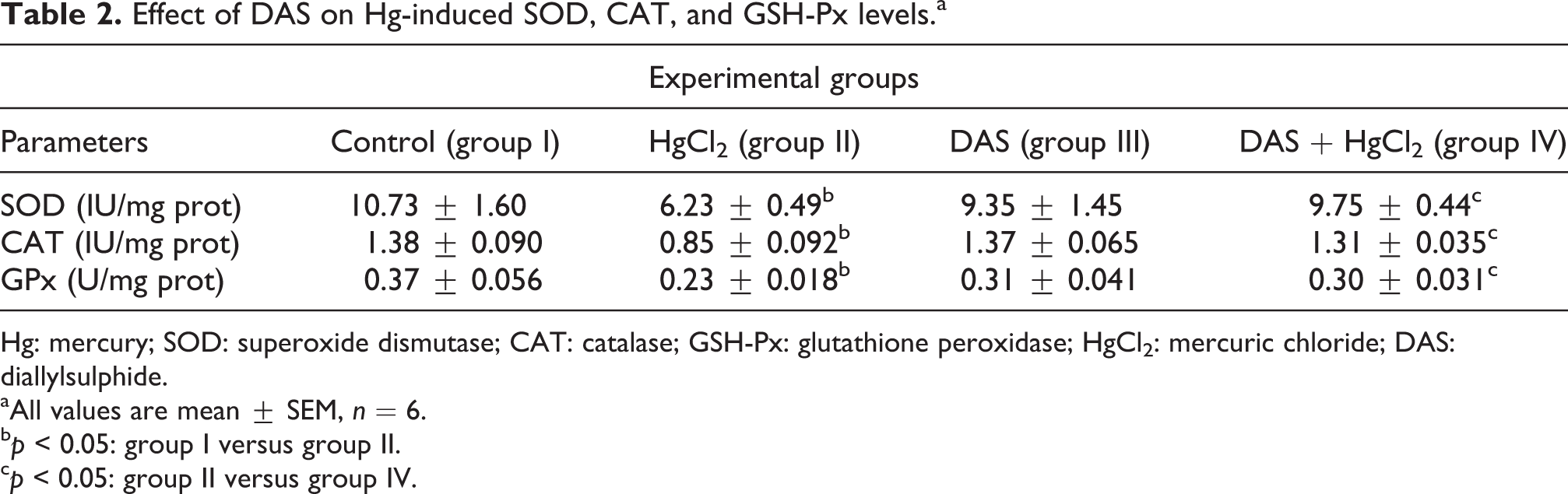
Hg: mercury; SOD: superoxide dismutase; CAT: catalase; GSH-Px: glutathione peroxidase; HgCl2: mercuric chloride; DAS: diallylsulphide.
aAll values are mean ± SEM, n = 6.
bp < 0.05: group I versus group II.
cp < 0.05: group II versus group IV.
Histopathological investigation
Microscopic examination of the liver cells was performed, and the histopathological slides shown in Figure 1 (group I) highlights the hepatic histology of the control rats (group I). No pathological changes are shown, architecture of the liver cells which were normal in shape and size; Figure 1 (group II) highlights the abnormal change in the liver tissue due to HgCl2 treatment (group II) including disorganization of normal radiating pattern of cell plates, and degeneration of normal hepatic cells as compared to control group (I). Figure 1 (group III) shows DAS-treated group (group III) showing no visible changes in cell architecture as compared to group (II). Figure 1 (group IV) shows that tissue was fully protected, and cells looked normal in DAS pretreated-HgCl2-treated group (IV) as compared to group (II).

Transverse section of liver of male rats treated with HgCl2 and DAS (group I) control: showing normal structure of hepatocytes with granular cytoplasm, centrally placed nuclei and open sinusoidal spaces; (group II) mercury treatment showing disarrangement and mild degeneration in cytoplasm; (group III) DAS treatment only showing normal cellular architecture with distinct hepatic cells and sinusoidal space; (group IV) DAS treatment before mercury administration showing moderate hepatoprotective activity. Scale bar: 50 µm, magnification: ×20. HgCl2: mercuric chloride; DAS: diallylsulphide.
Discussion
Toxicity produced by heavy metals in relation to enzyme activities of different organisms is the main focus of any toxicity studies. Treatment with HgCl2 has been shown to cause tissue damage in various animal species and in humans. 31 –36 The HgCl2-induced hepatotoxicity in animals is commonly associated with oxidative stress. 37 –39
The purpose of the present study was to evaluate the effects of DAS on the inhibition of HgCl2-induced hepatic oxidative stress and hepatocellular injury. The results of the present study show that serum AST and ALT activities were increased in HgCl2-intoxicated rats. Elevation of serum enzymatic activity is associated with hepatic disease and necrosis in other tissues. It has been shown earlier that the elevation in AST and ALT enzymes may be due to the accumulation of Hg in the liver tissues and disruption of enzyme system due to blocking of active sites as a result of toxicity. 40 –42
In this study, DAS is shown to reduce enzymes (transaminases) activities and increase the level of antioxidant enzymes. DAS administration in HgCl2-pretreated group also alleviated the toxic effects of HgCl2 on the biochemical parameters. Hg toxicity was confirmed by determination of GPx, SOD and catalase enzyme activities, and histopathological observations of liver tissue. Hg toxicity is associated with superoxide radical generation and GSH reduction.
43
HgCl2 is also known to increase the production of many reactive oxygen species, such as
The protective effects of garlic have been attributed to the presence of organosulphur compounds like diallyl sulphide (DAS), diallyl disulphide, ajoene, allixin, allyl mercaptans and allyl methyl sulphides. The inhibitory effects of DAS against the toxicity of HgCl2 may be related to the presence of sulphhydryl groups, which may chelate with HgCl2 instead of enzymes. The most important protective mechanism for free radical scavenging and SODs belongs to a family of antioxidant enzymes that catalyse the dismutation of superoxide to yield H2O2 and oxygen. Decrease in its activity can lead to adverse effects because superoxide anions are extremely toxic and may accumulate in the cells. As shown in this study, supplementation of DAS to the HgCl2-treated groups ameliorated antioxidant enzymes activities. This could be explained by the major role of natural antioxidants in protecting functions of tissues and cells. Antioxidants may play an important role in abating some health hazards of heavy metals in connection with an interaction of physiological free radicals. Henceforth, it could be interpreted that the tissue protection against Hg may also be due to the free radical scavenger effect of DAS.
Histopathological analysis of liver tissue shows control group (I) with no pathological changes, and liver cells appear normal in shape and size. In HgCl2-treated group (II), disorganization of normal radiating pattern of cell plates and degeneration of hepatic cells is observed as compared to control group (I). In DAS-treated group (III), the histopathological profile of the rats showed no visible changes in liver cells as compared to group (II) and cells appear normal as compared to group (I). Pretreatment of DAS in HgCl2-treated group (IV) exhibits no pathological changes as compared to HgCl2-treated group (II) and shows normal architecture of hepatic cells as in groups I and III.
The present study therefore suggests that oxidative stress contributes to the hepatotoxicity induced by HgCl2 in male rats. The antioxidant effect of DAS might be one of the most likely mechanisms contributing to its beneficial effect against hepatic injury. It could be suggested that DAS scavenges Hg free radical generation and inhibits Hg-induced injury in hepatic tissues, protecting hepatic tissue structure and function.
Footnotes
Acknowledgements
The support of “Research Center of the Center for Female Scientific and Medical Colleges” and the Dean of Scientific Research at King Saud University, Riyadh, Saudi Arabia for the grant is gratefully acknowledged.
Declaration of Conflicting Interests
The author(s) declared no potential conflicts of interest with respect to the research, authorship, and/or publication of this article.
Funding
The author(s) received no financial support for the research, authorship, and/or publication of this article.