




Abstract
Agomelatine is a potent agonist at melatonergic 1 and 2 (MT1 and MT2) receptors and an antagonist at serotonin-2C (5HT-2C) receptors. It was suggested that psychotropic effects of agomelatine is associated with its melatonergic and serotonergic effects. In this study, we aimed to evaluate the effects of agomelatine alone or in combination with ritanserin (5HT-2A/2C antagonist) on memory and learning. Male Balb-C mice (25–30 g) were used, and all drugs and saline were administrated by intraperitoneal (i.p.) route 30 min prior to evaluating retention time. Whilst agomelatine was administered at the doses of 1, 10 and 30 mg/kg, ritanserin was administered at the doses of 0.1, 1 and 10 mg/kg. To evaluate memory function, passive avoidance test was used. On the first day, acquisition time and on the second day (after 24h), retention time of mice were recorded. To evaluate the synergistic activity, only the least doses of agomelatine and ritanserine were used, that is, 1 and 0.1 mg/kg, respectively. Scopolamine (1 mg/kg) was used as a reference drug, so it was combined with drug groups. Our results show that 5HT-2A/2C receptor antagonist ritanserin (1 and 4 mg/kg, i.p.) and agomelatine (10 and 30 mg/kg, i.p.) improve memory deficit induced by scopolamine, whilst a synergistic interaction is observed between ritanserin and agomelatine (0.1 mg/kg and 1 mg/kg, i.p., respectively) when they were administered at their ineffective doses. According to our findings, we concluded that agomelatine improves memory deficit and thus improves the effect of agomelatine arises from its 5HT-2C receptor antagonist activity.
Introduction
Agomelatine is a new class of synthetic melatonin analogue antidepressant that mimics the effects of melatonin for many cognitive functions including depression and anxiety. 1,2 It exerts a potent effect on melatonin 1 (MT1) and melatonin 2 (MT2) receptors. 3 Agomelatine has also been shown to be a serotonin-2C (5HT-2C) receptor antagonist. 4 MT1 and MT2 receptors are located in the hypothalamic suprachiasmatic nucleus, the hypocampus and the frontal cortex, whilst 5HT-2C receptors are located in limbic structures such as the suprachiasmatic nucleus, the ventral tegmental area, the frontal cortex, the locus ceruleus, the amigdale and hippocampus; these regions are associated with the regulation of many cognitive functions. 5 Agomelatine has been reported to exhibit antidepressant-like effects in learned helplessness syndrome 6 and is also effective against anxiety. 7 Psychotropic effects such as antidepressant and anxiolytic action have been associated with its antagonistic effect on 5HT-2C receptors as well as on MT1 and MT2 receptors. 7,8
Antidepressants, especially tricyclic antidepressants (TCAs), have been reported to have negative effects on cognitive functions. 9,10 In contrast, some monoaminergic antidepressant drugs, such as TCAs and selective serotonin reuptake inhibitors (SSRIs), have been reported to have a beneficial effect on memory. 11–13 To date, commonly used antidepressants that act by monoamine reuptake inhibition such as TCAs and SSRIs have been evaluated. However, non-monoaminergic mechanisms have also been investigated by forced swim and the chronic post-stress procedures – models used to evaluate depression experimentally – in order to obtain a new class of antidepressants. 14,15 However, studies involving the possible effect of the novel antidepressant agomelatine on learning and memory are limited. 16,17 Since agomelatine is an analogue of melatonin, it might be expected to play an important role in cognitive functions associated with melatonin. For instance, melatonin has been shown to improve memory impairment caused by chronic ethanol administration in mice. 18,19 Furthermore, MT1 receptors have been shown to play in short-term memory in the social memory test. 20 Interestingly, in addition to its melatonergic activity, agomelatine, but not melatonin, was able to block the activity of 5HT-2C receptors in the rodent brain. 21 In this regard, agomelatine may have greater effect on learning and memory than does melatonin.
Cholinergic systems have been shown to play a role in the regulation of cognitive functions, learning and memory and sleep and mood. 22,23 The non-selective muscarinic receptor antagonists scopolamine and atropine have been shown to cause cognitive impairment in humans 24,25 and rodents. 26,27 The well-established amnesia models applied in many studies were induced using scopolamine. 28,29 We also used scopolamine to induce amnesia in mice. In this study, the potential effect of agomelatine and the possible role of 5HT-2C receptors in the effect of agomelatine on learning and memory were examined alone or in combination with scopolamine in mice using passive avoidance task.
Materials and methods
Animals
Ninety 6-weeks-old male albino mice were used. These animals were kept in cages under controlled temperature (22 ± 1°C), humidity (55 ± 10%) and 12-h light/12-h dark cycle (7:00 a.m. to 7:00 p.m.). Food and tap water were available ad libitum. Six mice were housed to a cage. All animals were obtained from the Ondokuz Mayıs University Laboratory Animals Research and Application Center and were acclimatized to the laboratory environment for 2 weeks. The study was approved by the Committee for Animal Experiments at Ondokuz Mayıs University, Turkey. All experiments have been maintained in accordance with the recommendations of the Guide for the Care and Use of Laboratory Animals.
Passive avoidance task
A step-through passive avoidance apparatus with dark and light compartments and an automatically opening door (Ugo Basile, model 7551, Italy) was used to evaluate memory function. During the acquisition and retention trial period, the door was opened 30 s after each animal was placed in the light chamber. In the acquisition period, once the mice had crossed the dark compartment the door was closed automatically, and all mice received a 3-s 0.3 mA electric shock. After giving shock, all animals were returned to their cages. Animals that did not cross the dark chamber within 60 s in the acquisition period were excluded from the test. The retention trial was performed 24 h after the acquisition period.
In the retention trial period, the mice were placed back in the light compartment once again. We then waited for all animals to cross to the dark compartment. Electric shock was not given to the feet when the animals entered the dark compartment in this trial. If the mice did not enter the dark compartment within 300 s they were returned to their cages. The latency period was thus set at 300 s. Time of crossing was recorded for all mice and defined as the animals’ memory performance.
Drugs and experimental design
All chemicals were freshly prepared on the day of the experiment. Ritanserin was dissolved in dimethyl sulfoxide at a concentration of 5 mg/ml and diluted with saline at a concentration of 500 μg/ml. Acetic acid was added to the solution (2 μl/10 ml). Scopolamine and agomelatine were dissolved in 0.9% saline solution and administered by the i.p. route in a volume of 2 ml/kg body weight. Agomelatine was purchased from Sigma (St Louis, Missouri, USA). All drugs were administered 30 min prior to testing for evaluation of the retention trial period. Control groups were treated with 0.9% saline solution alone. We used combination (scopolamine + drugs) groups to evaluate the effect of each drug on scopolamine-induced amnesia.
Mice were divided into 15 groups with six animals in each group. These were classified as the saline, scopolamine 1 mg/kg, agomelatine 1, 10 and 30 mg/kg, ritanserin 0.1, 1 and 4 mg/kg, agomelatine 1, 10 and 30 mg/kg + scopolamine 1 mg/kg (respectively), ritanserin 0.1, 1 and 4 mg/kg + scopolamine 1 mg/kg (respectively) and agomelatine 1 mg/kg + ritanserin 1 mg/kg + scopolamine 1 mg/kg groups.
After drug administration, locomotor activity was measured using the locomotor activity test (Ugo Basile, 7430-Varese, Italy). None of the drugs disturbed the locomotor activity.
Statistical analysis
Statistical analysis of data without normal distribution was performed using the Kruskal–Wallis test. The Bonferroni-corrected Mann–Whitney U test was used for double comparisons. Statistical analysis of data with normal distribution was performed using one-way analysis of variance. Values were expressed as median and mean ± SD. In all tests, p < 0.05 was considered significant. Retention times in each drug group were compared with the retention time for scopolamine.
All analyses were performed on Statistical Package for Social Sciences (SPSS) version 15.0 (SPSS Inc., Chicago, Illinois, USA). Synergism, additivity and antagonism were quantified by determining the combination index (CI) calculated by Calcusyn software (Biosoft, Cambridge, UK). 30
Results
The effects on single administration dose groups
Saline, scopolamine and all drug-treated mice exhibited similar results in terms of acquisition time (on the 1st day) in the passive avoidance task. Scopolamine (1 mg/kg), used as a reference drug, significantly impaired retention time (2nd day) compared to saline (Figure 1, p < 0.001). None of the drug groups and saline reduced retention time when administered alone in comparison with scopolamine (Figure 1).

The effects of saline, scopolamine (1 mg/kg, i.p.), agomelatine (1, 10 and 30 mg/kg, i.p.) and ritanserin (0.1, 1 and 4 mg/kg, i.p.) alone. Scopolamine significantly decreases the retention time (day to) as compared with saline (p < 0.001). The effect of drugs on retention time is similar to saline group. Day 2 shows the retention time. i.p.: intraperitoneal.
The effects on scopolamine combination groups
In the scopolamine combination groups, agomelatine at doses of 1 and 10 mg/kg and ritanserin at 0.1 mg/kg failed to improve the reduced retention time induced by scopolamine. Whilst agomelatine significantly improved the retention time only at 30 mg/kg in combination with scopolamine (Figure 2, p < 0.05), ritanserin significantly improved the retention time at doses of 1 and 4 mg/kg in combination with scopolamine in comparison with scopolamine alone (Figure 2, p < 0.05).

The effects of agomelatine and ritanserin in combination with scopolamine (1 mg/kg, i.p.). Scopolamine + agomelatine (30 mg/kg, i.p.) and scopolamine + ritanserin (1 and 4 mg/kg, i.p.) significantly increases the retention time as compared with scopolamine (p < 0.05 and p ≤ 0.05, p < 0.05, respectively) and increase in retention time is similar to saline group. Day 2 shows the retention time. i.p.: intraperitoneal; scp: scopolamine; agm: agomelatine, rts: ritanserin.
In the agomelatine 1 mg/kg + ritanserin 0.1 mg/kg + scopolamine 1 mg/kg group, the retention time also improved significantly in comparison with scopolamine alone (Figure 2, p < 0.05). An additive effect was seen in this group. Figures 3, 4 and 5 show the dose–effect curve of the ritanserin (0.1 mg/kg, i.p), agomelatine (1 mg/kg, i.p) and ritanserin (0.1 mg/kg, i.p) + agomelatine (1 mg/kg, i.p) + scopolamine (1 mg/kg, i.p. Figure 6 shows the synergism index (CI = 1).
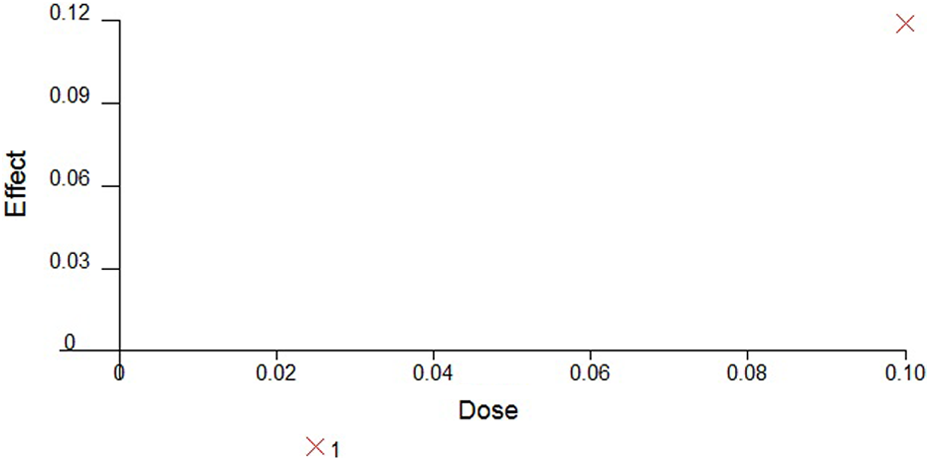
The dose–effect curve of ritanserin at 0.1 mg/kg, i.p.; ritanserin is named as 1, retention time is showing as nearly 0.12 (=119 s). i.p.: intraperitoneal.
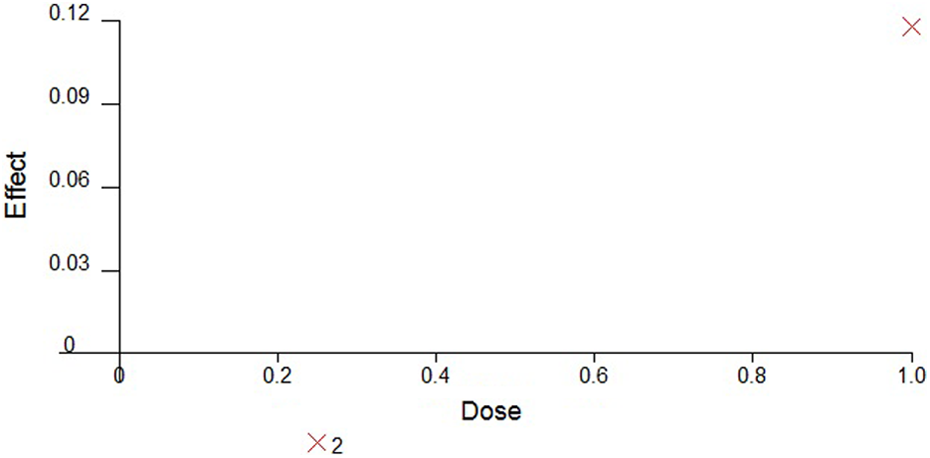
The dose–effect curve of agomelatine at 1 mg/kg, i.p.; agomelatine is named as 2, retention time is showing as nearly 0.12 (=118 s). i.p.: intraperitoneal.

The dose–effect curve of ritanserin 0.1 + agomelatine 1 + scopolamine 1 (mg/kg, i.p.), the combination group are named as 1 + 2 + 3, retention time is showing as nearly 0.3 (=300 s). i.p.: intraperitoneal.

The synergism index of the combination for ritanserin 0.1 + agomelatine 1 + scopolamine 1 (mg/kg, i.p.) is 1, which shows the synergism between the combination group (CI = 1), according to Calcusyn software (Biosoft, Cambridge, UK) programme. i.p.: intraperitoneal; CI: combination index.
Discussion
Our results show that neither agomelatine nor ritanserine had an adverse effect on memory retention when administered alone at the specified doses in the passive avoidance task. The reference drug scopolamine used to cause amnesia 26 clearly impaired retention time in mice at 1 mg/kg in comparison with saline. Both agomelatine and ritanserine improved the memory deficit in a dose-dependent manner, but only agomelatine at 30 mg/kg and ritanserine at 1 and 4 mg/kg significantly improved the retention time. Furthermore, when the ineffective doses of ritanserin and agomelatine (0.1 mg/kg and 1 mg/kg, respectively) were combined together with scopolamine, an improving effect on the retention time was also observed. These results clearly suggest that both agomelatine and ritanserin improve memory deficit and that a combination of agomelatine and ritanserine exerts an enhanced improving effect on memory deficit induced by scopolamine in mice.
Melatonin, synthesized from the amino acid tryptophan released by the pineal gland, is an important hormone that regulates circadian rhythm in mammals. Decreases in the production and impairment of rhythmic release of melatonin are associated with numerous psychiatric disorders. 27,28 Cognitive deficits including learning and memory may be present during ageing because of the decreased level of melatonin in plasma in these patients. 29 The beneficial effects of melatonin have also been suggested to be associated with its antioxidant effects, 31,32 anti-apoptotic activity and inhibition of β-amyloid deposition 33,34 and agonistic activation on MT1 and MT2 receptors. 35 The melatonin agonist agomelatine is currently used for the treatment of different types of depression states. 36,37 Its mechanism of action is regarded as being independent of non-monoaminergic mechanisms. The antidepressants that block the reuptake of monoamines such as tricyclics or selective serotonin reuptake blockers have limitations involving their side effects and safety under some conditions. 38–40 Furthermore, most depressive patients also suffer from memory problems. 41,42 An association between depression and memory problems has been proposed in some studies. 43,44 In addition to memory problems arising from depression, ageing and the other psychiatric problems, a growing number of studies have suggested that some antidepressant drugs act by reuptake inhibition may also cause memory impairment. 45–47 Therefore, it is necessary to develop new types of antidepressant drugs that act via non-monoaminergic mechanisms such as agomelatine without impairing cognitive functions including learning and memory.
There are limited studies investigating the effects of agomelation on learning and memory. 47 Agomelatine potentially acts on both melatonergic M1 and M2 receptors 3,48 and also affects 5HT-2C receptor antagonism. 4,49,50 Newer mechanisms and pathways might therefore be explored regarding the positive effect of melatonin on memory deficit. The potential beneficial effects of agomelatine on memory in experimental animals were established in mice at an early date by Jaffard et al. using a T-maze. 47 The muscarinic cholinergic system is well known to be associated with cognitive functions. 51–53 The antimuscarinic drug scopolamine has been used in tests as a reference drug to impair memory function. 26 A decrease in acetylcholine esterase (AChE) activity indirectly leads to an increase in acetylcholine levels that establishes the improving effect. 54,55 In terms of Alzheimer’s disease, in which central cholinergic cells degenerate, many studies have focused on the effect of drugs or molecules that may have a positive effect on memory. 51,52 For example, the AChE inhibitor tacrine and rivastigmine are used to repair memory impairment in patients with Alzheimer’s disease. Furthermore, amitriptyline, a TCA, has been shown to cause memory deficit due to its anticholinergic effects. This deficit has been shown to be improved by AChE inhibitor neostigmine. 55 Melatonin has been shown to improve scopolamine-induced memory deficit in mice in the passive avoidance task. 56 In that study, Agrawal et al. suggested that agomelatine blocks AChE activity in the hippocampus, a very important brain region for memory and learning. In addition, in an APP 695 transgenic mouse model, Feng et al. established that melatonin improves memory deficits. 57 Melatonin has been shown to improve learning and memory by ameliorating cholinergic system function in ovariectomized rats, a model that causes memory deficit. 58 These findings support the idea that agomelatine may improve memory deficit act increasing acetylcholine levels in the brain and at least reverses memory deficit related to the cholinergic system.
One study reported that agomelatin, but not melatonin, blocked the 5HT-2 receptors in the brain. 21 It may therefore be important to establish the positive effect of 5HT-2 receptors in the agomelatine mechanism in addition to those dependent on its melatonin receptor activation. Antagonism of 5HT-2 by melatonin has been reported to have certain physiological effects. For instance, Bourin et al. reported that the 5HT-2A/2C receptor antagonist ritanserin enhanced the antidepressant activity of agomelatine in the forced swimming test used to evaluate depression in mice. 15 5HT-2C receptor antagonists have been shown to reinforce the antidepressant activity of agomelatine in rats following olfactory bulbectomy. 59 Blockade of 5HT-2C receptors also causes anxiolytic properties in rodents. 60,61 Furthermore, the atypical antidepressants mianserine and mirtazepine act on 5HT-2C receptors and had anxiolytic effects. 62,63 These studies show that agomelatine has beneficial effects on cognitive functions by affecting the 5HT-2C receptors.
Regarding the role of 5HT-2 receptor activation on learning and memory, previous studies reported that blockade of these improves learning and memory. 64–67 For example, the 5HT-2A/2C receptor antagonists ketanserin and ritanserin have been shown to improve spatial discrimination and learning consolidation. 68,69 Other studies have also reported that the serotonergic-2 receptor antagonist RP62203, SR463493 and SDZSER082 have no effect (but also not negative effect) on retention time in passive avoidance tests. 70,71 These discrepancies may be due to the selectivity of the 5HT-2 antagonists. According to our results, however, ritanserin improved retention time when administrated alone, a synergistic effect was also seen in combination with agomelatine (1 mg/kg) and ritanserine (0.1 mg/kg) compared to when these agents were administered alone. Our findings also contribute supporting data regarding the improving effect related to 5HT-2C receptor antagonism.
The improving effect of agomelatine on scopolamine-induced memory deficit may also be related to its own melatonergic receptor activity. Agomelatine acts on both melatonergic MT1 and MT2 receptors. 3,72,73 Melatonin-binding sites are found in regions of the brain related to learning and memory. 74,75 A long-term potentiation decrease has been shown with ageing in the hippocampus. 76,77 long term potentialization (LTP) values decreased in MT2R knockout mice compared with control group mice. 77 MT2R knockout mice have also been reported to exhibit impaired memory in the elevated plus maze test. 78 These studies suggest that melatonergic receptors, especially MT2 receptors, may be involved in learning and memory processes. In this study, although we were unable to evaluate the role of melatonergic receptors, and this is our main limitation, this possibility should be kept in mind for assessing in future the role of agomelatin in learning and memory.
In conclusion, these results suggest that acute administration of the 5HT-2A/2C receptor antagonist ritanserin and agomelatine improves memory deficit induced by scopolamine, whilst a synergistic interaction is observed between ritanserin and agomelatine. New therapeutic potentials or physiological mechanisms on memory deficits can be established by further studies.
Footnotes
Authors’ Note
This research was performed in the laboratories of Ondokuzmayıs University, School of Medicine, Department of Pharmacology, Samsun, Turkey.
Conflict of interest
The authors declared no conflicts of interest.
Funding
This research received no specific grant from any funding agency in the public, commercial or not-for-profit sectors.