



Abstract
Background:
Fasting has been recently discovered to improve overall health, but its beneficial effects in the presence of hepatic insufficiency have not been proven.
Aim:
The influence of fasting on the metabolism, immunological aspects, and oxidative stress of 40 male carbon tetrachloride (CCl4)-intoxicated Wistar rats was investigated in the present study.
Methods:
The rats were divided into four groups, including a placebo group, CCl4-intoxicated rats, which were injected subcutaneously with 1.0 ml/kg of CCl4 solution, a fasting group, which was fasted 12 h/day for 30 days, and a fourth group, which was injected with CCl4 and fasted.
Results:
The metabolism, immunity, and oxidative stress improved in CCl4-intoxicated rats fasted for 12 h/day for 30 days, as evidenced in significant increase (p < 0.05) in total protein, globulin, immunoglobulin M (IgM) and IgG levels, and total antioxidant capacity. In contrast, significant decrease (p < 0.05) in blood glucose, total cholesterol, low-density lipoprotein-cholesterol, alanine aminotransferase, C-reactive protein, and malondialdehyde levels were observed. Compared with CCl4-intoxicated rats, significant differences in the albumin, triacylglycerol, high-density lipoprotein-cholesterol, very low-density lipoprotein-cholesterol, cardiovascular risk factor, calcium and magnesium levels were not detected.
Conclusions:
The results of the present study showed that fasting improved metabolism, immunity, and oxidative stress in CCl4-intoxicated rats. Thus, fasting during Ramadan is safe for patients with hepatic disorders, as the prophet Mohammed (S) said “Keep the fast, keep your health”.
Introduction
Fasting has been used for religious purposes around the world to improve health, achieve enlightenment, and help strengthen self-control. Fasting is defined as the abstinence from food and drink for a specific period of time. Fasting can take on three essential forms, including dry fasting, which involves abstaining from all food and liquid, juice fasting, which involves abstinence from all food and drink, except water and pure vegetable and fruit juices, and modified fasting, which includes small amounts of food, usually raw fruits and steamed vegetables, or the use of herbal teas or broths. Fasting normally lasts from 1 to 3 days and can be safely tolerated by most people. However, fasts lasting longer than 24 h should include plenty of rest and abstinence from vigorous exercise.
Two conflicting and inconsistent viewpoints about fasting are prevalent among scientists. Namely, some researchers feel that fasts are unnatural and dangerous, slow down the metabolism, and cause long-term health problems. Other health professionals feel that fasting can have beneficial effects, both physical and mental.
Liver insufficiencies are primarily due to toxic chemical exposure, heavy alcohol consumption, infections, and autoimmune disorders. The majority of hepatotoxic chemicals damage liver tissue by inducing oxidative stress. 1 Carbon tetrachloride (CCl4) is a chemical model used extensively to study liver injuries induced by free radicals in animal model systems. CCl4 has been reported to induce not only necrosis but also apoptosis in the liver of rats. 2,3 Although the mechanism by which CCl4 induces liver injury has not yet been defined, several hypotheses suggest that liver damage may be due to free radical metabolites. 4 Moreover, CCl4 is converted to trichloromethyl radicals by cytochrome P450 through a one-electron reduction, in which a fatty acid radical is generated by the reaction between trichloromethyl radicals and unsaturated fatty acids and is accompanied by the induction of lipid peroxidation. Although several studies regarding the effects of fasting on various aspects have been performed, the results are conflicting, especially in established diseases. Furthermore, a limited number of studies on the effects of fasting on immunity and oxidative stress have been reported. Thus, the purpose of the present study was to evaluate the effects of fasting on the metabolism of different foods, immunological aspects, and oxidative stress of CCl4-intoxicated rats.
Materials and methods
Chemicals
Thiobarbituric acid was purchased from Fluka (Buchs, Switzerland). All the other reagents were of analytical, high-performance liquid chromatography compatible (HPLC), or the best available pharmaceutical grade. Most of the biochemical parameters were analyzed using commercially available kit methods. UNICO 2100 ultraviolet spectrophotometers, ELx800 (7407, Microplate Readers - Absorbance Reader, Bio Tech Elx800, wavelengh 380-750) absorbance microplate reader and other laboratory equipment aids were used for biochemical analysis. Moreover, each parameter was performed according to the instructions of the respective kits.
Experimental animals
Albino Wistar male rats (aged 10 weeks and weighing 150–180 g) were used in the experiments. The animals were housed in metal cages under standard conditions (temperature: 28 ± 2°C, relative humidity: 50 ± 2%, 12-h light/dark cycle) and provided with a standard pellet diet and water ad libitum. The animals were acclimatized for 2 weeks in their new environment prior to the experiment.
All the animals received humane care in compliance with the National Institute of Health Guidelines for the Care and Use of Laboratory Animals, and the study protocol was approved by the local authorities.
Grouping of animals
Animals were divided into 4 groups with 10 animals in each group. Group 1 represented the positive control group, which received food and water ad libitum, group 2 represented the negative control group, which was injected subcutaneously with 1.0 ml CCl4 solution per kilogram, group 3, which was fasted 12 h a day for 30 days, and group 4 was considered the testing group and injected with CCl4 and fasted.
Induction of hepatotoxicity
CCl4 hepatotoxicity was induced by a single dose of CCl4 (50% v/v) in paraffin oil, which was administered subcutaneously.
Sampling and analysis
At the end of the experiment and after a night of fasting, all animals were anesthetized with a 50 mg/kg intramuscular injection of ketamine hydrochloric acid. The blood samples were collected (3 ml) by the retro-orbital plexus method into centrifuge tubes without an anticoagulant. The sera were separated by centrifugation at 704g for 15 min, and the samples were frozen at −20°C until analysis. The clear sera were used to determine the glucose, 5 total protein, 6 albumin, 7 globulin, 8 alanine aminotransferase (ALT) and aspartate aminotransferase (AST), 9 triacylglycerols, 10 total cholesterol, 11 low-density lipoprotein cholesterol (LDL-c), 12 high-density lipoprotein cholesterol (HDL-c), 13 cardiovascular risk factor (CVR), 14 calcium (Ca), 15 phosphorous (Ph), 16 magnesium (Mg) 17 C-reactive protein (CRP), 18 total antioxidant capacity (TAC), 19 malonaldehyde (MDA), 20 immunoglobulin M (IgM) and IgG levels. 21
Statistical analysis
The results are expressed as the mean ± SE. Data analysis was performed using one-way analysis of variance. The value of p < 0.05 was considered statistically significant.
Results
Effects of fasting on the metabolism of CCl4-intoxicated rats
The injection of CCl4 had a deleterious effect on metabolism in rats reflected in significant (p < 0.05) decreased total protein, albumin, globulin, triacylglycerol, total cholesterol, LDL-c, and nonsignificant changes (p > 0.05) in blood glucose, VLDL-c, HDL-c, and CVR levels when compared with the control group. On the contrary, the fasting of CCl4-intoxicated rats for 12 h/day/30 days resulted in a significant improvement in metabolism reflected in significant (p < 0.05) increase in total protein and globulin and significant (p<0.05) decrease in blood glucose, total cholesterol, and LDL-c in the absence of changes in albumin, triacylglycerol, HDL-c, VLDL-c, CVR, Ca, and Mg levels compared with CCl4-intoxicated rats (Tables 1 to 3).
Effect of fasting (12h/day/30 day) on Glucose, Total protein, Albumin and Globulin of CCL4 intoxicated rats.
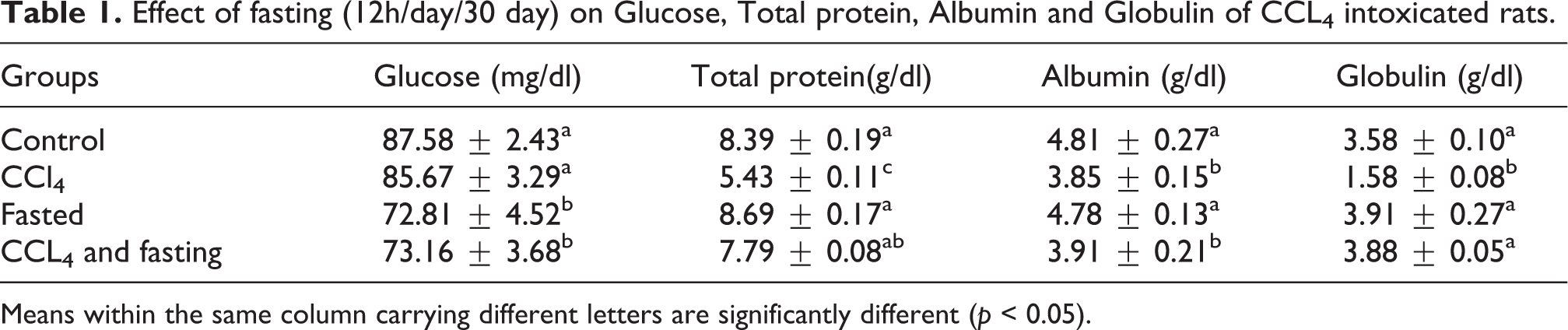
Means within the same column carrying different letters are significantly different (p < 0.05).
Effect of fasting (12h/day/30 day) Triacylglycerol Total cholesterol, LDL-c and HDL-c of CCL4 intoxicated rats.

Means within the same column carrying different letters are significantly different (p < 0.05).
HDL-c: high density lipoprotein cholesterol, LDL-c: low density lipoprotein cholesterol.
Effect of fasting (12h/day/30 day) on VLDL-c, CRV, Ca, Ph and Mg of CCL4 intoxicated rats.

Means within the same column carrying different letters are significantly different (p < 0.05).
CRV: cardiovascular risk factor, VLDL-c: very low density lipoprotein cholesterol.
Effects of fasting on the immunity of CCl4-intoxicated rats
Compared with the control animals, as shown in Table 4, the IgM and IgG levels were significantly decreased (p < 0.05) in CCl4-intoxicated rats. Fasting of rats 12 h/day/30 day significantly (p < 0.05) increased IgM and IgG levels when compared with CCl4-intoxicated rats.
Effect of fasting (12h/day/30 day) on IgM, IgG, ALT, AST and CRP of CCL4 intoxicated rats.
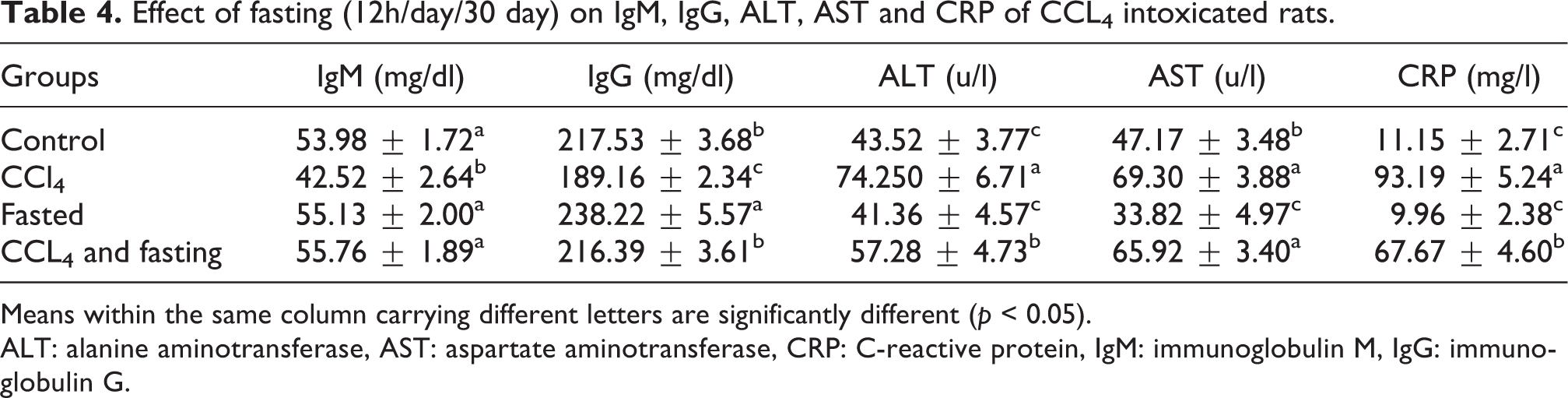
Means within the same column carrying different letters are significantly different (p < 0.05).
ALT: alanine aminotransferase, AST: aspartate aminotransferase, CRP: C-reactive protein, IgM: immunoglobulin M, IgG: immunoglobulin G.
Effects of fasting on the hepatic enzyme activities and inflammatory markers of CCl4-intoxicated rats
The CCl4-intoxicated rats resulted in significant (p<0.05) increase in serum ALT, AST, and CRP levels when compared with the untreated control group. However, fasting for 12 h/day/30 days resulted in significant decrease (p < 0.05) in ALT and CRP levels when compared with CCl4-intoxicated rats as shown in Table 4.
Effects of fasting on oxidative stress of CCl4-intoxicated rats
Table 5 revealed that the oxidative stress (decreased TAC and increased MDA) in rats intoxicated with CCl4 was significantly increased (p < 0.05) compared with the control group. Nevertheless, when the rats were fasted for 12 h/day/30 days, a significant (p < 0.05) decrease in oxidative stress as compared to CCl4-intoxicated rats was observed.
Effect of fasting (12h/day/30 day) on TAC and MDA of CCL4 intoxicated rats.

Means within the same column carrying different letters are significantly different (p < 0.05).
MDA: malonaldehyde, TAC: total antioxidant capacity.
Discussion
Fasting is a controlled type of hunger in which one refrains from eating or drinking for a specific period of time. Fasting has been used for various medical reasons, such as to manage weight, rest the digestive tract, and decrease the lipid content. Moreover, an improvement in the lipid profile and blood glucose levels is related to reduced risks of cardiovascular events. The results provided in Tables 1 to 5 showed that metabolism, immunity, and oxidative stress improved in CCl4-intoxicated rats fasted for 12 h/day/30 days, as evidenced in increased total protein, globulin, IgM and IgG levels and improved total antioxidant capacity. In contrast, decreased blood glucose, total cholesterol, LDL-c, ALT, CRP, and MDA levels were observed. Compared with CCl4-intoxicated rats, significant differences in the albumin, triacylglycerol, HDL-c, VLDL-c, CRV, Ca, and Mg levels were not detected. These results are in accordance with previous studies, which revealed that the continual use of glucose in the body for various vital functions reduces blood glucose levels, despite the fact that calories are not consumed during fasting. 22 –26 The depletion of glycogen stores after prolonged fasting further decreases glucose levels. Nevertheless, other studies suggest that adult males show insignificant changes in blood glucose levels 27 –29 or increased blood glucose levels during fasting. 30,31
An increase in blood glucose was also reported by Scott, who noted that variations in glycogen storage, physical activity, and dietary habits may be an important factor in the observed variability in the blood glucose levels among studies. 32
Clore et al. reported an increase in the level of glucose during fasting. According to the aforementioned authors, increased glucose levels were due to the activation of gluconeogenesis. 33
Regarding the debate on the effects of fasting on lipid profiles, the previous data reported that total cholesterol, triacylglyceride, LDL-c, and VLDL-c levels decreased and HDL-c levels increased due to fasting, which suggests that fasting has a beneficial effect on coronary heart disease patients. 34 –38 The observed decrease in the cholesterol levels may be due to the reduction in the synthesis of endogenous cholesterol during fasting. 39 An increase in the rate of HDL-c often coincides with the reduction in the rate of VLDL, which suggests that increased hepatic hydrolysis of VLDL leads to the synthesis of HDL. 37 Streicher et al. showed that insulin levels, which decrease during fasting, increase the expression of genes that encode hepatic receivers of LDL-c. 40 Moreover, previous results showed that the level of glucose, total cholesterol, and LDL decreased after Ramadan compared to the levels observed prior to Ramadan; however, an increase in the HDL content was observed. 41 The authors attributed the observed decrease in the glucose, total cholesterol, and LDL levels to changes in energy intake, hormonal alternations, increase in fat oxidation during the fasting period, and changes in body water levels. Alternatively, hepatic lipogenic enzyme activities (fatty acid synthetase, citrate cleavage enzyme, malic enzyme, glucose-6-phosphate dehydrogenase, and 6-phosphogluconate dehydrogenase) decreased in coho salmon fasted for several weeks 42 and rats fasted for hours. 43 Nevertheless, other studies evaluated the effects of Ramadan fasting on the level of plasma lipids and lipoproteins and found that the body weight, body mass index, and HDL content decreased and LDL level increased during fasting in Ramadan. 27,31,44 However, significant changes in the total cholesterol, triglyceride, and VLDL levels were not observed. Fasting resulted in nonsignificant changes in the total cholesterol, HDL-c, LDL-c, triglycerides, AST, LDH, ALP, and fasting blood glucose levels in patients with heart disease. 45
Unalacak et al. revealed that the HDL, LDL, and total cholesterol content did not significantly change during fasting. 24
Our results contradict those of Larijani et al. who found that triglyceride levels increased due to the lipolytic effect of fat tissues during Ramadan fasting. 23 Likewise, fasting leads to increased serum cholesterol concentrations due to cholesterol mobilization from adipose tissue. 46 The observed variation in lipid levels among researchers may be attributed to differences in dietary habits and durations of fasting in different seasons and countries. 47 Concerning the effect of fasting on serum protein and enzyme levels, our results are in accordance with those of Arindkar et al. who showed that the total protein content increased and ALP, AST and ALT levels decreased in fasted STZ-induced diabetic mice. 48 Other studies have shown that the total serum protein and albumin levels were statistically lower during and after fasting. 25,26 The authors attributed these results to the submission of subjects to a hypocaloric diet. Ait et al.; Maislos et al.; Unalacak et al. revealed that the total protein and albumin content did not change significantly during fasting. 24,27,37 The effect of fasting on serum electrolytes was inconsistent with the results of previous studies, in which Latifi reported that fasting resulted in decreased potassium and Ph levels. 49 In contrast, El-Gendy et al. found that fasting caused insignificant changes in serum electrolyte levels in diabetic patients. 50 These controversial results may be due to geographic, climatic, economical, and nutritional variations and the evaluation of different species. 51
Regarding the effects of fasting on immunoglobulins, the results of previous studies, which showed a slight reduction in Ig levels as compared to those observed in the healthy nonfasting control group, are inconsistent with the present results. 38
Concerning the effect of fasting on inflammatory markers, Aksungar et al. demonstrated that interleukim-6, CRP, and homocysteine levels were significantly lower in fasting subjects of both genders during Ramadan compared with basal values, which is in agreement with the results of the present report. 52
Our study was extended to evaluate the effect of fasting on oxidative stress induced by CCl4, and the results showed that fasting ameliorated oxidative stress, which confirms the remarks of John and Richard who suggested that the favorable effects of Islamic and Daniel fasting include reduced biomarkers of oxidative stress. 53 In addition, fasting for 48 h in fattened chicken supplemented with selenium resulted in reduced lipid peroxidation and increased glutathione peroxidase (GSH-Px) activity in the liver. 54 Similarly, muscle and red blood cell antioxidant enzymes (superoxide dismutase, GSH-Px, and catalase) increased due to fasting in elephant seal pups. 55 Fasting alone and fasting with vitamin E supplementation resulted in significant reductions in serum MDA and significantly elevated levels of GSH. 50 Previous studies have shown that caloric restriction can increase one’s life span, reduce the incidence of various age-related diseases, and reduce oxidative stress due to free radicals liberated by normal metabolism and inflammation in rodents and nonhuman primates. 56
Conclusion
The results of the present study showed that fasting improved metabolism, immunity, and oxidative stress in CCl4-intoxicated rats. Thus, fasting during Ramadan is safe for patients with hepatic disorders and devoid of any serious complications. As the holy prophet Mohammed (S) said “Keep the fast, keep your health.”
Footnotes
Acknowledgements
The author gratefully acknowledges the assistance of the staff from the Department of Veterinary Medicine, Damanhur University, Egypt. The authors also acknowledge the scholars who published the articles included in the reference section of this article.
Conflict of interest
The authors declared no conflicts of interest.
Funding
This research received no specific grant from any funding agency in the public, commercial, or not-for-profit sectors.