



Abstract
Concentrations of 36 polychlorinated biphenyl (PCB) congeners were measured in serum of 372 Italian residents of general population living in Novafeltria, Pavia, and Milan. Total PCB level differed significantly between these sites (p < 0.0001) with median concentrations of 836.50, 1354.57, and 2062.08 pmol/g lipid, respectively. However, there is no evidence for the difference in distribution of total PCB levels by genders. Total dioxin-like PCBs differed significantly (p < 0.0001) between the sites (median 109.78, 50.88, and 166.99 pmol/g lipid, respectively) and genders of Novafeltria and Pavia (p = 0.011 and 0.009, respectively). PCB 138, 153, 170, and 180 differed significantly between the places of residence (p < 0.0001) with higher values in Milan population. In the overall population, total PCB and PCB 138, 153, 156, 170, and 180 correlated positively with age (correlations range between 0.320 and 0.569, p < 0.0001). In Novafeltria, the correlations ranged between 0.545 and 0.670, and in Pavia, the correlations ranged between 0.516 and 0.666. In Milan, correlations with age range between 0.327 and 0.417 for total PCB and congeners 138, 153, and 180. With an exception of PCB 170, there was no evidence of significant difference in the distribution of most abundant PCB congeners and total PCB across the body mass index categories.
Introduction
Polychlorinated biphenyls (PCBs) constitute a group of 209 congeners, which are used in industrial applications and commercial products. Complex mixtures of PCBs found large industrial applications mainly as dielectric fluids in capacitors and transformers and as non-flammable heat transport fluids in heat exchangers. Globally, total PCBs production was estimated to be approximately 1.3 million tons between 1930 and 1993. 1 In Italy, it is estimated to be approximately 150,000 metric tons from 1938 to 1984. In 1970s, the production was between 2500 and 5000 metric tons/year from the main producing plant (Caffaro) in Brescia, Italy. 2 In 1977, production and use of PCBs was banned in the United States and in 2001 by the Stockholm Convention on Persistent Organic Pollutants. 3
The interest to measure PCBs contamination in the environment, food, and human population of Italy started in the early 1970s, a few years after the discovery of PCBs as a new class of ubiquitous contaminants of the Baltic Sea. 4–6 Between 1971 and 1989, a group at the Istituto Superiore di Sanità, Rome expanded the interest into the measurement of chlorinated pesticides, 7–9 followed by other groups within the national agencies for health protection and in the academy which published their reports in Italian scientific journals and mainly starting from the early 1980s in the international literature. 10,11 One main health concern was reproductive toxicity, 12–14 since some PCBs were reprotoxic in experimental animals.
In the 1980s, several studies started establishing reference values of serum PCBs in the general population in countries with past or current use of PCBs. The aims were to confirm or refute the contribution of exposure to observed or suspected clusters of cancer incidence in towns where production plants were located or close to places where release into the environment had occurred.
A meta-analysis of 37 studies conducted between 1990 and 2003 established a mean reference value (0.9–56 μg/L) for total PCB in blood in the general population. 15 Such levels are within the range reported in the toxicological assessment of PCBs performed in the United States (4–19 ng/mL). 16 In Brescia, where the main PCB production plant was located, a mean value of 5.15 ng/mL for the total serum PCB level in the general population was measured in 2001–2003. 17 Based on this finding, further investigations proposed were aimed at determining the geographical distribution of PCB levels in the Italian population with larger study cohorts.
In this article, we are presenting results of serum PCB congeners levels obtained within the REALEXPO project among the residents from three Italian population subgroups from general population and explore their relationship with residence, gender, age, and body mass index (BMI).
Materials and methods
The details of subjects’ recruitment, blood collection, and laboratory and statistical analyses have been described in Part 1 of Mrema et al. 18 along with this article. Briefly, those who were recruited were supposed to have neither history of occupational exposure nor accidental exposure to PCBs. After securing informed consent, data from 372 subjects regarding their personal information like demographic information, lifestyle, and dietary habits were collected. All the 372 participants donated 10 mL of blood, which was collected by venipuncture. Specifically 167 volunteers were recruited from Pavia, 163 from Novafeltria, and 42 from Milan. Novafeltria is assumed to be a rural area (a nonindustrialized area in Central Italy), Pavia a semiurban town, while Milan is clearly an urban area with past manufacturing activities. We expected to see variation in PCBs pattern among these regions where Novafeltria was presumed to be the lowest contaminated region, while Milan was considered to be highly contaminated. We understand that for Milan, the largest urban area, more samples were expected as compared to the other two sites. However, all samples used in our study were taken from already recruited subjects who participated in population-wide surveys. Thus, only 42 subjects participated in Milan and were only available for analysis, which is reported in this article. This is one of the limitations of our study.
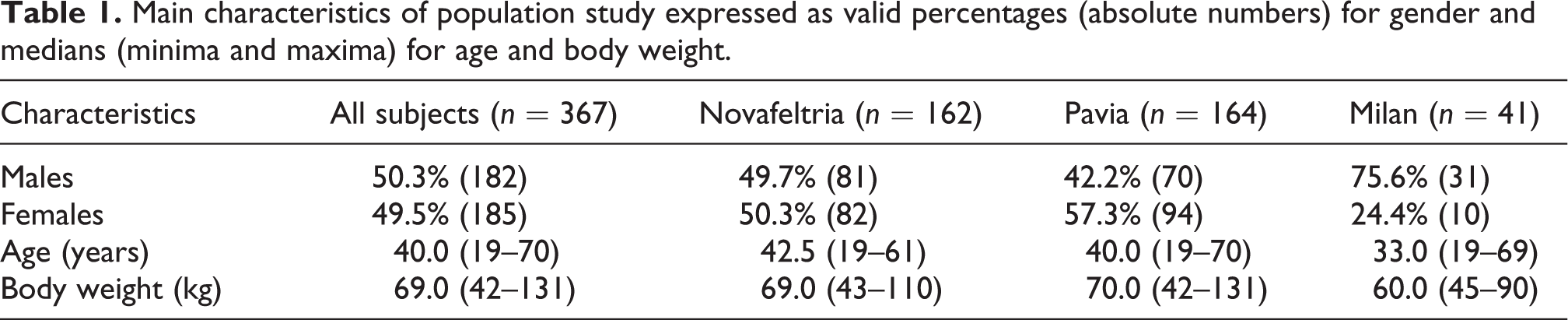
We analyzed 36 PCB congeners in the overall population. Specifically, 36, 34, and 15 congeners were analyzed in serum samples of Novafeltria, Pavia, and Milan, respectively. Due to the difference in the measured congeners in these sites, 15 congeners commonly investigated in all three sites were selected to facilitate comparison of total PCB levels among the sites (Table 2 and Supplement Tables S3 and S4).
Main characteristics of population study expressed as valid percentages (absolute numbers) for gender and medians (minima and maxima) for age and body weight.
Median, minimum, and maximum concentrations of total PCBs in three Italian population subgroups (expressed in picomole per gram serum lipid).
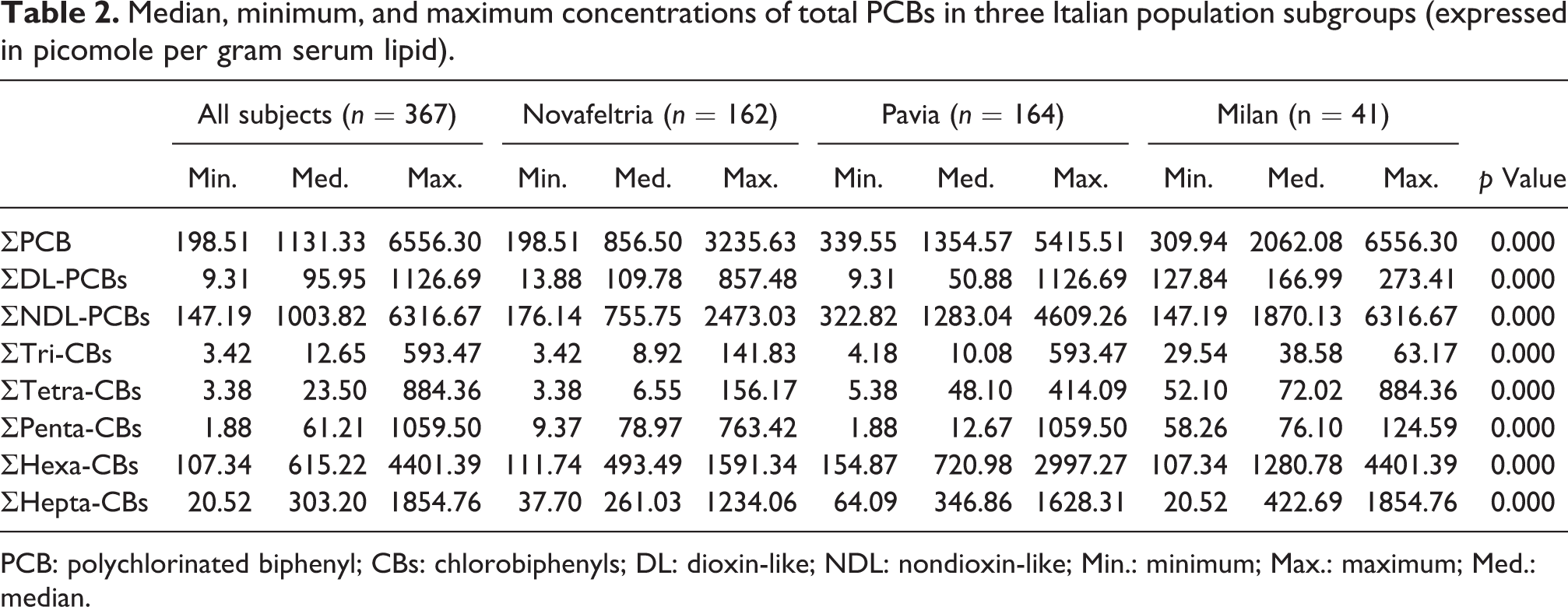
PCB: polychlorinated biphenyl; CBs: chlorobiphenyls; DL: dioxin-like; NDL: nondioxin-like; Min.: minimum; Max.: maximum; Med.: median.
For practical (shorter time analysis) and economic (higher sample throughput of the laboratory) reasons, it was decided to reduce the number of measured PCBs congeners to 15 in the Milan cohort, which was the last to be analyzed. The experience from previous studies conducted elsewhere and from the two cohorts from Pavia and Novafeltria, which were analyzed earlier, showed that most of the 15 congeners (such as PCBs 28, 52, 101, 118, 138, 153, and 180) are stable in the environment and may be good markers for human PCB exposure without the need to perform a much longer analysis.
A Shimadzu gas chromatograph mass spectrometer GCMS–QP5050A (Shimadzu Deutschland GmbH, Duisburg, Germany) equipped with an autoinjector/autosampler AOC–20 was used to analyze the selected PCB congeners. Analytical technique, limit of detection (LoD), and accuracy of the method are described elsewhere. 19,20
Serum concentration of triglycerides and total cholesterol measured by standard clinical chemistry were used to define total lipid concentrations derived by the equation reported by Phillips et al. 21 and quoted in Part 1 of Mrema et al. 18 Concentrations of congeners were adjusted for total lipid and expressed in picomole per gram lipid to allow comparison between congeners since there are substantial differences in molecular weight between the congeners. All laboratory analyses were conducted at the Laboratory for Environmental and Toxicological Testing, Salvatore Maugeri Foundation, Pavia, Italy.
Data analyses were performed with the software used elsewhere.18 The concentrations of PCB congeners were summarized by medians, minimum, and maximum values. Since distributions of PCB congeners were nonsymmetrical as checked by Shapiro–Wilks’ test, nonparametric tests were performed and medians were used as a measure of central tendency. Subjects with undetectable values were assigned half the LoDs of the PCB congener before lipid adjustment. After adjustment, half LoDs differed for every sample due to the differences in total lipid. The median concentrations were reported for those congeners detectable in >50% of the population sample or 50% of the groups stratified by residence, gender, age, and BMI. Kruskal–Wallis test was used to test the difference in concentrations of PCB congeners between the strata. The Mann–Whitney U test assessed the difference in PCB concentrations between genders. The correlation analyses were performed using Spearman’s correlation test. Multivariate models were used adjusting for residence, gender, age, and BMI. The variance was estimated using the determination coefficient, R 2 . Statistical tests were considered significant at the 0.05 level and in some cases at the 0.01 level.
Results
All subjects’ data and other statistical analyses collected are provided in the supplementary data.
Study population
Table 1 displays the main characteristics of the study subjects. Only in Milan, the distribution of gender was skewed with females under represented. The mean body weight of the subjects (69.94 kg) and mean BMI (24.36 kg/m2) are in accordance with those reported for a general Italian adult population (69.4 kg and 24.5 kg/m2, respectively). 22 Our population had individuals who were fairly normal in terms of BMI.
Of the total 372 subjects participated in the study, five subjects who had incomplete information were excluded from the analysis. Thus, the final statistical analyses were based on 367 subjects (164 from Pavia, 162 from Novafeltria, and 41 from Milan).
Serum concentrations of PCB congeners
For better understanding of complex pattern of PCB congeners occurring in samples, PCB congeners were classified in five classes according to the increasing number of chlorine atoms in their structures, that is, tri-, tetra-, penta-, hexa-, and hepta-chlorobiphenyls (CBs) and according to toxicological characteristics, according to their insertion into the dioxin-like PCBs (DL-PCBs) or non dioxin-like PCBs (NDL-PCBs). Thus, the levels of PCBs were computed from the individual results of sample analysis as follows:
total PCB as sum of 15 PCB congeners (
total tri-CBs as the sum of PCBs 28 and 31, total tetra-CBs as the sum of PCBs 52 and 77, total penta-CBs as the sum of four PCBs (
total DL-PCBs as the sum of six DL-PCBs (
To account for the undetected congeners, censored data corresponding to half LoDs for each congener were included in the summations.
Distribution of PCB congeners by residence
Novafeltria
The median total PCB in Novafeltria was 856.50 pmol/g lipid, whereas total DL- and NDL-PCBs were 109.78 and 742 pmol/g lipid, respectively. Total hexa-CBs presented the highest median concentration of 493.49 pmol/g lipid followed by total hepta-CBs (261.03 pmol/g lipid; Table 2). PCB 138, 153, 180, 170, 156, and 118 were detected in between 85 and 100% of the samples with median levels of 173.70, 264.92, 189.16, 76.62, 29.5, and 70.05 pmol/g lipid, respectively. PCB 77, 126, and 128 were detected in <2% of the samples (Supplement Tables S3 and S4).
Pavia
The median total PCB, DL-, and NDL-PCBs were 1354.57, 50.88, and 1278 pmol/g lipid, respectively. Total hexa- and hepta-CBs presented the highest median levels of 720.98 and 346.86 pmol/g lipid, respectively (Table 2). PCB 52, 138, 153, 156, 170, and 180 (median: 44.33, 293.95, 394.03, 32.59, 88.13, and 258.82 pmol/g lipid, respectively) were detected in between 84 and 100% of the samples. PCB 77, 105, and 169 were detected in <2% of the samples, whereas congener 101, 126, and 128 were under LoDs (Supplement Tables S3 and S4).
Milan
The median total PCB was 2062.08 pmol/g lipid. All DL-PCBs were not detected in Milan. As for Novafeltria and Pavia, total hexa-CBs presented the highest median (1280.78 pmol/g lipid) followed by hepta-CBs (422.69 pmol/g lipid). Total tetra-CBs had the median of 72.02 pmol/g lipid (Table 2). Of the 15 PCB congeners investigated, six were above the LoDs, the most prevalent ones being PCB 138, 153, and 180 with median concentrations of 532.15, 667.5, and 402.97 pmol/g lipid, respectively. PCBs 52, 170, and 128 were the least abundant congeners (Supplement Tables S3 and S4).
Comparison among places of residence
The distribution of total PCB, total DL-PCB, total tri-, tetra-, penta-, hexa-, and hepta-CBs concentrations were significantly different across the sites (p < 0.0001). The median levels of these PCB groups follow the order Novafeltria < Pavia < Milan with exception of total DL-PCB and penta-CBs. Based on PCB homologues in overall population, the order is
The highly prevalent PCBs were 138, 153, 156, 170, and 180 in overall population and in individual sites with an exception of 156 and 170 in Milan, which were under LoDs. These congeners differed significantly across the sites (p < 0.0001; Figure 1). The median levels of PCB 138, 153, and 180 follows the order 138 < 180 < 153 for Novafeltria and Pavia with a slight change in Milan (180 < 138 < 153). PCB 153 had the highest median concentrations in each site.

Distribution of serum PCB 138, 153, 180, 170, 118, and 156 in picomole per gram lipid (logarithmic scale) among the study population stratified by residence. Displayed results had significant different concentrations between the areas of residence. O indicates mild outliers and * indicates extreme outliers.
PCB 52 was more prevalent in Pavia (91.5%). PCB 118 (Novafeltria) and PCB 156 (Novafeltria and Pavia) were detected in >50% samples, whereas PCB 28 and 31 were detected in <50% of the samples in each site. PCB 126 was detected in only two samples both from Novafeltria (Supplement Table S3).
Distribution of PCBs by gender
A total of 182 females and 185 males were investigated. The median total PCB levels were 1142.43 and 1050.62 pmol/g lipid, respectively. There was no evidence for the difference in distribution of total PCB levels between genders. However, total DL-PCB levels were significantly higher in females than in males (median 119.83 and 74.55 pmol/g lipid, respectively; p < 0.0001). Significant difference was also evident for total penta-CBs concentration (median 77.70 and 17.39 pmol/g lipid, respectively; p < 0.0001, Supplement Figure S2).
In the overall population sample, PCB 118 was detected in 102 females (56.04%) with median concentration of 51.7 pmol/g lipid, while in males, it was detected in 80 samples (43.24%). The distribution of this congener differed significantly by gender (p < 0.0001). PCB 128 was least prevalent and was detected in 1.65 and 1.62% of females and males, respectively.
As observed in the overall population, there was no evidence of variation in total PCB concentrations between genders in individual sites. However, the distribution of total DL-PCB and total penta-CBs differed significantly by gender in Novafeltria and Pavia. As for total tetra-CBs, the distribution differed significantly between genders in only Novafeltria (p = 0.045). No evidence of significant difference in the distribution of most congeners between genders with exception of PCB 52 and 105 (in Novafeltria) and 118 (Novafeltria and Pavia) was identified (Table 3).
Medians, minima, and maxima concentrations (in picomole per gram serum lipids) for PCB congeners stratified by residence and sex.a
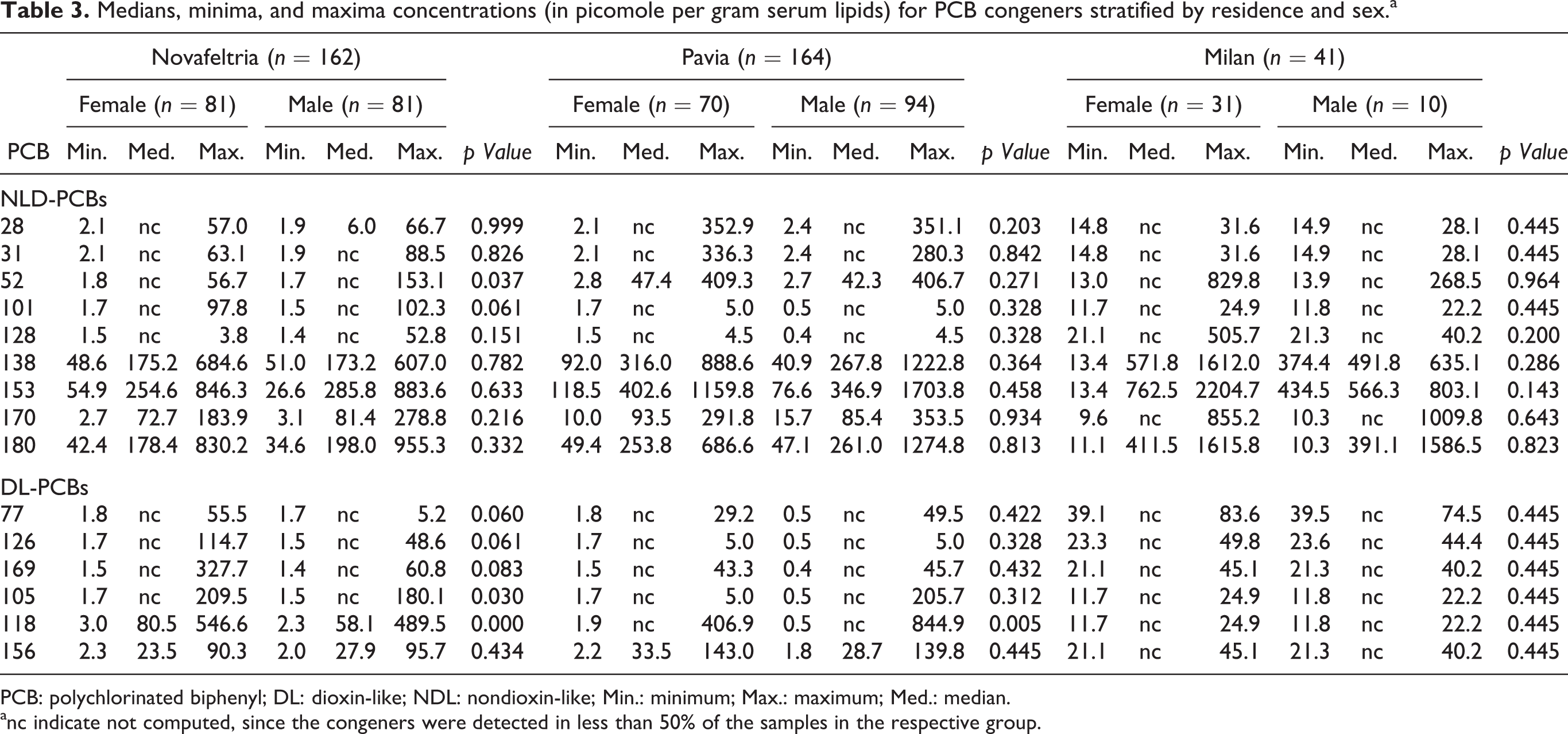
PCB: polychlorinated biphenyl; DL: dioxin-like; NDL: nondioxin-like; Min.: minimum; Max.: maximum; Med.: median.
anc indicate not computed, since the congeners were detected in less than 50% of the samples in the respective group.
Distribution of PCBs by age
Participants’ age was categorized into four groups: 10–25, 26–40, 41–55, and 56–70 years. The majority of subjects had age between 26–40 and 41–55 years. Compared with the other two sites, Milan had fewer subjects in the age group 26–40, 41–55, and 56–70 years, whereas Novafeltria had fewer subjects in the age group 10–25 years (Supplement Table S6).
In the overall population sample, the median concentrations of total PCB, total DL-PCBs, total NDL-PCBs, total hexa-, and hepta-CBs increased consistently across the age groups (p < 0.0001). The trend was inconsistent for the total tri-, tetra-, and penta-CBs. The median concentrations of PCB 138, 153, 180, 156, and 170 presented statistically significant increasing trend across these age groups (p < 0.0001) (Supplement Figures S3 and S4).
In individual sites, similar trends and significance levels were observed for Novafeltria and Pavia populations. In Milan, PCB 153 and 180 levels were shown to increase consistently and significantly (p = 0.032 and 0.033, respectively; Figures 2 and 3). Although PCB 138 had median concentrations that tend to increase across the age groups, there was no evidence of significant difference in its distribution along these age groups.
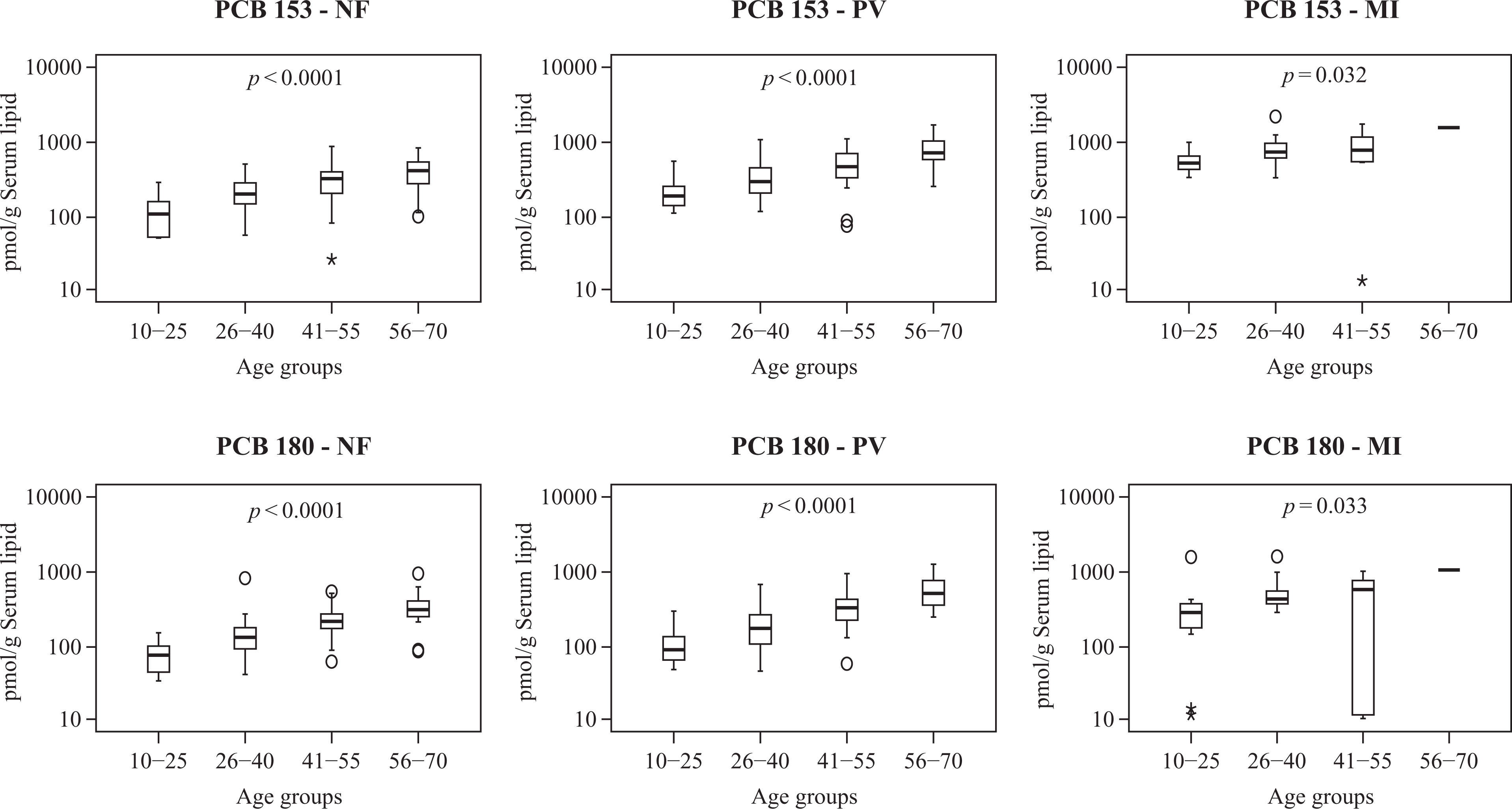
Distribution of PCB 153 and 180 concentrations by age groups expressed in picomole per gram lipid (logarithmic scale). Displayed results had significant different concentrations across the groups. O indicates mild outliers;* indicates extreme outliers. NF: Novafeltria; PV: Pavia; MI: Milan.

Distribution of PCB 138 and 170 concentrations by age groups expressed in picomole per gram lipid (logarithmic scale). Displayed results showed significant different concentrations across the groups with exception of PCB 138 and 170 in MI. O indicates mild outliers; * indicates extreme outliers. NF: Novafeltria; PV: Pavia; MI: Milan.
The trends observed were supported by positive correlations between subjects’ age and some PCB congeners. In the overall population sample, PCB 138, 153, 156, 170, and 180 had positive correlations between 0.285 and 0.569 (p < 0.0001). Correlations observed in Novafeltria were between 0.404 and 0.670 and in Pavia were between 0.424 and 0.666. PCB 118 correlated significantly with age in Novafeltria (r = 0.267, p = 0.001). In Milan, positive correlations were observed for PCB 138, 153, and 180 (r = 0.346; p = 0.027, r = 0.417; p = 0.007, and r = 0.329; p = 0.035, respectively). In all the three sites, age correlated positively with total PCBs (r = 0.598; p < 0.0001, r = 0.545; p < 0.0001, and r = 0.327; p = 0.037, for Novafeltria, Pavia, and Milan, respectively) but at different levels; Novafeltria and Pavia at 0.01 level, while Milan at 0.05 level (Supplement Table S7).
Distribution of PCBs by BMI
The minimum and maximum BMI in the study population were 15.6 and 38.5 kg/m2, respectively. Based on the international classification of BMI, our population had five underweight individuals (1.4%), 213 normal (58.04%) individuals, and 149 overweight (40.6%) individuals. None of the subjects were severely underweight or severely obese. The influence of BMI in the distribution of PCBs was assessed.
Significant difference in distribution across BMI categories was observed for PCB 170 (p = 0.010). Though not significant, consistent increase in median concentrations was observed for PCB 138 across the categories (median: 203.93, 239.39, 240.64, and 243.39 pmol/g lipid). The median concentrations of PCB 153 and 180 tend to increase across the categories but the trends were inconsistent (Supplement Tables S8–S11). Correlation analyses supported the observed trends. Thus, significant correlations with BMI were observed for PCB 170 (overall sample); PCB 138 (Novafeltria); and PCBs 138, 153, 180, and 170 (Pavia). In Milan, this relationship was not observed. All significant correlations observed range between 0.182 and 0.197 (Supplement Table S12). When analyses were stratified by gender while controlling for places of residence and age, we found a weak positive relationship between BMI and PCB 118 concentration in females of overall population (r = 0.032; p = 0.030). Inverse relationship was observed with PCB 28 and 31 in females (r = −0.031; p = 0.01 and r = −0.026; p = 0.029, respectively), whereas in males the relationship was observed with PCB 101, 128, 180, and 156 (r = −0.011; p = 0.02, r = −0.011; p = 0.04, r = 0.010; p = 0.050, r = −0.018; p = 0.044). When analyses were stratified by places of residence and gender while controlling for age, a weak positive relationship between BMI and PCB 118 among females of Pavia (r = 0.064, p = 0.038) was observed. Inverse relationship with PCB 180 was observed in female and male subjects of Novafeltria (r = −0.016; p = 0.033 and r = −0.013; p = 0.043, respectively) and with PCB 28 in only females of the same population subgroup (r = −0.036; p = 0.007).
Discussion
This is one of the largest performed studies in Italy and in Western Europe, as for the number of examined subjects. Samples were taken from the participating subjects within the frame of wide-population surveys but without any specific aim. For this reason, most pertinent information such as women’s reproductive histories and general health status with reference to degenerative illnesses, not to say clinical parameters such as peripheral sex hormone levels were not available, nor requested for. There is no chance whatsoever to retrieve this information retrospectively, since sample anonymization was performed well before the samples were delivered to the laboratory for PCBs and organochlorinated pesticides measurements. The four determinants of PCB body burden, which can be considered in a causative analysis, given the information, which could be collected on the subjects of our study, are residence, gender, body mass, and age.
To understand the magnitude of exposure in our population, we compare our results with the results of previous studies 17,19 ,20, 23–30 published in the literature and collected in Table 4. For the epidemiological studies reported, only the data for control groups were considered, to reflect the levels of exposure in the general population rather than in specific groups for which specific sources of exposure were known or suspected. The numbers of PCB congeners measured in those studies were between only four and 60 different molecules out of 209 congeners. As a result, the total PCB levels and the concentrations measured in the different studies also varied according to the number of congeners considered for the laboratory analysis. In order to allow comparisons, only 15 congeners were considered and their units were converted to match our unit of picomole per gram lipid. In most literature, results are reported in heterogeneous units, such as raw concentration (nanogram/milliliter in serum) without reporting relevant biochemical measurements necessary to define total blood lipid contents of the subjects. We thus used the upper and lower limits of cholesterol and triglycerides of the healthy population to compute the corresponding total lipids, which were used to adjust the PCB concentrations reported in the literature. Finally, the literature results were expressed in toxicologically relevant molecular units as picomoles per gram serum lipid, which facilitated comparison of our results.
Concentration of polychlorinated biphenyl congeners (in picomole per gram serum lipid) in blood/blood serum of Italians living in various regions (2004–2010).
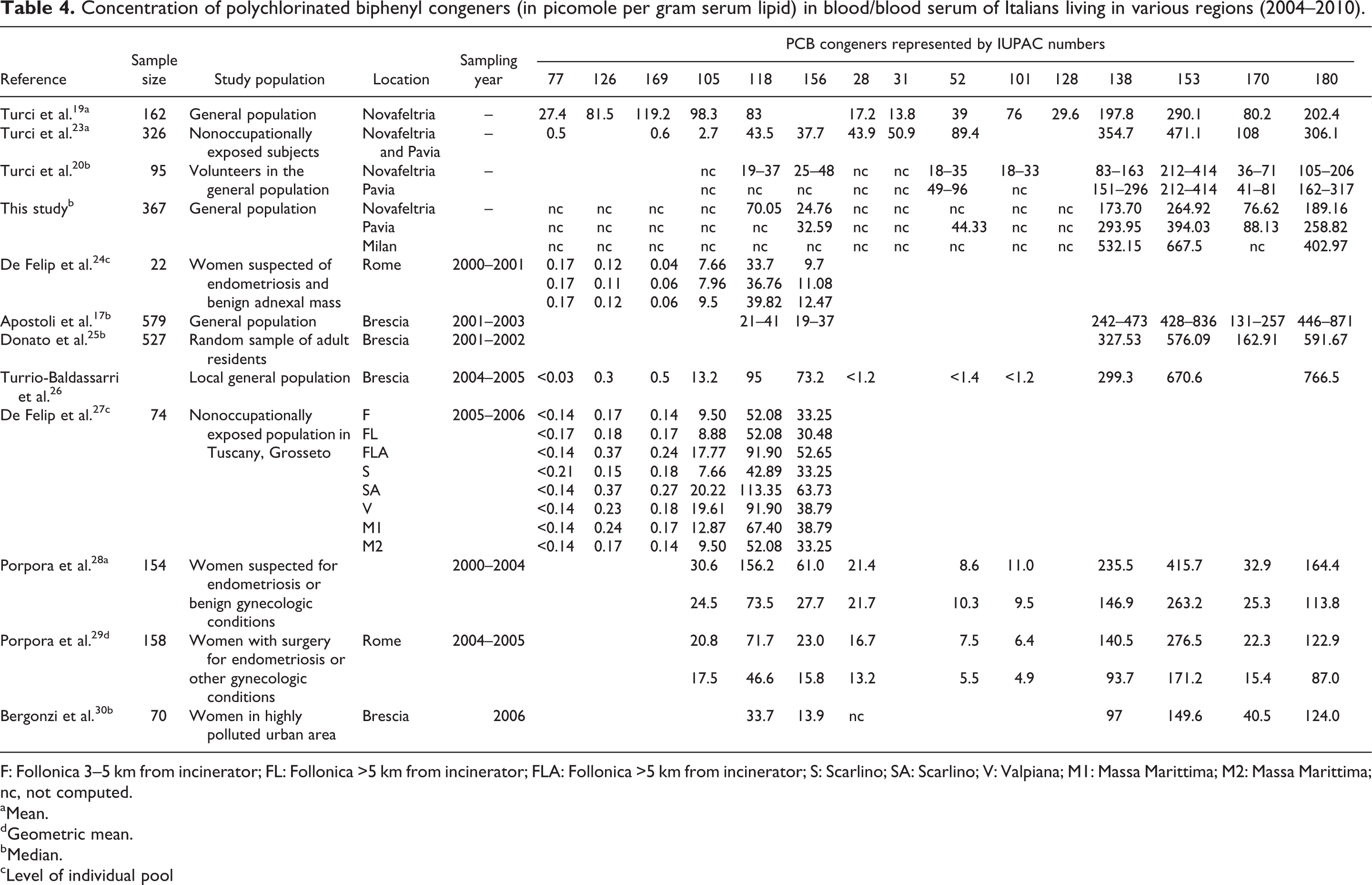
F: Follonica 3–5 km from incinerator; FL: Follonica >5 km from incinerator; FLA: Follonica >5 km from incinerator; S: Scarlino; SA: Scarlino; V: Valpiana; M1: Massa Marittima; M2: Massa Marittima; nc, not computed.
aMean.
dGeometric mean.
bMedian.
cLevel of individual pool
We observed a significant difference in total PCB among residents of the three sites. The residents from Milan had the highest PCB concentrations followed by Pavia and Novafeltria. These variations may be related with different dietary habits, sample group characteristics, 20 and industrial activities. Milan is an urban area with intense past industrial activities with a considerable proportion of the population coming from other regions of Italy, while Pavia is a town with little current and past industrial activity and few immigrants. Novafeltria is a small village with a predominantly local population and no industrial activity. Our results agree with the previous literature studies, which show that urban residents have significantly higher levels of PCBs than people from semiurban or rural areas. 31,32 What is seldom clear is the exact source of higher levels in the urban population with respect to that of small town and of rural areas. In most industrial countries where studies were performed, the use of PCBs has been discontinued for at least 15 years. Thus, the spread of the PCB pool into the environment through several global cycles should have led to a leveling of differences from localized emission sources to less contaminated areas.
The explanations presented in the study, accounting for the observed differences in PCB body burden of individuals from the three locations, are mostly conjectural, since no reliable retrospective information can be obtained to strongly support any claimed explanation. Starting from the reasonable assumption that for the general population, dietary intake of PCBs is estimated to account for >90% of human exposure to these chemicals, 33 we nevertheless face with the very limited information available on dietary exposure to PCB in Italy. Studies report that, in Italy, dairy products, meat, and fish are the principal sources of PCB contamination, 34 while vegetables contribute very little to the daily dietary exposure. Turci et al. reported that the average daily intake of total PCBs for the population subgroup of Pavia is approximately 0.26 µg. 35 Since dietary habits vary among individuals even within the population of an individual site, levels of PCBs and main sources may differ in different population subgroups. Donato et al. found high serum PCB levels in humans living in an industrialized town in Italy and related this observation mainly due to consumption of food produced in polluted areas. 36
It should also be considered that large-scale food distribution through the General Distribution Organization (GDO; supermarkets) has become increasingly popular in Italy even in small towns. This accounts, on the nationwide average for approximately 50% of supply, expressed as monetary value 37 and with a marked North–South gradient. 38 These store chains get food from the global market at national and supranational scale so that it is conceivable that the proportion of daily PCB intake, which comes from “supermarket” food is approximately analogous throughout the Italian population.
To account for the differences in PCB body burden among the three Italian populations investigated, we may well propose that the amount of consumed food that originates locally, in presumably less contaminated areas, and that is marketed outside the GDO, accounts for the lower body burden (proportional to the approximately constant intake) in rural Novafeltria and in the small town Pavia with reference to large urban Milan.
Direct exposure to PCBs happens to be relatively rare in Italy outside well-known specific areas such as in the neighbors of the only production plant in Italy (the Caffaro plant in urban Brescia) and of a few big industrial areas where large electrical appliances and heat exchangers were manufactured or installed. Localized spills from transformers’ fires were, however, common although mostly unreported (except for the recording of local blackouts by maintenance staff with little if any awareness of the hazard of transformer oil), especially in rural areas. One case of spillage of PCB-containing oil occurred in 1988 in southern Italy during road transportation of a large transformer. This area is well distant from any of the investigated sample areas. 39,40
The overall population had the median total PCB level of 1131.33 pmol/g lipid; males having the median of 1050.62 pmol/g lipid and females of 1142.43 pmol/g lipid and thus showing no gender differences. As for congener groups, the only showed differences were total DL (tDL)-PCBs (with males having lower levels than females), total penta-CBs (in Novafeltria and Pavia), and total tetra-CBs (only in Novafeltria), which were also lower in males. Most individual PCB congeners did not differ significantly between genders with exception of PCB 52, 105, and 118, for which the levels were lower in males than in females.
Our measured levels are within the range (0.9–56 μg/L) reported in the meta-analysis of Mangili et al. 15 and are also consistent with the results of previous studies, which did not find substantial differences in concentrations of PCBs between males and females. 20,25,41–44
Other studies 45–48 measured higher PCBs concentrations in males than in females and in particular Park et al. found higher level of PCB 118 in males than in females. 49 Minh et al. found higher concentrations of hepta-CBs in males than in female, while tetra- and penta-CBs were lower in males. The authors suggested preferential elimination of more chlorinated biphenyls in females. 50 We found total median hepta-CBs level of 302.98 and 306.01, penta-CBs 77.7 and 17.39, and tetra-CBs 27.5 and 19.16 pmol/g lipid, for females and males, respectively.
In the general population, exposure of males and females to PCBs is not expected to be significantly different, the factor which can lead to lower serum concentrations of some congeners in females than in males. 51,52 Differences in the PCBs distribution between genders observed in the examined cohorts may be explained as intergender physiological differences, females having a higher proportion of body fat than males. 44,53 Alternative explanation can be due to possible differences in exposure, males possibly having additional occupational exposure, or their diet may be richer in fatty foods, which may be in turn a more abundant source of ubiquitous PCBs. However, there is no clear or demonstrated explanation of the observed differences.
When lower levels of PCBs are measured in women, one explanation may be that body burden has been cleared through breastfeeding. This explanation needs support from data on reproductive history of females such as parity and lactations, which could not be collected from our subjects and is seldom reported in literature studies.
BMI is a proxy for the proportion of human body fat based on a calculation from individual’s weight and height. This is widely used in several fields of clinical medicine and epidemiology as a first-tier approach to understand the effect of obesity on health. It does not actually measure the percentage of body fat, the accurate evaluation of which entails the use of physiological measurements such as total body impedentiometry, which were not available during subjects’ recruitment stage. Due to lipophilic character of PCBs, “fatter” subjects are expected to accumulate more of these chemicals than “leaner” ones with the same body weight. However, we did not observe significant difference in the distribution of most PCB congeners and total PCB across the BMI categories or any significant correlation of total PCB concentration with BMI in the overall population. Only for some congeners (PCB 138, 153, 180, and 170), we observed very weak positive correlations.
Few studies, however, observed a positive association of BMI and PCB concentration, 54,55 while in one case, an inverse association with PCB 180 was reported. 44 Apostoli et al. warned that spurious positive association between PCB levels and BMI can be obtained when serum lipid adjustment is not performed. 17 However, the role of BMI on the level of organochlorine compounds has not yet been clearly established. 44,56 In our study, the multivariate analyses confirmed age and residence but not BMI as the only important predictors for total PCB level (Supplement Table S13).
Accumulation of persistent chemicals is expected to increase with age due to continued exposure without excretion. We observed consistent increase in median levels of total PCB and of PCB congeners 138, 153, 180, 156, and 170 across the age groups, as highlighted by correlation analyses. Duarte-Davidson et al. showed a relatively high proportion of the more persistent congeners among older people but did not observe significant differences in the total PCB between gender, residence, and the body weight. 33 The body burden of serum NDL-PCB was shown to increase among two-55+ year age groups living close to incineration plants in Italy. 27 Hirai et al. observed significant correlation between total PCB level and age (Spearman r = 0.62; p < 0.01). 57 Apostoli et al., in an Italian study population, calculated an increase in total PCB levels of 1.7 ng/mL for every 10-year increase in age. 17 The increase in PCBs levels with age can be the consequence of exposure prior to the ban of PCB production. 54
Our results reported in Table 2 show a greater accumulation of the more highly chlorinated PCBs. This phenomenon results from preferential clearance of lower chlorinated congeners by biotransformation and excretion. The global half-life of a chemical with low metabolic clearance depends on the physicochemical properties, especially its lipophilicity (log K low) and on its biotransformation rate. As the number of chlorine atoms in the biphenyl nucleus increases, lipophilicity also increases, so that the compound is preferentially stored in body fat, a compartment where biotransformation of xenobiotics is intrinsically low, due to low to nil expression of pertinent enzymes by adipocytes. Biotransformation leading to clearance, therefore, occurs only for the fraction of PCB pool, which is at equilibrium in the “nonfat” body compartment, where lower chlorine PCB congeners are more abundantly represented. Biotransformation of PCBs mostly occurs by monooxygenation through the arene oxide pathway catalyzed by P450 isoenzymes. The biotransformation rate of individual PCB congeners thus depends on the availability of positions in the chemical structure where monooxygenation can occur. Congeners with a higher number of suitable positions in the molecular structure are therefore more easily biotransformed, the fat to nonfat equilibrium in concentrations is thus perturbed and more of the easily biotransformed congeners are displaced from the fat to the nonfat compartment, where they are biotransformed. As a quantitative consequence of both phenomena, the more chlorinated congeners, which are both, less abundant in the nonfat, biotransforming compartment and less efficiently biotransformed are preferably left in the body. The less chlorinated congeners, which are both more abundant in the nonfat, biotransforming compartment and more efficiently biotransformed, are preferably cleared. As such, they may be measured as circulating hydroxy-PCBs or as conjugated products excreted through the biliary route; on the global, they account for a minute fraction of body fat PCBs. 58
The median concentrations of PCB 138 (Pavia) and 153 (Milan) reported in our study are within the lower and upper median concentrations reported in 2005 by Apostoli et al. 17 and comparable with those reported by Turrio-Baldassarri et al. 26 in 2008. In Milan, PCB138 concentration was higher than those reported in these studies. In Novafeltria and Pavia, the median concentrations of PCB 153 and 180 fell within the lower and upper median levels as observed in the study by Turci et al. 20 In all the three sites, the median levels of PCB 180 were lower compared to the studies by Apostoli et al. 17 , Donato et al., 25 and Turrio-Baldassarri et al. 26 , but higher than that observed in Bergonzi et al., 30 particularly in serum matrix (Table 4). Porpora et al. 28 found significant higher PCB 153 level in women with endometriosis (415.7 pmol/g lipid) than the control group (263.2 pmol/g serum lipid) (p = 0.0004). In comparison with our study, PCB 153 level (762.5 pmol/g lipid) found in Milan females was higher than that in endometriosis cases of Porpora et al. study, while females of Pavia had comparable level (402.6 pmol/g lipid) with the cases. Novafeltria females had PCB 153 level of 254.6 pmol/g lipid, which was comparable to the control group (Table 4).
In conclusion, our study has shown detectable levels of analyzed PCBs among the residents of Italian general population despite long-time ban indicating that they are still circulating among nonoccupationally exposed population. These levels are within the range of those observed in people of general population in other studies worldwide. Differences in PCB concentrations with places of residence were evident, Milan having the highest levels. Since the reason for these elevated concentrations in the city notwithstanding ban of use and cessation of industrial activities is still obscure, more research is needed to understand the cause. Total PCBs and some abundant congeners correlated positively with age. This indicates a life-long accumulation, the higher levels in older people being the results of accumulation over a long period of time, especially since the period when the use of these chemicals was more widespread. The only significant difference in concentrations between females and males was observed for tDL-PCBs, with females having higher levels than males. This finding may concern long-term health of women, since this particular class of PCBs shows a weak estrogenic activity and can thus be a factor in determining the incidence of gender-specific cancer. Finally, since PCBs have been shown to have adverse effects even at low concentrations, regular surveillance and monitoring programs should evaluate their trends and patterns in food and in the general population, to highlight exposure hotspots and counter their release into the environment as a consequence of past use.
Footnotes
Authors’ Note
The authors EJ Mrema and FM Rubino contributed equally to this article.
Conflict of interest
The authors declared no conflict of interest.
Funding
This study was financially supported in partial by the Italian Ministry of Health within research project entitled REALEXPO (2009–2010).