




Abstract
Urea plays an important role in the urinary concentrating mechanism in the kidney by contributing greatly in the generation of hyperosmolar medulla due to the presence of urea transporters, which mediate facilitated transport of urea. In this study, we investigated the possible diuretic effect of urea analog and urea transporter inhibitor, dimethylthiourea (DMTU), in rats. Female Wistar rats were divided into two groups, group 1 (control group, n = 7) rats were injected with saline intraperitoneally (i.p.), while group 2 (DMTU group, n = 7) rats were injected with 500 mg/kg DMTU (i.p.) and an additional dose of 125 mg/kg DMTU after 8 h. DMTU administration induced an approximately three times increase in daily urine volume (p < 0.001) and decreased urine osmolality to approximately 35% of controls (p < 0.0001). DMTU also increased free water clearance (p < 0.0001) without a significant change in osmolar clearance. DMTU treatment caused an increase in urea clearance (p < 0.05) and fractional excretion of urea (p < 0.05) with a decrease in serum urea concentration (p < 0.001). DMTU had no effect on creatinine clearance or serum electrolytes, creatinine levels and osmolality. With these findings, we report for the first time that DMTU has a prominent diuretic effect with increased urea excretion, which may be explained by the inhibitory effect of the drug on urea transporters. Our findings suggest that DMTU may be used as a diuretic agent and also could be used as a lead compound for the development of novel diuretics.
Introduction
Urea, being a byproduct of protein metabolism, plays a crucial role in urinary concentrating mechanisms in mammals, since it is the major solute in hyperosmolar renal medulla together with sodium chloride. During antidiuretic state, under the influence of arginine vasopressin (AVP), urea is highly concentrated in renal medulla by absorption at inner medullary collecting duct (IMCD) and complex urea recycling systems. 1 Urea, which is a highly polar molecule, has low lipid solubility and hence low permeability against lipid bilayers such as plasma membrane. However, urea displays high permeability across different segments of nephron and red blood cell (RBC) membranes, which is due to specific urea transporter proteins that allow facilitated transport of urea. 2 There are several types of urea transporters described in mammals, which are divided into two major subfamilies (i.e. UT-A and UT-B) each encoded by separate genes. 1 The UT-A gene encodes several messenger RNA transcripts via the use of alternative splicing and alternative promoters, 3 whereas UT-B gene encodes only one urea transporter in humans. 2 Among urea transporters, UT-A1/UT-A3 and UT-B play major roles in urinary concentrating mechanisms. 1 Both UT-A1 and UT-A3 are primarily located in IMCD cells and function to transport urea to medullary interstitium, thereby contribute in the generation of the hypertonic medulla, which is an essential component of the urinary concentrating mechanism. 2,3 Expressions of UT-A1/UT-A3 and urea transport across IMCD are regulated by AVP, which is one of the main hormones of the antidiuretic state. 3,4 UT-A1/A3 knockout mice were reported to have impaired urine concentrating ability and thus exhibited increased daily urine volume. 5,6 UT-B in humans is a blood group antigen (Kidd antigen), and humans lacking Kidd antigen on RBCs were reported to have impaired urine concentrating ability. 7 UT-B is primarily located in endothelium of descending vasa recta and RBCs, which are accepted to preserve the efficiency of countercurrent exchange mechanisms and thus contributing to urinary concentrating ability of the kidneys. 2 This hypothesis is supported by the finding that is similar to UT-A knockout mice; UT-B knockout mice also had impaired urine concentrating ability and increased daily urine volume. 8,9
Since urea is a major contributor of the mechanisms responsible for concentrating urine, urea transporter inhibitors were proposed to be used as a new class of diuretics. The term ‘urearetics’ were introduced by Levin et al. in 2007, and in the same study, they screened molecules to be used as UT-B inhibitors and discovered many potent molecules, which had effective concentration for 50% response (EC50) for UT-B at nanomolar level. 10 However, till date, none of these molecules were shown to have diuretic effect either in experimental animals or in humans. Besides these molecules, there are several urea analogs (methylurea, thiourea, dimethylurea, dimethylthiourea (DMTU), etc.) having urea transporter inhibitory effects in vitro. 11 Among these analogs, DMTU is widely used for experimental purposes as a hydroxyl radical scavenger, 12,13 with its long plasma elimination half-life (∼34 h) in rats. 14 In this study, we investigated the possible diuretic effect of a urea analog and inhibitor of urea transporter (DMTU) in rats.
Methods
Animals
Female Wistar rats weighing 200–270 g were used in this study. Animals were housed in communal cages with food (20% protein) and water available ad libitum. The procedures in the study were approved by Hacettepe University Animal Care and Use Ethics Committee (2010/36-1).
Study design
Rats were randomly divided into two groups. The first group was assigned as the control group (n = 7) and received saline intraperitoneally (i.p.) in an equal volume to DMTU group. Group 2 (DMTU group, n = 7) rats received 500 mg/kg DMTU (i.p.) at the beginning of the experimental protocol and an additional dose of 125 mg/kg (i.p.) was given after 8 h, as described previously. 12,13 DMTU (Sigma Chemical Co., St Louis, Missouri, USA) was dissolved in sterile saline to a final concentration of 20 mg/mL. After saline injection or the first DMTU injection, the rats were placed in metabolic cages for 24 h urine collection. After 24 h follow-up period, rats were anesthetized with diethylether; blood samples were obtained by intracardiac puncture and left kidneys were excised for kidney weight measurement. Blood and urine samples were centrifuged immediately (2000g for 10 min at 4°C). Serum and urine samples were frozen and stored at −80°C until assay.
Serum and urine biochemistry
The serum and urine samples were used to assess urine concentrating ability of kidneys and the mechanism of diuretic effect of DMTU. Creatinine, urea, sodium (Na), potassium (K), chlorine (Cl) and phosphorous (P) levels were measured in serum and urine samples using Cobas Integra 800 Analyzer (Roche Diagnostics Ltd, Rotkreuz, Switzerland). Serum and urine osmolalities were measured by freezing point depression osmometry using Model 3320 Osmometer (Advanced Instruments Inc., Norwood, Maryland, USA). Using these variables, creatinine clearance, urea clearance, free water clearance, osmolar clearance, daily osmolar excretion, daily excretion of Na, K, Cl and P and fractional excretion (FE) of Na (FE Na), K (FE K), Cl (FE Cl), P (FE P) and urea (FE urea) were calculated.
Statistical analysis
Data were expressed as mean ± SEM. All measurements and calculations were analyzed with Student’s t test. For all data sets, p < 0.05 was accepted to be statistically significant.
Results
Before the beginning of the experimental protocol, there was no difference between the body weights of the rats in the control and DMTU groups (Table 1). At the end of the urine collection period, DMTU treatment did not alter kidney weights compared with that of the control animals (Table 1). Drug administration did not cause mortality in the experimental group. DMTU treatment resulted in an increase in 24 h urine volume to approximately threefolds (Figure 1, p < 0.001). DMTU administration caused a significant decrease in urine osmolality (p < 0.0001), while serum osmolality remained unchanged (Table 1). A detailed analysis of urine and plasma samples revealed that DMTU treatment resulted in an approximately 35% increase in urea clearance (Figure 2(a), p < 0.05), while creatinine clearance (Table 1) was unchanged. DMTU did not alter serum Na, K, Cl, P and creatinine levels (Table 1) but resulted in a significant decrease in serum urea level (Figure 2(b), p < 0.001). DMTU treatment had no effect on FE Na and FE P but resulted in an increase in FE K (p < 0.05) and a decrease in FE Cl (p < 0.05; Table 1). After DMTU administration, there was a significant increase in daily urinary K excretion (p < 0.01), while daily Na, Cl or P excretion remained unchanged (Table 1). DMTU also lead to a significant increase in FE urea (Figure 2(c), p < 0.05). DMTU increased free water clearance (Figure 3(a), p < 0.0001) but did not alter osmolar clearance or daily osmolar excretion (Figure 3(b) and (c), respectively).

Daily urine volume of control and DMTU-treated rats. n = 7 for each group. The values are expressed as mean ± SEM. ***p < 0.001. DMTU: dimethylthiourea.

Urea clearance (a), serum urea level (b) and FE of urea (c) of control and DMTU-treated rats. n = 7 for each group. The values are expressed as mean ± SEM. *p < 0.05, ***p < 0.001. DMTU: dimethylthiourea; FE: fractional excretion.
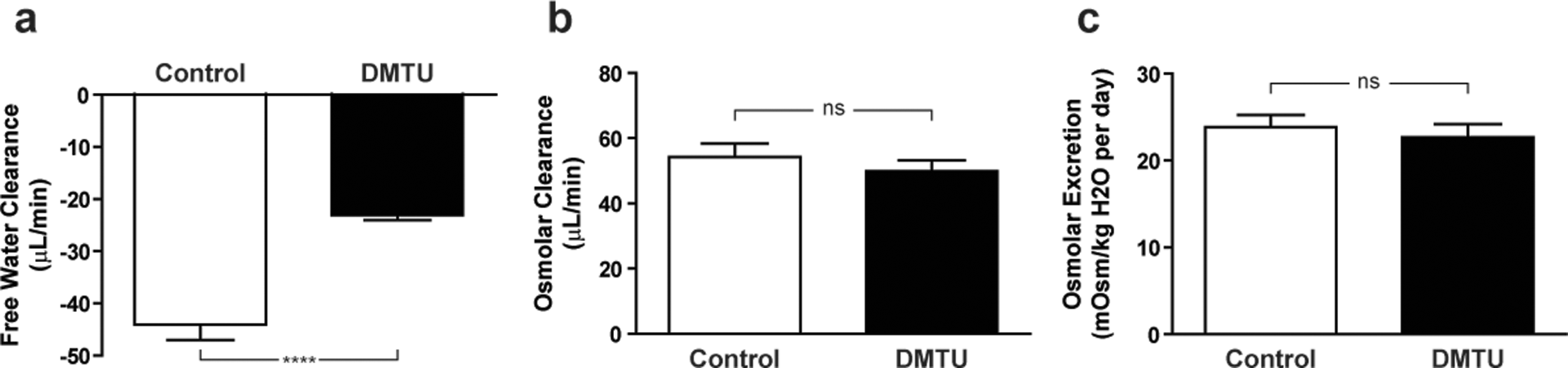
Free water clearance (a), osmolar clearance (b) and daily osmolar excretion (c) of control and DMTU-treated rats. n = 7 for each group. The values are expressed as mean ± SEM. ****p < 0.0001. DMTU: dimethylthiourea, ns: not significant.
Body weight, kidney weight and kidney function tests of control and DMTU-treated ratsa
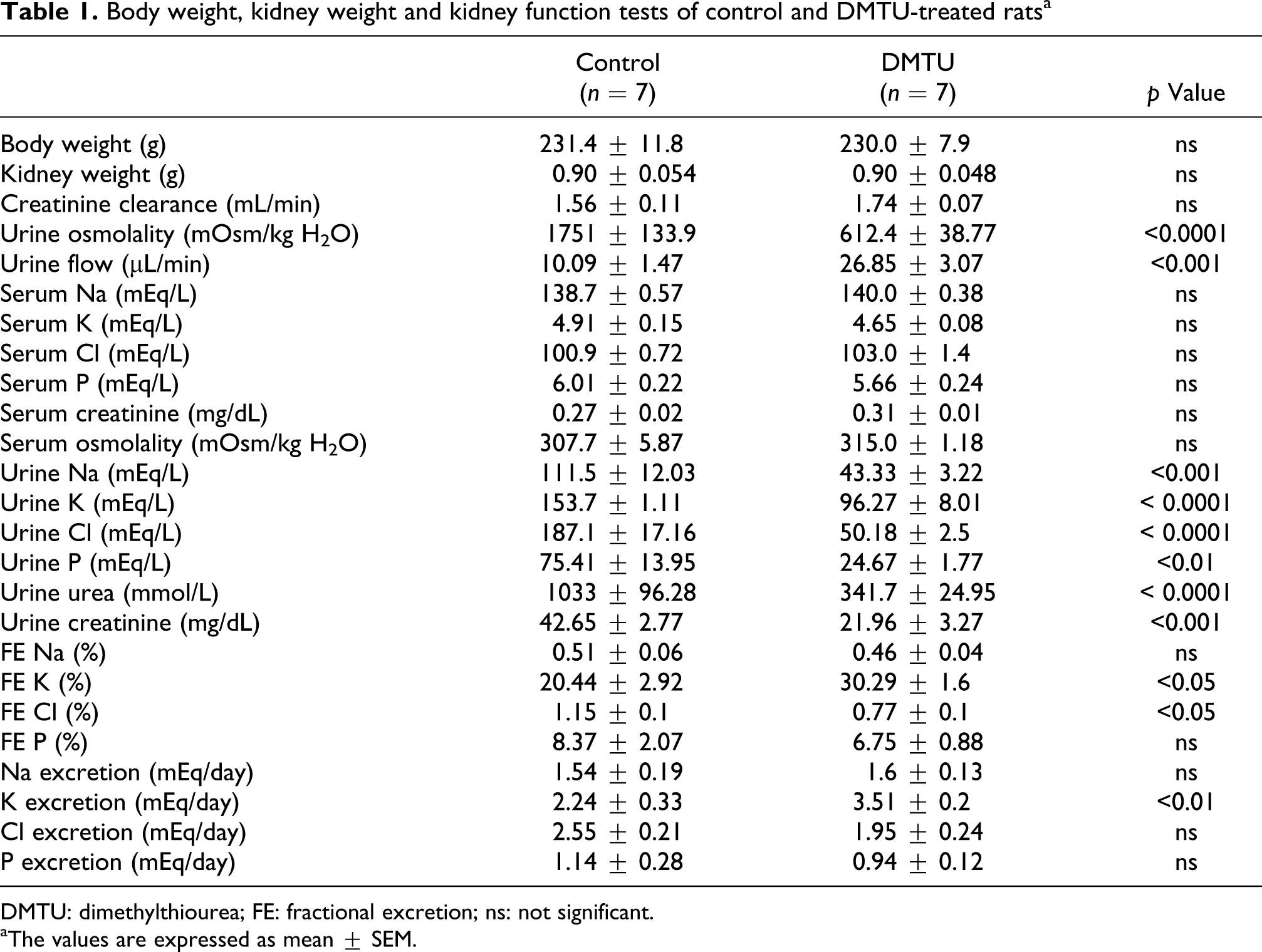
DMTU: dimethylthiourea; FE: fractional excretion; ns: not significant.
aThe values are expressed as mean ± SEM.
Discussion
In this study, for the first time, we showed that a urea analog (DMTU) has a significant diuretic effect in rats. Diuretic effect of DMTU appears to be related to decreased urea reabsorption and the impairment of urine concentrating ability of the kidneys, which suggests the potential therapeutic benefit of urea transporter inhibitors as diuretic agents.
Protein catabolism generates several waste products, including ammonia, which is excreted from body in the form of urea. Urea represents approximately 40–50% of all urinary solutes in humans and about the same in rodents, depending on protein content of their diet. 1 Excretion of urea constitutes a large osmotic load to the kidneys and it could be expected that this large osmotic load may lead to urea-induced osmotic diuresis. However, due to the presence of urea transporters in IMCD, urea excretion needs less water than any other solute. 15 During the antidiuretic state in the presence of AVP, an endogenous regulator of urea transport in IMCD, 4 urea accumulates in the interstitium at high concentrations and osmotically balances the high urea concentration in IMCD lumen. 15 This mechanism prevents osmotic diuresis due to urea and thus conserves a significant amount of water. This thought is supported by the finding that in UTA1/A3 or UT-B knockout mice, the ability of the kidney to conserve water is impaired. 6,8
Diuretic effect of DMTU demonstrated in this study is primarily due to impaired water reabsorbtion, suggested by increased free water clearance but unchanged osmolar clearance. Analysis of urine and serum samples showed that DMTU treatment decreased urine osmolality, suggesting an impairment in the urine concentrating ability, without altering serum osmolality. These changes in daily urine volume and urine osmolality are very similar to that observed in UT-A1/A3 5,6 and UT-B 8,9 knockout mice. In addition, DMTU increased urea clearance and FE urea and decreased serum urea without changing creatinine clearance, serum creatinine or electrolytes, suggesting increased urea excretion by the kidneys, which may be explained by effective urea transporter inhibition. Increase in urea clearance and FE urea and decrease in serum urea have been reported in UT-A1/A3 knockout mice 6 but not in UT-B knockout mice. 8 The similarity of abovementioned parameters between UT-A1/A3 knockout mice and DMTU-treated rats in our study strongly suggests that DMTU exerts its diuretic effect via urea transporter inhibition. DMTU also increased FE K and daily K excretion, decreased FE Cl without effecting FE Na, FE P and daily excretion of other electrolytes (Na, Cl and P) or osmolar clearance. UT-A1/A3 knockout mice had slightly but not significantly increased FE K and FE K excretion. 6 It was demonstrated that UT-B knockout mice also displayed a slight but not significant increase in K excretion compared with wild types. 8 Studies in UT-A1/A3 or UT-B knockout mice did not evaluate chloride excretion. In our study, we found that daily K excretion was increased due to DMTU treatment, although serum K levels did not alter. Since the K content of plasma is less than 1% of the total body K, a brief duration of increased K excretion might not be readily reflected to serum K levels. When some fraction of the K is removed through the kidneys under the influence of DMTU, efflux of K from the tissues, and especially from the skeletal muscles, may easily compensate for the K loss. In the current study, we administered two doses of DMTU in 24 h. However, a prolonged treatment with DMTU is expected to reduce plasma K levels significantly, but this needs to be investigated.
DMTU is widely used for experimental purposes as a hydroxyl radical scavenger and antioxidant, 12,13 but its diuretic effect has not been reported before. The inhibitory effect of DMTU on UT-B has been previously shown, 11 but its effects on UT-A1 or UT-A3 have not been studied yet. The diuretic effect of DMTU demonstrated in the current study may be a result of UT-B inhibition, but we propose that DMTU may also have an inhibitory effect on UT-A1 and/or UT-A3, since the renal phenotype of DMTU-treated wild type rats are very similar to that of UT-A1/A3 knockout mice rather than UT-B knockout ones, but this hypothesis requires further investigation. Apart from hydroxyl radical scavenger effect, our findings suggest that DMTU could also be used as diuretic or urearetic. Since the drug increased free water clearance without effecting serum electrolytes or osmolar excretion, it could be effectively used as a diuretic of choice in volume overload states. In our study, we administered DMTU at similar doses to previous studies, but it has been reported to be mildly toxic to lungs at this usual dose in rats. 16 Even if DMTU may not be used as a diuretic due to its toxic effects, it could be used as a lead compound for discovering new ‘urearetics.’
In conclusion, we demonstrated for the first time that the urea analog DMTU has a marked diuretic effect in rats. The diuretic effect of DMTU seems to be due to its urea transporter inhibitory effect, which has been demonstrated previously in vitro as well as suggested by our urine and serum analysis findings. DMTU could be used as a new type of diuretic agent and also may be used as a lead compound for the synthesis of novel and more potent urea transporter inhibitors.
Footnotes
Funding
This study was supported by Hacettepe University Scientific Research Unit (010 D09 101 005).