




Abstract
The etiology of drug addiction, a central nervous system (CNS) disease, is not fully known. This complex problem is believed to be connected with concurrently affecting genetic, psychological and environmental factors. The development of addiction is connected with CNS reinforcement system and dopaminergic neurotransmission. Molecular processes are postulated to be of universal character and allow to presume a similar mechanism of dependence for both ethanol and other substances. Therefore, elements of dopaminergic transmission become excellent candidates for the examination of genetic influence on the development of addiction. A relationship between alcoholic disease and the presence of TaqIA1 and DRD2 alleles permits to initiate another investigation of gene-coding DRD2 dopamine receptor. The latest results indicate the importance of brain-derived neurotrophic factor (BDNF) in the regulation of dopaminergic route. The purpose of this research was to reveal the relationship between the Val66Met BDNF gene polymorphism and dependence of psychoactive agent. The examinations were performed with the Local Research Ethics Committee approval and patient’s consent. The study group consisted of 100 patients (88 men and 12 women) aged 18–52 years, qualified for research program according to the International Classification of Diseases, Tenth Revision (ICD-10) requirements, medical examination and detailed questionnaire.
Introduction
Drug addiction is known to be a chronic and reversible disease of central nervous system (CNS), based on the yet not fully investigated substructure, which is of interest to clinicians, scientist and lawyers. This phenomenon is thought to be influenced by several concurrent parameters (environmental and psychological), one of them being closely connected with genetic factors. Genetic polymorphism may influence the risk of dependence evolution and frequency of intake of drug abuse substances, whereas environmental agents are responsible for occasional contact. 1 The genetic predisposition may be responsible for 50–60% risk of ethanol dependence. 2 The universal mechanism of dependence extension was postulated to be common for both ethanol and other psychoactive compounds through dopaminergic transmission. Therefore, the polymorphism of dopaminergic neurotransmission genes (DRD2) and brain-derived neurotrophic factor (BDNF) becomes the adequate candidates for the examination of correlation between genetic factors and evolution of addiction. 3
The recent associative examinations of the human genome have revealed the relationship between the locus of coding BDNF gene polymorphism and the dependence of psychoactive agents. 4 It was proved that the expression of BDNF gene in CNS changed after exposure to alcohol, nicotine, cocaine or amphetamine, and similarly during the period of abstinence. 5 The BDNF coding gene is located in the chromosome 11p13-15 region. The polymorphism of G196A gene is connected with substitution of guanine with adenine in the position 196 of the coded sequence. It results in the substitution of valine amino acid with methionine at the protein synthesis level. 6,7 The obtained observations are ambiguous, although some of the examination results confirm this association. 7 –10
Aim of the research
The aim of the study was to examine the association between G196A BDNF gene polymorphism and predisposition to the dependence development for selected psychoactive compounds (amphetamines, tetrahydrocannabinol (THC) and opiates) in patients from Dependence Treatment Centre in Szczecin, Poland.
Methods
The examinations were performed with the Local Research Ethics Committee approval and consent was obtained from each patient. The group under investigation consisted of 100 patients (88 men and 12 women) at the age of 18–52 years, from Szczecin Centre of Dependence Treatment. The dependence status (simple or multidrug) was established according to the International Classification of Diseases, Tenth Revision (ICD-10) requirements. Patients were qualified for research program according to the ICD-10 requirements, medical examination and detailed questionnaire. 3
The blood was collected on a sterile piece of cotton and extracted for DNA isolation. Then genomic DNA was extracted from the dried stain. It was performed with universal kit Sherlock AX (A&A Biotechnology for Biological Traces Examination, Gdansk, Poland). The control DNA samples were obtained from umbilical cord blood from 114 infants (95 males and 19 females), born during the years 2004 and –2005 at the Gynecology and Obstetrics Department.
Estimation of Val66Met BDNF gene polymorphism was carried out with polymerase chain reaction (PCR; restriction fragment length polymorphism) technique (Figure 1). The pairs of oligonucleotides: 5′ – TGT CTG GTG CAG CTG GAG – 3′ as a sense primer and 5′ – TCG GCG GGC AGG GTC AGA G – 3′ as a nonsense primer were used. 11 DNA samples (40 ng) were amplified in the 20 µl solution including 4 pM each starter kits, 2.5 mM each triphosphates (dATP, dTTP, dCTP and dGTP), PCR buffer (1.5 mM MgCl2 concentration) and 0.5 unit of Taq polymerase (MBI Fermentas). Amplification was performed with termocycler-Mastercycler gradient (Eppendorf) under the following conditions: initial denaturation at 94°C for 5 min, and next 35 cycles, denaturation at 94°C for 20s, starter binding for 40s at 62°C and chain elongation at 72°C for 40s. The PCR process ended with 8-min chain elongation at 72°C. Subsequently, all the PCR amplicons were digested by restricted enzyme, and electrophoresis separation (3% agar gel colored with ethidium bromide) was performed. The electrophoresis files were documented with UV camera DS-34 (Polaroid system).

Polymorphism of Val66Met BDNF gene. PCR products after digestion by restrictive enzyme Eco 72I (MBI Fermentas). MW: size marker; 1: non-digested PCR product; 2: heterozygote AG; 3: homozygote GG; 4: homozygote AA. BDNF: brain-derived neurotrophic factor; PCR: polymerase chain reaction.
The 576 base pairs length was a PCR product for used primer pairs. The allele of ‘wild’ G type is digested by Eco72I restricted enzyme result in DNA fragments of the length 336 and 210 base pairs. A loss of restriction position in the mutated allele A resulted in non-digestion process.
Statistical analysis
The frequency of respective genotypes was estimated with Chi-quadrat test. Qualitative variables were estimated with Chi-quadrat test (frequency of examined genotypes), while quantitative variables with the Mann–Whitney U test. The results with p < 0.05 were accepted as statistically significant.
Results
In the present article, no differences for examined genes and alleles disposition as well as for studied and control groups were observed (p > 0.05; Table 1).
Distribution of genotype and allele polymorphism of Val66Met BDNF gene in the studied and control groups.

BDNF: brain-derived neurotrophic factor.
In the study group, no statistically significant differences for most of the estimated parameters (Table 2) were noted for both homozygotes (GG) and patients with mutated allele A (AG and AA). The only statistically significant differences were found to be the duration of intake and the attempts of abstinence.
Studied group characteristics in relationship to genotype BDNF gene. a
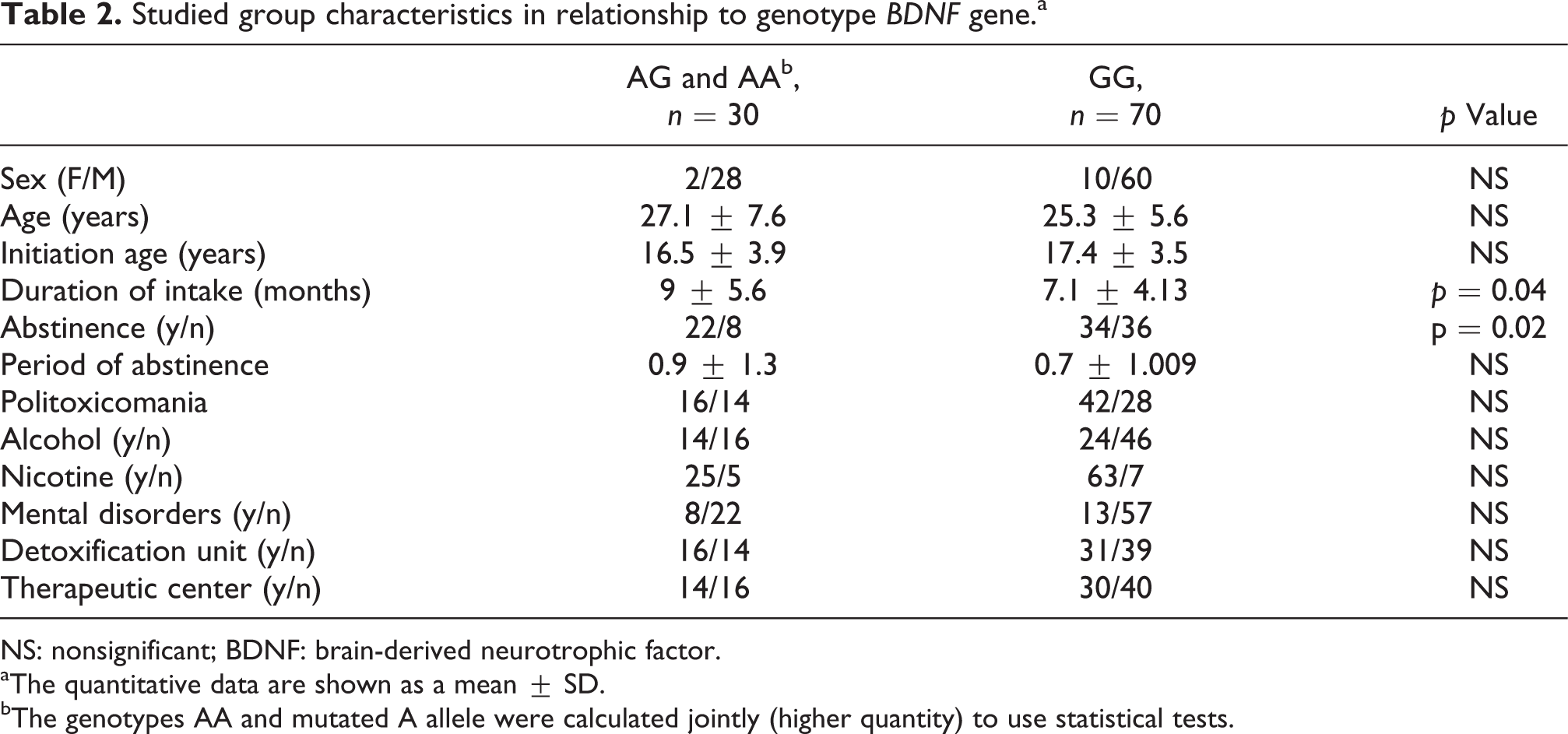
NS: nonsignificant; BDNF: brain-derived neurotrophic factor.
aThe quantitative data are shown as a mean ± SD.
bThe genotypes AA and mutated A allele were calculated jointly (higher quantity) to use statistical tests.
The obtained distribution of genotypes was not significantly different compared with prospective schedule based on Hardy–Weinberg equation (p = 0.8).
Discussion
The hitherto examinations of G196A BDNF gene polymorphism and correlation with the development of dependence were performed exclusively for Asian populations and the obtained results were ambiguous. Results obtained by Itoh et al. indicated lack of such an association among Japanese metamphetamine addicts. 12 Similarly, the studies of Cheng et al. did not prove correlation for polymorphism G196A variants for Euro-American patients addicted to drugs and alcohol. However, they observed significantly higher frequency of 712G alleles and 712G/712G genotype (single nucleotide polymorphism) in patients with dependence syndrome. 8
The observations of Matsushita et al. may indicate that the polymorphism of G196A BDNF gene results in the modification of alcohol disease clinical course (higher frequency of A allele in alcoholic patients with pathological disorders as a violence predisposition and delirium episodes) rather than in a higher susceptibility to dependence development. 7
On the other hand, Cheng et al. confirmed the association of BDNF polymorphism and susceptibility of addiction as well as younger age of initiation in China’s metamphetamine and heroin users. 8 Gratacós et al. used the meta-analysis method for the estimation of previously performed ‘case control’ studies and confirmed the polymorphism of G196A BDNF gene connection with addictions, feeding disorders and schizophrenia. 10
In the present study, no statistically significant connection with the polymorphism of G196A BDNF gene and dependence status of 100 examined patients (amphetamine, THC and opiates) was observed. However, results of our investigation may indicate that the mutation of BDNF gene (GG genotype, allele A) can result in the clinical course of addiction (duration of addiction and frequency of abstinence). These observations would support the previously mentioned observations by Matsushita et al. for alcohol disease. 7 The methodology and technical problems, connected with molecular examination of addiction, were previously described and could explain differences and contradictory results obtained by researchers. One should remember that psychological disorders as well as dependences are oligo-gene qualified, and therefore they are not inherited according to Mendel’s laws.
A number of genes were identified as responsible for the development of dependence, but none of them is indispensable and sufficient to initiate the disorders; however, all of them may affect addiction. 8 –10 The differences of susceptibility within a population result from individual genetic differences, environmental factors and their mutual interactions.
There is evidence that social and environmental elements (e.g. availability of drugs of abuse) influence the age of initiation and, above all, sustaining an addiction process. 12,13
Most of divergences in earlier results can be explained by a high heterogeneity of the studied population, stratification effect, clinical course of disorders and different clinical and diagnostic criteria for studied and control groups. 14,15 Therefore, the umbilical infant blood from the same population was used as a control group in the present study to limit the influence of environmental, social and psychological factors on the genetic examinations. This kind of control material was previously successfully applied and described by other researchers. 11,16,17 However, it is understood that it could not potentially eliminate the later mutations.
Conclusions
The results of present examination may suggest that polymorphism of G196A BDNF gene does not result in a higher risk of addiction for the examined psychoactive substances.
Although the discussed genetic changes can influence the clinical course of addiction, they are not of crucial importance.
Footnotes
Funding
This research received no specific grant from any funding agency in the public, commercial, or not-for-profit sectors.