



Abstract
Objectives:
Pesticide poisoning stands as a major public health issue worldwide. The objective of this study was to examine the epidemiologic characteristics of pesticide-related hospitalizations in South Korea.
Methods:
Data from the Korea National Hospital Discharge Survey were analyzed to describe the epidemiologic characteristics of pesticide poisoning among hospitalized patients from 2004 through 2006. Pesticide-related hospitalizations were identified using the International Classification of Diseases, Tenth Revision codes. National estimates of pesticide-related hospitalizations were calculated using sampling weights for number of hospitalizations.
Results:
A total of 25,982 pesticide-related hospitalizations were estimated during the years 2004–2006, yielding an average annual pesticide-related hospitalization rate of 17.8 per 100,000 population in South Korea. Age-specific rates for pesticide-related hospitalization increased with age, with the highest rate noted among those aged 70 or above. The majority of pesticide-related hospitalization was cases of intentional poisoning in rural areas. Seasonal variation in the rate was observed, with summer being the highest among both men and women.
Conclusions:
Pesticide-related hospitalization is prevalent and demonstrates demographic and seasonal and regional variations. More effective strategies to reduce pesticide-related hospitalizations are required in South Korea.
Introduction
Pesticide poisoning is a major cause of morbidity and mortality throughout the world, especially in developing countries. 1 Approximately 250,000–370,000 annual suicides through deliberate pesticide poisoning are estimated to occur worldwide, 2 and the numbers of victims of nonfatal pesticide poisoning are projected to be much greater. Previously, pesticide poisoning has been reported to account for the largest proportion of deaths among all forms of poisoning, with a 5.3 per 100,000 population age-adjusted pesticide-related death rate recorded from 1996 to 2005 in South Korea. 3
However, only a small percentage of pesticide poisoning cases result in death and are subsequently registered on a death certificate. Therefore, pesticide poisoning data based on deaths may seriously underreport the frequency of such poisonings. 4 In field studies, acute pesticide poisoning has been reported as a prevalent health issue among South Korean farmers. 5 As a result, studying nonfatal pesticide poisoning remains an important public health concern in South Korea.
Since understanding the pattern of pesticide-related health problems in a particular country at a national level is fundamental to develop preventive strategies at the community, we investigated pesticide-related hospitalizations with data from the Korea National Hospital Discharge Survey. The Korea National Hospital Discharge Survey is a nationally representative sample of discharges from general hospitals, offering a unique opportunity for investigative epidemiologic study of pesticide-related hospitalization. In this study, we calculated estimates of numbers and rates of pesticide-related hospitalizations and described the epidemiologic characteristics of pesticide-related hospitalization cases in South Korea.
Materials and methods
Data sources
The data used in this study were obtained from the Korea National Hospital Discharge Survey, which is conducted annually by the Korea Centers for Disease Control and Prevention. 6 The Korea National Hospital Discharge Survey is an annual nationally representative sample of discharges from general hospitals, excluding rehabilitation, military, and veterans’ facilities. It has a two-stage sampling design. Stage one includes a stratified probability sample of all South Korea hospitals with 100 or more beds and is based on a sampling frame with two strata: hospital size based on number of beds and geographic location. Stage two includes a random sampling of discharges from each selected hospital. The patients’ information was abstracted from medical records using either an electronic system or manual reviews by medical record researchers, depending on the equipment used in a particular hospital. The discharge records were weighted according to hospital size and region to allow the calculation of national estimates. From 2004 to 2006, the Korea National Hospital Discharge Survey gathered data on hospitalizations from a nationally representative sample of 150 hospitals per year, the most recent available data, representing approximately a 29% stratified sample of all hospitals in South Korea with 100 or more beds.
Case definition
Variables included in the analysis were age, gender, area of residence, health outcome such as death or live discharge, and dates of admission and discharge. Up to 20 listed disease diagnoses were presented according to the International Classification of Diseases, Tenth Revision (ICD-10). 7 Pesticide-related hospitalizations were defined as those with the ICD-10 code for pesticide poisoning (T60.0–T60.9) listed as the primary diagnosis code. Among cases with a pesticide ICD-10 code in all diagnostic fields, 95% showed a pesticide ICD-10 code in the principal diagnosis. The external cause of injury code (X48, X68, X87, and Y18) was used to characterize the circumstances, leading to poisoning. Most cases (98%) included an external cause of injury code. Total poisoning cases were also defined when a patient had the ICD-10 code for poisoning (T36.0–T65.9) in the primary diagnostic field. Urban or rural status was categorized into three groups (i.e. metropolitan, urban, and rural) based on the administrative district of residence.
Data analysis
National estimates of pesticide-related hospitalizations were calculated using weighted sample estimates for number of hospitalizations. For hospital cases, the final weight was computed as the product of the sampling weights for the hospital and for the case within the hospital; the hospital was identified as the primary sampling unit. Pesticide-related hospitalization rates per 100,000 population were estimated using the weighted number of pesticide-related hospitalizations as the numerator and the 2004–2006 Korean census population from Statistics Korea 8 as the denominator. Average annual rates were obtained by dividing the summed rates for 3 years. Confidence intervals for rates were calculated using the Taylor series linearization method to account for the complex survey designs. 9 Descriptive statistics by sociodemographic characteristics for pesticide-related hospitalizations were presented. Statistical analyses were performed using Stata 11.0 (StataCorp., College Station, TX, USA).
Ethics statement
This study analyzed publicly available data sets and was therefore exempt from institutional review board approval.
Results
A total of 2369 cases of hospital discharges related to poisonings were identified from Korea National Hospital Discharge Survey data over 2004–2006 (Table 1). Pesticide poisoning (n = 891) was the most common (37.6%) cause of all hospital discharges connected with poisoning. Pesticide poisoning also showed the highest fatality rate (19.1%) of all hospital discharges connected with poisoning. Men were more likely to be hospitalized as a result of pesticide poisoning than were women and the fatality of pesticide poisoning was much higher for both men and women than with total poisoning. These patterns were similar in each year of the study period (data not shown).
Distribution of hospitalizations due to poisoning by substances involved in South Korea, 2004–2006

ICD-10: International Classification of Diseases, Tenth Revision.
a Case fatality percentage.
Table 2 shows pesticide-related hospitalizations according to the substance. It was further divided by the fact, whether it was intentional or accidental. The most commonly reported substances were herbicides and fungicides (T60.3; 47.2%), followed by organophosphate and carbamate insecticides (T60.0; 27.6%). Intentional pesticide poisoning was the primary cause of hospitalizations (72.1%). The distribution of number of cases by cause of poisoning was similar for each substance. These proportions were similar in both men and women (data not shown).
Distribution of pesticide-related hospitalizations by substances and cause of poisoning in South Korea, 2004–2006
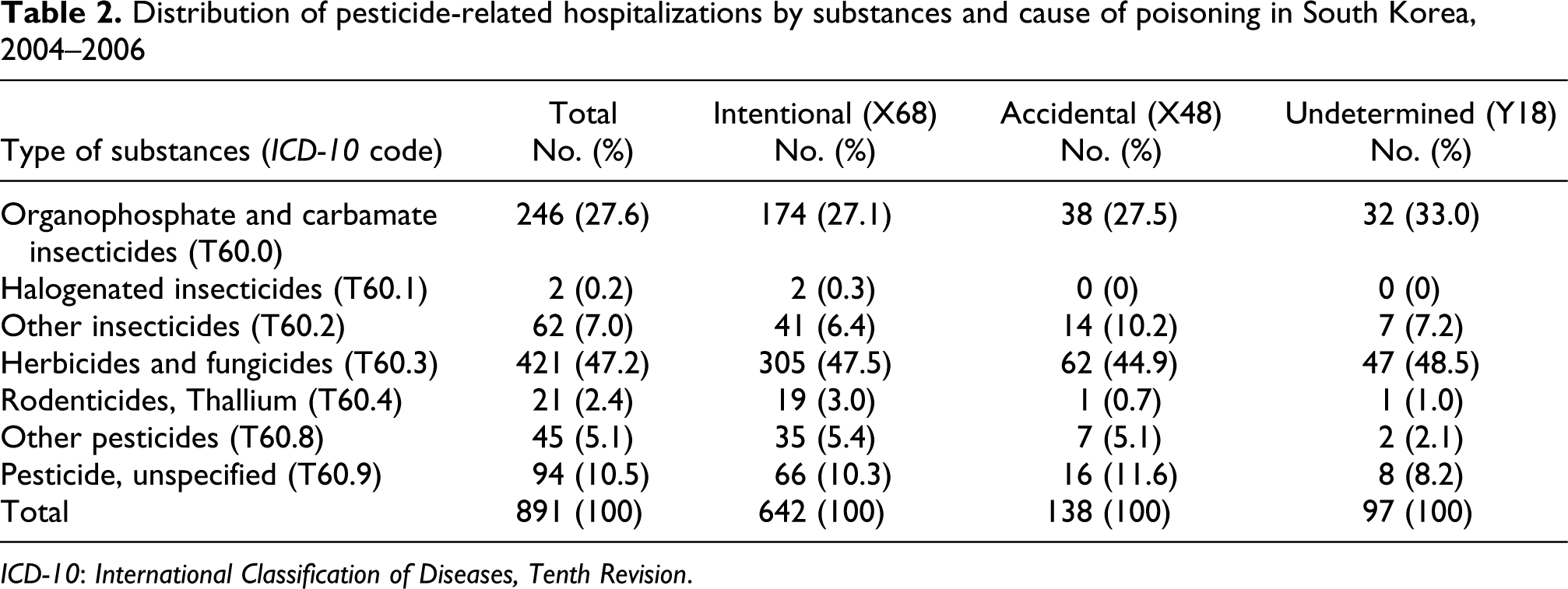
ICD-10: International Classification of Diseases, Tenth Revision.
The number of hospital discharges and deaths caused by pesticide poisoning were estimated to be 25,982 and 5185 during the study period, respectively (Table 3). The average annual rates of pesticide-related hospitalizations and mortality were 17.8 and 3.5 per 100,000 populations, respectively. Those rates remained relatively stable during the 3 years covered by the study, although they were slightly lower in 2005. In each year, men showed higher rates of pesticide-related hospitalization and of mortality than did women.
Age-specific rates for pesticide-related hospitalization increased with age and were highest among the 70 or over age group (Table 4). The hospitalization rate was higher among women in the age group of 0–19 years compared to men of the same age group, but it was sharply higher among men than among women after age 50. The differences between the genders increased with age. Residents of rural areas suffered the highest rate of pesticide-related hospitalization, while those in metropolitan districts showed the lowest. The majority of pesticide-related hospitalization stemmed from intentional cases with the average rate peaking in summer for both men and women.
The rates of pesticide-related hospitalization and mortality by year and gender in South Korea, 2004–2006
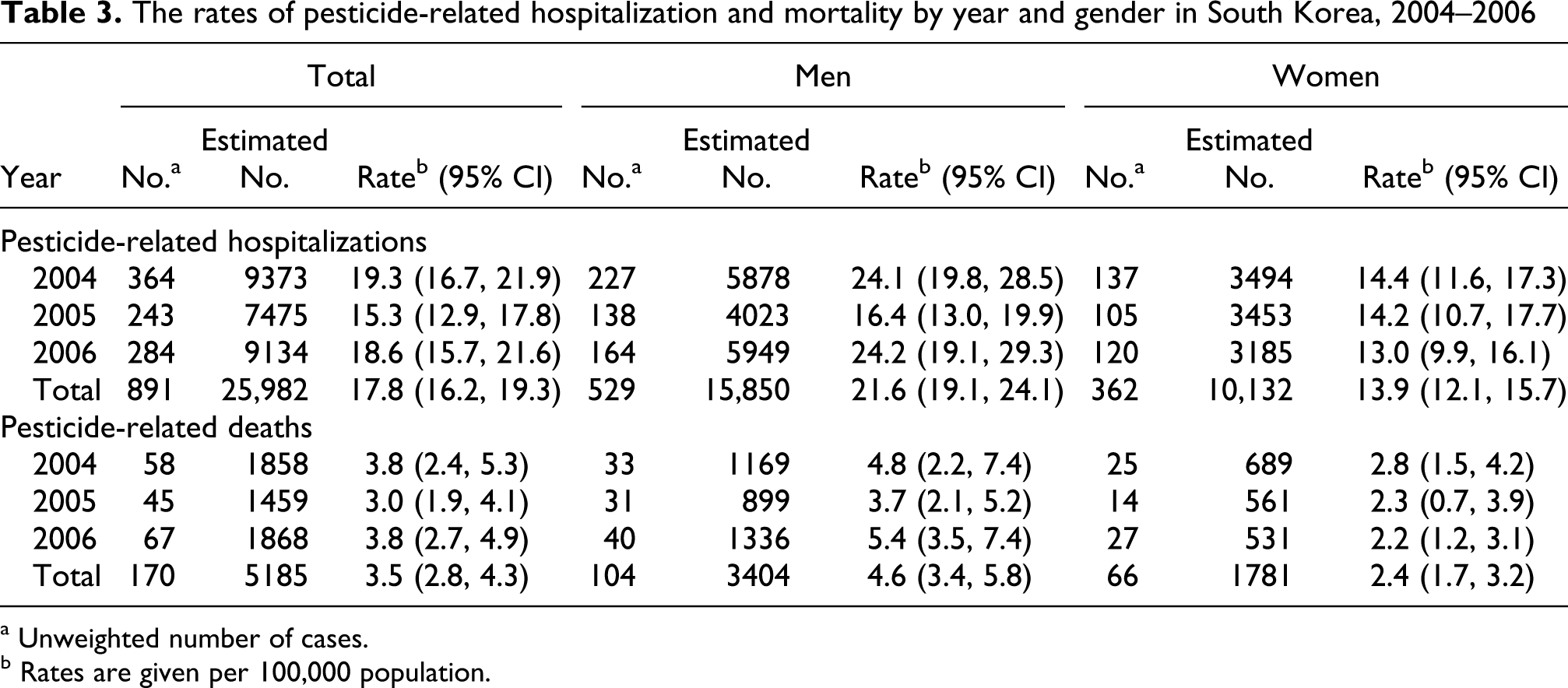
a Unweighted number of cases.
b Rates are given per 100,000 population.
The rates of pesticide-related hospitalization by age, area, cause of poisoning, and season in South Korea, 2004–2006

a Rates are given per 100,000 population.
Whereas the cause of poisoning in children in the age group of 0–9 years was mostly accidental, rates of intentional self-poisoning increased with age until becoming the cause of the majority of pesticide poisoning cases (Figure 1). Men showed a higher rate of hospitalization from intentional pesticide poisoning than did women (Table 4), and the mortality for intentional self-poisoning (2.6 per 100,000) was greater than that for accidental poisoning (0.4 per 100,000).

The rates of pesticide-related hospitalization by age and intention in South Korea, 2004–2006.
Discussion
Our results demonstrate that pesticide poisoning is an important public health issue, annually resulting in 17.8 pesticide-related hospitalizations per 100,000 population in South Korea. This is the first study in South Korea, estimating the rate of pesticide-related hospitalization at the national level and its epidemiological characteristics. Our estimate is higher than that seen in developed countries and lower than that seen in developing countries, although direct comparisons might not be possible due to the differences in data sources and study periods.
The annual rate of pesticide-related hospitalization was estimated from hospital discharge files for the US state of California over 1994–1996 as 1.38 per 100,000 population. 10 An average of 0.89 per 100,000 population was obtained for Louisiana, ranging from 0.39 in 2006 to 1.30 in 1998. 11 In Finland, the rate of hospitalizations decreased significantly from 0.50 per 100,000 people in 1980–82 to 0.13 in 1987–88. 12 Over the 5-year period from 1998 to 2003, 237 hospital admissions of adults aged 16–69 years were attributed to accidental pesticide poisoning in England. 13 An average of 50–60 patients were estimated to be hospitalized annually due to pesticide poisoning in Sweden. 14 This pattern contrasts with that in developing countries where the rates of pesticide-related illness are much higher. The national morbidity rate for pesticide poisoning was 79 cases per 100,000 population in Sri Lanka in 1979. 15 In the southern part of the country, the annual incidence for adult admissions with acute pesticide poisoning was estimated at 163 per 100,000 for the year 1999. 16 Over the 7 years spanning 1980 through 1986, 3330 pesticide poisonings were found in the social security hospital discharge register in Costa Rica, with an average annual rate of 20 per 100,000 population. 17
The relatively high rate of pesticide-related hospitalizations revealed by our study compared to other developed counties may be explained by higher rates of suicide by means of pesticide ingestion. More than 70% of the pesticide poisoning cases in our study were due to self-inflicted exposure. A similar pattern was also observed in Sri Lanka, where over 80% of all cases of pesticide poisoning admitted to hospitals were self-inflicted. 16 Pesticides are the most common method of self-poisoning in many developing countries and are associated with a high mortality rate. 18 The problem is particularly acute in Asia, such as in China, Sri Lanka, Bangladesh, and Nepal, where pesticide poisoning is the common cause of suicides. 2 A previous study in South Korea also showed that the majority of pesticide poisoning deaths were from intentional ingestion for the purpose of suicide. 3 This pattern is distinct from that reported in developed countries, such as in the United States 19 or Sweden 14 where accidental poisoning is the leading cause of pesticide-related hospital admissions. Therefore, it is also important to consider the role of cultural factors in pesticide poisoning.
Easy access to pesticides is an important factor in explaining the higher rates of suicide by means of pesticide ingestion in South Korea. Pesticides may be purchased and applied without training or license for pesticide application, 3 and only a small percentage of farmers in South Korea lock their storage facility for pesticides. 20,21 Our finding that the highest rate of hospitalization due to pesticide poisoning in rural areas may be explained by easy access to pesticides in rural areas. In addition, the seasonal variation in pesticide-related hospitalizations, with peaking in summer shown in our study, may also be explained by unobstructed access to pesticides during the farming period, April to October in South Korea. Thus, ensuring safe storage of pesticides and strict regulation of licenses for purchase would all be beneficial in restricting the accessibility of pesticide poisoning and its negative consequences. 22
South Korean farmers also showed less of a tendency to use personal protective equipment, because it is often perceived as inconvenient in the hot summer. 21 Similarly, a study performed on agricultural workers also revealed a less frequent use of personal protective equipment, such as protective clothes, masks, gloves, and eye shields. 23 Therefore, implementing educational and training efforts, encouraging appropriate use of protective equipment, 24 and promotion of integrated pest management strategies 25 can be counted among the strategies employed for the prevention of pesticide poisoning among agricultural workers.
The rates of pesticide-related hospitalization increased with age in our study and peaked among those aged 70 or over. This pattern differs from that reported in developed countries. In Louisiana, the mean annual rate of pesticide-related hospitalizations was greatest among children aged 0–4 years. 11 Acute pesticide poisoning occurred most frequently in children under age 5 in both Minnesota and Milan. 26 Our finding is also distinct from those reported in most developing countries. In Costa Rica, the highest incidence rate of pesticide poisoning, both occupational and nonoccupational, peaked at 20–29 years of age. 17 In India, the commonest age group was 21–30, followed by 13–20 years 27 ; and in Zimbabwe approximately half of all the pesticide poisoning cases occurred in the age group of 16–25 years. 28 The major age group affected by poisoning in Ecuador was adolescents and young adults between 15 and 25 years old. 29
The high rate of pesticide poisoning among the elderly may be explained by the rapid ageing of the population across South Korea in recent decades, particularly among farmers. 30 Ageing as a social issue is a concern in South Korea and the ageing rate of the Korean population appears to be far higher than that of other industrial countries. This trend is similar in Japan, where the highest incidence of pesticide poisoning falls in the age group of 60–69 years. 31 In addition to ageing, elderly suicides have sharply increased in South Korea. The suicide rate among seniors aged 64 years and over is the highest compared to all other age groups in South Korea. 22 Elderly suicide attempters by self-poisoning had more ingestion of pesticides than did the under 65 group, which is associated with higher fatality than other drugs. 32
Men were predominant in pesticide poisoning cases in this study. Similar findings have been reported in studies performed in the other countries. 11,12,14,16 The higher rate among men may reflect the higher proportion of men working in occupations involving pesticides, such as in pesticide application.
Our study has shown herbicides and fungicides to be the leading cause of hospital admissions due to pesticide poisoning, followed by organophosphate and carbamate insecticides. This pattern is somewhat different from those reported in other countries, including Costa Rica, 17 India, 27 Sri Lanka, 16 and Ecuador, 29 where organophosphates are the leading cause of hospitalization due to pesticide poisoning. Zimbabwe 28 showed the highest percentage of admissions to be due to pesticide poisoning occurring from the oral ingestion of rodenticides. Although our data set lacks information about the specific pesticides involved, the disproportionately larger percentage of hospitalizations is probably related to the greater toxicity of the herbicide paraquat. In South Korea, paraquat is widely used and easily accessible not only to farmers but also to the general population. High-concentration paraquat products (24%) remain in the market, while many European countries prohibit them or set strict regulations on their purchase and use. Therefore, paraquat is frequently used in suicide attempts in South Korea. 33 Furthermore, the perception among farmers that herbicides are the most lethal chemicals may also lead to a more frequent use of herbicides for self-poisoning. 20
One of the limitations of this study is that the Korea National Hospital Discharge Survey only covers those hospitals housing 100 or more beds and may under represent all pesticide-related hospitalizations. However, in 2004 in South Korea the total number of beds provided by hospitals with 100 or more beds was 87% of the total number of beds provided by all hospitals, 34 and hospitalization cases due to poisoning tend to concentrate at large hospitals because the larger hospitals have better resources to treat pesticide poisoning. Thus, we believe that the number of uncaptured hospitalized cases due to pesticide poisoning to be relatively small. The other limitation is the validity of the discharge codes recorded. However, pesticide poisonings occur acutely and tend to be more severe clinically and, therefore, may be more easily identified than other causes of poisoning. The lack of detailed information on causative agents also hindered further analysis.
Despite these limitations, our study includes a nationally representative sample of data, and we demonstrate that the magnitude of pesticide-related hospitalizations in South Korea is higher than that in developed nations. The majority of cases were intentional poisoning, and seasonal and geographical patterns suggest that easy accessibility to pesticides is a major factor related with the high rate of pesticide-related hospitalizations. This finding suggests that pesticide-related hospitalizations in South Korea are mainly preventable. Therefore, intensive intervention efforts, such as the strict regulation of pesticides and prevention efforts to control suicide, are critical to reduce the burden of hospitalization associated with pesticide poisoning in South Korea.
Footnotes
Funding
This work was supported by the National Research Foundation of Korea (NRF) grant funded by Korea government (MEST) (No. 2010-0021742); and by the Cooperative Research Program for Agriculture Science & Technology Development (Project No. PJ007455), Rural Development Administration, Republic of Korea.