




Abstract
Seafood is considered by nutritionists to be a high source of omega 3 long-chain polyunsaturated fatty acids (n-3 LC-PUFAs) which are involved in prevention of cardiovascular diseases. The aim of the present study is firstly to detect the presence of organochlorine pesticides and heavy metals in some fresh seafood of Red Sea commonly used in KSA in relation to its contents. It was found that the fatty acids 18:2n-6, 18:3n-6, 18:3n-9 was statistically significantly higher in fresh samples than frozen (p < 0.05), smoked (p < 0.01) and canned fishes (p < 0.05), respectively. Total lipids and cholesterol content of canned and smoked fishes were significantly higher than fresh and frozen samples (p < 0.01, <0.05 and p < 0.01, <0.05). Vitamin D was found to be lower in frozen samples than fresh, smoked and canned (p < 0.05 for each). While vitamin A was higher in fresh and smoked as compared with frozen and canned samples. No organochlorine tested were detected in either fresh or processed samples (smoked, frozen and canned). Among the heavy metals, the highest lead level was detected in fresh and smoked samples as compared with frozen and canned samples. No correlation was found between organochlorine compounds in fish and the corresponding levels in fatty acids. We concluded that, all fishes are safe for uses but it is preferable to use fresh samples due to its high content of PUFA and low lead level.
Introduction
The pollution of inland waters by poychlorinated biphenyls (PCBs), chlorinated pesticides and related chemicals follows mainly the dissolving of these substances present in the contaminated industrial, agricultural and sewage effluents, thereby enabling fish to absorb retaining and concentrating them particularly in the fatty tissues. 1 In view of the assessment of the health risks posed by these compounds to humans/mammals, fish and birds, the concept of toxic equivalency factor was developed by the World Health Organization (WHO) jointly with the European Centre for Environment and Health. On the general assumption that the metabolic disposition, tissue distribution, body burden and toxicity of congeners of PCBs operate on an additive basis, the quantitative levels of these congeners can be expressed as toxic equivalents (TEQs). Furthermore, the National Academy of Sciences and National Academy of Engineering as well as Sweden (Swedish Food Regulations, 1983) define the limits for total DDTs, dieldrin, endrin, heptachlor, chlordane compounds and HCB. Moreover, Canadian tissue residue guidelines for the protection of wildlife consumers of aquatic biota also set tolerance limits for organochlorines. 2 Organochlorine pesticides (OCPs) are among the most widely applied chemicals in the world. They have been used for pest and insect control in more than half a century, owing to their negative impact on the ecosystem and human health.3,4 The agricultural uses of most OCPs, in particular, technical DDT and hexachoro-compounds HCH, have been banned worldwide since the late 1990s. However, these chemicals are hard to be degraded and hence are capable of remaining in the environment up to decades. In the meantime, some specific OCPs are still allowed to be used, for instance, g-HCH as an effective component in lindane, chlordane for termite control, and DDT for malaria control (in some tropical and subtropical countries).
In general, the environmental persistence and the use of some OCPs make it a long-term challenge for the international community to control and finally phase out in the environment.
Polybrominated diphenyl ethers (PBDEs) are a class of flame-retardants widely used in plastics, textile, electronics and other materials. PBDEs were put into use in 1970s and its global annual consumption in 1999 reached ca. 70,000 tons. PBDEs can impair attention, learning, memory and behavior in laboratory animals. 5 PBDE concentrations in biota are estimated to have been doubling every 5 years. 6 It was reported to have increased by 60-fold in human breast milk in Sweden between 1972 and 1997. 7 Compared with the well known OCPs, PBDE contamination has become an emerging environmental thrust in the recent years, which is attracting more and more attention from the public and environmental community.
Both OCPs and PBDEs are hydrophobic organic compounds (HOCs) capable of accumulating in the organisms. In aquatic environments, HOCs can enter into fish, mainly via two pathways, bioconcentration directly through the water environment 8 and/or biomagnification through food web preys,9,10 Lipid content, 11 depuration rates, 12 size and exposure duration of the organism, 13 as well as the structure of the food and the environmental concentrations of the chemicals are all potential factors influencing bioaccumulation of HOCs in an aquatic organism. Pelagic organisms were found to be more subjected to HOC bioaccumulation than biota relying upon benthic primary production. 14
The significance of mercury bioaccumulation in fish is mainly with respect to possible direct effects on wildlife, and indirectly through the consumption of a contaminated food source. Mercury is known to bioaccumulate in fish and can impair osmoregulatory function. 15 Other effects may occur due to heavy metals as mercury possesses a strong affinity for sulfur and sulfhydryl groups, and thereby may interfere with important basal biological functions in organisms. 16 However, much of the potential risk of the mercury accumulation in fish lies in its potential to bioconcentrate. As such, the potential of toxic effects in wildlife and humans that consume mercury-contaminated fish may be considerable.
Essential fatty acids (EFAs) cannot be synthesized by the body and therefore necessitate dietary intake. They are polyunsaturated fatty acids (PUFAs) that occur in the cis-configuration including linoleic acid (LA) and alpha-alinolenic acid (ALA) as their parent FAs. 17 However, both FAs are converted by alternating desaturation (rate-limited) and elongation (rapid) reactions to their respective active metabolites (arachidonic acid [AA], eicosapentaenoic acid [EPA] and docosahexaenoic acid [DHA]). 5
It is known that DHA taken into the body is mostly delivered to the liver through plasma lipoprotein. 6 Previous studies have shown that DHA oil has been used for the treatment of several pathologies such as glomerulonephritis, rheumatoid arthritis, autoimmune diseases, allergic asthma, hypertension, cardiovascular diseases and as adjuvant in cancer therapy such as mammary and colon tumors. 7
The aim of the present study is firstly, to determine the levels of selected organochlorine pesticides and heavy metals including cadmium, lead, mercury, arsenete, cobalt, manganase and nikel) in some seafoods commercially used at Saudi Arabia compared with the processed fishes (smoked, frozen and canned). In addition, determination of total lipids, cholesterol and fatty acids composition.
Materials and methods
Samples collection
Several criteria were taken into account: quantities consumed, consumption frequencies, preservation or transformation methods if any (fresh, semi-fresh, frozen, canned etc.), provisioning place (beach fishing, purchase on the fish dock, at the market, from a fishmonger, in another type of shop, or consumption outside the home) and geographical origin of product (preferably local, regional etc.).
Six common commercial fresh fishes (mackerel, shrimp, lobster, crab, oyster and squid) were used. A composite sample of about l00 g of edible portion was taken for each fresh product, allowing five 100 g primary samples. In addition, eight frozen samples, three smoked samples, and six canned samples were purchased from different local market at Jeddah
The preservation method (percentage of purchases of fresh and/or frozen products) was taken into account in the number of primary samples corresponding to purchases made in supermarkets. The composite samples of canned and smoked products and prepared seafood dishes were composed taking the market shares of the different brands into account. The primary samples were transported from the purchase location to the lab in a refrigerated truck. Time between purchase and reception by the lab did not exceed 3 hours. Products were stored at −20°C immediately after reception by the lab.
Sample preparation
For each product in the list, the edible portion of the primary samples were mixed, ground and remixed to obtain a single homogeneous composite sample of the product. More precisely, the edible portion for fish will be defined as fillets i.e. flesh without skin and without entrails, meaning that each one was gutted. The fillet was used for all fish samples.
The canned foods were drained well from oil. For shellfish, only the soft content was ground.
The mixing equipment used was made of stainless steel. In compliance with good laboratory practices, the hardware used to prepare the composite samples were thoroughly washed between each preparation in order to avoid cross-contamination between species and composite samples. After preparation, the composite samples were stored at −20 °C in polypropylene containers until the time of analysis.
Analysis of total lipids
The total lipids were analyzed by the following method, samples were freeze-dried, powdered and transferred into solvent extraction. The extraction solvent was a mixture of toluene/acetone 70:30 (v/v), and three successive extraction cycles (5 min each) were performed. The extract was evaporated to dryness, permitting the gravimetric determination of fat content. The extracts were dissolved in hexane for sample clean up. 18
The shrimp samples were washed, blotted dry, and after removal of heads, shells, tails, legs and intestines, the flesh were ground into a homogenous mass in a domestic food processor. Ten grams samples were submitted to duplicate analyses. Lipids were extracted as described previously. Aliquots was taken from the same extract for the determination of total lipids by weight after evaporation of the solvent, cholesterol by colorimetric technique using kits from Biosystem.
Determination of cholesterol
Aliquots were taken from the same extract for the determination of total cholesterol after evaporation of the solvent, by colorimetric technique using kits from Biosystem. 19
Determination of fatty acid composition
For the analysis of the free FAs, after extracting with hexane, the fat was filtered then esterified with 1.5 mL of a methanol/sulphuric acid mixture, 13:2 (v/v). saponification were done according to the method of. 20 Derivatization of fatty acids was accomplished according to ref 21
The gas chromatograph (Varian 3300) was equipped with a split injector (100:1); fused silica capillary column (30 m × 0.30 mm i.d., 0.25 μm film thickness of polyethylene glycol; DB-WAX, JW Scientific, California, USA); flame ionization detector (FID). The chromatographic conditions as follows: column temperature, 150°C for 11 min, programmed at 3°C/min up to 210°C; injector temperature, 250°C; detector temperature, 280°C; carrier gas, hydrogen at 1.26 mL/min with a linear velocity of 39.4 cm/s; make-up gas, nitrogen at 30 mL/min.
Fatty acids were identified by spiking, the adjusted retention times and equivalent chain lengths 22 as applied to fish fatty acids. Monounsaturated and polyunsaturated fatty acid standards Sigma were used, along with PUFA-1 and PUFA-2 of Supelco (USA). In addition, the equivalent chain length results were found to correlate well with mass spectrometric data in our laboratory. 23
Detection of organochlorine pesticides in seafood
Poychlorinated biphenyl (PCB) standards were obtained from the Sigma company and the internal standard 1,2,3,4-tetrabromobenzene (98%). All of the solvents and other chemicals used were analysis grade, purchased from Merck Glass-ware having been used, was soaked, cleaned with chromic sulfuric acid solution, thoroughly rinsed with deionised water and acetone, and heated to 150°C for 12 h.
Sample treatment
After preparing the homogenate, an aliquot of 2 g was taken and mixed with 5 g of anhydrous sodium sulfate and 100 μL internal standard (1,2,3,4-tetrabromobenzene, 98%) in 50-mL glass tube and the column was eluted with 120 mL of n-hexane: dichloromethane mixture (4:1). The extract was evaporated to dryness with nitrogen gas stream) and reconstituted in 250 μL iso-octane for gas-chromatographic/mass spectrometry (GC/MS) analysis.
Chromatographic separation organochlorine compounds
Gas chromatography (GC) has been widely used for pesticide determination/quantification with the electron capture detector (ECD).
The high presence of OCPs (HCH, DDT, DDD, DDE) in fishes must be emphasized, due to their persistence and bioaccumulation in the environment. However, these pesticides are still frequently found in soils, water from which they continue to cycle through the environment.
The determination of heavy metals
Determination of heavy metals (mercury, lead, arsenate, nikle, cobalt, manganase and cadmium) in fishes was performed on a hydride attachment to the AAS-30 atomic absorption spectrophotometer using heavy metals-hydride attachment to the Buck AAS-30 atomic absorption spectrophotometer. This method is an integral component of chemical toxicological analysis in expert evaluation of poisonings. 24
Statistical analysis
To verify significant differences in relation to species, size, and place of capture, the results were submitted to analysis of variance (ANOVA) at 5% level of confidence. The results for the principal fatty acids, total lipid and cholesterol were also submitted to principal component analysis, using SAS (1985)
Results
Analysis of PUFA in different types of fishes samples were listed in Table 1 . It was found that the fatty acids 18:2n-6, 18:3n-6, 18:3n-9 were statistically significantly higher in fresh samples than frozen (p < 0.05), smoked (p < 0.01) and canned fishes (p < 0.05) respectively. However, smoked and canned were higher than frozen. Also, it was found that, non-significant changes were detected in 18:3n-3 and20:4n-6.
Essential fatty acids levels (μg/g) in the different samples (Mean ± SD).

n = No. of samples
a Groups II,III and IV compared with group I.
b Groups III and IV compared with group II.
*p < 0.05.
**p < 0.01.
***p < 0.001.
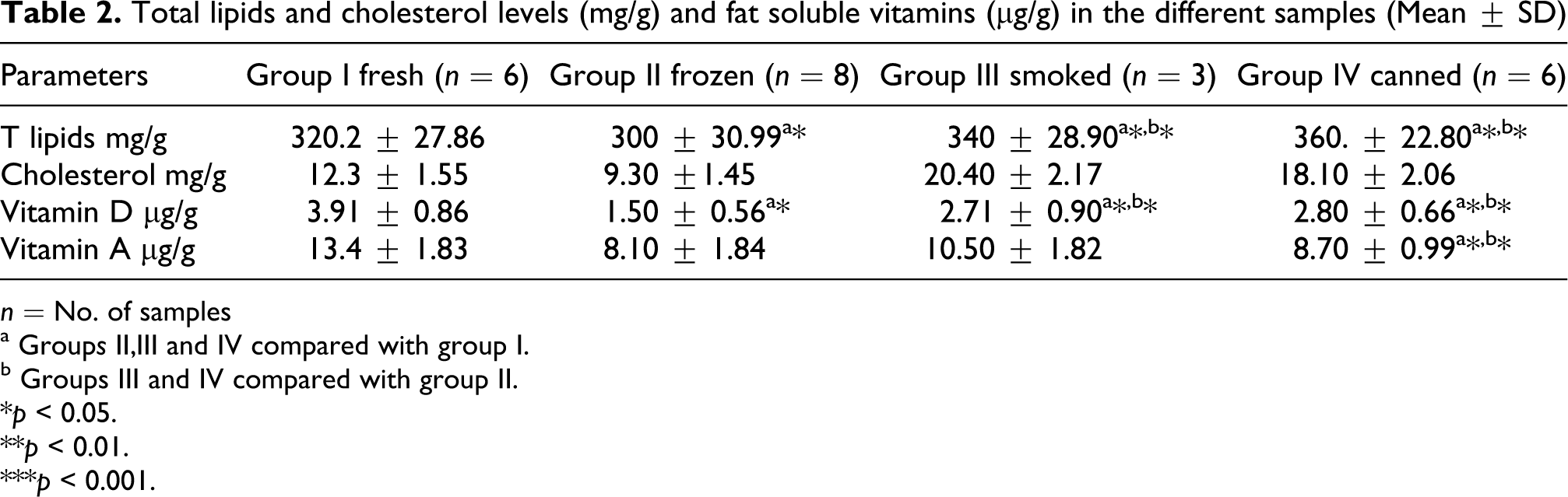
Table 2 revealed that, total lipids and cholesterol content of canned and smoked fishes were significantly higher than fresh and frozen samples (p < 0.01, <0.05 and p < 0.01, <0.05. Vitamin D was found to be lower in frozen samples than fresh, smoked and canned (p < 0.05 for each), while vitamin A was higher in fresh and smoked as compared with frozen and canned samples.
Total lipids and cholesterol levels (mg/g) and fat soluble vitamins (µg/g) in the different samples (Mean ± SD)
n = No. of samples
a Groups II,III and IV compared with group I.
b Groups III and IV compared with group II.
*p < 0.05.
**p < 0.01.
***p < 0.001.
However, the four kinds were not detected in the tissues or organs of all tested samples.
The distribution of heavy metals was different (Table 3 ). In general, the highest lead level was detected in canned and smoked samples as compared with frozen and fresh samples. Interestingly, some specific distribution was also observed for the selected metals. Greater concentrations of cobalt, manganese and cadmium were detected. However, levels of nickel, arsenate and mercury were relatively low.
Heavy metals contents (μg/gm) in the different samples (Mean ± SD)

n = No. of samples
*p < 0.05.
**p < 0.01.
***p < 0.001.
a Groups II, III and IV compared with group I.
b Groups III and IV compared with group II.
Discussion
Due to industrialization, the number of factories and population has increased rapidly. Massive amounts of domestic wastewater and industrial effluents are transported by rivers and discharged into the sea, contaminating rivers and coastal waters. Such anthropogenic pollutants are the main sources of heavy metal contaminants in the ocean. These contaminants entering the aquatic ecosystem may not directly damage the organisms; however, they can be deposited into aquatic organisms through the effects of bioconcentration, bioaccumulation and the food chain process and eventually threaten the health of humans by seafood consumption. 25
The use of chemical compounds for agriculture such as insecticides herbicides, organophosphorus pesticides (OPPs) and organochlorine pesticides (OCPs), can cause the contamination of the environment because they are persistent, broad-spectrum toxicants that tend to accumulate in the food. OCPs can enter the water environments by runoff from discharge of industrial wastewater, wet or dry deposition, and persist for a long period .They can be transferred into food chains and finally reach human being. Therefore, the residues of OCPs might ultimately pass onto people through consumption of drinking water, fish and agriculture food. Thus, different pesticides can be introduced in the seafood, affecting the biological and nutritive value of the fishes. 26
The aim of the present study is to determine the levels of selected organochlorine pesticides and heavy metals in relation to total lipids, cholesterol, fatty acids composition in some seafoods in Red Sea (commercially used) at Saudi Arabia compared with the processed fishes (smoked, frozen and canned).
The lipids present in fish species divided into two major groups: the phospholipids and the triglycerides. The phospholipids make up the integral structure of the unit membranes in the cells; thus, they are often called structural lipids. The triglycerides are lipids used for storage of energy in fat depots, usually within special fat cells surrounded by a phospholipid membrane and a rather weak collagen network. 27
In addition to phospholipids, the membranes also contain cholesterol, contributing to the membrane rigidity. In lean fish muscle cholesterol may be found in a quantity of about 6% of the total lipids. This level is similar to that found in mammalian muscle. 28
Depending on the amount of polyunsaturated fatty acids, most fish fats are more or less liquid at low temperature.
Results obtained in Table 1 showed that the fatty acids 18:2n-6, 18:3n-6, 18:3n-9 were statistically significantly higher in fresh samples than frozen (p < 0.05), smoked (p < 0.01) and canned fishes (p < 0.05), respectively. However, smoked and canned were higher than frozen. Also, it was found that, non-significant changes were detected in 18:3n-3 and 20:4n-6.
Fish lipids differ from mammalian lipids. The main difference is that fish lipids include up to 40% of long-chain fatty acids (14-22 carbon atoms) which are highly unsaturated. Mammalian fat will rarely contain more than two double bonds per fatty acid molecule while the depot fats of fish contain several fatty acids with five or six double bonds. 29
The percentage of polyunsaturated fatty acids with four, five or six double bonds is slightly lower in the polyunsaturated fatty acids of lipids from freshwater fish (approximately 70%) than in the corresponding lipids from marine fish (approximately 88%). 29 However, the composition of the lipids is not completely fixed but can vary with the feed intake and season.
In human nutrition, fatty acids such as linoleic and linolenic acid are regarded as essential since they cannot be synthesized by the organism. In marine fish, these fatty acids constitute only around 2% of the total lipids, which is a small percentage compared with many vegetable oils. However, fish oils contain other polyunsaturated fatty acids which are ‘essential’ to prevent skin diseases in the same way as linoleic and arachidonic acid. As members of the linolenic acid family (first double bond in the third position, w-3 counted from the terminal methyl group), they will also have neurological benefits in growing children. One of these fatty acids, eicosapentaenoic acid (C20:5 w 3), have found this acid high in the diet of a group of Greenland Eskimos virtually free from arteriosclerosis. 30
Seafood is considered by nutritionists to be a high source of omega 3 long-chain polyunsaturated fatty acids (n-3 LC-PUFAs) which are involved in prevention of cardiovascular diseases, but little data is available concerning fatty acids and especially n-3 LC-PUFAs composition of Red sea fishes.
Nutritionists consider seafood products to be an important source of high-quality proteins, minerals, vitamin D and EFAs such as omega 3, although only half the population follows the recommendation of the National Nutrition and Health Program to consume fish at least twice week. 30
Many studies have already demonstrated the involvement of those n-3 long-chain polyunsaturated fatty acids (PUFAs), especially EPA and DHA, found mainly in fish and seafood, in the mechanisms protecting against certain pathologies, notably cardiovascular diseases. 31
The American Heart Association has recommended that all individuals should eat fish, especially fatty fish, twice a week and those with documented coronary heart disease (CHD) should eat a fish diet or take fish oil supplements 1 g/day of EPA and DHA 32 showed that elderly study participants had 60% less risk of developing Alzheimer's disease if they consumed fish one or more times per week.
It is believed that the lack of balance of the polyunsaturated fatty acids in the diet is responsible for hypertension, disorders of the immune system and inflammation, depression and certain disturbances of neurological functions. 33
Table 2 shows that, total lipids and cholesterol content of canned and smoked fishes were significantly higher than fresh and frozen samples (p < 0.01, <0.05 and p < 0.01, <0.05).
Vitamin D was found to be lower in frozen samples than fresh, smoked and canned (p < 0.05 for each). While vitamin A was higher in fresh and smoked as compared with frozen and canned samples.
The amount of vitamins and minerals is species-specific and can furthermore vary with season. In general, fish meat is a good source of the vitamins and, in the case of fatty species, also of the A and D vitamins.
Heavy metals have the tendency to accumulate in various organs of marine organisms, especially fish, which in turn may enter into the human metabolism through consumption causing serious health hazards. 34 Hence, the present study was undertaken to evaluate the metal concentrations in the fish samples. The analysis of the selected metals in the present study revealed an order of Ni < Ar < Hg < Mn < Co < Cd < Pb in almost all the species. Accumulation of metal in different species is the function of their respective membrane permeability and enzyme system, which is highly species-specific and because of this fact different metals accumulated in different orders in different fish samples (Table 3). The extremely high values of lead in the samples indicate that the environment is highly stressed with respect to lead. Cd is a toxic element that would deposit in human body and is danger to human health. 35 Its concentration in fish meats in the study were far lower than the consumption safety tolerance in fish set by countries elsewhere.
For instance, Pb and its salts were capable of damaging the nerve system, hematosis and kidney in the body of fish or human being. 36 As a whole, all metal concentrations were below the maximum permissible levels according to ref 37. There were significant positive correlations among concentrations of metals found in the samples with fatty acid 18:3n-9 and 18:3n-6.
However, the four kinds of organochlorine compounds were not detected in the tissues or organs of all tested samples. This suggests that fish did not only accumulate the pesticides from sediment at the site of sampling but also from water and maybe from sediment at other sites in the river.
No correlation was found between organochlorine compounds in fish and the corresponding levels in fatty acids. When focusing on a single fish species occurring in different areas, pesticide levels showed a negative correlation with content of fishes.
Conclusion
Pollution due to accumulation of organochlorine pesticides and heavy metals in fish from ecosystems was studied. In the tested samples (fresh, frozen, smoked and canned) there were no any organochlorine traces but there are accumulation of lead in smoked and canned higher than fresh and frozen. The other metals were detected but in low ranges. The safest one is fresh due to its high content of PUFA and low heavy metals contents.
Footnotes
Acknowledgment
The investigators would like deeply to thank the Deanship of Scientific Research, King Abdulaziz University, for awarding the grant to undertake studies on our project No.3-11/430, entitled “Impact of pesticides residue and heavy metals on lipids and fatty acids composition of some seafood of Red Sea (KSA).
The authors declared no conflicts of interest with respect to the authorship and/or publication of this article.