




Abstract
Introduction: Human colostrum and mature milk samples from rural mothers were separately screened for organophosphate pesticides (OPPs). The samples were assessed for the pollution load they are transmitting to the nursing infant to determine potential toxicity. The role of colostrum for toxicity monitoring was assessed in comparison to mature milk as it is the very first infant food. Materials and methods: The pesticides were quantified using a Gas Chromatograph equipped with Electron Capture Detector (GC-ECD) and the results were further validated on GC linked with Mass Spectrophotometer (GC-MS) and Fourier transform infrared (FTIR). Results: A total of 33 samples were analyzed out of 40 samples collected. These samples were from 33 mothers. Out of these, 25 were colostrum samples and 8 were mature milk samples. Frequency percentage (N%) of organophosphates analyzed was highest for ethion (23.1% or 6/26) in colostrum and chlorpyrifos (50% or 4/8) in mature milk samples. Frequency percentage in colostrum was 19.2% (5/26) for chlorpyrifos and 3.8% (1/26) for dimethoate; 25.0% (2/8) mature milk samples carried dimethoate and 12.5% (1/8) carried ethion. Mean OPPs in colostrum: dimethoate (85.888 ng/g fat) > ethion (48.000 ng/g fat) > chlorpyrifos (4.003 ng/g fat); and mature milk: ethion (744.925 ng/g fat) > chlorpyrifos (37.274 ng/g fat) > dimethoate (26.752 ng/g fat). MS data revealed the presence of methyl parathion, which was not quantitated. None of the samples exceeded acceptable daily intake standards set by Joint Meeting on Pesticide Residues (JMPR). The study will pave way for further analysis on pesticide toxicology.
Introduction
India, having agriculture-based economy, is one of largest insecticide consumers in the world (Figure 1).
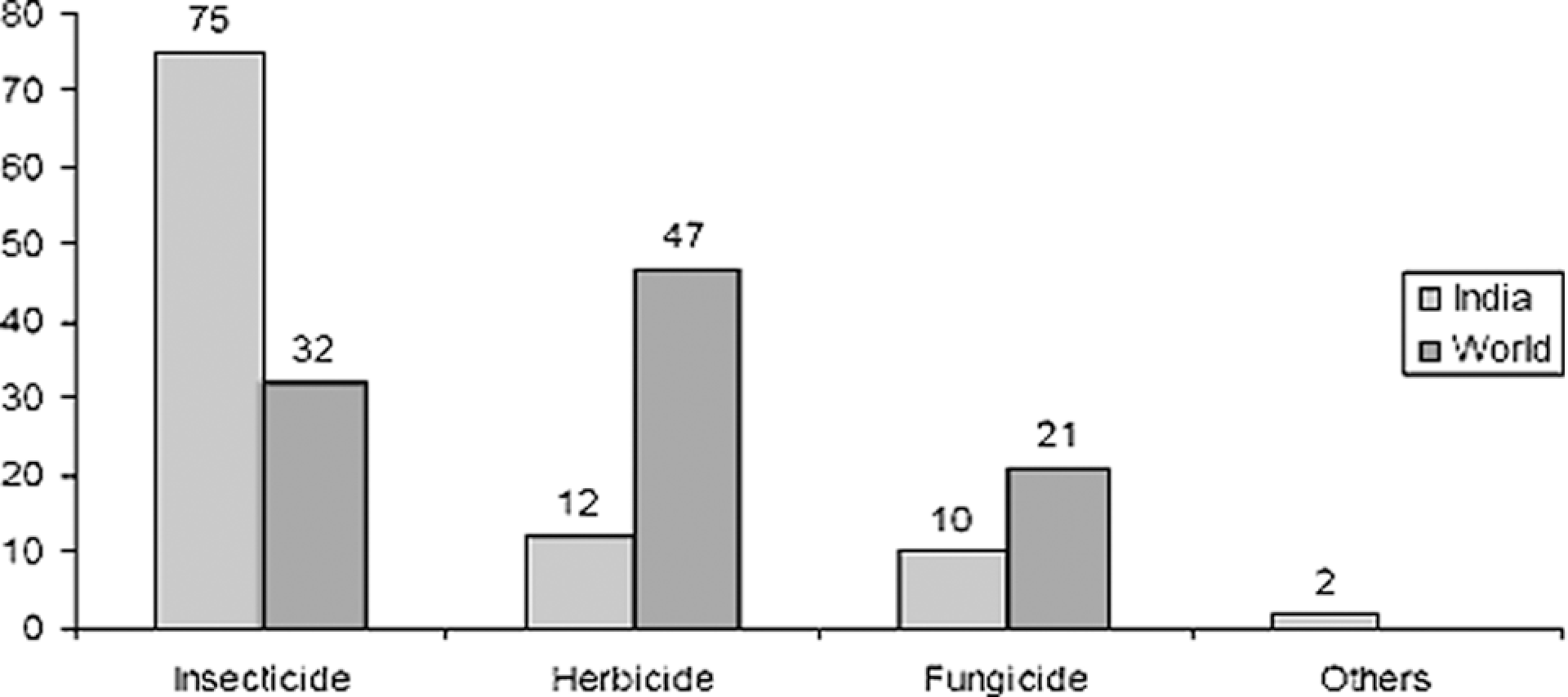
Comparison of pesticide consumption of India with the rest of the world (Source: Report of Centre for Science and Environment, India).
Moreover two-thirds of the pesticides consumed are Class I and II pesticides as listed by World Health Organization (WHO), which are highly toxic. No wonder a number of studies from India have reported widespread contamination of various food and water sources with these pesticides. As indicated by Sanghi et al., 1 after the implementation of ban on organochlorines (OCs), the thrust has shifted to organophosphate (OP) group of pesticides. Although this group is relatively safer as it has low persistence, indiscriminate usage of these pesticides in various food commodities has finally led to bioaccumulation of these pesticides in the body of consumers.
In India, largest pesticide consumption has been in the state of Uttar Pradesh, according to the data of 1995-1996 and 1999-2000, produced by Central Insecticide Board and Registration Committee, India. Still there is paucity of recent data on body burden of OPs from the region. Therefore, Faizabad, which is placed in Eastern Uttar Pradesh, India, was chosen for the study. Moreover, past studies indicating the body burden of these chemicals have been limited to the larger centres. Remote areas like the one chosen in the study have remained largely ignored so far.
Human milk is the major source of nutrition for the nursing infant. The level of chemicals contaminating the milk not only reflects the exposure and body burden of the chemical in mother’s body but also must be a cause of concern as it is finally making way into the body of the infant. The present study was therefore done to assess the levels of these chemicals separately in colostrum and mature milk as the composition of the two are quite different. Subsequently, the levels were compared to the acceptable daily intake (ADI) standards set by Joint Meeting on Pesticide Residues of WHO. This was done to assess the toxic potential of these chemicals to the nursing infant.
Material and methods
Sample collection and storage
Human milk samples were collected from 40 mothers living in rural areas of Faizabad, India. The samples were collected over a span of 6 months. All the donors were such that they had spent their entire lifetime in the rural areas of Faizabad that is they were born and married in the same region. The donors were quite reluctant and had to be extensively persuaded for participation in the study. This was largely due to their belief in numerous myths associated with milk prevalent in rural, orthodox communities.
Out of the total 40 samples collected, only 33 could be analyzed as 5 were used for determination of recovery% and 2 were inadequate in volume. As per Jensen et al., 2 first 3 days secretion postpartum was collected as colostrum and 4th day postpartum onwards was collected as mature milk. Out of the total number of samples analyzed, 25 were colostrum samples and 8 were mature milk samples. The samples were collected over a span of 6 months that is from July to December, 2006. Written permission from hospital authorities was obtained before collecting the samples. The samples were collected by manual expression in sterilized glass vials with plastic screw cap. The vials were covered with aluminum foil before placing the cap to prevent the contact of samples with the cap. Milk samples were refrigerated at 4°C until analyzed, generally within 24−48 hours. All the vials were kept in an airtight opaque container to protect the samples from light.
Determination of organophosphate pesticides
The milk lipids were extracted following procedure of Environmental Protection Agency Protocol (EPA). 3 A total of 2 mL hexane was added to the extract and aliquots were injected into gas chromatograph (GC) for estimation of the pesticides. Fat was determined gravimetrically. One µL aliquots of the sample were injected in GC (Perkin Elmer Autosystem XL) equipped with a selective 63Ni ECD. The samples were calibrated against 0.1, 1 and 10 ppm standard solutions for all pesticides. Standards were procured from Labor Dr. Ehrenstorfer-Schäfers, Germany, via. Promochem India, Bangalore, India and M/s Rallis India limited. Chlorpyrifos was of 97.5% purity. Levels of pesticides in samples were directly determined after calibration using Totalchrom software (Figure 2). Recovery of residues from samples was 89.6%–93.2%. Results were not corrected for recovery. Fourier transform infrared (FTIR) analysis of all the samples was carried out to confirm the results of GC using Perkin Elmer FTIR-Spectrometer-Spectrum RXI.

Gas chromatogram of a sample.
The results were further validated on Mass Spectrophotometer. GC-MS Spectra of pesticide standards from MAINLIBNIST, REPLIBNIST, and TUTORIALNIST spectral libraries were referred for identification of samples, on the basis of fragmentation pattern and molecular weight (e.g. Figure 3).

Gas chromatogram linked with mass spectrophotometer (GC-MS) Spectra of a sample containing chlorpyrifos.
Results
Before collecting the sample, the donors were interviewed according to the exposure assessment questionnaire that determined the age, health status, socioeconomic status, parity, day of postpartum, type of delivery, breast-feeding pattern of the infant, food frequency pattern, smoking habit, medication, residence history, and employment history of the mother. All these demographic factors have a bearing on the level of pesticide contamination in milk. The donors were of mean age 23.09 ± 2.49 and low-to-average body size. All the mothers were non-smokers and healthy with no long-term or serious illness. None were engaged in agricultural practices and were housewives. Majority (75.8%) of the mothers were vegetarian.
Organophosphate pesticides (OPPs) were found to contaminate 62.5% (5/8) samples of mature milk while 34.6% (9/26) colostrum samples were found to carry OPP contamination. Thus, higher percentage of mature milk samples were found to be contaminated with either of the OPPs analyzed. This can be explained by the higher fat content of mature milk. But the colostrum samples, despite of having a low fat percentage, also show significant contamination.
As far as OPPs in colostrum are concerned, the most common contaminant is ethion, followed by chlorpyrifos, and the least common is dimethoate (Figure 4) being present in a single sample (Table 1). Mean value of OPs is quite high in colostrum than in mature milk (Table 1). This is due to relatively higher hydrophilicity of OPs. This is the reason why OPs are expressed in colostrum which has higher water content. Also, the usage of OPs has increased after ban on organochlorine (OCs) as stated by Sanghi et al. 1 Organophosphorous pesticides have overtaken OC pesticides as the most used insecticides in the recent decade. 4 The results are in clear agreement of this fact. However, none of the OP pesticides have exceeded the ADI.

Comparative chart of pesticides in colostrum and mature milk samples.
Comparative content of organophosphorus (OP) pesticides in colostrum and mature milk samples from rural Faizabad

Abbreviations: JMPR: Joint Meeting on Pesticide Residues, ADI: acceptable daily intake, WHO: World Health Organization, EDI: estimated daily intake.
a Excluding one sample having dimethoate content 975.808 ± 690.0005 ng/g fat.
b
In mature milk samples, chlorpyrifos is the most prevalent contaminant (Figure 4). Comparison of estimated daily intake (EDI) with ADI recommended by Joint Meeting on Pesticide Residues (JMPR), administered jointly by WHO and Food and Agriculture Organization of United Nations (FAO), shows that the intake of all the pesticides is below the prescribed limit except for ethion in mature milk sample. Intake of ethion is higher as compared to the recommended ADI. However, ethion was detected in just one sample of mature milk. Though dimethoate is present in just 25.0% (2/8) mature milk samples, the mean values are notable in both colostrum and mature milk samples. However, the level of contamination has not exceeded the ADI. MS data revealed the presence of methyl parathion also which was not quantitated in the study.
Mean levels of pesticides were compared in colostrum and mature milk using Student’s t-test.
Levels of all the pesticides were higher in mature milk samples but only mean chlorpyrifos [p (one tailed) = 0.041288] was found to be significantly different between colostrum and mature milk. Higher fat content of mature milk brings all the lipophilic chemicals with it. But, level of contamination in colostrum is not negligible and not significantly different for most of the pesticides analyzed. Higher polyunsaturated fatty acid content of colostrum is supposed to be one of the factors that retain the pesticide load in colostrum. 5 Colostrum can and should, therefore, be analyzed for pesticidal contamination.
Discussion
Dimethoate and chlorpyrifos, both class II (moderately hazardous) pesticides, are identified as commonly used OP insecticides in India by Abhilash and Singh. 6 The growing usage of these pesticides is resulting in bioaccumulation of these chemicals in the bodies of the people. A number of studies have reported chlorpyrifos in various diet sources such as vegetables, 7 mutton, 8 ghee, and butter. 9 Kumari et al. 9 reported chlorpyrifos residue above maximum residue limit (MRL) value in 9.0% of ghee and butter samples in Haryana, India.
The donors chosen for study were such that none of them were involved in agricultural practices directly. Thus, occupational exposure is ruled out. Thus, the level of pesticide pollution in general population is reflected by the study.
Dimethoate has a low lipophilicity (log Kow = 0.7), but since it has log Koa = 8.04, 10 it has a fairly good environmental bioaccumulation potential in humans through dietary exposure. 11 This clearly suggests that mature milk having higher lipid content is likely to carry lesser load of dimethoate than colostrum having larger water content and lesser lipid content. This fact can clearly be observed from the dimethoate content in colostrum and mature milk samples from rural Faizabad. All the pesticides taken for analysis had Kow lesser than 6, hence all of them have potential to bioconcentrate. 12
Positive correlation (r 2 = 0.5087) was observed between mother’s age and level of chlorpyrifos. Elimination rate of chlorpyrifos is low resulting in build up of this pesticide in adipose tissues of the body. Levels of ethion and dimethoate were found to decrease with age showing negative correlation. Thus, ethion and dimethoate show lower persistence than chlorpyrifos.
Prenatal chlorpyrifos is reported to have a detrimental effect on neurodevelopment in children by Rauh et al. 13 Pre and postnatal chlorpyrifos exposure induces alterations in neuro-specific proteins causing developmental neurotoxicity. 14 Prolonged exposure to low doses of dimethoate can result in impaired memory and concentration, disorientation, severe depression, irritability, confusion, headache, speech difficulties, delayed reaction times, nightmares, sleepwalking, and drowsiness or insomnia. An influenza-like condition with headache, nausea, weakness, loss of appetite, and malaise has also been reported on exposure to dimethoate. 15 Experiments in both humans and animals show that plasma acetylcholinesterase enzyme is inhibited by ethion at lower levels of exposure than required to inhibit neural or erythrocyte acetylcholinesterase.16,17 Comstock et al. (1967) 18 reported accidental ingestion of 15.7 mg/kg ethion from a contaminated milk bottle by a 6-month-old male infant resulted in diaphragmatic respiration with shallow excursions and intercostal retraction. Generalized rales and rhonchi and inspiratory and expiratory wheezes were noticed in auscultation within an hour of ingestion. Respiratory arrest occurred approximately 5 hours after ingestion, and mechanical ventilation was necessary for the next 3 hours. Ethion ingestion also resulted in gastro-intestinal effects in infant, which included frothy saliva 1 hour after ingestion and a watery bowel movement at 90 minutes. 18 These effects of pesticides analyzed can have a detrimental impact on the future society at large. Thus, the influence of intake of these pesticides through human milk and colostrum in this region needs to be monitored.
Conclusions
The study clearly shows that inspite of low persistance of OPPs, they are present in considerable amounts in the bodies of residents of rural Faizabad. This suggests extensive non-occupational exposure of these chemicals. The routes of exposure have to be identified in the interest of the population and environment. Hence, there is a need for conducting monitoring studies on environmental sources of pollution. In addition to this, monitoring studies on health effects resulting from high consumption of these pesticides are also required. Training and awareness campaigns on health effects and safe handling of these pesticides to applicators are required to curb the use of these pesticides and prevent subsequent environmental pollution in this region. The study gives a glimpse of a problem which needs to be addressed in greater detail. The study also emphasizes the need for special MRLs and ADIs for pesticides for infants and children in India and world over, especially through human milk and colostrum.
Footnotes
Acknowledgements
Authors are grateful to Dr Rashmi Sanghi, Senior Scientist, Facility for Ecological and Analytical Testing, Indian Institute of Technology, Kanpur, India, for helping with the methodology and Dr Madhuban Gopal, Scientist, Indian Agriculture Research Institute, Pusa, New Delhi, for confirming the presence of pesticides on GC-MS. We are also thankful to M/s Rallis India Limited for providing standards of pesticides. The authors also express their gratitude to Er Varun Srivastava for helping in preparation of the artwork.
This research received no specific grant from any funding agency in the public, commercial, or not for-profit sectors.