




Abstract
Poisoning with depilatory agents is a rather uncommon entity in western countries. In this study, we describe poisoning with a corrosive arsenic-based depilatory agent (CABD) and factors related to its mortality in a poisoning center in Tehran. In a retrospective study, the medical records of all patients with CABD intoxication who attended the emergency ward of Loghman-Hakim hospital, the only poisoning center in Tehran, over a 9-year period between 2000 and 2009 were reviewed. The majority of patients were men (78.7%, n = 122 vs. women: 21.3%, n = 33). The mean age was 35.55 ± 16.68 years. Mean time of arrival to hospital was 3.63 hours (SD = 4.07). The mortality rate was 5.8% and increased significantly with higher amounts of ingestion and delay in arrival to hospital. CABD poisoning may be lethal if not treated promptly and correctly. Restriction or, if not practical, reduction of harmful components of this substance should be considered.
Keywords
Introduction
In addition to the wide range of prescription and over-the-counter drugs that can lead to either accidental poisoning or intentional suicide, bizarre substances can cause poisoning in various cultures. One of the agents that is less known and studied in western cultures is a corrosive arsenic-based depilatory agent (CABD) that is known as ‘Vajebi’ in Iran. It has been traditionally used in Iran and some other countries like India for hair removal. The low cost and availability of CABD make it an ideal and lethal mean for suicide in correctional facilities where observation of strict controls restrict inmates access to more conventional methods of suicide.
CABD is produced in small workshops and under conditions that are far from standard. Nevertheless, it has been shown to consist of approximately 65% calcium bicarbonate (Ca(HCO3)2), 25% arsenic sulfide (As2S3), and 10% clay and moisture. 1 When dissolved in water, As2S3 produces arsenous and arsenic acid. Calcium bicarbonate, arsenous acid, and arsenic acid are acidic components that cause severe damage to the digestive tract following ingestion,2–4 while the arsenic compounds cause the signs and symptoms of arsenic poisoning. A unique feature of CABD poisoning is that it can cause a bezoar in the gastric fundus, which needs to be removed surgically. 5
Treatment of arsenic poisoning includes gastrointestinal decontamination, chelation therapy, diuresis, fluid replacement, and supportive cares. Dimercaprol and dimercaptosuccinic acid are chelating agents that sequester the arsenic away from blood proteins and are used in treating acute arsenic poisoning.6,7 There is controversy regarding the role of dialysis when renal failure is not present.8,9
The main goal of this study was to describe some of the characteristics of the patients presenting with CABD poisoning in a tertiary poison center in Tehran, Iran.
Materials and methods
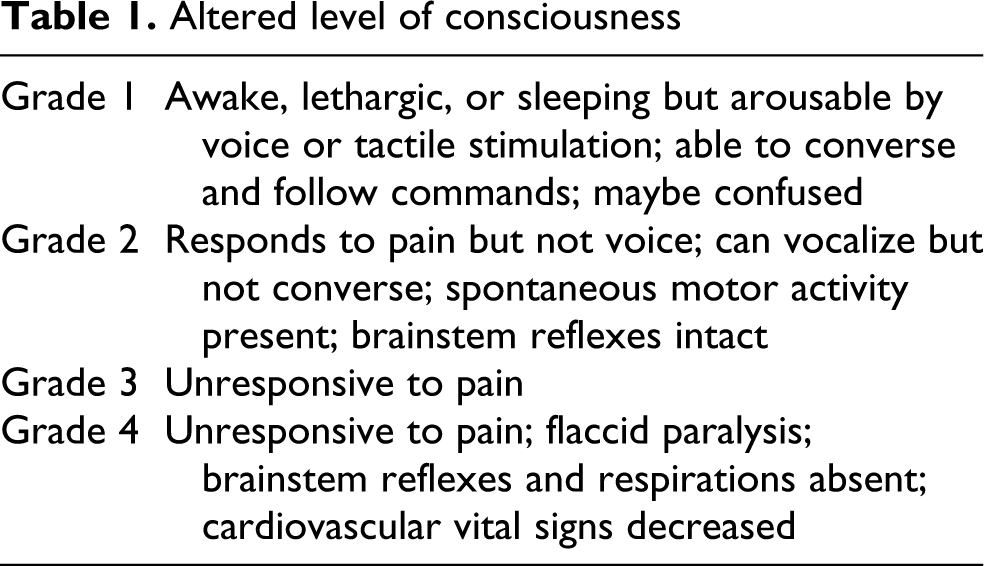
The medical records of all patients with CABD poisoning that presented to Loghman Hakim Hospital, a tertiary poison center in Tehran, Iran, during a 9-year period between 2000 and 2009, were reviewed. Data on patient age, sex, form of CABFD used, motivation of use, history of chronic illness, substance abuse, and suicide attempt was gathered. The level of consciousness at presentation was classified according to physiologic depression grading as shown in Table 1 . 10 According to the hospital protocol, patients with CABD poisoning are admitted for initial medical management; the need for laparotomy and surgical care is assessed after consultation with the surgical service. Therefore, data were also collected regarding the type and outcome of treatment where possible. SPSS ver.17 was used to analyze the data with descriptive (frequencies) and analytical tests. We evaluated factors associated with mortality using binary logistic regression; odds ratio, confidence intervals, and p values are reported. The level of significance was 0.05.
Altered level of consciousness
Results
A total of 155 patients with CABD poisoning were recorded. A majority of patients were men (78.7%, n = 122). The mean age was 35.55 ± 16.68 years, with a range of 1 to 90 years. A large number of patients (93.5%, n = 145) used CABD as a means of suicide. There were three cases (1.9%) of accidental poisoning and seven cases with unknown motivation. The powder form of CABD was used most commonly (80%, n = 124). Among 71 patients with a known quantity of poison ingestion, sixteen patients (22.5%) ingested less than 100 g of CABD, 46 patients (64.8%) ingested between 100 and 200 grams, and 9 (12.7%) ingested more than 200 grams of CABD. In 48 patients (30.96%) history of psychiatric illness was positive.
All of the 155 cases were hospitalized of which about 9% (n = 14) were admitted to the Intensive Care Unit (ICU). Mean length of hospital stay was 1.91 ± 2.36 days.
Most patients presented with gastrointestinal symptoms (70.3%, n = 109) with gastric pain being at the top. Few patients presented with nausea (3.2%) or vomiting (5.8%) as the sole symptom. However, combined with other symptoms, nausea and vomiting were the major presenting symptoms (38.5%, n = 42). Endoscopy was performed for 61 patients. In 45, the result was normal (73.7%) and in 16 patients (26.3%) it showed edema and erythema of the mucosa.
Most patients were conscious at the time of presentation (86.5%, n = 134). Altered level of consciousness was classified: 11 patients were grade I (7.1%), 5 patients were grade II (3.2%), 2 patients were grade III (1.3%), and 3 patients were grade IV (1.9%). Table 2 shows the frequency of some signs and symptoms.
Frequency of signs and symptoms

Of the patients, 133 (85.8%) were treated with general conservative measures, whereas 18 patients received dimercaprol (11.61%), 1 received N-acetylcysteine (0.64%), 1 required dialysis because of renal failure (0.64%), and 2 (1.29%) were treated surgically. Mean time of arrival to hospital, as stated by the patients or their relatives, was 3.63 hours (SD = 4.07). Nine of the patients died despite management (5.8%). The characteristics of the deceased cases are shown in Table 3. Factors associated with increased mortality were evaluated using binary logistic regression and it was found that time of arrival at hospital (OR = 2.7, CI = 1.50−4.86, p < 0.001) and quantity of ingested CABD (OR = 4.2, CI = 2.95−5.98, p < 0.001) were associated with higher mortality rate. Mean dose of ingestion was 213 ± 141 g in the expired patients. Logistic regression analysis showed that the LD50 was 194 g. All cases used the agent as a means of suicide, except for the 3 cases described so there were no differences in this regard among men and women.
Characteristics of patients deceased due to CABD ingestion
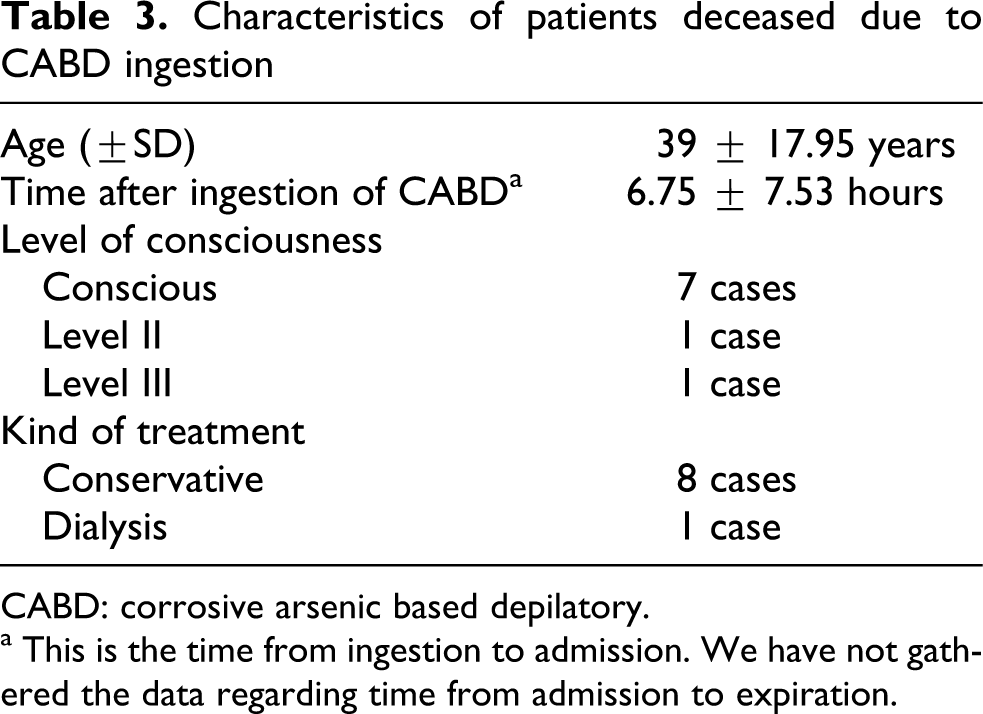
CABD: corrosive arsenic based depilatory.
a This is the time from ingestion to admission. We have not gathered the data regarding time from admission to expiration.
Discussion
Mortality due to depilatory substances, either in form of accidental poisoning or in the setting of homicide or suicide is mainly seen in countries where traditional and less-accepted methods of depilation are still used and also where there are religious or cultural obligations for hair removal. Consequently, various substances are used in different countries based on availability. Thallium, for instance, was used for depilation and treatment of tinea capitis in the 1930s 11 but was subsequently abandoned since a large number of poisoning cases were reported. 12
In recent years, there have been several reports of thallium poisoning, mainly used for homicide, from countries like Japan, China, Iraq, Russia, etc. 13
Peripheral neuropathy and hair loss are distinctive features of thallium toxicity along with gastrointestinal, ocular, and pulmonary symptoms. 14 Barium slats, specifically barium sulfide, are another group of depilatory agents that have been used for suicide. Aks et al. reported several cases of poisoning with barium sulfide containing depilatory agents in a correctional facility in the United States. 15 Muscle weakness and hypokalemia are the main clinical features of barium poisoning. 16
In the present study, the medical records of all patients who presented with CABD poisoning during a 9-year period from 2000 to 2009 were reviewed. The mortality rate related to CABD was 5.8% in this study that is close to the rate reported in similar studies. 17 In a study by Tofighi et al., the mortality related to CABD was reported to be 20.9% in 1998. 18 The decrease in mortality is believed to result from reduction of the arsenic content of the depilatory substance. 17
All deaths in our study occurred in those who ingested CABD in the powder form. In another study, it was shown that liquid form of CABD had the highest mortality. Authors of the same study believed that drinking water after ingestion of the powder has the same effect. 19
Furthermore, like other studies, ingestion was the most common route of poisoning in our patients.17–19 However, there have been anecdotal reports of intra-arterial injection. 20
In all but three cases, the patients used CABD as a means of suicide. The cases of accidental poisoning occurred in either very young (a 1-year-old boy) or very old patients (two men 90-year-old and 87-year-old, respectively). Eight out of nine deaths in our study happened among men. A review of case records showed that most men used CABD for suicide during their jail sentence. This may explain the high male to female ratio. All women had ingested this depilatory agent outside correctional facilities.
Fourteen patients were admitted to ICU. Prevailing indications for ICU admission were hypotension, altered level of consciousness, and metabolic acidosis. Unlike other ICU patients, the clinical condition of poisoning victims (recovery or death) becomes clear in a short time. This and the fact that in our center, the mean ICU stay was 2.3 days in the previous year explain the relatively short duration of ICU stay in the patients under study.
Decision about chelation therapy rests on clinical condition and arsenic level in a 24-hour urine sample. Accordingly, not all patients undergoing chelation therapy required ICU admission.
Two patients in this study were sent to the operating room. The decision for surgical treatment was based on a protocol that mandates surgical removal of the poison in patients with evidence of severe poisoning.
Mortality in the present study was due to hypovolemic shock, cardiac arrhythmia, acute renal failure, and toxic hepatitis. The variables associated with high mortality were amount of CABD ingested and time of arrival to hospital. It is therefore necessary to monitor the amount of arsenic in the CABD during production. Timely referral to poison control center in case of ingestion decreases mortality.
Footnotes
Acknowledgement
The author would like to thank Farzan Institute for Research and Technology for technical assistance.