




Abstract
3,4-Methylenedioxyphenol (sesamol) is effective against acetaminophen-induced liver injury in rats. Whether sesamol’s anti-hepatotoxic effect is comparable to that of N-acetylcysteine has never been studied. We investigated the anti-hepatotoxic effects of sesamol and N-acetylcysteine on acetaminophen-induced hepatotoxicity in mice. Equimolar doses (1 mmol/kg) of sesamol and N-acetylcysteine significantly inhibited acetaminophen (300 mg/kg)-increased serum aspartate transaminase and alanine transaminase levels 6 h post-administration. Sesamol and N-acetylcysteine maintained hepatic glutathione levels and inhibited lipid peroxidation. Moreover, the combination of sesamol and N-acetylcysteine antagonistically inhibited sesamol’s protection against acetaminophen-induced liver injury. We conclude that the protective effect of sesamol against acetaminophen-induced liver damage is comparable to that of N-acetylcysteine by maintaining glutathione levels and inhibiting lipid peroxidation in mice.
Introduction
3,4-Methylenedioxyphenol (sesamol; Figure 1) is one of the nonfat antioxidants in sesame oil. 1 It is effective against drug- and chemically induced organ injuries.2,3 Sesamol is anti-photo-oxidative because it scavenges singlet oxygen. 4 It inhibits lipid peroxidation, hydroxyl radical-induced deoxyribose degradation, and DNA cleavage; 5 attenuates the production of nitric oxide and hydrogen peroxide, reduces monoamine oxidase activity in glial astrocytes, 6 and significantly protects the liver from acetaminophen-induced mitochondrial oxidative stress, glutathione depletion, and liver injury. 7
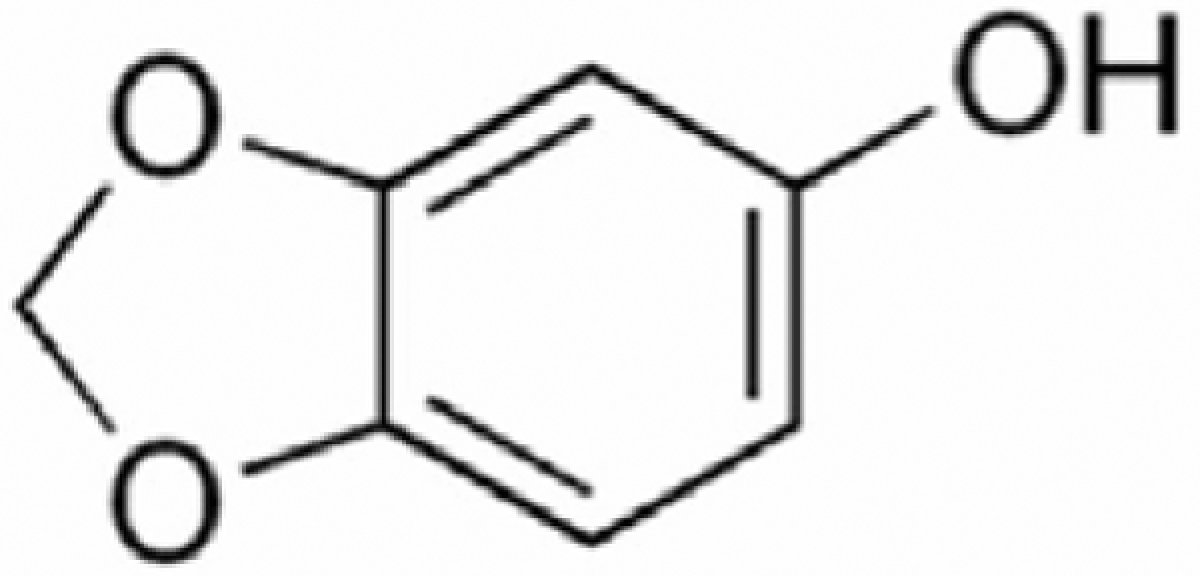
Structure of 3,4-methylenedioxyphenol.
Acetaminophen is an analgesic and antipyretic. It is safe when taken as directed but can cause extreme harm and even death in amounts above recommended doses. 8 It is one of the most common agents deliberately ingested in self-poisoning and is a leading cause of acute liver failure in the Western world.9,10 The United States Acute Liver Failure Study group reported 11 an increase in the proportion of acute liver failure cases attributed to acetaminophen, from 28% in 1998 to 51% in 2003, which far exceeded all other causes. N-acetylcysteine is the standard clinical antidote for treating overdoses of acetaminophen. The primary role of N-acetylcysteine in the treatment of acetaminophen toxicity is to replace stores of intracellular hepatic glutathione.12,13 Liver injury after an acute overdose acetaminophen may be averted by timely treatment with N-acetylcysteine.14,15 However, the optimal dose, route, and duration of N-acetylcysteine therapy remain unknown despite more than 30 years of experience with this antidote. The search for a novel and effective antidote for acetaminophen overdose continues. We investigated the anti-hepatotoxic effect of sesamol and N-acetylcysteine on acetaminophen-overdose-induced liver injury in mice.
Materials and methods
Chemicals
Acetaminophen, sesamol, N-acetylcysteine, and polyethylene glycol were purchased from Sigma-Aldrich Co. (St. Louis, Missouri). Acetaminophen was prepared in a suspension using 40% polyethylene glycol. 16
Animals
In previous experiments on acetaminophen-induced liver injury, rats were used.7,16,17 In the present study, mice were used to test the effects of sesamol on species variation. Ten-week-old male C3H/HeN mice (weight range: 25 to 30 g) were purchased from our institution’s Laboratory Animal Center. They were given pellet feed (Richmond Standard; PMI Feeds, Inc., St. Louis, Missouri) and water ad libitum. They had a 12/12-h light/dark cycle and central air conditioning (25°C, 70% humidity) throughout the study. The animal care and experimental protocols were approved by the institution’s animal ethics committee and were in accord with nationally approved guidelines.
Experimental design
The mice were fasted for at least 12 h before each experiment and fed 3 h after acetaminophen and sesamol treatments. The dose of oral acetaminophen (300 mg/kg) was selected based on a dose-response study.
Experiment 1
The mice were divided into eight groups (n = 6). Group I (HC) were untreated healthy controls; Group II (S) were given only intraperitoneal (i.p.) sesamol (1 mmol/kg); Group III (APAP) were given only oral acetaminophen (300 mg/kg); Groups IV to VIII (AS 0.01, AS 0.03, AS 0.1, AS 0.3, and AS 1, respectively) were first given oral acetaminophen and then were immediately injected with different doses of sesamol (0.01, 0.03, 0.1, 0.3, and 1 mmol/kg, respectively; i.p.). After 6 h, aspartate transaminase (AST) and alanine transaminase (ALT) levels were assessed in serum.
Experiment 2
The mice were divided into eight groups (n = 6). Group I (HC) were untreated healthy controls; Group II (N) were given only N-acetylcysteine (1 mmol/kg; i.p.); Group III (APAP) were given only oral acetaminophen (300 mg/kg); Groups IV to VIII (AN 0.01, AN 0.03, AN 0.1, AN 0.3, and AN 1, respectively) were first given oral acetaminophen and then were immediately injected with different doses of N-acetylcysteine (0.01, 0.03, 0.1, 0.3, and 1 mmol/kg, respectively; i.p.). After 6 h, AST and ALT levels were assessed in serum.
Experiment 3
The mice were divided into six groups (n = 6). Group I (HC) were untreated healthy controls; Group II (S) were given only sesamol (1 mmol/kg; i.p.); Group III (N) were given N-acetylcysteine (1 mmol/kg; i.p.); Group IV (APAP), positive controls, were given only oral acetaminophen (300 mg/kg); Group V (AS) were first given oral acetaminophen (300 mg/kg) and then sesamol (1 mmol/kg; i.p.); Group VI (AN) were first given oral acetaminophen (300 mg/kg) and then N-acetylcysteine (1 mmol/kg; i.p.). After 6 h, lipid peroxidation and glutathione levels were measured in liver tissue.
Experiment 4
The mice were divided into nine groups (n = 6). Group I (HC) were untreated healthy controls; Group II (APAP) were given only oral acetaminophen (300 mg/kg); Group III (AN) were first given oral acetaminophen and then N-acetylcysteine (0.1 mmol/kg; i.p.); Group IV (AS 0.1) were first given oral acetaminophen and then sesamol (0.1 mmol/kg; i.p.); Group V (AS 0.3) were first given oral acetaminophen and then sesamol (0.3 mmol/kg; i.p.); Groups VI to IX (ANS 0.01, ANS 0.03, ANS 0.1, and ANS 0.3, respectively) were first given oral acetaminophen, then immediately injected with N-acetylcysteine (0.1 mmol/kg), and then with different doses of sesamol (0.01, 0.03, 0.1, and 0.3 mmol/kg, respectively; i.p.). After 6 h, AST and ALT levels were measured in serum.
Collecting blood
Blood was collected in serum separation tubes from a femoral vein while the mice were under mild ether anesthesia. The tubes were left at room temperature for 30 min to clot and then centrifuged at 1000 × g at 4°C for 10 min.
Assessing liver injury
We assessed liver injury by measuring the levels of AST and ALT in serum using a biochemical analyzer (Fujifilm Dri-Chem 3500s; Fujifilm, Kanagawa, Japan).
Determining glutathione levels in liver tissue
A 10% liver-tissue homogenate (1 g in 10 mL of ice-cold 10% trichloroacetic acid) was used to determine glutathione levels. Tissue samples were homogenized and centrifuged (3000 rpm for 10 min), and then 500 μL of supernatant was added to 2 mL of 0.3 M Na2HPO4 2H2O solution. Next, 200 μL of 5,5′-dithiobis(2-nitrobenzoic acid) in 1% sodium citrate (0.4 mg/mL) was added, and the absorbance was immediately measured at 412 nm. 18
Measuring lipid peroxidation in liver tissue
Liver tissue was homogenized in Tris-HCl buffer (20 mM [pH 7.4]) and then centrifuged at 2500 × g at 4°C for 10 min. Two hundred micro liters of supernatant was analyzed for malondialdehyde (MDA) levels using a kit (Bioxytech MDA-586; Oxis Research, Foster City, California, USA), and the spectrophotometer (DU 640B; Beckman, Fullerton, California, USA) was read at 586 nm. 16
Statistical analysis
The data were analyzed using one-way analysis of variance (ANOVA) and then Tukey's multiple comparison tests to evaluate the significance between the treatment groups. Values are means ± standard deviation. Statistical significance was set at p < 0.05.
Results
Effect of sesamol on acetaminophen-induced liver injury
To determine the protective dose of sesamol against acetaminophen-induced liver injury, we did a dose-response study. AST (Figure 2A) and ALT (Figure 2B) levels were significantly (p < 0.001) highest in the APAP and AS 0.01 groups. Rises in AST and ALT were significantly (p < 0.001) lower in the AS 0.1, AS 0.3, and AS 1 groups than in other groups. A 1 mmol/kg dose of sesamol was the most protective against acetaminophen-induced liver injury.

Effect of sesamol on acetaminophen-induced liver injury. Mice were divided into eight groups of six. Group I (HC) were untreated healthy controls; Group II (S) were given only sesamol intraperitoneally (i.p.) (1 mmol/kg); Group III (APAP) were given only oral acetaminophen (300 mg/kg); Groups IV to VIII (AS 0.01, AS 0.03, AS 0.1, AS 0.3, and AS 1, respectively) were first given oral acetaminophen and then were immediately injected with different doses of sesamol (0.01, 0.03, 0.1, 0.3, and 1 mmol/kg, respectively; i.p.). After 6 h, AST and ALT levels were assessed in mouse serum. Data are means ± standard deviation. Different letters indicate significant differences between groups (P < 0.05; one-way ANOVA and then Tukey’s multiple comparison tests).
Effect of N-acetylcysteine on acetaminophen-induced liver injury
To determine the protective dose of N-acetylcysteine against acetaminophen-induced liver injury, we did a dose-response study. N-acetylcysteine (AN 0.3 and AN 1 groups) inhibited acetaminophen-induced AST and ALT (Figure 3A, B; p < 0.001). N-acetylcysteine at 1 mmol/kg (AN 1 group) was the most protective against acetaminophen-induced acute liver injury.
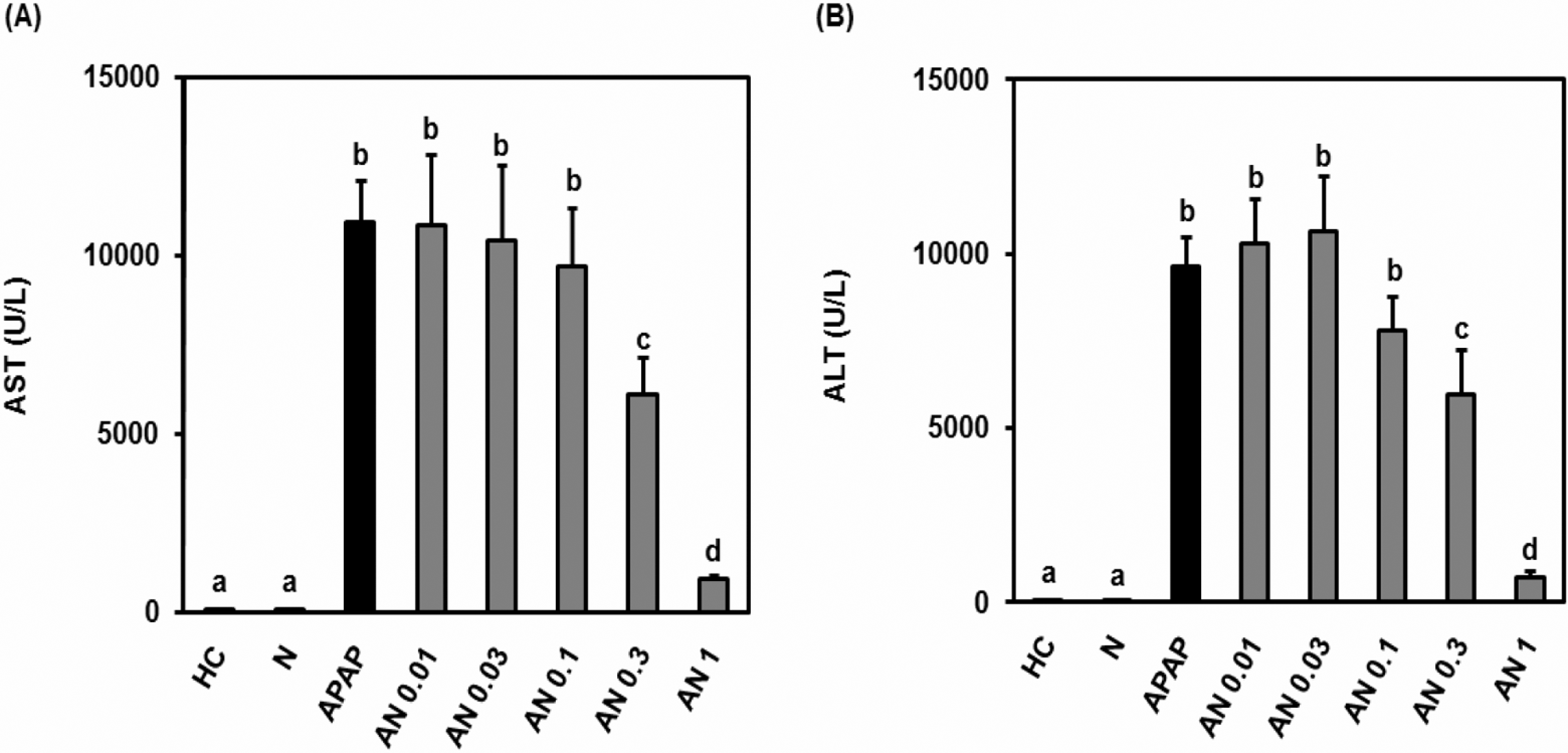
Effect of N-acetylcysteine on acetaminophen-induced hepatic injury. Mice were divided into eight groups of six. Group I (HC) were untreated healthy controls; Group II (N) were given only N-acetylcysteine (1 mmol/kg; i.p.); Group III (APAP) were given only oral acetaminophen (300 mg/kg); Groups IV to VIII (AN 0.01, AN 0.03, AN 0.1, AN 0.3, and AN 1, respectively) were first given oral acetaminophen and then were immediately injected with different doses of N-acetylcysteine (0.01, 0.03, 0.1, 0.3, and 1 mmol/kg, respectively; i.p.). After 6 h, AST and ALT levels were assessed in mouse serum. After 6 h, AST and ALT levels were assessed in mouse serum. Data are means+standard deviation. Different letters indicate significant differences between groups (p < 0.05; one-way ANOVA and then Tukey’s multiple comparison tests).
Effects of equimillimolar doses of sesamol and N-acetylcysteine on acetaminophen-induced glutathione and lipid peroxidation levels
To study the involvement of anti-oxidative-stress on sesamol’s and N-acetylcysteine’s protection against acetaminophen-induced liver injury, we measured the glutathione and lipid peroxidation levels in liver tissue. Sesamol (AS group) and N-acetylcysteine (AN group) significantly increased glutathione levels (p < 0.001) (Figure 4A ) and significantly inhibited lipid peroxidation (p < 0.001; Figure 4B) compared with the acetaminophen (APAP) group.

Effect of sesamol and N-acetylcysteine on acetaminophen-induced glutathione (GSH) and lipid peroxidation (LPO). Mice were divided into six groups of six. Group I (HC) were untreated healthy controls; Group II (S) were given only sesamol (1 mmol/kg; i.p.); Group III (N), were given N-acetylcysteine (1 mmol/kg; i.p.); Group IV (APAP), positive controls, were given only oral acetaminophen (300 mg/kg); Group V (AS), were first given oral acetaminophen (300 mg/kg) and then sesamol (1 mmol/kg; i.p.); Group VI (AN), were first given oral acetaminophen (300 mg/kg) and then N-acetylcysteine (1 mmol/kg; i.p.). After 6 h, lipid peroxidation and glutathione levels were measured in liver tissue. Data are means ± standard deviation. Different letters indicate significant differences between groups (p < 0.05; one-way ANOVA and then Tukey’s multiple comparison tests).
Combined effect of sesamol and N-acetylcysteine on acetaminophen-induced acute liver injury
Sesamol (AS 0.1 and AS 0.3 groups) inhibited acetaminophen-induced AST and ALT. Although sesamol-plus-N-acetylcysteine (ANS 0.1 and ANS 0.3 groups) significantly (p < 0.001) protected against liver injury, sesamol-plus-N-acetylcysteine did not increase sesamol’s inhibition of acetaminophen-induced liver injury (Figure 5A and B).

Effect of sesamol and N-acetylcysteine on acetaminophen-induced hepatic injury. Mice were divided into nine groups of six. Group I (HC) were untreated healthy controls; Group II (APAP) were given only oral acetaminophen (300 mg/kg); Group III (AN) were first given oral acetaminophen and then N-acetylcysteine (0.1 mmol/kg; i.p.); Group IV (AS 0.1) were first given oral acetaminophen and then sesamol (0.1 mmol/kg; i.p.); Group V (AS 0.3) were first given oral acetaminophen and then sesamol (0.3 mmol/kg; i.p.); Groups VI to IX (ANS 0.01, ANS 0.03, ANS 0.1, and ANS 0.3, respectively) were first given oral acetaminophen, then were immediately injected with N-acetylcysteine (0.1 mmol/kg), and then different doses of sesamol (0.01, 0.03, 0.1, and 0.3 mmol/kg, respectively; i.p.). After 6 h, AST and ALT levels were assessed in mouse serum. Data are means ± standard deviation. Different letters indicate significant differences between groups (P < 0.05; one-way ANOVA and then Tukey’s multiple comparison tests).
Discussion
The protective effect of sesamol against acetaminophen-induced liver injury was comparable to that of N-acetylcysteine. Equimillimolar doses of sesamol and N-acetylcysteine inhibited AST and ALT levels induced by an overdose of acetaminophen. Sesamol and N-acetylcysteine protected mice from acetaminophen-induced liver injury by maintaining glutathione levels and inhibiting lipid peroxidation. Additionally, the treatment of sesamol-plus-N-acetylcysteine decreased sesamol’s effect against acetaminophen-induced liver injury.
Sesamol partially inhibited the loss of glutathione levels; however, N-acetylcysteine completely inhibited the loss of glutathione levels, in acetaminophen-overdosed mice. Acetaminophen-induced liver injury is primarily associated with the depletion of glutathione levels.19,20 Liver injury may be prevented if intra-hepatic glutathione levels can be maintained. 21 N-acetylcysteine acts primarily as a glutathione precursor, and therefore minimizes the risk of liver injury. Despite N-acetylcysteine’s ability to directly react with N-acetyl-p-benzoquinone imine, the toxic metabolite of acetaminophen, it has been clearly shown12,13 that the protection of N-acetylcysteine against an acetaminophen overdose requires the synthesis of glutathione. However, to be effective using this mechanism, N-acetylcysteine must be administered during the metabolism phase of acetaminophen toxicity. A delay in admitting acetaminophen-overdose patients to the emergency room may limit the efficacy of using N-acetylcysteine with this mechanism. 22 Sesamol and N-acetylcysteine exhibited a strong inhibitory effect against acetaminophen-induced lipid peroxidation. Sesamol not only maintains glutathione levels but also reduces mitochondrial oxidative stress by inhibiting the reaction between hydrogen peroxide and ferrous ion during acetaminophen intoxication. 7 Sesamol’s multiple actions may be important in treating acetaminophen-overdose patients. However, its efficacy in humans will have to be tested.
Sesamol is considered an antidote for acetaminophen-overdose-induced liver injury. Sesamol is water-soluble with same active constituents of natural sesame seed oil. 2 It is active against various drugs and chemically induced organ injuries,23,24 inhibits acetaminophen-induced hepatic injury in rats, 7 maintains glutathione levels, and protects against acetaminophen-induced liver injury. In addition, sesamol is a potent anti-inflammatory agent during lipopolysaccharide intoxication. 24 During N-acetylcysteine treatment, flushing, nausea, urticaria, and anaphylactoid reactions have been reported.25,26 There is very little information about the adverse effects of sesamol. We hypothesize that sesamol is an effective antidote for an overdose of acetaminophen. However, more investigation is needed.
Conclusion
We conclude that sesamol is comparable to N-acetylcysteine as protection against acetaminophen-induced liver injury because it maintains glutathione levels and inhibits lipid peroxidation in mice. The combination of sesamol and N-acetylcysteine decreases the potency of sesamol’s protective effect against an overdose of acetaminophen.
Footnotes
Acknowledgments
We thank Dr. YC Chang for valuable discussion.
This study was supported by grants 96-2628-B-006-038-MY3 from the National Science Council, Taiwan.
The authors declare that there is no conflict of interest.