




Abstract
We observed that an aqueous extract of this medicinal plant exhibited significant neuroprotection against glutamate-induced toxicity in primary cultured rat cortical cells from methanol extracts of the roots of Vitis thunbergii var. sinuate (Vitaceae). To further clarify the underlying neuroprotective mechanisms of this observed effect, we isolated and identified various active fractions and components. By using such fractionation procedures, five resveratrol derivatives − vitisinols A (
Introduction
Alzheimer’s disease (AD) is one of the most common neurodegenerative disorders affecting many elderly people worldwide. In addition to the neuropathologic hallmarks of this disease, namely neurofibrillary tangles and amyloid plaques, it is also characterized by the loss of cholinergic neurons in the basal forebrain and a major cause of morbidity and disability in the adult population.
1
Neuronal death is an important feature of both acute and chronic neurodegenerative diseases. AD is associated with the accumulation of
Material and methods
General
Thin-layer chromatography (TLC) was performed on precoated silica gel G and GP uniplates from Analtech and visualized with 254-nm UV light. Vacuum liquid chromatography was carried out on silica gel 60 (Scientific Adsorbents Incorporated [SAI], particle size 32–63 µm, pore size 60 Å]. 1 H NMR spectra was recorded on a Bruker DPX 500 at 500 MHz; respectively. The chemical shifts are reported in parts per million (ppm) downfield from tetramethylsilane, and J–values are in Hz. DL-2-amino-5-phosphonovaleric acid (APV) and 6-cyano-7-nitroquinoxaline-2,3-dione (CNOX) were purchased from Sigma Chemical Company (St. Louis, Missouri, USA).
Plant materials and isolation of compounds
The roots of V. thunbergii var. sinuate were collected to Cheon Kwan San in August 2008 at Jangheung-gun, Jeolranamdo, South Korea. A voucher specimen (JNNRR-2008-0263) was deposited at herbarium, Jeonnam Institute of Natural Resources Research, Jangheung, South Korea. The air-dried roots of V. thunbergii var. sinuate (10 kg) were extracted with methanol by refluxing for 4 h (three times × 50 L) on a sonication bath at 35°C. The extract was filtered through a Buchner funnel using Whatman No. 1 filter paper. The combined MeOH extract was evaporated under reduced pressure to yield a black residue. Vacuum liquid chromatography (1 kg, 50 × 60 cm) of the MeOH extract (500 g), using n-hexane:CH2Cl2 (1:0 – 0:1) and CH2Cl2:MeOH (1:0–0:1) step gradients, produced 42 fractions. These were pooled by TLC profile into eight fractions (VT1–VT8), in which fraction VT 5 (23 g) eluted with petroleum ether-acetone (1:0 [500 mL], 2:1 [500 mL], 1:1 [500 mL], 1:2 [500 mL], 1:5 [500 mL], and 0:1 [500 mL]). The major three spot were purified by recrystallization with MeOH to afford compounds
Vitisinols A (
Vitisinols B (
Vitisinols C (
(+)-Vitisin A (
(+)-Vitisin C (
Cortical cell culture and cell viability assessment
Primary cultures of mixed cortical cells containing both neurons and glia were prepared from 17−19-day-old fetal rats (Sprague-Dawley) as described previously. 1 Cultures were allowed to mature for at least 2 weeks before being used for experiments. Test fraction and compounds were dissolved in DMSO (final concentration in culture, 0.1%). Cortical cell cultures were washed with DMEM and incubated with test compounds for 1 h. The cultures were then exposed to 100 μM glutamate and maintained for 24 h. After the incubation, the cultures were assessed for the extent of neuronal damage by measuring the efflux of lactic dehydrogenase (LDH) which reflects the integrity of cellular membrane.
Statistical analysis
The results are expressed as means ± standard errors (SE). The data were statistically analyzed by one-way analysis of variance (ANOVA). Differences with p < 0.05 were considered significant.
Results and discussion
We found that methanol extract of the roots of V. thunbergii var. sinuate might inhibit glutamate-induced toxicity in primary cultured rat cortical cells. In order to clarify the neuroprotective components of V. thunbergii var. sinuate, as part of a continued study of neuroprotection effects of V. thunbergii var. sinuate, isolation was performed to seek active fractions and components. After solvent fractionation, we compared the inhibiting effects of various fractions on neuroprotective activity and the aqueous extract of V. thunbergii var. sinuate was found to inhibit the this activity in a dose-dependent manner in the assay system using glutamate-induced toxicity in primary cultured rat cortical cells. To clarify the active substances of V. thunbergii var. sinuate, we examined the effects of the major secondary metabolites from V. thunbergii var. sinuate on neuroprotective activity. Two biological activity resveratrol derivatives were isolated from VT-7 fraction by repeated vacuum liquid chromatography and recrystallization. Compound was identified as vitisinols C (
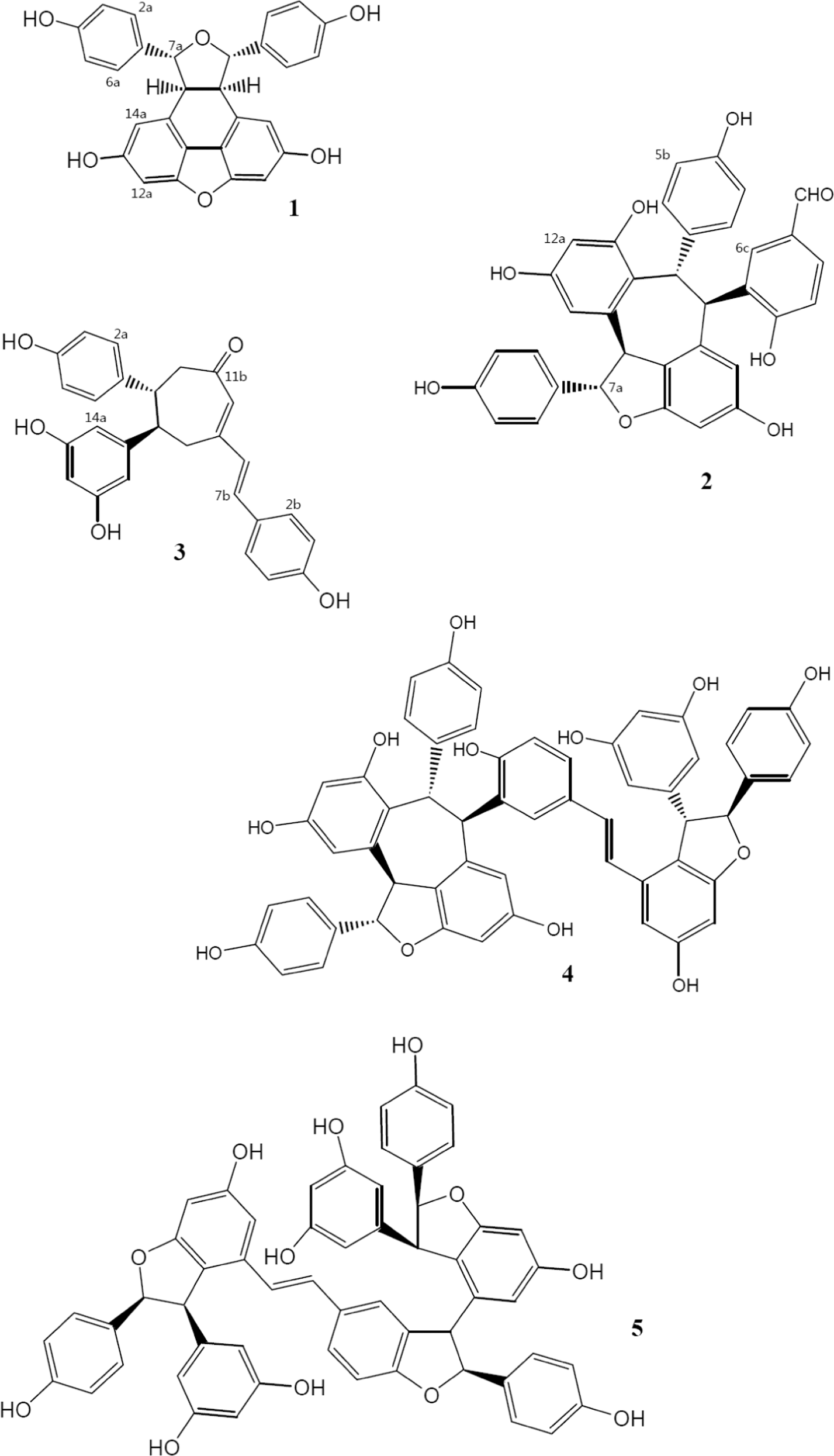
Isolated compounds from Vitis thunbergii var. sinuate.
Neuroprotective effects of resveratrol derivatives against glutamate-induced toxicity in primary cultured rat cortical cells a

Abbreviation: LDH: lactic dehydrogenase.
a Rat cortical cell cultures were incubated with test compounds for 1 h. The cultures were then exposed to 100 μM glutamate for 24 h. After the incubation, the cultures were assessed for the extent of neuronal damage.
b Cell viability was measured by the LDH assay.
c LDH released from control and glutamate-treated cultures were 11.7 ± 1.3 and 47.9 ± 4.0 units/mL, respectively;
d Cell viability was calculated as 100 × (LDH released from glutamate-treated-LDH released from glutamate + test compound-treated) / (LDH released from glutamate-treated-LDH released from control). The values shown are the mean ± STD of three experiments (3−4 cultures per experiment). Results differ significantly from the glutamate-treated: *p <0.05, **p < 0.01, ***p < 0.001.
e Glutamate-treated value differed significantly from the untreated control at the level of p < 0.001.
f APV: DL-2-amino-5-phosphonovaleric acid, a competitive NMDA (N-methyl-D-Aspartate) receptor antagonist.
g MK-801: dizocilpine maleate, a noncompetitive NMDA receptor.
h CNQX: 6-cyano-7-nitroquinoxaline-2,3-dione, non-NMDA receptor antagonist.
Footnotes
This study was partly supported by 2009 research fund of RDA.