




Abstract
Due to the reduction of air change rates in low-energy houses, the contribution to indoor air quality of volatile organic compounds (VOCs) emitting from oriented strand boards (OSB) has become increasingly important. The aim of this study was to evaluate sensory irritations, pulmonary effects and odor annoyance of emissions from OSB in healthy human volunteers compared to clean air. Twenty-four healthy non-smokers were exposed to clean air and OSB emissions for 2 h under controlled conditions in a 48 m3 test chamber at three different time points: to fresh OSB panels and to the same panels after open storage for 2 and 8 weeks. Chemosensory irritation, exhaled nitric oxide (NO) concentration, eye blink frequency, lung function and subjective perception of irritation of eyes, nose and throat were examined before, during and after exposure. Additionally, olfactory perception was investigated. Total VOC exposure concentrations reached 8.9 ± 0.8 mg/m3 for the fresh OSB panels. Emissions consisted predominantly of α-pinene, ▵3-carene and hexanal. Two-hour exposure to high VOC concentrations revealed no irritating or pulmonary effects. All the subjective ratings of discomfort were at a low level and the medians did not exceed the expression ‘hardly at all.’ Only the ratings for smell of emissions increased significantly during exposure in comparison to clean air. In conclusion, exposure of healthy volunteers to OSB emissions did not elicit sensory irritations or pulmonary effects up to a VOC concentration of about 9 mg/m3. Sensory intensity of OSB emissions in the chamber air was rated as ‘neutral to pleasant.’
Keywords
Introduction
The potential impact of volatile organic compounds (VOCs) on health and wellbeing has become an increasingly important issue over the last 25 years, driven in particular by the development of ‘tight,’ low-energy buildings with very low air change rates. It is well known that wood and wood-based materials influence the quality of indoor air and numerous wood-based materials and wooden tiles including construction panels of the type ‘Oriented Strand Board (OSB)’ have already been tested for their VOC emission characteristics. In Germany, OSB is usually produced from Pinus sylvestris L. VOC emissions from OSB panels during production and use phases are described in the literature. 1 –7 Wood-specific resins are mainly responsible for the emission of VOCs from OSB, and these resins may vary considerably depending on the kind of timber used and the conditions under which it has grown. The predominant compounds identified are terpenes, especially α-pinene, β-pinene and Δ3-carene, which may react with ozone to form ozone/terpene reaction products comprising of hydroxyl radicals (OH·), hydrogen peroxide, submicron particles and selected condensed-phase constituents of these particles. 8,9 Additionally, various saturated (pentanal, hexanal) and unsaturated aldehydes (heptenal, octenal) have been identified as being emittied from OSB. These compounds are released from OSB panels over a period of at least 6 months. 6 Recently, the Federal Research Center for Forestry and Forest Products compiled an extensive study about the influence of the OSB production process on the emission of VOCs, focusing on the splinter drying process, press temperature and time, storage conditions and time in relationship to the measured emissions. Whereas terpene concentrations decreased quite rapidly after production, some aldehydes showed an increase in emission concentrations weeks after production. 5
Despite the wide use of OSB materials, information on the possible health effects from exposure to VOC emissions from OSB is scant. Olfactory and trigeminal effects, such as sensory irritation are likely to be the most critical, as discussed by several researchers during the last decades. 10 –15 In this context, chemical sensory irritation has to be defined as the broad range of physiological responses (including sensory, secretory, respiratory, cellular and biochemical) produced when airborne chemicals stimulate unspecialized free nerve endings. This is distinct from chemical stimulation of the specialized olfactory or taste receptor cells. 16
Bicyclic terpene hydrocarbons can easily penetrate the different barriers of the body, with uptake of pinenes taking place through the lungs, the gastrointestinal tract and the skin. 17,18 Weak irritative effects of α-pinene and hexanal were found in exposure studies with healthy volunteers, albeit at very high concentrations (Table 2). Two 90-day animal inhalation studies (6 h/day, 5 days per week) were performed with α-pinene in which all the male and female organs and tissues underwent histopathological examination. Neither study reported any observed adverse effect levels (NOAELs) associated with exposure to α-pinene 20 at concentrations of 94–188 mg/m3 for males and 750 mg/m3 for females.
Emissions of selected (very) volatile organic compounds (VOCs and VVOCs) from clean air and OSB panels during the five exposures a

Abbreviations: ND: not detectable, VOCs: volatile organic compounds, OSB: oriented strand board, DNPH: 2,4-dinitrophenylhydrazine.
a Data are mean values ± standard deviation (MV ± SD) of concentrations of six VOC measurements with six volunteer groups (N = 24 volunteers).
b Sum of the average of each individual compound.
c Acetaldehyde, propionaldehyde, butyraldehyde
d Total volatile organic compounds: Includes all individual VOCs from C6 to C16.
Summary of human exposure studies on inhalative toxicity towards selected VOCs typically emitted from OSB
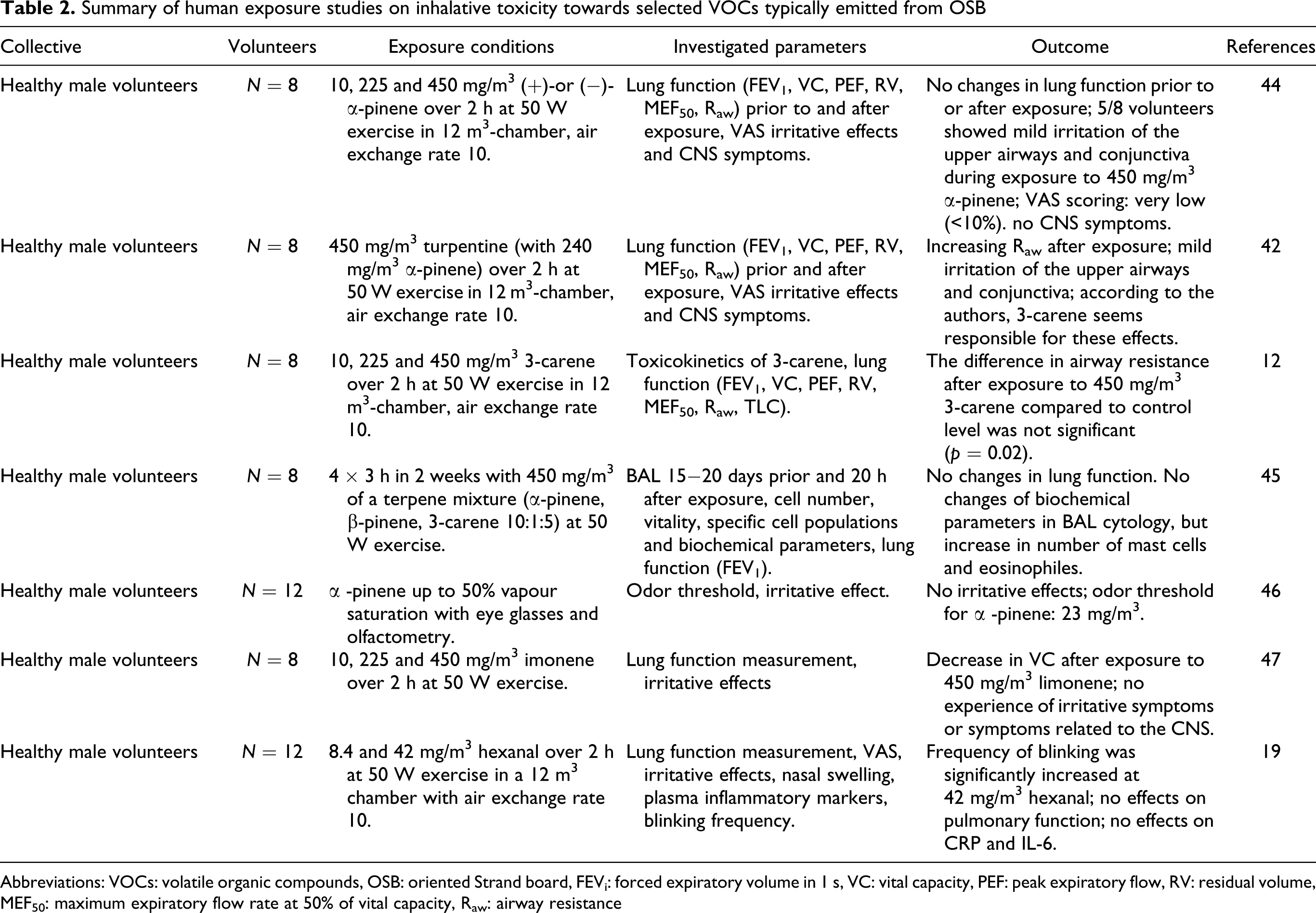
Abbreviations: VOCs: volatile organic compounds, OSB: oriented Strand board, FEVi: forced expiratory volume in 1 s, VC: vital capacity, PEF: peak expiratory flow, RV: residual volume, MEF50: maximum expiratory flow rate at 50% of vital capacity, Raw: airway resistance
Hexanal and the other aldehydes are probably formed by oxidative degradation of natural lipids present in wood. At low concentrations, these low-molecular weight aldehydes emitted from OSB are mild irritants to the mucous membranes in the nose, mouth and airways. 19 Furthermore, these aldehydes can also produce objectionable odors, even at low concentrations. Odor thresholds for hexanal and other aldehydes can be exceeded in new houses for many months after construction. 21 –23 Unfortunately, research on the relationship between odor, odor perception and psychoneurological health effects is still scarce. 24 Altogether, there is a lack of data on possible health effects of VOCs emitted from wood-based building materials such as OSB. Thus, a hypothesis of our study was that the known specific emission behavior of OSB may alter the perception of exposed humans. Therefore, we used OSB at three different stages of ageing to reflect different VOC emission patterns. The objective of the present study was to examine sensory irritative effects elicited from possible synergistic impacts of the VOC emissions. For this purpose, sensory irritative effects, irritation to the mucous membranes of the upper respiratory tract on the basis of exhaled nitric oxide (NO) measurements, lung function impairment, subjective irritant effects or health complaints and odor perception were investigated in human volunteers at relatively high worst case concentrations for the indoor air environment.
Methods
Study design
Twenty-four volunteers participated in the study. To simulate a ‘worst case’ scenario, subjects were exposed to five sessions of either clean air or emissions from OSB panels at a high loading rate of 3 m2/m3 in a 48 m3 exposure test chamber. The constant loading rate was necessary to evaluate exposure to the expected shift in VOC pattern during ageing and off-gasing (terpene-aldehyde-shift) of the OSB material. The exposure conditions were as follows: (i) exposure to clean air I; (ii) exposure to fresh OSB panels; (iii) exposure to the same OSB panels after 2 weeks off-gasing; (iv) exposure to the same OSB panels after 8 weeks off-gasing; (v) again exposure to clean air II. Each subject was exposed to the five exposure conditions for 2 h each, with an air exchange rate of 1 h−1. During exposure, subjects performed six 20-min sessions of cycle ergometry at 50 W. Due to investigation of ageing and off-gasing of the OSB material, it was not possible to permutate groups and conditions according to the ‘latin square’ procedure. Exposure to OSB emissions was conducted blind, i.e. the subjects were not aware of the test material and the exposure conditions. Each exposure session was separated by at least 2 weeks. The subjects were instructed not to discuss their symptoms or assumed exposure levels with anyone. The study was approved by the Ethics committee of the Medical Faculty of the University of Freiburg and was performed between October 2008 and February 2009.
Characterization of test material
The selected OSB panels were of industrial origin, produced by three mills in Central Europe and mixed at a ratio of 1:1:1. All the boards had a thickness of 12 mm and fulfilled the requirements of OSB type 3, i.e. boards used for building purposes. The boards were uniformly manufactured from strands of pinewood (Pinus sylvestris L.) and were bonded with polymeric methylene diphenyldiisocyanate (PMDI). The adhesive content was in the range of 3.5%−4%. The panels were taken directly after hot pressing and cut into pieces of 2 m length and 1 m width. To prevent exposure to or loss of VOCs during transport and storage, the panels were wrapped in plastic foil immediately after cutting. Three to four days after arriving at the institute, and at most 7 days after production, the OSB panels were unwrapped and placed vertically in the exposure chamber in an electropolished stainless steel holder. At that time, the moisture content of the panels was approximately 5.5%−6% (m/m). To maintain a high concentration of VOCs, the edges of the boards remained open. The 48 m3 chamber was loaded with 36 boards giving a loading rate of 3 m2/m3 (without consideration of edge area). The used OSB boards were put in a separate room and stored unwrapped at room temperature for off-gasing until the next exposure session.
Study subjects
The mean age of the study subjects was 22.9 ± 2.6 years ranging from 21 to 31 years. The group consisted of 11 female and 13 male subjects. None of the volunteers wore contact lenses. All subjects were non-smokers (self-reported status by questionnaire), healthy, without allergies or other chronic diseases of the upper airways, lungs, heart or skin. Prior to exposure, a medical examination to check the subjects' general health status was performed and clinical blood chemistry tests were undertaken. Among all the volunteers, the median concentration of immunoglobulin E (IgE) in plasma was 34 kU/L (range: 0–418 kU/L) and the median concentration of C-reactive protein (CRP) in plasma was 2 mg/L (range: 1–19 mg/L). Five subjects with high concentrations of IgE (>100 kU/L) showed no clinical symptoms of inflammation or allergic diseases like asthma, atopic eczema or allergic rhinitis. This was also the case for two subjects with concentrations of CRP >6 mg/L. Odor sensitivity was tested with ‘Sniffin Sticks' and was found to be 83%−100%. Thus, all the volunteers were normosmic (odor identification rate: ≥83%), i.e. they had a normal sense of smell. To investigate the influence of psychological parameters on the results of this type of study, detailed characterization of the subjects was performed with psychometric questionnaires: ‘Freiburger Persönlichkeitsinventar’ (FPI-R) 25 and ‘Fragebogen zur Lebenszufriedenheit’ (FLZ). 26 The data obtained by FPI-R and FLZ were in the range of normal reference groups (stanine and sum score 4–6). Analyses of the single parameters were not accomplished.
Blood tests
Two inflammatory markers, interleukin-6 (IL-6) and CRP, were analyzed in blood collected in vaccutainer tubes (with EDTA, Becton Dickinson, Heidelberg, Germany). The analyses were carried out by LADR GmbH, Medizinisches Versorgungszentrum, Braunschweig, Germany.
Testing of odor identification
“Sniffin Sticks” 27 –29 were used to evaluate the sensitivity of the subjects to odors at study onset. The test result was a sum score of the correctly identified odors. Identification of 10 out of 12 odorants was evaluated as normosmic.
Exposure experiments
Exposure was carried out in a 48 m3 exposure chamber (3 × 4 × 4 m; L × W × H) with an air change rate of 1 h−1. The chamber was manufactured by Weiss Umwelttechnik GmbH (Giessen, Germany) and was made of electropolished stainless steel. The chamber fulfilled international emission-testing standards. 30,31 Temperature, relative humidity, organic gases (total organic carbon, TOC), carbon dioxide level and outlet flow rates of chamber air were continuously monitored. The airflow was conditioned to a temperature of 21°C (±0.5°C) and relative humidity of initially 50% (±3%). To achieve low VOC background values, the supply air was purged through an active charcoal and a fine particle filter. This system produces clean air with total volatile organic compounds (TVORC) values below 20 μg/m3 and individual VOC levels below 1 μg/m3. Samples of the chamber air were collected via stainless steel sampling lines from outside.
Chemical analysis
Organic gases (TOC) were continuously monitored in the chamber air by a photoacustic monitor (Innova, Ballerup, Denmark), which measures any compounds that absorb infra-red light (expressed as propane equivalents). VOC sampling of exposure chamber air took place according to Tenax TA. 32 The organic compounds were desorbed thermally and subsequently analyzed by capillary column gas chromatography combined with mass spectrometric detection (GC/MS). All VOCs identified were quantified using their own response factor; their limits of quantification were <1 µg/m3. Low-molecular weight aldehydes and ketones were determined using the DNPH-method (2,4-dinitrophenylhydrazine). 33 Their limits of quantification were <1 µg/m3.
Examinations of test subjects
Before and immediately after exposure, subjects underwent the following examinations: Physical examination including general health status, allergy and/or skin diseases, acute infections, acute diseases of the upper airways, lungs, heart, skin and eyes. Moreover, measurements of pulse frequency, blood pressure and pulmonary function were performed.
Lung function measurements
To evaluate airway resistance or airway obstruction, pulmonary functions were examined prior to and immediately after exposure to OSB emissions. Spirometry was performed according to the American Thoracic Society/European Respiratory Society guidelines 34 using a True Flow™ PC spirometer (ndd Medizintechnik, Zürich, Switzerland). The measurements included vital capacity (VC), forced vital capacity (FVC) and forced expiratory volume in 1 s (FEV1). The highest value of three measurements was used. The difference between FVC or FEV1 measurements before and after exposure to the different conditions in comparison to clean air was used as an indication for the presence of respiratory alteration.
Exhaled NO
Exhaled NO was measured according to the European Respiratory Society (ERS) with a hand-held device (NioxMino™, Aerocrine, Solna, Sweden). 34,35 The difference between the NO concentrations before and after exposure to the different conditions in comparison to clean air was used as an indication for the presence of an inflammatory effect.
Blinking frequency
Eye blinking was monitored by electromyography (EMG) 36 throughout the entire 2-h exposure. The electrodes were connected to Becker Meditec™ amplifiers, the raw EMG signal was analyzed automatically by a four-channel contour-following integrator (Becker Meditec™, Karlsruhe, Germany). To standardize visual demands during the assessment, the volunteers were asked not to speak, read or to listen to music. All counting was performed by the same experimenter, blinded with respect to exposure conditions. For analyses of blinking frequency, specific sections were selected, representing time series 15–20 min, 55–60 min and 115–120 min after the beginning of exposure.
Visual analogue scales
Symptom ratings were performed using 0-100 mm visual analogue scales (VAS) graded from ‘not at all’ (0 mm) through ‘hardly at all’ (6 mm), ‘somewhat’ (26 mm), ‘rather’ (48 mm), ‘quite’ (72 mm), ‘very’ (90 mm), to ‘almost unbearable’ (100 mm). The eight symptoms to be rated were (1) ‘discomfort in the eyes: burning, irritated, or running eyes'; (2) ‘discomfort in the nose: burning, irritated, or runny nose’; (3) ‘discomfort in the throat or airways'; (4) ‘breathing difficulty’; (5) ‘smell of emissions'; (6) ‘headache’; (7) ‘dizziness'; (8) ‘fatigue.’ Ratings were performed immediately after entering the exposure chamber (time point 0 min), during exposure (20, 40, 60, 80, 100 min from onset of exposure) and at the end of the exposure (time point: 120 min). The questionnaire used was elaborated for vapor exposure and has been used in several inhalation studies. 19,37,38
Sensory evaluation
The semantic differential (SD) method was used for assessment of volunteers' perception of OSB emission odor in the chamber. 39 Before the sessions, the subjects were asked to rate ‘odor’ and ‘malodor’ using the SD's adjectives without any exposures. Scores on each scale ranged from −3 to +3. After leaving the exposure chamber subjects were also asked to rate the odor in the chamber. All ratings were made by filling in a questionnaire. The complete data set for determining odor perception and the representative profile value was evaluated according to a method for hedonic assessment of smell of emissions in plants and other technical installations. 39
Statistical calculations
The underlying parameters were analyzed by non-parametric methods. 40 The Friedman test was applied to investigate differences between the different exposure conditions. In the case of a significant result ( p < 0.05) a pairwise Wilcoxon signed rank test was used to test the ‘concentration effects' more precisely. Due to the fact that the underlying study investigated ‘safety aspects,’ no adjustment of the significance level was done. Furthermore, the Page’s trend test 41 was used to detect a trend, whereas the different exposure conditions were arranged in an increasing manner, i.e. clean air, OSB emissions after 8 weeks off-gasing < OSB emissions after 2 weeks off-gasing < emissions from the fresh OSB. Finally, the Wilcoxon signed rank test was used to test for reversibility. Therefore, the two control conditions (clean air I and clean air II) were tested for differences. Gender differences of the median of the VAS ratings, lung function parameters, NO differences and blink frequencies were tested by Mann-Whitney U-test. The significance level was set at p < 0.05 in all statistical analyses.
Results
Exposure atmosphere
The composition and average concentrations of VOC emissions released from OSB during the different exposure conditions are summarized in Table 1 . The OSB panels used generated a typical VOC emission pattern in the chamber air. The VOCs predominantly emitted were terpenes and aldehydes. The loading rate of 3 m2/m3 fresh OSB panels yielded mean TVOC concentrations of 8.9 mg/m3, of which 4.6 mg/m3 were terpenes (predominantly α-pinene: 2.2 ± 0.3 mg/m3) and 3.0 mg/m3 were aldehydes (predominantly hexanal: 2.6 ± 0.2 mg/m3). Terpene emissions from the OSB decreased continuously after 2 and 8 weeks off-gasing (from 52% to 38% of TVOC content), whereas aldehyde concentrations initially increased (from 34% to 51% of TVOC content) and subsequently decayed during ageing and off-gasing of the OSB panels. Formaldehyde was also present in the chamber air, albeit at relatively low concentrations. VOC chamber concentrations decreased from 8.9 ± 0.8 mg/m3 for fresh OSB panels to 4.9 ± 0.4 mg/m3 for OSB panels after 8 weeks off-gasing. The average temperature was about 21°C for all exposure conditions.
Clinical effects
The subjects showed no changes in clinical parameters at the end of all exposure conditions, especially no eye or throat redness, no increased tear production and no neurovegetative symptoms (dizziness, nausea, problems with orientation).
Lung function measurements
No differences were found between the different exposure conditions ( p = 0.051, Friedman test; p = 0.281, Page’s trend test) with regard to FEV1 (Figure 1), although a significant difference was found in FVC ( p = 0.034, Friedman test; p = 0.194, Page's trend test; Figure 1). However, no significant differences were found in FVC changes after subsequent pair-wise comparison by means of the Wilcoxon signed rank test of the three exposure conditions with the clean air control. No differences were observed between clean air I and clean air II controls with regard to either FVC or FEV1 ( p = 0.589 and 0.535, respectively, Wilcoxon signed rank test).

Box plots of changes in forced vital capacity (FVC) and in forced expiratory volume in 1 s (FEV1) in 24 volunteers measured prior to and after exposure to clean air or to oriented strand board (OSB) emissions under various exposure conditions. The box plots denote the minimum observation, 25th percentile (lower quartile), 50th percentile (median), 75th percentile (upper quartile) and the maximum observation. Normal outliers are marked with a circle, extreme outliers with an asterisk.
Exhaled NO
Exhaled NO did not change significantly in 24 volunteers before or after 2-h exposure to OSB emissions under the different exposure conditions ( p = 0.216, Friedman test; p = 0.402, Page’s trend test; Figure 2). A median of 17.5 to 19.5 ppb for exhaled NO was recorded before and after all exposure sessions with only a few and statistically irrelevant outlier levels (45–80 ppb). Furthermore, no differences were observed between clean air I and clean air II controls ( p = 0.093, Wilcoxon signed rank test).

Box plots of changes in exhaled nitric oxide (NO) concentrations of 24 volunteers exposed to clean air and oriented strand board (OSB) emissions under various exposure conditions measured prior to and after exposure. The box plots denote the minimum observation, 25th percentile (lower quartile), 50th percentile (median), 75th percentile (upper quartile) and the maximum observation. Normal outliers are marked with a circle, extreme outliers with an asterisk.
Eye blinking frequency
Blinking frequencies were evaluated visually for the 24 volunteers at the beginning, in the middle and at the end of the different exposure conditions (Figure 3). The frequency of blinks per minute did not vary considerably between exposure groups. Blinking rates ranged from 12 to 29 blinks/min, the medians from 18.5 to 21.5 blinks/min. Exposure conditions showed no effect on blinking frequencies compared to clean air I control at time points 15–20 min, 55–60 min and 115–120 min ( p = 0.934, p = 0.49 and p = 0.204 Friedman test and p = 0.298, p = 0.274 and p = 0.048, Page’s trend test). Additionally, no differences were seen between clean air I and clean air II controls ( p = 0.410, 15–20 min; p = 0.076, 55–50 min; p = 0.970, 115–120 min, Wilcoxon signed rank test).

Box plots of the eye blinking frequency of 24 volunteers during exposure to clean air and to oriented strand board (OSB) emissions under various exposure conditions. Results are presented in time series 15−20 min, 55−60 min and 115−120 min each for 5 min. The box plots denote the minimum observation, 25th percentile (lower quartile), 50th percentile (median), 75th percentile (upper quartile) and the maximum observation. Normal outliers are marked with a circle, extreme outliers with an asterisk.
Gender differences
No concentration-dependent gender differences were found for pulmonary function, differences in exhaled NO or for blinking frequencies.
Visual analogue scales
The results of the VAS ratings made during the five exposures at different time points showed that the ratings were subject to large inter-individual variation, sometimes with normal and extreme outliers. Moreover, with the exception of the rating of ‘smell of emissions,’ the median ratings were relatively low and only occasionally exceeded the verbal label ‘hardly at all’ (≤6 mm). The VAS rating of ‘discomfort of the eyes,’ ‘discomfort in the nose’ and ‘discomfort in the throat and airways' showed no consistent concentration and time-dependent differences between the investigated exposure conditions ( p > 0.05, Page’s trend test; Figure 4A−C ). The rating of ‘smell of emissions' was significantly increased (Figure 5) in all three conditions under exposure to OSB emissions, compared to clean air I control ( p < 0.001, Friedman test; p < 0.001, Page’s trend test). Regarding the time-course of the VAS rating of ‘smell of emissions' as seen in Figure 5, subjects showed rapid adaptation during the 2 h of exposure to the OSB emissions. However, VAS ratings did not decrease to the control level of clean air. No differences were seen in ‘smell of emissions' between clean air I and clean air II controls at all time points ( p > 0.05, Wilcoxon signed rank test). No concentration-dependent significant effects were detected in the VAS ratings of ‘breathing difficulties,’ ‘headache,’ ‘dizziness' and ‘fatigue’ at all time points investigated (data not shown).

A−C: Box plots of the visual analogue scales (VAS) ratings ‘discomfort in the eyes,’ ‘discomfort in the nose” and “discomfort of the throat or airways' of 24 volunteers exposed to clean air and to oriented strand board (OSB) emissions under various exposure conditions and different time points over an exposure period of 2 h. The box plots denote the minimum observation, 25th percentile (lower quartile), 50th percentile (median), 75th percentile (upper quartile) and the maximum observation. Normal outliers are marked with a circle, extreme outliers with an asterisk. Symptoms ratings were performed using a 0–100 mm VAS graded from: 0 mm: not at all; 6 mm: hardly at all; 26 mm: somewhat; 48 mm: rather; 72 mm: =“quite; 90 mm: ‘very; 100 mm: ‘almost unbearable.

Box plots of the ratings ‘smell of emissions' of 24 volunteers exposed to clean air and to oriented strand board (OSB) emissions under various exposure conditions and different time points over an exposure period of 2 h. The box plots denote the minimum observation, 25th percentile (lower quartile), 50th percentile (median), 75th percentile (upper quartile) and the maximum observation. Normal outliers are marked with a circle, extreme outliers with an asterisk. Symptoms ratings were performed in a questionnaire using a 0-100 mm visual analogue scale (VAS) graded from: 0 mm: not at all; 6 mm: hardly at all; 26 mm: somewhat; 48 mm: ‘rather’; 72 mm: quite; 90 mm: very; 100 mm: almost unbearable.
Semantic differential
Using the semantic differential (SD) method 24 subjects judged the sensory intensity of the fresh OSB emissions to be closer to ‘neutral to pleasant’ than ‘unpleasant’ (Figure 6). The mean SD scores for ‘malodor’ and ‘odor’ were −1.5 and +1.3, respectively. For the five exposure conditions, the SD scores were 0.33, 0.03, 0.10, 0.02 and 0.12.

Evaluation of odor quality after exposure of 24 volunteers to emissions of clean air and oriented strand board (OSB) particleboard emissions (loading rate: 3 m2/m3) using a semantic differential (SD) method.
Discussion
Over the last decades, a number of studies have been performed to evaluate the significance of health effects caused by various VOCs typically emitted from wood and wood-based materials. These studies focused on terpenes such as α-pinene, ▵3-carene and some of their mixtures, but also on aldehydes such as hexanal. 11 –13,19,42,43 Most of the studies used exposure concentration measurements, lung function tests and VAS as survey instruments for identification of perception of odorous and irritating effects to the eyes and upper respiratory tract (Table 2). However, all the studies mentioned in Table 2 dealt with single compounds or artificial mixtures and do not, therefore, reflect the real indoor situation regarding OSB emissions. As already stated in the introduction, the profile of VOC emissions from OSB changes over time, with a terpene-to-aldehyde-shift caused by several physico-chemical factors. 5 Based on the results available from previous studies, to simulate a worst case-scenario, we used a high OSB loading rate of 3 m2/m3, yielding VOC concentrations of up to 9 mg/m3. In some studies, especially those examining new or recently renovated housing, wood-specific VOCs were found in concentrations of more than 1 mg/m3. Otherwise, the mean values for α-pinene or hexanal, as marker compounds for wood and wood product-associated emissions in indoor air, ranged between 10 and 40 µg/m3 for α-pinene 14 and 10 and 18 µg/m3 for hexanal. 48 Hence, the OSB-specific VOC concentrations in our experiments were about 225-fold higher than the highest mean value for α-pinene and 500-fold higher than that for hexanal. This high loading rate might be responsible for the relatively low humidity due to adsorption of high amounts of water. However, in these climatic conditions (relative humidity in the range from 50%–80%), no irritating effects caused by dryness on mucous membranes is expected.
The main result of this study is that none of the investigated target parameters such as chemosensory irritation, lung function impairment, subjective irritative effects or health complaints and judgement of odor quality provided any evidence that exposure of healthy volunteers to VOC emissions from OSB causes acute health effects at concentrations up to 9 mg/m3.
Only validated and/or standardized methods were used in the present study: measurement of lung function parameters 34 synthesis of NO, 49 –54 measurement of eye blinking frequency 36, 55 –60 and VAS as a widely used survey instrument to record subjective symptoms. 11,12,37,61 –65 Exhaled NO was used as a marker for acute upper respiratory effect from exposure to OSB emissions. Higher levels of exhaled NO have been described as resulting from exposure to a range of ambient, domestic and occupational pollutants, e.g. formaldehyde, environmental tobacco smoke or traffic pollution. 66 –68 In the present study, the NO concentrations in exhaled air before and after exposure to OSB emissions were in the same range as NO concentrations in adults not suffering from airway inflammation (10–20 ppb) 69 However, attention should be paid to the fact that considerable doubt has been cast on the validity of NO measurement, particularly in asthma management. 70
Increased blinking frequency as a marker for sensory irritation to the eyes has previously been reported in studies on industrial chemicals in workplace concentrations, e.g. 3-methylfuran and 1-octen-3-ol, 71,72 n-hexanal, 19 ϵ-caprolactam, 73 methacrolein 56 and formaldehyde. 74 But increased blinking frequency has also been reported for environmental tobacco smoke 75 and limonene oxidation products. 55 In this study, median blinking rates for all exposure conditions and all three-time series were detected in the range of about 20.4–20.8 blinks/min and correspond to the findings of other studies. 38,76,77 Statistical analyses did not reveal any significant changes in blinking frequencies during the exposure experiments conducted under the various conditions.
The medians did not exceed the expression ‘hardly at all’ in all the subjective ratings of discomfort, with the exception of ‘smell of emissions' and ‘fatigue.’ An adverse health effect is regarded as causing an acute impact on health, including subjective symptoms with higher gradings on the VAS score of between ‘severe’ and ‘very severe.’ 78 Based on this definition of ‘adverse health effect,’ the results for the subjective symptoms in this study were not considered to be adverse. Obviously, the most pronounced response from volunteers to exposure to OSB emissions was perception of odor. In general, for the single experiments, the highest ‘smell of emissions' ratings were given immediately after entering the exposure chamber. Then, in what may be regarded as a process of adaptation to the smell of the emissions, the ratings declined during the 2 h of exposure, did not, however, reach the control value of clean air. Interestingly, ‘smell of emission’ was not concentration-dependent. The main reason may be the flat concentration-odor intensity perception curve over a wide range. Reduction of the VOC concentration has no effect as long as the level is on the flat plateau. 79 Smell threshold levels for terpenes, i.e. for α-pinene, ▵3-carene or limonene are quite high compared to the terpene concentrations identified in the test chamber atmosphere. Thus, in the present study, terpenes released from OSB (maximum 4.6 mg/m3) may not be responsible for the perception of odor by the study volunteers, although odor thresholds in other publications have been orders of magnitude too high, see also ref 15,80,81 . Hexanoic acid, an unpleasant-smelling substance with an odor threshold of between 3 and 5 µg/m3, was found in a concentration of about 450 µg/m3 and may therefore possibly be responsible, however, it does not fit the results of hedonics. 82,83 Additionally, after 2 weeks off-gasing, aldehydes, e.g. pentanal and hexanal, were found in concentrations 15- to 44-fold higher than their odor thresholds of 22 µg/m3 and 58 µg/m3, respectively. 84 They, too may, therefore, have contributed to odor perception in the test chamber air.
It is well-known that wood and almost all wood-based building materials such as OSB possess an odor. Usually, the odor intensity decreases to low and acceptable levels within a few weeks or months after completion of the building. 85 However, odor perception varies and represents a wide range from pleasant to unpleasant appraisal. 15 The interaction between odor and a person’s psychological state (e.g. emotion/mood) or manipulation 86 is complex, and cultural differences also exist. 87,88 Interestingly, the study subjects rated the OSB emissions in the chamber air as ‘neutral to pleasant’ for all exposure conditions, i.e. they accepted the indoor air quality perceived and did not express dissatisfaction. The sensory intensity of OSB emissions rated by the volunters was comparable to that of the clean air.
The present study investigated possible chemosensory irritative and odor perception effects from short-time exposure to relatively high levels of VOCs emitted from OSB panels. Because no irritation effects could be identified, even at VOC concentrations of up to 9 mg/m3, and effects caused by irritant receptor-mediated mechanisms are early-onset mechanisms with threshold values and without cumulative characteristics, the study provides important and resilient data with respect to the health evaluation of OSB-mediated emissions in indoor air. On the basis of our results, no evidence was found for sensory irritating effects to the eyes, throat or pulmonary system for the indoor air situation relatively high VOC concentrations tested. It is not likely that health effects will arise long after short-period inhalation. However, the possibility of long-term health effects such as obstructive pulmonary disease emerging after repeated short-period inhalation over a long time cannot be ruled out with certainty. However, according to the literature, there is no basis for this assumption.
An important result of the present investigation is that the α,β-unsaturated aldehydes 2-heptenal and 2-octenal were emitted from OSB into the chamber air at relatively high concentrations of 43 µg/m3 and 104 µg/m3, respectively. In a recent study with in vitro exposure at the air liquid interface and LOAEL concentrations of 100 mg/m3 and 40 mg/m3, respectively, both compounds showed to have pronounced DNA damaging potency in human lung A549 cells. 89 To prevent such effects, a manufacturing process should be developed for OSB that destroys or inhibits the formation of reactive α,β-unsaturated aldehydes, without major changes of the product properties. 6 However, only a few micrograms of α,β-unsaturated aldehydes can be detected in indoor air (9–14 µg/m3); thus, under normal circumstances, a substantial risk to residents is not to be expected from these indoor air pollutants. Nonetheless, in view of the uncertainties regarding (i) long-term exposure, (ii) individual susceptibility to irritant substances, 90 (iii) chemical reactions of OSB-specific VOCs with other indoor air contaminants such as ozone 91 –94 and from a preventive point of view, exposure to VOCs in indoor air should be minimized wherever possible.
In conclusion, acute exposure of healthy volunteers to OSB emissions for 2 h did not elicit sensory irritations or pulmonary effects up to a VOC concentration of about 9 mg/m3. Sensory intensity of OSB emissions in the chamber air was rated as ‘neutral to pleasant.’
Integrative concepts focusing on low-emission building products, energy saving technologies and heat, ventilation and air conditioning systems are necessary to reconcile future environmental and health issues.
Footnotes
Acknowledgements
We thank Prof. Dr Tunga Salthammer and his group at the Department of Analytical Chemistry, WKI Braunschweig, Germany, for performing the chemical analyses of the exposure chamber atmosphere. We are also very grateful to Prof. Dr Uwe Heinrich and Prof. Dr Norbert Krug, Fraunhofer-Institute for Toxicology and Aerosol Research (ITEM), Hannover, Germany, Prof. Dr Gerhard Triebig, Institute for Occupational Medicine, University of Heidelberg, Germany, and Dr Christoph van Thriel, Leibnitz Research Center for Working Environment and Human Factors (IfADo), University of Dortmund, Germany, for their precious scientific input and discussion of the study design in the run-up of the experiments. Additionally, we are grateful to the skillful technical assistance provided by Astrid Schwarz and Stephan Thiele during the experiments.
The study was financed by the ‘Holzabsatzfonds' and the working group VOC of the producers of wood-based materials in Germany.