




Abstract
Radiocarbon dates on multiple individual charcoal fragments floating together down the Macdonald River, New South Wales, Australia, have calibrated ages spanning >1700 years. Partial explanations of this range of inherited ages can be attributed to the inbuilt age of living biomass, charcoalisation conditions, hillslope transport and storage and/or valley floor (fluvial) transport and storage, but the contribution of each of these components can be constrained only rarely. These results caution against using radiocarbon dating of charcoal as the sole dating technique to interpret Late-Holocene sedimentary histories. These findings also show that it is unlikely that deposit age has a dependable relationship to charcoal age.
Keywords
Introduction
Forty-five years ago Blong and Gillespie (1978) reported that charcoal deposited in a riverine environment may have substantial inherited ages that can seriously complicate interpretations of geomorphic and paleoenvironmental history. While the Blong and Gillespie paper has been cited nearly 200 times, many authors then overlook the paper’s conclusions which imply serious errors may occur in ascribing deposit age to charcoal age in fluvial environments unless multiple samples are assayed with the youngest ages selected, or charcoal ages are combined with luminescence dates (e.g. Optically Stimulated Luminescence (OSL)) or other evidence of antiquity. While the potential differences between charcoal age and deposit age are most serious for Late-Holocene deposits, they may also occur for older sedimentary sequences. Here we explore the radiocarbon ages of 33 individual charcoal fragments collected in 1978 from the same site as the original samples assayed in bulk by Blong and Gillespie (1978). The aim is to account for the >1700 year range in charcoal ages and to argue that any study that aims to produce Late-Holocene chronologies and histories using radiocarbon dating should attempt to account for the inherited charcoal age and deposit age in their analysis.
In 1976, a large sample of charcoal fragments floating or saltating down the sand bed of the Macdonald River (Latitude −33.31°, Longitude 150.97°E, New South Wales, Australia) was collected and gently sieved into four size fractions. Each sample of 40–50 g was radiocarbon dated using liquid scintillation technology. The results showed older calibrated bulk ages with decreasing particle size (Figure 1a).
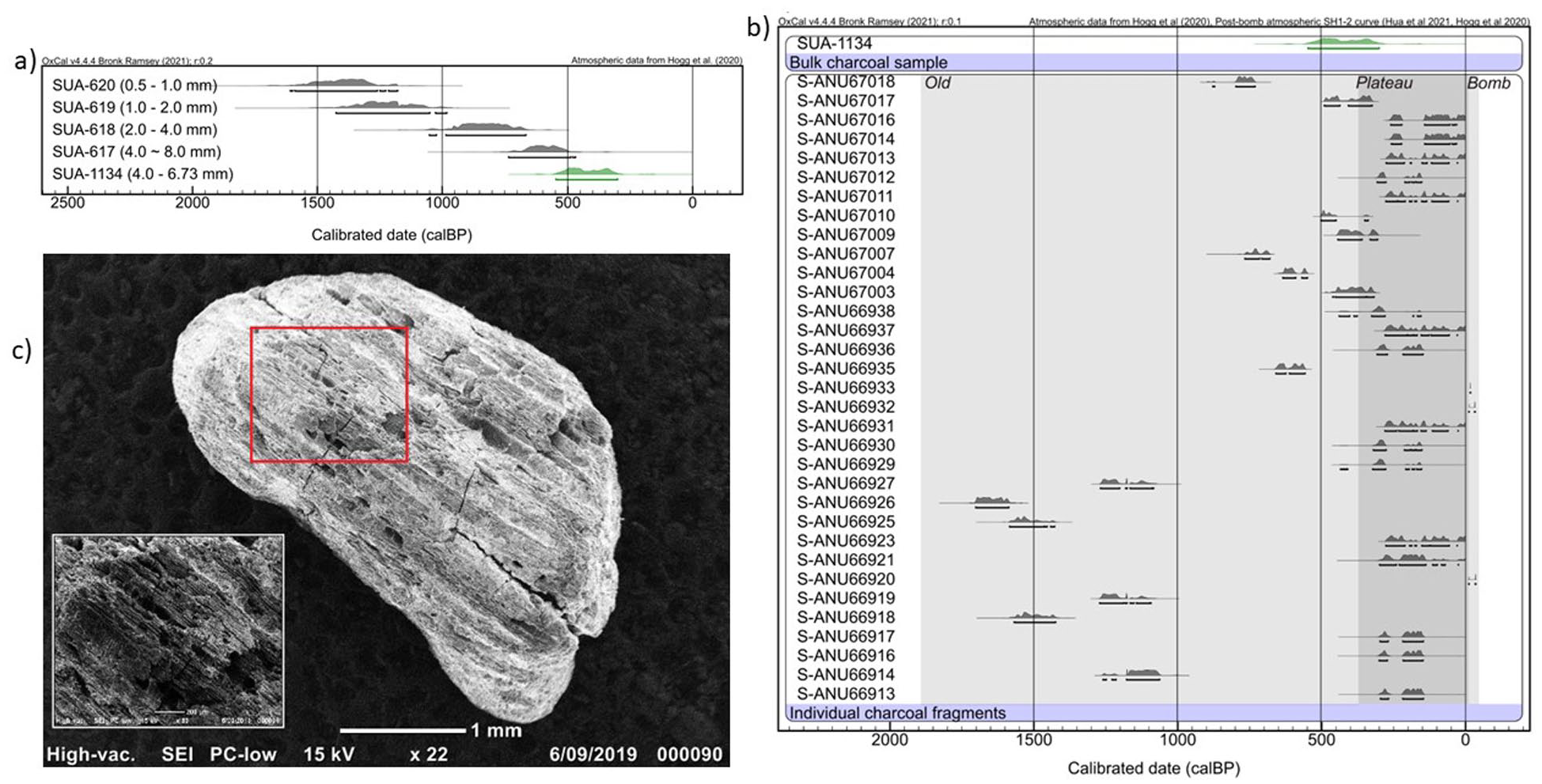
(a) Calibrated ages versus sieved sizes of charcoal fragments floating/saltating down the Macdonald River in 1976 (modified after Blong and Gillespie, 1978) and 1978 (SUA-1134, 420 ± 80 cal BP, green); (b) Calibrated ages (OxCal v4.4.4 – http://c14.arch.ox.ac.uk/oxcal; atmospheric data from SHcal 2020 – Hogg et al., 2020; post bomb data from Hua et al., 2022) of 33 individual charcoal fragments (4.0–6.73 mm a-axis length) from the same sample as SUA-1134 (as reported in Wood et al., in press); (c) Charcoal fragment #28 – see S_ANU67010 in (b).
Recently, Wood et al. (in press) reported AMS dates on 33 individual charcoal fragments from the bulk sample SUA-1134 collected by Blong and Gillespie in 1978. The modelled calibrated ages of the 33 fragments (Figure 1b) span >1700 years. Three fragments have minimal inherited age (defined as the time between carbon fixation and sample deposition), falling between the 1960s and the date of collection in 1978. In contrast, six fragments have ages >1000 years. Each of the 33 dated fragments was characterised by 12 taphonomic and sedimentary variables including taxonomic identification, wood calibre, decay alteration, fungal infestation, vitrification level, a and b axes length and roundness using binocular examination and SEM imagery. The small size fragments and their poor preservation state (including vitrification and mineral precipitates) rendered them unidentifiable, although dendrological features were detailed. As a result, taxonomic identification was only possible for one charcoal fragment (S-ANU66935) identified as cf. Eucalyptus (Wood et al., in press). No variable correlates well with fragment age (Wood et al., in press), indicating that choosing the most appropriate charcoal fragments to estimate the age of a sedimentary deposit is not easy.
Inherited age
For a charcoal sample collected to provide an age estimate on a deposit, the time elapsed between carbon fixation and sampling can be divided into inherited age and deposit age. As the Macdonald River samples were collected while still in transit in the river, and had not yet been deposited, the only concern here is with the two components of inherited age – inbuilt age (the time between carbon fixation and charcoal formation) and the time elapsed between charcoalisation and sample deposition. Ideally, inbuilt age will be 0 year and the time between charcoalisation and deposition will be close to zero. Here four components of inherited age are considered – inbuilt age, charcoalisation, hillslope transport and storage and valley floor transport and storage – specific to the Macdonald Valley but applicable to a wide range of fluvial and other sedimentary environments.
Inbuilt age
Inbuilt age is the age of the wood before it is burnt. Inbuilt age has three wood components – fine woody debris (FWD – mainly small-calibre branches, twigs and small fragments of wood); coarse woody debris (CWD – dead trees and large branches) and living biomass. Both FWD and CWD can be affected by residence time of dead wood on the ground or in trees before charring. For FWD, this might be controlled by taxonomic identification and species knowledge of dead wood resistance. Both wood from CWD and living biomass may be from older layers, hence affected by the number of years of wood growth between formation and charring or death. Thus the inbuilt age can be reduced by choosing wood samples with short life spans and/or sample residence times, such as wood from short-lived species or small twigs (Gavin, 2001; McFadgen, 1982).
There is surprisingly little information on the potential longevity of trees, or of potential dead wood resistance to decay, in NSW forests. Turner (1984), provides two dates on a recently felled Tristania conferta (brush box) of 880 ± 70 and 1080 ± 80 cal BP, and Brookhouse (ANU, personal communication) reports an unpublished 14C date on a fallen Eucalyptus camaldulensis at Moree of 770 ± 90 cal BP. All dates were from as close to the middle of the stems as possible though some decay had occurred. While Ryan et al. (1996) describe the natural vegetation of the Macdonald valley no specific information is available about the longevity of trees and shrubs in the area. Grierson et al. (1992) (working in a range of Victorian forests), showed that the rate of biomass growth is fastest in the early years, with biomass/ha declining after a woodland reaches 80–95 years without burning. For a 100-year old tree, 70–90% of the biomass is >50 years old, and the proportion of old biomass is even higher for older trees. While a large proportion of the 33 charcoal fragments were from large calibre xylem wood with no fungal infestation signalling decay, these limitations suggest that the inbuilt ages of charcoal fragments in the Macdonald Valley will only very rarely be older than 1000 years.
Charcoalisation
Another key component of the inherited age of a charcoal fragment is charcoalisation – the conversion of wood to charcoal. It is difficult to attach charcoal characteristics to specific fuel or fire conditions or to suggest individual fire and fuel characteristics that lead to charcoals with varying levels of resistance to biological and physical degradation or longevity (Belcher et al., 2018; Théry-Parisot et al., 2010). Two components need to be considered – fire severity, which may have had an important effect on the age of the wood that is charcoalised, and fire frequency.
Generally, three categories of fire severity can be recognised (after Keeley, 2009): Light – canopy trees with green foliage remain but stems are scorched; Moderate – some canopy cover killed, all understory plants charred or consumed together with FWD on the ground and CWD charred; Crown fire – canopy trees charred or burnt, FWD and CWD largely consumed. Hollis et al. (2011) examined the variables affecting combustion processes and consumption of woody fuels in southern eucalypt forests, and showed that the more severe the fire, the higher the proportion of older living biomass that is burnt. Thus, more severe fires are likely to produce more charcoal with larger inbuilt ages.
Forested areas, which cover more than 90% of the Macdonald Valley, are dominated by dry sclerophyll (scrubby sub-formation) forests with an ecologically sustainable fire frequency of between 7 and 30 years (Hammill and Tasker, 2010). The relative frequencies of light, moderate and crown fires are likely to have changed with the arrival of Europeans a little over 200 years ago (Fletcher et al., 2021), but severe fires have historically been documented as relatively rare, implying that most charcoal fragments will have short rather than lengthy inbuilt ages.
Hillslope transport and storage
The Macdonald Valley hillslopes are composed of essentially flat-lying regolith-mantled sandstone benches interspersed with rock outcrops typical of the rugged terrain around the Sydney basin (Shakesby et al., 2006). The two main geomorphic processes on these hillslopes are slopewash and bioturbation (Humphreys and Mitchell, 1983).
Post-bushfire sediment yields recorded in closed plots in the Sydney basin range from a few t/ha/year to >60 t/ha/year during the first year, but fall as revegetation occurs. A few years after a bushfire sediment loss rates fall to <1 t/ha/year (Adamson et al., 1983; Atkinson, 2012; Blong et al., 1982). Where bushfires occur more frequently than once every decade or two, more than half the transported sediment and charcoal will be moved in the year or so following bushfires.
Bioturbation is the result of a whole suite of processes which result in the net downslope transfer of soil and charcoal material on a hillslope. While many bioturbation processes seem minor, Adamson et al. (1983) estimate that turnover rates of soil and litter by lyrebirds (Menura novaehollandiae) reach about 63 t/ha/year in the Sydney Basin while Ashton and Bassett (1997) record lyrebirds in Victoria moving up to 200 t/ha/year of litter and topsoil, a rate Maisey et al. (2021) describe as unparallelled by any other vertebrate soil engineer in terrestrial ecosystems globally. Nugent et al. (2014) speculate that lyrebirds have a preference for young (<50 years) even-aged eucalypt forest because these forests are almost devoid of ground vegetation. This contrasts with sites where canopy burns occurred less than 2 years ago which have dense ground cover which inhibits lyrebird foraging and movement.
Neither bushfires nor bioturbation are distributed evenly across the sandstone hillslopes. Whether slopewash or bioturbation is dominant, the transport and storage times of a charcoal fragment on a hillslope is likely to be long, with lengthy periods of storage interspersed with short, episodic phases of transport.
Valley floor transport and storage
Major floods occurred in the Macdonald Valley from 1949 to 1955 (Henry, 1977), producing 1–3 m deep sand sheets across extensive areas of the valley floor and significantly widening the channel. In subsequent decades bench formation and riparian revegetation has seen the channel narrow and instream geomorphic units (landforms) stabilise (Erskine, 1986; Mould and Fryirs, 2018), only to be overwhelmed again by a major flood in 2022. Fluvially-derived geomorphic units reside in the landscape for varying lengths of time (Fryirs et al., 2007). Terraces may store sediment for thousands of years, floodplains for hundreds of years and in-channel units (e.g. bars) for years or days. The recurrence with which sediment is moved in and out of these different units has been considered a ‘jerky conveyor belt’ (Ferguson, 1981). The timeframes over which sediment is either in storage or in transport is dictated by flow magnitude, frequency and the transport capacity of sediment of different calibre. Several cycles of entrainment, transport and storage could occur (Fryirs, 2013).
In the Macdonald Valley, bars can be readily reworked and sand transport can occur in small-moderate flows that inundate those features. At the 1976 and 1978 charcoal collection site, a contemporary 1:2 Average Recurrence Interval (ARI) flow will inundate and deposit/erode in-channel sand bars, and a 1:5 ARI flow will inundate and deposit/erode sediment from benches (step-shaped features attached to the channel bank) (Mould and Fryirs, 2018). As the stability of both bars and benches fluctuates with the establishment of vegetation and river recovery (Fryirs et al., 2018), the timeframes of sediment storage can lengthen and reduce. To inundate and deposit sand on the floodplain requires a 1:10 ARI flow, but it takes a much larger flow to erode the floodplain. At the floodplain pocket upstream of the Blong and Gillespie (1978) charcoal collection site, Rustomji et al. (2006) reported an Optically Stimulated Luminescence (OSL) date at 1.5 m depth of 770 ± 140 years and a radiocarbon age at 5.5 m depth of 1940 ± 190 cal BP (ANU-12046). Other floodplain pockets have ages at depth of around 5.5 k year (Mid-Holocene) (Rustomji et al., 2006).
Discussion
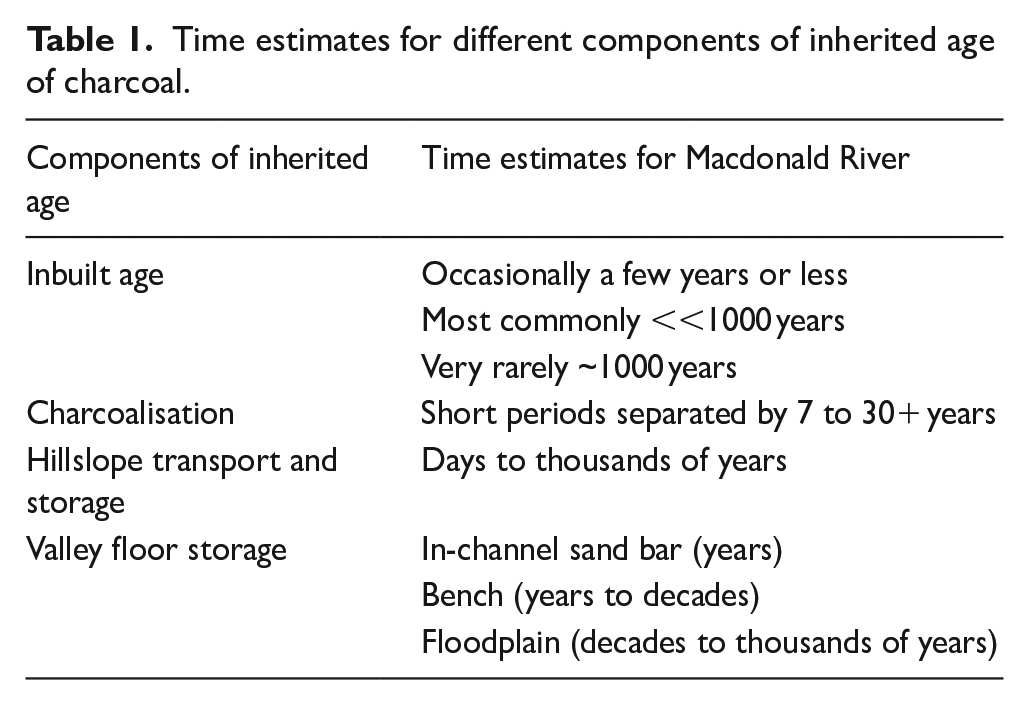
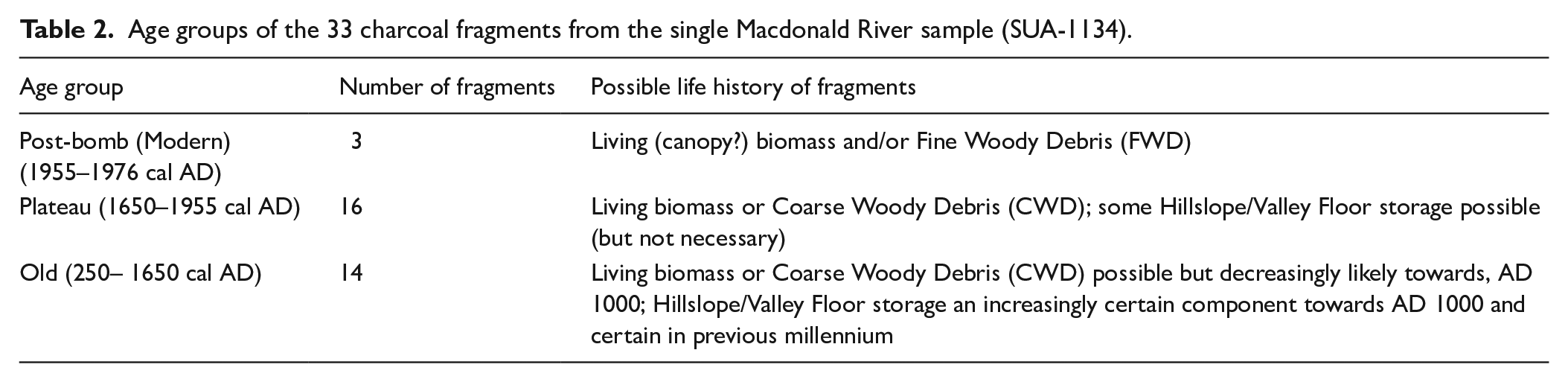
Table 1 summarises our understanding of the time estimates that can be attached to each of the four components of inherited age. Table 2 divides the 33 dated charcoal fragments into three age groups as per Wood et al. (in press). While the life history of any of the 33 fragments is uncertain, consideration of the longevity of living biomass or dead wood, charcoalisation conditions, and the likely paths of hillslope and valley floor transport and storage suggest some constraints on the histories. While it is difficult to determine the true sources of the individual fragments, the range of dates indicates that it is extremely unlikely that all 33 fragments (or the bulk sample SUA-1134) were produced in a single fire in the 1970s. A number of fires, some severe enough to charcoalise old wood (as confirmed in the anatomic observations; Wood et al., in press), seems more likely. All fragments may have been produced in an area of just a hectare or two, or come from a single hillslope, or from sites spread across the ~2300 km2 area of the catchment upstream of the collection site. Possibly, a single catastrophic event (e.g. a shallow slope failure or fluvial bank erosion at a hillslope margin) precipitated the charcoal fragments into the channel. More likely, dozens of minor events spread across the catchment over more than a 1000 years produced the few kilograms of charcoal that was intercepted and collected in a few minutes as the fragments were transported downstream by flowing water.
Time estimates for different components of inherited age of charcoal.
Age groups of the 33 charcoal fragments from the single Macdonald River sample (SUA-1134).
The implications of these new results and those in Blong and Gillespie (1978) are not trivial. For example, Blong and Gillespie (1978) reported the age of a charcoal sample (finer than ~8 mm) collected 4.65 m below the surface of a river terrace 10 km upstream from the SUA-618 and SUA-1134 site as 1710 ± 120 cal BP (SUA-315). It is not known whether the charcoal fragments in this sample have an inherited age of a few hundred years or more than a 1000 years – in short, the deposit age is not known. Similarly, the Late-Holocene ages on charcoal in high level benches in the Macdonald Valley reported by Rustomji et al. (2006) are constrained only by a few overlying OSL dates.
Only three of the 33 fragments in sample SUA-1134 provide a Post-Bomb Modern age (Table 2), suggesting that around 10 radiocarbon assays would be required to improve the chances of determining the age of charcoal fragments floating down the river. As Figure 1a shows, coarser and finer charcoal fragments exhibit different bulk ages. Questions remain:
How many individual fragments require radiocarbon dating to produce Post-Bomb Modern ages?
Would charcoal fragments passing finer sieve sizes (SUA-619, -620) exhibit broader ranges of ages and coarser fragments (SUA-617) a shorter range?
These radiocarbon assays demonstrate how fragile and inadequate current understanding is of the contribution inherited age makes to a radiocarbon age estimate of the age of a sedimentary deposit. To truly achieve an accurate result, four components need to be accounted for – inbuilt age, charcoalisation, hillslope storage and transport and valley floor storage and transport. This raises further questions, for example:
Inbuilt age – In an area with longer-lived trees would a broader range of ages be produced?
Charcoalisation – How would fewer fires or fewer more severe fires affect the distribution of ages?
Hillslope storage and transport – Would smaller catchments or shorter hillslopes produce a narrower age range?
Valley floor storage and transport – Would broad valley floors with greater sediment storage capacity produce a wider range of ages? Does charcoal age vary with the timing of moderate/major floods?
Radiocarbon dates on charcoal taken from colluvial hillslope deposits and alluvial sediments on riverine valley floors in southeastern Australia have been presented by numerous authors (e.g. Prosser et al., 1994; Tomkins et al., 2004). It is likely that the inherited ages of those charcoal samples are not dissimilar to those reported here. Therefore, it is possible that the alluvial histories of these systems, variously ascribed to regionally synchronous deposition, localised catastrophic events or intrinsic geomorphic changes (Gillespie et al., 1992), rely on imprecise chronologies. A positive is that internally inconsistent chronologies based on radiocarbon dates on charcoal in stratigraphic sequences may be more easily explained.
The range of inherited ages in a single charcoal sample is unlikely to be unique to the Macdonald Valley or to the sand-bed streams of southeastern Australia. Very likely, similar ranges of inherited ages occur in alluvial sediments in other fire-prone terrains in southern Europe and North America, and it is likely that many hillslope, lacustrine and coastal sediment sequences also contain an (unknown) range of inherited ages. Do radiocarbon-dated peak charcoal layers in lakes provide an accurate record of palaeofires? The range of possible charcoal pathways and unknowns is statistically large (Figure 2). In summary, can radiocarbon dating of macroscopic charcoal fragments in sedimentary sequences, without the addition of collaborative evidence, be used to determine the timing of local events reliably?
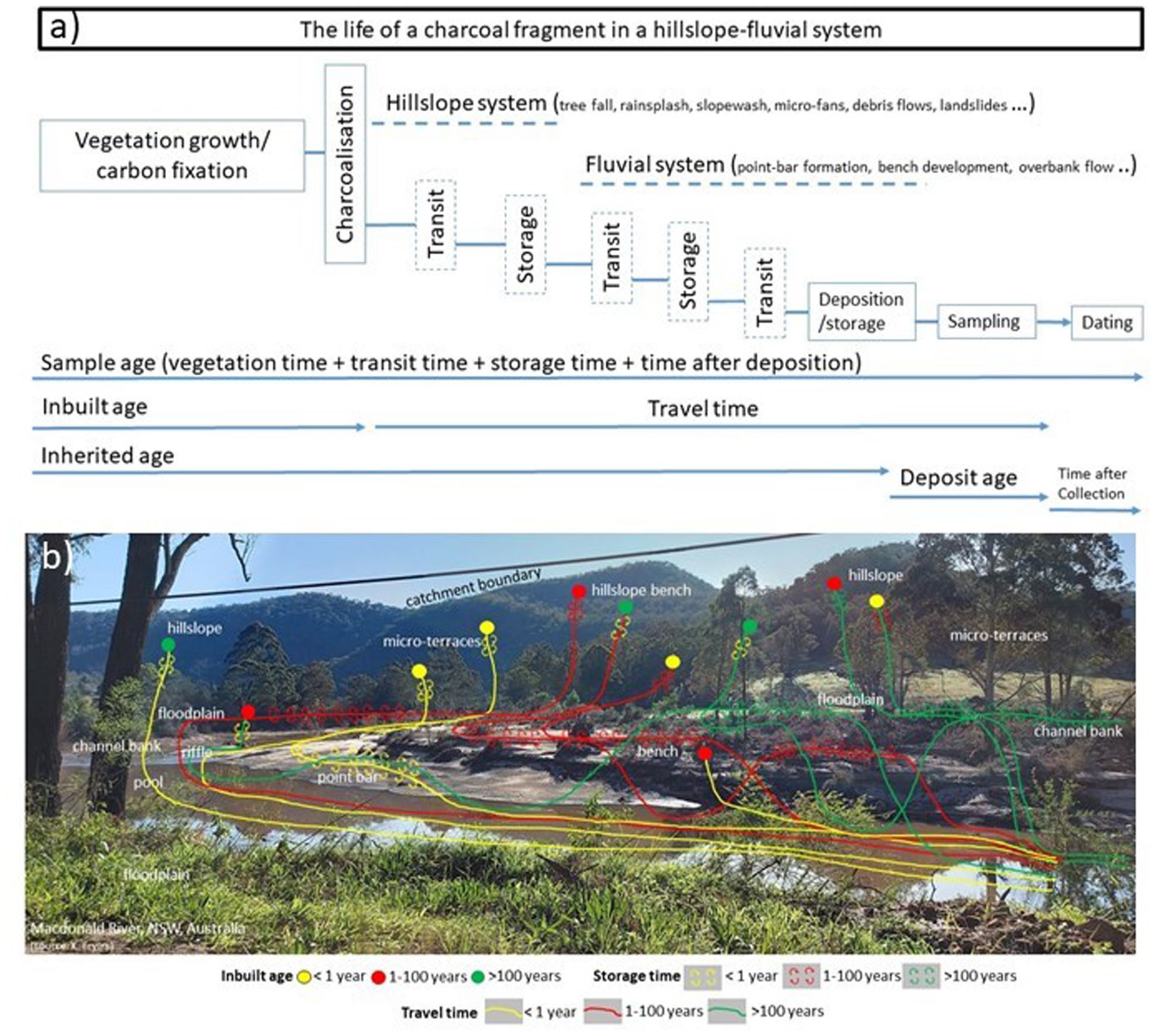
(a) The possible stages in the life of a charcoal fragment in a hillslope-fluvial system with schematic definitions of sample age, inbuilt age and inherited age; (b) some potential pathways and travel times for charcoal fragments collected at a site superimposed on an image of the Macdonald River valley looking upstream at −33.301°, 150.972°E after the 2021 flood.
The findings of this paper provide a global ‘wake-up call’ for the interpretation and use of radiocarbon ages of macroscopic charcoal in isolation, for studies that reconstruct landscape histories. This comes some 45 years after Blong and Gillespie (1978) first highlighted the issue. It is likely that the Caughley (1988: 248) quote that ‘A single date is virtually useless’ is true, and that a small number of multiple dates may also be ‘virtually useless’.
Conclusion
Radiocarbon dating of 33 charcoal fragments of a similar 4–6.73 mm size, floating/saltating together down the Macdonald River produced calibrated inherited ages ranging from (effectively) zero to >1700 years. This range of ages implies that inherited age cannot be solely attributed to the inbuilt age of the living biomass (including fine and coarse woody debris), but that hillslope and/or valley floor transport and storage also contribute (Figure 2a).
Earlier (1978) liquid scintillation assays of bulk collections of fragments from a similar floating/saltating sample indicated a clear relationship between fragment size and radiocarbon age (Figure 1a). While the implication is that the larger the fragment size the shorter the inherited age, the age range of the 33 individual fragments, all in one specific size range, is larger than the range of ages on all four bulk samples. It is highly likely that these charcoal fragments have had a varied set of life histories (Figure 2b). Disentangling these life histories remains a research challenge, albeit one that can start to be addressed through specific attention to anatomical characteristics of charcoal fragments and a careful understanding of stratigraphic provenience and sedimentary context. These results have implications not just for the radiocarbon dating of fluvial deposits, but also for hillslope, lacustrine and coastal dune sequences in a range of different settings.
Footnotes
Acknowledgements
We acknowledge the Darkinjung elders, past present and future, as the traditional custodians of the land between St Albans and the Hawkesbury River and other traditional custodians of the extensive Macdonald Valley. We also thank John Munns and family who farmed the area near our main charcoal collection site in the 1970s. Our thanks also to the Editors of The Holocene and to two anonymous reviewers who provided invaluable comments on an earlier version of the manuscript.
Funding
The author(s) received no financial support for the research, authorship, and/or publication of this article.
