




Abstract
Diatom-rich sediment in a small subarctic lake (Lake 850) was investigated in a 9400 cal. yr BP sediment record in order to explore the impact of Holocene climate evolution on silicon cycling. Diatom stable silicon isotopes (
Introduction
In natural waters silicon is primarily present in the dissolved form as silicic acid H4SiO4, also called dissolved Si (DSi), which originates from the weathering of primary minerals. Rivers and lakes act as a sink for DSi in the global silicon cycle, where lakes store the DSi primarily as diatoms (Frings et al., 2014b), which are unicellular siliceous algae. The DSi delivered to a lake is a product of processes in the lake catchment area, such as weathering and erosion, and can be modified by vegetation and soils. Subsequently, diatom production and dissolution are partly controlled by the sensitivity of diatoms to DSi concentration (Hamm et al., 2003; Yool and Tyrrell, 2003), and thus both processes – production and dissolution – influence changes in lake DSi (Panizzo et al., 2017). Fossil diatoms in lake sediment are used as an archive of environmental history and can be used for unravelling changes in silicon cycling as a result of their high preservation potential. Biogenic silica (BSi) concentrations have been used previously in Canadian Arctic lakes as an indicator of aquatic palaeoproductivity (Fortin and Gajewski, 2009). In Lake Baikal the sedimentary BSi concentration recorded diatom responses to changes in summer temperatures associated with variation in summer insolation (Khursevich et al., 2001). However, BSi concentration in lake sediments is also affected by diatom preservation (Panizzo et al., 2016; Ryves et al., 2003). Additionally, low detrital input can result in high sediment BSi concentration (Conger, 1942; Zahajská et al., 2021b).
Diatoms preferentially incorporate the lighter Si isotope, 28Si, to form the diatom frustule when sufficient DSi is present (De La Rocha et al., 1997). The stable silicon isotopes from diatoms (
Changes in climate, recorded in lake sediments in northern Sweden spanning the last 9400 years, have been reconstructed using oxygen isotopes, changes in diatom communities (Bigler and Hall, 2003; Rosén et al., 2001; Shemesh et al., 2001), pollen-based vegetation reconstruction (Barnekow, 1999; Berglund et al., 1996; Seppä and Hammarlund, 2000) and chironomids (Rosén et al., 2001). In northern Sweden, post-glacial climate and vegetation development is commonly subdivided into three periods (Barnekow, 1999; Hammarlund et al., 2002; Seppä and Hammarlund, 2000). Early Holocene climate was characterized as humid oceanic, with warm summer temperatures, rising treeline and a shift in vegetation from subarctic shrub and birch tundra to boreal pine-birch forest (Seppä and Hammarlund, 2000). Mid-Holocene climate was more stable and continental compared with the early-Holocene, with warm and dry summers and strong seasonality (Berglund et al., 1996; Rosén et al., 2001). Gradual cooling with some short-term fluctuations is suggested for the late Holocene (Barnekow, 1999; Bigler et al., 2003; Rosén et al., 2001).
We examine here the impact of changes in climate on silicon cycling and BSi accumulation in Lake 850 within the framework of existing knowledge on Holocene climate changes in the Abisko area, northern Sweden (Berglund et al., 1996; Bigler and Hall, 2003; Hammarlund et al., 2002; Rosén et al., 2001; Seppä and Hammarlund, 2000). Pollen records in the Lake 850 area suggest that the lake has been above the pine treeline throughout the last 9400 cal. yr BP. We hypothesize that changes in DSi sources, derived from hydrological changes connected to changes in climate, are responsible for BSi concentration and
Study area
Lake 850 is situated in northern Sweden, 14 km south-east from Abisko Research Station (388 m a.s.l.). Mean temperatures during summer and winter in the Abisko region are 9.8°C and −10.1°C, respectively, and the mean annual temperature (from 1913 to 2019) was −0.4°C (Abisko Scientific Research Station, 2019). The diatom growing season is from June to August (Shemesh et al., 2001). The lake, at an elevation of 850 m a.s.l. (68°15′N, 19°7′E), lies above treeline, which is currently at 600 m a.s.l. (Figure 1). The catchment area is 0.35 km2 (Rubensdotter and Rosqvist, 2003), and the lake surface area is 0.02 km2. Approximately 48% of the lake area lies within the deep basin, with a maximum depth of 8 m, and 52% of the lake surface area is shallow, with a depth of <4 m. The vegetation in the catchment area is comprised of Arctic species of mosses, grasses and shrubs, and the bedrock is composed of granites and syenites overlain by a thin layer of till (Shemesh et al., 2001). There are two ephemeral 1−2 cm deep inlets in the eastern part of the lake and one outlet in the western part (Figure 1). From mid-October until late May–early June, the lake is ice-covered, and its catchment area is snow-covered from mid-September to mid-June. In August the lake is well-mixed with no thermal stratification and has a pH of
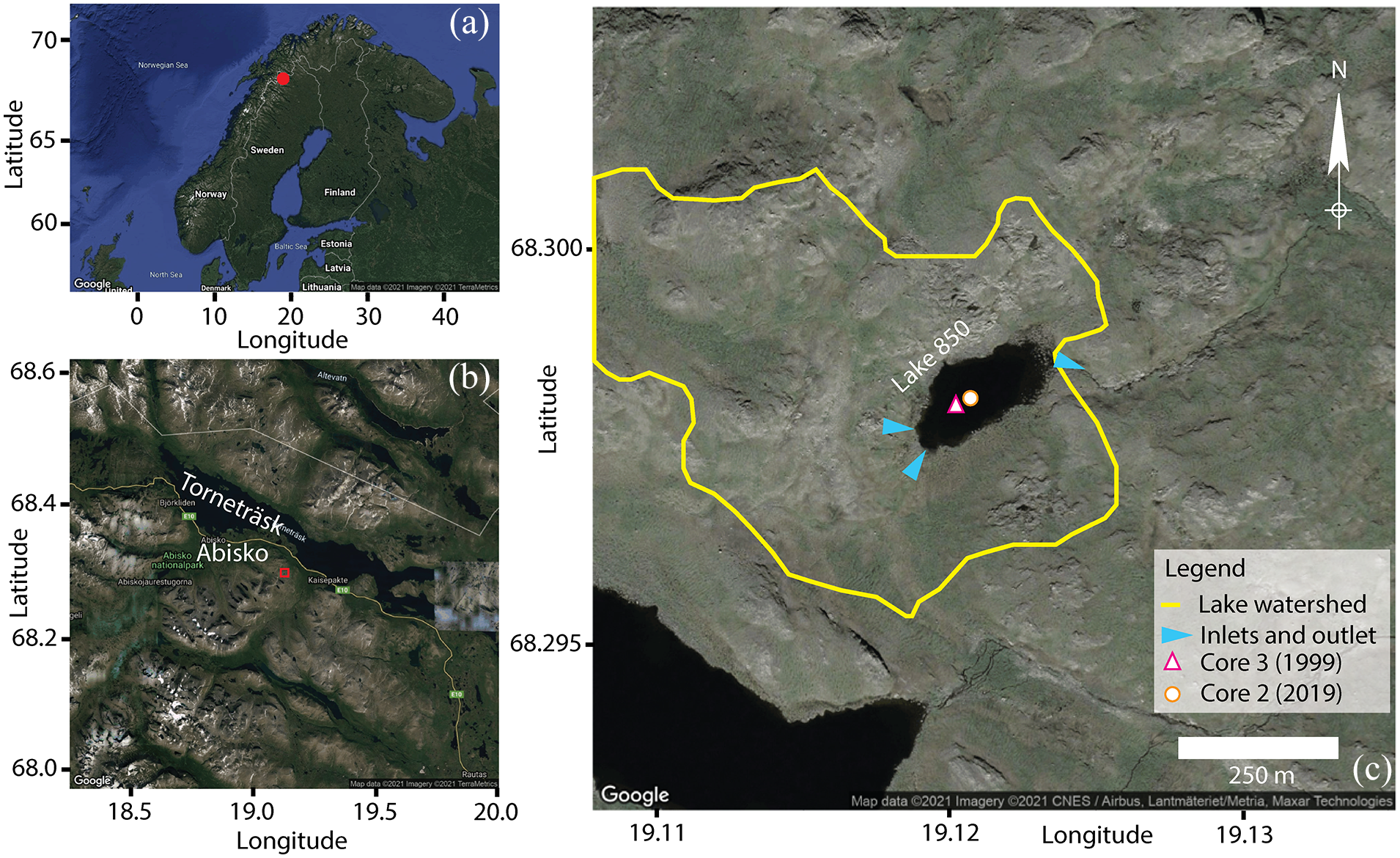
Location of Lake 850 (red circle) in northern Sweden on inset (a), the location of the lake in Abisko area (red square) on inset (b) and detailed map of the lake watershed (yellow line), inlets, outlet (blue arrows) and coring locations of two cores (from 1999 and 2019, triangle and circle, respectively) on inset (c). Plotted in R using package ggmaps (Kahle and Wickham, 2013) and modified.
Methods
Core collection
In April 1999, a 125-cm sediment core was cored from the centre of the ice-covered Lake 850 using a modified Livingstone piston corer (Shemesh et al., 2001) at a water depth of 6.9 m. The core was subsampled into 62 2-cm sections, but only the top 56 samples contained sufficient biogenic silica (Shemesh et al., 2001) and are used here for stable Si isotope analysis.
To investigate BSi accumulation, a 74 cm-long sediment core was taken using a modified Livingston piston corer in March 2019 from the ice in the deep basin (68°17′53.2″N, 19°7′17.2″E) at a depth of 7.0 m. The piston core was scanned for density, magnetic susceptibility and X-ray fluorescence (XRF) with an ITRAX CS37 at the GLOBE Institute, Copenhagen University, Denmark. The core was correlated with the previously collected piston core (Core 3) from 1999 (Rubensdotter and Rosqvist, 2003; Shemesh et al., 2001) using age-depth models and total organic carbon (TOC) (see section Chronology).
Sediment characterization
The 2019 core was halved, and one half was continuously subsampled in 1-cm sections and placed into cubic boxes with known volume. The other half of the piston core was used for XRF and magnetic susceptibility scanning and archived. All sediments were weighed before and after freeze drying for water content, to obtain porosity and wet and dry bulk densities.
Total organic carbon (TOC) and total nitrogen (TN) analyses were carried out on freeze dried samples (
The BSi concentration was analysed at a resolution of 1 cm by sequential alkaline extraction (Conley and Schelske, 2002). Freeze-dried homogenized samples were digested in 0.1 M Na2CO3 in a shaking bath at 85°C. Subsamples were taken at 3, 4 and 5h and neutralized with HCl to examine for the dissolution of minerals. There were no changes in the amount of total amorphous SiO2 extracted during the time course of the dissolution, therefore mean values were used to estimate BSi concentration with no mineral correction applied (Conley, 1988).
Chronology
Five terrestrial macrofossil samples from the piston core were dated by 14C using accelerator-mass-spectrometer at the Radiocarbon Dating Laboratory, Department of Geology, Lund University (Table 1). Radiometric dates were calibrated with IntCal20 radiocarbon calibration dataset (Reimer et al., 2020). The age-depth model (Figure 2) was established based on 14C dates using the software package Bacon with five age controls (Blaauw, 2010). A priori assignment of mean sediment accumulation rate, based on the sediment accumulation rate from a previously dated core from 1999 (Shemesh et al., 2001), was set to 100 yr cm−1, as suggested by Bacon. Thickness for spline calculation was set at 15.5 cm, above which the model diverged greatly from the age controls provided. The age-depth model had 100% of the dates overlapping within the mean 95% confidence ranges.
Samples from Lake 850 sediment core from 2019 dated by 14C AMS method.
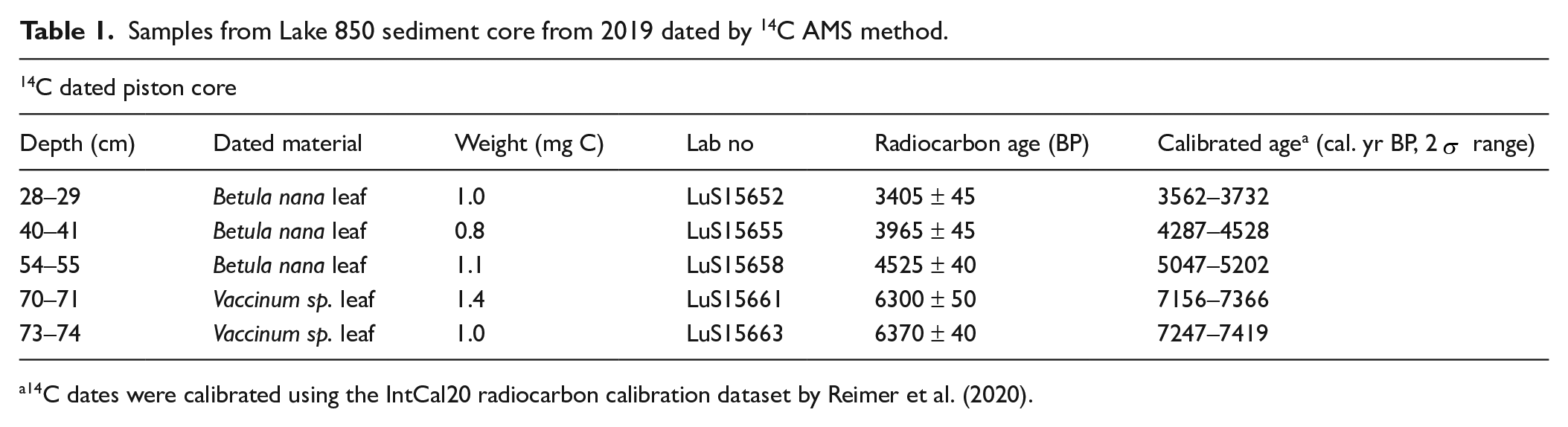
14C dates were calibrated using the IntCal20 radiocarbon calibration dataset by Reimer et al. (2020).
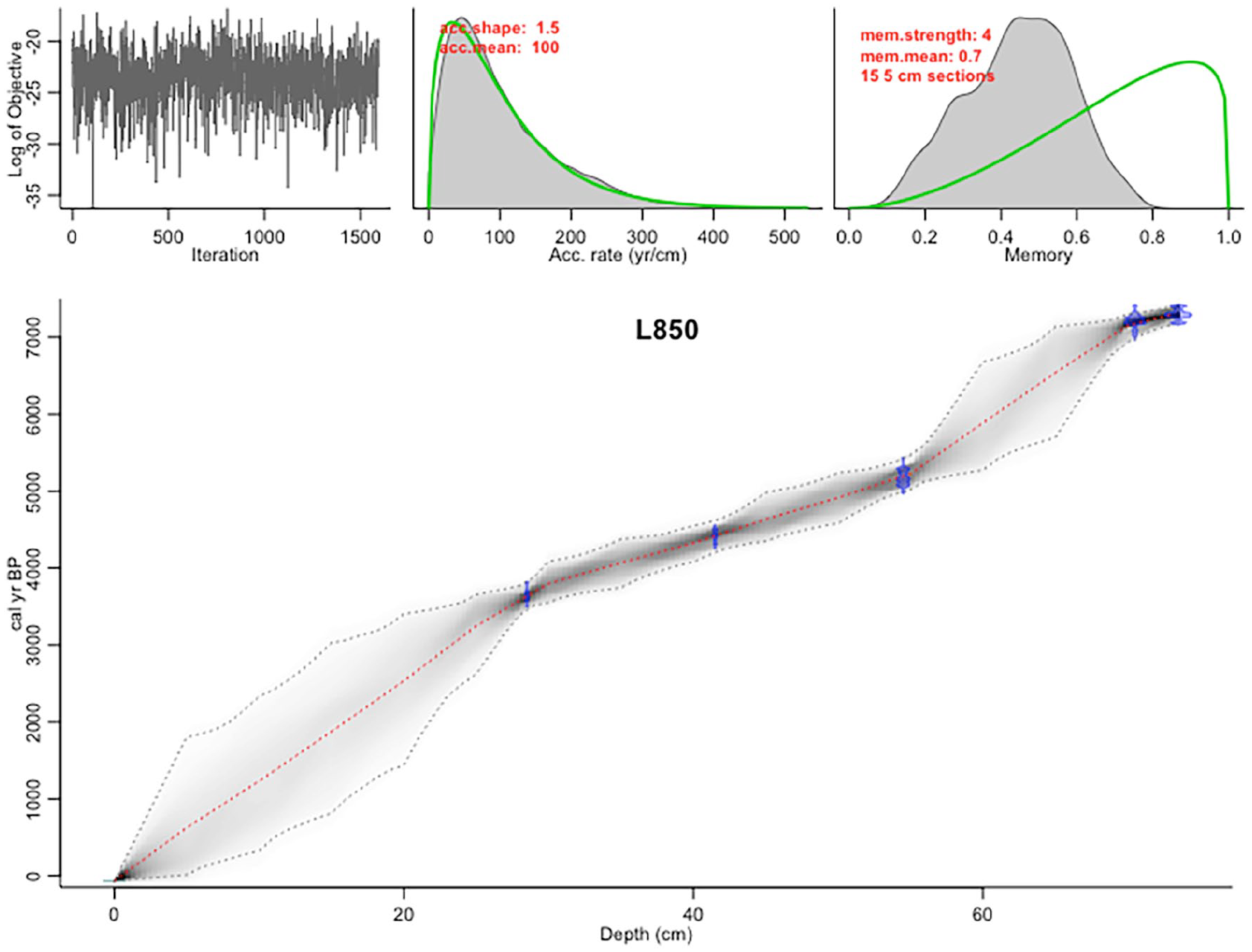
The age-depth model of piston core from 2019 from Lake 850 based on 14C data (see Table 1) using the software package Bacon (Blaauw, 2010). The red line is the median probability age from all age-depth iterations, representing the best point estimate of age for any given depth. Grey shading represents the age model probability and contains the 95% confidence interval (dashed lines). Iteration history (left inset), prior and posterior densities of the mean accumulation rate (middle inset), and prior and posterior of the memory (right inset).
An updated age-depth model for the core from 1999 (Supplemental Figure S1) was established based on six original 14C dates from the published age-depth model (Shemesh et al., 2001) using the same approach as described above. A priori assignment of mean sediment accumulation rate was set to 100 yr cm−1, and thickness for spline calculation was set at 24.5 cm. Only 86% of the dates overlapped with the age-depth model’s mean 95% confidence ranges.
Both cores were aligned based on age-depth models. A secondary control of the alignment was done through comparison of TOC calculated from loss on ignition (LOI) on the core from 1999 and a proxy for organic carbon (incoherent/coherent scanning ratio) measured on the new piston core (Figure 3), which showed good fit. The proxy for organic content is based on the rhodium (Rh) scatter peak areas, expressed as
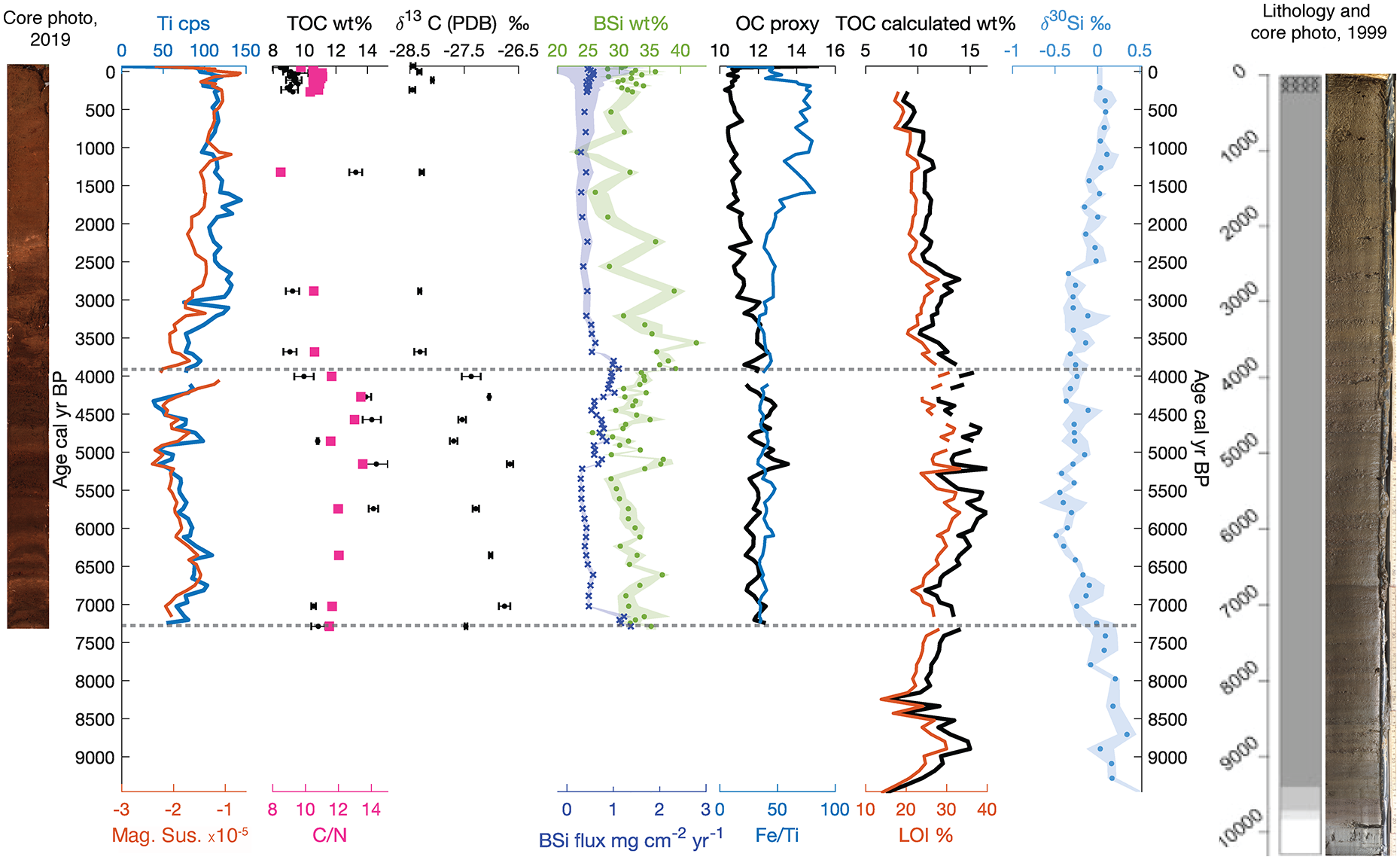
On the left, data for the 2019 piston core: core photo with lithology, titanium (Ti in cps) as a detrital input proxy, magnetic susceptibility (MS) as the grain size changes proxy, total organic carbon (TOC wt%), C/N ratios and
Stable Si isotopes analysis
Clean bulk diatom material (several diatom species with a minor contribution from chrysophytes, Supplemental Figure S2) from Lake 850 with 2-cm resolution was obtained from a 125-cm-long core used in a previous study (Shemesh et al., 2001) and processed for stable silicon isotopes. Sample purity was evaluated using a scanning electron microscope Tescan Mira3 at the Department of Geology, Lund University. Cleaned diatom samples (
Stable Si isotopes were measured on a NuPlasma (II) HR multi-collector inductively conducted plasma mass spectrometry (MC-ICP-MS, Nu Instruments™) with an Apex HF desolvation nebulizer at the Vegacenter, Swedish Natural History Museum, Stockholm. The 28 Si signal of full procedural blanks was determined to be <0.35% of the total signal, thus sample contamination was not observed. All samples were diluted to 2–3 mg1−1 of Si and matrix matched with standards in 0.12 M SeaStar HCl. Further, all samples and standards were doped to contain 3 mg l−1 of Li (IPC-MS standard) to match the matrix of Vegacenter standards prepared by LiBO2 fusion (Sun et al., 2010).
Silicon isotopes data are reported as deviations of
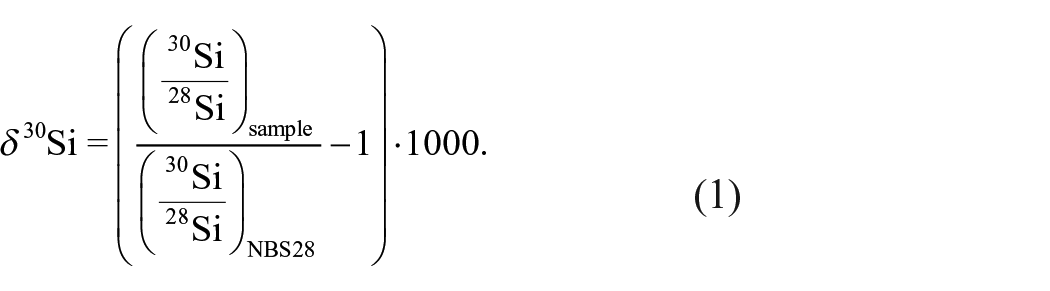
Each sample was measured three to six times with bracketing of NBS-28 in between. Full chemical replicates were measured on 68% of all samples (
Long-term (ca. 3 years) variance from the secondary reference materials is as follows: Diatomite
Statistical analyses
For testing the statistical significance of proxy correlations, a Pearson correlation test was run on data in R software. A statistically significant correlation was considered to have a confidence interval of 95% and thus, the p-value
Results
Age-depth model and core alignment
The base of the 2019 piston core was dated at approximately 7400 cal. yr BP (Table 1). The mean sedimentation rate over the entire core was estimated to be 0.012 cm yr−1 or 83.3 yr cm−1 (Figure 2), which is in the same range as a previously published sedimentation rate from Lake 850 of 0.013 cm yr−1 (Shemesh et al., 2001). Based on this sedimentation rate, the mass accumulation rate was calculated to be 1.8 mg cm−2 yr−1. However, the age-depth model is not linear, especially in the top 28 cm. The increased sedimentation rate in the top of the core has a high uncertainty, as no age constraint was obtained between the surface and 28 cm. The top of the core is considered to have the age of the coring year. However, the sediment-water interface was disturbed during coring and thus, the age-depth model can suffer from the incompleteness of the record. The age-depth model of a short core from Lake 850 also shows non-linear changes in sedimentation rate in the surface of the core (Zahajská et al., 2021b).
A new age-depth model of the published core from 1999 (Supplemental Figure S1) indicates that the base of the core is approximately 9400 cal. yr BP and shows linear changes in sedimentation rate through time, which is in agreement with the previous Holocene age-depth model (Rubensdotter and Rosqvist, 2003; Shemesh et al., 2001).
Lithology
The 74-cm 2019 sediment core was examined for its lithology, elemental composition using XRF, total organic carbon (TOC), total nitrogen (TN), biogenic silica (BSi) and magnetic susceptibility. Low and negative values of magnetic susceptibility show that the whole core is diamagnetic, which indicates that the core is composed of clay and/or pure organic. This result corresponds well with the sediment composition of the previously published 125-cm sediment core (Shemesh et al., 2001), which lithology is predominantly carbonate-free clay gyttja. The sediment porosity (data not shown) is generally high, averaging 86%, with maximum values of 90%. The wet bulk density (data not shown) is 1.15 g cm−3, and the dry bulk density is 0.16 g cm−3.
The XRF measurements generally showed low counts, that is, below 1000 counts per second, for the majority of elements, which may indicate low allochthonous input. Therefore, the magnetic susceptibility (MS) and the titanium (Ti) and iron normalized by Ti (Fe/Ti) XRF data are used as proxies for changes in grain-size and detrital/terrigenous input into the sediment, respectively (Figure 3). The Fe/Ti ratio was considered to represent detrital input as iron XRF counts were 10–100 times higher than all other identified elements (Figure 3), thus all trends found in redox proxies, such as Fe/Mn or Fe/Ti, are strongly influenced by the Fe counts, which show trends similar to MS. Titanium, iron and magnetic susceptibility show a generally increasing trend from the base to the top of the core. An increase in all three proxies is observed, especially in the last 3000 cal. yr BP. In contrast, the TOC and C/N data show elevated values from 7400 to 3500 cal. yr BP and are generally stable during the last 3500 cal. yr BP. Total organic carbon and BSi share some similarities in their trends, with increased values from 7400 to 3500 cal. yr BP, followed by lower values in last 3500 cal. yr BP. However, BSi varies greatly, whereas TOC and C/N display smaller variations. BSi concentrations and TOC together constitute from 38 wt% to 51 wt% of the sediment. The remainder of the sediment is considered to be minerogenic.
The non-minerogenic component of the sediment is used as a proxy for changes in productivity or terrigenous input. TOC varies greatly throughout the core, from
The BSi shows large variability, with the BSi minimum of
Biogenic silica fluxes
The Holocene BSi flux into the sediment was determined from the piston core BSi and the mass accumulation rate of 1.85 mg cm−2 yr−1. The mean BSi flux into the sediment from 7300 cal. yr BP to present is 0.60 mg SiO2 cm−2 yr−1 (Figure 3). At the bottom of the core, the BSi flux is higher, with values up to 1.38 mg SiO2 cm−2 yr−1, and with a mean of 1.23 mg SiO2 cm−2 yr−1 from the period 7300 to 7100 cal. yr BP. From approximately 7100 cal. yr BP to 5200 cal. yr BP, the BSi flux stabilizes at a mean of 0.40 mg SiO2 cm−2 yr−1. An increasing trend in the BSi accumulation rate during younger ages is observed from 5200 cal. yr BP to 3700 cal. yr BP, with values varying from 0.53 mg SiO2 cm−2 yr−1 up to 1.12 mg SiO2 cm−2 yr−1, with a mean of 0.75 mg SiO2 cm−2 yr−1. From 3700 cal. yr BP to present, the BSi flux is stable at 0.46 mg SiO2 cm−2 yr−1, with some minor variation (Figure 3). Large uncertainties in the top part of the core are propagated from the age-depth model, where ages are extrapolated between the youngest 14C date and the top of the core, which is considered to be recent.
Stable Si isotope record
The stable silicon isotopes measured on cleaned bulk diatoms (Supplemental Figure S2) from the 125-cm-long core from 1999 show generally light
Statistical analysis
Pearson correlation tests conducted on the entire core record of XRF, LOI, OC, TOC, BSi and
Magnetic susceptibility, reflecting changes in grain-size, is positively correlated with the detrital input proxy – Ti
A strong positive correlations between Fe, MS and Ti together with the negative correlation between BSi and Fe (
Discussion
Factors influencing the diatom accumulation and
To explain sedimentary
In DSi-unlimited systems, such as Lake 850, diatom accumulation and
changes in diatom production and species composition derived from changes in summer temperatures and the length of the ice-free period, and
relative changes of DSi sources (groundwater vs surficial streams).
The Holocene lake history suggests that a combination of low detrital input (Ti, MS) and high BSi production are governing the diatom-rich sediment formation (Figure 3). The detrital input is low and thus, minerogenic particles do not dilute the amount of diatom settled in the lake floor, and BSi concentrations as high as 42 wt% were found. Additionally, many of the processes influencing
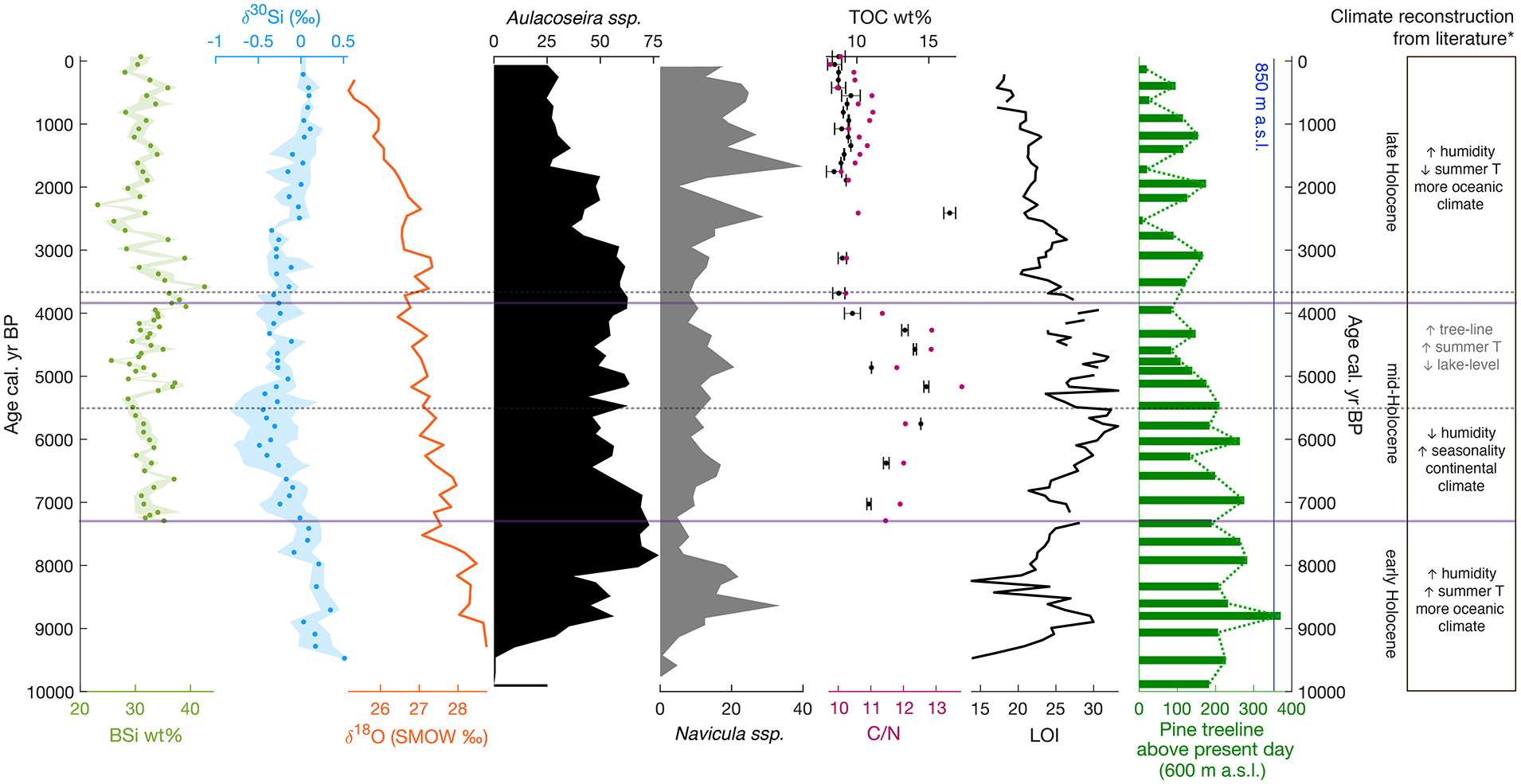
Summary of BSi wt%, TOC wt% and C/N ratios from the 2019 core and
Climate reconstructions in the Abisko area suggest a warmer and more humid early Holocene influenced by Atlantic air masses (Berglund et al., 1996; Rosén et al., 2001), more continental climate with pronounced seasonality and increased elevation of the pine treeline during the mid-Holocene (Barnekow, 1999; Berglund et al., 1996; Hammarlund et al., 2002; Rosén et al., 2001), cooling connected with decreasing insolation (Barnekow, 1999) reflected in
Diatom production and species composition
No significant correlation of BSi and
Relative changes in DSi sources
Changes in DSi sources have been demonstrated to influence
Holocene climate reconstructions of the Abisko area suggest changes in summer temperatures (Barnekow, 1999; Berglund et al., 1996; Bigler et al., 2003; Hammarlund et al., 2002; Rosén et al., 2001; Seppä and Hammarlund, 2000), which may have influenced the length of the ice-free period and in turn diatom growth. Thus, Holocene
Holocene development of Lake 850
Early Holocene–Shift in DSi sources
No BSi and XRF data are available for the early Holocene period, however, the
Mid-Holocene–lake dominated by diatom production and groundwater
Climate reconstructions from other sites in the region suggest a reduced influence of Atlantic air masses, thus a more continental climate with lower humidity, more pronounced seasonality and colder winters (Barnekow, 1999; Berglund et al., 1996; Hammarlund et al., 2002; Rosén et al., 2001). Yet,
High and variable TOC together with increased C/N (Figure 4) suggest more terrestrial organic carbon input, especially during the altitudinal increase of treeline in the Abisko area between 5500 and 3400 cal. yr BP (Barnekow, 1999; Berglund et al., 1996; Hammarlund et al., 2002; Rosén et al., 2001; Seppä and Hammarlund, 2000). This increase in treeline corresponds with an increase of summer temperature documented in nearby Lake Tibetanus (Barnekow, 1999; Seppä and Hammarlund, 2000) and Lake Sjuodjijaure (Rosén et al., 2001). However, the pine treeline did not reach an altitude of 850 m a.s.l. (Figure 4), and the detrital input (Ti, MS, Fe) during this period is at a minimum and negatively correlated with TOC. Together these data suggest that the total organic carbon likely originates from the shoreline and littoral areas of the lake, supported by the
Additionally, lake-level changes evident in other lakes in Scandinavia (Seppä and Birks, 2002, and references therein) suggest the possibility that lake shallowing and expanded growth of terrestrial mosses in littoral areas could account for both increased TOC and C/N but low detrital input. A slight increase in benthic Navicula ssp. is consistent with the hypothesis of moderate lake-level change and expanded littoral habitat. Alternatively, the low detrital input could be explained by lower run-off due to a generally drier period.
The diatom assemblage (Figure 4) does not show substantial changes, and the prolonged dominance of heavy silicified Aulacoseira ssp. may be responsible for the high BSi concentrations as a result of a prolonged ice-free period (Bigler et al., 2002). The recent Lake 850 mass-balance models showed that a prolonged ice-free period increases the relative contribution of isotopically lighter groundwater DSi to the lake water balance and produces isotopically lighter
Late-Holocene–increased run-off and shortening of ice-free period
The oscillations of BSi concentration during the late Holocene reflect changes in sedimentation due to a slight increase in detrital input (Ti, Fe, MS, Figure 3), coincident with a C/N ratio that suggests increased autochthonous production. Thus, detrital input is likely to be of mineral composition originating from enhanced physical weathering during spring snowmelt with little organic carbon. A positive correlation was found between BSi concentration and the OC proxy (
During the late Holocene, a gradual shift towards heavy
Additionally, during the spring snow melt a higher relative contribution of run-off and stream DSi supply is expected to influence the lake
Sparse
sediment records
Approximately, 100 lakes in Northern Sweden have been investigated for BSi concentrations in surface sediments (Rosén et al., 2010), including Lake 850, but no
The mean
The isotopically light signature of fossil diatoms from Lake 850 (mean
In Lake Huguangyan, the
Conclusions
Changes in detrital input and TOC suggest that increased run-off and changes in summer temperatures are responsible for the long-term variation in BSi concentration. The diatom-rich sediment in Lake 850 is formed due to low sedimentation rates and a stable DSi source that supports diatom growth, which is not DSi-limited. The Holocene environmental changes in the catchment, such as increases in treeline recorded by other proxies, are not reflected in
The Holocene history of Lake 850 is influenced by climate-inducing changes in the relative proportions of DSi sources, as well as changes in the length of growing season, and thus diatom species composition and diatom production. The lighter Si isotopic signature of the diatoms during the mid-Holocene suggests higher groundwater input bringing isotopically lighter DSi into the lake compared to the early- and late Holocene. The late Holocene Si isotopic composition of the diatoms is consistent with changes in climate documented in
Additionally, the
This study shows that combining BSi concentration and the
Supplemental Material
sj-png-1-hol-10.1177_09596836211025973 – Supplemental material for Impact of Holocene climate change on silicon cycling in Lake 850, Northern Sweden
Supplemental material, sj-png-1-hol-10.1177_09596836211025973 for Impact of Holocene climate change on silicon cycling in Lake 850, Northern Sweden by Petra Zahajská, Rosine Cartier, Sherilyn C Fritz, Johanna Stadmark, Sophie Opfergelt, Ruth Yam, Aldo Shemesh and Daniel J Conley in The Holocene
Supplemental Material
sj-png-2-hol-10.1177_09596836211025973 – Supplemental material for Impact of Holocene climate change on silicon cycling in Lake 850, Northern Sweden
Supplemental material, sj-png-2-hol-10.1177_09596836211025973 for Impact of Holocene climate change on silicon cycling in Lake 850, Northern Sweden by Petra Zahajská, Rosine Cartier, Sherilyn C Fritz, Johanna Stadmark, Sophie Opfergelt, Ruth Yam, Aldo Shemesh and Daniel J Conley in The Holocene
Supplemental Material
sj-eps-3-hol-10.1177_09596836211025973 – Supplemental material for Impact of Holocene climate change on silicon cycling in Lake 850, Northern Sweden
Supplemental material, sj-eps-3-hol-10.1177_09596836211025973 for Impact of Holocene climate change on silicon cycling in Lake 850, Northern Sweden by Petra Zahajská, Rosine Cartier, Sherilyn C Fritz, Johanna Stadmark, Sophie Opfergelt, Ruth Yam, Aldo Shemesh and Daniel J Conley in The Holocene
Footnotes
Acknowledgements
We thank the organizations and the individuals who helped with the fieldwork and/or provided us with equipment and/or advice: Thomas Westin, Keith W. Larson, Erik Lundin, Svante Zachrisson, CIRC, Christian Bigler, Lena Rubensdotter, Gunhild Rosqvist, field assistants Carla Nantke and Ethan Silvester. We thank Mats Rundgren for help with 14C samples evaluation and species identification. We acknowledge Hans Schöberg and Melanie Kielman for assistance during sample preparation and isotope data acquisition. This is Vegacenter contribution number # 043.
Funding
The author(s) disclosed receipt of the following financial support for the research, authorship, and/or publication of this article: This work was supported by The Royal Physiographic Society in Lund and by the Center for Geosphere Dynamics (UNCE/SCI/006) to PZ, the Swedish Research Council to DJC, the Swedish Research Council Tage Erlander Professorship to SCF, and the “Fonds National de la Recherche Scientifique” (FNRS, Belgium, FC69480) to SO.
Data accessibility
All data, if not directly available in tables and supplementary materials, are available in the PANGAEA database DOI:10.1594/PANGAEA.929941.

Supplemental material
Supplemental material for this article is available online.
References
Supplementary Material
Please find the following supplemental material available below.
For Open Access articles published under a Creative Commons License, all supplemental material carries the same license as the article it is associated with.
For non-Open Access articles published, all supplemental material carries a non-exclusive license, and permission requests for re-use of supplemental material or any part of supplemental material shall be sent directly to the copyright owner as specified in the copyright notice associated with the article.


