




Abstract
Transformations of human societies and environments are closely interwoven. Due to improved possibilities of paleoecological reconstruction and archaeological methods, we are now in a position to empirically collect detailed data from a variety of records. The Collaborative Research Centre 1266 ‘Scales of Transformation’ has developed a concept in which both deductive and inductive transformation dimensions are compared on different temporal and spatial scales. This concept includes the connection between the environmental and social spheres, which are often inseparable. Accordingly, a holistic principle of socio-environmental research is developed, which is exemplified by the contributions to this special issue of The Holocene.
Keywords
Introduction
This special issue is a comprehensive output of research carried out in the first 2.5 years of the Collaborative Research Centre 1266 (CRC 1266) ‘Scales of Transformation: Human-Environmental Interaction in Prehistoric and Archaic Societies’ in Kiel, Germany. It takes a long-term perspective, from 15,000 to 1 BCE, to investigate processes of transformation in crucial periods of human history from the Palaeolithic to Archaic times, as they relate to a transforming environment from the late Pleistocene to late Holocene, including different societal constellations, from foraging to farming and early urban societies and covering geographical transects from northern to southern Europe (Figure 1). In each of the different landscapes, environmental and archaeological archives of high quality produced by the different social formations were identified. This foundation allows the confrontation of transformational processes in a wide array of environmental settings and societal formations in the past with high spatial and temporal resolutions.
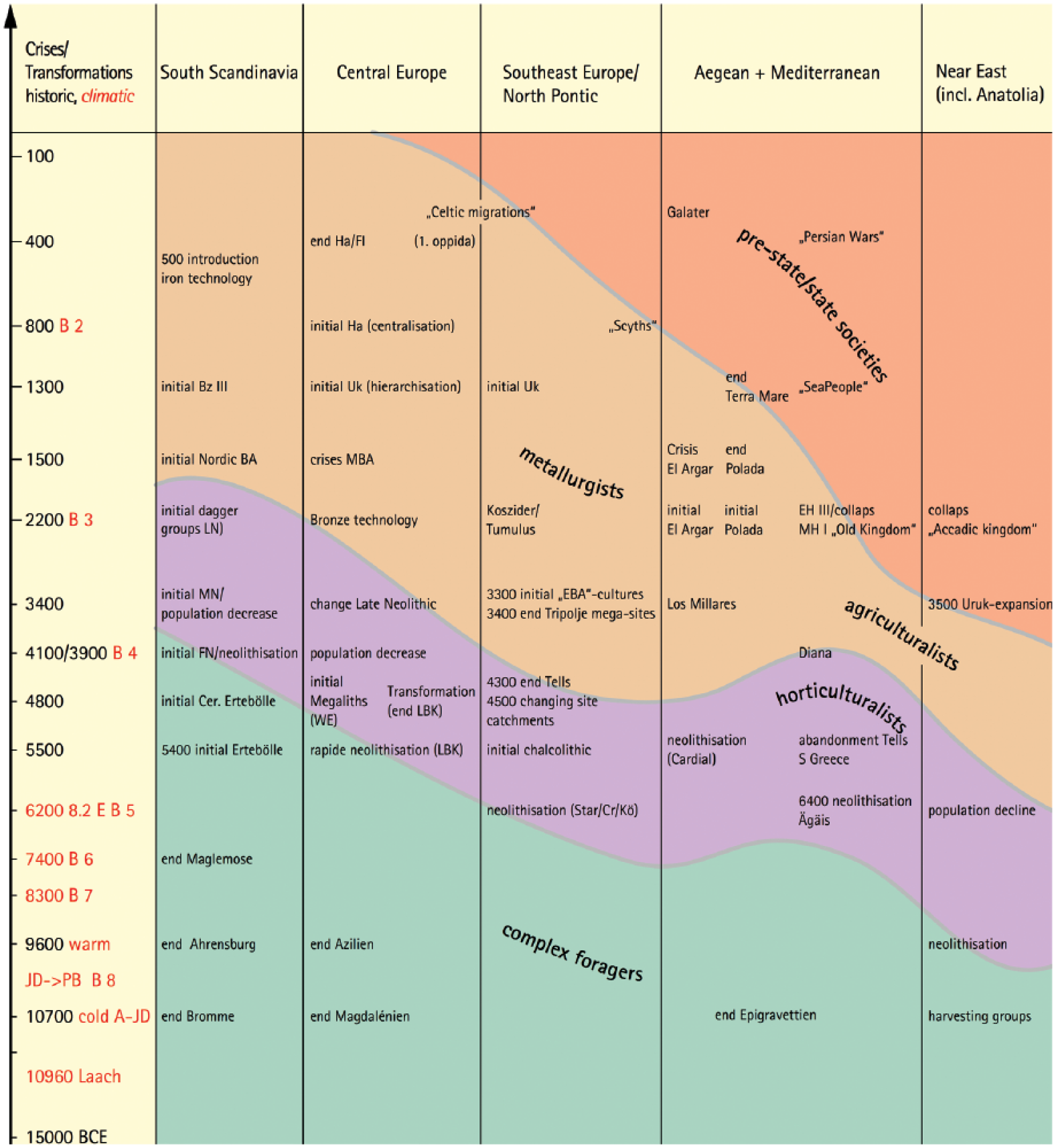
The CRC 1266 chronological framework, showing the approximate historical positions of the idealised social formations in Europe and the Mediterranean.
This special issue compiles first results on a variety of past socio-environmental transformation processes from an interdisciplinary perspective, representing some of the ongoing research efforts of the CRC 1266. The concept of the Centre (described below) integrates archaeological, environmental, and life science research into the wide scope of studies. The articles of the special issue bring together studies from the Mesolithic to the Bronze Age, and from the Baltic to the Pontic region. In addition, new insights into methodological and theoretical issues of socio-environmental research on past societies and environments are presented as examples of important advances developed within the CRC.
Concept and definitions
We define transformations primarily as condensed processes leading to a substantial and enduring reorganisation of socio-environmental interaction patterns. Transformations in prehistoric and archaic societies occur on different temporal, spatial and social scales, and thus have effects of differing degrees. The possibility is envisaged to detect the impact of certain triggers on the respective scales: human adaptation and coping strategies, the role of certain environmental constraints and societal patterns, like the shape of socio-economic and cultural systems. Furthermore, the delineation of the general structure, shape and impact of socio-environmental transformation processes is of great importance. To detect the socio-environmental dimension of transformations, a combination of archaeological and palaeoenvironmental methods is applied. This special issue introduces the concept of socio-environmental transformation, the theoretical implications of interdisciplinary cooperation and the development of joint methods.
The approach to the scales of socio-environmental transformation in prehistoric and archaic societies
The understanding of human practices in their social and environmental context is one of the most fundamental issues of archaeological research. The dynamics of human–environmental relationships have also become a central focus in current debates through the perilous consequences of human-induced alteration, pollution and destruction of natural landscapes, which are transforming both the environment and human societies to a hitherto unprecedented extent. Archaeology, with its long-term temporal perspective on human societies and landscapes, is in a unique position to trace and link comparable phenomena in the past, to study human involvement with the natural environment, human impact on nature and the consequences of the various dimensions of environmental change on human societies (Bevan et al., 2019; Deák et al., 2018; Hansson et al., 2018; Ledger et al., 2015; Müller, 2018; O’Brien and Shennen, 2010; Rowley-Conwy and Layton, 2011; Shennan, 2009; Walsh et al., 2019; Widlok et al., 2012; Zimmermann, 2012). Archaeology has the means to contrast major transformations with minor changes, rapid transitions with continuous modifications, transient with enduring changes, periods of more stable relations with the occurrence of crises, and restoration with collapse.
Research on prehistoric and archaic transformations demands an approach that pursues four general goals:
The development of a specific archaeological anatomy of transformation through a broad and multi-faceted handling of the dynamics of socio-environmental interrelations from a diachronic perspective.
The analyses of individual cases of transformation as historical incidences with their particular developments, diagnostics and triggers; their actors, including foragers, horticulturists, agriculturalists and early metallurgists; as well as pre-state and state societies.
A systematic identification of temporal, spatial and social scales of transformation by a standardised comparison of individual cases studies.
An exploration of the general characteristics of transformation for describing the environmental and social history of change in the period 15,000–1 BCE.
The CRC 1266 takes a comparative perspective, where transformation processes are explored at various spatial and temporal scales, as well as with regard to the scale of social reach. A fundamental parameter affecting transformation processes is the socio-economic framework within which, and between which, they take shape. The CRC 1266 is organised along four main foci (Figure 2), whose mutual collaboration is crucial for the overall approach.
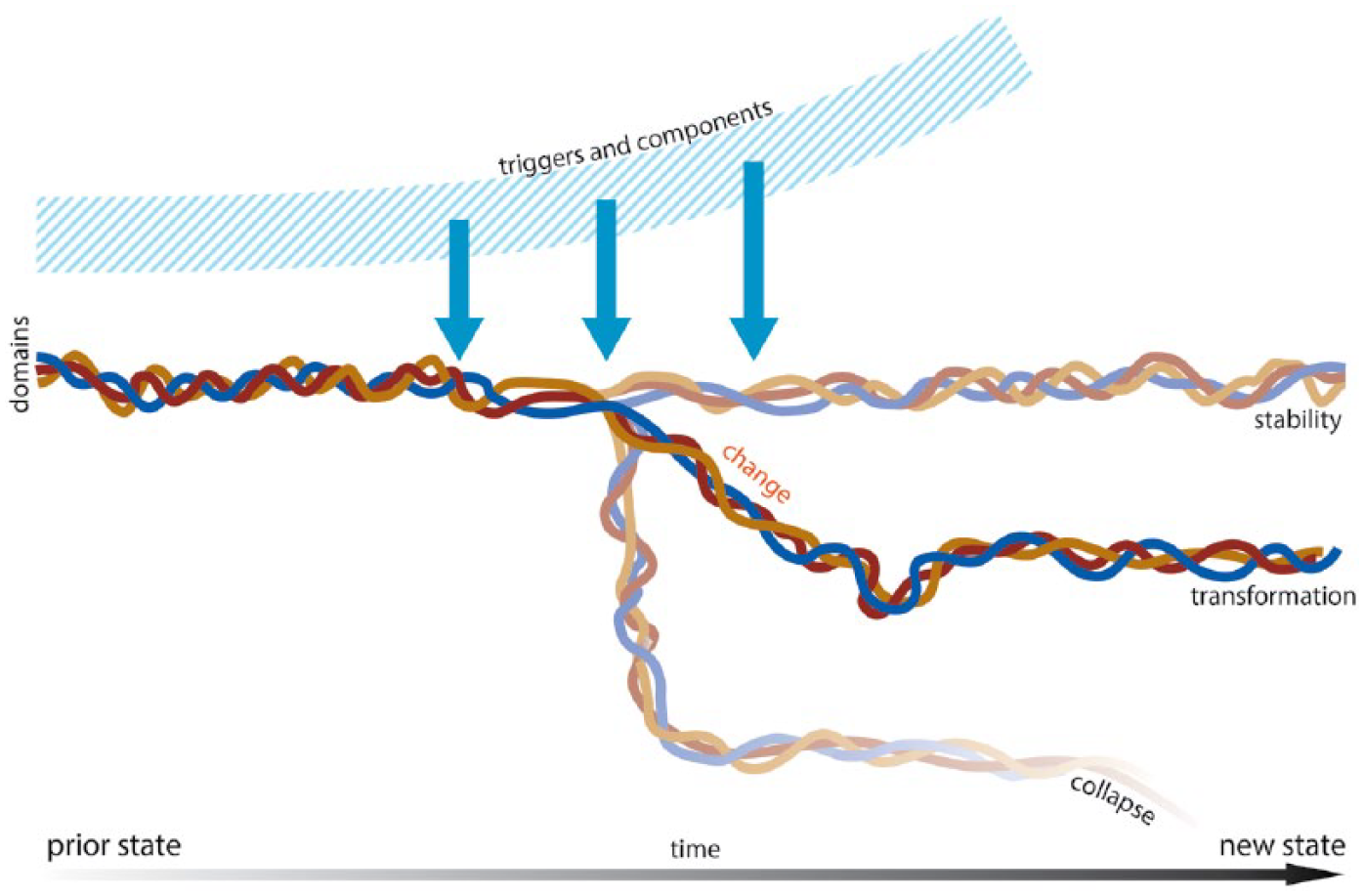
Processes of transformation and concepts of stability, transformation and collapse. For prehistoric and archaic time periods, we define ‘transformation’ as enduring and significant changes within societies, triggered by socio-environmental components on different spatial and chronological scales.
Focus 1 Theory and modelling addresses key issues of transformation theories to develop middle-range theories with respect to human–environmental interaction, and provides operational models with which to connect these conceptual considerations with the different indicator and proxy data explored in the other foci. The article by Arponen et al. (this issue) tries to identify a robust concept of the role and character of theory in socio-environmental studies, while also acting as a reflection on the ongoing research identified as environmental determinism in archaeology (Arponen et al., 2005). The contributions of Knitter et al. (this issue) and Dal Corso et al. (this issue) exemplify the application of innovative fuzzy modelling techniques to disentangle environmental and social scales of transformation for distinct case study regions.
Focus 2 Transformation of socio-economic formations addresses, in different spatial and temporal case studies, the ongoing socio-environmental changes as observed within different social formations. Studies of ‘Complex Foragers’ relate to the adaption and niche manipulation in Palaeo- and Mesolithic forested and aquatic environments as well as technological change (Eriksen et al., this issue; Groß et al., this issue, 2018a, 2018b; Mevel et al., this issue; Sørensen et al., 2018; Sommer et al., 2018). ‘Horticulturalists’ are investigated with respect to the temporal dimension of Linearbandkeramik houses and settlements (Meadows et al., this issue), the monumental expression of socio-cultural and technological transformations (Brozio et al., this issue) and the concept of Neolithisation itself (Blank et al., 2018; Terberger et al., 2018). The research foci for the socio-economic formation of ‘Agriculturalists and First Metallurgists’ are on the spatial and environmental expressions of societal change (Bech et al., 2018; Dal Corso et al., this issue; Hartz and Müller, 2018; Pickartz et al., this issue) and socio-political transformations as inscribed into megasites (Müller et al., 2018; Ohlrau, this issue). The topic of centralisation comes into play with the formation of ‘Pre-state and State Societies’ (Knitter and Nakoinz, 2018).
Focus 3 Socio-environmental components of change concentrates on specific factors or components of change, be they climate and human adaptation strategies (Butruille et al., 2017; Groß et al., this issue; Hinz et al., this issue; Schirrmacher et al., 2019); vegetation and faunal change, human impact, and resource management (Dal Corso et al., this issue, 2018; Feeser et al., this issue; Sommer et al., 2018; Wieckowska-Lüth et al., 2018); the dynamics of soils and erosion processes, demography, mobility and diseases (Capuzzo et al., 2018; Feeser et al., this issue; Fuchs et al., this issue; Furholt, 2017; Krause-Kyora et al., 2018; Müller and Diachenko, 2019); the development and impacts of subsistence practices (Filatova et al., 2019; Filipović et al., this issue, 2018; Jahns et al., 2018) or the social role of technologies and innovations (Bech et al., 2018; Brozio et al., this issue; Kirleis, 2019; Schaefer-Di Maida and Kneisel, this issue).
Focus 4 Setting the frame supports enquiries concerning the temporal resolution and the exploration of temporal patterns (Filipović et al., 2018; Meadows et al., this issue) as well as the ability to explore spatial patterns of change through the application of novel geophysical methods (Pickartz et al., this issue). The broad array of case studies in the CRC 1266 provides Focus 4 projects with the opportunity for intensive method development within an archaeological framework.
In the methodological concept of the CRC 1266, the interdisciplinary reconstruction of dynamics of change within prehistoric and archaic societies links different domains by certain parameters. Within social space and the environment (thus landscape), dynamics are visible in both the socio-cultural context and the environmental context. These domains are furthermore intertwined in multiple ways, especially with respect to human ecology, landscape and economy. The dialectical link of archaeological case studies (Focus 2) and studies on ‘socio-environmental components’ (Focus 3) enables both a bottom-up and a top-down perspective on scales of transformations. This constitutes the innovative analytical strategy. Being able to access scales of transformation in the manifold patterns of societies and landscapes concerns the understanding of the history of mankind. The dynamics of human–environmental interactions are one of the most fundamental and urgent topics of current discourses, as well as political and socio-cultural debates. It also features prominently in current research on ecology, climate, and geography, as well as historical and archaeological research (Carleton and Collard, 2019; Contreras et al., 2018; Ivanova et al., 2018a, 2018b; Krossa et al., 2017; Roberts et al., 2019; Rohling et al., 2019; Shennan, 2000, 2018; Zimmermann, 2012). Our understanding of the topic will greatly benefit from a systematic and diachronic approach as has been pursued in this CRC 1266.
Research goals
A long-term, diachronic approach to human–environmental interactions as integrated phenomena, with a concentration on processes of transformation, should be able to add an extraordinarily important perspective to our understanding of the dynamics of societies. Building on an integrative approach, which focuses on European societies that left valuable archaeological and environmental archives, local, regional and global aspects of transformations can be disentangled. Processes and parameters of change (Figures 2 and 3), detectable in the development of, for example, settlement systems, material culture, or ritual sites, can be linked to the different socio-environmental components.
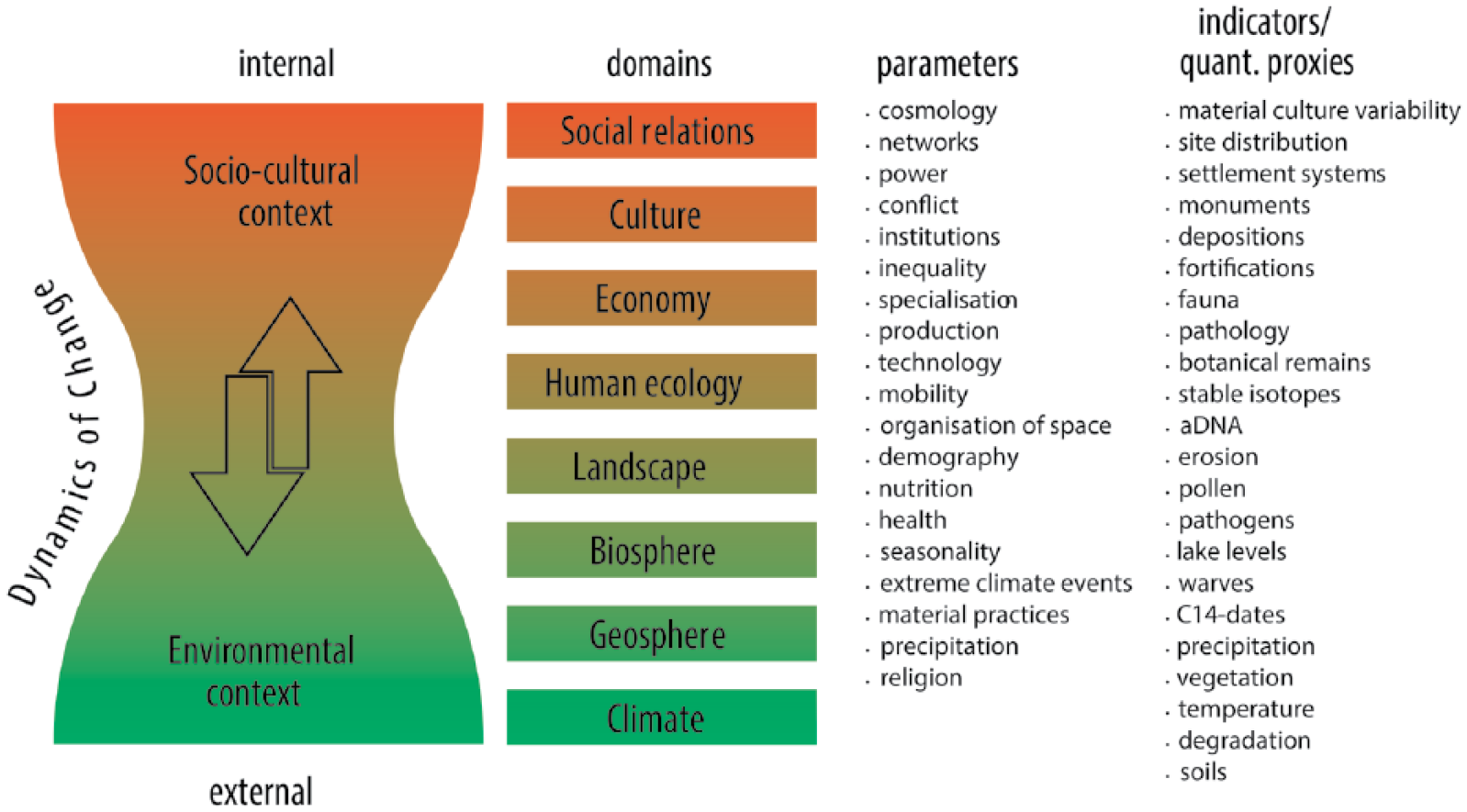
The CRC 1266 approach to studying transformation: Exemplified indicators/quantitative proxies revealing parameters connected to domains of socio-environmental contexts. Both the identification of categories of archaeological and palaeoenvironmental archives that can be used for the reconstruction of transformations, and the translation of these categories into domains and processes are indicated.
As the role and trajectories of the scales of transformation in prehistoric and archaic societies still need to be systematically assessed, the integration into a common framework and the emergence of new perspectives and results from the individual historical and environmental cases enhance a re-evaluation and re-formulation of the existing concepts of transformation, stability, and resilience, and the character of human–environmental interactions within prehistoric and archaic societies (e.g. Gronenborn et al., 2014; Kristiansen and Rowlands, 1998; Widlok et al., 2012; Zimmermann, 2012).
Development of a specific archaeological anatomy of transformation
Conceptual considerations led to the definition of certain aspects of transformation, human–environmental interactions, and terms that seem to be essential for the understanding of transformation processes (Furholt et al., 2012; Hofmann et al., 2012; Käppel and Pothou, 2015; Kiel Graduate School, 2010; Kneisel et al., 2012; Müller, 2014). The frame of reference in which transformation processes are imbedded is the concept of landscape (Bastian and Steinhardt, 2002; Doneus, 2013; Haug et al., 2018; Ingold, 1993; Kluiving and Guttmann-Bond, 2012; Leser, 1997; Müller, 2018), which integrates both social and physical dimensions of the environment.
Arising from the exchange between case studies, modelling and theory, specific questions appear: Are the parameters that we define for the investigation of transformation of human–environmental interactions (cf. Figures 3 and 4) adequate and sufficient for description, reconstruction and analysis? And how can this collection be altered or complemented? How can the key concepts be translated to the realm of operational models and research strategies for the study of prehistoric and archaic societies? What are the specifics of the transformation concept from an archaeological and socio-environmental perspective?
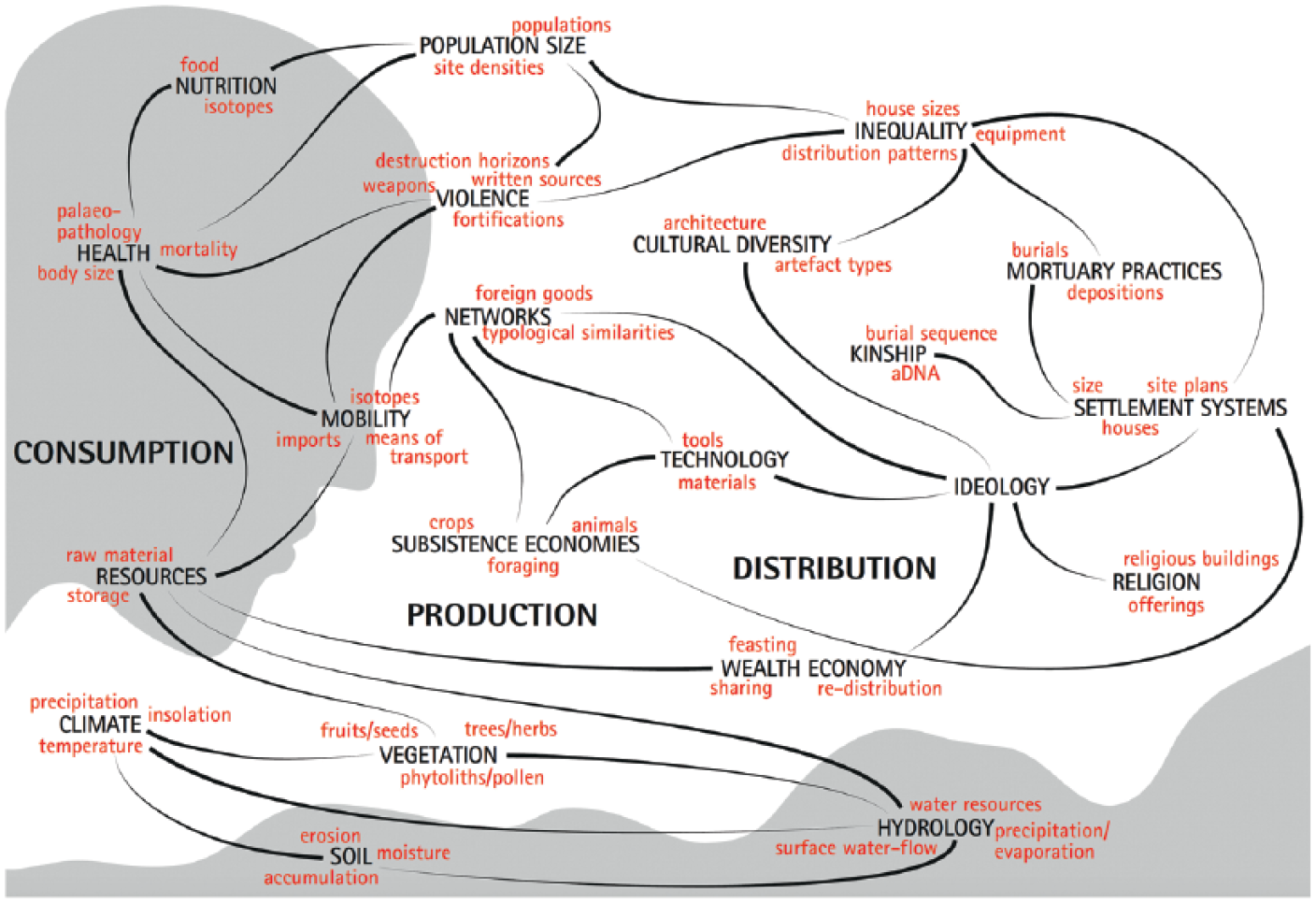
A mind map indicating the relational network of different spheres and aspects of parameters that are relevant for the reconstruction of transformation in prehistoric and archaic societies. Indicators (red) describe the variables of our archives, which are used in the CRC 1266 to reconstruct change.
Within the development of an archaeological ‘anatomy of transformation’, a specification in relation to the character of our archaeological and environmental archives is necessary. While research on recent transformation usually defines transformation as a substantial change in social systems (e.g. Böhme, 2011), including an identification of intentionally operating social actors, for prehistoric and archaic social formations, the identification of the rearrangement of structures of meaning, and thus of social intentions, is problematic (Kubik, 2015). In spite of the possibility of identifying transformations as a result of (a) activities of cultural entrepreneurs (e.g. Bell Beaker warriors for the introduction of metal technology in Scandinavia (Prescott, 1995)), (b) specific internal conflicts (e.g. internal social conflicts with an abrupt change of social structure in El Argar (Lull et al., 2011)), or (c) a change in terms of trade (e.g. of amber items with rearrangements of social space in Central Europe (Müller and Kneisel, 2010)) or in the distribution of copper and jade axes (Klassen, 2004), an archaeological anatomy of transformation will have to include the palaeo-environmental perspective and focus on the incorporation of the palaeo-environment with the material culture as basic aspects of an advanced transformation concept (e.g. Brozio et al., this issue; Dal Corso et al., this issue; Feeser et al., this issue; Groß et al., this issue; Kirleis, 2019; Müller, 2019; Wieckowska-Lüth et al., 2018).
Transformation, scale, human–environmental interaction
The described concepts of transformation are relevant for different disciplines with divergent research histories. Therefore, in the following, we will elucidate the specific meaning of central terms.
Transformation
Societies and environments are never in a steady state. Rather, they are subject to continuous change on different spatial and temporal scales. Alterations in any parameter of social and cultural practices or in the environment result in changes and rearrangements of the whole socio-environmental system (e.g. Sutton and Anderson, 2004). From this general perspective, and reflecting the spatio-temporal dynamics of the socio-cultural and environmental contexts, we define a transformation as a process of change that can be conceptualised by making the following distinctions:
A transformation is a directed and condensed change leading to a substantial reorganisation of socio-environmental relations, which can take place on different temporal and spatial scales. By ‘directed change’, we mean the occurrence of a number of interconnected changes, which reinforce each other, leading to a new sustained state of societies and their socio-environmental relations.
A transformation is connected to the introduction of new social, cultural and/or material attributes and values, which change the existing socio-environmental interplay. These changes in social practices or environmental constitutions might result from societal or environmental processes, or from both.
A transformation results in a new state with certain endurance, so that changes are clearly visible in different domains of society and the environment, and leave traces in the archaeological and environmental records.
In consequence, a transformation is a complex process in which several aspects, elements, meanings and perceptions of social, cultural, and environmental developments of a society are involved and influence each other. A transformation is thus not a simple displacement where a new state of affairs in one social domain replaces the original one without affecting developments in other domains, nor is it the cessation of an old aspect or the introduction of one new aspect that does not affect the others. For example, the introduction of pottery into several hunter-gather communities did not necessarily lead to changes in economy, social relations or ritual behaviour, and would thus not classify as a transformation (Van Berg, 1997). In the same way, the evidence for domesticated pigs in Mesolithic hunter-gatherer groups also probably does not mark a turning point leading to transformation. Rather, the domesticated pig was integrated into the existing system, most probably as a prestige item (Krause-Kyora et al., 2013).
Clearly, there are transformations of lower and higher significance or extent, and the comparison of such different scales is important. For example, on a supra-regional scale, one of the most marked transformations of human–environmental interaction is the transition from a hunting and gathering economy to one relying mainly on horticulture and animal husbandry, an economy which involves a fundamentally different relationship to the environment (cf. Whitehouse and Kirleis, 2014). These developments in the economic domain were connected to changes in nearly all other domains of the socio-cultural context, and to severe changes in most domains of the environmental context. Although acted out at a smaller scale, the establishment of tin bronze metallurgy in Central European settlement sites and the extension of cattle breeding on a local scale in many cases also furthered ecological problems and resulted in a collapse of different village systems around 1650 BCE. The interplay between technological and social changes and anthropogenic influences on the environment created feedback dynamics that contributed to the establishment of new types of domestic sites – restricted, however, to a local scale (Kneisel and Müller, 2011).
The identification and exploration of large transformations, such as Neoilthisation, at different scales and the comparison to transformations acting at a smaller scale, such as changes in resource exploitation or the organisation of space in Bronze Age village communities (cf. Brozio et al., this issue; Dietre et al., 2017; Kneisel et al., this issue; Knitter et al., this issue; Münster et al., 2018), enable a concrete, practical understanding of transformations. In the aforementioned examples, transformations are enduring: on the broader historical scale at a supra-regional level, and at a local scale for the whole living world of prehistoric communities. Nevertheless, the interweaving of changes, developing from local to global or from global to local, must also be taken into consideration. An example for such a discourse is the identification of the innovation of the wheel and waggon in Europe (cf. Bakker et al., 1999; Maran, 2004). Both convergent regional inventions and a possible sudden spread from one area of origin were discussed, contributing to societal changes from horticulture to agriculture (northern Europe) and triggering urbanisation processes (Near East) and the construction of megasites (north Pontic, Müller and Pollock, 2015).
Transformations can take place on different scales. We have to differentiate between characteristics of transformations regarding tempo, intensity, depth and breadth. Transformations can be continuous and long-lasting, or abrupt and fast, they can be accompanied by phenomena of instability and crisis, or they can even lead to catastrophic events or the collapse of whole societies. They can affect a specific part of the society only or the whole group, can alter specific domains of the socio-environmental contexts, of several of them at once, or transformations in several domains may be interlinked. For example, the environmental and societal development of southwest German Hallstatt and early Latène societies has shown many components of different transformation patterns (Müller-Scheeßel, 2013; Nakoinz, 2013; Steffen, 2012). Besides ‘slow’ changes of material culture and environmental conditions, the rapid destruction of the Heuneburg and the reduced importance of central sites around 530 BCE reveal it is possible to detect the depth of social transformations that happen within the time-space of a generation (Fernandez-Götz, 2017; Laffranchi et al., 2019).
In consequence, to identify transformations of human–environmental interactions in prehistoric and archaic societies, studies on changes and the interplay of developments in settlement systems, subsistence and wealth economies, technologies, mortuary and ritual practices, and exchange and networks, as well as studies on contemporaneous climate changes, soil and vegetation developments, demography, and diseases have to be explored and integrated.
Human–environmental interaction
A transformation of human–environmental interactions implies the transformation of social activities, social formations, and social systems which depend on, are influenced by, and which themselves influence the environment. We define the environment as the surrounding conditions of these social activities, that is, material and spatial conditions, influences, and forces which constrain and modify social life. This includes temperature, precipitation, climate events, soil, vegetation and fauna (Figure 3). Acknowledging that this conceptual separation of the social and the environment reproduces a major divide in modern thought as revealed by the supposed opposition between the sciences and the humanities, we explicitly use these terms as analytical units, while at the same time concentrating on the kind of phenomena which actually bridge this divide. This is what we call socio-environmental dynamics (Figure 1): the developments and activities of human individuals and groups in the web of external and internal contexts. These contexts are never exclusively social or material, but always simultaneously embodied and meaningful. For example, houses and villages are an expression of social communities and their relation to the environment, but they are also always an important material means with which these relations are structured and maintained (cf. Hahn, 2000; Wunderlich, 2019). Specific patterns of land-use result from specific kinds of social organisation, environmental conditions and technological means, but these land-use activities will, in turn, always shape social relations (Chevalier et al., 2014). Changes in the social organisation of Funnel Beaker societies around 3500–3300 BCE from farmstead-based communities to agglomeration in villages and the adoption of a new burial ritual (Brozio, 2016; Hage, 2016; Müller, 2019) were at the same time accompanied by fundamental transformations of the crop-growing system (Brozio et al., this issue; Kirleis, 2019; Sørensen and Karg, 2014). The changes concern both an intensification of crop cultivation, shown by an enlargement of small-scale arable plots to wide arable fields, and a reduction in the number of cultivated crop species, which can be interpreted as a specialisation on the use of robust species with reliable high yields (Kirleis and Fischer, 2014; Klooß et al., 2015). Interestingly, the changes in crop cultivation occur not only with evidence for the use of the ard (Kirleis, 2019), but further archaeozoological/osteomorphological investigations show the regular use of the ard integrated with draught animals in the Middle Neolithic, thus proving the need for extended arable fields to implement this technological innovation (Johannsen, 2006). This example also stands for a transformation related to the way Funnel Beaker societies perceived and shaped the landscape, from acting on a low impact level towards the large-scale creation of a cultural landscape.
For analytical reasons, these contexts are divided into the socio-cultural and the environmental (Figures 3 and 4). The parameters that can be selected, circumscribed, and measured only describe observable phenomena which are always intertwined, and, more importantly, always in flux and subject to continuous change. We may, again for analytical reasons, speak of phases of stability, but it is clear that such stability is always a relative term, referring to a phase of only slight changes, opposed to phases of more marked transformations. From an archaeological point of view, most parameters will be mirrored in material culture and the organisation of social space; from an environmental point of view, they will be recorded in the archives related to the biosphere. Furthermore, the reconstruction of transformations depends on the possibilities of the chronological resolution. In consequence, the scale of the quality of our archives influences the extent to which transformation processes will be reconstructed.
Scales
Any comparative approach needs certain parameters, along which a scaling of phenomena can be achieved. ‘Scales’ refer to several different dimensions. From an analytical point of view, we identify scales of data quality that precondition the kind of transformation that we are able to reconstruct. Besides these aspects of data acquisition and hermeneutic interpretation, scales concern the spatial, temporal and social dimension of the phenomena under study.
Spatial Scale
We investigate a spectrum of transformations from local to ‘global’, although these are dependent on the significance given to these terms by the respective social concepts of space (both emic and etic). Transformations in prehistoric and early historic times can be studied in the context of local social groups, be they located in foraging territories, hamlets, villages or settlement clusters in naturally confined areas. Here can be addressed, for example, issues of social organisation within settlements or settlement systems, the effects of different mobility patterns, the exploitation of locally restricted resources, and the destruction or pollution of natural habitats. On a ‘regional’ scale, changing configurations of political systems might affect the relationship between local communities, altering their possibilities to interact and organise exchange. Regional transformations may also be caused or influenced by changes in the availability of certain resources that make the supply of these resources for different local or regional groups problematic. Also, already in prehistoric times, the sum of anthropogenic landscape alteration might have influenced the climate (Carcaillet et al., 2002; Ruddiman, 2003). On a ‘global’ or ‘super-regional’ scale, the effects of major climate events may reach different regional societies simultaneously, but potentially in very different ways (e.g. Capuzzo et al., 2018).
Temporal Scale
Transformation evolves at different temporal levels, and they and their components have different durations, velocities and rhythms. We may differentiate between short-term, medium-term and long-term transformation processes that seem to build on distinct historical and environmental bases, and accordingly exhibit very different durations. An example for a long-term transformation is the gradual change of climatic conditions leading to the aridification of the western Mediterranean region from about ca. 4000 BCE, the end of the Atlantic maximum, leading to changes in demographic productivity and economy, yielding significant social consequences triggered, for example, by the need for irrigation in Mediterranean landscapes (Broodbank, 2013; Kröpelin et al., 2008). A medium-term transformation would be state formation, for example, in the Aegean, where the development of the Mycenaean power lasted several centuries. In the same way, phenomena of centralisation of settlement systems are usually connected to processes spanning several generations (Bintliff, 2012). A short-term transformation is the abandonment of the circum-alpine pile-dwelling settlements as a result of the flooding of the lake shore areas around 2400 BCE which interfered with both settlement systems and economies (Jacomet, 2008; Menotti, 2015; Schibler, 2008).
These different scales of transformation will always be connected or superimposed. However, developments in different domains of the social and environmental contexts may occur at different velocities or tempi. Besides the observable ‘temporal scales’ of changing material culture or environmental preconditions, we are aware of the many time-concepts that exist for premodern societies (cf. Whittle, 2018; Whittle et al., 2011). Even here, the identification of emic linear versus non-linear time-concepts is expressed within different media of the individuals and communities, for example, the rhythm of offering seasons at monuments.
One strength of the high-quality archives of many of our case studies lies in the possibility to identify both changes at high temporal resolution, up to single-year precision, that then are set in value and account for long-term trends and tendencies at different velocities and rhythms (e.g. Dörfler et al., 2012; Dreibrodt el al., 2012). The reconstruction of the chronological dimension of distinct stages within transformation processes, and of the repercussions of social and environmental transformation processes, is one of the main challenges for the CRC 1266. We deal with archives of different chronological resolutions. To meet this challenge, a categorisation of well-defined temporal scales with respect to the dating possibilities is necessary (cf. Hinz and Müller, 2014). They are the basis for an exploration of novel ways of extracting finer information from our data sets using cutting-edge statistical and modelling techniques (Meadows et al., this issue). However, we will also have to deal with inherent data limitations.
Social Scale
We want to identify the societal depth of transformation processes, both in a horizontal and a vertical perspective. With horizontal, we mean the spheres of society which are affected; vertical refers to levels of society, that is, which groups or subgroups of societies are affected by and contribute to processes of transformation (Müller and Bernbeck, 1996). For example, the Early Bronze Age transformation in Central Europe involved changes in metallurgy against the background of a flourishing agricultural subsistence in core areas, which seems to have had an effect on the social systems (Bartelheim, 2002; Meller and Bertemes, 2010). However, it could be argued that besides a small group of princely graves, the majority of the population seems to have been buried very much in the same way as in previous periods. The same kind of continuity seems to be the case for the settlement patterns and subsistence base. In our terminology, on a horizontal scale, only certain social spheres are affected. In terms of the vertical scale, the technological changes gave rise to social differentiation, which, however, is most visible in the upper ‘ranks’.
Thus, we understand social practices as an interplay between artefacts, technologies, individuals, households, subgroups of society and whole communities (cf. David, 2009; Kadrow and Müller, 2019; Koch and Kirleis, 2019). At different social spheres and levels, coping strategies, behaviour causing and triggering transformations, and the effect of transformations will have different implications. The analysis of material culture with respect to the role of things and technologies is an important archaeological tool for the identification of social scales (cf. Maran and Stockhammer, 2012; Van Gijn et al., 2014).
While identifying and characterising the agents of transformation, it is important to study the changes to group sizes over time in the course of transformation processes, and the effect of these changes on the development of transformations (Müller and Diachenko, 2019). Connected to this is an evaluation of the importance of the territorial behaviour of social groups, their mobility patterns and integration into exchange networks. This will help us understand how transformation evolves in specific ways and which feedback processes are the effect of specific coping strategies.
Reconstruction and evaluation of specific transformation processes
On one hand, spatially/temporally limited studies on the dynamics of the concrete, historically situated processes of transformation within different local and regional settings allow a distinct bottom-up perspective when different examples are linked (e.g. Dal Corso et al., this issue; Kleijne, 2019; Knitter et al., this issue; Meadows et al., this issue; Müller and Vandkilde, this issue; Pickartz et al., this issue; Schultrich, 2019). On the other hand, general diachronic and transregional socio-environmental components of change allow a top-down perspective (e.g. Brozio et al., this issue; Feeser et al., this issue; Kneisel et al., this issue). These two perspectives can then be compared and contrasted. For example, three case studies on changes in the material culture, domestic structures, and local environments around 2200 BCE in southern Scandinavia and northern Germany (Müller, 2015) could be linked (bottom-up perspective) and then compared with studies on the 4.2 event with respect to climate change (Weinelt, 2018) or vegetation development (Feeser and Dörfler, 2015), in which regional and local consequences of climatic changes are discussed from a general perspective (top-down perspective). These are two distinct perspectives on transformation processes, and their integration provides the possibility of a broad and combined synthesis.
To disentangle the role of single factors and components contributing to socio-environmental transformations, it is necessary to assess a wide range of potential and interacting factors from both the archaeological and environmental spheres, which are generally considered to cause, shape, and modulate transformation, or to undergo (sometimes a constant) transformation (Figures 3 and 4). For analytical reasons, it is necessary to isolate components of transformation in order to assess their spatial and temporal scales and their impact on a society or different parts thereof.
Thus, within the methodological concept, the interdisciplinary reconstruction of the dynamics of change of prehistoric and archaic societies links different ‘domains’ by certain ‘parameters’ that are detected by archaeological, historical, and environmental ‘indicators’ (Figure 3). The goal is to identify and explore these indicators, parameters and domains in order to identify transformation processes.
The dialectical socio-environmental character of parameters for change is visible in many respects: for example, the parameter ‘networks’, which is a fundamental part of the domain ‘social relations’, is triggered both by environmental indicators (natural limitations, demography) and by societal ‘indicators’ (e.g. organisation of space, ratio of conflict). Thus, the interrelation of socio-cultural and environmental domains expresses internal and external parameters that are linked in the overlapping spheres of environmental and societal dynamics. In the same way, it is the general goal to take an integrative approach to these parameters, which are isolated only for methodological purposes. Processes of transformation of human–environmental interactions can only be understood when the parameters studied representing the dynamics of the ecological, economic, social and ritual spheres are seen as fundamentally interwoven (Figures 4 and 5). In particular, Figure 4 displays the a priori relationships between many parameters, which are again in many cases constituted by different archaeological or environmental indicators. They form the basic source for the reconstruction. In principle, they are the basic variables for modelling transformation processes and they constitute the demand on information which is expected. Figures 2 and 3 display parameters and indicators on different scales that reflect and trigger developments. In the aforementioned example of transformation around 2200 BCE, the role of metallurgists and metallurgy and of the 4.2 event are identified as modulating transformations. For detailed investigations, both aspects have to be analysed via the wide range of indicators displayed in Figure 3 and structured in Figure 2.
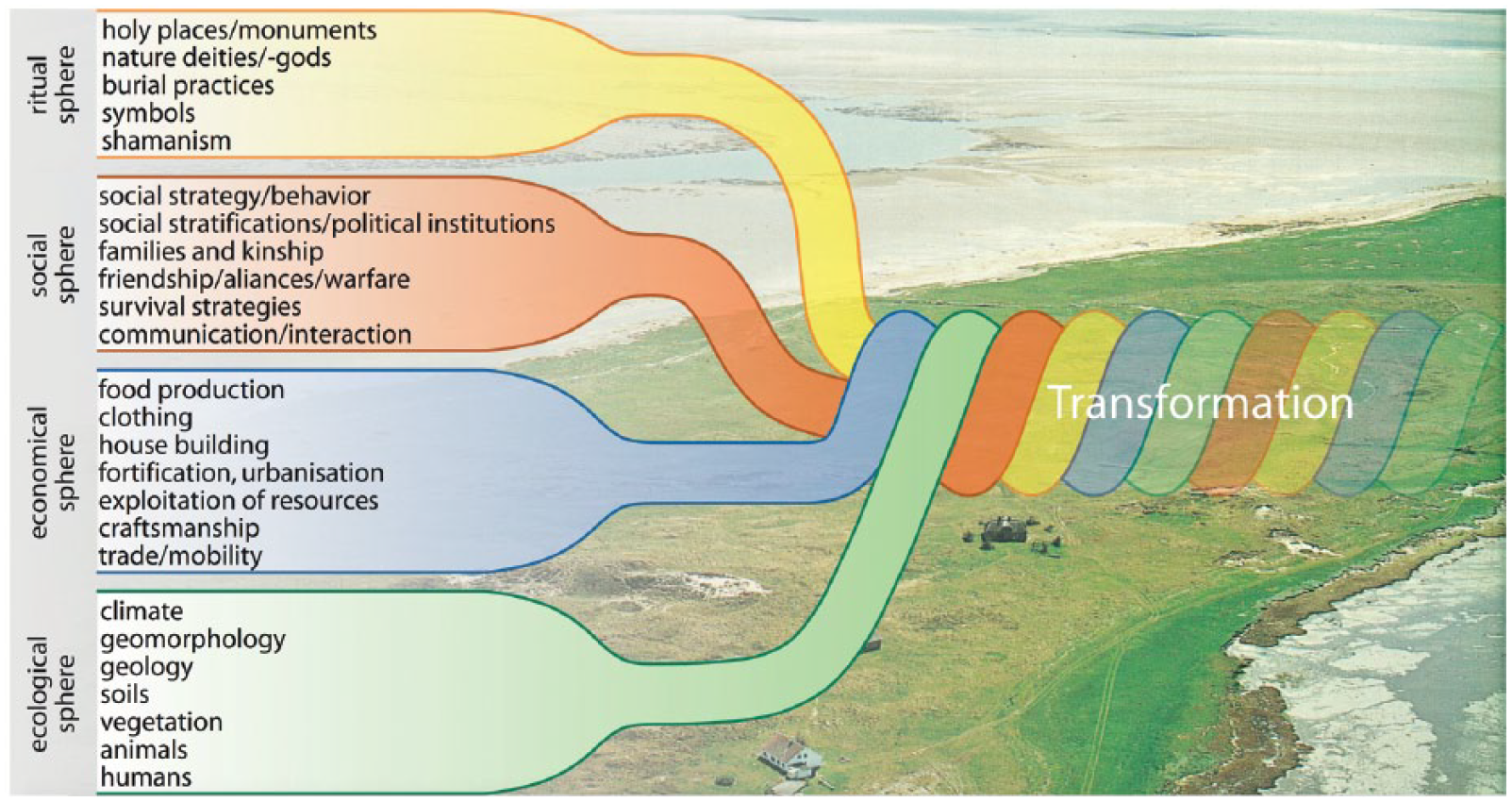
Different socio-environmental spheres that are interwoven in transformation processes.
The identification and understanding of the developments leading to and constituting transformation phenomena in all their breadth and variability enables a focus on the range of different possible scenarios. In addition, we can connect these scenarios to different types of transformation processes and assess their various impacts on different types of social formations and environments. The systematic investigations and reconstructions, providing detailed regional patterns of very different scenarios, form the basis for comparisons, further exploration and detection of general patterns of transformation. In our example, the introduction of tin bronze technology in Central Europe is associated with different impacts on regional social groups and on different scales. While, in Greater Poland, technological and societal changes are followed by a centralised settlement pattern and management problems with respect to the local environment (Kneisel and Müller, 2011), in southern Germany, the main environmental and social changes appear later than the first introduction of the new technology (Stockhammer et al., 2015). In one case, the development of new casting practices took place independently, and in the other case, the adaption of technologies was practised through supra-regional networks. Furthermore, the identification of metal-accepting and metal-rejecting regions (Rassmann, 2011) point to possible different scenarios of cultural behaviour.
Within such a concept of transformation, it is possible first to identify specific factors, parameters, and preconditions that are important for the initiation, character, course, and results of transformation processes; second, to investigate the linkage of the prior and new states of transformation in the individual scenarios; and third, to delimit the range of transformation scenarios empirically present and assess the variability of phenomena.
Taking this into account, the different scales of inquiries result in transformation scenarios that describe the interwoven factors of change, which are both responsible on one hand, and produce on the other hand, certain imprints in the material culture and environment of past societies (Figure 5).
Comparison of individual transformation processes along their spatial, temporal and social scales
The effects of differences in scale for the form and structure of transformations can be explored through a re-integration of these dimensions of scale, which will further characterise the concrete phenomena, as well as causal or influencing factors. This provides the necessary basis for the investigation of general patterns of transformation. The scenarios for transformation ca. 4100–3500 BCE in northern Europe from hunter-gatherer to agrarian societies that are visible in different environmental and archaeological components are an example for the different dimensions of scales. In southern Scandinavia and northern Germany, the seasonal variability reflected in laminated sediments describes 40 years with cold winters 4050–4010 BCE (Dreibrodt et al., 2012) that might have triggered the introduction of a new agrarian technology, the ‘Brandfeldbau’ (Schier, 2009) on a broader scale. While this affected a huge area from the northern border of the Loess area to Scania, on a temporal scale, changes in societal aspects took centuries to develop. In fact, further technological innovations also entered the picture before a real change took place (e.g. ard, wheel and waggon: Maran, 2004; Mischka, 2011). From a social point of view, the segment of the population which effectively integrated the changes was still limited, as proven by the continued importance of aquatic resources for centuries, even inland (Knitter et al., 2019; Lübke et al., 2009). Thus, different temporalities of processes, different spatial dimensions of parameters, and different effects on sections of societies describe an interwoven transformation dynamic.
Generalisation of transformational processes as historical phenomena
As we study societies and periods of human development that are explicitly distant from our present one, we have the possibility to aim at the identification and evaluation of general patterns in the reconstructed behaviour and reactions of individuals and societies towards transformations. The development of prehistoric and early historic transformation processes should reveal repeated schemes of reaction and coping strategies which can either be connected to specific socio-economic formations, or may even transcend such historical locations. Both types of patterns provide insights for a better understanding of our present experiences of transformations, irrespective of their different socio-economic contexts. For example, the analyses of the role of social inequality for transformation processes could be of importance for discussions in recent societies. While, on one hand, investigations clearly indicate that there is no correlation between the unequal distribution of access to resources and wealth and the type of socio-economic formation (Bowles et al., 2010), on the other hand, different studies describe comparable patterns with respect to the breakdown of social systems after an increase in social inequality that was expressed in terms of access to resources and goods (Arponen et al., 2015; Windler et al., 2012). Such information about the role of ‘inequality’ issues within prehistoric and archaic transformation processes is of important relevance for the anatomy of transformation.
Overview on the contributions to the special issue and concluding remarks
In the first paper by Groß et al. (this issue), human adaption to environmental conditions is discussed by integrating case studies of Mesolithic camp sites with ethnographic studies as a basis to differentiate between strategies of active niche construction and natural processes. A critical review by Fuchs et al. (this issue) on the effects of one major prehistoric transformation, namely, Neolithisation, on human health comes to the conclusion that at the current state of the art, evidence for infectious diseases among Neolithic populations is scarce and arises at an individual level rather than showing large-scale epidemic events that affect full populations. Transformations related to different monumentality booms and busts in the northern Neolithic are identified by Brozio et al. (this issue) and show different scales of the interplay of the economic, social, and ritual sphere of society while identifying different scales of the intensity of transformations, especially for the younger to late Neolithic. Hypotheses about Neolithic socio-cultural transformation dynamics as mirrored in land-use patterns are tested for the intensively researched northern German region in the paper by Knitter et al. (this issue) by application of a fuzzy modelling approach that shows that, independent from population size, the carrying capacity of the investigated regional landscape was not reached at any time. This indicates the high relevance of social organisation of the economy and the cultural development of Neolithic societies for social change in transformation phases. The aspect of Neolithic subsistence regimes in this particular region is further detailed by integration of archaeobotanical with stable isotope data in the contribution by Filipović et al. (this issue), identifying specific management practices for individual crop species, indicating a high degree of complexity in farming strategies that links well with the assumption by Brozio et al. (this issue) of the importance of socio-cultural elements for transformation processes. The reconstruction of Neolithic to Bronze Age palaeoenvironmental dynamics in north-western Europe by Feeser et al. (this issue) interprets human impact on the vegetation and soils as a proxy for the estimation of population density. This palaeoecological attempt is further incorporated into the contribution by Kneisel et al. (this issue) on the identification of cultural change in the Bronze Age by integration with archaeological records, allowing for an in-depth description of Bronze Age transformations. With extremely high population densities, the phenomenon of population agglomeration in the Tripolje megasites of the fourth millennium BCE in the transitional forest steppe environment of modern Ukraine and Moldova raises the question of resource management, which is here centred around archaeobotanical and archaeological data on wood usage, considering wood as crucial resource for house construction and as fuel (Dal Corso et al., this issue). By application of a multidisciplinary approach including modelling, landscape scenarios are provided that consider water availability as a main trigger for wood growth, with the result that in only an extremely dry scenario would the settlement’s needs go beyond the threshold for wood availability; even in the phase of major population agglomeration, the intermediate and wet scenario indicate sufficient wood resource availability in the naturally grown woodlands. Related to the investigations of the Tripolje megasites, innovative method development in geophysics is presented by Pickartz et al. (this issue) with new tools to facilitate the handling of extremely large sites and the archaeological interpretation in particular with respect to aspects of changing social organisation that are expressed in the spatial arrangement of settlement infrastructure. From a methodological point of view, the application of Bayesian radiocarbon calibration on large sites from the LBK in Slovakia (Meadows et al., this issue) allows the creation of spatial models of the arrangement of long-houses in LBK settlements. The paper by Arponen et al. (this issue) provides a theoretical background discussing the benefits and limitations of the bringing together of approaches by the humanities and the natural sciences to gain a holistic understanding of transformation processes, as partly done within the papers of the special issue.
Overall, this compilation already shows that simplifying eco-deterministic monocausal explanations for transformation processes have to be denied. For the different societal formations, as well as for the diverse environments, it is clearly shown that human agency is an important factor that superimposes on natural driving forces and hinders the identification of general patterns with global relevance. In contrast, in many cases, the diverging expressions of sustainable socio-environmental turn-over are shown. From the comprehensive perspective on human and environmental history, we are committed to the idea that understanding and finding explanations for prehistoric and early historic transformation processes and their consequences holds informational value for our own present and future development.
Footnotes
Acknowledgements
The concept of ‘Scales of Transformation’ was intensively discussed within the CRC 1266. We acknowledge the support and contributions of its members. The principal investigators are (in alphabetical order) Thorsten Bauersachs, Michael Blaschke, Hans-Rudolf Bork, Walter Dörfler, Rainer Duttmann, Berit Valentin Eriksen, Martin Furholt, Sönke Hartz, Annette Haug, Lutz Käppel, Wiebke Kirleis, Jutta Kneisel, Ben Krause-Kyora, Harald Lübke, John Meadows, Thomas Meier, Johannes Müller, Oliver Nakoinz, Almut Nebel, Konrad Ott, Wolfgang Rabbel, Chrsitoph Rinne, Ulrich Schmölcke, Ralph Schneider, Lorenz Schwark, Bernhard Thalheim, Ingmar Unkel, Mara Weinelt, Josef Wiesehöfer, and Dennis Wilkens. Furthermore, we appreciate especially the discourses with Katharina Fuchs, Martin Furholt, Daniel Gross, Nils Müller-Scheeßel, and Magdalena Wieckowska-Lüth.
Funding
The author(s) disclosed receipt of the following financial support for the research, authorship, and/or publication of this article: This study was funded by the Deutsche Forschungsgemeinschaft (DFG, German Research Foundation, Projektnummer 2901391021 – SFB1266).
