




Abstract
Prominent voices in archeology have expressed deep skepticism about the role of theory in archeology, while with new, exciting methods at its disposal, archeological science is occasionally perceived as not needing theory at all. This article reflects upon the debate about theory in archeology to arrive at a robust but critical middle-range concept of the role and character of theory in socio-environmental archeology. It is argued that archeology is a data-based science and, consequently, in order for theory to be meaningful in socio-environmental archeology, theory ought explicitly aim to make its qualitative concepts quantitative to establish a clear relation to data and its interpretation. On the turn side, theory plays an important role critically reflecting upon the use of concepts in archeological understanding and explanation, as well as their origins in particular paradigms, as examples of which certain debates in scientific archeology are discussed (aDNA and migration, evolutionism). We argue that such a model would serve archeology far more than the dismissal of theory on the one hand and the continued production of ‘high’ theory in absence of operationalization on the other.
Introduction
Archeology is a historical discipline between the natural sciences and the humanities. There is a more scientific and positivistic side to archeology, and there is a more theoretical and speculative side (Killick, 2015; Kristiansen, 2014; Sørensen, 2017). The division echoes the classic ‘two cultures’ argument made by C.P. Snow (2001 [1959]). At least since the emergence of postprocessual archeology, the relationship between archeological science and archeological theory has been tense. Our concern in this essay is to attempt to locate the crux of the tension and then attempt an inclusive but critical account of the role of theory in archeological science. We write in the context of a larger, interdisciplinary, socio-environmental archeological research effort the fruits of which this Special Issue displays.
On the scientific (positivistic, empirical, material) side of archeology, we find research and data mining at different sites, we find refined dating methods, restoration of fragmentary remnants, inventories, collections, and archives. Remnants are excavated, dated, physically analyzed, and stored. This side represents the actual and solid disciplinary work proceeding according to established as well as innovative scientific methods. It constitutes a growing database. On this what one might call positivist side, we see firm and impressive results, and we register slow but steady progress over decades, from DNA and isotope analysis to digitalization. One can take this dimension as the hard core of archeology (Kristiansen, 2014). The history of archeology, then, can be written as the development ‘of techniques of recovery and material analysis’ (Ion and Barrett, 2016: 133). In this sense, sequencing of ancient DNA, pollen analysis, and isotope analysis would be paradigm examples of scientific progress.
Given the above, it is not obviously wrong to define the epistemic self-understanding of archeology in a prudent, modest, and enlightened, positivist, research-oriented way. This definition will entail some skepticism of ‘lofty’ or ‘mere’ theoretical speculations.
In works such as John Bintliff’s (2011) provocative The Death of Archaeological Theory (see also Bintliff, 2000, 2015), the problematic nature of the relationship of scientific archeology to theory was discussed. Bintliff (2011) argued that Published papers increasingly begin with pages of scholastic citation to works of theory, followed by applications to archaeological data which rely more on repeated reference to the favoured approach than providing convincing matching of concepts to recovered material evidence. (p. 9)
In other words, theory appears to serve a lofty role detached from the archeological practice, while the real core of the archeological practice is to be found in rigorous empirical work (see also Johnson, 2006).
Arguably, the actual targets of the ‘death of theory’ charge may not so much be theory in the broadest sense – for often, the critics themselves are prolific theorists themselves – but rather some particular instances of (postprocessual) theory.
Nonetheless, well-known practitioners of scientifically but also social theoretically informed archeology continue to be unimpressed by the fruits of the latest theoretical work citing ‘a lack of interpretive implementation and progress’ (see, for example, Kristiansen, 2017). Elsewhere, Kristiansen (2014) observed in the literature a wider ‘critical stance against a previously predominant post-modern/post-processual hegemony, and the reintroduction of a revised modern/processual approach’ in archeology (p. 11). Similarly, in reference to the concept of agency as it came to archeology from the works of Pierre Bourdieu (1977) and Anthony Giddens (1979, 1984) some decades ago, Dobres and Robb (2000) argued that ‘agency in archaeology is not a theoretically sophisticated paradigm, but rather a lingua franca – an ambiguous platitude meaning everything and nothing’ (p. 4).
A closely related critique of theory is that where the import of a theoretical framework with regard to archeological interpretation is made explicit, the results regularly fail to convey anything substantially new about the research object at hand. Such a morale arises, for example, from John Barrett’s (2014: 68–71) discussion of the inanimate agency thesis in new materialist archeology, a fairly fresh entrant to the archeological theoretical scene (Harris and Cipolla, 2017; not to be confused with the agency theory mentioned above). In closer scrutiny, says Barrett (2004), either the inanimate agency thesis is vague in its statements as to wherein causality resides in an assemblage of human and non-human things, or it implausibly proposes that causal agent to be able to be a material thing or, finally, that what the inanimate agency thesis really is proposing is the kind of holism that most would accept anyway: ‘Archaeologists have long characterized the conditions of the past as the operation of a complex system of relationships between different kinds of component’ (p. 65).
At the same time, every once in a while, archeologists implicate themselves as guilty of naïve empiricism, a certain ‘fetishisation of “data”, “facts” and quantitative methods’ (Sørensen, 2017: 1), the way we look at archeological features, findings, or data, and the question we ask are often implicitly directed by those theoretical approaches and certain ‘controlling models’ (Clarke, 1972; Wylie, 2002).
Where, then, does all this leave theory? How, if at all, can it be combined with scientific archeology? What is the role of theory in archeology? Despite these difficult questions, a longer standing view is ‘that everything archaeologists do is infused by theory (much of it, regrettably, still implicit)’ (Schiffer, 1988: 461). Similar observations have been made at various junctures over the decades such as those of Alison Wylie (2002): observations are theory-laden and richly dependent on extended networks of theoretical claims and assumptions … that include generalizations about observables as well as claims about unobservable dimensions of the reality under study … These constitute a conceptual framework without which observations have no meaning or evidential import – indeed, without which they cannot be identified as observations. (p. 7)
It is thus not that there is no need for archeological theory, but we seem to be at loss as to what it can be in the cross fire of natural and human scientific conceptions.
Against the foregoing background, this article argues that archeology is essentially a discipline orientated to the extraction and analysis of data, and that being the case, theory can be meaningful in archeology once theory connects theoretical concepts with data. That is to say, archeological theory has to say what patterns in our data does a given piece of archeological theory lead us to look for. To the detriment of not an insignificant portion of 20th and 21st century archeological theory, the relationship of theoretical concepts to data and interpretation has unfortunately often been felt to be tenuous.
At the same time, we draw attention to a longer history of conceptual problems arising from the extension of emerging natural scientific techniques and ideas being applied to understand (pre)history that were later criticized for having ignored considerable socio-cultural depth to them. Issues from sociobiology via the ‘selfish gene’ (Dawkins) to the modern day archeological debates about aDNA and migration are cases in point. This is a history that any third and subsequent scientific revolutions in archeology and elsewhere probably ought to keep in mind. With a view on this history, our article is a plea for reflective middle-range theory (MRT) in interdisciplinary, socio-environmental archeology.
MRT
Any introduction to archeology will characterize the discipline as essentially orientated to the excavation and analysis of the archeological record. Therefore, if an archeological concept means anything, it does so because the concept is somehow, even if indirectly, connected with the kinds of stuff archeologists find in the ground. In a phrase, in archeology, quantitative concepts should be associated with qualitative concepts.
This simple observation allows us to pinpoint the nature of Bintliff’s and others’ critique of archeological theory. Basically, in their view, ever since the emergence of postprocessualism, archeological theorists have been struggling to connect theoretical concepts with archeological data. As a result, postprocessual archeological theory has been charged with making grand theoretical assertions but failing to connect these with particular data in a way that is unequivocal and/or substantially new.
We would like to suggest that the concepts of MRT on one hand and those of high theory on the other can be used to conceptualize the situation. We do not wish to go in too much detail to the long debate about MRT in archeology (Forslund, 2004), but few words on the notion are in order to make explicit the kinds of issues MRT has historically involved.
The term goes back to the American sociologist Robert K. Merton (1949, 1957, 1968) who in his Social Theory and Social Structure criticized the tendency in American sociology of the time to work with grand theoretical systems (Merton, 1968: 39; Geels, 2007: 628). At the same time, Merton also expressed his criticism toward the opposite approach – small-scale empirical propositions informing day-to-day research. Merton (1968) suggested MRT as a middle way between minor empirical hypotheses and grand theory: […] middle-range theory enables us to transcend the mock problem of a theoretical conflict between the nomothetic and the idiothetic, between the general and the altogether particular, between generalizing sociological theory and historicism. (p. 44)
One hallmark of MRT for Merton (1968) was its ability to ‘guide empirical inquiry’ (p. 39). Merton (1968) wrote, Middle-range theory involves abstractions, of course, but they are close enough to observed data to be incorporated in propositions that permit empirical testing. (p. 39)
The concept of MRT entered archeology with Lewis Binford (1977) who used the term to refer to the theories of the formation processes of the archeological record. Others followed with a critique introducing concepts of MRT that were taken as more Mertonian than Binfordian in spirit and letter (Raab and Goodyear, 1984; Schiffer, 1988; see also Flannery, 1972a).
As a result of the multifaceted history of the concept, the words ‘middle-range theory’ tend to evoke many associations in archeology. In our modest concept of MRT, it simply denotes archeological theory that prioritizes the relation of theoretical concepts to empirical data.
Relatedly, MRT signals a certain desire to mediate ‘between undesirable extremes’, as Frank Geels (2007) observed in the context of Science and Technology Studies 1 – the appearance of the concept of MRT is ‘an indication of discontent in a discipline’ (p. 627). This arguably is the situation in archeology in that there exists the perception that the latest breakthroughs in archeological theory are failing to make an unequivocal interpretative difference. Its content as a concept aside, MRT can, therefore, be seen as quite specifically situated in a particular juncture in the history of archeology characterized by the breaking of a wave of high theory against a backdrop of archeological science with MRT as mediating between the two the extremes.
High range theory and reflectivity
Generally, theories can so to speak ‘fly at different altitudes’. In biology, a theory within population ecology flies at a different altitude than the general theory of evolution. This holds true also for archeology. As we saw above, aversion against theory in archeology often stems from the impression that here is too large a distance between the archeological record and some ‘satellite’ altitude of general theories stemming from the remote stratosphere of social theories.
Merton and several commentators on the MRT debate thereafter distinguish between high- and middle-level theory, and sometimes low level theory (Raab and Goodyear, 1984; Smith, 2011). High level theory is by definition something that sets off from fairly abstract (philosophical, if you like) debates about the fundamental nature of something – say, of agency, materiality, or causation to pick some recent examples (Arponen et al., 2019; Dobres and Robb, 2000; Witmore, 2014). The worry raised by Bintliff and others about ‘high’ theory is that it threatens not to have an obvious empirical application for archeological purposes. In our view, Bintliff and others’ worry is essentially justified.
That said, ‘high’ theory and reflectivity ought to be considered a part of any scientist’s toolkit. 2 In the most general sense, the concept of reflection refers to the awareness of research traditions or paradigms, their key ‘high’ theoretical concepts and the influence these have on archeological interpretation. In a more particular sense, reflectivity critically looks at how concepts are (implicitly) defined and used for explanatory purposes within a given paradigm (Kuhn, 1996; Lucas, 2017). A case in point is the ongoing debate about how the aDNA techniques are being used to (implicitly) define migration.
At issue is the implicit transmission of concepts and thought-models from one domain to another as recently debated in the aDNA studies regarding the concept of migration (Furholt, 2018; Heyd, 2017; Ion, 2017). For decades in archeology, Gustaf Kossinna’s (1920) concept of monolithic archeological cultures identified on the basis of shared material culture, and the associated concept of migration as geographical movement of such a monolith, has been discussed critically to the point of rejection (cp. a similar paradigm in ‘New World archeology’, see Clark, 1993). However, with the rise of aDNA, this concept of migrations has seemingly returned, this time migration being equated with the movement and appearance of certain aDNA in different areas. The debate is ongoing, but arguably – alongside technical questions about the adequacy of sample sizes and the like – the danger here is the unreflective equation of the ‘movement’ of aDNA from one geographic area to the next with the concept of migration the latter of which arguably contains social, cultural, and political dimensions not as such visible in mere transmissions of aDNA. In Ion’s (2017) words, aDNA ‘is just data in want of a narrative’ (p. 186; see also Gramsch, 2015: 343). It seems explanatory power has been sought in a reduction to the supposed essentials – genetic processes – seemingly allowing the archeologists not to step into the bog of interpretative socio-cultural particularities regarding, for example, under what conditions does shared (ancient) DNA imply a shared culture, tribal, kin, or other such relation.
An underlying issue we wish to draw attention here is that we have been here before. The history of science knows of cases of how a natural scientific discoveries have first seemed to reveal the nature of things only for significant doubts and reversals to surface later. Thus, in a parallel case of a reduction to the essentials, Richard Dawkins’ (1976) view on the selfish gene were once, in not too distant past, used to provide a one-stop shop accounts of such arguably quite complex and mixed phenomenon as altruism. Later, critics would indeed argue that the reduction to the essentials was mistaken as, once again, what was once thought to be the essential causal core of a phenomenon was probably better thought of as at least partly socio-culturally shaped (Gould, 2002; Sterelny, 2007).
The immigration of natural scientific concepts into human scientific interpretation, of course, has a longer history. A classic example is social evolutionism, inspired by Darwin’s (1871) evolutionary theory and leading to the imposition of the concept of stages of development upon the variety of human social and cultural life. The concept of evolution extended to human social and cultural development had the analysts project the concept of evolution upon a domain that, however, worked by rather different principles, as prominent critics such as Tylor (1881), Spencer (1864), and Boas (1904) would argue.
In archeology, Shanks and Tilley’s (1987) classic critique of evolutionism in archeology is complex, but one of the key statements was that, in this tradition, ‘societies were viewed as being involved in an endless series of technologically governed environmental adaptations’ (p. 152). In other words, in evolutionistic research, ‘[t]he search is for universal processes underlying different empirical sequences of societal change, and the reason for this change is environmental adaptation’ (Shanks and Tilley, 1987: 140). Shanks and Tilley trace this heritage to a range of literature from Childe (1936) to then-recent work in the 1970s and 1980s by Binford (1972), Flannery (1972b), Renfrew (1972), Bintliff (1984), and others.
The alternative to evolutionism Shanks and Tilley (1987) proposed was put forward with apologies for the general, outline-like quality – one might say ‘high’ theoretical character – of their remarks (p. 185). A central aspect of it was that Societies, unlike individual organisms, do not have any clear-cut physical parameters or boundaries, nor do societies have conscious problems of self-maintenance or a need to adapt. Individuals may have these characteristics but they cannot be validly anthropomorphized in terms of entire social totalities … Societies construct their own social reality and the reproduction of societies entails far more than physical, biological reproduction. (Shanks and Tilley, 1987: 155)
The alternative proposed there essentially says that humans are subject to different, socially constructed determinations that can and do supplant and redefine the environmental constraints. The jury is essentially still out on this question and both sides are able to field important argumentation in support of their position (Arponen et al., 2019).
In any case, the present point is, it is only ‘high’ theory that produces this sort of reflection on the fundamentals of our scientific conduct. Reasoned and reflective archeology is better than one conducted unaware of major paradigm alternatives.
Furthermore, reflection may help avoid implausible equations of scientifically detected phenomena (such as demic shifts of aDNA) with migration. Interdisciplinary work environments – ones in which representatives of both ‘cultures’ regularly meet, present, and discuss ongoing work – constitute an excellent forum for facilitating awareness and debate. In the end, however, as argued above, archeology is a fundamentally data-based science, and ‘high’ theory really ought to make the extra effort to descend from principled discussions upon the middle-range level, that is, to questions of operationalization of theoretical insights.
Scales of transformation
Building on the aforementioned metaphor of altitude, we see a continuum of theory formation in archeology. This array can be organized as different layers or levels of theory formation (cp. Schiffer, 1988 3 ). The layer model gives a static picture of theoretical altitudes, while a dynamic perspective would explain, why and how theories can ‘reach’ specific different altitudes and how layers can come into contact. What is needed, then, would be a fleshed-out meta-theoretical hierarchical layer model of theories within archeology. We argue that such model would serve archeology far more than the dismissal of theory on one hand and the continued production of ‘high’ theory in absence of operationalization on the other. Our ultimate interest is to improve our explanations through providing an explicit epistemological model of the scales of transformation.
To begin to conceptualize these scales, an analytic distinction between climatic and environmental spheres on one hand and social and cultural spheres on the other may be made (Figure 1). In such a scheme, a reductivist explanation can be understood as one that seeks to collapse the two spheres together again by proposing that some one explanatory factor or factors from one sphere would alone account for the phenomenon under investigation. An example of a reductionist account could be the naïve Marxist view that changes in economic structure in the last instance drive other changes. A second example would be the environmental determinist view that the changing biological frame ultimately drives change in (pre)history.
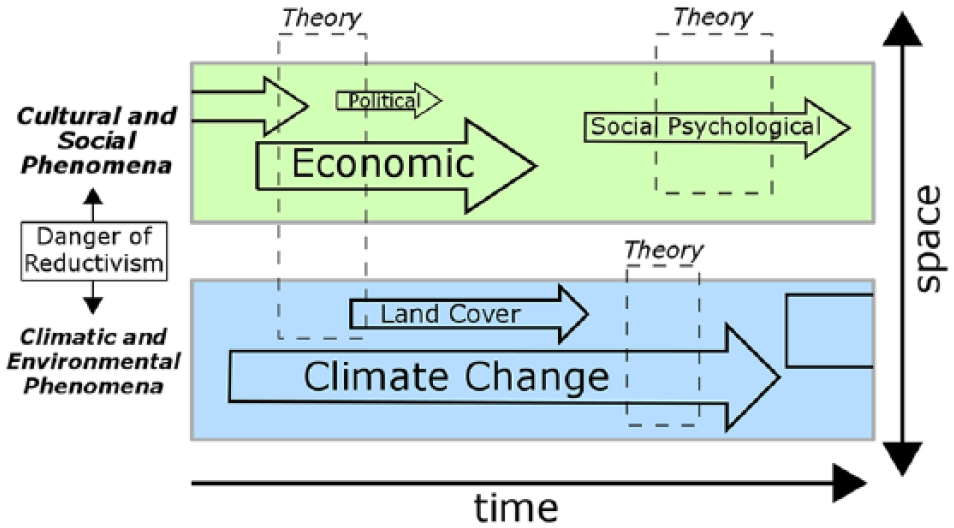
Scales of transformation and socio-environmental archeology. The sphere of cultural and social processes is analytically distinguished from the sphere of climatic and environmental processes. Sub-processes and theories of them, within these spheres are characterized by their differing hypothetical temporal and spatial scales (lengths of the arrows).
By contrast, the non-reductivist argument can be made that even if we assume triggers from one sphere – say, changing climate and environment – the logic by which these changes develop in the other sphere would be its own. Thus, for example, differences and changes in the form of governance will crucially affect the way communities deal with environmental challenges (Arponen et al., 2019; Grattan, 2006; Keyzer, 2016; Oliver-Smith, 2012).
A second point we wish to argue is, there are differing spatial and temporal scales at which a given (pre)historic phenomenon could plausibly be said to be occurring which bears some significance to explanation and understanding. To give a simple example, unless we talk about sudden catastrophes (Grattan, 2006; Middleton, 2017), most climatic and environmental changes occur over far longer time spans (geological time) than most socio-cultural processes do (cp. longue durée, Braudel, 2009 [1958]). In modern contexts, this is referred to as the shifting base line: over human generations, changes in the environmental and climate may become imperceptible due to the relative comparative shortness of human memory as well as contextualism pertaining to human perception of the environment. As a rule, phenomena in the socio-cultural sphere can perhaps be said to be occurring in temporally and spatially shorter scales, yet, arguably, there is great variation there in how some economic processes may be global while cultural processes often are more local.
The point is, given the potential differences in the scales in which different phenomena can be plausibly be said to be occurring, socio-environmental archeology probably ought to be conscious of the differences in the scales. For example, it is not plausible that the temporally long and geographically large scale phenomenon of the Neolithisization could be reductivistically understood and explained by appeal to long-term climatic environmental nor by short-term ideological changes. In so far as Neolithisization was a spatially and temporally dispersed phenomenon (Robb, 2013), its explanation would seem to require explanations of equal character. The ideal type of socio-environmental archeology would be one that is conscious of, studies, and provides insights into the different scales of transformation.
Footnotes
Funding
The author(s) disclosed receipt of the following financial support for the research, authorship, and/or publication of this article: This study was funded by the Deutsche Forschungsgemeinschaft (DFG, German Research Foundation, Projektnummer 2901391021 – SFB1266).
