




Abstract
The period from the late third millennium BC to the start of the first millennium AD witnesses the first steps towards food globalization in which a significant number of important crops and animals, independently domesticated within China, India, Africa and West Asia, traversed Central Asia greatly increasing Eurasian agricultural diversity. This paper utilizes an archaeobotanical database (AsCAD), to explore evidence for these crop translocations along southern and northern routes of interaction between east and west. To begin, crop translocations from the Near East across India and Central Asia are examined for wheat (Triticum aestivum) and barley (Hordeum vulgare) from the eighth to the second millennia BC when they reach China. The case of pulses and flax (Linum usitatissimum) that only complete this journey in Han times (206 BC–AD 220), often never fully adopted, is also addressed. The discussion then turns to the Chinese millets, Panicum miliaceum and Setaria italica, peaches (Amygdalus persica) and apricots (Armeniaca vulgaris), tracing their movement from the fifth millennium to the second millennium BC when the Panicum miliaceum reaches Europe and Setaria italica Northern India, with peaches and apricots present in Kashmir and Swat. Finally, the translocation of japonica rice from China to India that gave rise to indica rice is considered, possibly dating to the second millennium BC. The routes these crops travelled include those to the north via the Inner Asia Mountain Corridor, across Middle Asia, where there is good evidence for wheat, barley and the Chinese millets. The case for japonica rice, apricots and peaches is less clear, and the northern route is contrasted with that through northeast India, Tibet and west China. Not all these journeys were synchronous, and this paper highlights the selective long-distance transport of crops as an alternative to demic-diffusion of farmers with a defined crop package.
Introduction
Within the last decade there has been a growth of interest in prehistoric food ‘globalization’ (Boivin et al., 2012, 2014, 2015; Jones et al., 2011; Van der Veen, 2011). Globalization implies increasingly intense and complex connections between distinct and distant cultural traditions. Some authors (e.g. Jennings, 2012), have connected globalization with complex societies and early states. However, the evidence from Central Asia, as with the Indian Ocean (Boivin et al., 2014; Fuller et al., 2011a), highlights the role of societies that were not complex in the conventional hierarchical proto-urban way, but small scale and mobile. Archaeologically, this is a major dynamic for Central Asia, where highly mobile societies with forms of horizontal complexity, drew upon resources spanning a range of ecotopes, and were enmeshed in broader geographies of exchange (cf. Frachetti, 2012; Spengler, 2015; Spengler et al., 2013b).
Ever evolving research, spearheaded through archaeobotanical studies, continues to shed light on the origins and spread of the major cultigens. The routes, dates and points of first contact for various crops form an important part in the establishment of historic trade networks, vital to our understanding of the development of later global economic systems. Systems influencing not only agricultural regimes, cuisine, consumption and cosmology, but the very fabric of later political and social histories. Yet the nature of these translocations themselves is poorly understood.
In order to explore these translocations, a database comprising archaeobotanical data from across Asia recording reports of domesticated plant species, with geo-referencing and radiocarbon dating (AsCAD; see Table S1, available online), has been compiled allowing the mapping of the chronological and spatial appearance of major crops. The present contribution reviews the state of knowledge of the geography of taxa that were anthropogenically spread, concentrating on crop plants as seen recorded within AsCAD, but also with consideration of animals.
Defining Middle Asia
The ‘Middle Asian’ region, stretching from the Arabian Peninsula through the Iranian Plateau and Central Asia (Figure 1, an extension of the region defined by Possehl, 2002), represents the frontier between summer monsoonal regions and winter-rain Mediterranean climates and the corridors along which small-scale, mobile societies played a key role in moving crops and innovation between major centres of settled population. It can be seen as a semi-arid region where possibilities for extensive rain-fed agriculture are limited, with agriculture concentrated around oases in areas that are well-watered, and pastoralism more prevalent as a means of turning the dominant grassland biomass into food.
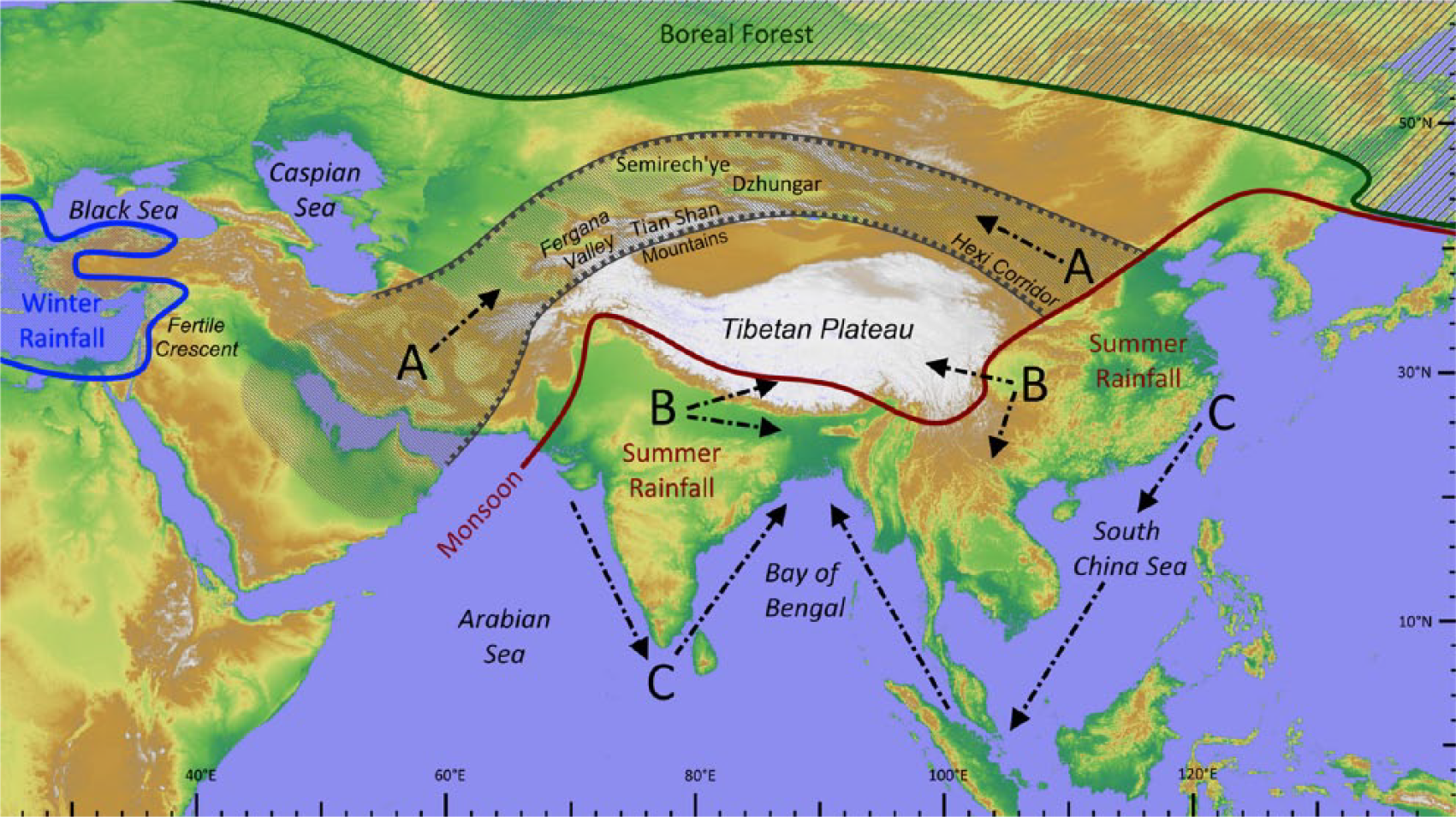
Map showing the defined area of Middle Asia, bounded by the winter rainfall Mediterranean climates in the west, the summer monsoon summer rainfall zones to the south and the boreal forest to the north. Potential prehistoric routes from East Asia to West Asia. (A) Northern route through the Inner Asian Mountain Corridor (IAMC), the proto-Silk Road via the Hexi corridor and Fergana Valley, encompassing Xinjiang, southern Kazakhstan, Kyrgyzstan and Tajikistan, branches into Afghanistan and Uzbekistan/Turkmenistan; (B) Southern Himalayan/Tibet route; Sichuan, Yunnan, Tibet, Bhutan, Sikkim, Nepal and Arunachal Pradesh with southern branches via Laos. Thailand, Myanmar, Assam, Bangladesh and northern India; (C) Maritime route, Chinese Coast via Vietnam, Malaysia, Sri Lanka and Southern India.
Processes of increasing movement and exchange, beginning in the third millennium BC, saw the diffusion of selective items of culture across multiple cultural and linguistic groups and stands in contrast to earlier Neolithic modes of dispersal involving migrating farmers or agro-pastoralists who introduced whole subsistence packages to new regions (cf. Bellwood, 2005; Fuller, 2006; Harris, 2010). Recent scholarship has taken a particular interest in the arrival of wheat in China, in terms of timing, route and process (e.g. Barton and An, 2014; Betts et al., 2014; Flad et al., 2010; Frachetti et al., 2010; Liu et al., 2014). Conversely, the spread of millet westwards from China to Europe or western Asia has been increasingly debated (e.g. Motuzaite-Matuzeviciute et al., 2013; Spengler, 2015; Valamoti, 2014).
The space through which this movement took place (Figure 1) encompasses core Central Asia (Kazakhstan, Kyrgyzstan, Tajikistan, Turkmenistan and Uzbekistan) and adjoining regions (Turkmenistan, Afghanistan, northern Pakistan and northwest India, Mongolia and Xinjiang northwest China) – Route A. Also considered are possible routes though the southern Himalayas (Tibet, Bhutan, Sikkim, Nepal), Bangladesh, Myanmar and northeast India (Assam, Arunachal Pradesh) – Route B and maritime routes connecting China to South East Asia, South India, Arabia and East Africa (Route C).
The first part of this paper discusses the earliest evidence within AsCAD for the movement of wheat and contemporary cultigens out of the Near East and into China and India. The second the translocation of crops from China across Central and Western Asia, in particular millets, peaches, apricots for which there is good supporting evidence in AsCAD, and finally japonica rice and its role in the evolution of indica rice within India.
Wheat goes east
Beginning around 9500 BC, a few varieties of wheat, alongside barley, started their paths to domestication within various regions of the ‘Fertile Crescent’ in Western Asia (Fuller et al., 2014; Riehl et al., 2013; Tanno and Willcox, 2012). The cultivation of pea (Pisum sativum), lentil (Lens culinaris), chickpea (Cicer arietinum) and flax (Linum usitatissimum) is likely broadly contemporary or a few centuries later (Fuller et al., 2014: supplementary material, available online). Nevertheless, the movement of this crop package east was neither synchronous nor complete, with elements dropping out, while others lagged behind.
Most archaeological prehistoric Chinese wheat remains, as with the dominant cultivated form today, are likely hexaploid free-threshing, Triticum aestivum ssp. aestivum (cf. Crawford, 2006; Flad et al., 2010; Spengler, 2015). This contrasts with the west, where Neolithic and Bronze Age agriculture was largely based on hulled wheats; diploid einkorn (Triticum monococcum ssp. monococcum), tetraploid emmer wheat (Triticum turgidum ssp. dicoccum) (see Kirleis and Fischer, 2014; Zohary et al., 2012: 45) and a now extinct hulled wheat ‘new glume wheat’ (Jones et al., 2000; Kohler-Schneider, 2003). However, secondary hulled wheats, with limited distribution, emerged in Tibet (T. aestivum var. tibetianum JZ Shao) and Yunnan (Triticum aestivum subsp. yunnanense King ex SL Chen), probably shortly after their arrival on the Tibetan plateau (cf. Wang et al., 2007; Zeng et al., 2010; contra Tsunewaki et al., 1990).
By 7000 BC, this whole package of emmer and einkorn wheat, barley, pea, lentil and flax had reached western Iran (Figure 2). But in northern Iran, Turkmenistan and Pakistan, cereals predominantly without pulses constituted the earliest crops, with an emphasis on hulled wheats in the Djeitun Culture of southern Central Asia (Charles and Bogaard, 2010; Roustaei et al., 2015), and free-threshing bread wheat in Pakistan, although emmer and einkorn remained present (Fuller, 2006; Tengberg, 1999).
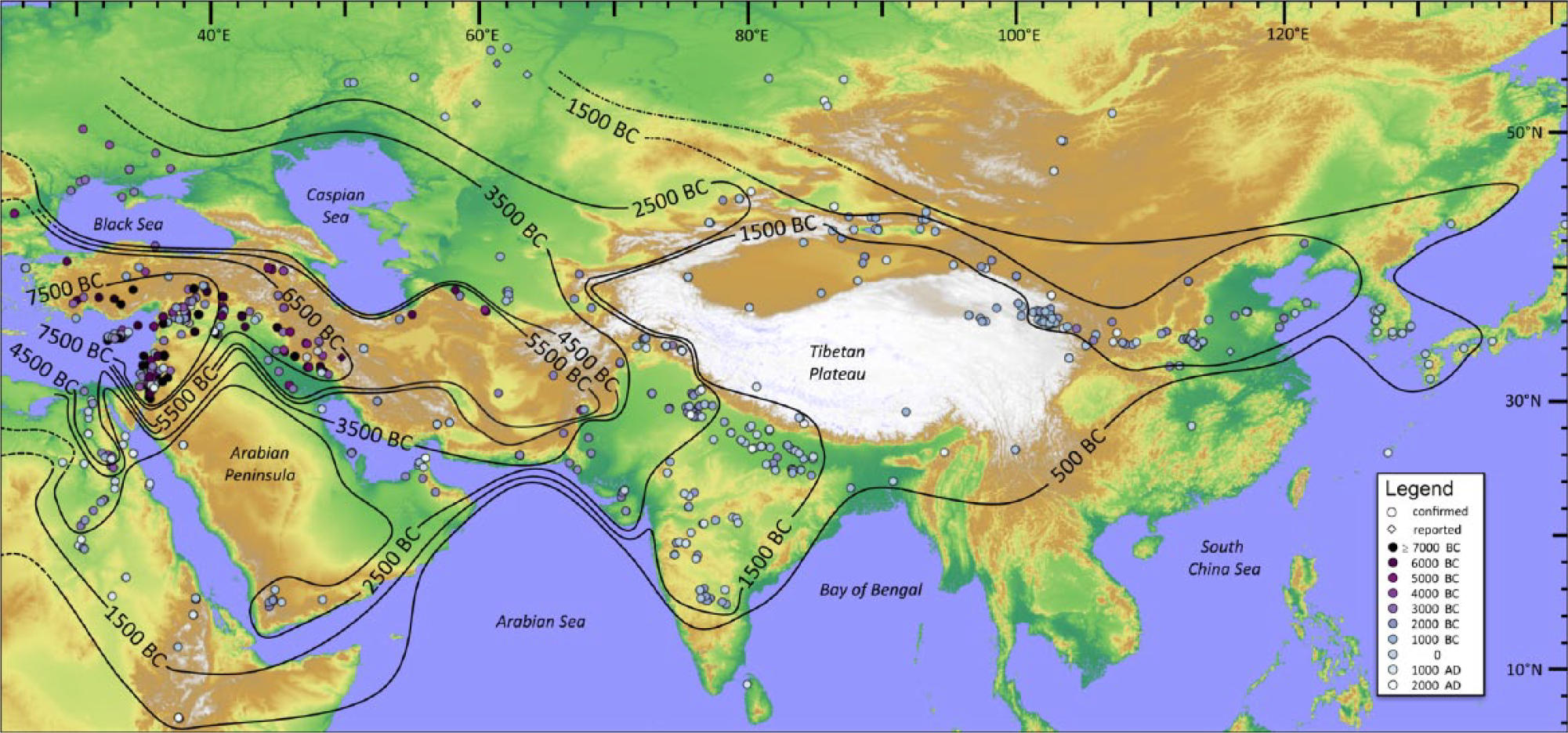
Map showing chronological diffusion of wheat (Triticum sp.) and barley (Hordeum vulgare) throughout Eurasia compiled from AsCAD. Individual sites with evidence for wheat and/or barley are shown. The contours are within 1000-year increments covering the period 8500–500 BC and provide a general indication of the chronological spread of wheat and barley based upon our best reading of current existing data as given within the text.
In Central Asia, a compact free-threshing wheat arrived between c. 5500 and 4000 BC (Miller, 1999, 2011). For many sites, it is unclear if these free-threshing wheats are hexaploid or tetraploid. However, the near spherical compact form suggests hexaploid, for example, Anau South, 3000–2700 BC, Turkmenistan (Miller, 1999), and Harappan Shortugai, Afghanistan after 2200 BC (Willcox, 1991). Wheat rachises from Harappan Miri Qalat, southern Pakistan, also clearly indicate hexaploid, not tetraploid, free-threshing wheats (Tengberg, 1999), as do those illustrated from Shortugai (see Willcox, 1991). Further research is needed on whether the compact forms of wheat that characterize the Indus Valley, Central Asia and Eastern Asia arose multiple times during the eastward dispersal of wheat, as seems likely (see Spengler, 2015).
In contrast to Central and Eastern Asia, tetraploid free-threshing wheats, along with emmer wheat, have traditionally been important across much of India (Salunkhe et al., 2012; cf. Fuller, 2006). However, while emmer, with pea, lentil and native Indian pulses, black gram (Vigna mungo) and/or mungbean (Vigna radiata), was present in Kashmir by the third to mid-second millennia BC (Mani, 2004; Saraswat and Pokharia, 2004), in South India by the second millennium BC (Fuller, 2006, 2011a, 2011b), and in the upper Punjab plain in the first half of the third millennium BC (Fuller, 2006: 23; Saraswat, 1986; Saraswat and Pokharia, 2003), hulled wheats neither appear to have extended north or east of Turkmenistan and Afghanistan in prehistory, nor is there evidence for free-threshing tetraploids.
The subsequent spread of compact hexaploid free-threshing wheat and barley to the northeast and southeast of the Tibetan plateau is broadly synchronous. At 2840–2490 BC, free-threshing wheat is recorded from Tasbas I, eastern Kazakhstan (Spengler, 2015), with hexaploid-type free-threshing wheat and barley at early Harappan sites by 3200–2600 BC (Fuller, 2011a, 2011b; Weber, 2003). It reached inner India, northeast of the Aravalli hills in Rajasthan, by the mid to late third millennium BC, and entered the southern Deccan by the start of the second millennium BC (Fuller, 2011b; Kajale, 1988, 1996; Pokharia, 2007). While originally only emmer and barley were present in Kashmir, free-threshing wheat dominates the later early second millennium BC Neolithic sites (Fuller, 2011b; Lone et al., 1993).
Throughout India, wheat and barley frequently co-occurred with lentil, grasspea (Lathyrus sativa), pea, sometimes chickpea, and always sheep, goat and zebu cattle, representative of a clear subsistence package of predominately Western Asian origin. In Central Asia, of the pulse crops, only pea from Tasbas 2A, dated to 1441–1262 cal. BC (Spengler, 2015), appears present, and no archaeological remains of Near Eastern pulses are recorded prior to this in AsCAD from Central Asia nor China.
Concerning the date by which wheat and barley first enter China, problems arise, compounded by possible intrusive material or contaminated dates. Of the Chinese sites with wheat and/or barley in AsCAD (n = 113), 14 purportedly date between 3000 and 2200 BC. An early C14 direct date from Donghuishan was dismissed in light of six further direct dates on wheat and barley between 1900 and 1400 BC (Dodson et al., 2013; Flad et al., 2010). Potential early finds of wheat from Shandong include one in association with directly dated rice, 2150–1770 cal. BC (Crawford et al., 2005), and a direct date of 2570–2200 cal. BC, on wheat from Longshan contexts at Zhaojiazhuang, Shandong (Jin et al., 2011). Dodson et al. (2013) present a case for the entry of wheat via the Hexi Corridor into northern Gangsu around 3000 BC, with an eastern spread into Shaanxi from 3000 to 1800 BC, south into Xizang around 2600 BC, and then west to Xinjiang from 1900 BC. However, taking a more sceptical view of material that is not directly dated, and regarding Zhaojiazhuang as an anomalous result like the initial result from Donghuishan, wheat is only securely dated in China from the early second millennium BC (Zhao, 2015), for example, Houshiliang 2135–1895 cal. BC, north Gansu (Dodson et al., 2013), making it 500 years later in China than Tasbas, Kazakhstan (Spengler, 2015).
A more cautious review of the evidence within the AsCAD, especially when combined with that for the spread of millets westwards (see below), puts the arrival of wheat in China more conservatively between 2200 and 1800 BC (Figure 2). The most likely route of dispersal being via the Hexi Corridor into north Gangsu (following Dodson et al., 2013), given the spread of millet farming outwards (see below). However, without more research, and dating, for example into wheat records for the Longshan Culture of Shandong, questions will undoubtedly remain over how rapid this spread was or indeed whether multiple routes existed.
Associated with the spread of wheat, sheep and taurine cattle reach China by the end of the Longshan (c. 2000–1900 BC). Dates as early as 3000 BC (Fuller et al., 2011b; Mair, 2003) for the arrival of these species remain unconfirmed by direct C14 dating, with potential misidentification through confusion with indigenous caprines and bovines.
In Sichuan, the earliest dates for wheat and barley are around 1400–1000 BC from Ashaonao (D’Alpoim Guedes et al., 2015). In Yunnan, C14 dates for wheat from Haimenkou are of similar age, 1450–1150 BC (Li and Min, 2014; Xue, 2010), with earlier levels producing only rice and millets. Notably, wheat appears in the same horizon as the first record for soybean (Glycine max), implying a potential secondary crop diffusion process from the north.
Concerning the spread of wheat and barley back east, D’Alpoim Guedes et al. (2014, 2015) highlight the importance of spring-grown varieties for enabling agriculture at higher altitudes, and archaeobotanical evidence indicates that barley, and to some degree wheat, facilitated further upwards colonization of Qinghai and Tibet after 1600 BC (Chen et al., 2014). Yaks (Bos grunniens) are also likely to have been domesticated by this time (Larson and Fuller, 2014; Rhode et al., 2007), and thus a suitable agro-pastoral complex facilitated rapid colonization of the Tibetan plateau.
The site of Changgougou in southern Tibet, dated 1470–850 BC, yielded a cultural assemblage with affinities to the earlier Karuo Culture to the northeast (see below), suggesting dispersal through southeast Tibet. Remains of free-threshing wheat, barley and foxtail millet along with a single possible pea, and naked oats were recorded (Fu, 2001). The oats (Avena nuda) potentially implies a separate eastern Asian domestication, as the date is plausibly as early as domesticated oats in western Eurasia (Zohary et al., 2012).
Other western domesticates enter China later. While flax is known from the Jhong Valley, Nepal, between 1000/400 BC and AD 100 (Knörzer, 2000), the earliest records of probable cultivated flax in China are from Ashaonao, Sichuan, at 200–50 BC (D’Alpoim Guedes et al., 2015). There is an implication based on the small size of the seed that it might be a local wild species or local domestication (cf. D’Alpoim Guedes et al., 2015, supplementary material, available online). However, the size is within the range of charred archaeobotanical specimens of cultivated flax from Near East, Europe and the Indus Valley, and there is no reason to suspect that flax had not reached China by this date. Chinese written sources suggest flax (used exclusively as an oilseed) and sesame, originating in India/Pakistan (Fuller, 2003), were introduced via central Asia in Han times, 206 BC to AD 220, and sometimes confused as ‘western hemp’ (Hu ma) (Bray, 1984: 526).
Similarly, written sources suggest broad bean (Vicia faba) and pea were introduced in the Han dynasty, and often referred to as ‘western beans’ (Hu dou) (Bray, 1984: 516). Finally, written sources suggest that sorghum reached southwest China only in the first half of the first millennium AD (Hagarty, 1941), and a third-century text suggests introduction at this time via Central Asia (Sogdhiana) (Bray, 1984: 449), although earlier, unsubstantiated archaeological finds have been claimed (Kimber, 2000)
Millets go west
The domestication and spread of millets across China
Two types of millet were cultivated and domesticated in northern China (Stevens and Fuller, in press; Liu et al., 2009; Zhao, 2011). Evidence for the cultivation of broomcorn millet (Panicum miliaceum), together with foxtail millet (Setaria italica), first appears in Hebei associated with the Cishan Culture 6500–5500 BC. Contemporary centres of domestication with mainly broomcorn millet, and foxtail millet later, are found associated with the Xinglongwa Culture of the northeast in Manchuria. While Peiligang Cultures to the southwest in northern Henan have just foxtail millet reported. Two further centres for early cultivation are known; with both foxtail and broomcorn millet in northwest Shandong, associated with the Houli Culture, and just broomcorn millet in southeast Gangsu with the Dadiwan Culture. However, the collapse of these cultures between 5500 and 5000 BC, followed by breaks in settlement, suggest cultivation dead-ends, without full domestication. To the south, contemporary separate processes of rice domestication were taking place in the Yangtze basin (Deng et al., 2015), with subsequent dispersal northwards into the millet zone of the Yellow River Valley by 3500 BC, and south to the tropics by 2500 BC (Silva et al., 2015).
By 4500 BC, millet cultivation had spread west along the Yellow and Weihe River valleys into Shanxi (Figures 3 and 4), and by 4000 BC re-entered Gansu during the rise of the Banpo Culture (Stevens and Fuller, in press). The drive behind this expansion is attributed to demic-diffusion with settlement and population increase evident in Shaanxi from 5000 to 4000 BC (Wagner et al., 2013). Further population increase over the next 500 years saw the diffusion of millet farmers initially up the Weihe and Zhanghe river valleys, and later along the Yellow River and its tributaries into eastern Qinghai between 4200 and 3750 BC (Wagner et al., 2013).
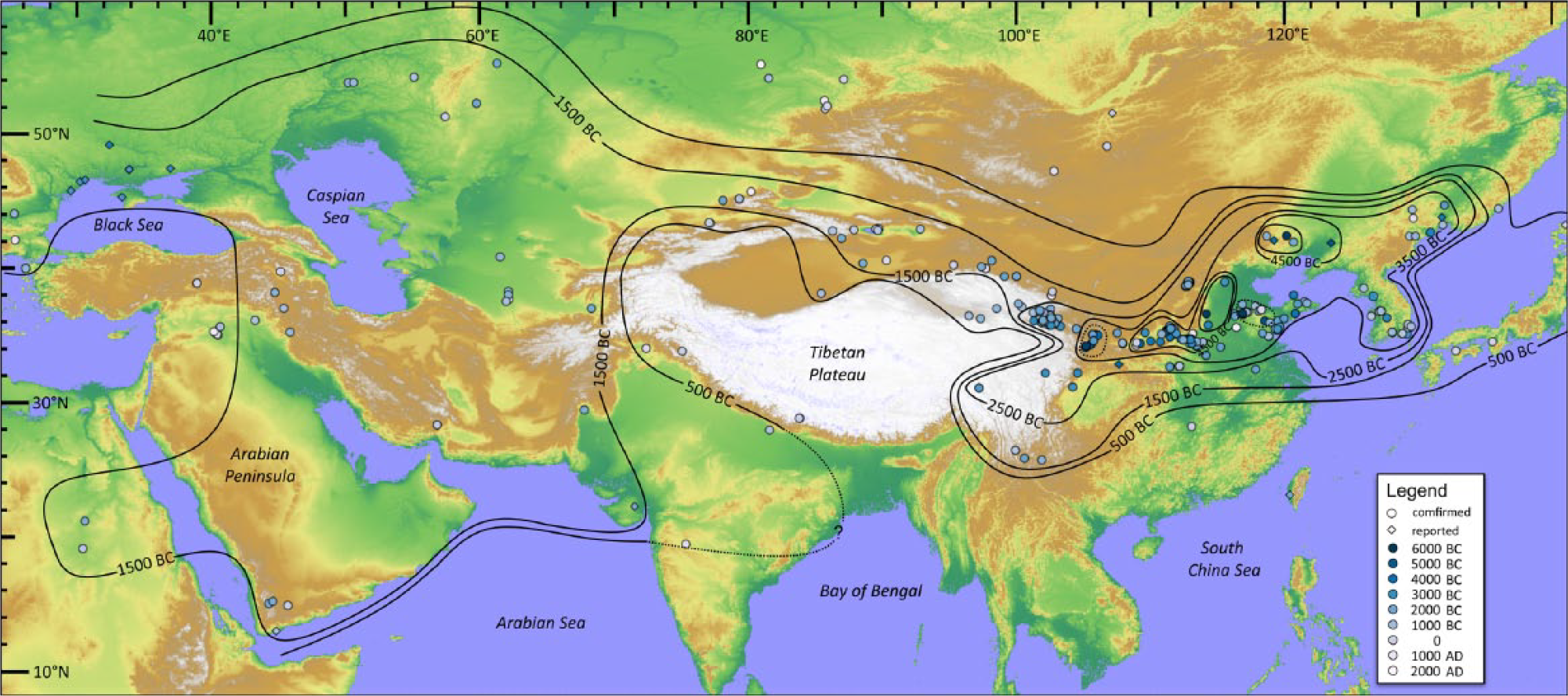
Map showing chronological diffusion of broomcorn millet (Panicum miliaceum) throughout Eurasia compiled from AsCAD. Individual sites with evidence for broomcorn millet are shown. The contours are within 1000-year increments covering the period 5500–500 BC and provide a general indication of the chronological spread of broomcorn millet based upon our best reading of current existing data as given within the text. Earlier possible dead-end centres of cultivation and possible chronological limits are shown with a dotted line.
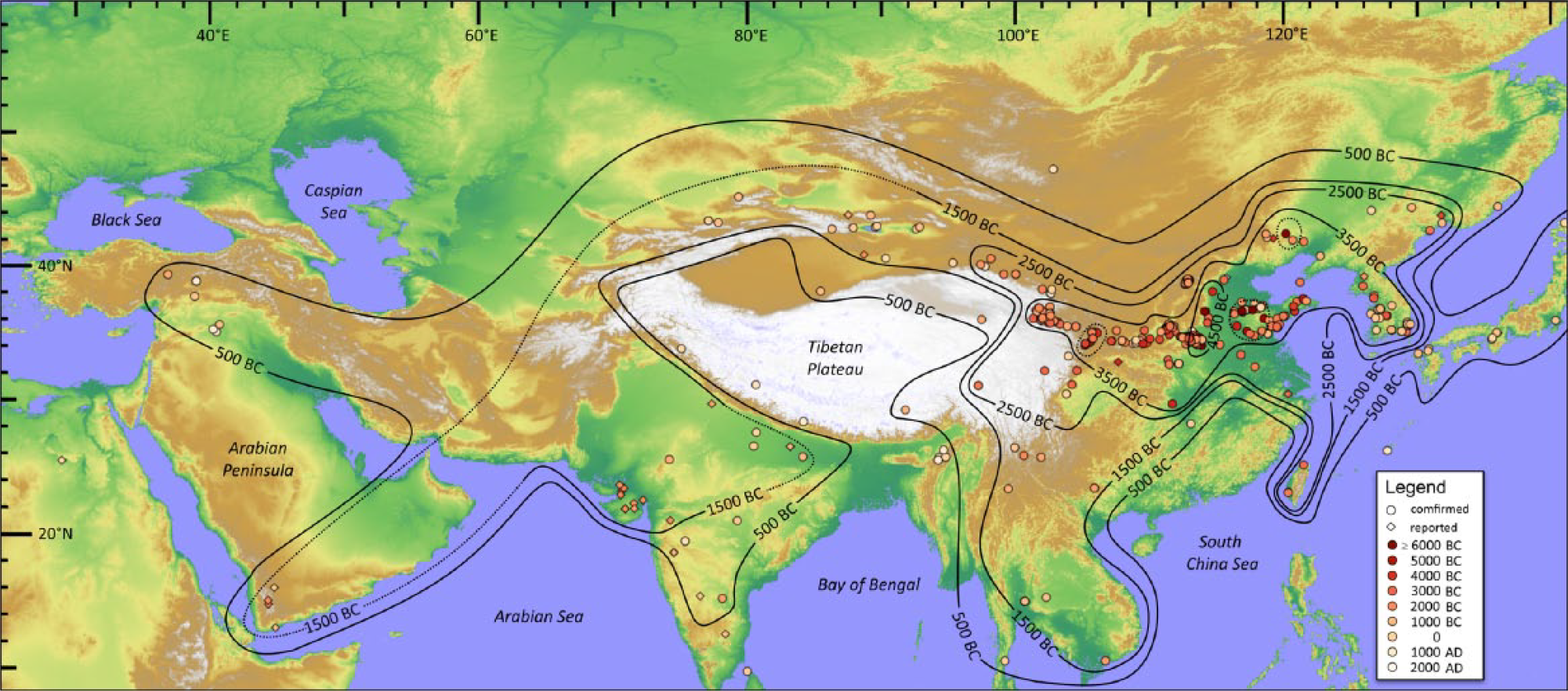
Map showing chronological diffusion of foxtail millet (Setaria italica) throughout Eurasia compiled from AsCAD. Individual sites with evidence for broomcorn millet are shown. The contours are within 1000-year increments covering the period 5500–500 BC and provide a general indication of the chronological spread of foxtail millet based upon our best reading of current existing data as given within the text. Earlier possible dead-end centres of cultivation and possible chronological limits are shown with a dotted line.
While the body of evidence for millet farmers increases in eastern Qinghai, 3000–2000 BC, there is no evidence for substantial settlement, population growth or further movement into the higher altitudes of the Tibetan plateau until after 1750 BC (cf. Wagner et al., 2013), facilitated by wheat and barley cultivation (cf. Chen et al., 2014). The movement southwest into Sichuan appears after 3300 BC (D’Alpoim Guedes, 2011), with dispersal west into the eastern mountainous regions of Tibet by 2700–2300 BC, associated with the Karuo Culture (D’Alpoim Guedes et al., 2014). It might be noted that while millets are present in Taiwan at around 2500 BC, there is no tradition of millet cultivation in mainland southeast China. Both millets move southwest into Yunnan from Sichuan by 2500–2000 BC (D’Alpoim Guedes and Butler, 2014; Stevens and Fuller, in press), and into western Guangxi during the early second millennium BC (Zhang and Hung, 2010). An early C14 date on foxtail millet from Thailand, 2500–2200 BC, suggests a rapid diffusion south (Weber et al., 2010), raising the possibility that early third millennium sites await to be found in Yunnan. The distribution of Sino-Tibetan languages through Nepal hints at dispersal along the Himalayan foothills by groups with ancestral knowledge of foxtail millet, broomcorn millet, rice, barley, wheat and buckwheat (Bradley, 2011). Changguogou in southern Tibet, 1450–800 BC, as noted, has affinities to the Karuo Culture, and yielded remains of foxtail millet (D’Alpoim Guedes et al., 2014). However, the absence of loan words for millet connected to those used in Indic languages (see Witzel, 2009) argues against diffusion of the Chinese millets themselves further west via the sub-Himalayan route, or indeed wheat or barley eastwards from south of the Himalayas.
The spread of millets into Central Asia
The transport of millets into Central Asia, as with wheat, can be regarded with a low or high chronology. A cautious approach using only direct-dated finds proposes millet diffusion from China into Central Asia no earlier than the late third millennium BC (e.g. Frachetti et al., 2010; Fuller and Boivin, 2009). The earliest securely dated occurrence of broomcorn millet outside China comes from Begash, Kazakhstan, c. 2200 BC, with foxtail millet by c. 1400 BC at Tasbas some 100 km to the northwest (Spengler, 2015; Spengler et al., 2014). A high chronology, utilizing the earliest postulated evidence for wheat, puts the diffusion of broomcorn millet at 3000 BC, supporting early third millennium BC identifications from ceramic impressions in Ukraine (Pashkevich, 2005; Rassamakin, 1999), and charred grains from the Jevišovice Culture, Austria, at 3000 BC (Kohler-Schneider and Canepelle, 2009: 67). Regarding the former, these millet impressions may be of wild Panicum or even Echinochloa, as millet identification criteria have proved a challenge (cf. Fuller, 2003). Generally, Chinese millet finds dating before 2000 BC are uncommon west of Kazakhstan, raising questions as to the security of early finds in terms of identification criteria and direct C14 dating. Where millets have been directly dated in Europe, they invariably turn out to be no older than the second millennium BC (Motuzaite-Matuzeviciute et al., 2013; Valamoti, 2014). Thus as concluded by Spengler (2015), more systematic archaeobotanical sampling, morphological documentation and direct dating are needed to track the spread of millets.
Chinese millets in Southern and Western Asia
Concerning the arrival of the two Chinese millets on the Indian subcontinent or Africa, one faces the challenge of a wide range of local congenic relatives, including cultivated crops like Indian little millet (Panicum sumatrense) and yellow foxtail (Setaria pumila), not to mention other morphologically similar crops, for example, Brachiaria ramosa and Echinochloa frumentacea (Fuller, 2006; Kingwell-Banham and Fuller, 2014). In compiling AsCAD, we have taken a cautious approach to less secure identifications. Of 41 sites in South Asia (India, Pakistan, Sri Lanka, Nepal) with reports of both species, only six Panicum miliaceum and 14 Setaria italica are regarded as secure (Figures 3–5).
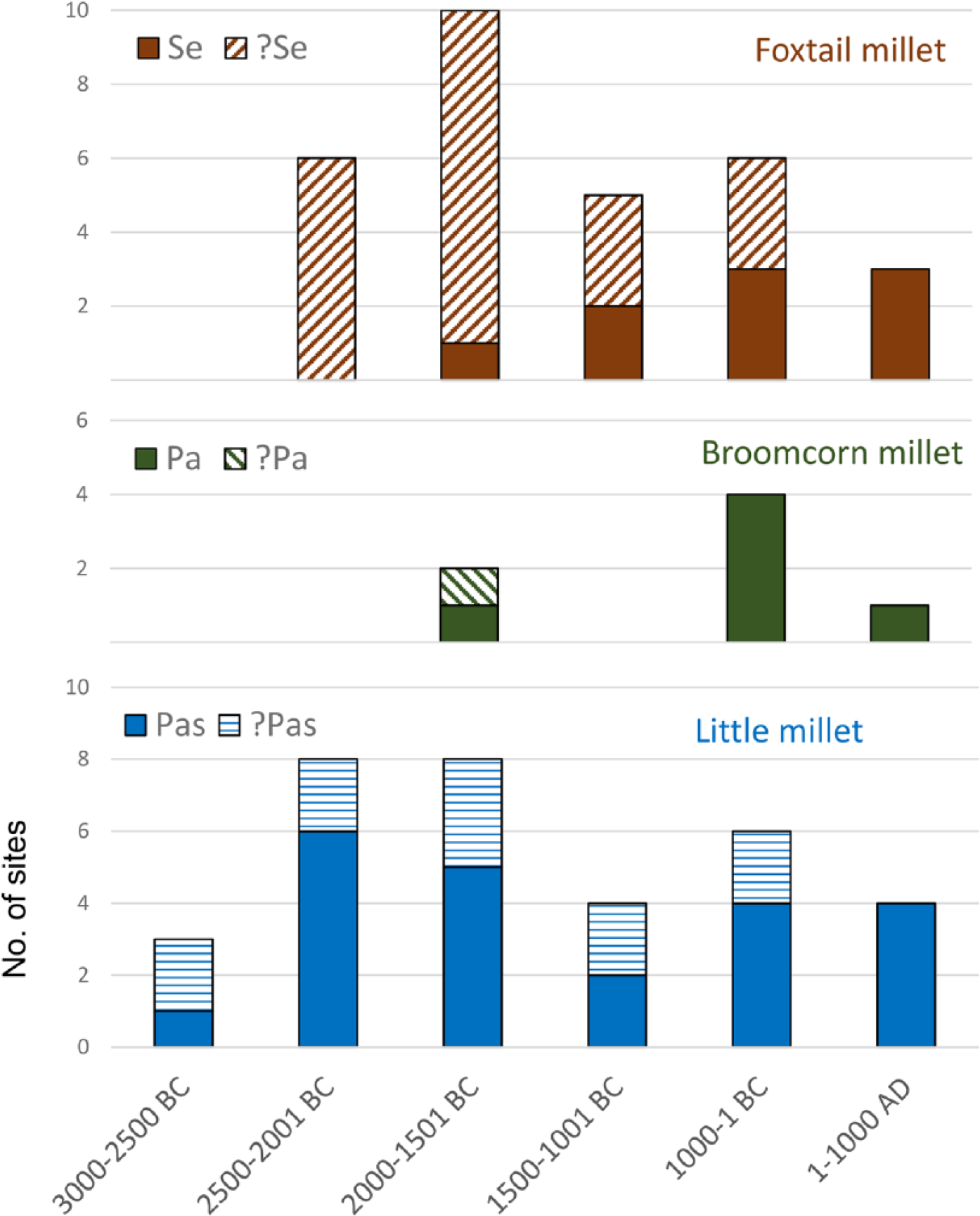
Graph showing number of sites with reported millets for South Asia for different time periods. Solid colours indicate secure identifications and hatched lines indicate specimens of questionable date or identification. Top: foxtail millet (Setaria italica); middle: broomcorn millet (Panicum miliaceum); bottom: little millet (Panicum sumatrense).
Broomcorn millet appears to have spread rapidly from Central Asia in the late third millennium, with evidence from Shortugai, Afghanistan, shortly after 2000 BC (Willcox, 1991), and similar dates from Pirak, southern Pakistan (Costantini, 1979), becoming widespread in the late Harappan period (Fuller, 2011b). Notably, sites in Kashmir, despite earlier finds of peach and apricot, only provide evidence for broomcorn millet at c. 100 BC, and for foxtail millet at AD 250 (Lone et al., 1993).
Third millennium BC foxtail millet finds from Harappan era Gujarat (Pokharia, et al, 2014; Weber, 1993) predate those from Tasbas (cf. Spengler, 2015), but these Indian finds remain problematic. The application of improved identification criteria has confirmed only the presence of Brachiaria ramosa and native Setaria spp. on other sites in the region (Fuller, 2006, 2011a; García-Granero et al., 2015). Secure Setaria italica identifications appear in the late Harappan period after 2000 BC, at Surkotada, Ojiyana and Hulas (cf. Fuller, 2003, 2006; Pokharia, 2007), with increasing evidence thereafter. As such, they predate Central Asian finds of foxtail millet, but not broomcorn millet. The earliest finds being in northwest India/Pakistan and later to the south and east (Figures 3 and 4). The Chinese millets arrive in India and Pakistan well after the establishment of native Indian millets (Figure 5), for example, Panicum sumatrense, confirming the inference that Chinese millets, like their African counterparts, were adopted by peoples already familiar with millet cultivation (Fuller and Boivin, 2009; Weber, 1998).
West beyond southern and Central Asia, broomcorn millet appears earlier than foxtail millet, with apparent dispersal via Arabian Sea connections to Yemen, and after Sudan before the mid-second millennium BC (Fuller and Boivin, 2009). A rapid spread is also seen across central southern Europe in the Bronze Age with evidence for possible millet consumption from around 1600 BC (Tafuri et al., 2009; Valamoti, 2014). Setting aside the Austrian early third millennium BC find (Kohler-Schneider and Canepelle, 2009), broomcorn millet is reported from Troy at c. 1550 BC (Riehl, 1999), and three other sites in Turkey, Syria, Iraq and Iran between 1500 and 1000 BC. The earliest foxtail millet in the region from late Bronze Age Kusakli in Turkey is similarly dated, 1550–1200 BC (Pasternak, 1998). The late, and inconsequential place of millets in the Middle East suggests they spread south via the Indus region to the Arabia Sea to reach Yemen and Nubia in the same era that brought African crops to South Asia (Boivin and Fuller, 2009; Fuller and Boivin, 2009).
It is perhaps worth drawing attention here also to sorghum, pearl millet and hyacinth bean that travelled to India from northeast Africa on the reverse route by the early second millennium BC based on secure finds (Fuller 2003; Fuller and Boivin, 2009), with a few earlier reports of sorghum claimed from third millennium BC Harappan sites in northwest India (Pokharia et al., 2014).
The ‘Chinese Horizon’
In the early second millennium BC, a number of sites arise in northern India and Pakistan with elements that constitute a defined ‘Chinese Horizon’ (Fuller and Boivin, 2009). These include artefacts, along with cultigens; peach (Amygdalus persica) and apricot (Armeniaca vulgaris), potentially Chinese rice, Oryza sativa subsp. japonica (discussed below) and hemp (Cannabis sativa), correlating with the earliest occurrences of Chinese millets on the Indian subcontinent (Figure 6). The seemingly broadly synchronous arrival of these crops of Chinese origin, in northwest India and Pakistan led to hypotheses that they diffused utilizing social exchanges and incipient trade networks through Central Asia (see Boivin et al., 2012; Fuller, 2006, 2011b; Fuller and Boivin, 2009; Fuller and Madella, 2001; Frachetti, 2012; Hunt and Jones, 2008; Hunt et al., 2008). It might be noted that many authors refer to this route in general terms as the Eurasian Steppe, while Spengler (2015) specifically narrows it to the southern valleys and mountain foothills linking China to Central Asia (Spengler, 2015), although he sees such diffusion as less synchronous (Route A).
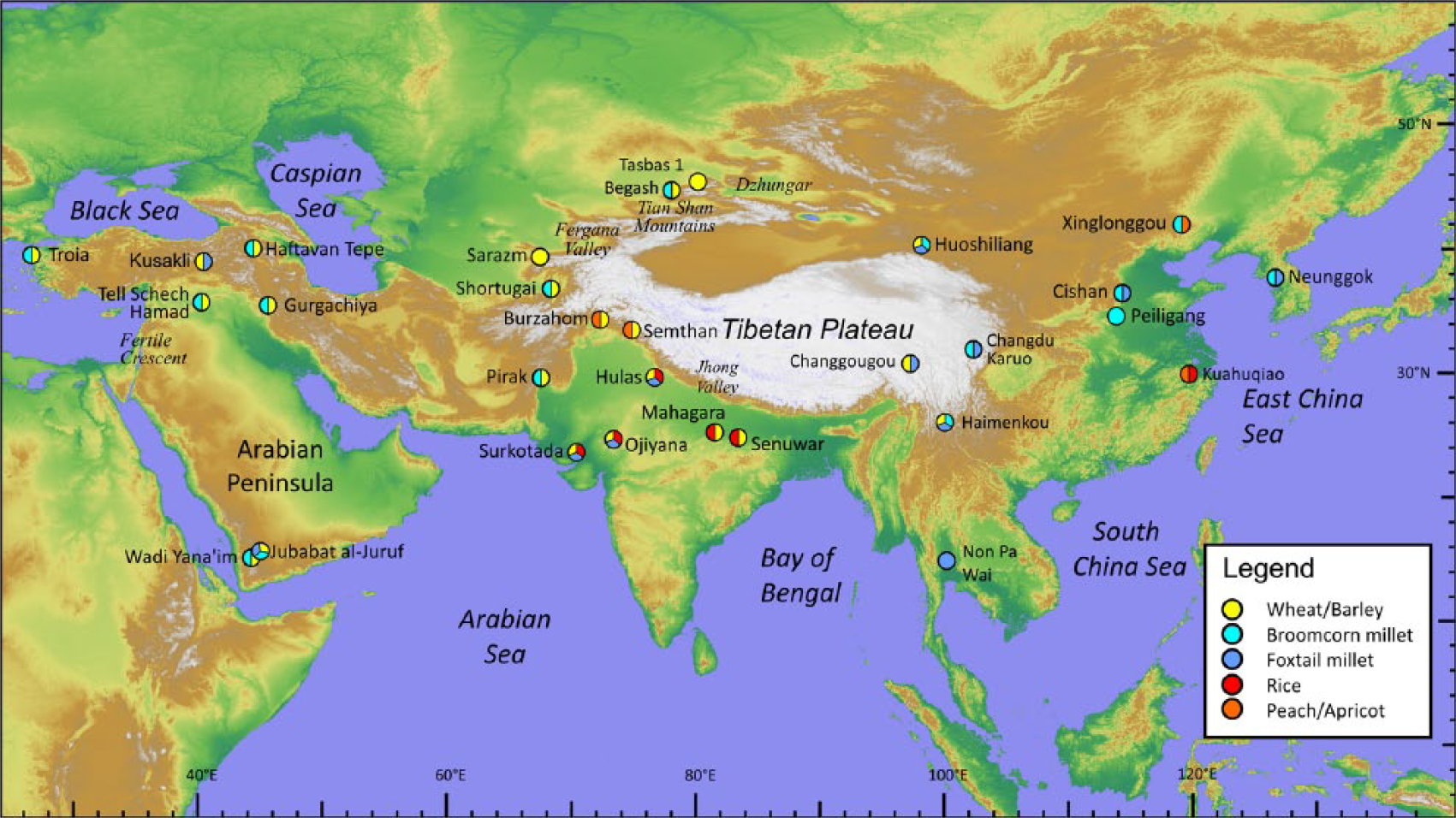
Eurasia showing locations of key sites in the text with early evidence for translocations of crops; including apricot (Armeniaca vulgaris) and/or peach (Amygdalus persica) (Burzahom, Semthan); cannabis/hemp (Cannabis sativa) (Senuwar); along with broomcorn millet, foxtail millet, wheat and/or barley, and evidence for the introduction of japonica rice (Oryza sativa subsp. japonica) (Mahagara). Additional information on the dating of these can be found in the supplementary data (available online).
As seen from AsCAD, these elements arrive in South Asia piecemeal and are non-uniform in their spatial occurrence, in contrast to the ‘agricultural-packages’ that characterized the gradual demic-diffusion of migrating agriculturalists across Europe (Rowley-Conwy, 2011), China (Stevens and Fuller, in press) and Southeast Asia (Bellwood, 1996, 2005, 2012). Instead they are congruent with the beginnings of an era in which exchange, trade, and associated small-scale migrations accompanying such trade, became the major forces behind a more rapid dispersal of cultigens.
Cultural and archaeobotanical assemblages from sites in Kashmir, and adjacent Swat, northern Pakistan, begin to show shared similarities from around 1800 BC. These similarities include elements originating in China, such as Chinese-style harvesting knives, square stone artefacts with one or two holes likely to be used for the harvesting of individual cereal panicles or ears, and a small number of possible jade objects (Coningham and Young, 2015: 124–126; Fairservis, 1975; Stacul, 1976, 1993: 88–90), and Chinese ceramic traditions (Han, 2012). While tripod vessels are notably absent, the earlier aceramic levels of Burzahom (3000–2850 BC) and Sari Kala also had bone tools and ground-stone ‘celts’ similar to those of the Yangshao Culture from northern China (Sharif and Thapar, 1992: 148). Along with Near Eastern crops; wheat, barley, lentil and pea; and native Indian mungbean, two of the sites have produced evidence for charred fragments of peach and apricots, potentially including the earliest levels at Burzahom (c. 2400–1700 BC), although Chinese millets are not present until the late first millennium BC (Lone et al., 1993, 2000). First millennium sites BC in Jhong Valley, Nepal, have also produced finds of apricot (Knörzer, 2000).
The Chinese artefacts have been associated with the Yangshao Culture (Dikshit and Hazarika, 2012; Mughal and Halim, 1972; Sharif and Thapar, 1992: 148), but Chinese scholars have more specifically related them to the Majiayao cultural phase of Gansu, Sichuan, Qinghai and Yunnan, noting strong similarities to the southeastern Tibetan Karuo Culture (Han, 2012; Huo, 1990). However, the origins of both peach and apricot in Kashmir, where they were likely cultivated, are still a matter for some debate.
Wild stands of apricot reported from Armenia (Zohary et al., 2012: 144) are considered introduced and feral (Kostina, 1971), and while archaeological finds of apricot have been reported from sites in Ukraine dating from 6000 to 4750 BC (Pashkevich, 2005), this appears contrary to their late arrival in Western Europe.
The origin of apricot domestication is generally identified as north and northeast China with secondary centres, in the Tian Shan Mountains of Xinjiang, the Zaliji and Dzhungar Mountains of Kazakhstan and the Caucasus, possibly constituting introgression between wild populations and Chinese cultivars (Weisskopf and Fuller, 2014a; contra Zohary et al., 2012: 144). The earliest finds of apricot within the AsCAD clearly support a Chinese origin (Figure 6; Table S1, available online). Early dates comprise Xinglonggou (6200–5400 BC) in northeast China (Liu et al., 2015), although here Armeniaca vulgaris may be confused with other local wild species, Kuahuqiao (6000–5400 BC) in the Lower Yangtze and possible early Yangshao period, Henan (Qin and Fuller, 2009; ZPIAC, 2004). Numerous finds from later sites dating to the Longshan/Erlitou period (2500–1700 BC), probably indicate full domestication and possible orchard cultivation by this period (Fuller and Zhang, 2007). Further finds are also present from Yunnan (1500–800 BC, authors’ own records).
The wild progenitor of peach is regarded as once being widely distributed through northern China (Kostina, 1971; Lu and Bartholomew, 2003), but now extinct (Weisskopf and Fuller, 2014b). Zheng et al. (2014) make a good case based on kernel size increase for at least one domestication centre within the Lower Yangtze between 5500 and 2500 BC. Peach finds recovered from the Yangshao period in central China could have been from wild trees, but it seems likely, as with apricots, that cultivation was established by the Longshan period, c. 2500 BC (Hosoya et al., 2010; Weisskopf and Fuller, 2014b). Notably, peach is only reported much later within the first millennium BC from European contexts (Zohary et al., 2012: 144) further supporting an eastern domestication.
Given peach finds are unknown outside China prior to the second millennium BC, and their close association with the arrival of Chinese-style harvesting knives, it seems likely that both peach and apricot came as cultivated species from China into Kashmir by, or perhaps even before, the early second millennium BC.
Regarding the modes and routes of dispersal, possibilities include its cultivation and exchange, as with millet, between groups of agro-pastoralists occupying the Inner Asian Mountain Corridor (IAMC comprising Semirech’ye, Tian Shan and Pamir; see Frachetti, 2012; Spengler, 2015); its exchange as dried fruits without cultivation over long distances as part of a proto-Silk Road; by the small-scale migration of peoples from east to west following early exchange networks; or finally by the diffusion of shifting cultivators via the southern Tibetan/Himalayan route.
Writing in 1919, Sturtevant Hendick postulated that the quick germination and growth of peach would have allowed its rapid dispersal along ancient caravan routes from China to Kashmir or Bukhara (Uzbekistan) (see Faust and Timon, 1995).
As with apricot, feral peaches are known from Gansu, while a close relative Amygdalus ferganensis (syn. Prunus ferganensis), grows within the Tian Shan Mountains (Faust and Timon, 1995), and is cultivated within Xinjiang, and the Fergana Valley, Kyrgyzstan and Uzbekistan (Lu and Bartholomew, 2003). The distribution of Amygdalus ferganensis and the existence of feral populations of both peach and apricot might suggest they could be spread relatively easily by agro-pastoralists at an early date.
Nevertheless, trees take some 3–4 years to produce fruit after planting, and hence we must ask if they would be congruent with the strategies of seasonally mobile pastoralists or agro-pastoralists. One of the potential secondary centres for apricot domestication is in the Dzhungar Mountains, where the sites of Tasbas and Begash are located. However, neither apricot nor peach stones have been recovered from these sites (see Spengler, 2015; Spengler et al., 2014).
The third millennium BC in parts of Central Asia began to see directed animal domestication processes aimed more at transport and trade than earlier Neolithic domesticates aimed at subsistence (Larson and Fuller, 2014). The start of the second millennium BC witnessed a transportation revolution, with the appearance of horses and Bactrian camels in the Indus region (Meadow, 1989). This arrival is often equated with the arrival of Indic languages in South Asia (Beckwith, 2009; Parpola, 1988; Witzel, 2005), although this process was likely more complex and protracted. The Old Indo-Aryan term for Bactrian camel appears to be a loan word from the same central Asian language that supplied the root for Cannabis sativa (Witzel, 2005, 2009), which also sees its first archaeobotanical record in South Asia on the Middle Ganges in the late second millennium BC (Saraswat, 2004). Evidence from Qinghai puts horses and camels in China from the first half of the second millennium BC (Mair, 2003).
During the second millennium BC, the cultivation of perennial woody plants was well-established in the Indus Valley, including grapes (Vitis vinifera), tree cotton (Gossypium arboreum), date palms (Phoenix dactylifera) and Indian jujube (Ziziphus mauritiana) (Fuller and Madella, 2001). The late Harappan period, after 2000 BC, along with apricot and peach, saw numerous fruit trees from the Indus and of western origin adopted into cultivation in northern Pakistan and Kashmir, including grapes, almonds (Amygdalus communis) and hackberries (Celtis caucasica) (Lone et al., 1993: Table 11.6; Fuller and Madella, 2001).
Dried fruit has long traditionally been seen as a valued trade item across Central Asia (Kostina, 1971). But could incipient trade systems have brought peaches and apricots all this way via the IAMC?
The preparation of dried fruit need not involve the removal of the stone, although the fruit stones themselves do have some food value (Hosoya et al., 2010). As such, whole fruits or stones would have to be exchanged, or carried, for them to be cultivated outside of the IAMC. Alongside the limited storage of such products using traditional techniques, that peach and apricot stones only remain viable for a year under normal dry storage conditions (Scorza and Sherman, 1996) further implies that if such diffusion was without cultivation, then stones or whole fruits would have had to pass quickly along established routes to be cultivated at their end points.
Regarding mechanisms of exchange within the IAMC, Frachetti (2012) proposes a loose system of exchange of seasonally mobile pastoralists gradually diffusing goods from one valley to the next with increased political and social ties giving rise to incipient trade networks within the second millennium BC. Spengler (2015) envisages a similar scenario although emphasizes the small-scale seasonal cultivation of crops. If diffusion via this sort of exchange was frequent enough to facilitate the trans-Eurasian journey of peach and apricots across Eurasia to Kashmir, we might again expect greater evidence of charred stones from the Eurasian Steppe and IAMC sites, and perhaps beyond Kashmir. Furthermore, unlike metals, beads or precious stones, given the value of fruit and their stones are as food it is questionable how many exchanges such objects could be expected to go through to bring them 2000–3000 km across Eurasia from northern China.
More direct forms of exchange beginning in the third millennium BC have been proposed linking the Indus, Western Turkmenistan/northeast Iran and the mountains of Central Asia (Winkelmann, 2000). However, the site of Sarazm in Tajikistan, which would appear key to understanding the origins of such trade (Spengler, 2015), produced no evidence for apricot and peach (Spengler and Willcox, 2013), nor Shortugai, Afghanistan (Willcox, 1991), a Harappan trading outpost. However, later finds of apricot and peach have been recovered from Xinjiang dated to around 200 BC–AD 30 (Jiang et al., 2008), while western grape (Vitis vinifera) is also well represented from around 400 BC at Tuzusai, southeast Kazakhstan (Spengler et al., 2013a) and Xinjiang (cf. Chen et al., 2012; Jiang et al., 2009, 2012).
A trade in ‘stone-less’ dried fruit would leave less evidence for peach and apricot, and as stated might encourage the transport or exchange of the stones themselves to Kashmir where they could be cultivated. The distinctive Chinese-style harvesting knives, if part of such a trade network, are not known from sites in Central Asia (cf. Spengler, 2015), although these might be regarded as labour-demanding (to make and to use) and inconsistent with more opportunistic cultivation by agro-pastoralists. The Chinese-style harvesters from at least Kalako-deray are made from a local light red schist (Stacul, 1993: 78), which might argue for the movement of people, including craftsmen, rather than mere trade per se. A strong case for the movement of crops through rapid long-distance migration of small groups is suggested for the entry of agriculture into Taiwan from Shandong, a journey of some 1400 km mostly by sea (see Sagart, 2008; Stevens and Fuller, in press).
While the northern route for the arrival of peach and apricot is the traditionally preferred route (Boivin et al., 2012; Lone et al., 1993: 195), it is worth drawing attention to the possible southern route favoured by Sharif and Thapar (1992: 149) for at least the material culture of the Kashmir Valley. Han (2012) using stylistic analysis distinguishes a southern and northern route for diffusion of ‘painted pottery’ traditions from China into Central Asia, and associates the ceramics from Kashmir with the Karuo Culture and a southern Himalayan/Tibetan route. Furthermore, the only finds of Chinese-style harvesting knives in southern Asia outside of Kashmir and the Swat Valley come from Sikkim (Sharma, 1996) and southern and southeast Tibet (Han, 2012). However, the Sikkim finds are undated, while the Tibetan material generally dates to the mid-second to early first millennium BC postdating the Kashmir Valley sites, although evidence for the arrival of agriculturalists in Bhutan has been claimed to be as early as 2500 BC (Meyer et al., 2009).
Tree cultivation further east in India, such as in the middle Ganges plains, does not appear to start before c. 1400 BC, when jackfruit (Artocarpus heterophyllus), from South India, and mango (Mangifera indica), probably from Assam, began to be cultivated (as well as tamarinds, Citrus and bael fruits). This was some centuries after permanent villages based on winter wheat/barley and summer rice cultivation had been established in the region (Fuller, 2009; Kingwell-Banham and Fuller, 2012).
Early finds of hemp seeds (Cannabis sativa) from Senuwar, east India, were dated to 1400–700 BC (charcoal from earlier levels were only identified to Cannabeaceae/Urticaceae by Saraswat (2004: 474)) and also later in Nepal (Knörzer, 2000). The origin of hemp is uncertain. The earlier records for this species in AsCAD are mainly from China and Japan (where finds date back to the early-Holocene: Kudo et al., 2009; Noshiro and Sasaki, 2014), supporting an East Asian (Japanese and/or Chinese) origin of domestication (cf. Li, 1974); however, most botanists have pointed to eastern central Asian origins, including IAMC region, where free-growing (feral) forms are widespread (Russo, 2007; Zohary et al., 2012: 1067–1070). Archaeological finds in Xinjiang date back to the first half of the first millennium BC (Jiang et al., 2006). Seed impressions from Ukraine (Rassamakin, 1999) of a late fourth millennium to mid-third millennium BC date might suggest an earlier dispersal, but it is notable that most European records are no earlier than the late first millennium BC (Kroll, 2005).
The origins and evolution of indica rice
The case for separate domestication episodes for rice is well established, with Oryza sativa subsp. japonica domesticated within China, and Oryza sativa subsp. indica finding its origins in India or parts of Southeast Asia (Civáň et al., 2015; Londo et al., 2006). Regarding the latter, ancient DNA and grain morphometrics strongly favour India as the centre of origin, with evidence for the introduction of indica rice to mainland Southeast Asia in the past 1500 years or less (Castillo et al., 2015).
Genetic research has demonstrated that despite the deep genetic divergence between indica and japonica (Civáň et al., 2015; Yang et al., 2012), and distinct chloroplast genomes from different wild ancestors, Oryza nivara and Oryza rufipogon respectively (Kawakami et al., 2007), indica and japonica share several domestication mutations and post-domestication mutations. This implies ancient hybridization with japonica was necessary to produce domesticated subspecies indica (Kovach et al., 2007; Sang and Ge, 2007). The present hypothesis as it stands (Castillo et al., 2015; Fuller, 2011a, 2011b; Fuller et al., 2010) proposes that proto-indica ancestors, derived from Oryza nivara, were initially under pre-domestication cultivation in India. Hybridization with japonica types arriving from China then occurred, followed by back-crossing with the proto-indica parents. This hybridization was key in transferring several genetic traits of domestication that improved the proto-indica rice, thus creating fully domesticated indica. One particularly important aspect is the transference of the non-shattering gene sh4 from japonica to indica (cf. Fuller, 2011b).
The challenge to understanding when, where and how these transformations or hybridizations took place may lie in identifying the earliest archaeological occurrence of non-shattering types and tracking the potential routes of Chinese japonica rice west into India (Fuller, 2011a, 2011b).
It has been proposed that initially cultivation of proto-indica rice spread from the Ganges to the Upper Indus region by the third millennium BC (Fuller et al., 2010; Silva et al., 2015). Early finds of domesticated-type spikelet forks from Mahagara (Figure 6) then suggest a hybridization event around the start of the second millennium BC, contemporary within the appearance of the ‘Chinese horizon’ discussed above (Fuller, 2011a, 2011b).
While millets, wheat, barley and pea have been argued to be a suite of crops that could be cultivated along the northern route by seasonally mobile agro-pastoralists (Spengler, 2015), much of this area is not conducive for the cultivation of rice. It might be noted that by the second century BC, rice is reported from Dayuan (the Ferghana Valley) by a Chinese official, Zhang Qian of the Han Court (Nesbitt et al., 2010). Such crops likely required irrigation networks, although whether they were japonica or indica rice is unknown. The viability of rice seed is longer than peach and apricot, but declines rapidly with little germination after 4 years (Gupta, 2010). The question again then arises, as to whether rice could have been transported across parts of Central Asia in the later third to early second millennia BC without being cultivated (as advocated by Fuller, 2011a, 2011b; Fuller et al., 2011b)?
The origins of domesticated rice in China lie in the Middle and Upper Yangtze with cultivation beginning by the seventh millennium BC, and fully domesticated forms widely established by c. 4000 BC (Deng et al., 2015; Fuller et al., 2014; Stevens and Fuller, in press). Shortly after, this rice was adopted by northern Yangshao Cultures, often in small quantities, perhaps as a high status food (Fuller et al., 2010; Zhao, 2011). In India, early evidence for rice cultivation is more controversial. Proposed evidence from Lahuradewa for domesticated rice before 6000 BC (Tewari et al., 2008) has been argued to instead show the use and possibly management of morphologically wild rice (Fuller, 2011a, 2011b; Fuller et al., 2010). The first villages with rice (of unknown status) appear on the Ganges plains c. 2500 BC, with contemporary evidence recorded for parts of the Punjab, Harayana and Swat (e.g. Costantini, 1987; Saraswat and Pokharia, 2003). Domesticated rice associated with sedentism is inferred as widespread on the Ganges plains by 1700–1500 BC (Fuller, 2006; Fuller et al., 2011b; Harvey et al., 2005), being later established over much of northern India after 1500 BC and spreading to the far south and Sri Lanka by around 500 BC (Fuller et al., 2011b; Silva et al., 2015).
Unfortunately, there are few records of rice spikelet bases from South Asia with which to assess when non-shattering genes from japonica are introduced. It is only in the past few years that these have been systematically recovered, as traditionally flotation in India has used coarser sieve sizes (0.5 or 0.7 mm) with finer fractions often remaining unsorted. Nevertheless rice spikelet bases are now being recognized allowing clarification of rice status in the near future. The earliest published occurrence of non-shattering rice spikelet bases in the Ganges plains is dated between 1850 and 1500 BC at Mahagara, Uttar Pradesh, north India (Fuller, 2011a). The grains from this site, however, are not of the japonica type and more in keeping with the size and shape of traditional Oryza nivara/proto-indica types (Fuller, 2011b). The implication being that indica-type (japonica x proto-indica) hybrids had emerged before the mid-second millennium BC.
Concerning the route, a northern route has generally been hypothesized (Fuller et al., 2011b); however, an alternative school of thought is that domesticated subspecies japonica spread from Southern China through Northeast India and was Indianized by gene flow from wild populations along the way (e.g. Huang et al., 2012; Vaughan et al., 2008). This can be considered alongside hypothesized demic-diffusion from southwest China/Southeast Asia as part of the ‘austric farming dispersals hypothesis’ through Myanmar via Assam, along the southern foothills of the Himalayas (e.g. Bellwood, 1996; Higham, 2003, 2004).
This might be supported by sites with evidence for Neolithic contact between Northeast India and China in Assam. These sites have corded-ware pottery, grindstones, stone axes and shouldered stone hoes/celts, and hence show cultural similarities to both India and China, including the presence of possible distinctive Chinese-style tripod leg pottery (Dikshit and Hazarika, 2012). However, the date of these sites in Assam is not firmly established by C14 dating, with a range of potential first occupation from the late third to late second millennia BC (see Dikshit and Hazarika, 2012). And there is no indication of cultural similarities further west with the Ganges Valley heartland of Neolithic rice-based village societies in India.
One issue for the southern route is if japonica spread through the prime rice lands of Myanmar, Assam and Bengal, we would expect progressive introgression with local wild rice, and therefore a genetic cline rather than deep divergence between the genomes of indica and japonica. What is more, these regions of Bangladesh and Assam are the centres of cultivation of aus-type rices, which have recently been recognized as distinct from either indica or japonica, not sharing all the same domestication-related alleles and therefore to represent a third lineage of domesticated rice (Civáň et al., 2015; Schwatz et al., 2014; Travis et al., 2015). There are also very few genotypic japonica varieties found in Assam or West Bengal (Travis et al., 2015). In contrast, less than 3% of rice landraces in Yunnan are attributed to aus/boro varieties whereas >75% of landraces are japonica (Zeng et al., 2007). Thus, for an east to west dispersal to have occurred, it would have had to be confined to higher elevations to avoid genetic contact with the diverse wild rices and aus-types of the lowlands, which seems unlikely.
For rice, as with Chinese millets, entry from the northwest is suggested by the admittedly patchy data, but we would stress the need for increased archaeobotanical sampling around both northwest and northeast South Asia and throughout the Himalayas.
Conclusion
Having reviewed the evidence for these crops and the postulated routes by which they travelled, it is worth reconsidering this evidence with relation to social interactions. Within this exchange we have envisaged three possible social scenarios by which goods and technological innovation moved between east and west. The first is via established networks of exchange of the type on which the historical ‘Silk Road’ was based, with established routes, markets and stopping or weigh stations; in which traders have knowledge of the exchange value of the goods and services which they can provide and the markets by which these goods and services are redistributed. Within such systems, goods could take as little as 3–4 months to travel between the Yellow River and the Indus east to west. While incipient trade systems probably arose early on (see Frachetti, 2012), more established systems probably date to the early first millennium BC with the rise of Scythian dominance, established prior to the Han dynasty in the late first millennium BC (Beckwith, 2009).
Alternatively, we must envision loose networks of barter and social relations, or incipient trade networks in which individuals within small mobile societies exchange goods and services (including technological knowledge) over relatively shorter distances. Within such systems, we must envisage that while goods could theoretically travel relatively quickly, through transfer and exchange, it is less clear what the impetus for such speed would have been. Goods could be carried over distances of hundreds of kilometres during seasonal annual migrations, and distances of up to 200 km are also commonly recorded (Gerling, 2015: 78–79).
Currently, only this second is envisaged as the primary means of exchange in the third to second millennia BC (see Frachetti, 2012; Spengler 2015). A third alternative is direct individual transfer, in which individuals or groups of individuals travelled between east and west, perhaps following known exchange and migration routes, bringing small quantities of exotica, or materia medica with them. The arrival of African crops in India, around or after 2000 BC, has been seen in such light, as the by-product of small-scale exchange and long-distance voyaging by coastal, fishing-focused societies around the Arabian sea who were in contact with both inland pastoral and cultivation societies (Boivin and Fuller, 2009; Fuller et al., 2011a). Through the mountain foothills and steppe of Central Asia, facilitated by horses and camels and by agro-pastoral communities that could provide necessary sustenance and bartering, we can imagine small-scale voyaging across the inland expanses of grassland. Thus, the second and third go hand-in-hand.
As explored cross-culturally by Helms (1988), knowledge of distant locales and access to exotica tend to confer prestige and power in small-scale societies, long-distance voyages may have been initially as much about seeking prestige as about trade, but would have laid the foundation for later, more systematic trade systems (Boivin et al., 2012, 2014, 2015; Fuller et al., 2011a). When moved in small quantities and as rarities, food stuffs, whether rice spikelets, hemp seeds or dried apricots, may have been valued as novelties, regarded as medicines as much as foods, but where they had some resemblance to existing crops they could be trialled in local cultivation. The history of African millets in India, both archaeological and linguistic, suggests that these were adopted as they were similar to native Indian millets (Fuller, 2005, 2009), and the same would be true of Chinese millets or rice, for those groups using proto-indica rice. Adopted crops were likely selectively adapted to local cooking traditions. Thus, the arrival of bread wheat in China did not lead to the bread ovens that characterize the Neolithic of southwest Asia, Turkmenistan or the Indus (Fuller and Rowlands, 2011), nor did the adoption of sheep and cattle in central China lead to milk use and cheese-making (cf. Simoons, 1970).
There are nevertheless differences among these species. Earlier accounts have downplayed the cultivation of cereals through the IAMC and Eurasian Steppe of Central Asia (cf. Frachetti et al., 2010), but more recent interpretations advocate agro-pastoralists practising cultivation (Lightfoot et al., 2015; Spengler, 2015), at least in the IAMC, for whom wheat, barley and millets were useful crops. Thus, we do not envision a trade in cereals as a source of calories, but rather sporadic exchange leading to local cultivation where this suited the environment and economy. In Central Asia, this must have involved cycles of local cultivation through which varietal diversification would have taken place, including allowing for wheat and barley to develop the necessary seasonality adaptations that allowed them to shift from winter-grown cereals of the Indus or Near East to the spring-grown forms of northern China or Tibet. Thus, unsurprisingly, the eastward spread of wheat and barley potentially took 15–30 human generations between southwest Kazakhstan and Gansu, China, but after arriving in northwest China they quickly became key subsistence crops in this region and Tibet (Chen et al., 2014; Liu et al., 2014). Nevertheless, less suitable crops, such as apricots, peaches and rice, must have reached northwest India within a given year where they suited existing cropping conditions and climate, and were then tried.
In short, the opening of Central Asia through the expansion of indigenous agro-pastoral systems and the advent to better transport (horses and camels) facilitated inter-cultural communications. These contributed to the diversification of the subsistence base of Central Asian communities and led to more distant introductions, from China to India, while concurrent coastal connections provided parallel linkages brining African crops to India and Chinese broomcorn millet to Nubia.
Footnotes
Acknowledgements
The authors thank Robert Spengler, Mayke Wagner of the German Archaeological Institute and Pavel Tarasov of the Institute of Geological Sciences for inviting us to participate both in the conference ‘Introduction and Intensification of Agriculture in Central Eurasia’ held in Berlin and to this volume. Our thanks also to Jin Guiyun, School of History and Culture at Shandong, Zhijun Zhao, Institute of Archaeology, Chinese Academy of Social Sciences, Beijing, and Qin Ling of Archaeology and Museology, Peking University, Beijing, for helping us with access to published and unpublished Chinese archaeobotanical data.
Funding
The research within this paper was supported by a European Research Council grant to Dorian Fuller on ‘Comparative Pathways to Agriculture’ (ComPAg, no. 323842). The research rice, which is discussed, and the original framework for the crops database and GIS were developed by DF and FS as part of the Early Rice Project supported by a UK Natural Environment Research Council grant (NE/K0023402/1).
References
Supplementary Material
Please find the following supplemental material available below.
For Open Access articles published under a Creative Commons License, all supplemental material carries the same license as the article it is associated with.
For non-Open Access articles published, all supplemental material carries a non-exclusive license, and permission requests for re-use of supplemental material or any part of supplemental material shall be sent directly to the copyright owner as specified in the copyright notice associated with the article.
