




Abstract
The offshore islands of the North Atlantic were among some of the last settled places on earth, with humans reaching the Faroes and Iceland in the late Iron Age and Viking period. While older accounts emphasizing deforestation and soil erosion have presented this story of island colonization as yet another social–ecological disaster, recent archaeological and paleoenvironmental research combined with environmental history, environmental humanities, and bioscience is providing a more complex understanding of long-term human ecodynamics in these northern islands. An ongoing interdisciplinary investigation of the management of domestic pigs and wild bird populations in Faroes and Iceland is presented as an example of sustained resource management using local and traditional knowledge to create structures for successful wild fowl management on the millennial scale.
Background: The Anthropocene comes to the offshore North Atlantic islands
The North Atlantic islands have seen a dramatic expansion of multi-disciplinary projects combining environmental archaeology, history, and paleoecology over the past two decades. Much of this research has been coordinated by the North Atlantic Biocultural Organization (NABO, http://www.nabohome.org), an international, interdisciplinary research and education cooperative. NABO is now part of Integrated History and Future of People on Earth (IHOPE, http://ihopenet.org/; Costanza et al., 2012) and represents a component of IHOPE’s participation in the Future Earth ‘transformations towards sustainability’ program (http://www.futureearth.info/themes/transformations-towards-sustainability) aiming to mobilize the long-term record of millennial-scale human ecodynamics in service of more effective scenario building for a genuinely sustainable future.
A basic question we all face is how an Anthropocene perspective can aid or advance these ongoing efforts to get the humanist and social science perspectives on the message of the longue durée more fully integrated into global environmental change (GEC) research and policy (Van der Leeuw et al., 2011). The evolving Anthropocene concept has proved both widely engaging and somewhat controversial (Butzer, 2012; Ruddiman, 2003), especially concerning the date of onset (Neolithic/Holocene, mid-18th century, or 1950 Great Acceleration). This paper focuses upon a central concern of the Anthropocene concept – successful or failed human stewardship of land and resources – in the context of specific resource management of both wild birds and introduced domestic animals in two North Atlantic offshore islands (Faroes and Iceland) over the past millennium. While another debate continues about the isolation or inter-connection of ‘island laboratories’ (Anderson, 2008; Fitzhugh and Hunt, 1997), this paper notes the continued importance of the pre-human, but near-modern environmental baseline provided by late-settled offshore islands for assessing the relative impact of natural and human agents in ‘Anthropocene’ times.
A number of overview papers have taken a broad view of the long-term ecodynamics of human settlement of the North Atlantic (Dugmore et al., 2005; McGovern et al., 2007). This period, the early Viking Age (ca. 800–1000 CE), saw a large-scale movement of humans, their domestic animals and crops, and a host of commensal species westward from the Scandinavian mainland and long-settled near-shore islands (Ireland, Hebrides, Orkney, Shetland). This migration brought farming populations to Iceland and Greenland for the first time, while in the Faroes, Scotland, and Ireland, a mixed ‘hybrid North Atlantic’ culture evolved that was Nordic in language and dominant culture but which integrated a great deal of Celtic island expertise in surviving in treeless offshore environments, harvesting wild resources, and building in turf and stone (Keller, 2010). The initial wave of first settlement (Landnám) briefly brought Europeans to Vinland/Newfoundland around the year 1000 CE, and the Greenlandic community survived nearly 500 years before becoming extinct ca. 1450. Iceland and the Faroes survived the late 13th century onset of the ‘Little Ice Age’ and the multiple challenges of continued cooling and climate variability, epidemics, and early modern world system integration and are today prosperous, modern, Scandinavian societies.
Following the popularity of Jared Diamond’s (2005) Collapse, the Norse North Atlantic has gained a reputation as a place where transplanted NW European farmer/hunter/fishers made critical errors of initial environmental assessment, over-exploiting fragile island ecosystems and causing widespread degradation of key resources, and increasing vulnerability to the onset of ‘Little Ice Age’ climate change (Amorosi et al., 1997; McGovern et al., 1988). In the past decade, however, collaborative research has led to some reconsideration of the original ‘Viking environmental impact assessment’, with a recognition that these North Atlantic case studies present a more complex picture of rapid environmental change, near-miss failures of sustainability in some cases, and unqualified success in long-term management in others (Brewington, 2014; Dugmore et al., 2009, 2012, 2013; Hicks et al., 2015; Smiarowski et al., 2015). This paper focuses on two North Atlantic examples of successful resource management on the millennial time scale and seeks to place these cases within a wider consideration of community-level resource management for today and the future. Research on both island cases continues, so this paper is inevitably a report of work in progress.
Commons management, long-term sustainability, and LTK in the Anthropocene
Local and traditional ecological knowledge (LTK) is increasingly seen as an important contributor to sustainable, adaptive resource management in the 21st century (Berkes et al., 2000; Huntington et al., 2011; Peloquin and Berkes, 2009). However, the integration of LTK and disciplinary science has sometimes been problematic and the efficacy of traditional resource management strategies has been subject to prolonged debate, with real-world impact on indigenous resource use rights (Agrawal, 1995; Hunn et al., 2003; Krech, 2005; Nadasdy, 1999; Zavaleta, 1999). Cases asserting long-term successful resource management by indigenous societies are contrasted with cases asserting depletion of natural capital (Broughton, 2002; Diamond, 2005; Grayson, 2001). These controversies relate to wider debates about Hardin’s (1968) much-critiqued notion of the inevitability of a ‘tragedy of the commons’ (for critique, see Agrawal, 2002; Hunn et al., 2003; McCay and Jentoft, 2010; Ostrom, 1990). Some perspectives from human behavioral ecology likewise tend to see successful commons management as rare in the long-term (Tucker, 2003). Indeed, successful resource management – particularly in island ecosystems – must navigate complex challenges such as balancing long-term versus short-term payoff, maintaining community solidarity versus individual adaptive success, and adapting to unforeseen impacts such as sudden climate change.
If the Anthropocene is fundamentally characterized as an increase in human management of resources from local to global scale, a critical contribution of the broader IHOPE natural science–social science–environmental humanities community and its allies will be a better understanding of past cases of long-term success and failure in LTK-based management of communal resources (Palsson et al., 2013). As ‘completed experiments’, past records of long-term human ecodynamics have direct relevance to current debate over the value of LTK in current and future natural resource management. If we can identify and effectively document cases of long-term success (despite social and environmental challenges), demonstrating rather than simply asserting the importance and utility of LTK as one component of a diversified adaptive tool kit, then IHOPE may be able to significantly broaden the perspectives of scenario builders of possible Anthropocene futures. Recent research is beginning to provide some examples of a collaborative, interdisciplinary approach to these key questions (Groesbeck et al., 2014; Hicks et al., 2014; Lepofsky and Caldwell, 2013). This paper seeks to contribute to a clearer understanding of the role of LTK in local resource management over the longue durée.
Pigs in the North Atlantic
Domestic pigs have been a key part of NW European agriculture since the Neolithic, and their bones appear in substantial numbers in Iron Age and Viking Age archaeofauna from the British Isles and mainland Scandinavia. In marshlands or oak woodlands, pigs were often allowed free-range pannage, and pannage rights were carefully guarded (Biddick, 1984). Alternatively, pigs might be close-herded and kept in styes, provided with fodder either year-round or just prior to slaughter.
Zooarchaeological bone assemblages (archaeofauna) of domestic mammals from Viking Age and early medieval deposits show that pigs were a significant component of the imported domestic stock during the initial settlement and for some time thereafter in Iceland, Faroes, and Greenland (Figure 1). At the late Iron Age/early Viking period chieftains’ farm of Aaker, in southern Norway, the high proportion of cattle and pig bones signal elite status, and the assemblage may represent something of an aspirational ideal for Nordic chieftains in the North Atlantic diaspora (Perdikaris, 1990). The Viking Age settlement archaeofauna from Undir Junkarinsfløtti, in the Faroes, as well as the earliest (9th through early 10th century) archaeofauna from southern Iceland (Tjarnargata and Herjolfsdalur) and the Mývatn lake basin (Sveigakot) show substantial numbers of pig bones. In the later 10th–11th centuries, pigs are more variably present in Icelandic sites, and by the 12th century are on the whole far less abundant. While a few pigs were maintained in parts of Iceland into the early modern period, later archaeofauna indicate that they had become exceptionally rare after ca. 1200 (McGovern et al., 2014). In Greenland, the archaeofauna from the 11th-century settlement layers at the chieftain’s farm of W 51 Sandnes show a remarkably high percentage of both pig and cattle bone, showing more similarities to the early Norwegian aspirational ideal farming mix than to most contemporary Icelandic archaeofauna. While some pig bones are found in Greenlandic sites into the medieval period, they become extremely rare by the 11th–12th centuries, after the initial settlement period (Smiarowski et al., 2015). The continued importance of pigs into the 13th century at Undir Junkarinsfløtti in the Faroes is notable, although by early modern times, pigs had become rare in the Faroes as well (Arge, 2005; Arge et al., 2009; Brewington, 2014).
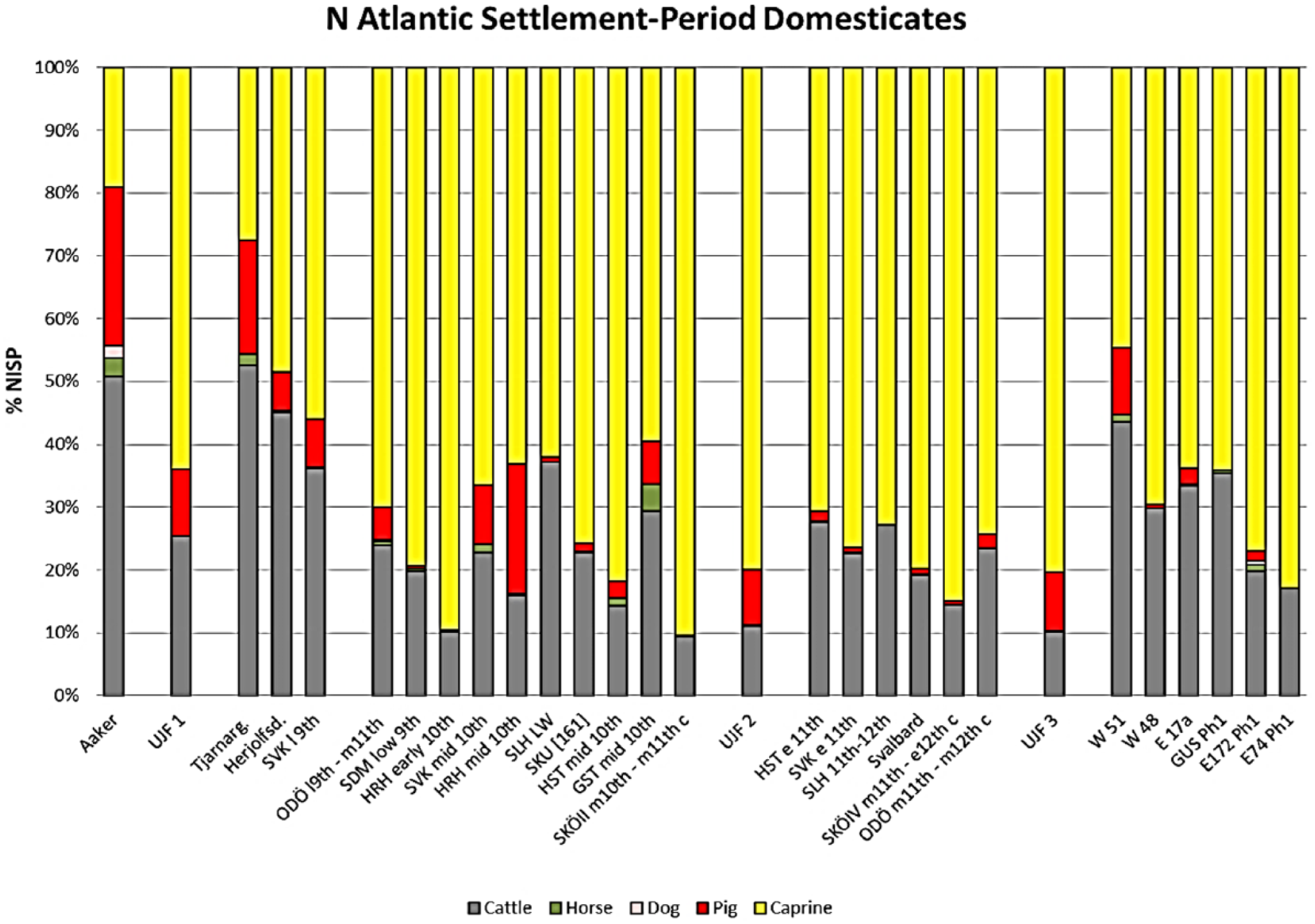
Proportions of pig bones (red) in the domestic mammal Norse-period zooarchaeological assemblages in the North Atlantic, grouped loosely by time period. Faroes: UJF1, 2, and 3 = Undir Junkarinsfløtti phases; Norway: Aaker = Aaker; Iceland: Tjarnarg. = Tjarnargata 4, Herjolfsd. = Herjolfsdalur, SVK L 9th = Sveigakot late 9th-century AD phase, SVK mid-10th = Sveigakot mid-10th-century AD phase, SVK e 11th = Sveigakot early 11th-century AD phase, ODÖ I 9th-m 11th = Oddstaðir late-9th to mid-11th century AD phase, ODÖ m 11th - m 12th c = Oddstaðir mid-11th to mid-12th century AD phase, SDM low 9th = Undir Sandmúla early-9th century AD phase, SLH LW = Selhagi Lower = 9th–10th-century AD phase, SLH 11th–12th = Selhagi 11th–12th-century AD phase, SKU [161] = Skútustaðir mid-10th century AD phase, HST mid-10th = Hofstaðir mid-10th century AD phase, HST e 11th = Hofstaðir early 11th-century AD phase, HRH early 10th = Hrísheimar - early-10th century AD phase, HRH mid-10th = Hrísheimar mid-10th century AD phase, GST mid-10th = Granastaðir mid-10th century AD phase (Einarsson, 1994), SKÖ II m 10th-m 11th c = Skuggi mid-10th to mid-11th century AD phase, SKÖ IV m 11th-e 12th c = Skuggi mid-11th to mid-12th century AD phase, and Svalbard = Svalbarð; Greenland: W 51 = Site W 51, W 48 = site W 48, E 17a = Site E 17a, GUS Ph1 = Gården Under Sandet Phase 1, and E 172 Ph1 = Site E 172 Phase 1, E 74 Ph1 = Site E 74 Phase 1 (Enghoff, 2003).
Pig keeping has many clear advantages in a colonizing economy (rapid reproduction, omnivorous diet, wide niche-breadth). It has been hypothesized, drawing on post-medieval analogies to Caribbean and North American colonialism and some Icelandic written references (discussed below), that the release of free-range pigs into newly colonized North Atlantic islands might have played an important role in the landnám process. The later decline of piggery in the North Atlantic islands is associated with deforestation and economic changes that brought an emphasis on milk and wool production (McGovern et al., 1988). A combination of new zooarchaeological, place-name, and biomolecular evidence now suggests a revision of this model is in order for both the Faroes and at least our best-studied regions in Iceland.
Faroese pigs in a managed landscape
As part of the Landscapes circum Landnám and Heart of the Atlantic projects, international teams collaborated on a multi-disciplinary investigation of human ecodynamics on the island of Sandoy in the Faroes (Ascough et al., 2006; Church et al., 2005; Lawson et al., 2005). These projects have provided many new perspectives on the settlement and ecology of the Faroes, including confirmation of a pre-Norse Iron Age occupation dating at least as far back as the 4th century CE (Church et al., 2013) and the confirmation that the Faroes were nearly entirely treeless long before the Norse arrival (Lawson et al., 2005). The steep topography and limited arable land have long been thought to have constrained settlement choices in the Faroes, resulting in long-lasting villages (Arge, 2015; Arge et al., 2005), a hypothesis supported by the deeply stratified deposits encountered on Sandoy. The zooarchaeological data from Sandoy documented the important role of domestic pigs in the local domestic economy (Brewington, 2011; Church et al., 2005) while also providing a wider view of the subsistence practices of the Viking Age and early medieval Faroese. Domestic mammal bones made up a small proportion of the overall archaeofauna, heavily outnumbered by marine fish (mainly Gadidae, cod family) and sea bird bones (overwhelmingly Atlantic puffin, Fratercula arctica). Figure 2 presents a whole-archaeofauna comparison of the same sites presented in Figure 1, illustrating the continued major role of wild species (especially puffins) in the domestic economy of the Sandoy villagers.
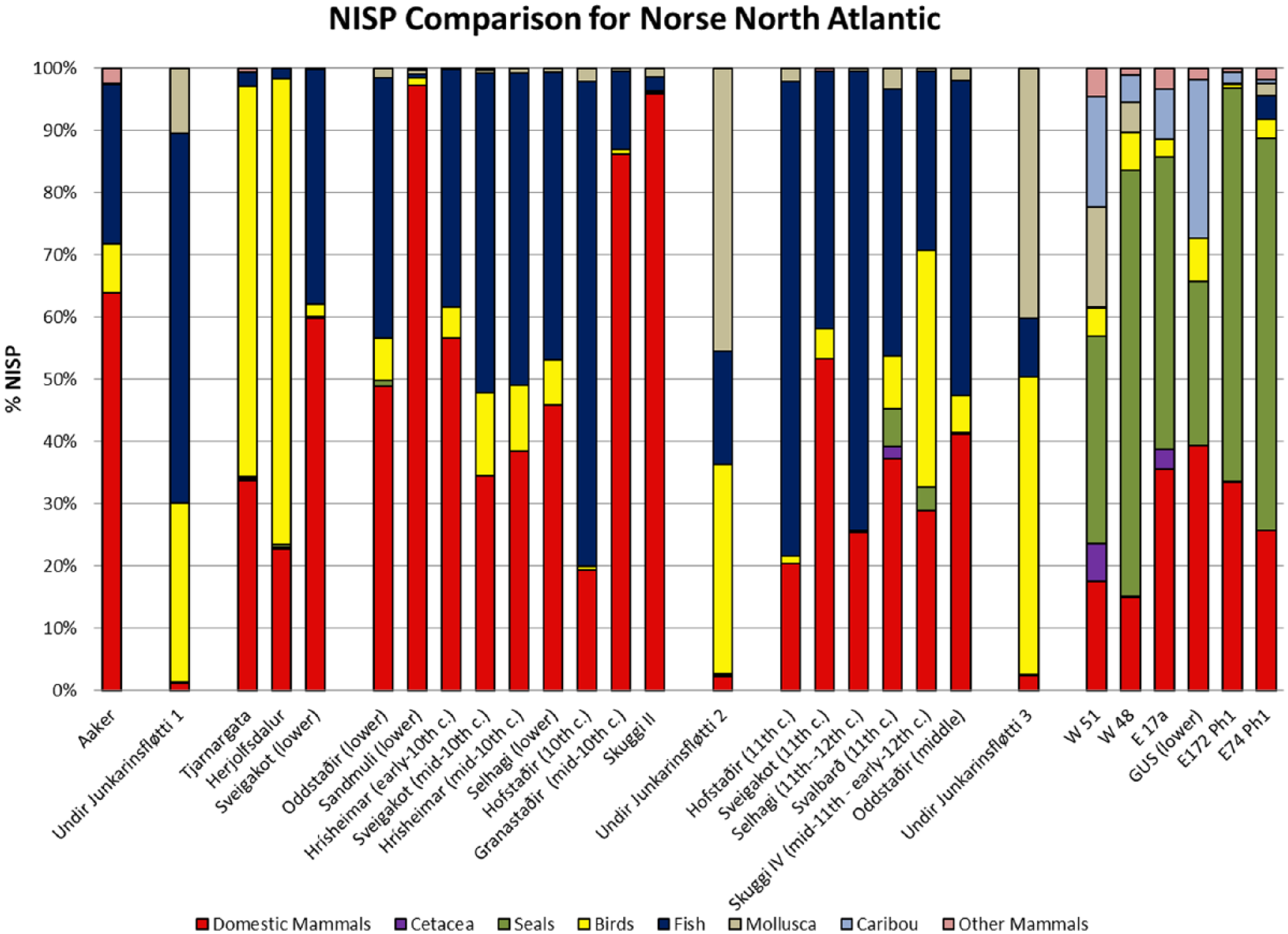
Comparison of all major taxa from the same archaeofauna as in Figure 1. Note the continued importance of sea birds (yellow) in the Viking Age to medieval phases at Undir Junkarinsfløtti on Sandoy Faroes.
Archaeobotanical samples confirm at least small-scale barley cultivation from earliest periods onwards (Church et al., 2005), and extensive geoarchaeological data and environmental modeling suggest a major investment in heavily amended agricultural soils (Lawson et al., 2005). Pig keeping was thus a component of domestic economy that emphasized small but intensively cultivated barley fields, marine fishing, sea bird exploitation, and pastoralism.
In this landscape, pigs retained their traditional value as sources of rapidly reproducing high-status meat, even if they also posed a serious threat to two key resource zones: the cultivated barley fields and puffin nesting sites. Rooting pigs could rapidly destroy planted crops and carefully developed field drainage systems in the infields if unsupervised, undoing a multi-generational effort that produced key storable food reserves. Pigs are also a major threat to nesting bird colonies, particularly on islands (Cuthbert and Davis, 2002; Klinger et al., 2011). As puffins burrow at the tops of bird cliffs, their seasonal breeding concentrations would be particularly vulnerable to pig predation. Pig management in the Faroes could therefore never have involved free-range pannage (nor simply exclusion from the infields) or the historic and modern puffin rookeries would not have existed.
A recent study of Viking Age-to-medieval pig management in the Faroes, conducted by researchers from the Faroese National Museum, the City University of New York (CUNY), Durham University, and the Scottish Universities Environmental Research Centre (SUERC), combined place-name analysis, field survey, zooarchaeology, and stable isotope analysis (Arge et al., 2009). Stable isotope analysis of pig bones from the Undir Junkarinsfløtti archaeofauna (Figure 3) suggested the majority of Undir Junkarinsfløtti pigs were not stalled and fed fish offal, seaweed, or other byproducts of the partly maritime economy, ruling out one attractively simple scenario for pig provi-sioning. Pigs were often entirely in the terrestrial food web, and apparently feeding on a terrestrial diet similar to the cattle from Undir Junkarinsfløtti.
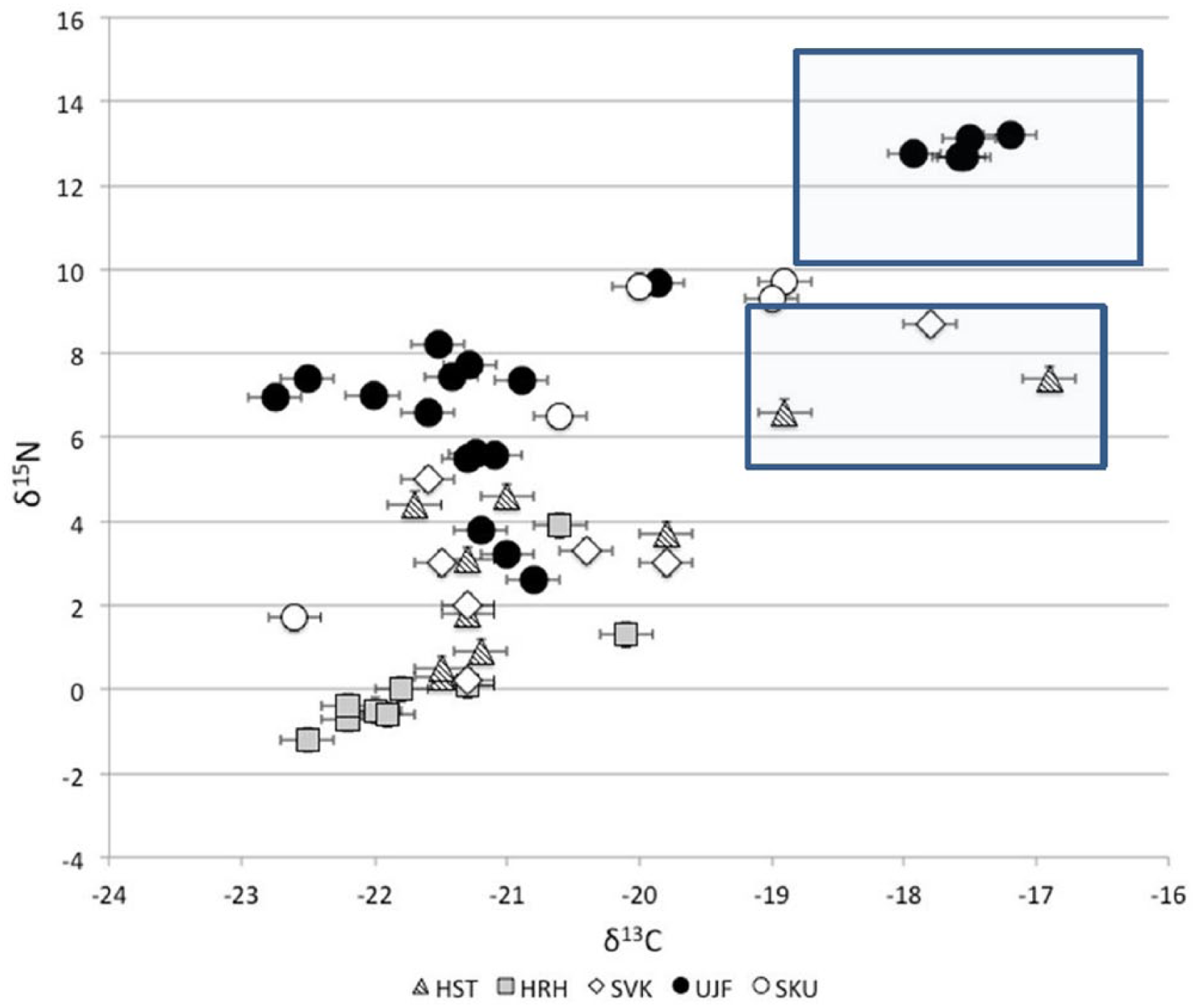
Stable δ15N (nitrogen) δ13C (carbon) isotopic results from archaeological pig bones from Iceland and Faroes (Ascough et al., 2007, 2010, 2012; Church et al., 2005; Sayle et al., 2013). UJF = Undir Junkarinsfløtti Faroes, HRH = Hrísheimar Mývatnssveit Iceland, SVK = Sveigakot Mývatnssveit Iceland, SKU = Skútustaðir Mývatnssveit, Iceland. Values clustering in the upper right corner (boxed) are likely to reflect a partly marine diet with elevated δ13C reflecting values from the base of the food web in marine ecosystems and elevated δ15N values reflecting the larger number of trophic levels in marine food webs. Values in the center and lower left corner of the graph (unboxed) reflect a terrestrial grazing or browsing diet. The values for the three HRH and one SVK pig (lower box) suggest consumption of freshwater fish because of elevated δ13C values coupled with ‘terrestrial’ δ15N values (c.f. Ascough et al., 2012).
Arge’s archival research at the Faculty of Faroese Language and Literature turned up about 140 different place names incorporating pig, swine, sow, or boar elements (Arge et al., 2009). Some place names, such as Svínadalur (pig valley), were connected to topographic features, while others were connected to structural remains and management (swine-dike, -fold, -pen, -path, -place). This documentary evidence combined with field survey revealed that while pig pathways, gathering points, and pen/fold place names and structural remains appear in both the infield and outfield, all of the outfield place names are at fairly low elevation (below 100 m) and near permanent water courses. Pigs thus seem to have been moved about the landscape along well-controlled track-ways, contained behind walls or in steep-sided valleys, and occasionally on offshore islands. They seem to have been well-supervised in special areas within the fertilized infields, to and from which they had access through special pathways. They were likely fed in much the same mid-upland zone as the domestic cattle, whose bones share a similar isotopic pattern. The pig place names (persisting long after the pigs were gone) suggest that this movement and management strategy was longstanding and deeply embedded in LTK. Two similar Faroese folk tales repeat a story of a feckless farm hand who eats food he should have delivered to pigs kept in a distant fold or island, with the pigs dying of hunger as a result (Arge et al., 2009: 29). This may be a parable for the eventual fate of most Faroese pigs, phased out for less-problematic sources of nutrition for humans. The Faroese may have renounced piggery to protect puffins and barley.
Icelandic pigs, waterfowl, and egg collection
As Figures 1 and 2 above suggest, Icelandic archaeofauna from Viking and medieval periods show considerable variability in both domestic stock keeping and in the use of wild species. On the two early, southern Icelandic sites of Tjarnargata (under modern Reykjavik) and Herjolfsdalur (on the Westman Islands), a high relative percentage of sea bird bones (including a few now-extinct Great Auk, Pinguinus impennis) apparently echoes later accounts explaining that in the early settlement days, bird colonies were unused to humans and fatally ‘unwary’ (Vésteinsson et al., 2002).
While later Icelandic archaeofauna thus far do not reflect as intense predation on sea birds, long-term collaborative research in the high lake basin of Mývatn in North Iceland has documented a very different sustained pattern of human–bird interaction (Hicks et al., 2014). In the Mývatn lake basin, harvesting duck eggs, but not killing adult birds, has been a traditional way of exploiting the waterfowl populations (Gudmundsson, 1979). Duck egg harvesting is first mentioned in the 1712 Jarðabók land register, recorded at 11 farms bordering the lake (JÁM, 1990). The reported annual harvest of about 4000 eggs in the Jarðabók register is possibly understated because of fear of taxation by the Danish authorities. A number 10 times higher (about 41,000) was obtained in Gudmundsson’s (1979) inquiry in 1941. The present rule to leave at least four to five eggs in the nest for the female to incubate is first mentioned by a traveler in the area in 1862 (Shepherd, 1867), but self-imposed restrictions to harvesting are mentioned some 40 years earlier (Thienemann, 1827). Although the primary purpose of the four to five egg rule is supposedly to avoid nest desertion by the incubating female, it also ensures a sustainable yield, as the ducks produce only 0.3–2.8 young per female a year on the average and the overall production of young is regulated by the availability of food in the lake, mainly midges and their larvae and small crustaceans (Gardarsson and Einarsson, 2002, 2004).
NABO archaeology teams working in Mývatn since 1992 have regularly encountered masses of crushed but otherwise well-preserved bird egg shell indicating that the intensive, seasonal collection of bird eggs has a deep history. In 1998, one layer of midden fill at Hofstaðir dating to the Viking age produced 37 egg shell concentrations within a 2 × 2 m2 unit, illustrating the density encountered. Bird bones (evidence of killed adult birds) are comparatively rare in the Mývatn collections and the great majority of bird bones on most of the sites are the non-migratory ptarmigan (grouse, Lagopus mutus) rather than waterfowl.
Initial identification of the recovered eggshell fragments was carried out in 2005–2006 by Jane Sidell, making use of the SEM and reference collections of the Institute of Archaeology, University College London. This initial work confirmed the presence of substantial amounts of duck eggshell as well as some ptarmigan and a few marine bird eggs. In 2006, our team published a report on the archaeological evidence for continuity between the modern and historically attested patterns of sustainable egg harvesting, and this contains the tabular data available up to that point and fuller site descriptions (McGovern et al., 2006). The team also collaborates with the local community around Mývatn to provide detailed historical and ethnological documentation of the collective management and harvesting of natural resources (Edwald, 2012).
From 2008 to 2013, NABO archaeologists retrieved additional eggshell deposits from Skútustaðir, and efforts are currently underway to refine the species-level identification of these shell fragments. Building on Sidell’s work, a key component of this research has been an effort to improve the reference specimen imagery required for accurate identification. This ongoing project, a collaboration between the Mývatn Research Station, the Department Life and Environmental Sciences of the University of Iceland, and the CUNY Hunter College Zooarchaeology Lab, is producing promising results, suggesting that secure identification of specimens to species level is possible where preservation conditions allow (Hicks et al., 2014).
Zooarchaeological evidence confirms the presence of pigs in the settlement age through the commonwealth (930–1264 CE) from sites such as Hrísheimar, Hofstaðir, Sveigakot, and Skútustaðir (Hicks, 2010; McGovern et al., 2007, 2009). Pigs, although regularly present, are always outnumbered by the more common cattle, sheep, and goats. The largest fully published Mývatn archaeofauna is from the Viking age great hall at Hofstaðir, which appears to have combined the functions of a high-status farm with seasonal pagan ritual activity, abandoned ca. 1000 CE when the site shifted across the home field and a Christian chapel was erected (Lucas, 2009; Lucas and McGovern, 2008).
Hrísheimar is probably a middle-ranking site, once overlooking a rich wetland but now at the edge of an arm of the central highlands erosion desert. It shows extensive evidence of large-scale iron production – probably based on extraction of bog iron from nearby wetlands combined with charcoal produced from the surrounding woodlands. Hrísheimar was settled in the first wave of colonization ca. 875 and abandoned before 1100 CE (McGovern et al., 2007; NABO PMS http://www.nabohome.org/cgi-bin/explore.pl?seq=104.
Sveigakot was probably always a low-ranking tenant farm, once located on the border of an extensive wetland (now filled by soil eroded from the inland desert) and a lava outcrop. This small settlement was begun ca. 875 and probably finally abandoned after several phases of occupation ca. 1200 CE (McGovern et al., 2007; NABO PMS http://www.nabohome.org/cgi-bin/explore.pl?seq=50).
The deeply stratified midden deposit at Skútustaðir (a high-status site on the lake shore) extends from first settlement to the modern period. This site effectively replaced Hofstaðir as the local community center, and remains one of the two main settlement concentrations on Mývatn. A very large archaeofauna has been excavated 2008–2013, and preliminary results from the extensive early modern record at Skútustaðir demonstrate that swine herding became nearly absent after the middle ages, and was rare after the Viking age (Hicks, 2010; Hicks et al., 2012)
In the Viking age, Skútustaðir, Sveigakot, Hofstaðir, and Hrísheimar probably had direct access to wetlands and nesting waterfowl and all (except the low status Sveigakot holding) have produced masses of well-preserved egg shell datable by multiple AMS radiocarbon assays and volcanic tephra (critically Veiðivötn 871, Veiðivötn 940, Hekla 1104, Hekla 1158, Hekla 1300, and Veiðivötn 1477). All these inland sites (Mývatn is 50–60 km from the nearest salt water) show clear interaction with the coast, and fish remains recovered include both freshwater trout and char from lakes and streams but also headless marine fish (mainly cod family) that seems to have been imported regularly from first settlement onwards as a dried product (McGovern et al., 2006). While the individual farm may have been the basic settlement unit, farms were linked together by social and economic webs that extended well beyond the lake basin.
The complex isotopic landscape of the Mývatn basin is also becoming increasingly well documented (Ascough et al., 2007, 2010), and collaborations continue on analyses of stratified zooarchaeological deposits, human burials, and a wide range of modern reference specimens collected with help from the Mývatn Research Station. Hofstaðir pig bones with calibrated 14C dates significantly older than paired cattle bone from the same contexts thus appear to have had diets consisting at least in part of freshwater fish, producing a freshwater reservoir effect (Ascough et al., 2007, 2010; McGovern et al., 2009). The potential of stable isotope analysis for investigating livestock feeding patterns (as well as for calibrating radiocarbon dates) is the focus of an ongoing collaborative project. One promising development is the addition of sulfur (S) to the nitrogen (N) and carbon (C) isotopic analyses, which offers the potential to identify differences in grazing patterns (Sayle et al., 2013).
Stable isotopic studies of pig bone from early phases of Skútustaðir in Mývatn indicate that pigs were consuming both terrestrial and non-terrestrial resources, yielding markedly different isotopic signatures when compared with sheep and cows, which had exclusively terrestrial diets (Sayle et al., 2013). Perhaps significantly, pigs that were regularly fed on freshwater fish or fish offal (and were therefore presumably penned) are found in Viking Age deposits at two of the known elite farms, Hofstaðir and Skútustaðir, at about the same period (just after the V 940 tephra fall). This places them within approximately the second or third generation since initial settlement, and during a period that saw intensive local and regional competition among chieftains. We would expect that competitive feasting played a major role in such jockeying for power, and the large Hofstaðir archaeofauna shows evidence of efforts being made to provide diverse and high-quality foods – perhaps including stalled pigs fattened on freshwater fish – for seasonal visitors (McGovern et al., 2009). Pig remains from smaller farms (like Hrísheimar) thus far show a fully terrestrial profile, and these pigs produce radiocarbon dates fully consistent with the tephra and calibrated AMS dates from associated cattle bone. A freshwater reservoir effect was noted in one pig specimen from the lower ranking farm of Sveigakot, however, suggesting that stall-feeding may not have been entirely restricted to higher status farms. The isotopic research program is clearly still in development, but the potential to identify pig-management regimes on a farm-by-farm basis through time is impressive.
Ongoing archaeobotanical research in the greater Mývatn region, led by Ian Lawson (University of Leeds) and Mike Church (Durham University), has focused on lake core analysis and the wide-scale survey and dating of numerous charcoal pits. This work has documented extensive charcoal production from first settlement until the late 12th century, with concurrent persistence of extensive birch and willow woodlands. There appears to have been no rapid depletion of woodlands, as indicated by pollen profiles from South Iceland, despite evidence of extensive and rapid settlement of the Mývatn landscape soon after the V871 ash fall (Lawson, 2009; Lawson et al., 2007; Vésteinsson and McGovern, 2012). This is again not the outcome expected if free-ranging pigs (together with sheep, goats, and cattle) were allowed full access to the scrub forests upon initial settlement in the late 9th century.
At present, we do not have for Iceland the systematic combination of place-name evidence with site survey available for Sandoy in the Faroes, but collaborative work is now beginning with environmental historians and saga scholars at the Reykjavik Academy as part of the Inscribing Environmental Memory project, a NABO/Nordic Network for Interdisciplinary Environmental Studies (NIES, http://www.miun.se/nies) collaboration under the IHOPE Circumpolar Networks program. A brief survey of place names in Mývatn does point to two islands, perhaps places of containment, named for pigs. Systematic place-name research tied to field survey and coordinated by ongoing GIS integration will potentially provide results comparable with the Faroese Sandoy project over the next few years.
There is a recurring topos in the Icelandic Book of Settlement (Landnámabók) about pigs that escaped and reproduced massively: Steinólfur of Saurbær in the west lost three pigs and found 30 in Svínadalur (Pig Valley) 2 years later; Ingimundur the Old in the Húnavatn region lost 10 pigs and found 100 in Svínadalur the following year; Helgi the Lean put two pigs on land at Galtarhamar (Hog’s Rock), the hog’s name was Sölvi, they were found 3 years later in Sölvadalur (Sölvi’s Valley) in a herd of 70 (Palsson and Edwards, 2007: 59–60, 85, 97). Friðriksson and Vésteinsson (2003) summarize a lengthy controversy about the literal historicity of Landnámabók with the recognition that the work should be seen as a retrospective scholarly creation largely based upon the later medieval compilers’ 13th century reflections on a Viking age past. This perspective may place the rapidly reproducing free-range pigs in the same recurring theme that ‘things were different back then’ as the initially unwary sea birds, but in any case emphasizes Icelandic awareness of the potential fertility and impact of free-ranging pigs.
The early Icelandic laws inscribed in the Grágás law code (probably based on written versions first set down ca. 1120 CE) flag pigs as problem animals: ‘Pigs are not to be kept in communal pasture. They have no immunity from injury on any man’s land except their owner’s unless it is a home field boar with a ring or withy in its snout’ (preventing rooting; Dennis et al., 1993: 139). Pigs are mentioned in this and succeeding medieval law codes far less commonly than sheep, cattle, horses, or goats, and as the quote above suggests, they had clearly become regarded as nuisance animals, likely to cause conflict between neighbors. By ca. 1200, pigs in Iceland become increasingly rare in the available archaeofauna, even on high-status sites, although they apparently survived in small numbers down to the late 14th century. Despite their value to elites in demonstrating and reinforcing status through feasting and providing highly desired meat, the perceived needs of the wider community and the value of alternate resources of equal or greater value tipped the scales against piggery in later medieval Iceland, as in the Faroes.
Giving up the pigs and keeping the birds: Medieval LTK and the Anthropocene
Further interdisciplinary collaboration on both of these island cases is clearly necessary, and indeed is underway; so this paper is at best an interim report. However, these North Atlantic cases may still serve to illustrate several more general points:
Conservation of specific natural resources may well be one agenda item for past and present indigenous people drawing upon both LTK and elite expertise, but always well embedded in a matrix of conflicting options and choices. Balancing the management of waterfowl, arable fields, wetlands, pigs, and community solidarity demonstrates indigenous adaptive management worth documenting and emulating in the modern world.
Long-term sustainability (on the millennial scale) in management of inherently fragile biological resources through good times and hard times is indeed demonstrably possible for local communities using only LTK and locally managed sanctions. Cheaters, elite manipulators, and an unpredictable climate all failed to defeat the long-term management of fragile bird resources in both the Faroes and Mývatn.
The broader Anthropocene story is not only about disaster and mismanagement. There are positive cases in our growing collection of ‘experiments in long term human ecodynamics’, and these stories need to be mobilized more effectively to ward off despair and inspire new thinking as we all move into ‘interesting times’ (Hegmon et al., 2014).
The past has substantial value in providing clear and practical ‘tool kits for resilience’. This is perhaps particularly true for cases in which we can combine the resources of natural science, archaeology, history, and environmental humanities. Archaeology and paleoecology can provide the necessary litmus test for actual (vs simply asserted) long-term success, but history, ethnography, and environmental humanities provide the keys to unlock the ‘black box’ of cultural rules and practices that allowed or prevented effective long-term stewardship.
‘Transdisciplinary’ investigations of the human past have a great deal to contribute to the Anthropocene concept and ongoing debates. Employing collaborative structures like IHOPE and Global Human Ecodynamics Alliance (GHEA, http://www.gheahome.org/) to connect our cases together and tie them to issues of general contemporary concern provides a way forward for us to usefully engage the Anthropocene discussion. The Anthropocene debate provides us with yet more incentive to organize.
Footnotes
Acknowledgements
We would like to send our warmest thanks to our host communities in Iceland and the Faroes who have supported this work and partnered in the investigation of their own rich heritage as a source for education for sustainability.
Funding
This research was made possible by generous grants from the National Geographic Society, RANNIS, Social Sciences and Humanities Research Council of Canada, the UK Leverhulme Trust, the Wenner-Gren Foundation for Anthropological Research, the Leifur Eiriksson Fellowship Program, the American Scandinavian Foundation, the US National Science Foundation (grants 0732327, 1140106, 1119354, 1203823, 1203268, and 1202692), Anadarko (Faroes), BP Amoco Exploration (Faroes), and the University of Iceland Research Fund.