




Abstract
This article examines the establishment of the European Sectoral Social Dialogue Committee (ESSDC) for Social Services and its potential to address the job quality dimension of Europe’s care trilemma – balancing service coverage, fiscal constraints and working conditions. Drawing on qualitative research, including 133 interviews across 11 countries and document analysis, we explore how this supranational forum can influence national employment practices in a sector marked by varied provision models and weak industrial relations. While ESSDCs have been criticised for limited ‘bite’ in shaping national policies, we argue that their coordination capacity offers meaningful leverage, particularly in countries with underdeveloped social dialogue. Our findings highlight both structural constraints and promising dynamics of knowledge-sharing. We conclude that although binding outcomes remain unlikely, the ESSDC fosters a community of practice that reframes care work as an investment, not a cost, enabling incremental improvements in job quality and professionalisation.
Keywords
Introduction
In July 2023 the new European Sectoral Social Dialogue Committee (ESSDC) for Social Services was formally established. In this article we assess its potential for coordination between EU and national employment practices in the care sector. In line with the empirical puzzle of this Special Issue, our driving question is the extent to which such European level of employment regulation can influence the quality of care work in national contexts, given the variety of employment governance structures of the care sector.
The contrasting pressures or ‘care trilemma’ of public budget constraints, service coverage and job quality has often been tackled at the expenses of staff pay and working conditions (Morgan, 2005; Pavolini et al., 2013; Pavolini and Marlier, 2024). This harms care quality and makes the sector’s labour market less attractive, with a spiralling effect on already challenging staff shortages. The processes of recognition and institutionalisation of care work are inextricably linked with those of the feminisation of workforce and de-familisation of care activities in post-industrial societies (e.g. Saraceno and Keck, 2010), which led European welfare states to increase early childhood education and care (ECEC), long-term care (LTC) and services for people with disabilities.
Provision involves public, non-profit, and increasingly private for-profit providers (Eurofound, 2017). Where the privatisation and marketisation of care services developed fastest, like in England, it has been noticed how the low-bargaining power, low-paid, largely feminised workforce proved a decisive pull factor for large, private care firms (Farris et al., 2025; Farris and Marchetti, 2017). Privatisation, in general, was found to lead to a fragmentation of collective bargaining at company and sector levels, leading to worsening working conditions for carers (Lethbridge, 2021).
Job quality is the element of the care trilemma to which the new ESSDC for Social Services can contribute. While ESSDCs have been criticised for their lack of ‘bite’ – that is, the alleged weak influence over national employment policies – in this case, we argue, it can enhance the coordination role of European social partners (SPs). A ESSDC has the double function of spreading good practices on, for example, training and work organisation and, at the same time, allowing SPs to jointly shape the institutional narrative around, in this case, care work in an opposite direction from the dominant low-pay and low-skill discourse. If not to achieve better pay – formally outside the ESSDC remit – this ESSDC for Social Services represents a new, effective forum to help tackling the widely recognised care crisis in Europe. From here, the relevant SPs can strengthen their long-held claim and core organisational value that the quality of care services is strictly related to the quality of work and that better working conditions should be seen as an investment, not a cost for society. This also aligns with the EU’s social investment approach (EC, 2013; Morel et al., 2012), which frames ECEC and LTC as strategic for labour market participation and reducing inequalities.
The article will first define the ESSDCs, their general functioning and contextualise the establishment of the ESSDC for Social Services within the European Care Strategy. We then turn to relevant ‘lessons learned’ from the literature referring in particular to two contrasting outcomes of the ESSDCs: the risk of limited impact on national policies on the one hand; and the coordination potential of EU SPs, particularly at sector level, on the other. We lay out our methods, to then analyse the factors and challenges of the formalisation of the ESSDC for social services and present evidence of how and to what extent the coordination potential of ESSDC in the care sector can outweigh the structural limitations of this supranational, voluntary system of regulation. The discussion will return to the expected impact of this new European committee on the care trilemma, and we will then conclude.
The European Sectoral Social Dialogue Committees (ESSDCs) and the care emergency in Europe
A European level of employment relations has been a key tenet of the European Union project since its origins (Bir, 2020). In particular, art. 154 and 155 of the Treaty for the Functioning of the European Union (TFEU) grant recognised SPs at the EU level access to ‘exclusive consultations on policy initiatives in the area of employment and social affairs’ and the opportunity to co-legislate EU law, respectively. ‘Developing and fostering social dialogue is an essential element of the European social model’ which ‘complements the social dialogue happening at the national level’ (European Commission, 2016: 3). After the 2008 economic crisis, there has been a growing interest from various institutions at the EU level to ‘revive’, as the President of the EU Commission Juncker (2014-2019) put it, social dialogue in economic and sectoral policies. Further impetus came in January 2024 with the Commission’s Pact for European Social Dialogue, marking Val Duchesse’s 40th anniversary, though with little follow-up (Lafuente et al., 2025).
European Social Dialogue takes two main forms: bipartite social dialogue between trade unions and employers (sub-divided into cross-industry and sectoral social dialogue), and tripartite social dialogue between public authorities (Commission, Council) and EU level trade unions and employers organisations.
We focus here on the European Sectoral Social Dialogue (ESSD), which enables representative SPs from specific sectors to set-up dedicated Committees (ESSDCs), providing them with a space at European level to exchange knowledge, ideas, practices and information on common, cross-border or transnational issues affecting the industry. Formalised in 1998 (Commission Decision 98/500/EC), there are today 44 officially recognised ESSDCs, covering sectors ranging from natural resources to transport, telecommunications, central government, and commerce. In several cases, ESSDCs started as joint advisory committees or as informal working groups. Similarly, this latest ESSDC for Social Services started with an informal group of social services employers from few countries in the early 2010s. They since engaged in capacity-building projects (Sowell, 2022), which culminated in the creation in 2017 of the Federation of Social Employers, instrumental for the formalisation for the ESSDC for Social Services, recognised by the Commission in 2023.
The timing is not coincidental. The Covid-19 pandemic in 2020 and 2021 brought an unprecedented spotlight on the care sector, showing a deeply dedicated, but also stressed and under-valued workforce. In a 2022 report of the World Health Organisation (WHO) covering Europe and central Asia, the care crisis was defined as a ‘ticking bomb’, with the ageing population and staff shortages at emergency levels everywhere. The growing concerns about ‘… Personnel shortages, insufficient recruitment and retention, migration of qualified workers, unattractive working conditions, and poor access to continuing professional development opportunities’ converged on a wake-up call for countries to better plan and govern their health systems (WHO, 2022: iv). The concomitant ‘2022 EU Care Strategy’ set an agenda ‘for both carers and care receivers’, acknowledging the ‘widespread’ shortages, non-standard contracts in the care sector and the 90% female workforce. The Strategy aims at making the access to quality care principles (11 and 18) of the European Pillars of Social Rights, ‘a reality’ (EC, 2022a: 3). It included two Council Recommendations to Member States on Early Childhood Education and Care (ECEC) and Long-Term Care (LTC) services, which were adopted by the European Council in December 2022 (COM (2022) 440 final; COM (2022) 441 final). The proposals provided guidelines to Member States to increase access to high-quality and affordable care services, while improving working conditions and work-life balance for carers, reflecting the tenets of the care trilemma.
In these documents, there are only mild references to the governance of employment relations in the care sector. Echoing the 2022 WHO report, the explanatory memorandum of Recommendation 440 on LTC attributed the difficulties of attracting and retaining care workers to ‘often poor working conditions and low wages, which could be alleviated through social dialogue’ (EC, 2022b: 2). It noted that ‘only in few Member States are almost all LTC workers covered by collective agreements. In other Member States, social dialogue is almost absent’ (pp. 2-3). As for the ECEC, the EU Care Strategy revised the Barcelona targets, increasing service coverage for 2030 from 33% to 46% of children under 3, and from 90% to 96% of children between the age of 3 and the starting age for compulsory primary education, anticipating possible recruitment issues.
Although the presence of private for-profit providers has been growing, the majority of social services comes from public – often outsourced – and not-for-profit organisations. However, increasing competition in care services means that providers face challenges in containing costs, at the expense of quality of the services and employment conditions (e.g. Eurofound, 2017). The recognition of the ESSDC for Social services is therefore momentous, but to what extent can European level SPs steer the EU care strategy in a socially – rather than just profit – oriented direction via the new ESSDC so to improve carers’ working conditions?
The answer builds on two contraposed ‘lessons’ from the literature on social dialogue in Europe: on one hand, the limited direct influence of the European level of employment regulation over the national one, although with some sector variations; and on the other, the coordination potential of the ESSDCs, whereby European and national social partners exchange knowledge and shape policies from the vantage point of this supranational community of practice.
The European Sectoral Social Dialogue Committees: Lacking ‘bite’ or coordination champions between EU and national industrial relations?
A key, initial focus of industrial relations studies on the European Sectoral Social Dialogue was on the drive to establish such institution, particularly in sectors not under the competence of the EU. As Leisink summarised, ‘There are economic, institutional and political factors that may push (a significant degree of economic integration of product markets) or pull (socio-economic policies of the Commission) employers’ and trade union organisations towards social dialogue at European level’ (2002: 107). In understanding why, at the time, a ESSDC in the graphical industry could not be established, the author draws on Traxler’s (1998) multi-employer bargaining concept of industrial relations, showing that its ‘cartelizing’ incentive is absent at the European level. Crucially, three factors were recalled that could help overcoming the collective action problem and make it attractive for employers to bargain collectively also at European and sector, rather than company only, level. The first is strong unions that mobilise large numbers of employees and make employers combine in multi-employer bargaining; secondly, strong employers’ associations which can impose agreements on individual employers; and finally, a supportive state which, for example through extension mechanisms, can make agreements binding also for non-affiliated employers and employees. Such incentives for collective organisation are largely absent at European level, explaining the failed attempt to establish an ESSDC in the graphical industry at the time 1 (Leisink, 2002).
The role of the sector was highlighted as pivotal in the trajectory to the Europeanisation of employment relations. Comparing ESSD and coordinated bargaining as its two main ‘tracks’, Marginson (2005) noted a prominence of social dialogue over coordinated transnational bargaining in particular in sectors that had common European Community policies – such as for example agriculture and fishing – or that were directly affected by EU liberalisation trends, relevant workforce mobility and common work practices, like telecommunications and transports. By contrast, sectors exposed to intensified competitive pressures with strong union presence, like some manufacturing sectors, led in some cases to cross-border bargaining coordination.
Push and pull factors, collective action problem and the role of sector-relevant EU policies are the crucial elements that will return in our analysis.
A substantial body of literature then turned to the achievements of established ESSDCs. Pessimism somewhat prevailed, partly due to limited employment relations coordination and influence capacity (De Boer et al., 2005; Keller, 2003; Tricart, 2019). The prevalence of soft outcomes such as common positions, recommendations or guidelines rarely acknowledged by national level actors foregrounds such scepticism. Binding outcomes, such as Autonomous Agreements 2 and Directives account for less than 2% of the ESSDCs activity from 1978 to 2020, while joint lobbying papers and declarations make 75% of the produced texts (Degryse, 2021). Moreover, Keller and Weber (2011) identified difficulties in the national transposition of ESSD-derived autonomous agreements and process-oriented texts. The obstacles to a greater impact on national levels included the limited representativeness of SPs at the EU level; the nature of national organisations (in particular employers’, at times only business organisations, with varying degrees of collective bargaining authority over their national affiliates); the responsibility on single individuals to follow up on implementation at national level, given how weakly ESSDCs are integrated into the organisational practices of some national SPs; finally, the different national systems of industrial relations (Keune and Marginson, 2013; Léonard, 2008; Weber, 2013). Consequently, the ‘non-committal nature of the dialogue and the problematic status of its outcomes’ (Leisink, 2002: 107), combined with the structural reasons listed above would certainly warrant some caution on the ‘bite’ of ESSDC-derived soft regulation on the working conditions in social care within member states.
Yet, there is more to consider. A first observation regards the soft nature of achievements. As recalled in Leisink (2002), these outcomes ‘also possess a hard side, directly or indirectly: for instance, the costs of health and safety arrangements or the implications of vocational training qualifications for job requirements and wage ladders’ (2002: 103). Particularly in the care sector, soft adjustments like skill recognition and an emphasis on safe staffing levels can already improve the status, recognition and working conditions of carers.
The second, crucial point for social services is the coordination potential of such European level of employment relations. Actor-centred studies of the ESSDCs have looked at varying benchmarks for effectiveness expressed by different actors (Larsson et al., 2020) and the importance of the coordination role of the European-level organisations for collaboration between different national level social partners (Bechter et al., 2021; Galetto et al., 2023; Perin and Léonard, 2011). Larsson et al. show that active participants in the hospital and metalworking ESSDCs do not dismiss the importance of direct effects on working conditions in member states but ‘downplay them in comparison with indirect effects from, and effectiveness in, European Sectoral Social Dialogue’ (2020: 410). Swedish and Italian representatives of both employers and employees, for example, were somewhat dismissive of the impact from the Needlestick Directive derived from the Healthcare ESSDC – a rare hard outcome – given that in both countries relevant regulation was already in place (Larsson et al., 2020: 418). What emerged was also an indirect effect of the participation in such European level of employment relations, defined as the ‘horizontal learning, knowledge sharing and pragmatic bottom-up work to reach consensus (over even soft outcomes)’. Active participants of the ESSDC emphasised such learning experience as more prominent than top-down regulatory effectiveness (Larsson et al., 2020: 422). Relatedly, Galetto et al. (2023) showed how the hospital ESSDC, with their combination of formal and informal exchanges during the regular, in-person meetings, represented an effective ‘community of practice’ for SPs where participants valued the exchange of employment experiences in their home countries and the joint production of sector-specific guidance and good practices. Taking the SSDC for healthcare as case study, a pivotal element identified in the study was the recognition of patients’ safety as a common goal for both employers and workers’ representatives at all levels, leading to progressive recognition of ‘similarities more than differences’ (Galetto et al., 2023:177).
The ESSDC, therefore, can become a genuinely collaborative space where all involved are ‘bound together by shared expertise and passion for a joint enterprise’ and ‘interact regularly to learn or improve their practice’ (Nicolini et al., 2022: 680). This is particularly so if active participation of the members is encouraged and unequal power relations between members are identified and addressed. Certainly, easier said than done, especially in an international employment relations context. Some representatives from specific MSs (often continental or northern European) are found to be more active than others, contributing and influencing the outcomes of the ESSDC to varying degrees (Bechter et al., 2021; Keller and Weber, 2011; Prosser et al., 2021). To balance this, sectoral EU level SPs play a key role in facilitating coordination and engagement among national actors and strengthen (or constrain) the relationships between more and less active members. In doing so, sectoral European-level SPs can ‘build bridges’ between otherwise disconnected ESSDCs actors or groups (Bechter et al., 2021). Coordination, in this context, refers in particular to the continued interaction and relationship-building amongst the sector-relevant national SPs. This has direct consequences on the themes discussed and the work programmes adopted by the ESSDCs (Bechter et al., 2021), and more generally on the spectrum of voices that will be represented.
Care provision models are markedly different across Europe (Annex Tables 1 and 2), while at the same time facing similar trilemma challenges in the context of the care crisis. In most countries there still is no dedicated care sector collective bargaining; in other cases, social services might be covered by other sectors’ collective agreements (local councils, education, healthcare).
Based on this, contained expectations about the formalisation of a ESSDC for Social Services would be understandable: how can European SPs expect to steer EU and national care agendas, without binding results at the EU level to improve working conditions in the member states, particularly in a sector so diverse in terms of workforce representation and provision models? Is there room for hope?
We argue there is. If with some caution, which has to do more with the structural limits of the ESSDCs themselves, than with their potential for coordination.
After presenting our methods, we return to the lessons learned to analyse the establishing of the ESSDC for Social Services through the lenses of push/pull factors and the collective action problem. Considering the specificity of the care sector, we propose a bite VS coordination framework to assess its early achievements.
Methods
Interviews with national representatives of TU, EOs or ‘Other’ (experts/professional organisations) for social services at country levels (HEROS project: 1) LTC sector only. SOWELL project; 1) LTC and ECEC sectors; 2) for Spain, reported interviews also cover local level case studies).
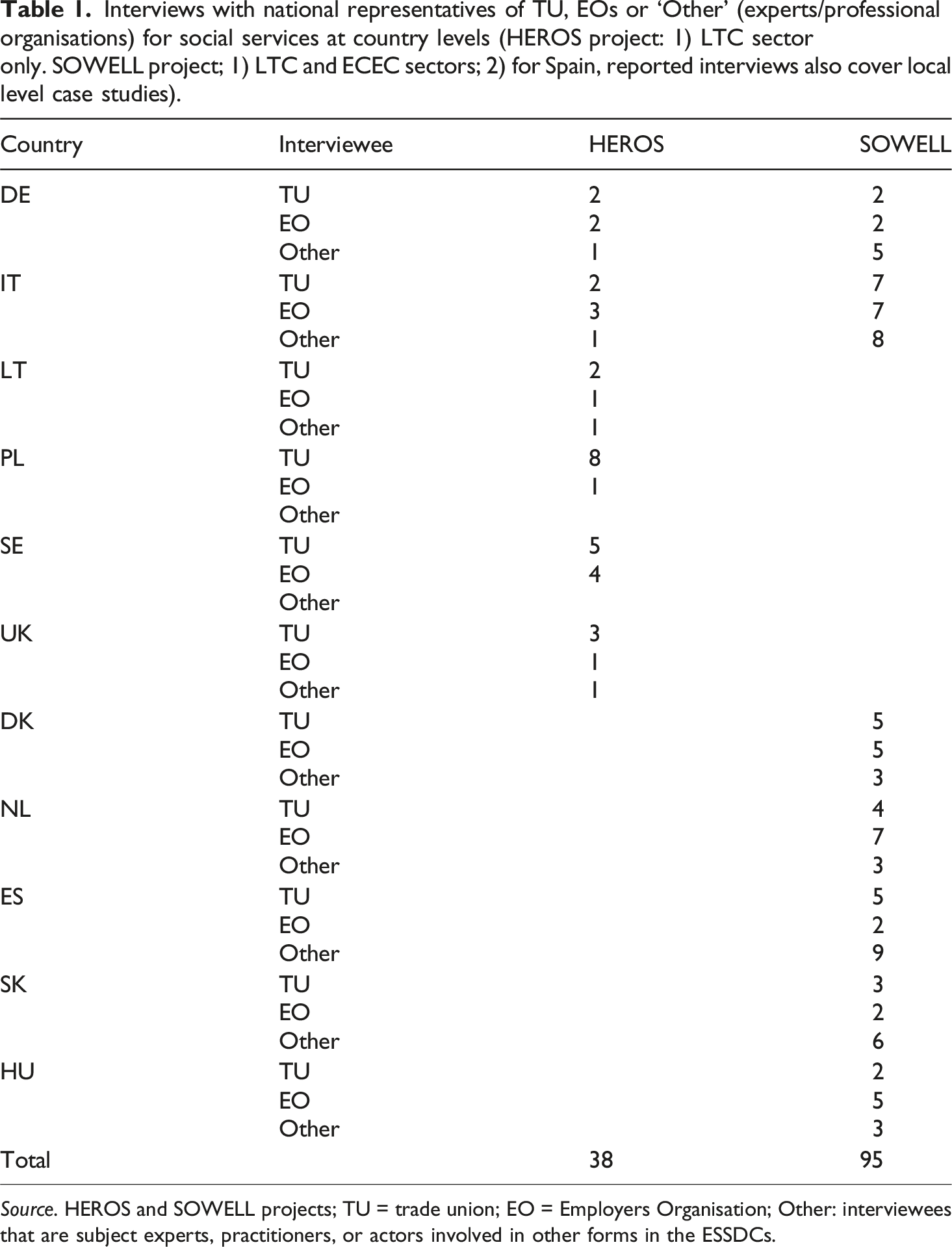
Source. HEROS and SOWELL projects; TU = trade union; EO = Employers Organisation; Other: interviewees that are subject experts, practitioners, or actors involved in other forms in the ESSDCs.
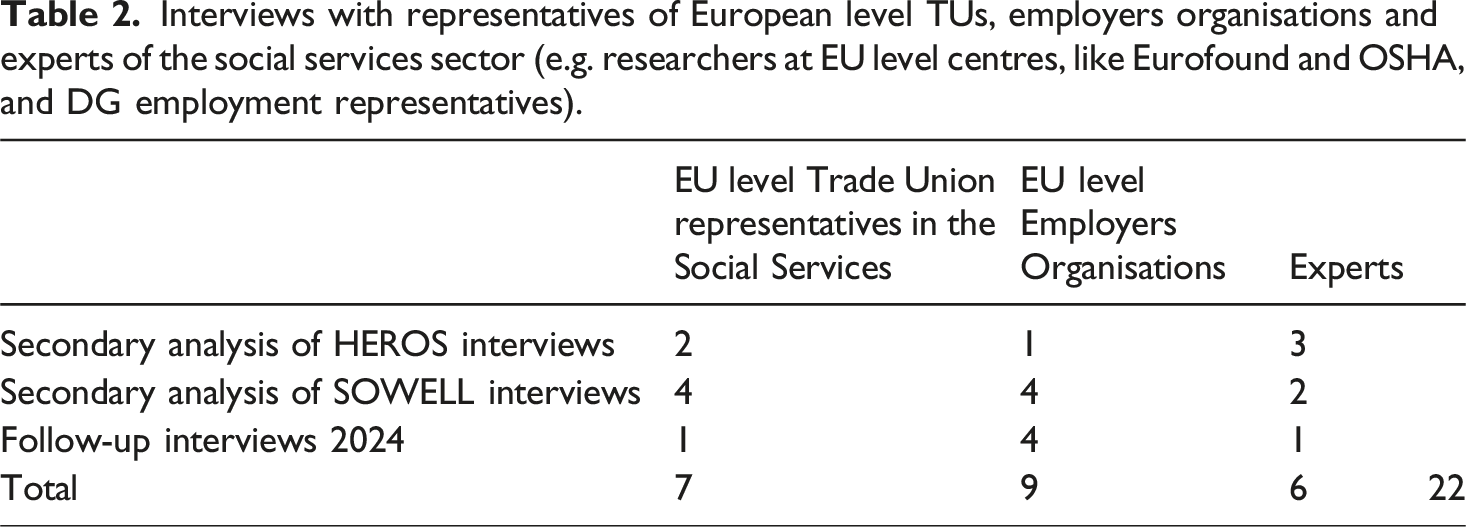
Interviews with representatives of European level TUs, employers organisations and experts of the social services sector (e.g. researchers at EU level centres, like Eurofound and OSHA, and DG employment representatives).
Comparable data are hard to collect, particularly in LTC and ECEC for children under 3 (Annex Tables 2 and 3). This reflects the nature of social care provision, often entangled with welfare systems that cover different degrees of assistance to groups such as elderly or persons with disabilities, as well as different types of services and support to families with children. Such complexities are mirrored in the difficult task to identify representative national SPs able to organise at the European level. For the ECEC sector as a whole, we rely on enrolment figures as a proxy for estimating the share of workers employed in the public versus the private sector (Annex Table 3).
Thanks to the broad data on social services collected in the two projects from the diverse national settings (133 interviews in total, Table 1) and from 22 EU partners (Table 2), we had a solid grounding for our research question on the extent to which the newly formed SSDC can influence countries’ grappling with the job quality element of the care trilemma.
We looked closely at the documentation produced during the establishing phase of the Federation of Social Employers and the results of past and ongoing research projects with academics and practitioners of employment relations in social services across Europe (Annex Tables 4 and 5). Importantly, in 2025 Social Employers and EPSU also signed a Framework of 15 actions on retention and recruitment of social service workers, calling for the member states and national social partner organisations to actively intervene in the staffing crisis, foreseen to be around 1.6 million additional long-term care workers needed by 2050.
This secondary analysis allowed us to identify SPs’ priorities, potentially controversial issues, and to assess the extent of participation and expectations from national employers and unions across EU countries. We finally complemented the study with semi-structured interviews with two representatives of the Federation of Social Employers; one from EPSU; one incumbent and one former representative from CEMR (Council of European Municipalities and Regions), and an additional expert who is also part of a European level trade union federation (row 3, Table 2). Furthermore, we benefited from feedback and discussions during dissemination events of the above projects, such as academic conferences and presentations to practitioners.
The ESSDC for social services: Where to now?
The emergence of a dedicated ESSDC: Push factors, pull factors, and collective action challenges
Since the 1970s, the NACE classifications (Nomenclature statistique des activités économiques dans la Communauté européenne) have facilitated statistical comparison across sectors and countries in Europe, although the evolving nature of economic activities requires continuous redefinitions. ‘Social care services’ are no exception. Only relatively recently has care been conceptualised as a distinct economic sector from healthcare and education and characterised by specific job and professional requirements. Activities range from NACE 87 (residential care activities) and 88 (social work activities without accommodation), including LTC workers, those supporting people with disabilities, and daycare for children. ECEC can also fall under the education sector (NACE 85; 88510, pre-primary education). Until July 2023, these activities were covered by other ESSDCs, such as those for Local and Regional Governments, Healthcare, Education and, in some member states, Central Government Administrations.
The Covid pandemic highlighted care as a distinct sector and carers as a workforce with similar characteristics across countries: precarious, often low-paid, of migrant or minority backgrounds, largely female, non-unionised and, until then, hardly recognised as ‘essential’. The emergence of a dedicated ESSDC for Social Services can be understood through the interaction of push factors driving demand for separate representation, pull factors from EU institutions enabling its creation, and persistent collective action problems among employers that shapes its functioning.
The push toward a dedicated ESSDC came primarily from two sources: the inadequate representation of care workers within existing ESSDCs, and the changing competitive landscape faced in particular by not-for-profit care providers.
Interviewees from CEMR, EPSU and Social Employers agreed that care workers’ needs had been previously ‘watered down’ by the dominant – and generally more favourable – conditions of local and central government, healthcare and school sectors’ core workers (Sowell, 2022). This diaspora of care workers’ representation across established sectors meant their specific concerns were systematically marginalised. For example, the ESSDC on Local and Regional Government, established in 2004, included public care service workers in many EU countries, but care services account for only a small share of local and regional government activities, and their workers rarely featured centrally in this ESSDC’s agenda. The ESSDC for Central Government Administration (2010) covers only some public care services (mainly kindergartens) in some European countries (Eastern European countries, France, Italy and Greece), where they are often under the direct responsibility of national governments. The ESSDC for Healthcare formally covers also workers performing care activities but has primarily represented established – traditionally unionised – healthcare professions; care workers are only occasionally and often indirectly addressed, for example through initiatives on patient-handling practices (Bechter et al., 2023). Finally, the ESSDC for Education covers education institutions from crèches to universities, including ECEC workers, but representation is complicated and fragmented where different age groups are covered by different unions and employers – as with crèches, often institutionally separated from kindergartens in Continental and Mediterranean Europe and the UK.
Growing marketisation created further pressures for not-for-profit providers. In many countries (Spain, Slovakia, UK), private for-profit organisations expanded their presence, often at the expense of public social services and numerous local, not-for-profit providers like cooperatives or social enterprises. At national and local level, in several countries, these not-for-profit providers found their position shifting from relatively stable service provision relationships with local authorities to one of growing competition with for-profit providers in market or quasi-market contexts, under worsening public finance. Examples are found in Germany, Italy and the Netherlands (Neri et al., 2025; Neri and Abramovski, 2024; SOWELL, 2022) and elsewhere (Lethbridge, 2021). This evolving dynamic contributed to increased awareness among well-established not-for-profit organisations and their associations of the need for a separate social dialogue arena. Changes in the sector and the intense organising activity of employers as opposed to the more common pattern of union-started social dialogue were therefore the key push factors in the creation of the ESSDC for Social Services.
While push factors created the demand for a dedicated ESSDC, EU institutions accommodated it. The evidence to prove a need for the Sectoral Social Dialogue Committee came from a Eurofound representativeness study (2020), confirming that around two thirds of social services in the EU were provided by private entities and that their 11 million workers (at the time inclusive of the UK) were not covered by any ESSDC. A key person in supporting the case for a care sector-dedicated ESSDC was a Commissioner for Jobs and Social Rights, described by one of our EU SPs interviewed as ‘one with a background in – and sensitivity towards – the social economy’. General support from MEPs was initially rather limited, when not outright opposed, due to a somewhat surprising lack of knowledge that care provision comes also from private – both for- and not-for-profit – organisations. Many in the Commission thought ‘social services were mostly public, so they didn’t understand very well why we were claiming the need for such a committee’ (Social Employers interviewee) expecting representation to already happen via the ESSDC of the European Council of Municipalities and Regions (CEMR).
It was then down to individual EU SPs to present themselves as representative of such sector. Social Employers and EPSU were prompt on the case. EU funding provided essential capacity-building resources. As reported by Social Employers, this ‘10-year project in the making’ started in 2012 with the first of several European-funded research projects (PESSIS, ‘Promoting employers’ social services in social dialogue’), co-financed by the European Commission. Resources were invested primarily in ‘capacity building’ for employers, starting from mapping the presence of social employers’ associations across member states, establishing whether there was collective bargaining for care workers at national level, and ‘gauging appetite’ from potential participants. This led to the formal – indispensable – creation of Social Employers in 2017, initially including six organisations from France, Belgium, Germany, Austria, Spain and the Czech Republic. Later, expressions of interest arrived from employers in Greece, Bulgaria and Romania. EU resources, EPSU’s early involvement, and institutional backing via the EU Care Strategy in 2022 pushed the ESSDC’s creation (Sowell, 2022).
The collective action problem: Fragmented interests and uneven engagement
From an industrial relations perspective, the diaspora of care representation across multiple ESSDCs reflects fragmentation of care sector SPs due to the variety of care provision models, which we have tried to capture in Tables 1 and 2 of the Annex. The plurality of providers encompasses an even wider range of institutions - for example, private economically dependent on the public sector/private economically independent, religious/not-religious, for-profit/not-for-profit, local/central - across and within individual member states. This fragmentation creates a persistent collective action problem that shapes the ESSDC’s functioning and limits its potential influence.
Although there are now social employers from almost all member states, these are not all equally active, echoing the uneven participation commonly found in other ESSDCs (Bechter et al., 2021; Keller and Weber, 2011; Prosser et al., 2021). The patchy country presence reflects differences in the prevailing nature of providers within member states. Predominantly publicly run care services in some countries – like in the Scandinavian region – are already covered by existing committees and were less interested in a dedicated ESSDC, as their absence from the Social Employers members indicates (Annex Table 6). However, some of these participate in ESSDC for Social Services meetings as members of the CEMR delegation – an unusual feature of this case that compounds the collective action challenge.
Indeed, CEMR is also a recognised partner of the ESSDC for Social Services, representing 60 European local and regional governments associations in more than 40 countries since 1951. Local councils and municipalities can act as social services providers, while simultaneously commissioning social services and negotiating with some Social Employers’ members in outsourcing processes. This dual role creates a structural tension. When prompted on the potential conflict of interest, this was downplayed by interviewees like Social Employers and EPSU: ‘it hasn’t been a problem so far’. For CEMR, however, preserving ‘the right to leave a negotiation’ was deemed important, especially if their own members are unsure about a topic or possible outcome. This right to defect, even when Social Employers achieve internal alignment, adds significantly to the collective action problem given the diversity of employers’ interests.
Resource disparities further constrain collective action. Social Employers expressed some frustration about lack of engagement from some countries which ‘ignored invitations to participate despite significant traditions of relevant organized employers operating in the care sector, like the Italian social cooperatives’, but also recognising that ‘larger organisations always have more resources to dedicate to European social dialogue’. However, Social Employers see capacity building as ‘continuous work-in-progress’, conscious that they are setting a ‘model’ and ‘this is just the beginning’ of a long-term project around improving employment practices for not-for-profit providers. There were cross-references by our interviewees to initiatives such as a series of ‘study visits’ to selected countries, during which members from those countries and participants from others had the opportunity to observe and exchange information about work practices.
For the workers’ side, EPSU has been central and consistently involved ‘right from the start’ in the various phases toward formalisation of the Committee, able to capitalise on their expertise as members of several other ESSDCs like Healthcare or Local and Regional Government. Two other EU workers’ representative organisations are involved: UNI Europa (representing private services, including domestic workers) and CESI (associating independent unions representing mostly public sector workers). UNI and CESI participate in plenary meetings as part of the trade union delegation together with EPSU, which however maintains the main role of informing and coordinating for the workers’ side on this ESSDC-related matters.
According to EPSU, the relationship with Social Employers is positive and cooperative, characterised by an open dialogue since the beginning, ‘there are no hidden agendas’. A key transformation flagged by EPSU is the increasing presence of large private, for-profit companies in the sector, including multinationals, in which EPSU have established (or tried to establish) European Works Councils. Members in the EWCs are EPSU’s ‘ear on the ground’ regarding working conditions in care contexts ‘where profits are often prioritised over safe staffing levels’, with common dynamics of narrow cost-containment strategies in both LTC and ECEC. A dedicated ESSDC for Social Services could attract new organisations representing care workers at national level, highlighting the coordination role EPSU has within this forum. Among the existing 41 EPSU members (Annex Table 7), some tend to be more active than others on the care front, like Spain, France, Cyprus, Greece and Italy. The extent of the participation, it was noted, depends on individuals available to represent their organisation, and less resourceful countries and organisations often lack staff to send. Additional occasional ‘observing’ members, for example from Georgia, the UK, Kazakhstan, Iceland, or Norway, can sometime participate without voting rights but with an interest in the work programme’s results and in drawing good practices (‘We are a European Federation, not just a European Union Federation’).
Bite problem VS coordination potential from the ESSDC of the Social Services
The intense establishing phase, marked by 4 European projects and various joint positions and papers (Annex Table 4), is significant of a cooperative modus operandi between EPSU and Social Employers as the two leading SPs, and of the coordination vocation of Social Employers in particular. This, we claim, could point to a potential community of practice in the making, one where, like in Galetto et al. (2023), similarities of intent – for example, shared commitment to improving job quality for care workers and framing care as social investment – become more prominent than the differences in the interests they represent.
Already during the informal years, the social partners have been actively engaging in EU co-funded projects with researchers, local actors, and training institutions on working conditions and specific themes ranging from ageing in the workplace, diversity management, Occupational Safety and Health (OSH) risks, skills, to musculoskeletal disorders and psychosocial risks prevention. This points at a mutual understanding and promising collaborative approach within this emerging community of practice.
Alignment on some substantive issues is evident. While migration is a central debate in relation to care workers globally, this was downplayed by SPs at both European and national levels interviewed in our previous projects. Both Social Employers and EPSU prioritise improving working conditions for those already employed and strengthening retention over debates about care worker migration. In December 2023, the first official meeting of the SSDC for Social Services was marked by a ‘full room’ of highly engaged members, setting a trend of active participation in the following meetings too. Interviewees agreed that broader participation is needed for the ESSDC to boost representativeness and influence national care policies. The current official work programme (the ESSDC portfolio of activities on which to conduct in-depth research and facilitate knowledge exchange amongst members) includes recurring topics like staff shortages, retention and recruitment, public procurement with social clauses, follow-up on the European Care Strategy regarding skills and staff investment, and continuous capacity-building across member states.
In June 2025, as mentioned, a Framework of 15 Actions was signed by EPSU and Social Employers to tackle widespread staff shortages, emphasising education, training, and the centrality of Health and Safety and Work-Life Balance Directives. Though ‘soft’, these topics can indirectly improve carers’ job quality. SPs share the driving argument that ‘social services are an investment, not a cost’ for society and the economy. During the interviews to both Social Employers and EPSU, the reference to the care sector in England, increasingly dominated by profit-focused private providers and public spending cuts, was often referred to as a negative model, as it is shown to lead to greater costs for society in terms of public health and participation of women in the labour market.
However, structural limits to the ESSDC’s potential ‘bite’ are equally apparent. The recurrent issue of low pay in the sector remains formally excluded, as per Article 153(5) TFEU, though both Social Employers and EPSU are confident that the Directive on Minimum Wage will have a positive effect. More significantly, disagreement on how to pursue shared goals reveals the constraints inherent to voluntary social dialogue. Employers, including Social Employers, prefer guidelines over Directives – reflecting a preference for soft interventions that limits the potential binding force of ESSDC outputs on national policies. This divergence materialised, for example, when EPSU invited Social Employers to negotiate an update of the Directive on third-party violence, but the invitation was declined. So, as the EPSU interviewee put it, ‘there is agreement on things that need to change, there is less agreement on the how’. As observed in other sectors, perceptions of effective social dialogue vary according to the different perspectives (e.g. Larsson et al., 2020).
Similarly, CEMR is notably absent from the Framework of 15 Actions signatories – suggesting that the double presence of Social Employers (representing service providers) and CEMR (representing regional and local government authorities, which may act as providers or commissioning entities) can produce diverging positions even on ostensibly ‘soft’ topics like work-life balance. Although ‘soft’ in nature, some topics may be perceived as ‘hard’ (Leisink, 2002), or hard enough in this case for CEMR to invoke its ‘right to leave’ and not adhere to the Framework.
Such limitations remain structural, as Keller highlighted early on (2003). The voluntary nature of participation, the exclusion of wages from ESSDC's remit, and the fundamental tension between SPs seeking binding regulation versus softer, non-binding guidance are features of the European sectoral social dialogue architecture. It would be unreasonable to expect the ESSDC for Social Services to overcome these constraints.
Yet, within these boundaries, meaningful potential exists. The European level provides leverage particularly for members from countries with weak or non-existent national social dialogue in the care sector. As a Social Employers representative noted: ‘when you are from Central-Eastern or Southern Europe, meeting your government with the support of a European organisation can be helpful because it shows that although they might be small organisations and not have big capacity, they still have a voice at a higher level’. This reverses the typical dynamic observed in established ESSDCs, where national mechanisms are prioritised. Here, the European arena offers arguments and legitimacy for influencing often greenfield national employment relations contexts. Alignment on principles – improving job quality, professionalising care work, positioning social services as societal investment – creates a foundation for gradual influence even where binding outcomes remain elusive. Greater representativeness, with more countries and members involved, will strengthen this potential further.
In sum, the ESSDC for Social Services exhibits both the promise of an emerging community of practice and the inherent limitations of voluntary, soft-law coordination mechanisms. The potential for coordination and mutual learning remains evident, even as structural constraints on direct policy impact persists.
Discussion
The growing attention of the Commission and the care emergency that culminated in the 2022 Care Strategy document could be seen as ‘the socio-economic policy of the Commission’ (Leisink, 2002) that represented a pull factor for the establishing of a new ESSDC for Social Services.
Perhaps more decisive, however, was the push factor of Social Employers, representing not-for-profit social services providers and presenting themselves as the indispensable pivot for the creation of the ESSDC. Recalling the collective action problem in the context of the European care crisis is useful here. The first obstacle is the wide diversity of care providers across Europe, which makes for a weak incentive for employers to bargain collectively for the entire sector. Secondly, in most countries there are no strong unions pushing for recognition, or able to mobilise their thin, often precarious and low-paid carers membership that could induce employers to organise too. The third factor to overcome is the absence of a State-sponsored national strategy to make collective bargaining compulsory for carers. While the Recommendations that accompanied the European Care Strategy notes that ‘only few countries have collective agreements that cover all LTC workers’, the related documents do not go beyond light-touch guidelines ‘to improve working conditions and work-life balance for carers’ (EC, 2022b), nor puts SPs in a position to more directly contribute to solve the crisis. It was the increasingly ‘commodified’ (Farris and Marchetti, 2017) landscape of care provision that led not-for-profit employers to seek common strategies and ‘push’ to build a common position from which to defend a particular socio-economic model of care, one that priorities quality of the services over profit.
While CEMR members, as public care providers and commissioners, share the aim of investing in good quality and widely accessible social care services, they might find themselves more tightly entangled in the care trilemma, as they are responsible for public finances and responding to rising service demand. The collective action problem (Traxler, 1998) for employers is therefore complicated by the intertwined nature of care providers.
Although interview evidence and the intense organising activities pre-2023 suggest EU SPs have significant coordination potential, the specific nature of the care sector could be both facilitating and challenging. On one hand, given the lack of sectoral industrial relations infrastructure in many countries, existing national SPs can leverage their membership to the EU organisations to promote good employment practices coming from the European level. On the other, the highly diversified nature of care provision can further weaken the influence of the ESSDC on grounds of representativeness. As noted, not only there are as many employment relations systems in the care sector as there are models of provisions at national level, but in some countries care sector collective bargaining is an entirely greenfield area. Such structural fault lines, stemming from national industrial relations systems (Keller and Weber, 2011), remain an obstacle to coordination, although not necessarily an obstacle to actor involvement in ESSDC activities.
Bigger organisations are known to have more capacity, that is, experts available and skilled enough for the European meetings and activities (e.g. speak English, Prosser et al., 2021); by contrast, smaller organisations, which would benefit from participating in an international network, are often less able to regularly attend (Sowell, 2022). It is therefore understandable how capacity-building is seen as an ongoing effort by Social Employer and EPSU, as they build bridges with the potential to coordinate employment relations practitioners across Europe (Bechter et al., 2021). Such objective might clash with the need to show ‘bite’ on national contexts. The outcomes produced via the ESSDC for Social Services might appear mild due to the complex nature of the interests represented, particularly on the employers’ side.
Yet, this research has highlighted some room for optimism in that it emerges that there is a common, shared principle of ‘care as an investment, not a cost’, as referred to by interviews with both sides, and as reflected in the inherent nature and organisational values of Social Employers, promoters of the Committee. As seen in Galetto et al. (2023), such shared understanding of the role of the care sector in the broader European emergency context offers a basis to build a community of practice where common objectives outweigh differing interests for (social) employers and employees. This means that while a ‘bite’ on European and national policies remains a long-term objective, in the meantime this coordination and learning space is shaped by participants in a way that takes into account those varied national experiences and prioritises common needs for knowledge around skills, recognition, professionalisation and participation of care workers. Such EU level community of practice thus provides national SPs with arguments to change the domestic narrative on employment conditions in social care. EPSU too are finding themselves engaging more effectively in a social dialogue with Social Employers than with the increasingly present large, private providers, who are proving less interested in collective bargaining at company nor at national level (HEROS project), let alone European, via the European Works Councils.
Conclusions
While the ESSDC for Social Services faces structural constraints – voluntary participation, exclusion of wage-setting, and fragmented provider interests – our evidence shows that its coordination role is significant. The Committee is already fostering a potential community of practice where employers and unions converge on the principle that social services are an investment, not a cost – echoing the EU’s social investment approach that recognises care as foundational to labour market participation, especially for women, and social cohesion. Although there are differing positions among SPs concerning not only individual issues but also, to some extent, which tools European social dialogue should prioritise, the shared narrative about role and functions of care and social services underpins joint initiatives such as the 2025 Framework of 15 Actions on retention and recruitment, which, although formally soft, can have concrete effects on job quality. Importantly, the ESSDC provides leverage for actors from countries with weak or non-existent national social dialogue, by hearing, informing and amplifying their voice in shaping care policy. These dynamics suggest that while binding outcomes remain unlikely, the ESSDC’s incremental influence through knowledge-sharing and capacity-building represents a potentially critical mechanism to address Europe’s care emergency.
When formal legal frameworks falter, these ‘soft’ mechanisms of engagement prove more resilient and, ultimately, more transformative tools to address Europe’s care crisis, particularly by changing the narrative about the role of care from a cost to be minimised or a sector for profit-making to a foundational element of our societies, now and in the future. More multi-level research will be needed to test how this capacity is then used at national and local levels, whether European social partners can help national actors resist commodification pressures resulting from cuts to public investments in care and even reverse a decades-long trend which led to worsening working conditions in the sector. However, efforts by the European SPs to value social work and make it more attractive are already visible in the early work of this ESSDC.
A final remark concerns the role of EU institutions. While the EU Care Strategy points to a commitment at the EU level to monitor care needs and strategies of care provision in the member states, it is fair to say that the EU support to the social dialogue has been inconsistent over the years. Much of the success of the voluntary ESSDC for Social Services will depend on this – ultimately political – willingness of the European Commission to continue backing – substantially as well as institutionally – a socio-economic model of development in the EU.
Supplemental material
Supplemental Material - “The new European sectoral social dialogue for social services: The ‘bite’ challenge, the coordination potential and the future of care”
Supplemental Material for ‘The new European sectoral social dialogue for social services: The “bite” challenge, the coordination potential and the future of care’ by Manuela Galetto, Stefano Neri in European Journal of Industrial Relations.
Footnotes
Acknowledgements
The authors acknolwedge the interviewees of both HEROS and SOWELL projects for their time and insight into the making of the European Sectoral Social Dialogue Committee for Social Services; the anomynous referees for the helpful comments to earlier drafts of the article; and the editors of the Special Issue on Social Care for the coordination and guidance.

Funding
Findings of this paper are drawn in part from two projects funded by the EU Commission - DG Employment, Social Affairs and Inclusion. One is ‘SOWELL - Social dialogue in welfare services. Employment relations, labour market and social actors in the care services’ (GA VS/2020/0242); and the other is ‘HEROS - Health Risk Outlooks by Social Partners. A multi-level analysis of health and safety policy interventions by social partners' (GA VS/2021/0234).
Declaration of conflicting interests
The authors declared no potential conflicts of interest with respect to the research, authorship, and/or publication of this article.
Data Availability Statement
The data supporting the findings are available in the relevant project reports of SOWELL (2022) and HEROS (Bechter et al. 2023). Any additional data supporting the findings are available upon request.
Supplemental material
Supplemental material for this article is available online.
Notes
Author biographies
References
Supplementary Material
Please find the following supplemental material available below.
For Open Access articles published under a Creative Commons License, all supplemental material carries the same license as the article it is associated with.
For non-Open Access articles published, all supplemental material carries a non-exclusive license, and permission requests for re-use of supplemental material or any part of supplemental material shall be sent directly to the copyright owner as specified in the copyright notice associated with the article.
