




Abstract
This paper uses the European Working Conditions Survey to investigate how different forms of work organisation, or ‘workplace regimes’, affect the prevalence and distribution of non-permanent employment in 14 EU countries from 2005 to 2015. These regimes include variants of Lean, Learning, Simple and Taylorist forms of work organisation. In particular, the paper investigates the relative effects of workplace regimes and social and institutional factors on permanency of employment; how social and institutional factors are amplified or ameliorated by insecure workplace regimes; and how workplace regimes are characterised by particular internal gender, age and citizenship profiles of employment insecurity. Furthermore, it sheds light on the ways in which workplace regimes shape employment insecurity across worlds of capitalism.
How does the organisation of work shape employment insecurity?
This paper uses the European Working Conditions Survey to investigate how different forms of work organisation affected the prevalence and distribution of non-permanent employment in 14 EU countries from 2005 to 2015. It builds on recent research that identifies forms of work organisation such as ‘lean production’ and ‘learning organisations’ in survey data to provide a more detailed classification of these various ‘workplace regimes’. We argue that these regimes are formed from different organisational configurations of elements including opportunities for learning and use of skills, autonomy in work decisions, control strategies employed in the work situation and arrangements about working time and working hours, extending from intensification of time pressures at work to the spread and flexibility of working hours across the standard working week and beyond.
Using this extended classification of workplace regimes, the paper asks three sets of questions. First, to what extent do various forms of workplace regime promote or reduce non-permanent employment (including both temporary and casual employment)? The analysis identifies the extent to which employment insecurities and flexibilities are shaped by other forms of flexibility (e.g. around working time) and/or various sources of worker skills and knowledge that characterise different workplace regimes.
Second, how do these workplace regimes shape inequalities in labour market insecurity, particularly around age, gender and citizenship? We analyse to what extent these social inequalities in exposure to labour market insecurity are mediated by differences in the distribution of social groups between workplace regimes and by group differences in risks of insecurity within different workplace regimes.
Third, we analyse how the mix and internal dynamics of workplace regimes affect differences in employment insecurity across the various ‘worlds of capitalism’, exploring the implications for national strategies which seek to address labour market insecurity through ‘protection’ and/or through ‘upgrading’.
Understanding contractual insecurity in contemporary capitalisms
A long-established approach sees the origins of labour market insecurity in the organisation of work and in employer labour force strategies (see, e.g. Althauser and Kalleberg 1981; Osterman 1975; Tilly and Tilly 1998). Grimshaw et al. (2017) extend this with a greater focus on the social construction of labour markets (particularly through gendering and racialisation along with other socio-demographic inequalities) and on the role of local, national and transnational institutional structures in shaping labour market outcomes. These insights are central to our analysis, as outlined below. First, we explain why a focus on workplace regimes is important in understanding labour market insecurity; then, how our research extends and develops existing analyses of workplace regime effects; and finally, how we incorporate the significant developments in understanding the effects of social inequalities and institutional contexts.
While there are many forms of labour market insecurity, our focus is on access to permanency of contract for employees, understood as the presence or absence of a permanent or indefinite contract of employment. Some sources of labour market insecurity lie outside the bounds of formal employment, or even at its boundaries (e.g. freelancing or bogus self-employment (Eurofound 2017)). Others exist within permanent employment itself as ‘permanent’ jobs may be quite insecure if employment protections are weak, hours are unpredictable, pay is closely linked to ‘performance’ and so on. Nonetheless, permanency is a significant resource among employees, particularly given evidence that temporary workers are distinctive in their social profile and organisational and regulatory environments (Doerflinger et al., 2020), as well as more likely to subsequently be in temporary employment or unemployment (Bosch 2004; Gash 2008; Giesecke and Groβ 2003; Reichelt 2015).
The workplace regime approach
Our approach is consistent with ‘Relational Inequality Theory’ (RIT) (Tomaskovic-Devey and Avent-Holt 2019) which has ‘placed renewed attention on how organisational contexts shape patterns of inequality’ (Fuller and Cooke 2018: 771), documenting intra- and inter-industry and/or occupational variation in labour market outcomes (e.g. Avent-Holt et al., 2020) and organisational effects on use of non-standard employment contracts (Arrighetti et al., 2022). However, RIT has relatively little to say about the particular links between work organisation and secure or insecure employment (including unequal access to it).
Other research examines the impact of particularly relevant features of the workplace (e.g. Gallie et al., 2017). Our analysis complements and strengthens this approach by investigating the cumulative effect of the configuration of these individual factors into distinctive workplace regimes. Doerflinger et al. (2020) provide an excellent example of such research, using EU Labour Force Survey data to incorporate a range of employment variables (including supervisory role and working hours) into the analysis of the effect of labour market segments on insecurities. However, our approach allows us to look more closely at work processes themselves which is important in understanding labour market insecurity for three main reasons.
First, the mobilisation of labour through labour markets (and employment contracts) is directly affected by employer understandings of the work practices workers are expected to engage in, the conditions of employment required to secure their effort and creativity in that work and employer and societal norms regarding which kinds of workers are suitable for those kinds of work. Second, a focus on work provides insights into employer practices, recognised by Grimshaw et al. (2017) as central to labour market segmentation, and the strategies they employ with regard to labour, including where rewards, compromises and concessions are provided. Third, different aspects of work may prove to be resources for workers in these workplace compromises – including the extent to which work processes depend on worker skills and autonomy; and the types of skills that are most important (e.g. specific vs general).
Contemporary workplace regimes
While workplace regimes are organised along common core dimensions, they also vary significantly over space and time (Wood 2021). A large qualitative literature has identified different forms of work organisation, with a flurry of studies in the 1980s that investigated new ways of working and crystalised into debates about lean production and its alternatives (e.g. Janoski and Lepadatu 2021).
This research has been complemented in recent years by quantitative efforts to provide a classification of workplace regimes. Using the European Working Conditions Survey between 2000 and 2010, previous analyses used variables associated with learning, autonomy and work organisation to identify four different forms of workplace organisation (Holm and Lorenz 2015; Lorenz and Valeyre 2005). These can be summarised as follows: Simple regimes have little complexity or scope for learning; Taylorist regimes have tight control and intense pressure but little scope for learning; Lean regimes are characterised by tight control and ‘Constrained Learning’; and Learning regimes have greater worker autonomy and enable ‘Discretionary Learning’ (Holm and Lorenz, 2015).
We might expect that, despite the overall trend towards labour flexibility, contractual insecurity would be lowest in the ‘newest’ workplace regimes of Lean and Learning. This is reflected in the origins of lean production in the Toyota system of lifetime employment, which sought to secure the commitment of workers with a great deal of firm-specific knowledge. However, Pardi (2021) notes that lean production systems are often associated with high proportions of temporary workers, used as a buffer against fluctuations in labour demand in the ‘just in time’ system (see also Janoski and Lepadatu, 2021). Similarly, Learning organisations have come to be associated with the popular idea of ‘boundaryless careers’, or more specifically, the interest of firms in being able to access knowledge from across firms and assemble work teams on a flexible basis (Brown et al., 2006). These processes can be ambiguous and contradictory – for example, Gallie et al. (2017) find that the use of high technology increased perceived insecurity while employee influence over work organisation decreased it (even though these factors are both commonly associated with ‘learning’ workplace regimes).
We employ the same datasets as Lorenz and colleagues in our analyses but significantly extend their research. First, we update their research to 2005–2015, where their analysis ends at 2010 (with their analysis of labour market insecurity based on 2000 data). This is important both because of historical changes during that period and because of changes in variable categories in the survey that enable new analysis of the data. While the EU Working Conditions Survey was also run in 2021, methodological differences in sampling and interview modes mean that it cannot be merged with the earlier rounds of the survey into a single dataset for the purposes of our analysis. Online Appendix A outlines in detail the methodological reasons for the lack of comparability between the surveys and the impossibility of incorporating the 2021 dataset into a pooled dataset. Nonetheless, Online Appendix B presents a cautious empirical comparison between 2015 and 2021, suggesting that, even on an empirical basis, the patterns identified in our analysis of 2005–2015 remain broadly the same in 2021.
Second, we provide a more comprehensive analysis of workplace regimes, including a range of additional variables in the analysis. These variables – primarily related to working hours, pay systems and training – allow us to identify a wider range of regimes. This in turn allows us to assess how various forms of labour flexibility are incorporated into workplace regimes (and therefore to assess their effects on labour market insecurity).
Third, we analyse the association of regimes with insecurity, controlling for socio-demographic and sectoral variables. Lorenz and Valeyre (2005) have specifically addressed the question of the association with employment insecurity, albeit with data from 2000. We provide a multivariate analysis which assesses the competing arguments that work arrangements that intensively use worker learning and related factors promote (Gallie et al., 2017) or reduce (Lorenz and Valeyre, 2005) labour market insecurity. We are also able to add to these existing analyses by making use of additional data included in our analysis to more clearly distinguish between ‘fixed-term’ and ‘casualised’ contractual arrangements, and to provide a preliminary identification of the key features of regimes that affect labour market insecurity (e.g. worker autonomy, demand for specific skills within the regimes and worker learning).
Fourth, we significantly extend Lorenz and Valeyre’s (2005) analysis by examining how workplace regimes mediate and structure the socio-demographic inequalities in labour market insecurity. We examine which socio-demographic groups are most likely to be allocated to the least secure workplace regimes and also examine how socio-demographic factors affect insecurity within each workplace regime.
Social and institutional contexts
We also extend the analysis of Lorenz and colleagues in two further directions, providing a more complex analysis of the role of categorical inequalities and institutional contexts. Much contemporary research on labour market dualism has focused on social closure by dominant groups, largely around age, gender, ethnicity and citizenship inequalities in employment opportunities (Barbieri and Cutuli 2016; Häusermann et al., 2015; Schwander and Häusermann 2013). Researchers have explored the impact of specific institutions on employment insecurity, including employment protection, union membership and density, collective bargaining arrangements and political partisanship (Anderson and Pontusson, 2007; Eichhorst and Marx, 2021; Giesselmann 2014; Palier and Thelen 2010; Rueda 2005). The ‘group closure’ approach linked these together to suggest that ‘insiders’ could use institutional rules to marginalise ‘outsiders’ in the labour market (e.g. based on age and gender). Lorenz and colleagues’ research showed the association between social categories, countries and workplace regimes (Arundel et al., 2007; Holm et al., 2010; Lorenz and Valeyre 2005). However, our analysis allows us to provide a more complete analysis of the dynamics of social inequalities and institutional effects.
Our analysis is closer to that of Acker (2006), who argues for a close analysis of gender, class and race regimes in the workplace. These shape workplace regimes as organisations ‘lock in’ particular sets of meanings of gender, for example, and the inequalities around them. While we cannot dig as deeply into the dynamics of gendering and racialisation as Acker advocates, we show which workplace regimes account for the bulk of the labour market insecurities faced by workers of different age, gender and citizenship (suggesting they are gendered and racialised in different ways).
Similarly, while we do not have space for an analysis of the full range of institutional effects, we examine how variation in forms of capitalism interacts with workplace regimes to shape insecurity. We examine the similarities and differences across four broad forms of national political economy, or ‘worlds of capitalism’. These ‘worlds’ are Mediterranean (Greece, Italy, Portugal and Spain), Nordic (Denmark, Finland and Sweden), Liberal (Ireland and the UK) and Continental (Austria, Belgium, France, Germany and the Netherlands). This complements the analysis of Doerflinger et al. (2020) who seek to combine macro (national regulatory systems) and micro (employment relations) factors to explain various forms of labour market insecurity. We extend their analysis to show how patterns of labour market insecurity in different worlds of capitalism are shaped by the composition of workplace regimes in each ‘world’ and the effects of world of capitalism on insecurity within different workplace regimes.
Analytical strategy and methodology
In order to examine these questions, our analysis proceeds in four steps. We pool data from the European Working Conditions Surveys (EWCS) for 2005, 2010 and 2015. 1 The EWCS (available from the UK Data Service) provides a random sample of workers within countries across Europe. All non-military employees in non-agricultural sectors from the EU-15 countries (except Luxemburg) have been included with a total sample size of 34,579. 2 We include any employee who worked 1 hour the previous week. Weighting for this analysis was done with a two-step process. First, the design weights that were included with each dataset were used to adjust for sampling error. Then, each sector by country was weighted to be equal to ensure that no sector or country would dominate the work typologies (e.g. as in Gallie 2013; Kankaraš et al., 2011). Clustered standard errors have been used given that the data was gathered within countries.
Work regimes generated from latent class analysis.
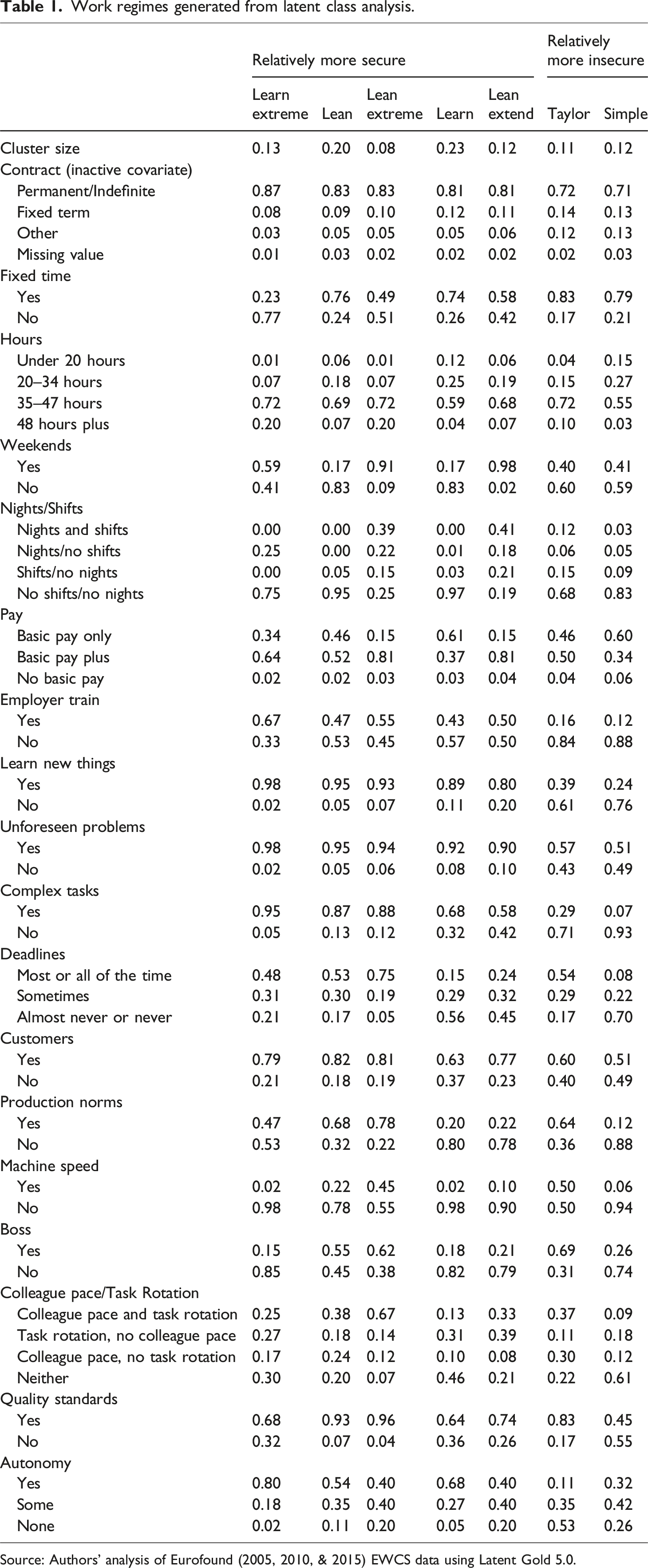
Source: Authors’ analysis of Eurofound (2005, 2010, & 2015) EWCS data using Latent Gold 5.0.
Latent class analysis (LCA) was used to identify the workplace regimes using Latent Gold (5.0). LCA is a data-reduction technique for categorical (nominal or ordinal) variables (McCutcheon 1987). Conceptually, LCA is based on the identification of how variables interact to produce distinct combinations of social elements within a broader social space. This provides an ideal conceptual fit with our concept of the workplace regime. LCA accounts for the distribution of cases within a cross-tabulation, producing mutually exclusive latent classes (in this research, workplace regimes) from the indicators/manifest variables used to build the workplace regimes. LCA identifies these latent classes through a maximum likelihood algorithm that was originally developed by Goodman (1974a, 1974b). For each case included in the analysis, the probability of being in each workplace regime is calculated as part of the solution with all of the probabilities adding to one for each respondent. Respondents are allocated to their ‘most likely’ regime and the uncertainty associated with this means that our analysis provides conservative estimates of the effects of workplace regimes. A further advantage of LCA is that goodness-of-fit indices are provided that assist the researcher in choosing the best-fitting number of classes. We use the most commonly used of these indices, the Bayesian information criterion (BIC); it takes the likelihood chi-square statistic and adjusts for degrees of freedom and sample size (Magidson and Vermont 2004). Descriptive statistics of variables and goodness-of-fit indices are included in Online Appendix C.
The second stage in the analysis involves analysing the differential effect of these workplace regimes, various organisational and demographic variables and the form of national political economy on the overall likelihood of being in non-permanent employment. We used multinomial logit to examine the effect of workplace regime on the odds of being in either fixed-term or casual employment (contract status of ‘other’), relative to having a permanent contract. This multivariate analysis also includes socio-demographic groupings (age, gender and citizenship), sectoral and occupational variables and ‘world of capitalism’. Data for non-citizens are only available for 2005. We carried out a parallel analysis using only 2005 data, and the resultant coefficients for the citizenship variable have been included with the results from the analysis using the entire pooled dataset (2005–2015) and marked accordingly. The odds ratios for the other variables in the 2005-only analysis are broadly similar to the analysis of the pooled dataset and are available from the authors.
Having established which workplace regimes offer less access to employment security, the final two steps use this information to assess the dynamics of unequal access to employment security through those regimes, examining how social and institutional factors interact with workplace regimes. The third step analyzes inequalities in exposure to insecure workplace regimes. The analysis uses fractional multinomial logit (FML) to determine which socio-demographic groupings and political economies are associated with each of the workplace regimes that has relatively lower prevalence of secure contracts, controlling for relevant sectoral and occupational variables. FML is similar to multinomial logit but is used to analyse multiple dependent variables, in the form of proportions which sum to one (Buis 2010; Papke and Wooldridge 1996). We analyse the probability of being in each of the workplace regimes that have relatively higher degrees of contractual insecurity, using the combined probability of being in all of the more secure work regimes as the reference category.
Finally, the fourth step investigates the determinants of access to permanency within each of the various work regimes, recognising that these regimes operate as local social orders with their own social and institutional organisation. We analyse who is more likely to be in contractually insecure employment based on age, gender, citizenship and world of capitalism within each of our workplace regimes, using logistic regression to predict the odds of being on a non-permanent relative to a permanent/indefinite contract. Control variables for occupation, sector and company size 4 are included in each regression. Because of constraints on space, this analysis is presented in Online Appendix D.
Workplace regimes and patterns of contractual insecurity
In our analysis in Table 1, we identify seven workplace regimes. For the latent class analysis, the lowest fitting BIC was associated with an 8-class solution, though the BIC for a 7-class solution was very close. 5 We proceed with the 7-class solution for the sake of parsimony, and because it generated a set of workplace regimes that were clearly intelligible in conceptual terms. Four of the workplace regimes that emerged from the LCA analysis – ‘Learn’, ‘Simple’, ‘Taylorist’ and ‘Lean’ – are very similar to the workplace regimes produced from previous analyses of EWCS data (Arundel et al., 2007; Holm et al., 2010; Lorenz and Valeyre 2005). The ‘Learn’ regime typifies jobs that have high learning opportunities and high autonomy with quality standards. The ‘Simple’ regime is the opposite with few learning opportunities and moderate to low autonomy. ‘Taylorist’ regimes also have low learning with little autonomy. However, they employ extensive control mechanisms such as deadlines, productions norms, machine speed, boss oversight, colleague pace and quality standards, making them higher intensity jobs. ‘Lean’ workplace regimes have high levels of learning, similar to Learn, but less autonomy and more diverse control mechanisms. Nonetheless, Lean regimes are clearly distinct from Taylorism which has far less learning and autonomy.
The three other regimes produced from our analysis are ‘Learn Extreme’, ‘Lean Extreme’ and ‘Lean Extend’. Each is an extension of either the Lean or Learning regimes outlined above – incorporating either a different organisation of work practices, of time and/or different mixes of control mechanisms. Workers in the ‘Learn Extreme’ regime are more likely to work over 48 hours a week including weekends, evenings and/or nights with no fixed time schedule and more intensive controls than in the ‘Learn’ regime. While Lorenz and Valeyre (2005) identified a single regime for lean work organisation, we find two further variants. ‘Lean Extreme’ jobs are typified not only by the presence of a wide range of control mechanisms (deadlines, customers, production norms, boss oversight, quality standards, colleague pace and task rotation) – but also by the possibility of long and extended hours, including shifts. This is an exceptionally intense workplace regime, albeit one that involves significant worker participation. ‘Lean Extend’ jobs are also likely to work weekends, nights and shifts but are controlled much less tightly and primarily through interaction with colleagues. The identification of these three additional regimes to those outlined by Lorenz and colleagues is significant in showing the degree to which working time arrangements and intensive labour controls can generate different work situations in addition to factors related to autonomy and learning. In addition, as we will see, these regimes have a quite distinctive profile in the analysis compared to their ‘Lean’ and ‘Learn’ cousins.
Having identified the workplace regimes, we order them in Table 1 according to the level of non-permanent employment within the regime. The overall percentage of non-permanent contracts (fixed-term contracts and other) across workplace regimes is about 22%. The level of insecure employment across workplace regimes ranges from relatively low in Learn Extreme (11% non-permanent) and Learn and Lean regimes (14% - 17%) to relatively high in Taylorist and Simple regimes (26% non-permanent). The differences are most striking for employment contracts classified as ‘other’ which includes ‘no contract’.
It is noteworthy that all regimes contain significant forms of ‘flexibility’, even where this is not primarily through the employment contract. For example, the Learn Extreme and Lean Extreme regimes both include quite widespread use of working time flexibility and long hours within their largely permanent workforce. Furthermore, earnings are linked to performance and/or to extra time as a means of rewarding/incentivising employees. At the other end of the spectrum, the most contractually insecure regimes, Taylorist and Simple, contain what could be considered the worst jobs in Europe – both have low learning/training opportunities and low-to-moderate autonomy at best. While hours in both regimes are often fixed, they can extend into weekends.
The three other regimes in the middle of the distribution incorporate different flexibilities – their relatively moderate employment contract insecurity is accompanied by the possibility of extensive short hour working in Learn; shift, weekend and night work in Lean Extend; and a mix of forms of flexibility within a standard working week in Lean Extreme. This indicates the value of including the additional three regimes in our analysis in that they are identified largely by distinctive forms of labour flexibility, particularly around working time but also including control over the flexible allocation of labour in production.
This descriptive analysis suggests that the low learning regimes are the least secure. Furthermore, regimes that involve more general problem-solving skills (e.g. learning new things, dealing with unforeseen problems and undertaking complex tasks) are more likely to have higher rates of permanent employment than those with greater focus on meeting specific requirements (e.g. production norms and quality standards). Higher autonomy levels in a regime are also strongly correlated with higher rates of permanency. Overall, the suggestion is that (more complex) ‘general’ skills are more significant in predicting permanency than ‘specific’ skills.
Predicting contract type, EWCS 2005-15 (multinomial logistic regression).
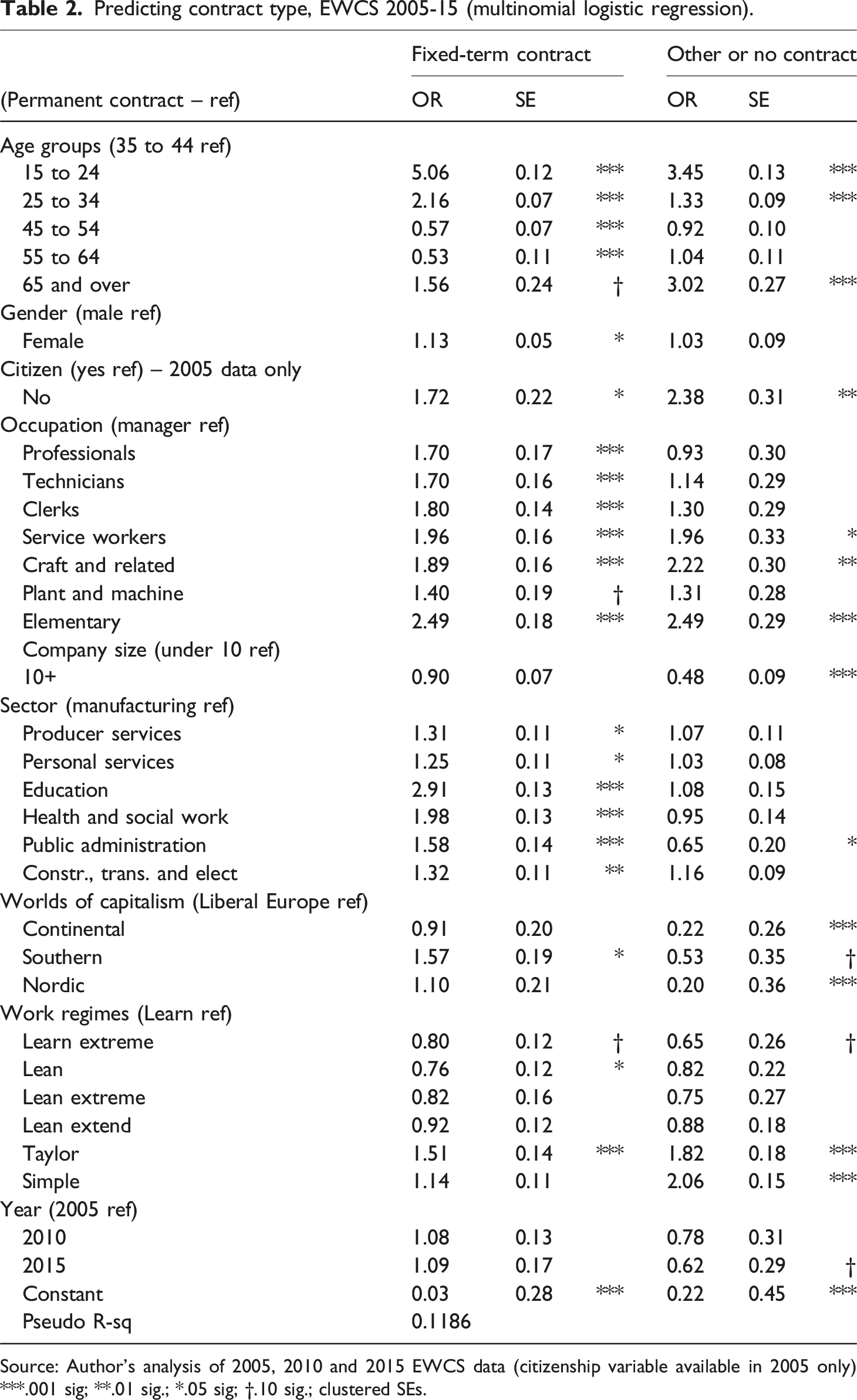
Source: Author’s analysis of 2005, 2010 and 2015 EWCS data (citizenship variable available in 2005 only) ***.001 sig; **.01 sig.; *.05 sig; †.10 sig.; clustered SEs.
Overall, these initial results provide enhanced evidence that the ‘new’ Lean and Learning regimes are unlikely to increase employment insecurity, especially if worker autonomy is enhanced. Nonetheless, there is also the suggestion from Table 1 of a ‘trade-off’ within those Lean and Learning regimes, as the higher levels of permanency are combined with the most highly pressured and highly flexible work practices.
While the effects of workplace regimes on insecurity are significant, there are also significant effects of a series of demographic, occupational and sectoral variables. Age has a clear relationship to both types of contractual insecurity, especially among the youngest and those beyond standard retirement age. Non-citizenship also strongly increases the odds of contractual insecurity. Class and gender are somewhat less clear-cut in their effects. Women are more likely to be in fixed-term employment, but there is no gender effect on risk of casual work. Occupational differences are also clear, although slightly different for each type of contract. In fixed-term employment the major differences are at either end of the occupational hierarchy, with managers significantly less exposed while elementary occupations are more exposed, whereas for casual work there is more of an occupational gradient.
There are higher rates of fixed-term contracts in construction, transport and electricity, production and personal services. However, it is in the social services sectors – education, health and social work and public administration – where fixed-term employment is most widespread. The high risk of this type of contract in these sectors which are usually associated with the public sector (and are often feminised) is striking. In terms of risk of casual employment, there are fewer significant differences although rates are higher in small firms and public administration.
Finally, we turn to the European worlds of capitalism and their association with contractual insecurity. Overall, the Mediterranean economies have a significantly higher risk of fixed-term employment, with no difference between the other political economies. More variations emerge in casual employment. Here, the Continental and Nordic political economies have much lower risk levels (casual work is relatively minimal) while Liberal economies have the highest risk with Mediterranean countries in between. This result should be interpreted with caution as Healy and Ó Riain (2021) find that workers without a contract in Mediterranean capitalisms are effectively casual workers but that Liberal capitalisms (uniquely) contain a group of workers who largely work as if permanent but without contractual guarantees and who seem to suffer some moderate disadvantage because of this.
Odds of being in a work regime with higher levels of non-permanent jobs (based on fractional multinomial logit).
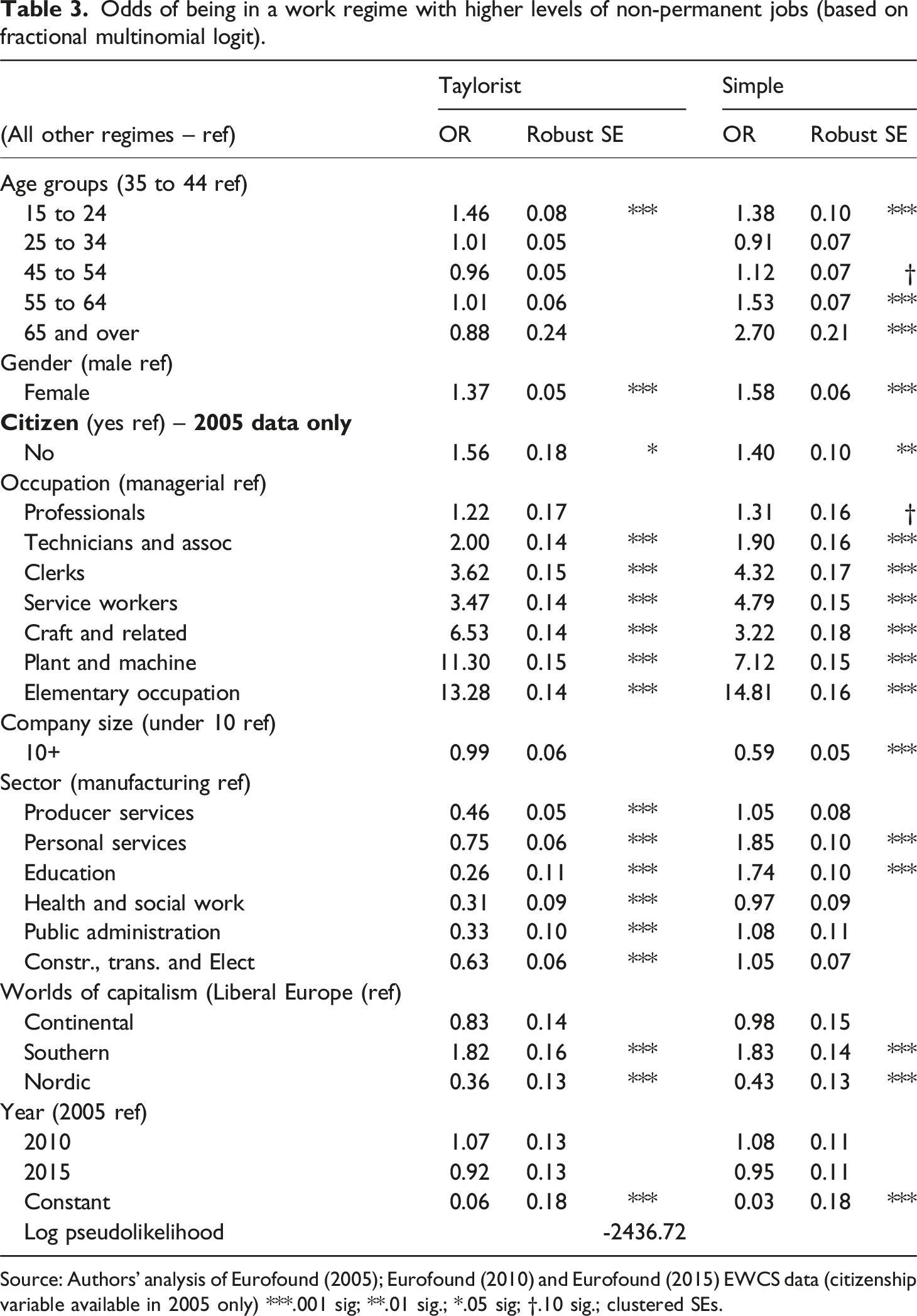
Source: Authors’ analysis of Eurofound (2005); Eurofound (2010) and Eurofound (2015) EWCS data (citizenship variable available in 2005 only) ***.001 sig; **.01 sig.; *.05 sig; †.10 sig.; clustered SEs.
The two regimes are somewhat different from one another. Taylorist regimes are most associated with manufacturing (and to a lesser extent, personal services and CTE (construction, transportation and electricity)), but Simple regimes are concentrated in smaller firms and in personal services and education. Class hierarchies are highly significant in explaining the risk of being in both these regimes. Despite the sectoral profile, manual production workers (plant and machine) and those in elementary occupations are more likely than service workers to be in these regimes. Furthermore, the occupational hierarchy effect on exposure to risky regimes extends across the whole range of occupations, unlike the direct occupational effect on insecurity where the effect is largely at the extremes of the range. Similarly, the effect of gender on exposure to risky regimes is highly significant and much greater than the gender effect on impermanency in Table 2. Non-citizenship is a significant risk factor for all types of insecure contracts and risky regimes. Youth remains a significant risk factor though workers older than 54 are more likely to be found only in Simple regimes. Overall, both regimes rely heavily not only on ‘outsider’ groups (women, younger workers and non-citizens) but also on manual workers.
Mediterranean economies consistently have the highest exposure to these contractually insecure regimes. Meanwhile, Nordic economies are the least likely to contain either Taylorist or Simple regimes, to the extent that these regimes seem to have largely disappeared from their menu of templates for organising workplaces. Liberal and Continental economies share similar odds for Taylorist and Simple regimes, despite being positioned on either end of the debates about dualism. While their national institutional contexts are quite different, their mix of workplace regimes is quite similar. The channelling of marginalised groups into workplace regimes with less contractual security is a significant factor in shaping group differences in contractual insecurity, fading to less significance only in Nordic economies because there are few workers in those regimes.
Overall, our analysis shows that workplace regimes are not only associated with labour market insecurity but are also significant mediators of exposure to the risk of insecurity for different socio-demographic groups. This is a new result in the context of contemporary work regimes, and particularly in comparative analysis.
The final step in our analysis examined socio-demographic determinants of insecurity within workplace regimes (because of constraints on space the details are presented in Online Appendix D). While the specific labour forces mobilised in different workplace regimes differ, there is no evidence of a ‘protection effect’ for more vulnerable groups in the most secure workplace regimes – they are equally disadvantaged in those regimes (and in the case of women, more disadvantaged).
Conclusion
This paper has re-visited the classic question of the link between the form of work organisation, or workplace regime, and the labour market (in)security of workers who work within that regime. The paper develops the perspective of labour market segmentation literature for a changed historical context and updates and extends the analysis of others who have analysed comparative European data on this topic (e.g. Holm and Lorenz, 2015; Doerflinger et al., 2020). Theoretically, we advance research in the area by providing a richer understanding and classification of workplace regimes and analysing their effects on employment insecurity and by providing a detailed analysis of the various ways that workplace regime interacts with social inequalities and institutional contexts to shape labour market security.
In terms of workplace regimes and insecurity, we have identified seven distinctive workplace regimes with varying effects on access to permanent employment contracts. Learn Extreme, Lean and to a lesser extent Lean Extreme regimes have higher levels of security and Taylorist and Simple regimes stand out as less secure. Learn and Learn Extreme regimes sit between these two groups. This indicates that worker autonomy and knowledge remain a buffer against labour market insecurity as regimes which rely on these characteristics offer higher levels of security. Indeed, our analysis suggests even more strongly than Lorenz and Valeyre (2005) that Lean and Learning regimes are the more secure in terms of employment. However, various Lean and Learning regimes bring their own trade-offs as the most secure regimes appear to make use of a wider range of types of labour flexibility and work control.
In terms of social inequalities, the ‘direct effects’ of socio-demographic group on insecurity are explained by a combination of allocation to risky regimes and by varying inequalities between groups in particular workplace regimes. For young workers, the risks are pervasive – both in allocation to risky regimes and in their disadvantage in all workplace regimes. Younger and older workers experience marginalisation in different ways – with extended tournaments of insecurity for younger workers while older workers are constrained within casual labour markets, typically most prevalent in regimes most common in services (Marsden 2011).
For women, the disadvantage is accounted for mainly by allocation to risky regimes at the less rewarding end of the labour market and by unequal access to permanency inside the relatively rewarding Learn Extreme regime. For non-citizens the pattern is different again, with greater allocation to risky regimes and restricted access to permanency in Lean Extend, Taylorist and (the slightly different) Learn Extreme regimes. Non-citizen and older workforces appear to operate as functional substitutes in the labour market with non-citizen insecurity highest in the regimes where insecurity is lowest for older workers, partly based on a split between manufacturing and service work. We therefore find that disadvantage tends to accumulate but to different degrees and through different workplace regime ‘channels’ for different groups.
The analysis also shows the value of including a wider range of regimes as the most striking labour market inequalities are largely in the ‘Extreme’ and ‘Extend’ regimes. There is no evidence of a ‘protection effect’ for more vulnerable groups in the most secure workplace regimes – they are equally disadvantaged in those regimes (and in the case of women, more disadvantaged). Moreover, there are no cases of countervailing forces against disadvantage – regimes serve as either neutral contexts or to reinforce existing inequalities.
Finally, we examined how patterns of contractual insecurity varied by world of capitalism, offering a critique of the group closure approach’s connection between protection and dualism. The Mediterranean economies show a clear pattern of exposure to contractual insecurity, particularly relative to Continental and Nordic countries. While there may be protected sectors and groups (particularly managers), the dominant feature of these economies’ labour markets is a pervasive insecurity of various forms (see also Healy and Ó Riain, 2021). This includes direct effects of Mediterranean capitalism on insecurity across and within workplace regimes and greater likelihood of insecure regimes in Mediterranean capitalism.
Comparing other worlds of capitalism is revealing. Looking first at the divide between ‘coordinated’ and ‘liberal’ market capitalisms, Continental and Liberal economies have a similar degree of exposure to ‘risky’ workplace regimes such as Simple and Taylorist. However, the Continental economies (with stronger employment legislation and corporatist institutions) combine this with relatively low rates of contractual insecurity (in casual work and within regimes) while Liberal economies (with the weakest legislation and corporatism in this period) end up with high rates of contractual insecurity, in casual and particularly ‘no contract’ work. More similar than we might expect in their workplace regimes, the greater security of workers in Continental than in Liberal economies appears to be largely explained by legal and institutional differences. Overall, the Liberal economies have a greater variety of forms of flexibilisation of the labour contract and fewer social protections, so the potential for further erosion of security seems greatest in those economies. While this should not be taken as the final word on the topic, the claim of the group closure literature that dualism is greater in the Continental and Nordic capitalisms is not supported, and indeed it may be stronger in Liberal market capitalisms.
This does not mean that there is only one road to enhanced employment security. In particular, Nordic capitalisms are willing to relax some protections against precarity – their employment protection legislation is somewhat more liberal, and their rate of non-permanent employment is typically slightly higher. However, the Nordic economies retain a ‘hedge’ against this slightly greater risk as there is a very low incidence of the most contractually insecure regimes (Taylorist and Simple), compared to each of the other worlds of capitalism. This is perhaps a typically Nordic pattern where market relations are relatively unconstrained but only within basic conditions of the market that involve the removal or weakening of the most inegalitarian elements (Thelen, 2014). Moreover, this greater security for workers through workplace regimes is explained by ‘organisational upgrading’ away from Simple and Taylorist regimes as well as by worker mobilisation.
Since the analysis relates to data from 2005 to 2015, there is the question of whether there have been significant changes in these patterns in recent years, particularly given the impact of the pandemic. While we could not integrate the pandemic-era 2021 data into our analysis, we have undertaken a partial comparison of workplace factors predicting non-permanent employment in 2015 and 2021 (see Online Appendix D). This indicates that the pattern of effects is generally very similar in both years and that the analysis for the earlier waves of the survey is likely to remain a useful guide to patterns during the pandemic.
Our analysis shows the importance of workplace regimes in structuring patterns of labour market insecurity, in interaction with social inequalities and institutional contexts (Grimshaw, 2017; Doerflinger et al., 2020). We show how these factors interact with workplace regimes and how age, gender and citizenship inequalities in the labour market work in significantly different ways (Acker, 2006). The paper significantly updates and extends existing analyses and shows the importance of understanding not only the differences between Taylorist and Simple regimes and the ‘new’ Lean and Learning regimes but also understanding the variety within these newer forms of work organisation. Overall, the paper argues for a renewed attention to and deeper understanding of workplace organisation and politics as critical factors in shaping labour market outcomes.
Supplemental Material
Supplemental Material - Workplace regimes and contractual insecurity in European employment
Supplemental Material for Workplace regimes and contractual insecurity in European employment by Amy Erbe Healy and Seán Ó Riain in European Journal of Industrial Relations
Footnotes
Declaration of conflicting interests
The author(s) declared no potential conflicts of interest with respect to the research, authorship, and/or publication of this article.
Funding
The author(s) disclosed receipt of the following financial support for the research, authorship, and/or publication of this article: This work was supported by the H2020 European Research Council (New Deals in the New Economy).

Supplemental Material
Supplemental material for this article is available online.
Notes
Author biographies
References
Supplementary Material
Please find the following supplemental material available below.
For Open Access articles published under a Creative Commons License, all supplemental material carries the same license as the article it is associated with.
For non-Open Access articles published, all supplemental material carries a non-exclusive license, and permission requests for re-use of supplemental material or any part of supplemental material shall be sent directly to the copyright owner as specified in the copyright notice associated with the article.
