




Abstract
We shed light on an understudied group: retirees in unions. Using representative individual-level data of 19 European countries, we find that the share of retirees in unions and the union density of retirees increased between 2008 and 2020. Econometric analyses indicate that on average retired workers’ probability of union membership is 17 percentage points lower than that of active workers, with some variation among countries. This finding is consistent with social custom models and cost–benefit considerations, but it partly questions the inter-generational solidarity model put forward in the literature. We further find that some determinants of union membership differ between active and retired workers; for instance, the (former) status of being a full-time or blue-collar worker is only statistically significant for active but not for retired workers. Overall, standard membership models better explain the unionization of active than retired workers.
Introduction
In Europe, trade union membership and density are on the decline (Schnabel 2020; Visser 2019), and the composition of union membership is changing in the continent’s ageing societies. Demographic change, with fewer young people entering the labour force and large baby boom cohorts retiring from the labour market, means that the union membership base among employees is shrinking. What is more, in European countries there is a general pattern of highly unionized cohorts of workers retiring from the labour market and being replaced by less unionized cohorts (Vandaele 2019). As union membership among active workers is declining, one way to maintain unions’ organisational and financial strength may be to also consider those who have retired from work (Kohli et al., 1997), and such a broader perspective is also taken in this paper.
To be sure, unions are traditionally regarded (and regard themselves) as representatives of workers in employment that intend to improve workers’ wages and working conditions. Unintentionally, however, in some countries such as Italy and Germany, unions have become relatively large old-age organizations (Chiarini 1999; Kohli et al., 1997; Leonardi and Pedersini 2023). In corporatist welfare regimes (like Germany), unions are important actors not only in the labour market but also in social policy, including pension and health insurance. If old-age pensions are linked to the development of aggregate income from work, union wage policies will also influence the level of pensions, and retired workers may have an interest to remain union members. For the unions, members who do not leave the union after retirement contribute to financial stability (in particular if the costs of services to retirees do not exceed their membership dues), and retirees may also provide valuable resources relevant to unions such as time, experience and organisational skills. Relying more on retired members, however, might change the very nature of unions, from agents of active workers mainly focussing on collective bargaining to more encompassing lobby organisations. 1
Although there are a number of union membership theories from economics and sociology, ranging from economic supply and demand considerations over social custom models to theories of social action (see the reviews by Schnabel 2003; Ebbinghaus et al., 2011 as well as section 2 below), these theories typically relate to active workers, and it is an open question whether they can also be applied to retired workers. Theoretical considerations to specifically explain unionization among retirees are scarce, but they offer some additional explanations why retired workers are union members and why unions may become vehicles of pensioner activism. These range from strategic, pecuniary reasons and instrumental motives (where retirees are using unions as lobby organisations) to inter-generational solidarity that may be beneficial to both unions and retirees (see Flynn and Croucher 2006). Against this background, this paper will investigate whether the extent and the determinants of unionization differ between retired and active workers.
Given persistent union membership problems and the growing population share of retired workers in ageing societies, it is surprising that the empirical literature on retirees and union membership is quite small. To begin with, in many countries it is not easy or even impossible to obtain up-to-date data from union statistics on the share of retired persons among union members, and it is unclear how many retired members exist only on paper. Moreover, there exist only a handful of studies providing empirical evidence, which typically are descriptive or qualitative in nature and cover one country (or even one union) only. Examples are Chiarini (1999) and Leonardi and Pedersini (2023), which explain the importance of pensioners’ unions in Italy, as well as Kohli et al. (1997) and Schroeder and Munimus (2011), which present some descriptive evidence for the largest union confederation in Germany (DGB). Flynn and Croucher (2006) have survey data for a major British union, the Public and Commercial Services Union, which provide some answers why retired workers stay attached to this union. To the best of our knowledge, there are no comparative analyses of unionization among retired workers that cover and compare several countries in Europe.
Some of these studies report occasional figures on the share of retired workers among union members, which has been rising in Italy and Germany (see Leonardi and Pedersini 2023; Schroeder and Munimus 2011). However, a more informative indicator would be the union density of retirees (i.e. the share of retired members among the retired labour force), and this density is usually not investigated. A partial exception can be seen in the empirical analysis by Blanchflower and Bryson (2022) which shows that in European countries union membership peaks in workers’ late 50s. Although their study does not focus on retirees, they report relatively low union density figures of workers aged 65 and above for the UK and the US. Finally, and most important, although there is a large literature on the determinants of union membership among active workers (surveyed by Schnabel 2020), econometric evidence on the determinants of membership among retirees is completely missing. Overcoming these various research deficits is the main motivation and contribution of the present study.
Taking a quantitative approach and focussing on 19 countries in Europe, we investigate the following four research questions: RQ 1) What is the share of retired persons among union members? RQ 2) What is the level of union density of retired persons compared to active workers? RQ 3) How does the propensity of being a union member differ between retired and active workers? RQ 4) What are the determinants of union membership among retired persons, as compared to active workers? Which determinants play a similar role among retired and active workers, which ones differ?
To answer these questions, we use representative individual-level data on union membership and retirement status from three waves of the European Social Survey (ESS), covering the years 2008, 2014 and 2020. Although the ESS is a cross-sectional survey and not a panel, so that we cannot follow workers over time and do not see when they retire, the representative survey based on identical questionnaires across countries provides rich information that allows us to analyse and compare unionization among retired and active workers in Europe.
The paper contributes to the literature in at least three ways. First, using a rich and representative dataset, we overcome the lack of comprehensive and reliable information on the prevalence of retired workers among union members across European countries. We document that the share of retired union members has risen over time and varies substantially across countries in Europe. Second, we provide descriptive and econometric evidence on differences in union density and in the probability of union membership between retired and active workers. We show that among individuals aged 50 to 79, union density of retired workers lies substantially below that of active workers, again with variation over time and across countries. Our econometric results indicate that on average the probability of being a union member is about 17 percentage points lower for retired compared to active workers, ceteris paribus. Third, our analyses show that some determinants of union membership differ between retired and active workers, suggesting that if unions want to keep or recruit retired members, their organizing strategies should be more focused on the needs and preferences of this group.
Theoretical background
A fundamental but largely unresolved question is why active workers or retirees want to become or remain members of a trade union, in particular if many of the services unions provide (such as better pay and working conditions) accrue both to union members and non-members. Although some membership theories from economics and sociology have been developed (reviewed by Schnabel 2003; Ebbinghaus et al., 2011), most of these relate to active workers, and theoretical considerations to explain union membership among retirees are scarce. In this section, we first sketch the most prominent theoretical explanations used in the literature on active workers, such as the free-rider problem (Olson 1965), the social customs model (Booth 1985), the supply and demand model (Schnabel 2003), and Max Weber’s general categories of social action (Ebbinghaus et al., 2011). We discuss whether these theories carry over to retirees and then focus on explanations that specifically relate to retired union members (Flynn and Croucher 2006).
As already pointed out by Olson (1965), in most European countries unions face a free-rider problem. Many union services, such as collective bargaining and better working conditions, apply to all workers regardless whether they are union members or not. Hence, individuals have a free-rider incentive to benefit from union services without paying membership dues. Olson (1965) argues that in such a context, unions can only exist if membership is compulsory (e.g. in a closed shop) or if unions offer selective services available only to their members (e.g. strike pay or legal advice). What would Olson’s theory imply for retirees? In the majority of European countries, the development of old-age pensions is not linked to wage growth. 2 In countries where it is, retirees may influence wage setting and thus pensions by being a union member, and here the free-rider problem might become relevant. Whatever the case, the amount and quality of (selective) services offered by unions that meet the interests of retired people (such as legal protection or cheaper insurance policies) may be crucial for them when deciding whether to join or stay in a union.
In the light of the free-rider problem, Booth (1985) has developed the social custom model of union membership. It suggests that trade union membership enhances individuals’ reputation within a social group and thus their utility when behaving in accordance with a social norm. Peer pressure ensures that there is a strong incentive for individuals to be union members. In the social customs approach, the decision to unionize is thus interdependent. In the context of active workers, this means that within a company, individuals may be more prepared to become union members if their colleagues are also members and exert some peer pressure. But what happens when a worker retires? Following Booth’s (1985) reasoning, the reduction in work-related social contacts after retirement should go hand in hand with a reduction in peer pressure, resulting in a reduced incentive to remain in (or join) a union. Unless retired workers form a social group of their own with a distinct and enforced social norm of supporting unionism, the social custom model predicts that an increasing number of workers would leave the union after retirement.
Following Pencavel (1971), economic modelling has long analysed union membership within a conventional supply and demand framework (see also Schnabel 2003). Here, membership is the result of an interaction between workers’ demand for and unions’ supply of membership and services. Both workers and unions are utility maximisers. Workers’ demand is influenced by various factors such as membership dues, individual income, the union wage premium, the cost of alternatives to union services as well as non-monetary factors such as personal attitudes towards unions (e.g. class consciousness). The union, on the other hand, takes into account the revenues from membership dues, the costs of organising and serving new or existing members, and the goals of the union when deciding whom to recruit.
Let us briefly apply this model to retired membership, starting on the supply side. From a union perspective, the cost of recruitment is higher for retired workers because they cannot be recruited at the workplace but must be approached through personalised advertising. At the same time, the costs of service are likely to be lower as retirees may not need or use the full range of union services. Unions sometimes recognise this and offer retirees a lower membership due. 3 Cost–benefit considerations suggest that the union has a strong incentive to recruit members during their working lives and retain them after retirement. Coming to the demand side, retirement leads to a decline in individual income, inducing individuals to consume fewer goods and services, including unionization (if the latter is a normal good). Moreover, since trade unions regard themselves as representing active workers, other organisations (such as charities) that specialise in services for retirees, may be more attractive for retired workers. On the other hand, a reduction in membership dues for retired workers should have a positive effect on the demand for union services (in particular if retirees can still use valuable union services like legal advice, e.g. on pension issues). Finally, it is an open question whether and how personal attitudes towards trade unions change in retirement. All in all, countervailing effects on the demand and the supply side do not allow us to make clear general predictions on the extent and development of unionization after retirement.
From a sociological perspective, Ebbinghaus et al. (2011) interpret union membership in terms of Max Weber’s (1922) four general categories of social action. First, the decision to unionize can be based on instrumental-rational motives. Individuals join a union to assert their personal interests and obtain access to desired goods. Second, the solidarity principle and ideological convictions may play an important role. Third, workers may feel emotionally associated with the community of unionized friends or colleagues and become union members for affectual reasons. Fourth, traditional motives can be relevant, such as a tradition of unionization at the workplace or in the family, where membership is enforced by social customs. In this framework, all four categories can be related to the union membership of retired workers. In particular, solidarity, ideological convictions, personal affections and social customs can (partly) explain why union members might not leave the union after retirement.
After this elaboration of theoretical approaches that originally focus on active and not on retired workers, we now turn to union membership explanations derived specifically for retirees. Flynn and Croucher (2006) discuss four sociological models of union-pensioner relations, which they divide along the axes of what unions offer to retirees (money vs participation) and how far retirees’ interests are detached from those of employed people (detached vs integrated).
The consumer model hypothesizes that retirees value trade union services but may switch to alternative providers such as charities or financial service providers in retirement. This idea is also found in the supply and demand model discussed above, where the demand side is influenced by the number of alternatives to union services. The cross-subsidy model emphasizes the resources trade unions can provide for retired workers, taking the view that unions are used as a lobby group for the interests of retirees. As retirees, who unlike active workers cannot strike, are limited in the activities they can use to express their demands, they may see unions as the only way to influence old-age pensions. This approach can be related to the instrumental-rational motives by Max Weber (1922) in that retirees are using unions as a lobby organization.
In contrast, Flynn and Croucher’s (2006) inter-generational solidarity model puts retirees on a more equal footing with active workers. It is similar to the cross-subsidy model in that the union acts as a lobby group for the interests of the retired. The difference is that in the inter-generational model retirees have access to valuable resources relevant to trade unions (e.g. time, knowledge and organisational skills), which makes them attractive as members (see also Schroeder and Munimus 2011). At the same time, they share similar goals and a desire for political representation with workers on issues relevant to both active workers and retirees. For example, the level of pensions is in itself an inter-generational issue, as it is relevant to retired workers today, but also to workers who will be the new retirees in the future. In their member survey of a British union, Flynn and Croucher (2006) show that the inter-generational solidarity model has substantial validity in explaining why retired workers continue to be union members. They also find that retired members use the union to keep in touch with current working members. This suggests that the union can act as an inter-generational organisation, enabling retirees to serve as consultants to workers on how to address workplace issues. For the retired workers, having regular contact with active workers, for example, in regular meetings of local union groups, can be important activities in spending their newly won free time. Therefore, both the union and retirees have an interest in upkeeping the membership after the end of active working life. 4
Finally, the self-organizing model sketched by Flynn and Croucher (2006) sees retirees as a separate group within the union, committed to addressing the concerns of retirees and influencing union policy accordingly. The organisational structure allows retirees to expand their social networks within the union and to advocate for their specific issues. Because of the social aspect and the opportunity to address their specific needs, retirees have an incentive to become or remain members of the union.
Although the sociological and economic models presented here are not an exhaustive list of possible theories, 5 they suggest that there is a multitude of potential reasons for being and remaining a union member. In the following empirical investigation, we will analyse which determinants play a similar role for active and retired workers and which factors may be specific to retirees.
Data and descriptive evidence
Like most of the research on trade union membership across Europe (e.g. Blanchflower and Bryson 2022; Kirmanoğlu and Baslevent 2012; Schnabel and Wagner 2007), we use data from the European Social Survey (ESS). The ESS is a cross-sectional survey conducted every 2 years through face-to-face interviews in different European countries (European Social Survey European Research Infrastructure (ESS ERIC) 2022). In order to compare the development of retiree membership over time, our study is based on rounds four, seven and tenth of the ESS conducted in the years 2008, 2014 and 2020, for which we have consistent information on our variables of interest (while using all waves would reduce the number of countries in our sample). 6
For our research purpose, the ESS has several advantages (ESS ERIC 2022). First, the questionnaire is identical across countries. This makes the data more reliable for cross-country comparisons than data from national sources. Second, the survey is representative of all individuals aged 15 and above living in private households in each country, regardless of their labour force status, using a strict random probability sample with a target response rate of at least 70%. In addition, the survey provides information on the employment status of the respondents – whether they are currently employed, unemployed or retired. This allows us to clearly identify retirees. 7 Moreover, the survey also includes questions on work-related aspects, such as firm size or the sector of activity. These questions refer to the respondent’s last job in case he or she is not currently employed. Finally, the ESS contains information about individuals’ trade union membership status. Participants are asked whether they are or have been a member of a trade union or similar organisation. Although it is unclear what participants understand by ‘a similar organisation’, we assume, as Kirmanoğlu and Başlevent (2012) have done, that the ambiguity of the question does not bias the estimates. This assumption seems plausible in view of the strong correlation between union density on the basis of ESS data and the cross-national ICTWSS database found by Kirmanoğlu and Başlevent (2012).
Apart from these advantages, the ESS also has some disadvantages. The ESS is not a panel data set, meaning that we cannot observe individuals over time. We thus are not able to investigate when exactly workers retire, when they leave a union, and how these two incidents are related. We only observe a person’s current employment status, which means that if a retiree is not a union member, we do not know whether he or she left the union because of the change in employment status or whether they left the union when they were still active workers. In other words, we cannot identify the causal effect of retirement on unionization. We only can identify some factors associated with the likelihood of union membership among retired workers compared to active workers. Except this disadvantage, the ESS provides all the information we need for a clear comparison between retirees and the dependent labour force, allowing us to gain some insights into an under-researched group, retirees in trade unions.
For the following analysis, we restrict our sample to those countries that have taken part in all three rounds of the survey used and for which we have complete information on the variables we are using. 8 In addition, we only take into account those individuals who have indicated that they are currently employed or unemployed or that they are retired but were employees (excluding the self-employed) in the past. The groups of employed and unemployed individuals are combined into the category of active workers, which allows us to compare the unionization of retirees with that of people actively participating in the labour market. In our basic sample, we consider individuals aged 15 to 79. Although the upper age limit may seem arbitrary, it only results in a loss of about 5% of observations in our sample, and the relatively small numbers of observations of individuals aged 80 and above would make meaningful analyses and comparisons difficult. Since it could be argued that workers retiring at a young age represent a very special group, we also define a subsample of age 50 to 79, ranging from 15 years before to 15 years after the standard retirement age of about 65 years. Arguably, active workers and retirees in this subsample may be more comparable on observable as well as unobservable characteristics, and this subsample therefore serves as a robustness check for our results obtained in the full sample.
Finally, with regard to the trade union membership status, we define a dummy variable that takes the value of one if individuals report that they are currently a member of a trade union (or a similar organization), and zero otherwise. Individuals who state that they are former members or have never been members are included in the zero category.
We start our descriptive analysis by looking at the share of retirees among union members in 2008, 2014 and 2020 in our full sample of people aged 15 to 79. For each of these years, Figure 1 presents the (observation-weighted) average of the 19 countries pooled in our sample. It shows that there has been an increase in the proportion of retired members since 2008. While this share was 10.3% in 2008, it rose to 12.6% in 2020. Given that retirees are on average older than employees, our descriptive statistics suggest that the increasing share of retirees among union members is associated with an increase in the average age of union members over time, as has been found by other researchers (Blanchflower and Bryson 2022; Schnabel 2020; Vestin and Vulkan 2022; Visser 2019). Proportion of retirees among trade union members (in percent). Notes: Respondents aged 15 to 79, average across 19 countries, source: ESS.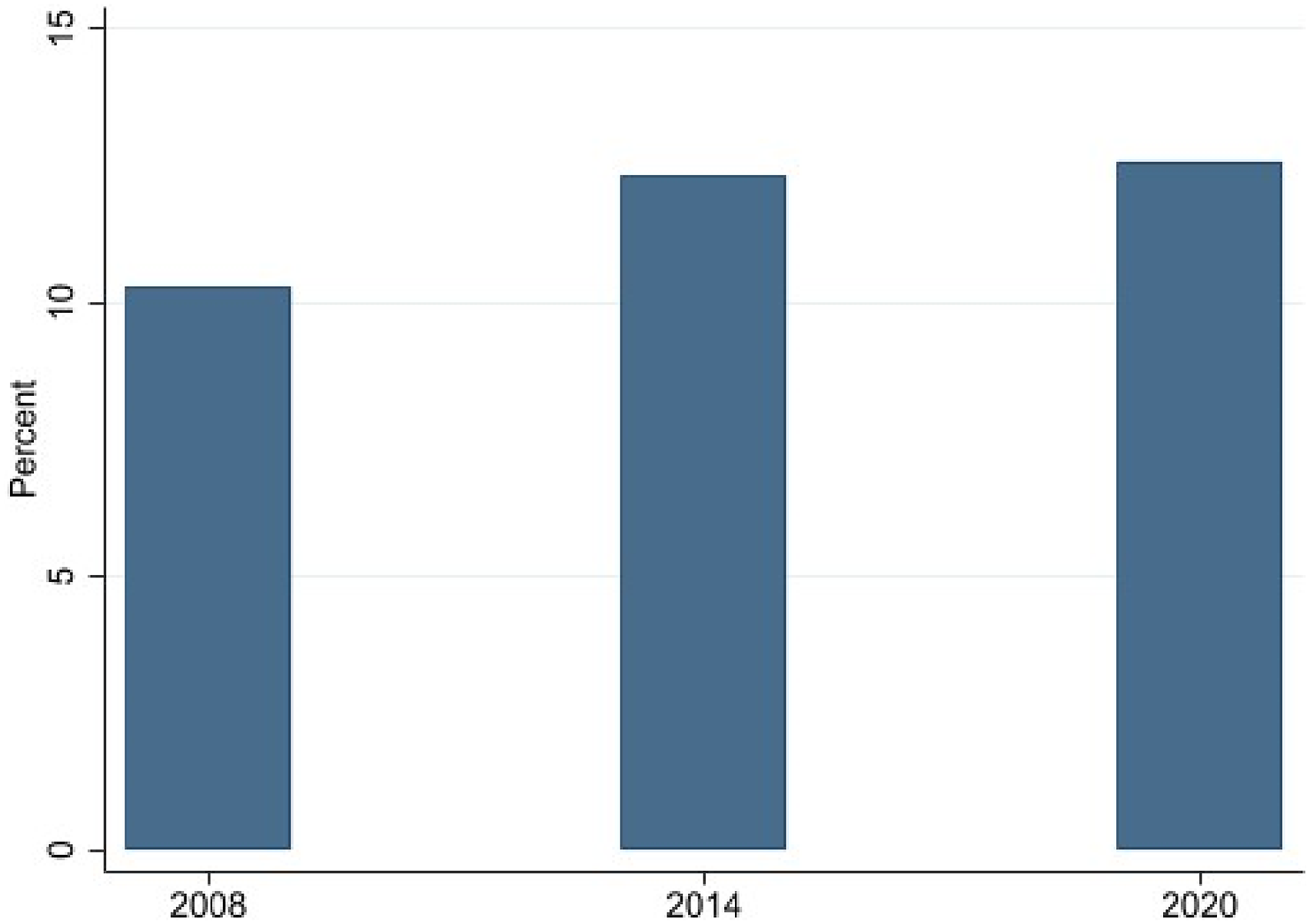
Figure 2 presents the average share of retirees among trade union members in each of the 19 countries, which varies substantially across Europe. While in the Netherlands and Germany, more than 18% of union members are retired, in other countries like Slovenia and Ireland, this share lies below 5%. More detailed analyses not reported in Figure 2 show that between 2008 and 2020, the share of retired union members has increased in 13 of the 19 countries investigated. This development makes retirees an increasingly important group of union members in most European countries. Proportion of retirees among trade union members in European countries (in percent). Notes: Respondents aged 15 to 79, years 2008, 2014 and 2020 pooled, source: ESS.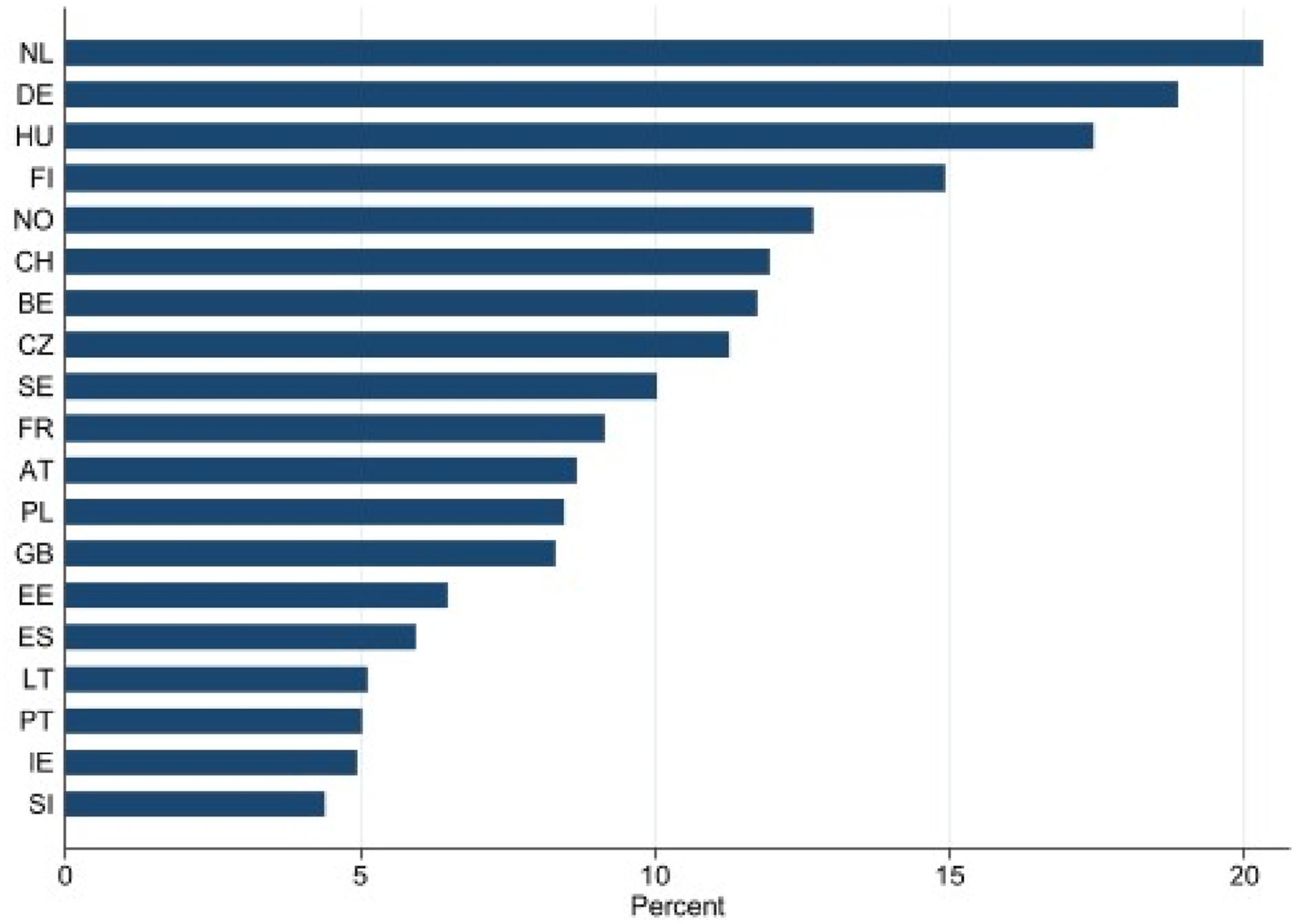
We now turn to union density among active workers and retirees, that is the proportion of union members relative to the total number of active or retired workers. To increase comparability of these two groups, we focus on individuals aged 50 to 79. Figure 3 reports (observation-weighted) averages of union density pooled across our 19 countries for the years 2008, 2014 and 2020. It shows substantially different levels and divergent trends in the union densities of active and retired workers. Union density among active workers is much higher compared to retirees but exhibits a continuous decline over the observation period, decreasing from more than 33% in 2008 to around 27% in 2020. In contrast, union density among retired workers slightly increased from 9.0% in 2008 to 9.7% in 2020.
9
Although the steady decline in union density among active workers in Europe is a well-known empirical fact (see e.g. Vandaele 2019; Schnabel 2020), it is surprising that this downward trend does not seem to carry over to retired workers – a finding that has not been reported before. Union density of active and retired workers (in percent). Notes: Respondents aged 50 to 79, average across 19 countries, source: ESS.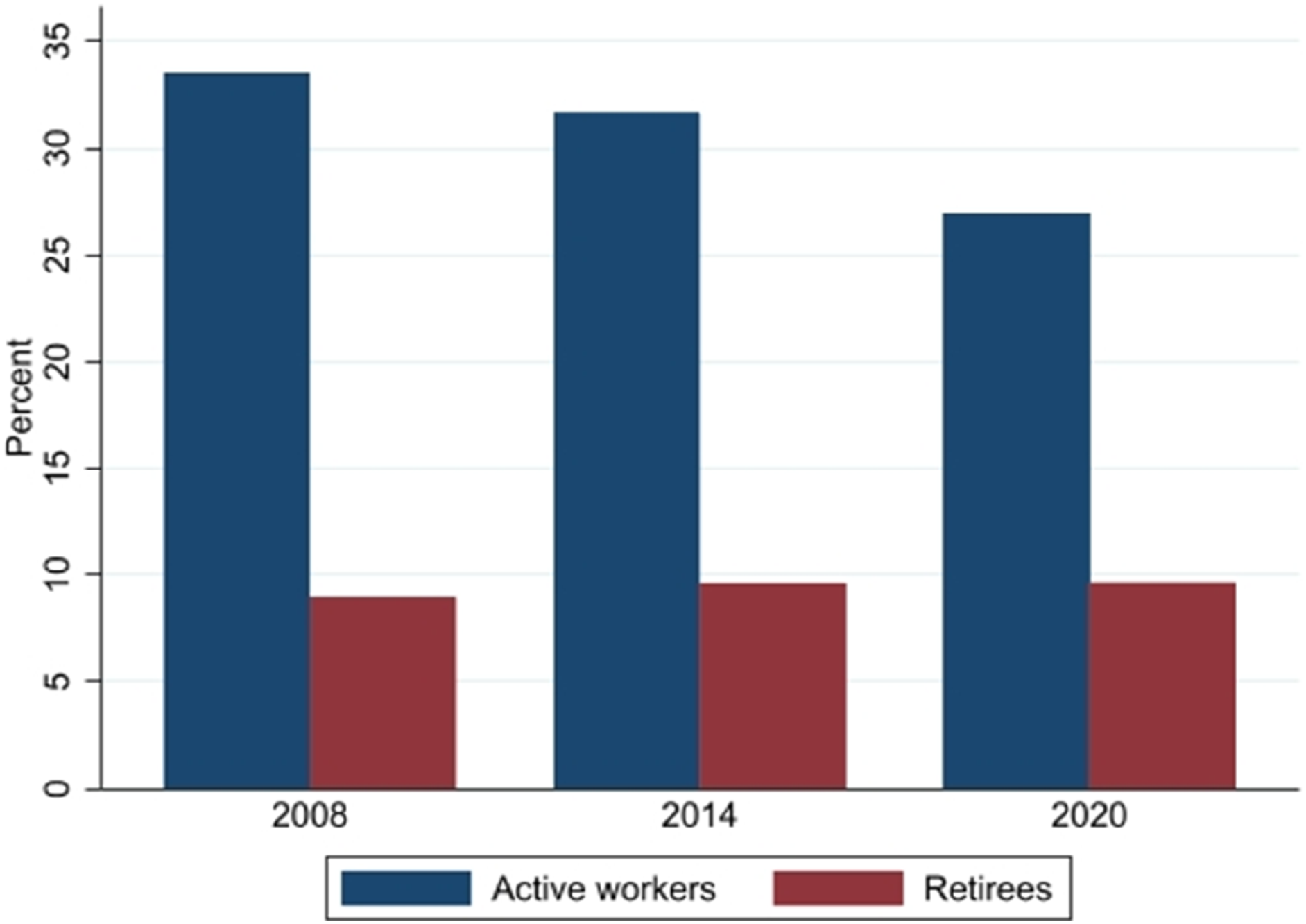
Figure 4 compares union densities of active and retired workers across countries, highlighting substantial differences across Europe. Not surprisingly, union density among active workers is particularly high in Norway as well as in Finland, Sweden and Belgium, three countries with a union-administered unemployment insurance (see e.g. Ebbinghaus et al., 2011). Interestingly, however, in these countries the union density among retired workers is also relatively high, exceeding 40% in Norway and reaching almost 30% in Finland. At the other end of the spectrum, union density among active workers is particularly low (i.e. below 10%) in Hungary and Lithuania, and so is density among retired workers. Across all 19 countries, there exists a strong and statistically significant correlation between the union densities of active and retired workers (with a Pearson correlation coefficient of 0.87).
10
Union density of active and retired workers in European countries (in percent). Notes: Respondents aged 50 to 79, years 2008, 2014 and 2020 pooled, source: ESS.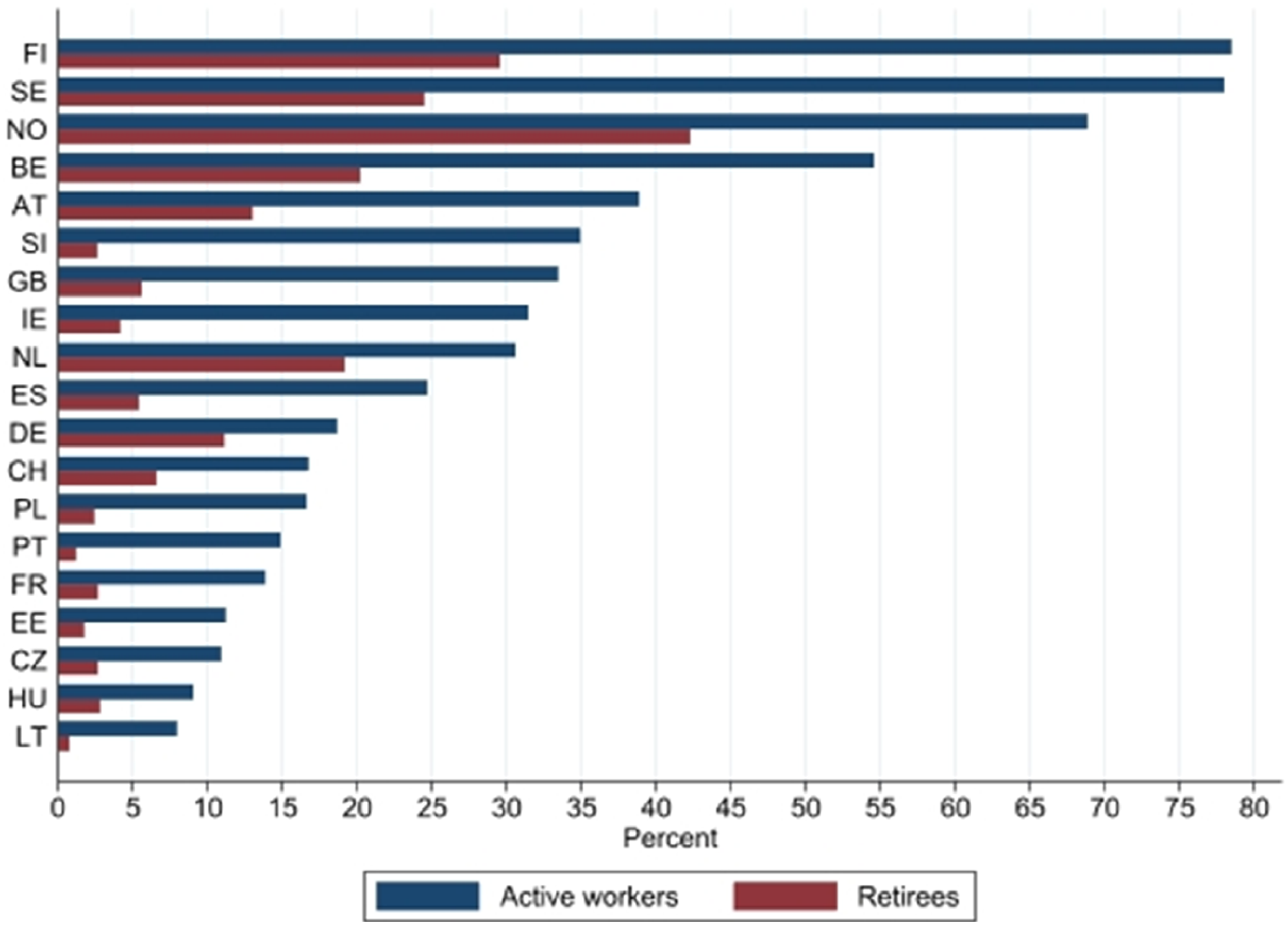
Although our descriptive evidence makes clear that there are substantial differences between the unionization of active and retired workers, we need to know how such differences can be explained theoretically and whether they also hold in a multivariate analysis. These aspects will be addressed in the following sections.
Multivariate analyses
In this section, we empirically analyse the determinants of union membership with a special focus on retired workers. We pool our ESS data across the 19 European countries and the three waves (2008, 2014 and 2020) in our sample but also present results for retirees in each country. Our sample covers individuals aged 15 to 79 but to increase comparability of active and retired workers, we also report estimations for a subsample of individuals aged 50 to 79.
As already discussed in section 2, the dependent variable in our analysis is a dummy taking the value of one if individuals report that they are currently a member of a trade union (and zero otherwise). Our explanatory variables are those variables that have been identified in previous empirical research as the main determinants of unionization in Europe. 11 They include socio-demographic variables like gender, being born in the country, education and age-categories, work-related factors like blue-collar worker and full-time worker, and attitudinal variables like self-assessment of individuals’ religiosity and political standing (on a left-right scale). A dummy variable indicating whether individuals’ father or mother was self-employed when they were 14 years old takes account of workers’ socialisation. We also control for firm size (five dummies) and for working in the public sector. Finally, we include dummy variables for the 19 countries and the three waves of the survey. In addition to these standard determinants, we employ a dummy variable indicating whether individuals are retired as our main variable of interest. Summary statistics of the variables employed are reported in Appendix Table 1. Conducting OLS estimations, we use linear probability models for individuals’ likelihood of being union members (as shown in the Online Appendix, using Logit or Probit models does not change our insights, but it makes interpretation of interaction effects more difficult). 12
Determinants of Union Membership (OLS Estimations).
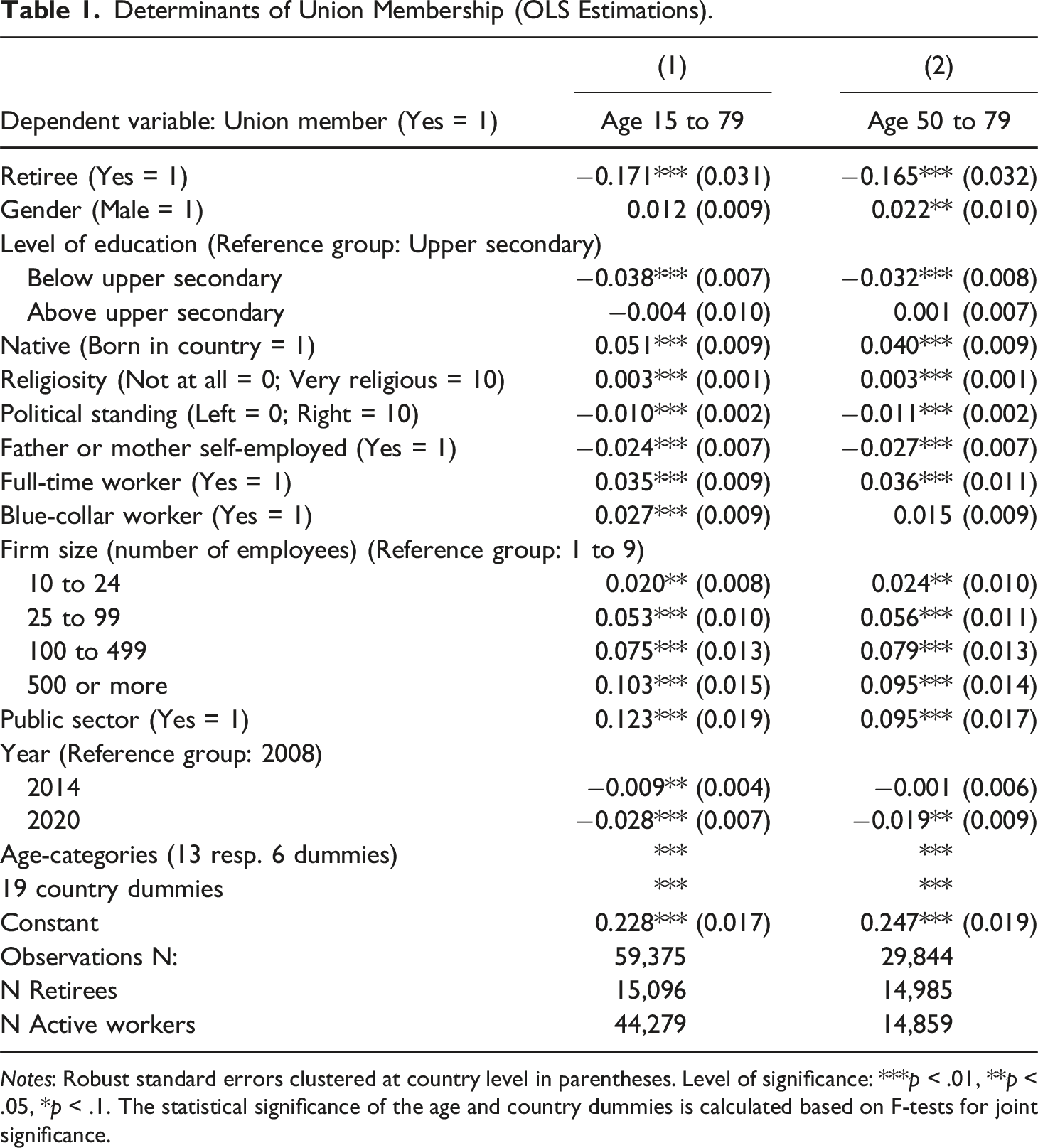
Notes: Robust standard errors clustered at country level in parentheses. Level of significance: ***p < .01, **p < .05, *p < .1. The statistical significance of the age and country dummies is calculated based on F-tests for joint significance.
Retiree Effect by Groups of Countries.
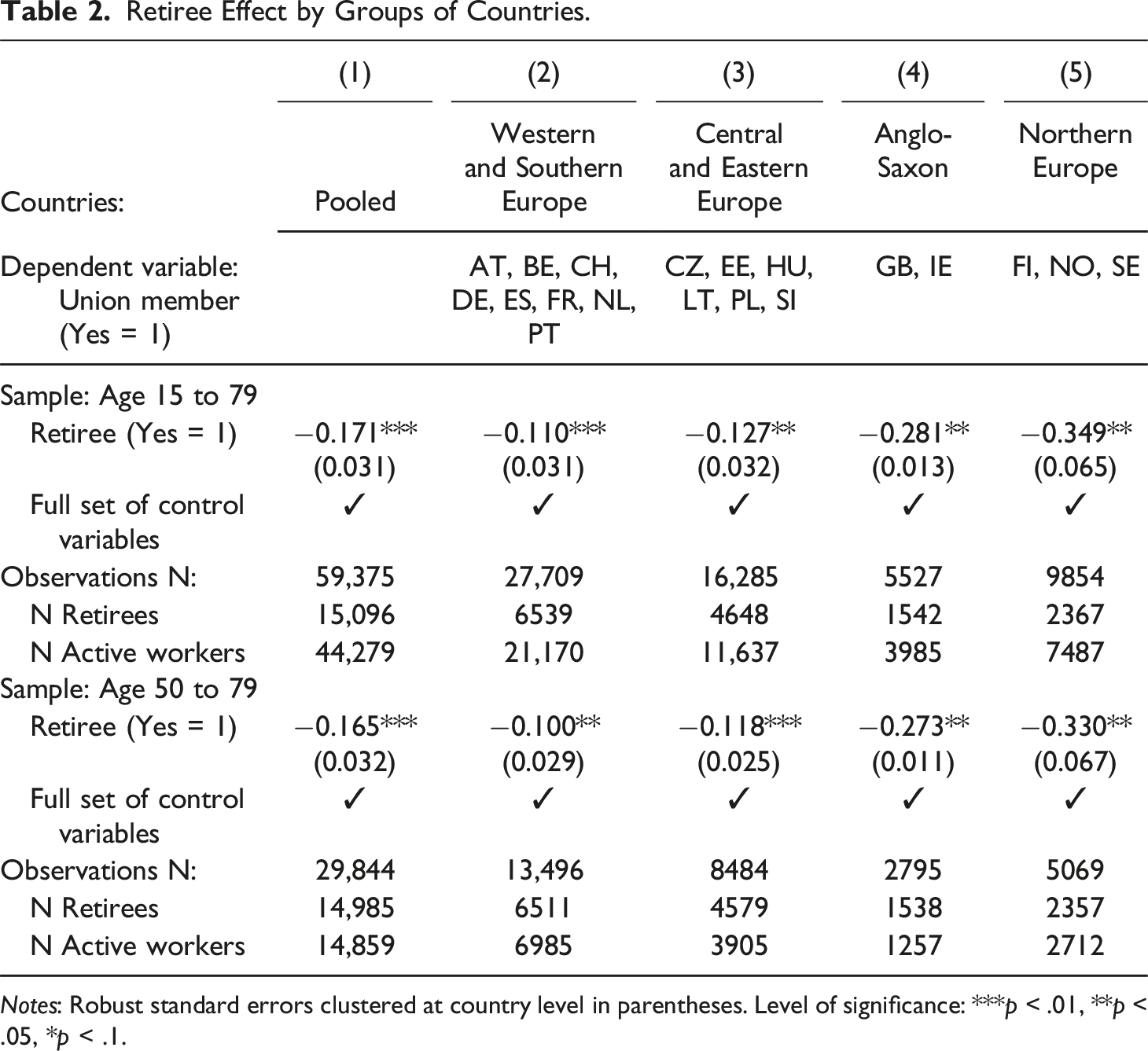
Notes: Robust standard errors clustered at country level in parentheses. Level of significance: ***p < .01, **p < .05, *p < .1.
Concerning our main variable of interest, Table 1 makes clear that retired workers are much less likely to be union members than active workers, ceteris paribus. On average, their probability of union membership is 17.1 percentage points lower in the full sample and 16.5 percentage points lower in the subsample of individuals aged 50 to 79. 13 These differences are large in size and statistically highly significant. Knowing this retiree effect 14 is important for unions and researchers alike since it gives some indication to which extent the organizational and financial stability and the resources of unions are negatively affected if more and more workers retire, above and beyond the ongoing decline in the union density of active workers.
Taking a brief look at the subgroup of retired workers who report to have had a paid job in the last 7 days, we see that their probability of union membership is just 6 percentage points lower than that of active workers in the full sample (see Appendix Table 2). This finding of a negative but much smaller retiree effect for retired workers who still have some connection to the world of work seems plausible and in line with our theoretical considerations, but it should be taken with a pinch of salt as it is based on only 307 cases across three waves and 19 countries.
We closer investigate the retiree effect by running separate membership regressions for each country (using the specification in Table 1). Figure 5 shows that the difference in the probability of union membership between retired and active workers is negative in all countries and statistically significant in 17 out of the 19 countries in our sample (with the Netherlands and Switzerland being the exceptions). The size of this retiree effect varies substantially, both in the full and the subsample. In the subsample of individuals aged 50 to 79, it ranges from less than 5 percentage points in Hungary and Germany to 41 percentage points in Finland. Retiree effect (in percentage points). Notes: The retiree effect is the coefficient of the retiree dummy in country-specific estimations of the model in Table 1 pooled for the years 2008, 2014 and 2020. 95% confidence intervals reported. Source: ESS.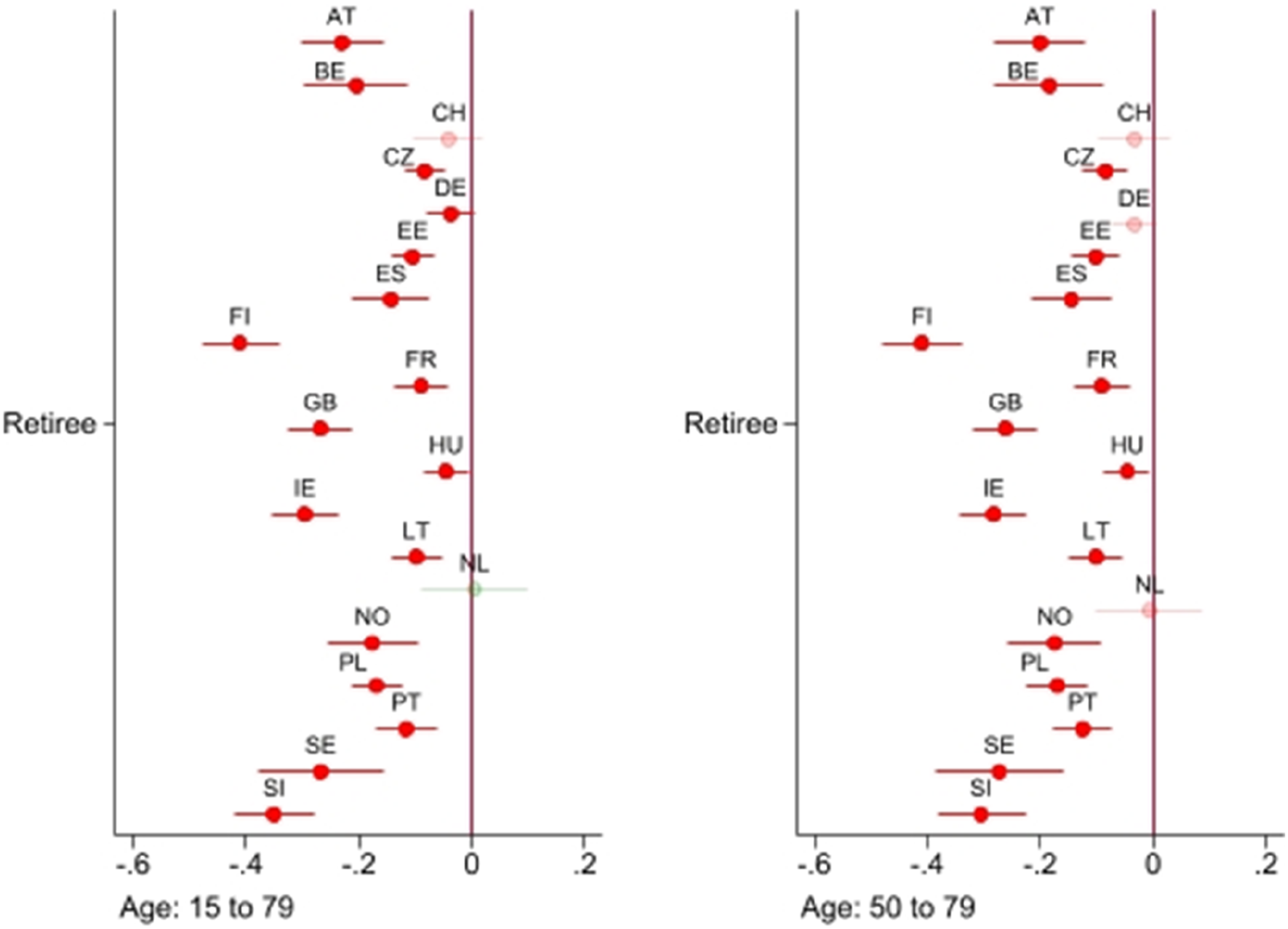
Of course, the retiree effect in percentage points may be more pronounced in countries where union density among the workforce is higher, and a similar retiree effect in percentage points thus can imply substantially different relative or percent effects. For instance, given that union density in Norway is almost 69 percent in the subsample of persons aged 50 to 79 (see Figure 4), the estimated negative retiree effect of 17 percentage points for Norway (Figure 5) suggests that the unionization of retired workers is just about one quarter lower than that of active workers. In contrast, the retiree effect of 17 percentage points estimated for Poland almost equals union density there.
The retiree effect may not only differ among countries, but also among regions or groups of countries with different industrial relations systems and historic experiences. Loosely based on a classification employed by Visser (2019, p. 61), we thus subdivide our sample into four regions in Europe. Table 2 shows that the percentage point retiree effect is largest in Northern Europe (i.e. FI, NO and SE) and smallest in the countries of Western and Southern Europe (AT, BE, CH, DE, ES, FR, NL, and PT). The large effect in the Nordic countries reflects that unionization among active workers is traditionally very high in these countries, which is often attributed to the Ghent system of union-administered unemployment insurance (see Ebbinghaus et al., 2011; Western 1997). Conversely, the rather small percentage point effect in the group of Central and Eastern European countries (CZ, EE, HU, LT, PL, and SI) must be seen against the backdrop of the low unionization in these post-communist countries. Despite these regional variations, we note that the difference in the probability of union membership between retired and active workers is negative and statistically significant in all groups of countries.
Differences in the Determinants of Union Membership Between Retired and Active Workers.
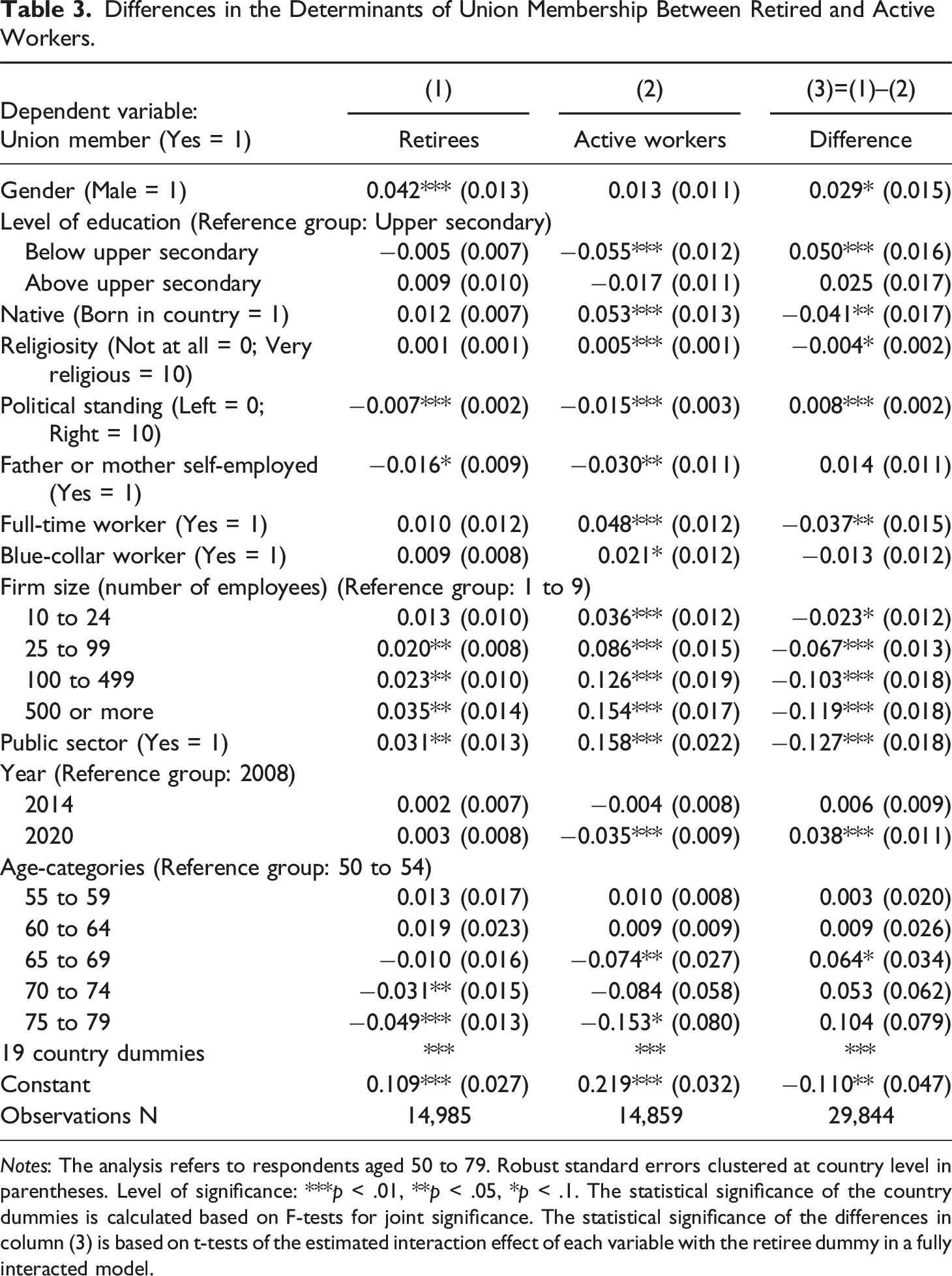
Notes: The analysis refers to respondents aged 50 to 79. Robust standard errors clustered at country level in parentheses. Level of significance: ***p < .01, **p < .05, *p < .1. The statistical significance of the country dummies is calculated based on F-tests for joint significance. The statistical significance of the differences in column (3) is based on t-tests of the estimated interaction effect of each variable with the retiree dummy in a fully interacted model.
To explore these differences in more detail, we ran a fully interacted model where all the determinants of unionization are interacted with the retiree dummy. The results for the estimated interaction effects are reported in Table 3 (column 3). It can be seen that the positive gender effect on unionization is statistically significantly larger for retired workers than for active workers (where it is not significantly different from zero). In contrast, the positive effects of having been born in the country, working full-time, being very religious and working in a larger firm or in the public sector are statistically significantly higher for active than retired workers. Similarly, the negative association between right-wing political views and union membership is stronger for active workers and the negative relationship of age and unionization for persons beyond age 65 is more pronounced for active workers.
In sum, the relevance and magnitude of explanatory variables clearly differs between employees and retirees. In the following section, we will discuss how these findings relate to our research questions and to the theoretical considerations in section 2.
Discussion and interpretation
Our descriptive and econometric evidence has revealed various new insights and overcome some research deficits in the literature. Addressing our research question (1), we have demonstrated that the share of retired persons among union members has increased over time in most European countries, reaching an average of 12.6% in 2020. However, this figure varies substantially across the countries in our sample, and retirees seem to be a crucial group of union members only in few European countries, such as the Netherlands and Germany. Against the background of our theoretical considerations in section 2, these findings suggest that in most countries the importance of retirees in unions is still limited and most retired workers do not seem to regard unions as a main lobby group for their interests.
Following our research questions (2) and (3), we have shown that the union density of retired persons is substantially lower compared to active workers. On average, retired workers’ probability of being union members is about 17 percentage points lower than that of active workers, ceteris paribus. The finding that retirees are less likely to be union members than active workers is consistent with the social custom model (Booth 1985) which implies that many workers leave the union after retirement due to a reduction in peer pressure from fellow workers. It is also consistent with a lower benefit-cost ratio that reduces the demand for union services in the traditional supply and demand model of unionization. In terms of the sociological models sketched by Flynn and Croucher (2006), our results are compatible with the consumer model which predicts that in retirement some workers may switch to alternative providers of union-like services, whereas it contradicts the inter-generational solidarity model according to which retirees should have a substantial interest in upkeeping the membership after the end of their active working life. Likewise, the lower union density of retirees questions the relevance of Weber’s (1922) solidarity principle. If the solidarity motive is relevant, it seems to be stronger for males than females (see the gender effect in Table 3), which may reflect their life-long stronger attachment to the world of work.
Addressing research question 4), our econometric analysis in Table 2 has compared potential determinants of union membership between active and retired workers. It indicates that work-related variables such as being a full-time or blue-collar worker as well as workers’ birthplace are relevant for active workers but do not play a significant role after retirement. 15 Some other variables like firm size and working in the public sector are statistically significant for both groups but their estimated coefficients are much smaller for retirees than for active workers. These findings reflect that in our dataset these variables refer to individuals’ last job. They are broadly consistent with the idea that the strength of social customs decreases after retirement.
Our finding that individuals’ probability of being a union member falls beyond age 65 both for active and retired workers (but more strongly for active workers) may be another indication of social custom effects occurring when the relevant peer groups of workers and retirees, and thus their influence to make peers stay in the union, become smaller over time. It would also be consistent with a reduced demand for union services of older persons. Active workers beyond the usual retirement age are a special, self-selected group that often have to work for financial reasons and may decide to save union membership fees (and rely on legal protection for older workers instead). Retirees’ propensity of remaining in the union may fall with age if they increasingly switch to alternative providers of social services such as charities (as in the consumer model sketched by Flynn and Croucher 2006). In terms of Flynn and Croucher’s (2006) inter-generational solidarity model, the declining unionization probability of older retirees could be interpreted as an indication that older retirees provide less valuable resources to unions or that they become less keen on keeping in touch with working members, so that both the union and the retired workers have less interest in upkeeping the membership.
Two other variables that are statistically significant determinants of unionization both for active and retired workers (although with reduced importance for the latter) are the self-employment status of individuals’ parents and individuals’ political standing. That workers’ socialization and their ideological convictions play a (long-lasting) role for union membership is consistent with the ideas of Weber (1922) and Ebbinghaus et al. (2011) sketched in section 3.
Note that our insights do not change when we perform a number of robustness checks (results are available on request). For instance, we dropped unemployed persons from our sample and reduced the sample to persons of age 50 to 65, in such a way excluding workers above 65 years who may be regarded as a special group. In another check of robustness, we restricted our sample to workers aged 60 to 69, that is the decade in which retirement typically occurs. In this small subsample, the negative retiree effect was 14.5 percentage points (not statistically significantly different from the effect in our main sample), and there was also no substantial change for the other explanatory variables. To avoid a potential outlier problem, we in turn dropped each of the 19 countries in our sample and conducted the pooled estimations for the remaining 18 countries. Finally, to test the argument that retired workers may have an interest to remain union members in order to influence wage policies and thus pensions, we restricted our sample to those 12 countries where pensions are or were (partly) linked to wage growth. However, in this subsample the estimated negative coefficient for retired workers is not statistically significantly different from the coefficient in our main specification and in the subsample of the remaining countries where pensions are not linked to wages growth. So, our insights on retired workers’ reduced probability of being union members are not affected by these robustness tests.
Concluding remarks
Using a representative individual-level data set for 19 European countries, this paper has investigated the extent and the determinants of union membership among retired workers, as compared to active workers. We show that the share of retired persons among union members increased over time in Europe, and on average amounted to 12.6% in 2020. We further find that the union density of retired persons is substantially lower than that of active workers and that it has slightly increased over time, whereas the union density of active workers has substantially fallen.
Our econometric analyses indicate that on average retired workers’ probability of union membership is about 17 percentage points lower than that of comparable active workers, with some variation among individual countries and groups of countries. The finding that retirees are less likely to be union members than active workers confirms some theoretical predictions we derived from the literature. It is consistent with decreasing social custom effects after retirement and with cost–benefit considerations of retired workers who may leave the union and switch to cheaper alternative providers of similar services for retirees. In contrast, the strong difference in unionization between active and retired workers questions the inter-generational solidarity model put forward in the literature (e.g. by Flynn and Croucher 2006) according to which both unions and retirees should have some interest in upkeeping the membership after the end of active working life.
We further find that the determinants of union membership somewhat differ between active and retired workers. Some potential determinants such as working full-time or being a blue-collar worker are only statistically significant for active workers but not for retired workers (where the data refer to their last job). The statistically significant coefficients of some other variables like firm size and working in the public sector or individuals’ socialization in the family and their political standing are much smaller for retirees than for active workers. These results reflect that our model better explains the unionization of active workers, whereas it is much more difficult to uncover the motives for keeping up union membership after retirement. Nevertheless, it is an interesting insight that individuals’ ideological convictions and socialization seem to play a long-lasting role when individuals decide whether to become or remain a union member.
A limitation of our study is that the data set used, the ESS, is cross-sectional and not a panel. We cannot observe individuals over time and are thus not able to investigate when exactly workers retire, when they leave their union, and how these two incidents interact. Our cross-sectional analyses can only detect correlations between variables but are not able to answer questions of causality. Although the ESS is a rich data set that provides information on many potential determinants of unionization, there may be other relevant factors such as national traditions, the union structure or individuals’ work-life experience that are not in the data but would be particularly interesting when investigating retirees’ behaviour.
Despite these limitations, our investigation has provided a first glimpse into the unionization of retirees in Europe, uncovering distinct differences between active and retired workers and substantial heterogeneities among countries. Our insight that standard union membership models cannot easily be transferred to the unionization of retired workers suggests that developing (theoretical and empirical) models for retired members may be a fruitful avenue of further research. Future empirical work could investigate in more detail the different determinants of union membership for active and retired workers in each country or in groups of countries with different systems of industrial relations. It should also make use of panel data and focus on the process of (retired) members leaving the union. In addition, interviews with retirees in all European countries may uncover the main motives for leaving or remaining in the union.
Only if unions know more about the reasons behind retirees’ exit decisions, they may be able to devise appropriate strategies for keeping retired members and thus curbing their persistent membership problems in times of demographic change. However, it is an open and largely unexplored question whether relying more on retired members could be a fruitful strategy. Not only would the very nature of unions change, from agents of active workers mainly focussing on collective bargaining to more encompassing vehicles for social justice and integration (Hyman 2001). It is also possible that retirees prove to be a force of inertia that may retard the revitalisation processes which unions have to engage in (Schroeder and Munimus 2011). For these and other reasons, it will be interesting to see whether unions in Europe really change course and more strongly embrace retired workers in the next years.
Supplemental Material
Supplemental Material - Unionization of retired workers in Europe
Supplemental Material for Unionization of retired workers in Europe by Vinzenz Pyka and Claus Schnabel in European Journal of Industrial Relations.
Footnotes
Acknowledgements
The authors would like to thank Laszlo Goerke, Joachim Wagner and two reviewers of this journal for helpful comments and suggestions.
Declaration of conflicting interests
The author(s) declared no potential conflicts of interest with respect to the research, authorship, and/or publication of this article.
Funding
The author(s) received no financial support for the research, authorship, and/or publication of this article.

Supplemental Material
Supplemental material for this article is available online.
Notes
Appendix
Union membership functions by retiree working status. Notes: Robust standard errors clustered at country level in parentheses. Level of significance: ***p < 0.01, **p < 0.05, *p < 0.1. The statistical significance of the age and country dummies is calculated based on F-tests for joint significance.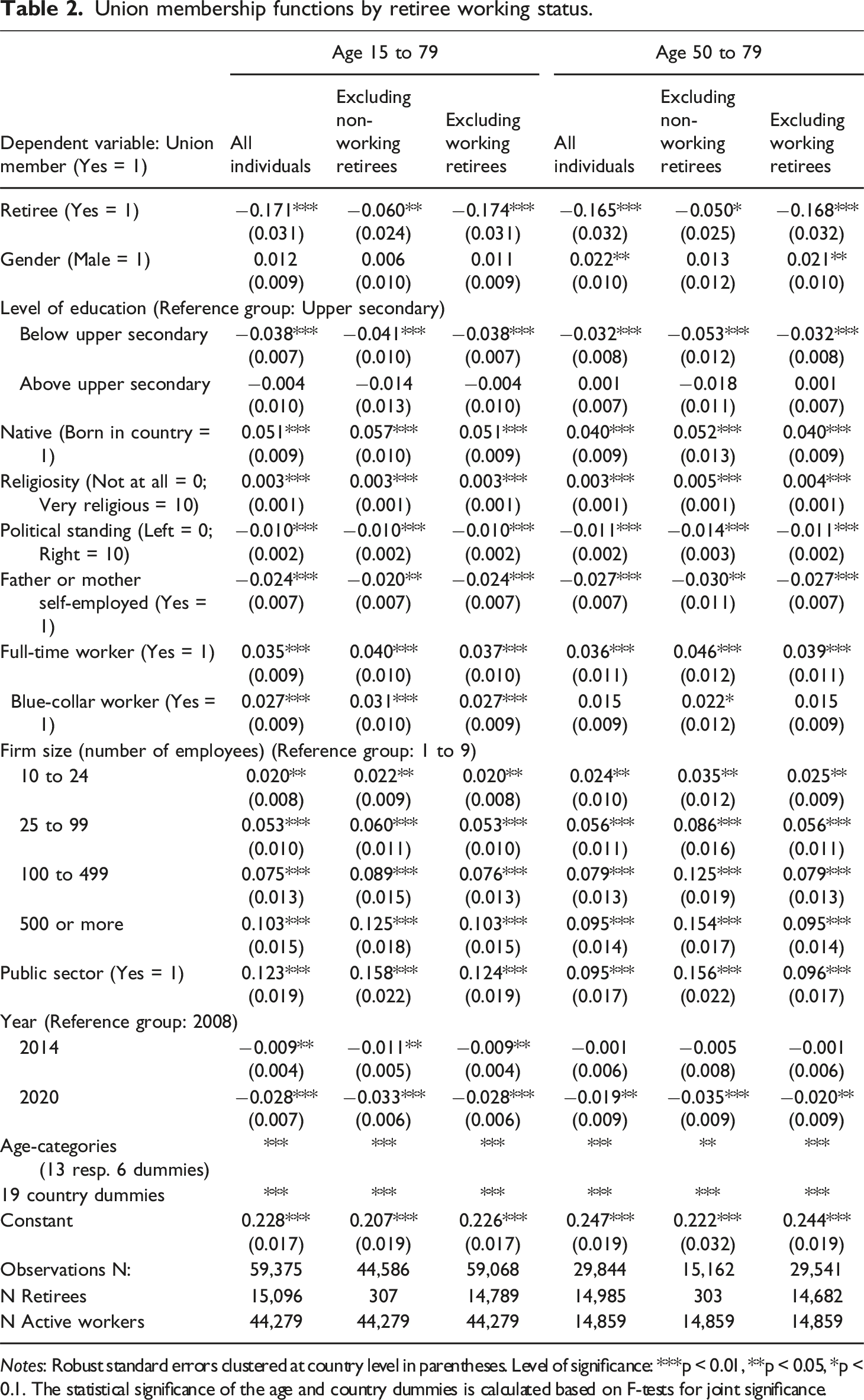
Dependent variable: Union member (Yes = 1)
Age 15 to 79
Age 50 to 79
All individuals
Excluding non-working retirees
Excluding working retirees
All individuals
Excluding non-working retirees
Excluding working retirees
Retiree (Yes = 1)
−0.171*** (0.031)
−0.060** (0.024)
−0.174*** (0.031)
−0.165*** (0.032)
−0.050* (0.025)
−0.168*** (0.032)
Gender (Male = 1)
0.012 (0.009)
0.006 (0.010)
0.011 (0.009)
0.022** (0.010)
0.013 (0.012)
0.021** (0.010)
Level of education (Reference group: Upper secondary)
Below upper secondary
−0.038*** (0.007)
−0.041*** (0.010)
−0.038*** (0.007)
−0.032*** (0.008)
−0.053*** (0.012)
−0.032*** (0.008)
Above upper secondary
−0.004 (0.010)
−0.014 (0.013)
−0.004 (0.010)
0.001 (0.007)
−0.018 (0.011)
0.001 (0.007)
Native (Born in country = 1)
0.051*** (0.009)
0.057*** (0.010)
0.051*** (0.009)
0.040*** (0.009)
0.052*** (0.013)
0.040*** (0.009)
Religiosity (Not at all = 0; Very religious = 10)
0.003*** (0.001)
0.003*** (0.001)
0.003*** (0.001)
0.003*** (0.001)
0.005*** (0.001)
0.004*** (0.001)
Political standing (Left = 0; Right = 10)
−0.010*** (0.002)
−0.010*** (0.002)
−0.010*** (0.002)
−0.011*** (0.002)
−0.014*** (0.003)
−0.011*** (0.002)
Father or mother self-employed (Yes = 1)
−0.024*** (0.007)
−0.020** (0.007)
−0.024*** (0.007)
−0.027*** (0.007)
−0.030** (0.011)
−0.027*** (0.007)
Full-time worker (Yes = 1)
0.035*** (0.009)
0.040*** (0.010)
0.037*** (0.010)
0.036*** (0.011)
0.046*** (0.012)
0.039*** (0.011)
Blue-collar worker (Yes = 1)
0.027*** (0.009)
0.031*** (0.010)
0.027*** (0.009)
0.015 (0.009)
0.022* (0.012)
0.015 (0.009)
Firm size (number of employees) (Reference group: 1 to 9)
10 to 24
0.020** (0.008)
0.022** (0.009)
0.020** (0.008)
0.024** (0.010)
0.035** (0.012)
0.025** (0.009)
25 to 99
0.053*** (0.010)
0.060*** (0.011)
0.053*** (0.010)
0.056*** (0.011)
0.086*** (0.016)
0.056*** (0.011)
100 to 499
0.075*** (0.013)
0.089*** (0.015)
0.076*** (0.013)
0.079*** (0.013)
0.125*** (0.019)
0.079*** (0.013)
500 or more
0.103*** (0.015)
0.125*** (0.018)
0.103*** (0.015)
0.095*** (0.014)
0.154*** (0.017)
0.095*** (0.014)
Public sector (Yes = 1)
0.123*** (0.019)
0.158*** (0.022)
0.124*** (0.019)
0.095*** (0.017)
0.156*** (0.022)
0.096*** (0.017)
Year (Reference group: 2008)
2014
−0.009** (0.004)
−0.011** (0.005)
−0.009** (0.004)
−0.001 (0.006)
−0.005 (0.008)
−0.001 (0.006)
2020
−0.028*** (0.007)
−0.033*** (0.006)
−0.028*** (0.006)
−0.019** (0.009)
−0.035*** (0.009)
−0.020** (0.009)
Age-categories (13 resp. 6 dummies)
***
***
***
***
**
***
19 country dummies
***
***
***
***
***
***
Constant
0.228*** (0.017)
0.207*** (0.019)
0.226*** (0.017)
0.247*** (0.019)
0.222*** (0.032)
0.244*** (0.019)
Observations N:
59,375
44,586
59,068
29,844
15,162
29,541
N Retirees
15,096
307
14,789
14,985
303
14,682
N Active workers
44,279
44,279
44,279
14,859
14,859
14,859
Author biographies
References
Supplementary Material
Please find the following supplemental material available below.
For Open Access articles published under a Creative Commons License, all supplemental material carries the same license as the article it is associated with.
For non-Open Access articles published, all supplemental material carries a non-exclusive license, and permission requests for re-use of supplemental material or any part of supplemental material shall be sent directly to the copyright owner as specified in the copyright notice associated with the article.
