




Abstract
This paper explores the industrial relations (IR) experiences of Chinese multinational enterprises (MNE) in Ireland, with particular focus on the impact of host and home country institutions on IR policies and practices. The study adopted a qualitative methodology of semi-structured interviews with managerial respondents from eight Chinese MNEs located in Ireland and personnel in other relevant public and private organisations. Our results indicate that host country IR institutions (e.g. trade unions, employment legislation and government support) largely explain the IR practices of Chinese MNEs in Ireland. This study also identifies home country effects mostly relating to a hierarchical managerial approach and the development of a culture of harmony and collaboration. Finally, our results also call attention to some emerging ‘convergence’ and ‘divergence’ between Chinese MNEs and other MNEs in Ireland in terms of their IR experiences and responses.
Keywords
Introduction
This paper aims to explore industrial relations (IR) in Chinese multinational enterprises (MNEs) investing in Ireland, with particular focus on home- and host-country IR institutions that shape and determine their IR practices. The choice of Chinese MNEs and their IR practices as our research focus is underpinned by the global rise of China in the last three decades that arguably has reshaped the power landscape of the global economy, including the nature and power dynamics in employment relations (Buckley et al., 2007; Cooke et al., 2019). China is now one of the world’s most important sources of outward foreign direct investment (FDI) sustaining momentum and achieving a very strong performance over the past three decades (UNCTAD, 2004, 2020). Consequently, it has attracted increasing scholarly inquiry over recent years (Buckley et al., 2007; Cooke and Lin, 2012), including some empirical studies of IR issues within Chinese MNEs (Khan et al., 2019; Zhu, 2015; Zhu et al., 2014). These empirical studies have shed light on Chinese MNEs’ adoption of IR practices and their adaption to local institutions. Notwithstanding this literature, gaps remain in terms of both empirical data collection and theoretical conceptualisation of IR behaviours and responses of Chinese MNEs to varying host country’s IR contexts. For example, there is limited attention on Chinese MNEs operating in advanced economies – this largely reflects the pattern of outward Chinese FDI primarily to Africa, Asia and other developing countries (Cooke et al., 2019). Cooke et al. (2019: 461) in a review of the extant literature notes ‘relatively weak theoretical underpinning’ associated with many studies on Chinese MNEs’ HRM and IR practices, including studies that lack any theorizing at all. Many critical issues and considerations relating to IR in Chinese MNEs remain to be explored in greater depth (Cooke et al., 2019; Zhu, 2015), in particular, the provision of empirical evidence of what, how, and to what extent, home- and host-country IR institutions may influence and shape the IR policies and practices within subsidiaries of Chinese MNEs.
The choice of Ireland as the research context for our study primarily emanates from the pivotal role played by FDI in the Irish economy (UNCTAD, 2004, 2020). Specific to Chinese investment, in 2020, Chinese FDI flows in Ireland totalled €1698 million, representing 2.5% of the country’s total inward FDI flows of €66,878 million (CSO, 2022). Chinese FDI stocks in Ireland for the same year amounted to €8216 million, constituting 0.75% of Ireland’s total inward FDI stocks of €1,098,888 million (CSO, 2022). Ireland has proven an important location to explore management behaviours and approaches of MNEs (Barry, 2007; Rios-Morales and Brennan, 2007). Within this body of literature, Ireland’s IR institutions represent a frequently examined dimension of MNE subsidiary (Belizon et al., 2014; Collings et al., 2008; Gunnigle et al., 2005; Lavelle, 2008). This range of academic attention, however, has predominantly been on MNEs from Western developed economies (e.g. US, UK and Germany), with very limited data and knowledge on MNEs from later developing Eastern economies (e.g. China) (Collinson et al., 2017; Wang et al., 2018).
This study seeks to explore the influence of home- and host-country IR institutions on the IR policies and practices of Chinese MNEs investing in Ireland. To address this overall research aim, three specific research questions are explored: (1) to what extent, are the IR policies and practices of Chinese MNE subsidiaries shaped by host-country (Ireland) IR institutions? (2) to what extent, are the IR policies and practices of Chinese MNE subsidiaries shaped by home-country (China) IR institutions and employment practices? (3) what are the conditions in which either home- or host-country effects prevail? In so doing, this paper contributes to the debate on the application of existing theories (e.g. institutional theory) on MNEs from emerging economies (e.g. China). It also contributes empirical evidence and advances knowledge on IR of Chinese MNEs in the Western developed world. Finally, this research also adds to the scholarly discourse on MNEs and their IR practices within a highly globalised country by investigating a cohort of MNEs that have not been part of that debate.
Theoretical framework: Host and home country effects
A variety of studies explore host-country and home-country effects on HRM/IR in MNE subsidiaries. 1 Within this body of literature, the institutionalist approach has been increasingly adopted (Meardi et al., 2009; Whitley, 2012). According to institutional theory, MNE subsidiaries are generally influenced by two sets of competing institutional pressures when operating overseas (Rosenzweig and Singh, 1991). On the one hand, MNE subsidiaries encounter institutional pressures from their headquarters (HQs) to retain home-country labour and IR practices, that is, home-country effects (Morgan et al., 2001). On the other hand, in foreign settings with different institutional environments, they also experience counter pressures of adapting to local labour and IR practices in order to gain the legitimacy required to effectively operate in host institutional environments, that is, host-country effects (Meardi et al., 2009). Therefore, the IR practices in MNE subsidiaries are often perceived as the outcome of the interplay between home-country effects, host-country effects, and MNEs’ needs. However, a majority of scholarly enquiries concentrate their analysis on MNEs from developed countries (e.g. USA, Japan or Germany) (Almond, 2011a; Ferner, 1997; Tuselmann et al., 2008), with notably less academic focus on MNEs from developing countries (e.g. China). This has resulted in some academic debate around whether existing institutional theoretical perspectives can be used to explore and explain IR practices and responses of MNEs from developing countries (e.g. China); or certain amendments maybe required given their unique features that mostly related to their home country (Buckley et al., 2007; Zhu, 2015).
Host country effects
Regarding the host-country effects on MNEs, labour and employment laws, unionization, collective bargaining coverage, worker representation and labour dispute resolution are all identified as the predominant IR institutions of a host country that may significantly impact on the operation and decision-making of MNE subsidiaries (Cooke, 1997; Radulescu and Robson, 2008). A majority of scholars in this domain suggest that labour laws and trade union-related regulation and issues generally provide significant challenges for inward investing MNEs primarily because of the added costs and complexities associated with such legislative and union-related constraints (Cooke, 1997; Radulescu and Robson, 2008). Notwithstanding this literature, some recent studies argue that firms may be less bounded by national constraints than theory suggest (e.g. the institutional theory) (Crouch, 2005; Ferner et al., 2012). In particular, MNEs are viewed as ‘powerful institutional entrepreneurs’ (Ferner et al., 2012: 170) that have the ability to shape the institutional settings in which they operate, that is, micro-institutional capabilities of MNEs (Almond, 2011b; Saka, 2002). Thus, in practice, national macro-institutional models and related IR institutions from the host country maybe less determinant in shaping and regulating IR within subsidiaries of MNEs (Ferner et al., 2012).
Ireland is generally considered a liberal market economy – despite some characteristics of a coordinated market economy over the last three decades (e.g. social partnership) (Hall and Soskice, 2001). Trade unions were traditionally well-established in Ireland, characterised by a long and rich history of high levels of trade union recognition (even among foreign MNEs), trade union involvement, collective bargaining and collective agreements in many sectors and industries in Ireland (Kelly and Brannick, 1985; Wallace et al., 2020). However, recent research indicates a general decline of union membership and influence in Ireland due to a variety of reasons, including the role of foreign MNEs (Belizon et al., 2014; Collings et al., 2008; Gunnigle et al., 2005, 2009; Lavelle, 2008; Lavelle et al., 2010). Focussing specifically on MNEs and the host institutional environment, Edwards et al. (2016) suggest that a dual institutional field exists in Ireland – that is, one set of institutions that influence IR practices in domestic companies but a different set of institutions that influence IR practices in foreign MNEs.
Home country effects
Home-country effects have also become a focal point of discussion in previous scholarly enquiries on FDI/MNEs (including HRM/IR within MNEs) (Almond, 2011a; Elger and Smith, 2005; Ferner, 1997; Gunnigle et al., 2005; Meardi et al., 2009; Zhu et al., 2014). Incontrovertibly, nations differ in the ways they organize economic activities and firms’ management practices tend to comply with their national culture and institutional arrangements (Beck et al., 2009; Morgan et al., 2001). Some scholars assert that MNEs, far from being ‘footloose’, are rooted in their home country, particularly in their home-country culture and business systems (Meardi et al., 2009; Morgan et al., 2001). For instance, scholars from the institutionalist perspective report that MNEs’ management practices (including their HR/IR practices) at the international context will be influenced by the business models and management practices that are developed at home in response to their home-country institutional arrangements (Almond, 2011a; Almond et al., 2005). Overall, scholars argue that MNEs cannot detach from their home base and will continue to be influenced by their home-country institutions, including a reliance on capabilities, knowledge, partners and agencies established in their home country (Edwards and Kuruvilla, 2005; Meardi et al., 2009; Whitley, 2012).
Within this range of scholarly enquiries, a majority concentrate their analysis on MNEs from the classic developed countries (e.g. USA, Japan or Germany) (Almond, 2011a; Ferner, 1997; Tuselmann et al., 2008) but with a growing body of literature addressing MNEs from developing economies (Buckley et al., 2007; Cooke et al., 2019; Khan et al., 2019; Zhu, 2015; Zhu et al., 2014). The rationale underpinning this, apart from their critical importance to the global economy, is largely due to some ‘plausible’ expectations on this cohort of MNEs, to export or transfer their perceived ‘best practices’ or advanced management systems and models that are often rooted in their home country’s national culture, business systems, and/or other institutions (Almond, 2011a; Ferner, 1997). For instance, American MNEs were reported to have tendencies of exporting their individualized patterns of performance management, avoiding trade unions, resisting sectoral bargaining, and/or encouraging non-union ‘representation’ in their subsidiaries (Almond, 2011a; Ferner, 1997; Gunnigle et al., 2005). Furthermore, Japanese MNEs were found to have intentions of exporting their well-known high-quality management systems and high reliance on hiring Japanese expatriate managers for the purposes of enhancing management commitment and coordination and establishing strong international networks in their subsidiaries (Elger and Smith, 2005; Ferner, 1997).
Profile of IR in China
Industrial relations profile of China and Ireland.
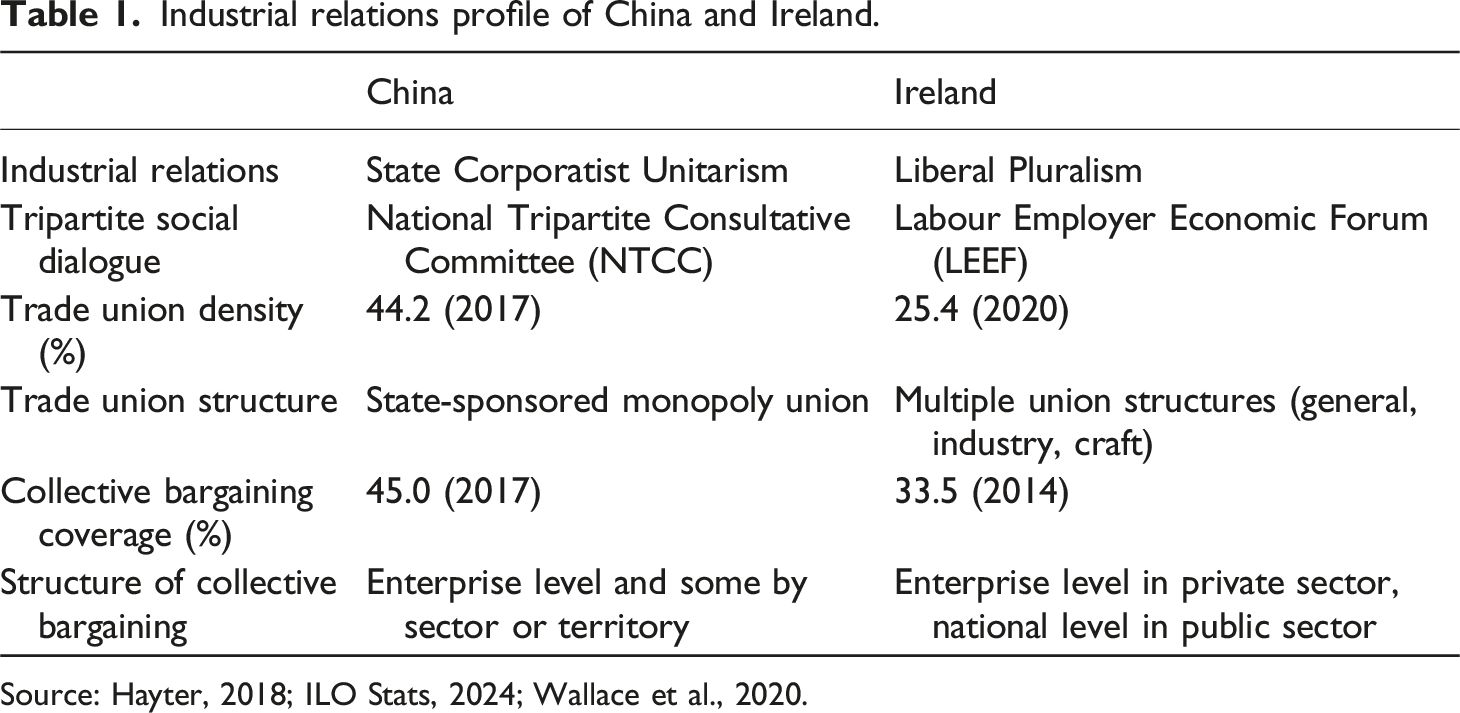
Source: Hayter, 2018; ILO Stats, 2024; Wallace et al., 2020.
Previous studies on IR of Chinese MNEs
Previous studies on IR of Chinese MNEs regarding home- and host-country effects illustrate mixed results. For instance, some studies found that Chinese firms formally recognized or intended to recognize local trade unions in their subsidiaries where the local unions were very active and powerful and/or where unionism was the local norm or local regulation (Cooke et al., 2019; Zhu, 2015). With respect to trade union involvement in workplace IR issues, this also hinged upon local unions’ strength and bargaining power in the host country. Examples of such evidence were reported in the subsidiaries of some Chinese MNEs that specialized in mining, steel and manufacturing industries and investing and operating in countries such as Korea, Peru, Vietnam, Australia and Argentina (Cooke et al., 2019; Zhu et al., 2014). However, if there is little institutional pressure from the host regime, in particular low levels of unionization bargaining power and penetration in the host context, home-country institutions will have the dominant impact on IR practices of their subsidiaries. In such low levels of unionization or more permissive host regime, the subsidiaries of Chinese MNEs tend to be non-unionized and allow no or very limited union involvement in their workplace IR issues. Some recent empirical studies reported strong evidence of home-country effects on management practices of the subsidiaries of Chinese MNEs (Khan et al., 2019; Zhu et al., 2014). For example, Chinese MNEs adopted certain management ‘measures’ and practices that are prevalent in their home country (China), such as low cost management approach; work intensification; long working hours; low levels of employee consultation, engagement, participation and involvement in firms’ decision-making activities relating to IR/ER; transferring home workers to overseas subsidiaries; and using casual workers who are paid at a much lower rate than permanent staff (Cooke et al., 2019; Khan et al., 2019; Shen, 2006; Zhu, 2015; Zhu et al., 2014).
In summary, the extant literature shows evidence of both home- and host-country effects on IR of Chinese MNEs investing in other jurisdictions (Cooke et al., 2019; Khan et al., 2019). This paper explores the extent to which IR practices in Chinese MNEs in Ireland reflect home- or host-country effects and under what conditions each are likely to prevail.
Methodology
Population of Chinese MNEs in Ireland: 1982–2018
In the absence of a definitive database, a representative list of Chinese MNEs investing in Ireland was compiled by the researchers through reviewing a wide range of primary and secondary sources, including some official sources (e.g. United Nations Conference on Trade and Development (UNCTAD), and Ministry of Commerce of the People’s Republic of China (MOFCOM)), Ireland’s industrial promotion agencies (IPAs), the Chinese government organisations in Dublin, related Irish and Chinese commercial chambers and associations, and selected popular Irish and Chinese media sources. Forty two Chinese MNEs were identified as having established FDI operations in Ireland across the period from 1982 to 2018, all of which are anonymised in this paper (Appendix A). Two waves of investment are identified. The first wave, dating from the early 1980s, comprised of a relatively small number of Chinese MNEs that were mainly involved in the manufacturing sector (mostly low-tech and labour intensive). The second wave emerged in the 2000s, with companies predominantly located in the services sector, especially in internationally traded services such as information and communications technology (ICT) and financial services (notably aviation finance).
Data collection & interview participants
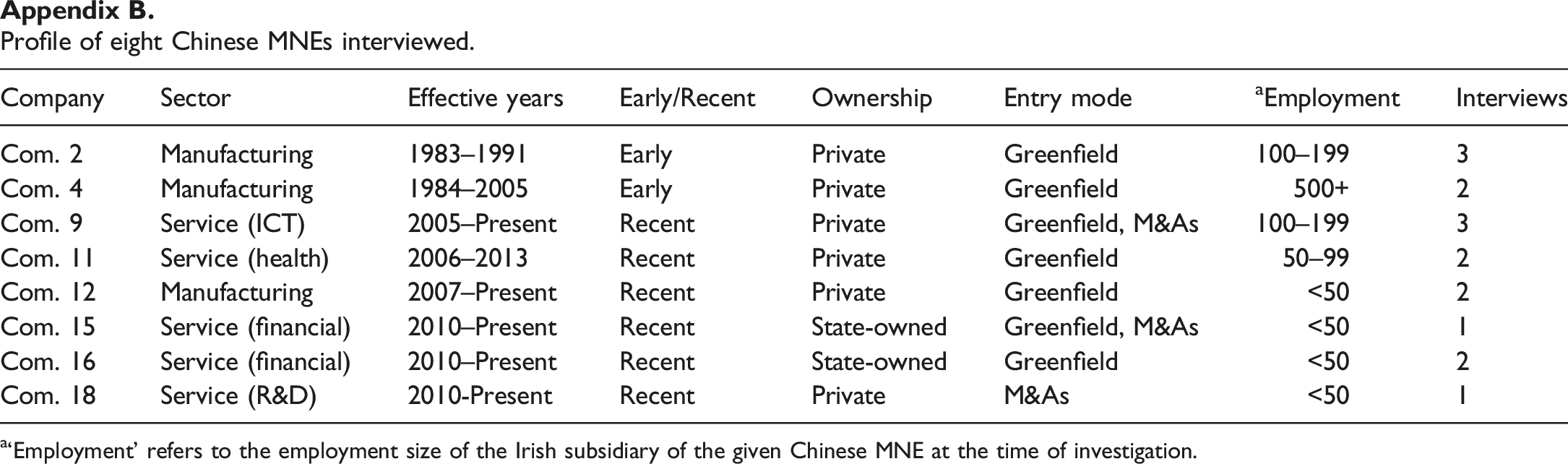
This study employs a qualitative interpretivist research approach to understand IR practices within the subsidiaries of Chinese MNEs. The primary research instrument adopted is semi-structured interviews, that is, offering a broad interview guide to participants (see Appendix D), with the purpose of garnering rich and novel insights and perspectives from the participating respondents. In total, eight Chinese MNEs participated in this study (see Appendix B). Our sample of Chinese MNEs was carefully selected with representation of Chinese MNEs from key industrial sectors (e.g. manufacturing, ICT and financial services), main entry methods (Greenfield and Mergers & Acquisitions), and types of ownerships (private and state-owned). Based on our empirical observation about Chinese FDI/MNEs in Ireland, these eight MNEs were grouped into early and recent cohorts in the subsequent data analysis and discussion.
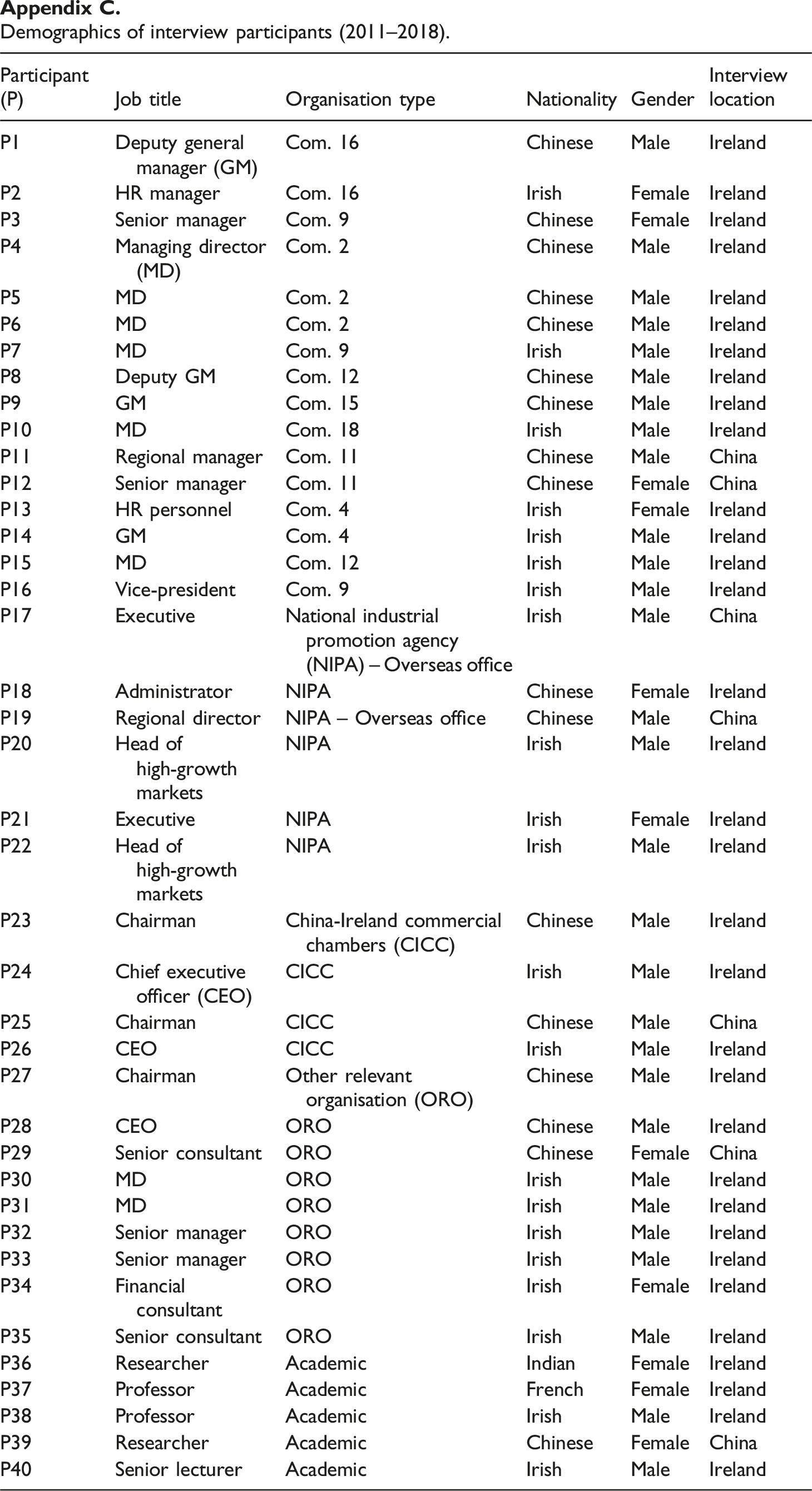
The most knowledgeable and authoritative respondent – based on discussions with key personnel and organisations – was selected and interviewed as a method of improving the validity and reliability of the data collected. The interview scope covers both managerial personnel employed in relevant Chinese MNEs and other key informants independent of Chinese MNEs. As a result, a total of 40 interviews have been conducted over a period from November 2011 to December 2018 (see Appendix C for details). Sixteen interviews were conducted with senior managerial respondents from the eight participating Chinese MNEs, including CEOs, managing directors, general managers, HR managers and other senior managers providing an organisational perspective. These included MNEs from manufacturing, ICT, and financial services sectors. In addition, a total of 24 interviews were conducted with other independent expert informants with relevant knowledge of host IR institutions and/or frequent interactions with Chinese MNEs in Ireland. These included managerial personnel from Ireland’s industrial promotion agencies, China–Ireland commercial chambers and associations, and some individual business professionals and academics.
On average, respondents were interviewed for between 60 and 120 min. Given one researcher’s proficiency in both Mandarin and English, participants were given the option of being interviewed in either language. The majority of interviews were conducted in English (33), with seven interviews conducted in Chinese. The digitally recorded 37 interviews were all transcribed and imported into NVivo 12, while the detailed notes from the three unrecorded interviews were also imported, coded and analysed using the same software.
Data analysis
A thematic analysis approach is primarily adopted in line with previous qualitative studies (Saunders et al., 2019). The first stage of this qualitative data analysis involved the generation of a descriptive coding reference, which was mostly derived from the literature review (e.g. the themes relating to host-country effects, see Figure 1). Following this, additional themes that emerged organically from interviews were also coded, such as specific themes identified relating to home-country effects. Some additional themes that might not be directly related to the research questions but provided interesting insights were also included and coded. Figure 1 summarises the coding structure adopted for our subsequent analysis of and discussion on host-country effects and home-country effects. Qualitative coding structure.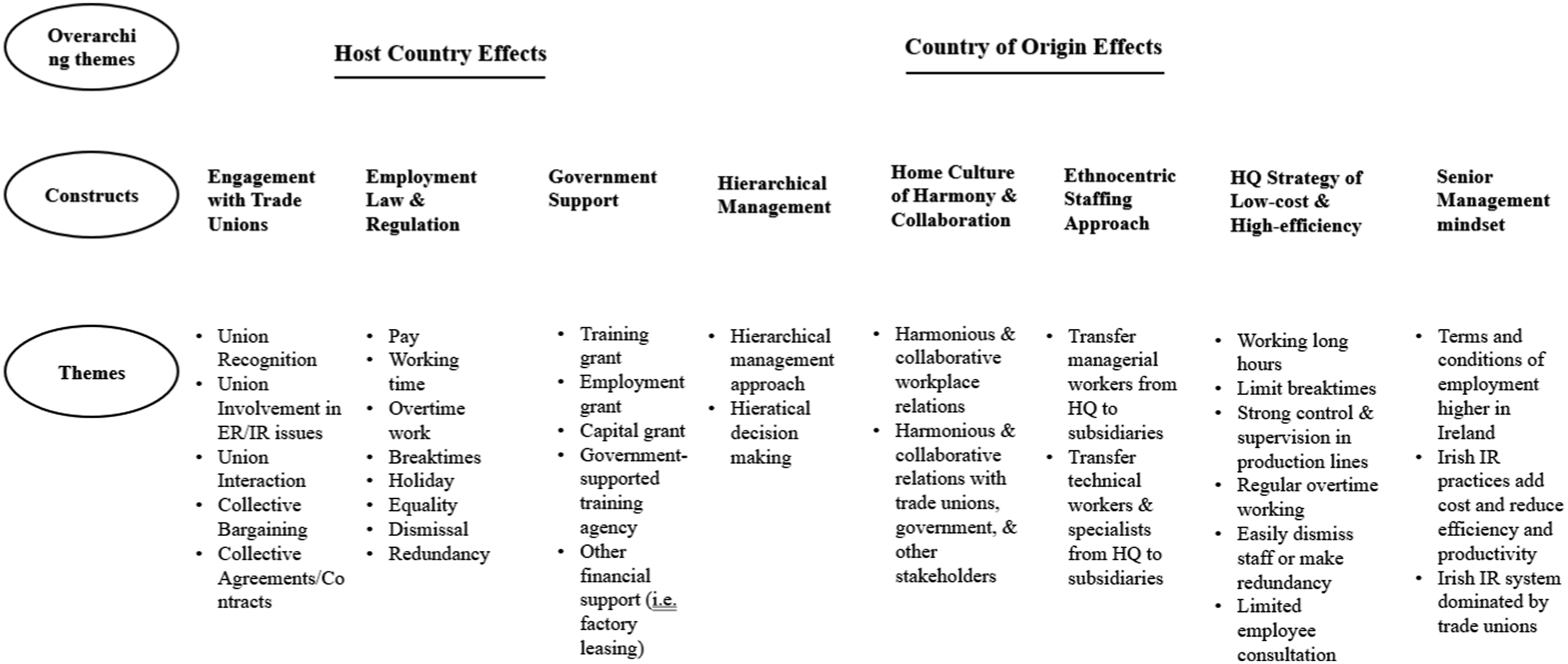
Findings and discussion
Overall, this study observes evidence of host-country institutional influence on the IR policies and practices of the subsidiaries of Chinese MNEs investing in Ireland, notably reflected in the areas of engagement with trade unions and employment law and regulation. With respect to examining home-country effects, we observed evidence of some home-country influence on the IR management approaches of Chinese MNEs in Ireland that mostly derived from a hierarchical managerial approach and the development of a culture of harmony and collaboration.
Engagement with trade unions
With respect to engagement with trade unions, this study observes evidence of host-country institutional influence on Chinese MNEs’ approaches towards local trade unions. We find that Chinese MNEs generally tend to follow practices in the host industrial relations environment and largely conform to the approaches by other MNEs in the host context – essentially Chinese MNEs follow the lead of other MNEs in the host country. This is reflected in the IR approach of the early cohort of Chinese MNEs (1980s–1990s) characterised by strong engagement with trade unions which was the prevailing norm of most MNEs at this time and the contrasting approach of the more recent cohort of Chinese MNEs in avoiding trade unions (mostly since the 2000s), again consistent with the approach of most other MNEs in Ireland.
The early Chinese MNEs who invested in Ireland during the 1980s to 1990s recognised and kept frequent managerial interaction with trade unions. These early investing Chinese MNEs engaged in collective bargaining with trade unions to determine terms and conditions of employment. For instance, one managerial respondent (P4) from Com. 2 commented that ‘the company was unionized…Manufacturing companies tended to be unionized (at the time of investment) …Unions were very strong … Everything was regulated (sic) and negotiated with the unions … We had an agreement with the union (general union) at that time’. This managerial respondent (P4) further explained that Com. 2 had ‘a standard union agreement’ – which covered issues such as pay, terms and conditions, grievance handling and discipline administration, and common to the majority of unionized manufacturing companies in Ireland at that time. Notably, these terms and conditions of employment (including pay rates, leave entitlements, working hours) were more favourable to workers than those offered in their similar factories in China. Trade unions generally ‘played a very active role’ and enjoyed ‘high influence and involvement in regulating IR issues in Ireland’ (P25) during the early phases of FDI activities among the early Chinese MNEs (1980s/1990s) (P23, P24 and P25). Our study further observed the significant influence exerted by the government agency responsible for promoting FDI in Ireland, namely IDA Ireland on early Chinese MNEs. These early Chinese MNEs received significant financial support from IDA Ireland via a combination of ‘employment grants’, ‘capital grants’, ‘financial help for factory leasing’, and ‘financial support for training’ local Irish workers (interview quotes from P13, P35, P34) and with this came pressure to engage with host institutions such as trade unions.
However, Chinese MNEs investing in what was effectively a second wave inward FDI into Ireland since the 2000s were found to have had much less engagement with trade unions. For instance, one managerial respondent (P11) from Com. 11 pointed that ‘our company had … very limited direct engagement with trade unions’ and further observed that ‘the vast majority of the later investing Chinese MNEs were non-unionized and generally encountered limited resistance or ‘push back’ from trade unions’ to the Company’s union avoidance approach. In contrast to the IR approach of early investing Chinese MNEs, none of the later investing Chinese MNEs investigated were found to have adopted collective agreements or any form of engagement with trade unions.
We attribute the variation in IR practices and responses observed between the early and more recent cohorts of inward investing Chinese MNEs to the prevailing host-country institutional environment. The early investing Chinese MNEs (similar to other MNEs of various nationality in Ireland) commonly experienced pressure to adopt the host IR practices (e.g. trade union recognition, trade union involvement, collective bargaining and collective agreements) to enhance legitimacy to effectively operate in host institutional environments (Collings et al., 2008; Gunnigle et al., 2009; Zhu, 2015; Zhu et al., 2014). We also note the important role played by the IDA Ireland which provides support for Whitley’s (1999) contention that MNEs who receive significant financial and other supports feel obliged to or are more likely to adopt to local policies and practices (in this case, engagement with trade unions). However, turning to more recent times, widespread decline of union membership and influence, especially in liberal market economies, characterises the IR context of Ireland with MNEs in particular demonstrating a strong preference for trade union avoidance (Collings et al., 2008; Gunnigle et al., 2009; Lavelle, 2008; Lavelle et al., 2010; McDonnell et al., 2014; Wallace et al., 2020). Thus, the institutional environment that the second wave of Chinese MNEs entered was in contrast to that of early investing MNEs, whereby union avoidance by most MNEs had become the norm.
Finally, to provide a little more context to our results, we briefly look at IR practices in Chinese MNEs in comparison with existing knowledge on foreign MNEs in Ireland. We posit that the IR practices of Chinese MNEs investing in Ireland are broadly in line with IR practices in MNEs of other nationalities, especially US MNEs who have an exceptionally strong presence in Ireland and MNEs from the continental Europe – the other major source of inward FDI into Ireland (Collings et al., 2008; Gunnigle et al., 2009; Lavelle et al., 2010; McDonnell et al., 2014). Thus, we have witnessed considerable variation in the IR approaches of Chinese MNEs in Ireland ranging from active engagement with trade unions during the 1980s and 1990s, to increasing union avoidance in recent years (since 2000s). It now appears that Chinese MNEs broadly follow the trend of US (and other) MNEs. However, unlike their US counterparts that often have the strength and capability (mostly relating to their ownership advantages) to resist the local institutional pressures (Gunnigle et al., 2009; McDonnell et al., 2014), our empirical data provides limited evidence of such strength and capability in the Chinese MNEs investigated. More likely, we would suggest that Chinese MNEs are taking advantage of the existing ‘more permissive IR environment’ (that is less engagement with trade unions and collective bargaining) that has already been promoted by other MNEs (e.g. mostly of US origin) in Ireland over recent years (Edwards et al., 2016; Gunnigle et al., 2009; McDonnel et al., 2014).
Employment law and regulation
Host-country influence was also evident in Chinese MNEs’ experiences and responses to local employment legislation and regulation, reported in both early and more recently established Chinese MNEs. In this study, a significant amount of interview quotes were collected from participants that commented on ‘the different sets of regulations’ between the home- and host-country employment legislation (P24). Ireland was generally reported to ‘have better protection for employees’ and ‘higher standards of employment rights and entitlements’ when compared to that in China (P17), with particular reference to pay, overtime working, working long hours, break times, dismissal and redundancy. For instance, one managerial respondent (P5) from Com. 2 highlighted the significant differences in regulating overtime working between the two nations: in China, when ‘overtime production’ emerges, the firms will ‘continue to work’ with little or no prior discussion or consultation with the workers, ‘the workers really do not have much choice’ and ‘the workers have to work overtime’; whereas in the Irish context, the firms ‘cannot freely activate overtime working’, ‘have to pay for extra’ and ‘have to look after the workers’. Thus, worker voice and ability to leverage that voice against the management is stronger in Ireland than in China. Another managerial respondent (P6) (also from Com. 2) further commented on the legislative differences in either reducing working hours or making workers redundant: in China, ‘if production demands go down’, employers are ‘quite free to tell some workers not to come to work’, ‘because the company has no work for them’; but in Ireland, ‘the labour law, the unions do not allow companies to do so’. ‘Adopting local practices’ or ‘complying with local legislation’ were generally viewed by respondents as ‘adding more costs’, ‘reducing efficiency and productivity’, and greatly diverging from the IR norms and practices adopted in their home country (interview quotes from P5 and P6). On some occasions, this resulted in ‘conflict’ and ‘tension’ (P13) regarding their overall IR experiences in Ireland. For instance, some Chinese MNEs reported being ‘pressurized by their HQs’ in terms of ‘having high operation costs’ or ‘maintaining staff who are no longer required by business’ (P6) in their Irish subsidiaries.
Despite encountering some occasional ‘conflict’ or ‘pressure’ from HQs in their home country, we found host-country employment legislation to be the main driving force shaping IR practices of their Irish subsidiaries. Based on our interview data, Chinese MNEs all strongly recognized the critical importance of adherence with local labour regulations, a theme consistent with previous literature (Cooke, 1997; Radulescu and Robson, 2008), and eventually they generally adopted local employment practices in their Irish subsidiaries. For instance, one managerial respondent (P2) from Com. 16 pointed that the company management was aware that ‘holidays, pay and other employment practices in Ireland are different (from that in China)’, and the company ‘follow the Irish holidays’, ‘standards’ and ‘employment practices’ in Ireland. In particular, the later-investing MNEs were all reported to have set up HR/personnel units in their Irish subsidiaries to facilitate compliance with Irish employment legislation. We found that these later-investing MNEs tended to emphasize and use individual employment contracts rather than having collective agreements with trade unions. Arguably, this is mostly due to the declining union density (as explained above) and a growing trend of adopting more sophisticated HRM approaches in Ireland that often emphasises individual approaches and practices (e.g. individual contract) (Gunnigle et al., 2009; Wallace et al., 2020). Training was normally provided for new employees to ensure they ‘understand what they are doing’. Formal and informal meetings were common between the management and employees to enhance mutual communication, employee voice and offer feedback on performance. The management of Chinese MNEs generally provided ‘performance feedback’ and encouraged employees ‘to ask questions’, ‘to learn more about company matters’, ‘to share ideas’, ‘to learn from each other’, ‘to talk about their ideas and plans’, and even ‘to make suggestions for the company’ (interview quotes from P1, P2 and P11). Most investigated companies were reported to be ‘satisfied with the people they got’ (P8) and kept ‘relatively good employee retention’ within their Irish subsidiaries (P13). The employees were generally reported to ‘work hard’, ‘undertake their responsibilities’, ‘deliver required work behaviour and performance’ and ‘follow companies’ policies, such as companies’ confidentiality and disclosure agreements’ (interview quotes from P2, P10, P13 and P15). Finally, they also reported a practice of hiring local Irish HR personnel and other functional managers with knowledge and expertise of local employment legislation, local norms and local practices, as explained by managerial respondent P2 ‘hiring someone who knows how work get done here in Ireland’. This local staffing approach was positively perceived as ‘to mitigate the potential risks or challenges’ (P2) that derived from the MNE’s liability of foreignness and the legislative differences (Hymer, 1960). Furthermore, it also provides evidence that Chinese MNEs were in keeping with trends in the Irish employment relations system as well as their attempt to access the local labour market.
IR management approach
In addition to observing above host-country influence (primarily from local trade unions and employment law), we also observed some home-country influence on IR management approach of Chinese MNEs in Ireland. Overall, we found that a majority of the Chinese MNEs had adopted a management approach that was characterised by ‘a strong hierarchy’ (top-down) in IR decision-making, but also tried to create ‘harmonious and cooperative relationships’ in their Irish subsidiaries, reflected in both early and more recent Chinese MNEs investigated (Com. 4, Com. 12, Com.16, Com.9). While these two observations may appear contradictory, they can be complementary elements within the Chinese organisational context. Chinese MNEs’ adoption of a ‘hierarchical’ management approach and ‘top-down’ decision-making may seek to align with HQ’s directives or strategic goals. In turn, there is also a strong need to develop a ‘harmonious and cooperative environment’ that might mitigate the possible drawbacks of such ‘hierarchical’ ‘top-down’ approach and ensure that employees are satisfied (Rarick, 2007; Warner, 1993).
For instance, senior management respondents from Com. 4 and Com. 12 commented that Chinese companies ‘tend to be very hierarchic (al) where the top man makes decision’ (P14), including making decisions on IR issues within their subsidiaries in Ireland. This was viewed as a result of home country’s ‘hierarchical’ management approach (Rarick, 2007; Warner, 1993). This importance of home country related ‘hierarchy’ in IR decision-making is in contrast with ‘western European countries which would normally have more than one person …able to make decisions’ (P8). Furthermore, ‘this centralized power’ and ‘strong reliance on one person to make (a) decision’ (P15) was reported to add procedures (particularly the need of reporting back to HQ in China) and limit subsidiary autonomy and decision-making, including limiting the decision-making relating to IR. The majority of Chinese MNEs had transferred home workers (particularly senior managerial and technical staff) from HQs in China to their Irish subsidiaries who often undertook critical responsibilities and key roles in the management and decision-making of their Irish subsidiaries, reported in both early and recent cohorts of Chinese MNEs (Cooke et al., 2019; Zhu et al., 2014). While there was no huge variation observed in comparison to some other MNEs in Ireland, arguably, this pattern of ethnocentrically staffing senior managerial and technical positions by Chinese MNEs facilitates the implementation of some preferred home country related expectations, goals, or management practices, in this case, implementing the ‘hierarchical’ management approach and decision-making in the IR management of their Irish subsidiaries (Rarick, 2007; Warner, 1993).
Furthermore, our empirical data also showed that the majority of Chinese MNEs sought to avoid conflict and develop ‘harmonious and cooperative’ working relationships within their Irish subsidiaries. For instance, as addressed above, the early cohort of Chinese MNEs often kept strong connections and good working relationships with local trade unions (Com. 2 and Com. 4). Chinese MNEs (including both early and more recent ones) generally tended to cooperate and avoid conflict with relevant government agents, organisations and local competitors. Turning to the workplaces of their Irish subsidiaries, an overall workplace of ‘harmony and cooperation’ was also reported and achieved. All of the Chinese MNEs investigated in this study conformed to relevant legal obligations and none of the eight Chinese MNEs investigated were reported to have encountered any major labour issues or disputes or strikes in their Irish subsidiaries. This common approach of seeking overall ‘harmony and cooperation’ in their Irish subsidiaries is very much consistent with previous literature (Zhu et al., 2014) that speaks to China’s unique history and culture that generally promote ‘harmonious’ relationships and communities and often discourages conflict (Liu, 2013; Zhu and Warner, 2005). However, unlike the home country (China) that ‘harmonious and cooperative’ workplace relationships could be achieved through supressing workers’ voices and managing labour conflict through official trade unions (Meng, 2015; Wang, 2013; Yu, 2010; Zhou, 2014), in the Irish subsidiaries, such ‘harmonious and cooperative’ workplace relationships were often created through networking events and gatherings for special occasions. For instance, quite a few managerial respondents from both early and recent Chinese MNEs commented on ‘good personal contacts and relationships’ often kept between employees and managers and also with other peer employees, via ‘going (to) dinner together’, ‘visiting living places’, ‘cooking together’, ‘going to the town together’, and so on (interview quotes from P1, P2, P11, P12, P13 and P14). Furthermore, one managerial respondent (P8) (Com. 12) commented that significant efforts were undertaken by the company to ‘integrate our staff’, such as ‘inviting all staff for Christmas Dinner’, ‘organizing parties to celebrate Chinese New Year’, and celebrating other influential events or Chinese festivals within their Irish subsidiaries. Such promotions of intensive personal interactions, personal relationships, frequent group gatherings and celebrations of national and international festivals and events are reported as common practices that are adopted in China to develop strong personal relationships and cultivate ‘harmonious and cooperative’ working relationships (Hung, 2004; Rarick, 2007). But in Ireland, such activities did not result in any power sharing between management and workers. In summary, this study found evidence of Chinese MNEs’ adoption of some home-country practices (e.g. promoting intensive personal interactions and group gatherings) to cultivate workplace ‘harmony and cooperation’ within their Irish subsidiaries albeit achieving a different environment to the one back in China. Arguably, this provides evidence of some home-country effects on IR of Chinese MNEs in Ireland.
Conclusion
This paper empirically examines the IR experiences and practices of Chinese MNEs investing in Ireland. Overall, this study found that IR practices in Chinese MNEs generally followed IR practices and trends in IR in Ireland (host country), including adherence to local employment law and IR practices in determining terms and conditions of employment. The study also observed evidence of some home-country influence on the IR management approach of Chinese MNEs in Ireland that mostly derived from a hierarchical managerial approach and the development of a culture of harmony and collaboration. However, such home-country effects were generally perceived as less dominant or less decisive when compared to the pressure and influence from the host-country institutions. Our empirical work points towards conditions within which home- or host-country effects are likely to dominate. Where institutions were hard/formal such as legislation, host-country effects prevailed and thus prevented the transfer of home IR practices to the Chinese MNEs’ subsidiaries. On the other hand, where institutions were soft/informal such as general work practices, this provided Chinese MNEs with opportunities to transfer some of their home IR practices – albeit somewhat modified by the host country. One explanation for such an approach by Chinese MNEs may be due to the ‘liability of emergingness’ as Cooke et al. (2019) describe. As Zhu (2015) and Khan et al. (2019) note, the late coming features of MNEs from emerging economies may explain why these MNEs are more likely to adhere to local institutional norms and pressures. They may lack the experience, knowledge and power to circumvent local institutional pressures. Another explanation for adherence to local institutional norms and pressures we argue is the motive for FDI by the MNEs. In our study, the primary motive for Chinese MNEs investing in Ireland were non-efficiency seeking reasons (Wang et al., 2018). We argue that this non-efficiency seeking motive for investment has the effect that these MNEs encounter comparatively less pressure from their HQs in controlling costs and efficiency when operating in Ireland. As a result, Chinese MNEs are more likely to emphasize and adopt the local norms of IR behaviours and practices (e.g. complying with local laws and regulations) to gain the legitimacy required to effectively operate in the host country (Meardi et al., 2009), rather than adopting home IR practices that generally are perceived as more cost-efficient (Cooke et al., 2019; Zhu et al., 2014). Thus, arguably, the paper has made a theoretical contribution by suggesting that when using institutional theory to explore MNEs’ responses to institutional pressures, there is a need to incorporate wider analytical frameworks, such as those from the international business domain that explain investment motivations of MNEs (Buckley et al., 2007; Cooke and Lin, 2012; Dunning, 2000). Understanding the reasons behind a MNE’s decision to invest in a country may have implications for the extent to which institutional pressures may or may not have an impact.
In addition, the study contributes empirical evidence and valuable insights on IR in Chinese MNEs. Firstly, the study provides empirical data and evidence on both home- and host-country effects on the IR practices of the subsidiaries of Chinese MNEs investigated. Secondly, our results shed some light on the main forces and conditions that shaped the IR practices of Chinese MNEs investing in the Western developed world. Host-country IR institutions largely explain the IR practices of Chinese MNEs investing in Ireland. However, we also find evidence of Chinese home-country effects with attempts to transfer home country’s core cultural values of promoting ‘harmonious relationships’ and encouraging collaboration, ‘hierarchical’ management approach and decision-making and ethnocentric staffing approach. Thirdly, this study also contributes to the recent scholarly discourse on IR of MNEs in Ireland by observing some emerging ‘convergence’ and ‘divergence’ between Chinese MNEs and other counterparts in Ireland. This study posits that the IR practices of Chinese MNEs investing in Ireland are broadly in line with that of US MNEs in Ireland, but the underpinning reasons for such adopted IR practices are slightly different from their US counterparts. Furthermore, our results contribute to the scholarly debate on the existence of dual institutional fields in some economies (e.g. Ireland).
More broadly, our empirical evidence and observations should provide some valuable practical implications. Notably, for policy makers, our findings illustrate the variation between China’s IR policies and practices and those in Ireland which may prove a significant challenge as Ireland seeks to attract Chinese FDI/MNEs. Thus, Irish policy makers must be aware of and develop appropriate measures and responses to cope with these challenges. For HR practitioners (particularly those who work directly in Chinese MNEs), our results illuminate some potential challenges for Chinese MNEs in the transfer of home IR practices into the Irish subsidiaries, such as the risk of breaching the local labour and employment legislation and engagement with trade unions.
Finally, the limitations of this work are acknowledged. Although this study represents the only investigation of IR practices of Chinese MNEs investing in Ireland, the small population limits our capacity to offer more definitive and/or generalisable results on the key themes investigated. Accordingly, the study should be seen as one that identifies potential avenues for future research. In this regard, the study recommends further comprehensive empirical exploration of IR approaches and practices adopted by Chinese MNEs in their subsidiaries; Chinese MNE’s IR responses to varying host-country IR contexts, and why it is the case; the possible influence and implications of Chinese MNEs for the host IR context and beyond, in the context of countries with a larger Chinese MNE presence. It also recommends more comparative work on these research focuses involving Chinese MNEs in other western economies.
Footnotes
Acknowledgements
The authors acknowledge the PhD Scholarship and PhD Scholar Bursary awarded by University of Limerick and the professional, logistical and personal support and advice received from colleagues at Technological University Dublin and University of Limerick. The authors extend gratitude to the participating companies, interview respondents and reviewers for their valuable contributions to this research.
Declaration of conflicting interests
The authors declare that there are no potential or perceived conflicts of interest with respect to the research, authorship, and/or publication of this article. All authors have agreed to the submission on these terms.
Funding
The author(s) disclosed receipt of the following financial support for the research, authorship, and/or publication of this article: This work was supported by the PhD Scholarship awarded by Kemmy Business School, University of Limerick and PhD Scholars Bursary awarded by the Graduate School, University of Limerick.
Ethical statement

Notes
Appendix
List of Chinese MNEs in Ireland (1982–2018).
a
aICT means information and communications technology; AL means aircraft leasing; (e) means the specific information was estimated based on the limited information found. Profile of eight Chinese MNEs interviewed. a‘Employment’ refers to the employment size of the Irish subsidiary of the given Chinese MNE at the time of investigation. Demographics of interview participants (2011–2018).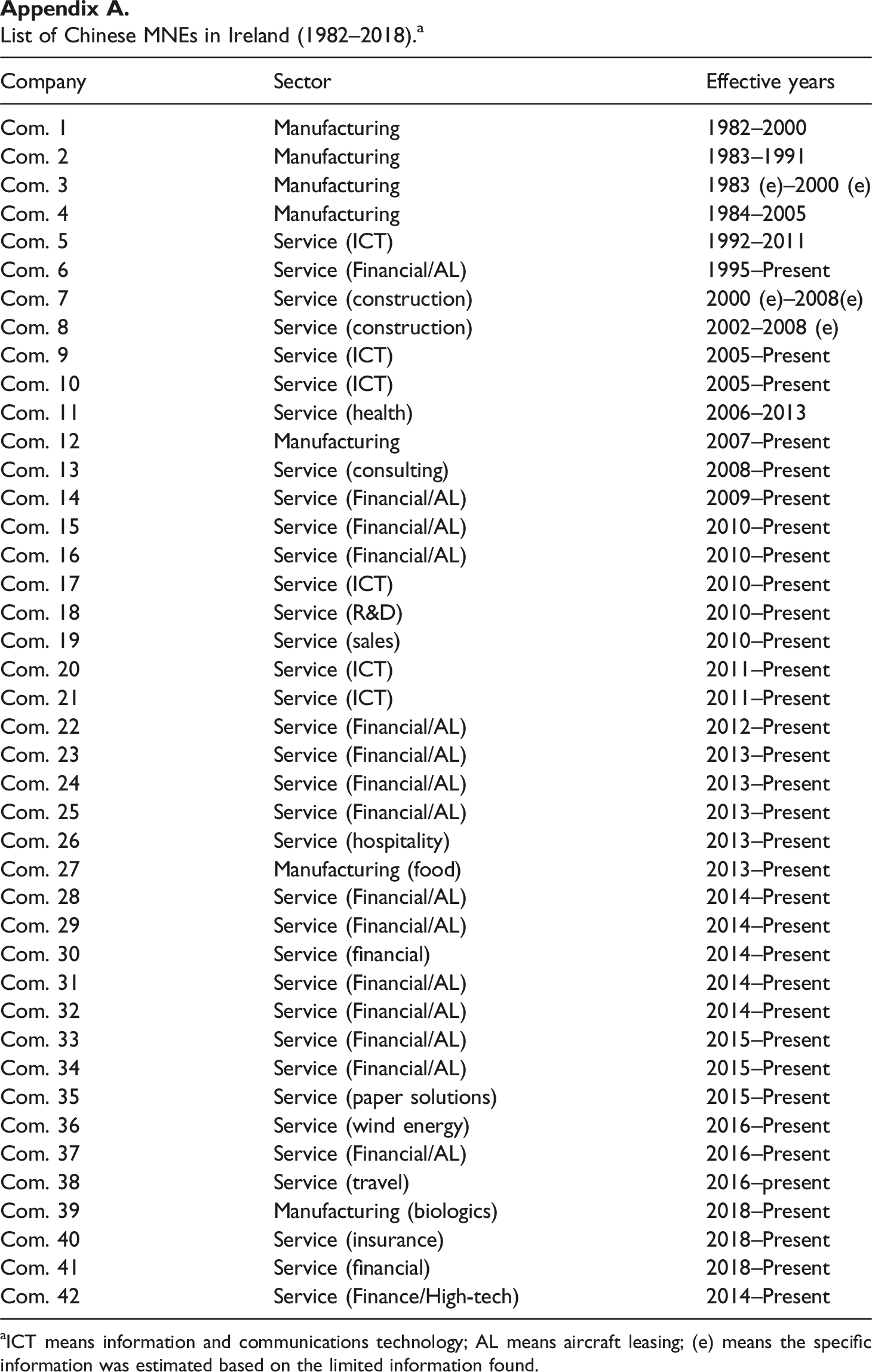
Company
Sector
Effective years
Com. 1
Manufacturing
1982–2000
Com. 2
Manufacturing
1983–1991
Com. 3
Manufacturing
1983 (e)–2000 (e)
Com. 4
Manufacturing
1984–2005
Com. 5
Service (ICT)
1992–2011
Com. 6
Service (Financial/AL)
1995–Present
Com. 7
Service (construction)
2000 (e)–2008(e)
Com. 8
Service (construction)
2002–2008 (e)
Com. 9
Service (ICT)
2005–Present
Com. 10
Service (ICT)
2005–Present
Com. 11
Service (health)
2006–2013
Com. 12
Manufacturing
2007–Present
Com. 13
Service (consulting)
2008–Present
Com. 14
Service (Financial/AL)
2009–Present
Com. 15
Service (Financial/AL)
2010–Present
Com. 16
Service (Financial/AL)
2010–Present
Com. 17
Service (ICT)
2010–Present
Com. 18
Service (R&D)
2010–Present
Com. 19
Service (sales)
2010–Present
Com. 20
Service (ICT)
2011–Present
Com. 21
Service (ICT)
2011–Present
Com. 22
Service (Financial/AL)
2012–Present
Com. 23
Service (Financial/AL)
2013–Present
Com. 24
Service (Financial/AL)
2013–Present
Com. 25
Service (Financial/AL)
2013–Present
Com. 26
Service (hospitality)
2013–Present
Com. 27
Manufacturing (food)
2013–Present
Com. 28
Service (Financial/AL)
2014–Present
Com. 29
Service (Financial/AL)
2014–Present
Com. 30
Service (financial)
2014–Present
Com. 31
Service (Financial/AL)
2014–Present
Com. 32
Service (Financial/AL)
2014–Present
Com. 33
Service (Financial/AL)
2015–Present
Com. 34
Service (Financial/AL)
2015–Present
Com. 35
Service (paper solutions)
2015–Present
Com. 36
Service (wind energy)
2016–Present
Com. 37
Service (Financial/AL)
2016–Present
Com. 38
Service (travel)
2016–present
Com. 39
Manufacturing (biologics)
2018–Present
Com. 40
Service (insurance)
2018–Present
Com. 41
Service (financial)
2018–Present
Com. 42
Service (Finance/High-tech)
2014–Present
Company
Sector
Effective years
Early/Recent
Ownership
Entry mode
a
Employment
Interviews
Com. 2
Manufacturing
1983–1991
Early
Private
Greenfield
100–199
3
Com. 4
Manufacturing
1984–2005
Early
Private
Greenfield
500+
2
Com. 9
Service (ICT)
2005–Present
Recent
Private
Greenfield, M&As
100–199
3
Com. 11
Service (health)
2006–2013
Recent
Private
Greenfield
50–99
2
Com. 12
Manufacturing
2007–Present
Recent
Private
Greenfield
<50
2
Com. 15
Service (financial)
2010–Present
Recent
State-owned
Greenfield, M&As
<50
1
Com. 16
Service (financial)
2010–Present
Recent
State-owned
Greenfield
<50
2
Com. 18
Service (R&D)
2010-Present
Recent
Private
M&As
<50
1
Participant (P)
Job title
Organisation type
Nationality
Gender
Interview location
P1
Deputy general manager (GM)
Com. 16
Chinese
Male
Ireland
P2
HR manager
Com. 16
Irish
Female
Ireland
P3
Senior manager
Com. 9
Chinese
Female
Ireland
P4
Managing director (MD)
Com. 2
Chinese
Male
Ireland
P5
MD
Com. 2
Chinese
Male
Ireland
P6
MD
Com. 2
Chinese
Male
Ireland
P7
MD
Com. 9
Irish
Male
Ireland
P8
Deputy GM
Com. 12
Chinese
Male
Ireland
P9
GM
Com. 15
Chinese
Male
Ireland
P10
MD
Com. 18
Irish
Male
Ireland
P11
Regional manager
Com. 11
Chinese
Male
China
P12
Senior manager
Com. 11
Chinese
Female
China
P13
HR personnel
Com. 4
Irish
Female
Ireland
P14
GM
Com. 4
Irish
Male
Ireland
P15
MD
Com. 12
Irish
Male
Ireland
P16
Vice-president
Com. 9
Irish
Male
Ireland
P17
Executive
National industrial promotion agency (NIPA) – Overseas office
Irish
Male
China
P18
Administrator
NIPA
Chinese
Female
Ireland
P19
Regional director
NIPA – Overseas office
Chinese
Male
China
P20
Head of high-growth markets
NIPA
Irish
Male
Ireland
P21
Executive
NIPA
Irish
Female
Ireland
P22
Head of high-growth markets
NIPA
Irish
Male
Ireland
P23
Chairman
China-Ireland commercial chambers (CICC)
Chinese
Male
Ireland
P24
Chief executive officer (CEO)
CICC
Irish
Male
Ireland
P25
Chairman
CICC
Chinese
Male
China
P26
CEO
CICC
Irish
Male
Ireland
P27
Chairman
Other relevant organisation (ORO)
Chinese
Male
Ireland
P28
CEO
ORO
Chinese
Male
Ireland
P29
Senior consultant
ORO
Chinese
Female
China
P30
MD
ORO
Irish
Male
Ireland
P31
MD
ORO
Irish
Male
Ireland
P32
Senior manager
ORO
Irish
Male
Ireland
P33
Senior manager
ORO
Irish
Male
Ireland
P34
Financial consultant
ORO
Irish
Female
Ireland
P35
Senior consultant
ORO
Irish
Male
Ireland
P36
Researcher
Academic
Indian
Female
Ireland
P37
Professor
Academic
French
Female
Ireland
P38
Professor
Academic
Irish
Male
Ireland
P39
Researcher
Academic
Chinese
Female
China
P40
Senior lecturer
Academic
Irish
Male
Ireland