




Abstract
In aviation, EU single market rules empowered Ryanair over three decades to defeat all pilot unions across Europe, regardless of the notionally strong power resources on which they were relying in their countries. Nonetheless, in December 2017, a transnational group of union-related pilots, the European Employee Representative Committee was critical in forcing Ryanair to finally recognize trade unions. This study shows that multinationals’ ability to circumvent national union power resources does not necessarily undermine transnational collective action. Hence, transnational union strength does not primarily depend on an aggregation of national power resources, but on union activists’ ability to exploit union-friendly peculiarities that the EU governance regime is also providing. We show that the apparently weaker institutional power resources at EU level provides more effective leverage for transnational collective action than apparently stronger power resources embedded within French, Danish, or Norwegian labour law. This requires an understanding of scale.
Keywords
Introduction
In the 1990s, EU leaders adopted three EU law packages that deregulated civil aviation and created a single European aviation market (SEAM) (Kassim and Stevens, 2010). EU executives gave little consideration to labour standards and hailed SEAM’s creation as a success that was ‘propelling European mobility forward’ (European Commission, 2017). The stellar rise of Ryanair to European domination is emblematic of the SEAM saga. In 2005, Ryanair had only 15 bases across Europe. By 2016, the number had increased to 79, partly because its anti-union stance gave Ryanair a competitive edge over its rivals. But how could Ryanair remain ‘union-free’ (Mooney, 2005) over three decades and then be compelled by its pilots to change policy in 2017? This critical study shows that SEAM’s creation produced not only a neoliberal regime, but also countervailing, apparently redundant institutional features (Crouch, 2005) that pilots and their unions could use to scale up their mobilizations against Ryanair, namely, the EU’s Flight Time Limitations Regulation (FTL; 83/2014), which came into force in 2016.
Initially, organized labour remained wedded to a national logic and struggled to adapt to the creative destruction of national boundaries generated by SEAM. During its ascent to aviation leader, Ryanair successfully thwarted all unionization attempts, regardless of the power resources that British, Irish, French, Danish, or Norwegian unions were able to mobilize within their national industrial relations systems. The prospect of transnational collective action also looked bleak, despite unions and scholars recognizing the need for it (Bamber et al., 2009; O’Sullivan and Gunnigle, 2009). Ryanair’s aggressive union-avoidance strategy looked set to continue, as many cross-border initiatives had proved unsuccessful, such as the International and European Transport Federations’ (ITF/ETF) ‘Ryan be Fair’ campaign or the Ryanair European Pilots Association (REPA) launched by Irish and British pilot unions.
In December 2017 however, the inconceivable happened. After a transnational, informal group of union-related pilots threatened coordinated strikes across Europe, Ryanair reversed its longstanding HR policy and decided to recognize unions (Boewe et al., 2021; De Spiegelaere, 2020; Geary, 2021; Harvey and Turnbull, 2020; Mendonça 2020). But why did this transnational group of union activists succeed where all national trade unions had hitherto failed, including unions who could rely on strong power resources, such as the French laws that force management to engage in collective bargaining or the Danish laws on industrial action that allow secondary picketing? Drawing on the literature on unions’ national and EU-level power resources and transnational union action (Bieler et al., 2015; Erne, 2008; Phelan et al., 2009), we show that apparently weaker institutional power resources at EU level, for example, under EU health and safety law, may provide a more effective lever for transnational collective action than apparently stronger national power resources, wielded by French, Norwegian, or Danish unions. When facing a ‘highly centralised management and a highly international and mobile workforce’ (De Spiegelaere, 2020: 232), workers and unions do not have to be exceptionally strong. However, they must be able to wield ‘context appropriate’ powers (Brookes, 2015: 129), which, in the Ryanair case, meant power resources that reach SEAM’s scale. Before presenting our critical case study’s findings, we conceptualize trade unions’ power resources beyond the nation state.
Conceptualizing trade unions’ power resources beyond the nation state
The power question remains ‘one of the most controversial concepts in the social sciences’ (Korpi, 1985: 31). Like Lukes (2005: 65), we see power in terms of agents’ abilities to bring about significant effects that further the agents’ own interests and/or affect the interests of others. Hence, power is relational and dynamic (Lukes, 2005: 73), not least when it comes to mobilizing transnational labour solidarity within multinational corporations (MNCs) (Novelli, 2010). The power resource approach (PRA) draws on the work of Korpi (1985) and Wright (2000), and renewed attention has ensured its continued relevance (Brookes, 2015; Gumbrell-McCormick and Hyman, 2013). PRA has, however, been critiqued on account of its institutionalist bias (Nowak, 2019). This does not mean that national institutional differences no longer matter, but we cannot understand the world of work without theorizing space and scale and the unevenness of workers’ power resources across them. This means going beyond the nation-state paradigm.
Silver (2003) makes an important contribution to PRA theory in two respects. Firstly, regarding structural power, derived from ‘the location of workers within the economic system’ (Wright, 2000: 962), Silver (2003: 13) further differentiates between workers’ workplace powers and marketplace structural powers. The former ‘accrues to workers who are enmeshed in tightly integrated production processes, where a localized work stoppage in a key node can cause disruptions on a much wider scale than the stoppage itself’ (Silver, 2003: 13). Marketplace bargaining power depends on labour market conditions and exists when there is a ‘possession of rare qualifications and skills demanded by employers’ (Silver, 2003: 13). Airline pilots, like transport workers in general, are seen to wield significant disruptive capacity and thus possess considerable marketplace power resources (Silver, 2003: 97–103). Secondly, drawing on labour geography scholarship in which ‘the production, reproduction and reconfiguration of space have always been central to understanding the political economy of capitalism’ (Harvey, 2001a: 23), Silver emphasizes the need to comprehend ‘spatial unevenness’ and ‘spatial fixes’ in order to appreciate how ‘old forms of workers` bargaining power are undermined only to create new forms on a larger and more disruptive scale’ (Silver, 2003: 19, emphasis added). Silver’s study on the automotive industry emphasizes primarily structural power resources embedded within national contexts. Other forms of power resources remain underexplored.
Traditionally, PRAs divide power into primary and secondary resources. Whereas structural power is considered primary, institutional power is ‘the residues of previous activations of power resources’ (Korpi, 1985: 38) and is therefore considered a substitutive or secondary power resource. At EU level however, unions were able to create structures before action (Turner, 1996). Erne (2008) therefore highlighted the importance of unions’ political exchange power within the EU. There would be no EU legislation in the social field if political leaders had not required union support to legitimize the EU integration process (Béthoux et al., 2018). Furthermore, institutional power is important because it may provide unions with a substitute when other power resources diminish (Gumbrell-McCormick and Hyman, 2013: 31).
Within the EU however, unions’ institutional power still differs significantly across countries (Meardi, 2014). In voluntarist industrial relations system, unions face an uphill battle in achieving recognition and thus rely mainly on structural power resources. Even where institutional power resources are well-established however, namely, in predominately corporatist or state-centred systems, they are not static. Rather, the pendulum can swing from side to side depending on economic conjunctures and competitive market pressures. One of the greatest threats to workers’ power resources are MNCs that seek to play off one national industrial relations system against another. This practice involves drawing new boundaries and reaffirming old ones (Silver, 2003: 23). The corresponding spatial fix (Harvey, 2001b) can be complemented by a juridical fix, whereby reference to national competences is ‘little more than a convenient fiction’ (Lillie, 2010: 683). The unevenness of the EU landscape facilitates the spatial–juridical fix and firms with transnational mobility can exploit it to effectively de-territorialize sovereignty (Lillie, 2010). MNCs can thus pursue a strategy that ‘takes advantage of increasingly unclear delineations of national sovereignty’ (Lillie, 2010: 688). This is by no means a linear process, as MNCs’ attempts may also spark new struggles if unions start to seek alternative spatial–juridical fixes. Thus, we focus on the interlocking scales of union and MNC action (Tufts and Savage, 2009).
Associational power is another power resource that matters, not least in a transnational context. Associational power is dynamic, and it derives from workers uniting to form collective associations (Wright, 2000: 963). Without this, solidarity, a core trade union value, would be meaningless. Hyman (2010: 19) argues that ‘trade unions need to redefine, indeed reinvent, their understanding of solidarity; and to do so they need to rediscover how to behave proactively and strategically’. This, of course, is part of a learning cycle: ‘organisations are clearly contexts within which learning can occur, and organisational effectiveness may well depend on the capacity of those within them collectively to learn appropriate responses to new challenges’ (Hyman, 2010: 21). Hence, unions need strategies to foster workers’ activism and organize them so that, if necessary, their structural power resource can be exercised (Gumbrell-McCormick and Hyman, 2013: 30). Inevitably, this is easier said than done.
Workers can belong to various communities even if they ‘do not share a common territory with all the other members’ (Papastergiadis, 2000: 208). That said, fostering a collective identity across borders is difficult and not helped by the growing fragmentation of workers’ identities at workplace level. Individualistic workplace cultures and low cohesion amongst workers are indeed inimical to an awareness of workers having ‘any power’ (Kelly, 1998: 11). Atypical workers are usually in a more precarious position vis-à-vis their employer and less likely to join a union, especially when management is hostile towards them. Their institutional power also varies across countries (see below). Within the EU, an employer can move workers strategically from one country to another. This process amounts to a spatial–juridical fix that undermines workers’ power resources (Jorens et al., 2015; Moen, 2017; Wagner and Refslund, 2016).
At the same time, workers’ collective identities are constantly remade through shared experiences. Turbulences may create windows of opportunity (Erne, 2008; Szabó et al., 2021; Geary, 2021). Workers’ capacity to respond collectively to them depends on the construction of a collective narrative (also known as framing), which engenders a sense of shared destiny. To this end, informal leaders can play a pivotal role (Kelly, 1998). The Ryanair case thus represents a critical case that allows us to assess the interlocking scales of MNC and union action.
Case selection and methodology
Critical cases not only provide insight into real-life situations, but also allow us to challenge predominant explanations. They have ‘strategic importance in relation to the general problem’ (Flyvbjerg, 2006: 233), making the case study approach well suited to this study’s objectives. Concretely, our study relies mainly on findings gathered through multi-sited fieldwork, notably in Ireland, Norway, the UK and Brussels. Seventeen face-to-face interviews of one to 2-hour duration were conducted. Interviewees included (former) Ryanair pilots, officials from national pilot unions in Ireland, the UK, and Norway, and ITF, ETF, and European Cockpit Association (ECA) officials. Officials from the latter two were interviewed on two occasions, both before and after the transnational action took place. This provided the opportunity to trace the genesis of the campaign. In 2010, one of the authors met the lawyer who represented the Union des Navigants de l'Aviation Civile in its dispute with Ryanair on the application of French social security and labour law. In addition, we draw on documents from Ryanair, various labour organizations (including the Ryanair Pilots Group), and other sources, for example, annual reports, press releases, presentations, commissioned reports, print media cuttings and unpublished Eurofound feasibility study (2020) data.
Triangulating the data gathered through the semi-structured interviews and from the various documentary sources, we can account for the factors that forced Ryanair into a U-turn in December 2017. Our findings also helped us to theorize workers’ power resources in a transnational setting. We return to this in the conclusion.
Ryanair: Becoming ‘Europe’s favourite airline’
Ryanair’s ascendancy can be explained by two factors: (i) its capacity to circumvent national collective labour law and industrial relations systems in the SEAM context, and (ii) its excessive use of atypical employment practices. Both factors are discussed through the prism of national unions’ institutional and associational power resources. Following that, we assess the scope for transnational counter-mobilizations.
Circumventing national collective labour law and industrial relations
Ryanair has dozens of bases across Europe, but the airline is headquartered in Ireland. This is critical to the rise of Ryanair in a broader European context. As the company grew, Ryanair became an increasingly important actor in the Irish industrial relations landscape. In Ireland’s voluntarist system, union recognition and bargaining outcomes are determined by raw power relations between employers and workers, or, as an interviewee described it, ‘the law of the jungle’ (IALPA official). Traditionally, workers with economic power are well placed to extract concessions from their employers, and collective bargaining at firm level is the critical institution for regulating conflict. This agreement, however, is voluntary and, because it lacks a statutory footing, it reintroduces the power dimension.
Unions’ operating in voluntarist systems have suffered a disproportionally high loss of power. Taking union density as a proxy for it (Kelly, 2015), we can see that Irish union density decreased from 55% in 1988, over 39% in 1998, to 24% in 2016/2017 (Maccarrone et al., 2019). In response, labour law became more important, thereby prompting industrial relations scholars to ask whether Ireland was still a voluntarist system (Lavelle et al., 2010). If we look at this question through the lens of union recognition, then the answer is a resounding ‘yes’. Here, Ryanair played a key role in ensuring such an affirmative response.
In the 1990s and 2000s, Ryanair faced down Irish unions’ recognition campaigns on two occasions. The first episode involved striking SIPTU workers at Dublin airport. O’Sullivan and Gunnigle (2009: 259) highlight two critical consequences of this strike: ‘The first was that Ryanair did not concede to any of SIPTU’s demands and continued to remain non-union. The second is that it appears that SIPTU’s inability to ‘break’ Ryanair sent out a strong message to other unions that the strike, as the traditional union weapon, was not effective against the company’ (emphasis added). The second episode saw IALPA drawing on a new Irish law designed to facilitate union recognition. This episode ended in a Supreme Court ruling that cast a long shadow over Irish industrial relations (Maccarrone et al., 2019). Under the Industrial Relations (Amendment) Acts 2001–2004, an employer may be compelled to grant unions the right to represent employees on workplace issues relating to pay and employment conditions. Equipped with this new institutional power resource, aggrieved pilots and IALPA brought a case to the Labour Court on the grounds that Ryanair refused to negotiate. Subsequently however, the Supreme Court overturned the findings of the Labour Court and ruled in favour of Ryanair, acknowledging its ‘right to operate a non-unionised company’ (Ryanair vs Labour Court, 2007). Put differently, the power dynamic characteristic of voluntarism was restored.
London Stansted became a significant Ryanair base in the 2000s. Under New Labour, the UK Employment Relations Act (1999) introduced a statutory recognition procedure that invested unions with significant leverage over employers, provided a majority of the workforce requested it in a ballot. Confident that it had the numbers, BALPA sought to harness this new-found institutional power resource and organized such a ballot for Ryanair pilots. Eager to avoid dealing with the union, Ryanair posted non-UK pilots to Stansted and advised them to ‘vote no (to collective bargaining) or they all collectively would be fired’ (cited in O’Sullivan ad Gunnigle, 2009: 262). Subsequently, 82% of Ryanair pilots voted against collective representation and precluded BALPA from seeking a recognition agreement for several years. Another recruitment drive was launched in the late 2000s. On this occasion, the union adopted a base-by-base approach, but it soon became obvious that the fear factor was insurmountable (BALPA official). In other words, it was difficult to establish associational power. Furthermore, Ryanair contended that BALPA’s actions had contributed to an uncertain business environment in the UK that could result in less activity in the airline (Ryanair Annual Report, 2009: 36). In other words, pilots would become unemployed.
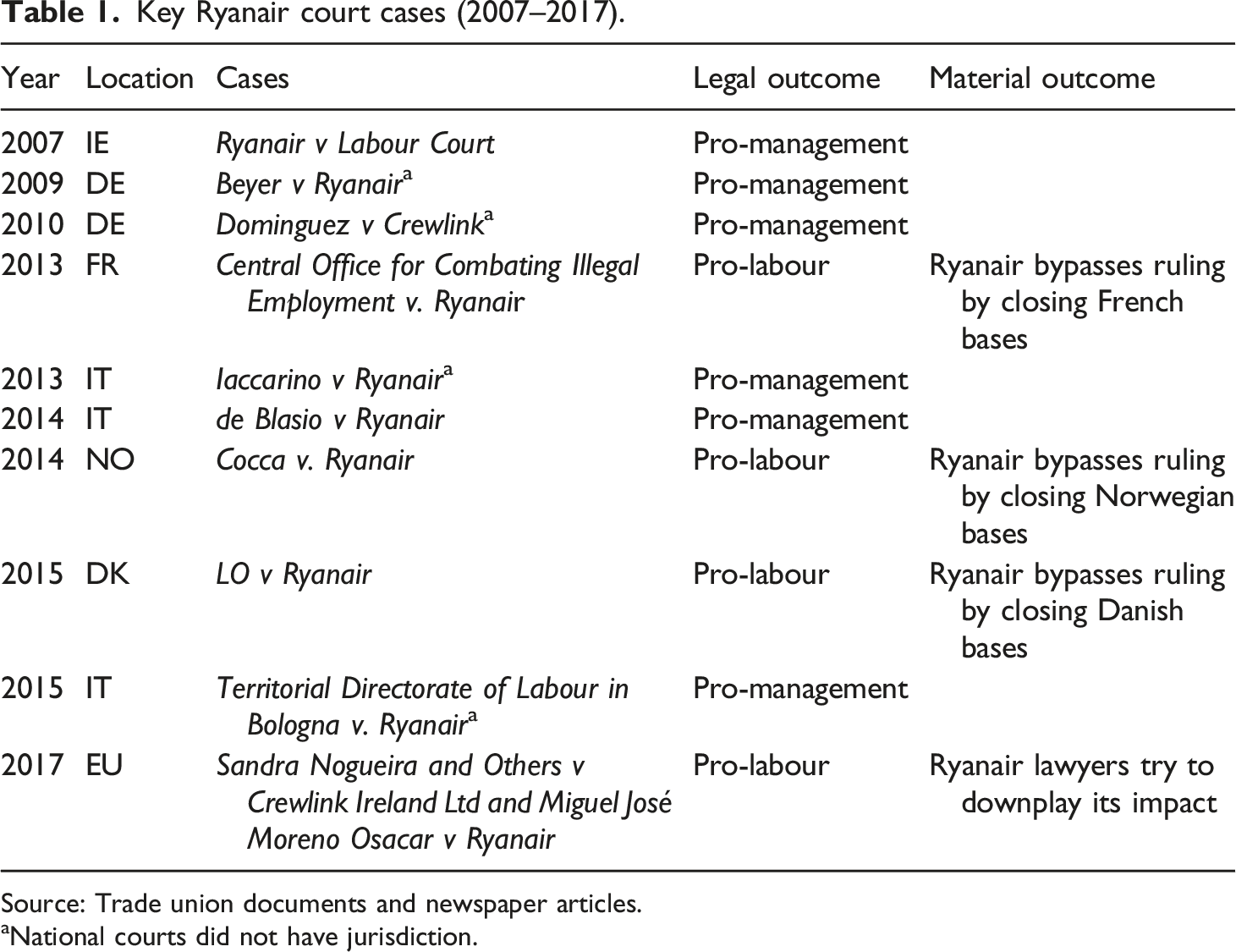
Upon announcement of the opening of two bases in Denmark in October 2014, Danish unions, which wield considerable institutional power, requested talks with Ryanair. Unsurprisingly, the latter declined. Subsequently, the unions asked the Labour Court to decide on the scope of their power resources. In other words, was taking secondary industrial action, in the absence of recognition and despite not having members in Ryanair, lawful? The Labour Court found that Ryanair must recognize the unions’ legal right to discussions, and, if Ryanair was unwilling, the unions could issue strike notice. With strike action imminent, Ryanair, rather than engage with unions, chose to close its bases at Copenhagen and Billund. Similarly in Norway, the Supreme Court ruled that a work-related case was subject to Norwegian, and not Irish, law. Shortly afterwards, Ryanair abandoned its base outside Oslo (Golden and Underthun, 2016).
Finally, following a Decree by the French government in 2006, low-cost carriers with operational bases were obliged to apply the Labour Code. French unions sued Ryanair for employing Marseille-based crew on Irish contracts. A French court ordered Ryanair to pay over €9,000,000 and hire staff on French contracts. This case set a precedent, as French law would then have led to union recognition and collective bargaining, but this did not happen, as Ryanair simply abandoned its French base.
Key Ryanair court cases (2007–2017).
Source: Trade union documents and newspaper articles.
aNational courts did not have jurisdiction.
Even where rulings have gone against the airline (e.g. France, Denmark and Norway), servicing those markets remains possible in the SEAM context and because of the freedom to provide services. Data show that between 2010 and 2018 Ryanair increased business in France despite having abandoned French bases in 2013 (FlightGlobal, 16 September 2018). Furthermore, any industrial action by unions could be illegal in the SEAM context and because of the ruling of the European Court of Justice (ECJ) in the Viking case 1 . These examples highlight the limitations of both state capacity and unions’ (national) power resources in a transnational marketplace. Even where unions can rely on a statutory recognition mechanism and can convert a hypothetical threat into an actual one, Ryanair can move its operations elsewhere without having to sacrifice service capacities. The terrain only began to shift on 14 September 2017 when the ECJ clarified in a joint case that Ryanair workers can bring work-related disputes before non-Irish courts despite having signed Irish employment contracts (C-168/16, Moreno Osacar and C-169/16, Nogueira). Although the court ruled on matters of jurisdiction, the judgements’ implications are substantive. Given the ECJ’s expansive interpretation of the notion of employee, its Moreno Osacar and Nogueira judgments can ‘lead Ryanair back to the mandatory set of rules that EU and pertinent national labour law provide for – inch by inch’ (Temming, 2018: 214). As the ‘wheels of justice’ (ibid: 214) turn slowly however, pilots’ attempts to amend the Ryanair employment model through litigation have not yet been effective. In contrast, Ryanair was able to use the courts on several occasions to undermine the development of worker solidarity. Two examples demonstrate this.
Firstly, IALPA and BALPA undertook a cross-border initiative, creating an online forum known as REPA, where Ryanair pilots could express job-specific concerns. To guarantee confidentiality and limit reprisal from management, pilots used pseudonyms. The forum was nevertheless infiltrated by Ryanair. Unable to identify the pilots, Ryanair sued for alleged harassment, only for the High Court to level the same charge of intimidation against the airline, whose evidence was found to be ‘baseless and false’ (O’Sullivan and Gunnigle, 2009: 261). Despite winning the battle, REPA was wound up for fear of reprisals should management learn of any pilot’s involvement in the online platform.
Secondly, in another attempt to overcome the culture of fear that permeated Ryanair, the Ryanair Pilots Group (RPG) was established and staffed by five ex-pilots or non-Ryanair pilots to avoid victimization and possible sacking. An interim council was headed by Captain John Goss, himself sacked for gross misconduct days after appearing on a TV documentary in which he raised concerns over Ryanair’s safety and fuel policy. Safety issues remained a priority for the RPG and to this end it created a petition for aviation regulators. When Ryanair management learned of this, it warned pilots that signatories would be guilty of ‘gross misconduct’ and ‘liable for dismissal’ (Independent, 17 May 2013). Ryanair sued the RPG on defamation grounds for having questioned Ryanair’s market integrity in an email to other Ryanair pilots. Tellingly, a serving Ryanair pilot refused to take the stand for fear of losing his job (Irish Times, 21 October 2013). After a lengthy process, in December 2017 the court returned a not guilty verdict. These two cases demonstrate the lengths to which Ryanair management is prepared to go to weed out those who challenge the status quo within Ryanair. Such litigation is designed to eliminate pilots’ associational power by establishing a culture of fear: pilots active within the RPG ‘didn’t dare to stand-up … because they know they would be immediately fired’ (ECA official 2).
Eroding workplace solidarity through the excessive use of atypical contracts
Ryanair employs only a clear minority of its pilots on permanent contracts (Jorens et al., 2015). In other words, the atypical is typical. Following IALPA’s representations in 2008 to the Irish Ministry of Finance regarding the airline’s affinity with labour intermediaries, Ryanair was forced to devise a new and complex employment arrangement (IALPA official). This new model means that, before providing their services exclusively to Ryanair via a piloting agency, a pilot must have established (or joined) a limited company (with other pilots), typically registered in Ireland. It is estimated that hundreds of such companies exist (IALPA official). Risk is thereby shifted from the airline onto the pilot, with the latter being subject to terms and conditions associated with zero-hour contracts (Jorens et al., 2015: 22). Ryanair is no longer responsible for paying pilots’ social contributions. Consequently, social and pension contributions represent only a small proportion of Ryanair’s labour costs, around 6% in total in 2011 (Steer Davies Gleave, 2015). This gives Ryanair a clear competitive advantage over its competitors.
Several aspects are important from a power resources perspective. Although self-employed workers are not bereft of structural power resources (Britwum, 2018), their mobilization requires significant associational power. However, mobilizing such power resources is problematical difficult given Ryanair’s vehemently anti-union stance. Two examples demonstrate this. Take a typical Ryanair pilot contract: ‘If Ryanair is forced to recognise any pilot trade union or association at [base name], or if there is any industrial action of any kind at [base name], then the roster will revert to 5 on 3 off with 5 on 2 off six times per annum and the annual allowance will be withdrawn …’ Hence, the favourable terms and conditions, to which reference is regularly made, are used to discourage pilots fostering associational power resources. The second example has to do with Ryanair’s in-house Employee Relations Committee (ERC) system, which precludes those on atypical contracts from participating in discussions about operations (RPG, Press Release, 29 October 2013). Hence, pilots are effectively at the mercy of management regarding base placements, stand-by, holidays and so on. Consequently, ‘the position of pilots is becoming increasingly more precarious … [and they] ha[ve] no voice in the matter’ (Jorens et al., 2015: 68).
Finally, many countries have legal criteria for distinguishing regular employment from self-employment, but this is not the case in Ireland where most pilots are registered. Under Irish labour law (bogus) self-employed workers ‘have very little access to worker protection legislation’ (Dobbins, 2009). Hence, the institutional power resource of pilots operating under such an arrangement is non-existent. In the absence of institutional power, the mobilization of other power resources can carry greater risks. An ECA official pointed to how these factors undermine any sense of empowerment: This type of social engineering – different nationalities, different types of contacts, different brokers, different bases, etc. … You move personnel from one base to another, so that they cannot declare social security, join a union … (ECA official 1).
A pilot’s average service period is 5.2 years (Ryanair Annual Report, 2014: 113). In theory at least, this scenario enhances pilots’ marketplace power (Silver, 2003). Nevertheless, management does not see this as problematic: ‘Ryanair will not face significant difficulty in hiring and continuing to employ the required personnel’ (Ryanair Annual Report, 2016: 114). To what extent this statement can be taken at face value is an open question. Nevertheless, it suggests that whatever marketplace power a pilot might possess is devalued in the transnational social space (Bamber et al., 2009: 98). Add to this a degree of precariousness through atypical employment and pilots’ power resources are further diminished.
To summarize, Ryanair’s union avoidance is best explained through the prism of the limited reach of institutional power resources in the SEAM context and associational power resourced within the transnational airline. The Irish, UK, Danish and French examples demonstrate that pilots’ institutional power resources ‘are easily deflected by airlines that have created new European spatial–juridical fixes to exert control over labor’ (Harvey and Turnbull, 2015: 322). Being domiciled in Ireland, where unions have weak institutional power, especially regarding union recognition, Ryanair, in the SEAM context, ‘experience[s] distinctly unequal access’ to other countries by effectively ‘exporting’ Irish voluntarism (Harvey and Turnbull, 2020: 554, emphasis original). Pilots’ associational power resources within the airline have been undermined on three fronts: firstly, Ryanair uses novel (self-)employment arrangements; secondly, Ryanair’s ERC system excludes those who are not on a permanent contract; thirdly, aggressive litigation strategies have limited union cooperation and perpetuated a culture of fear. Given this scenario, one might be forgiven for thinking that ‘the future is bleak’ (ECA official 1), with the prospect of transnational action seeming unlikely. Yet, this is precisely what happened, a matter to which we now turn.
Constructing transnational solidarity
In the 2000s, the ECA’s coordination activity increased. Having dismissed a strategy involving European works councils (ECA, 2007: 27), the ECA lobbied for a voluntary transnational collective bargaining framework. Cognizant that the prospect of such a framework materializing was ‘weak’ (ibid: 10), the ECA sought to ‘organise more unconventional activities’ (ibid: 17). This implied ‘developing the identity’ of pilots, if ‘industrial solidarity [is] to be effective’ (ibid: 20, 27). Transnational pilot associations (TNAs) were seen as necessary if ‘divide and rule’ strategies by employers were to be countered. In the words of an ECA official: TNAs try to overcome the limitations of the non-existing social legislation in Europe. Well, you can’t do European-wide strikes, you can’t be represented across borders etc. … We set up a TNA group, so that the unions in different countries can actually cooperate to make sure that the different pilot groups in different countries coordinate as closely as possible … to speak with one voice to its management, independently of its countries (ECA official 2).
In 2006, the ECA was instrumental in establishing the first transnational pilots’ group in EasyJet. This ‘ground-breaking’ (ECA, 2007) transnational agreement was signed by pilots’ associations from the UK, Germany, France, Italy, and Switzerland and would serve as a template for other airlines. The conditions, for reasons outlined above, were not present for such an initiative in Ryanair. Following IALPA and BALPA’s failed bilateral strategy with REPA, and the advent of Ryanair’s new employment model, concerns amassed within the wider airline community about a race to the bottom. A response came by way of the RPG, which is ‘a bit special’ (ECA official 2).
Claiming to represent over 50% of Ryanair pilots, the overarching objective was ‘a new form of Pan-European representative organisation … to arrest the progressive decline in their employment terms and conditions’ (RPG Press Release, 29 October 2013). The RPG conducted (quasi-)annual surveys to establish key issues and priorities. This was complemented by covert base visits to identify activists and build confidence (ECA official 2); in other words, to measure the degree of associational power amongst Ryanair pilots and their willingness to engage in contentious action. In October 2013, the RPG held its first public meeting to inform the public about Ryanair’s employment model and its deleterious effects. It sent an open letter to Ryanair requesting a meeting to discuss the prospect of a common contract for all Ryanair pilots and negotiate a collective labour agreement. The request was met with derision: ‘We don’t comment on the activity of false claims of KLM and Aer Lingus pilots’ (Irish Times, 30 October 2013).
A 2014 survey of RPG members attracted 1100 participants, 64% of whom were pilot contractors. The vast majority of the pilots (85%) desired a standard employment contract, with summer vacation possibilities. Also, 80% of respondents planned on leaving the airline within 2 years. The fiscal situation was also highlighted as an issue, and as an ECA official pointed out ‘[W]hen you go to flight school you don’t deal with international tax law and international labour law … you go to learn how to fly aeroplanes’ (ECA official 3). One of the largest cohorts of Ryanair pilots is based in Germany (ca. 20%), and in the summer of 2016 over a hundred pilots’ homes were raided by German tax authorities for alleged non-payment of income tax and social contributions. Could this dilemma act as a conduit for pilots to organize collectively? An ECA official’s response is insightful: ‘We’ve tried to organize that the Ryanair pilots get together, two or three representatives, from each [German] base. They won’t even meet with each other because they don’t trust each other’ (ECA official 1). This is indicative of the extent of the suspicion and fear in the pilot body and does not bode well for constructing transnational solidarity, which, as the following quote indicates, is a slow process: The big challenge is that if you have a hostile management … they don’t want the pilots to speak with one voice because it will shift the power balance and they can’t play one off against the other, [but] the pilots must be really willing to cooperate and that’s always a challenge … starting to talk about really substantial issues related to terms and conditions, it’s a big step and it needs a lot of convincing, a lot of regular meetings and trust-building and that’s a slow process … If, on the other hand, you had management that was very open and said ‘ok guys, let’s sit together around a table’, it would make things much easier, but management is quite happy to play one group against another … (ECA official 3).
Given this assessment, one might be forgiven for not holding out much hope of transnational solidarity emerging or of Ryanair changing its three-decade union-avoidance stance. Yet, this is precisely what occurred when in mid-December 2017 the threat of a transnational strike compelled Ryanair management to recognize unions. So, what explains this remarkable volte-face?
Day of recognition: Quite a U-turn
Ryanair, between September and December 2017, was forced to cancel thousands of flights. According to a Ryanair internal memo, the flights were cancelled because ‘continued poor weather across Europe, combined with ATC [air traffic control] delays which you have all experienced, compounded by this week’s French ATC strikes (which will be extended and escalated into next week), has meant a tight situation has become one that is negatively impacting our operation’ (cited in Irish Times, 16 September 2017). However, the real reason for the cancellation requires a discussion on the EU’s FTL Regulation (83/2014), which came into force in 2016, amending EU Regulation (216/2008) on common rules in the field of civil aviation. The regulation, enforced by the European Aviation Safety Agency (EASA), placed a ceiling on the number of hours a pilot can fly within the arc of a 12-month period. Except for Ireland, all EU member states and their airlines complied with this rule. Rather than interpreting ‘calendar year’ in the intended way, that is, 1 January to 31 December, the Irish Aviation Authority (IAA) permitted Ryanair to interpret ‘calendar year’ (EU FTL Regulation 83/2014. Annexe II. ORO. FTL.210) as meaning 1 April to 31 March. This favoured Ryanair’s operations particularly in the busiest summer months. Whereas all other airlines had to factor in holiday periods over the summer months, over 95% of Ryanair pilots could not take holidays between April and October (RPG, 2014). This provided Ryanair with yet another competitive edge over its rivals.
Following vertical pressure from EASA and national and European trade union lobbying, the IAA subsequently complied with the intended interpretation of the term calendar year. Consequently, Ryanair (2017) had to roster extra pilot leave between October and December so that it could start a new calendar year in 2018 with no backlog. However, all pilots transferring to the new calendar regime had to receive an additional month’s leave. Realizing the uniqueness of the situation, the pilot body identified the potential for a shift in the balance of power. The pilots’ structural power in general, and their marketplace bargaining power in particular, were enhanced vis-à-vis management on account of an imminent skills shortage. From within the pilot body emerged a European Employee Representative Committee (EERC), which ‘in parallel and partnership’ with over 20 national pilot unions, sent letters from 60 bases to Ryanair requesting the creation of a transnational bargaining unit with a view to formulating a company-wide collective agreement (Guardian, 2 October 2017) in order to avoid a divide et impera scenario materializing. Lucrative attempts were made by management to buy back pilots’ holiday time (c.a. €12,000). Former pilots were quick to point out the uniqueness of the situation and pleaded with pilots not to succumb to financial incentives (Guardian, 20 September 2017). A crowdsourced unity fund was established to offer succour to Ryanair pilots willing to put their head above the parapet in the pilots’ collective interest. This was ‘very important for morale’ (ECA official 2) and permitted pilots to challenge Ryanair’s proxy argumentation.
Various platforms (www.pilots-unite.com, www.eerconline.com, now discontinued), in addition to social media, were essential to creating strong momentum for the whole pilot body; however, collective agency requires a face. Captain Imelda Comer became the figurehead of the interim EERC and, in a communication with fellow pilots (seen by the authors), insisted that Ryanair’s ‘representation system is broken’ and ‘unreasonable’, which ‘works very well for the company’. The letter acknowledged that the scheduling fiasco had ‘resulted in an unprecedented level of unity throughout the pilot body, and a spontaneous desire to become an organised group and to respond to the company with a unified voice’. The EERC’s function was to harness this desire and strengthen the pilots’ resolve in the face of hostile management: ‘When the company offers nothing except money, they try to break our will to negotiate collectively’. Captain Comer also handed in a letter to Michael O’Leary (also seen by the authors) repeating a series of demands made by the EERC, but which had been ignored. These included, inter alia, permanent local contracts, following national laws and rights, and coordination between national and regional pilot teams – recognized as negotiating partners. Should these demands be respected, then ‘[P]ilots will surrender some of their leave to help resolve the current problems’. Ryanair continued to ignore the EERC and the pilots’ concerns by pointing to the Irish Supreme Court’s endorsement of its employee voice system (Irish Independent, 14 November 2017).
In early December 2017, pilots based in Ireland overwhelmingly backed industrial action (94%). Unions in Portugal, Spain, Italy and Germany followed suit. French and Danish unions could not join the strike as Ryanair no longer had bases in those territories. This impending transnational strike action forced Ryanair to abandon its longstanding anti-union policy. To frustrate transnational strike action in the future, however, the airline recognized national unions rather than the supranational EERC. This serves to highlight the limits of national industrial relations, which advantage Ryanair and allows the airline to play national unions off against one another. Even so, Ryanair workers continued to coordinate strike actions across borders. In July 2018, cabin crew unions from Belgium, Spain, Italy and Portugal coordinated a strike across borders. In August and September 2018, pilots’ and cabin crew unions from nine countries (BE, DE, ES, IE, IT, NL, PT, SE, UK) followed suit, which led to the conclusion of collective agreements in most of them. In August 2019, pilot unions and cabin crew from Spain, Portugal, Ireland and the UK coordinated another 24-hour-long strike. In the latter case, however, Ryanair partially succeeded in its divide et
Conclusion: Winning against the odds
Single European aviation market’s creation, coupled with the Viking ruling, created a spatial–juridical fix (Harvey & Turnbull, 2015) that Ryanair successfully exploited for three decades. At different points, Ryanair successfully eluded national unions, courts and legislators. In other words, unions’ national institutional power resources were increasingly limited in the SEAM’s context. In addition, Ryanair’s sophisticated employment model, which relies on self-employed pilots, undermined the emergence of solidarity within the pilot body. Unsurprisingly, scholars and practitioners alike were very pessimistic about any prospect of collective action by Ryanair pilots, but although competition hampers collective action, ‘it also motivates it’ (Anner et al., 2006: 24).
Following Marginson and Sisson (2006: 313), we argue that any analysis of industrial relations in Europe requires a multi-level perspective that takes different scales into consideration. This logic must also be applied to the PRA, as each level of governance entails different sets of powers. So far however, there is a limited understanding of interlocking scales of unions’ power resources, as most scholars who use that approach remain bound by a national (institutional) perspective (Nowak, 2019). This critical case study has shown that the weakening of national power resources does not prevent transnational counter-movements, contrary to the expectations of many (e.g. Baccaro cited in Phelan et al., 2009: 208).
We have shown in this article that successive union initiatives to engage Ryanair led to merely pyrrhic victories, as SEAM allowed Ryanair to bypass even the Danish, Norwegian and French unions, which had access to the strongest national institutional power resources. This seriously undermined union power in the highly unionized legacy airlines also. The more national options failed, the more pilot unions tried to coordinate their activities across borders. This requires taking scale into account.
To effectively exercise associational power across borders, ‘workers must first coordinate both internally (within individual unions) and externally (across national borders)’ (Brookes, 2019: 4). This means trial and error. Here, the creation of the first transnational union structures in Ryanair, for example, the RPG, was important in nurturing a sense of transnational solidarity even if it failed. The unorthodox RPG approach, and its successor the EERC, were critical in constructing the associational power resources necessary for transnational collective action. Had institutional power resources, which can be leveraged at EU scale, been absent or non-existent, a successful outcome would have been much less likely. The need to square unions’ power resources with a corresponding leverage scale factor requires a discussion of the pilot unions’ supranational institutional power resources at EU level. This vertical dimension, however, is usually neglected by comparative industrial relations scholars, who follow the methodological nationalism of varieties of capitalism and trade unionism approaches. In contrast, other scholars acknowledge the important role of supranational EU institutions, but usually dismiss their relevance as a potential source of institutional union power (Kiess and Seeliger, 2019).
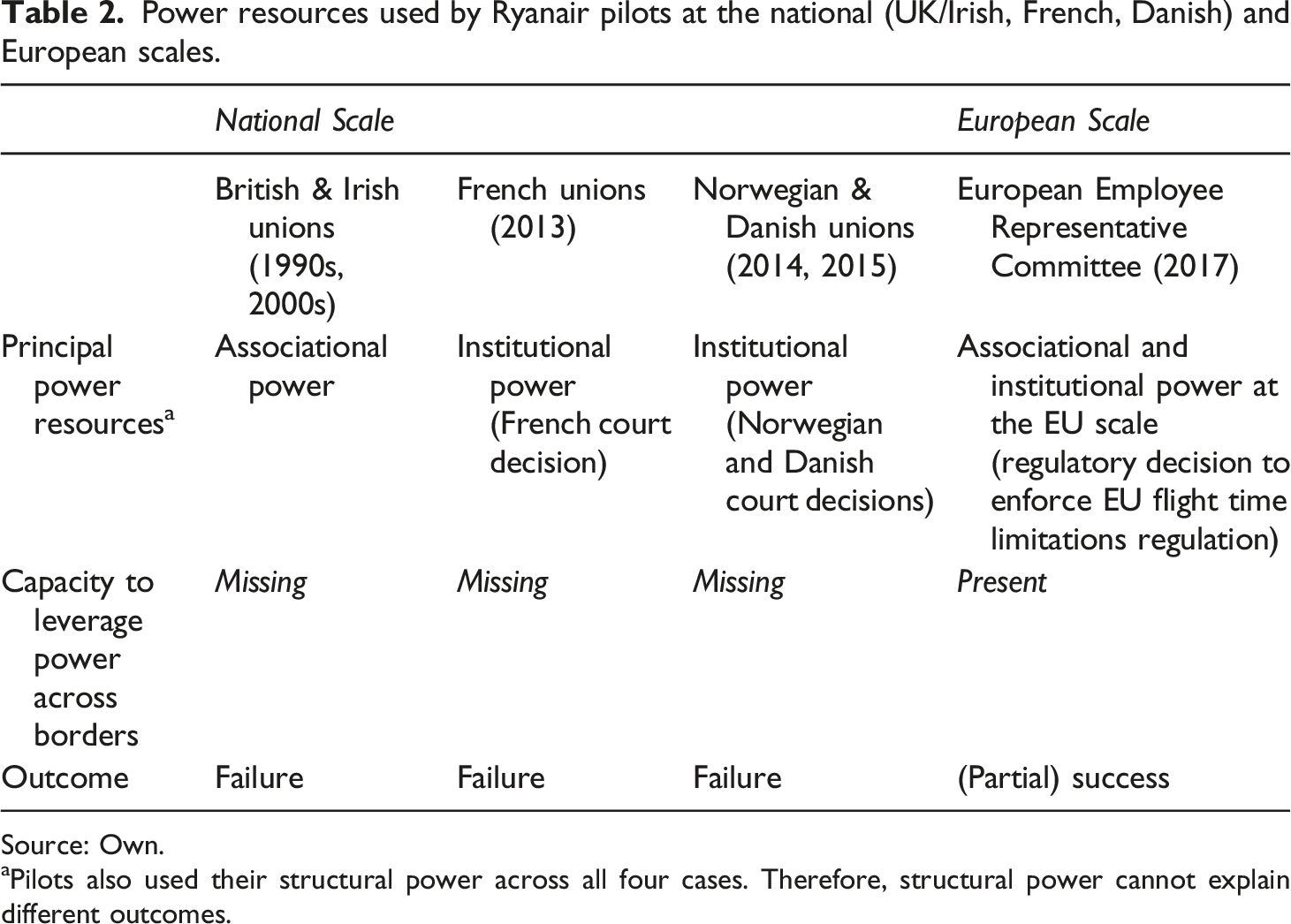
Power resources used by Ryanair pilots at the national (UK/Irish, French, Danish) and European scales.
Source: Own.
aPilots also used their structural power across all four cases. Therefore, structural power cannot explain different outcomes.
Ryanair pilots’ capacity to leverage their power resources at EU level was critical. If there is an institutional lever at supranational level, such as the FLT Regulation, even a relatively weak labour alliance may win, contrary to the expectations of Ryanair’s CEO who only a few weeks earlier had stated: ‘I don’t even know how there would be industrial action in Ryanair … There isn’t a union’ (cited in Guardian, 21 September 2017). Even so, no single power resource can alone explain the successful outcome. Rather, it is the interplay between power resources at different scales. Ryanair pilots effectively used the EU’s FTL as an institutional lever for transnational action, but the harmonization of Ryanair pilots’ rosters, required by the FTL, also increased their transnational associational power. This EU law dramatically increased the operational dilemmas that Ryanair was facing in late 2017. The rostering fiasco provided the pilots with a rare window of opportunity. The EERC, a relatively small transnational group of union activists, emerged organically (ECA official 2) and managed to get enough support from Ryanair pilots for a series of coordinated strike threats across Europe. When the Ryanair CEO began to realize that the informal EERC might succeed where even the strongest national unions had hitherto failed, he issued an ‘unprecedented apology’ and promised ‘salary increases, loyalty bonus payments, improved rostering and better compensation’ (Guardian, 5 October 2017). Even so, the EERC and Ryanair pilots maintained their threat of coordinated, transnational strike action, compelling Ryanair to abandon its longstanding anti-union policy. Here, a unity fund, designed to provide ‘financial security to pilot leaders, who have distinguished themselves in the struggle for collective representation’ (ECA, 2018: 9), also played a key role.
The shift in the balance of power arose from an ‘alignment of planets’ (ECA official 1), or – in our words – a well-timed mobilization of both institutional and associational power resources at EU level by a transnational group of union activists. Hence, the Ryanair case is a source of optimism. As one interviewee put it: ‘If you can organize Ryanair, you can organize everywhere’ (ETF official 2). That said, a degree of caution is necessary for, by deciding not to engage with the EERC, Ryanair, by understanding scale, has returned collective bargaining to the national level where it has successfully played one regime off against another (ECA, 2018). Albeit a step in the right direction, recognition alone does not translate into a collective agreement, which at the behest of Ryanair remains at the national level. This will be a source of frustration for Ryanair workers and their unions, as the firm has started to use different national dispute resolution mechanisms to prevent any coordinated transnational collective action in the future. How this scenario evolves is a question for future study, but it would appear that, despite the ‘union recognition, Ryanair remain[s] … Ryanair’ (ECA, 2018: 8).
Footnotes
Declaration of conflicting interests
The author(s) declared no potential conflicts of interest with respect to the research, authorship, and/or publication of this article.
Funding
The author(s) disclosed receipt of the following financial support for the research, authorship, and/or publication of this article: This work was supported by the Erasmus Plus Programme (European Research Council (ERC) (grant agreement), Research Council of Norway (grant agreement No 227)).
