




Abstract
Industrial relations scholars are paying increasing attention to the role of ideas in explaining shifts in bargaining systems and wage policies. This article contributes to this growing body of literature by conducting a meso-level analysis of the uses and impacts of ideas in wage regulation policy processes in coordinated market economies. Through our in-depth case study of the Finnish policy process leading to the Competitiveness Pact of 2016, we argue that certain ideas – which we call the ‘economic outlook’ – prescribed and legitimized exhausting institutional resources in wage regulation and enabled temporary consensus among divergent interests regarding wage policy. The economic outlook linked and enabled compromises between wage policy and wage regulation interests and effectively solidified a commitment to an uncertain policy process. The case study suggests that an ideational analysis of policy processes can offer explanations for shifts in wage policy and regulation that deviate from macro-level regime shifts. While all Nordic countries have faced similar economic and institutional reform pressures, Finland’s readoption of centralized bargaining shows that national policy ideas can drive distinct industrial relations patterns within the Nordic context.
Introduction
Industrial relations (IR) scholars have recently paid considerable attention to ideational explanations of shifts in national bargaining systems. Ideational explanations have been seen as complementary to institutional and interest-based (economic) explanations (McLaughlin and Wright, 2018). Ideational framings have been observed to influence perceptions and the legitimacy of IR (Cradden, 2014), shape wage regulation preferences and strategies (Boumans, 2021), and necessitate and legitimize changes in wage policy (McLaughlin and Wright, 2018). Most ideational research has focused on either the micro-level of analysis – that is, the contribution of ideas to shaping the form, dynamics and products of the employment relationship (Hauptmeier and Heery, 2014) – or the macro-level of analysis – that is, the ideas constitutive of IR regimes and contribution of ideas to long-term incremental change (Boumans, 2021; Howell, 2019). Few studies have adopted a meso-level approach to examine the use of ideas in specific wage regulation and policy processes (see McLaughlin and Wright, 2018). The research thus far has focused mostly on the context of liberal market economies (McLaughlin and Wright, 2018). Within the limited research on coordinated market economies (CMEs), studies show that ideas can shape wage policy preferences (Paster et al., 2020) and shift perceptions regarding actors’ preferences over time (Kinderman, 2017). However, the uses of ideas in wage regulation and their impacts on policy outcomes in specific regulation processes remain unexplored.
We address these topics with an in-depth case study of the Finnish policy process leading to the centralized agreement colloquially known as the Competitiveness Pact (Kilpailukykysopimus in Finnish) of 2016. Finland followed the other Nordic countries in gradually shifting towards a more decentralized but centrally coordinated wage regulation system and flexibility-oriented wage policy. However, Finland has appeared to be an outlier among these countries given its reintroduction of central bargaining in the 2010s. Various economic, ideational and institutional explanations have been presented for the incremental macro-level regime shift towards decentralized bargaining in Finland. The Competitiveness Pact (hereinafter CoPa) creates a puzzle for these explanations. Like the previous rounds of central bargaining in 2011 and 2013, the CoPa was a deviation from the macro-level trend, but as we argue below, it was also much more unlikely than these previous rounds due to increasingly divergent interests and the exhaustion of institutional resources (i.e. centralized bargaining). Therefore, we turn to ideational explanations of the process and its outcomes. Our analysis suggests that the set of ideas constituting what we call the ‘economic outlook’ plays a crucial role in explaining the CoPa process and its outcomes.
The analysis makes three contributions to the wider ideational scholarship in IR. First, we show that a meso-level policy analysis of ideas can offer explanations for wage policy and regulation shifts that temporarily deviate from macro-level policy trends and institutional change processes. Second, we demonstrate that ideas can foster a commitment to an uncertain wage regulation process. Previous research has recognized the importance of ensuring commitment through ideas for initiating institutional change in bargaining regimes (Culpepper, 2008); our analysis adds that ideas can be used similarly to reactivate old and uncertain institutional resources. Finally, we illustrate that ideational support for centralized bargaining in the 2010s, and for the CoPa in particular, explains why Finland diverged from a trajectory towards a more decentralized wage policy and regulation regime observed in the other Nordic countries.
The paper is structured as follows. We first discuss recent shifts in Finnish wage policy and regulation and present the theoretical tools for a meso-level ideational explanation. We then introduce our case study methodology and describe the CoPa process and its key puzzles. After presenting our results, we reflect upon their contributions to the broader IR research.
Meso-level ideational analysis and recent shifts in Finnish wage policy and regulation
In the CMEs of Northern Europe, wages have mostly been regulated and wage policy negotiated in a bipartite manner between organized capital and labour (i.e. the social partners) or in a tripartite manner between the social partners and the state (e.g. Kiander et al., 2011). Wage policy in Nordic countries changed significantly during the 2000s both in terms of wage policy contents and institutional settings for bargaining (Jochem, 2011). Wage flexibility and price competitiveness replaced fair distribution and wage growth as the main norms driving wage policy. Wage regulation was gradually decentralized in an organized manner and, depending on the country, shifted to either the local/company level or sectoral or industry level. The importance of the local bargaining component in wage determination grew. Bi- and tripartite bargaining became more a coordinator and/or regulator of decentralized wage policy than a policymaking arena (Andersen et al., 2015). Especially in the Nordic countries these transformations occurred in different guises and at varying paces but amounted to comprehensive reconfigurations of labour market institutions, (Dølvik et al., 2018).
As in the other Nordic countries, the longer-term evolution of Finnish wage policy was driven, in general, by institutional convergence and regime competition within the EU and, in particular, by the objective to maintain price competitiveness vis-à-vis Germany (Dølvik et al., 2018; Müller et al., 2018). In the case of wage regulation, Finland was the last country to abandon central bargaining as the main form of wage setting and adopt a coordinative approach to decentralized bargaining (Andersen et al., 2015). Finnish wage regulation took a major step towards decentralization during the industry-level bargaining rounds of 2007–2011 but, unlike the other Nordics, Finland returned to central bargaining in the 2010s with three bargaining rounds in total (2011, 2013 and 2016). Since 2017, when the Confederation of Finnish Employers (EK) removed from its articles of association its mandate to act as a contractual party in wage policy, central bargaining has been disabled.
Besides regime competition and institutional convergence, the macro-level shift towards more decentralized bargaining and competitiveness-driven wage policy in Finland has been explained by changing interests and ideas. The forestry and technology industries have advocated decentralization of bargaining and abandoning the incomes policy pacts ever since the 1990s (Bergholm and Bieler, 2013). As the interests in the Finnish business system polarized (Skurnik, 2005), a divergence emerged regarding wage policy between international competitiveness–oriented export industries and domestic demand–oriented local services. Opposing interests were suppressed in the 2000s through the strong export leadership in the EK (Bergholm and Bieler, 2013). The idea of national competitiveness emphasizing industrial upgrade provided a public justification and intellectual rationale for industry-level wage regulation and flexibility in the 1990s and early 2000s (Kaitila, 2019).
While these factors in combination may explain the longer-term macro-level regime shift, they provide, at best, a partial explanation for the temporary reintroduction of central bargaining in 2011–2016 and, consequently, the deviation from the Nordic trajectory. Thus far, the elastic commitment to central bargaining in Finland has been attributed to the tradition of using existing institutions pragmatically to achieve economic policy goals (Andersen et al., 2015). The idea of national competitiveness was revamped in the 2010s to emphasize labour cost reduction at the expense of sectoral flexibility and investment policies (Kaitila, 2019). Simultaneously, the interest constellation of the Finnish business system became tripolarized, and wage policy interests increasingly diverged between global service and technology companies pursuing ‘upward’ competition, export industries pursuing ‘downward’ competition and domestic service companies pursuing purchase power increases (Sorsa, 2020). Thus, it remains unlikely that a one-size-fits-all cost reduction would be perceived as a pragmatic instrument by any majority. External institutional pressures from the Eurozone appear to have had little impact on the Finnish wage policy and regulation of that time (Dølvik et al., 2018).
In this light, the CoPa of 2016 appears to be an especially puzzling case. As central bargaining was becoming an exhausted institutional resource (due to EK’s rule change in 2015), and the use of this resource was ridden with opposing interests (due to tripolarization), an explanation must be sought from other sources. Here, our attention turns to ideas.
Previous research suggests that Finnish policymakers, including government coalitions (Kantola and Kananen 2013) and social partners (see below), typically legitimize policy measures with consensual ideas. During the incomes policy era ideas emphasizing economic necessity became a powerful means to commit policymakers and the social partners to centralized agreements (Kyntäjä, 1993). As opposed to addressing foundational and normative issues, which is more common in Sweden, Finnish ideas typically emphasize domestic adjustment measures for managing perceived structural and external pressures (Kuisma, 2017). The economic outlook (see below) encapsulated these aspects.
In this paper, we focus on ideas that justified the use of exhausting institutional resources and enabled different parties to find common ground in the CoPa policy process. Explaining an individual policy process and its outcomes necessitates a meso-level analysis. A meso-level policy analysis examines a specific policy programme and all the factors framing and giving shape to the policy process. In the context of IR scholarship, this entails analysing the wage policy and regulation process emerging from the macro-level IR regime. We focus on how ideas were used, interests were articulated and institutional resources were mobilized through them in the negotiation process to form proposals and positions, coalitions and break-ups, consensus and dissensus and, eventually, the wage policy and regulation measures constituting the CoPa.
Ideas are considered essential for overcoming the uncertainties of non- or de-institutionalized, unconventional and/or tension-ridden policy processes (Blyth, 2002). Ideas influence policy actors’ preferences in specific situations through cognitive and normative thought structures that tell the actors what is possible and desirable (Campbell, 1998). In an IR context, ideational explanations can complement institutional and interest-based explanations (McLaughlin and Wright, 2018). For example, when influential actors succeed in producing and disseminating ideas that bear reform imperatives, other actors’ perceptions of interests typically change; however, as actors face various institutional constraints, these perceptions may be short-lived and ideas may explain policy changes only for a short time (Béland, 2009). Indeed, while interests may determine the attractiveness and relative value of different policy solutions (Pontusson, 1995), ideas are necessary for perceiving shared value in different proposals. Institutions may determine the external legitimacy and feasibility of different policy measures, but ideas may also open up existing institutions to reform and undermine the constraints they produce (Lieberman, 2002). New frames and beliefs are necessary for justifying aspired institutional changes; therefore, ideas are needed as ‘blueprints for institutional reform’ (Blyth, 2002).
While macro-level ideational analyses focus on collective paradigms and micro-level analyses on individual-level cognition, the appropriate research object at the meso-level is ideation. Here, the focus is on the ideas framing each decision-making instance and what emerges therefrom as new ideas or rearticulations and reframings of old ideas (Kamkhaji and Radaelli, 2022). In policy processes, ideas are typically pushed by exogenous inputs and feedback and often create new processes of ideation where thought structures are recreated and contextually reshaped. Ideas can be used as heuristics and strategic tools (Swinkels, 2020), which are typically used to construct policy problems and solutions, create reform imperatives and connect interests and/or legitimize policy prescriptions to form coalitions (Béland, 2009; Béland and Cox, 2016).
Methodology
Our case study focuses on the policy process that led to the tripartite agreement between Finnish central labour market organizations and the Finnish government, colloquially called the CoPa, in 2015–2016. The CoPa can be regarded as deviant from previous wage regulation processes and policy outcomes in the Finnish context. Focussing on deviant cases is an appropriate case study strategy for disconfirming deterministic arguments and probing new explanations (Seawright and Gerring, 2008). In this case, we probe meso-level ideational explanations for temporary shifts in wage regulation and policy that deviate from ongoing institutional change processes and publicly articulated interests, respectively. The CoPa deviated from the longer-term trend towards decentralized bargaining, like the two preceding rounds of central bargaining. Yet the CoPa process also included two new regulation measures: the government’s decision to use coercive policy instruments and the employer confederation’s decision to cease its own mandate for central bargaining. The CoPa also deviated from the two previous rounds of central bargaining in terms of wage policy contents, including the uniform lengthening of working time and cutting of indirect labour costs.
To analyse how ideas may explain the deviant process and its outcomes, we constructed a process description of the negotiations, mapped out key instances of ideation, recognized puzzles requiring an ideational explanation and mapped out the framings and reframings produced in ideation. We used the extensive reporting by Helsingin Sanomat (HS), Finland’s largest newspaper, as our primary material. The timeline of the process spanned from April 2015, when the newly elected government presented its first demands for central bargaining, to the signing of the final pact in June 2016. We searched the HS database using the string Yhteiskuntasopimus (‘The Social Pact’, the term used by the media) from April 2015 to March 2016. Next, we used the string Kilpailukykysopimus, the official title of the 29 February 2016 agreement. The retrieved HS materials comprised 1017 articles in total. We supplemented these materials with publicly available official reform documentation (cited in the next section) to widen our materials on frames brought to each ideation session. These materials included references to policy programmes, expert reports and other documents that the government employed in the negotiations.
We acknowledge that these data sources provide only a limited account of ideation, the transmission of ideas to negotiation settings and the dynamics of framing and reframing. A complete account would require observations of all negotiation sessions and their preparation processes, to which we did not have access. However, we argue that these documentary materials are both valid and sufficient for our purposes. We assume their validity, as the negotiating parties typically bring to the media their preferred ideational frames to set agendas for individual negotiation sessions, while media actors typically evaluate reframings produced in each session and transfer these frames to the next sessions (see Plowman and Walton, 2020). Given the extensive scope of HS coverage, we assume the materials provide a sufficiently rich account of all negotiating parties’ ideas, frames and positions throughout the negotiation process.
We used the ideational outcome process tracing analysis method developed by Vanhala and Hestbaek (2016) for negotiation settings to analyse the HS materials. We identified the outcome of each ideation and then traced backwards the ideas transmitted to the ideation and the reframings transmitted to the next ideation. From the 1017 articles, we selected for further analysis articles reporting negotiation instances, outcomes or proposals around the turning points and describing key negotiation agendas, items and frames. A representative sample of this body of articles (about 100) informs the argument below, but due to space limitations, we only cite the most salient articles (about 30). For the official reform documentation, we used a simpler forward citation tracing method, common in ideational analyses of programmatic policy documents (e.g. Alaja and Sorsa, 2020), to identify the ideas that travelled throughout the negotiation process.
The negotiation process and key puzzles
The events, puzzles and ideational explanations of the CoPa.
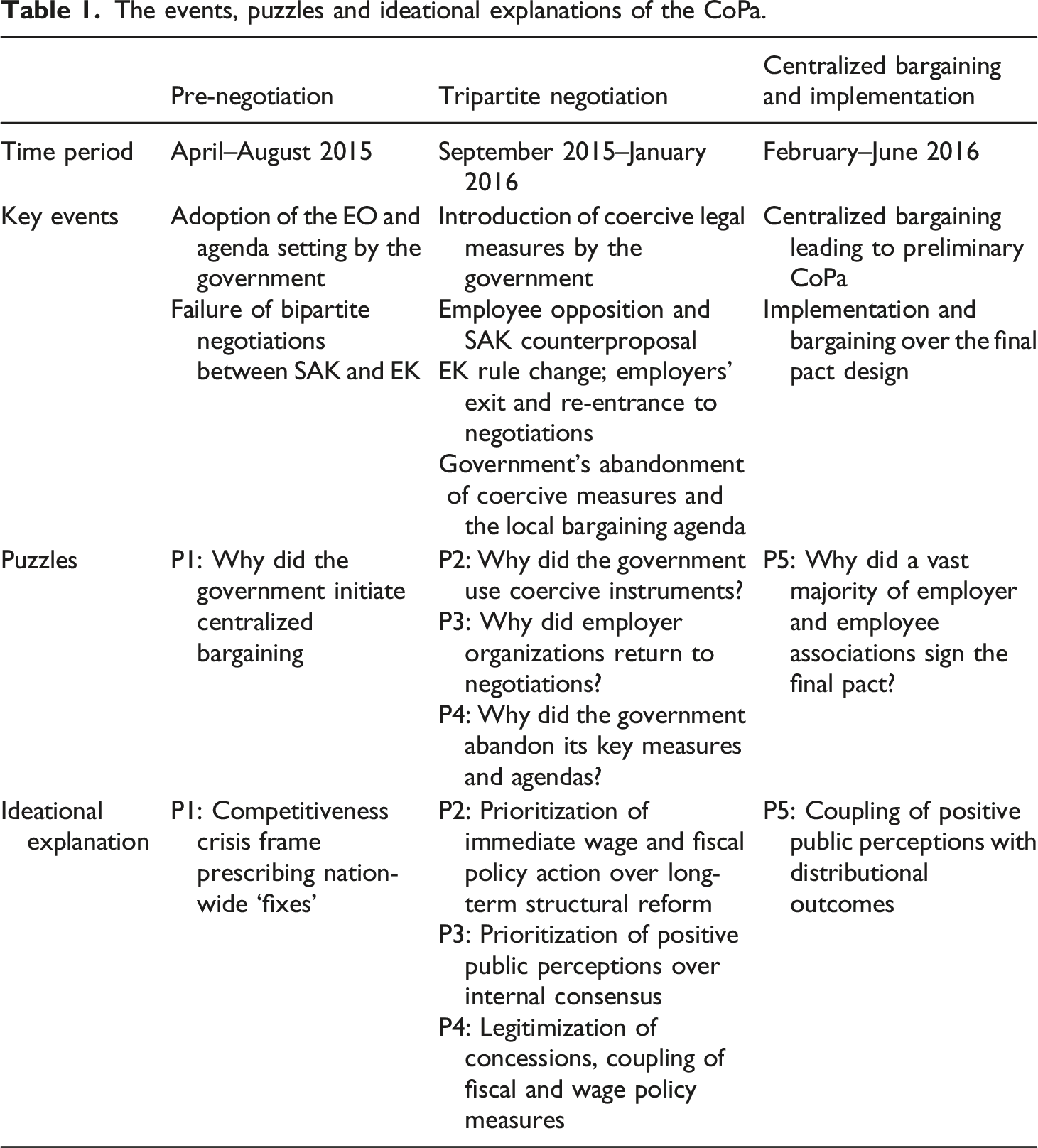
The first phase began with the formation process of the new centre-right government, led by Prime Minister (PM) Juha Sipilä of the Centre Party (CP), in May 2015. The other parties in the government were the National Coalition Party (NCP) and the Finns Party. Already before the new government’s term began, the coming PM Sipilä had invited the central labour market organizations to negotiate upon forming a social pact to meet three central objectives: (1) to enhance the international competitiveness of Finnish work and business, (2) to boost economic growth and (3) to create new jobs (Aiesopimus yhteiskuntasopimukseksi, 2015). The initial policy target set by the Sipilä government was to reduce unit labour costs (ULC) by 5% through an uncompensated increase in annual working time by 100 h combined with wage moderation (HS, 2015a). The first suggestion to the social partners failed to initiate a bargaining process (HS, 2015b). The subsequent government programme mandated that the social partners reduce ULC by 5% by March 2017, and a prolonged wage freeze would reduce them by another 5%. Higher competitiveness was intended to improve the fiscal balance by 0.5% relative to GDP by 2019. The programme also stipulated net expenditure cuts in case the social partners failed, whereas success would merit income tax cuts. (VNK, 2015a.)
The centre-right government made a centralized incomes agreement a key plank of its economic platform. This was somewhat surprising given the government constellation. Under the previous PM Alexander Stubb’s leadership, from 2014 onwards, the NCP had opposed consensual tripartism for enabling employee organizations to block structural reforms. Such reforms were at the forefront of the NCP agenda for the coming elections (NCP, 2015; Stubb, 2014). EK (2015) shared a similar agenda but coupled it with a demand for cost competitiveness remedies. CP (2015) was the main proponent of a centralized agreement despite the very negative responses to CP-led centralized pact proposals during the economic depression of the 1990s (see Kiander et al., 2011). Along with its economic and wage policy targets, the government programme set ambitious goals for reforming wage regulation (VNK, 2015a). A key issue here was the expansion of local bargaining. Organized Finnish employers can agree locally upon various issues but collective agreements, customarily extended to cover entire industries, lay the foundation for pay and working conditions. The government intended to extend local bargaining rights to non-organized employers and enable local bargaining over working conditions and pay, and it set up a committee to advance the required reforms (VNK, 2015a). The key puzzle requiring ideational explanation here is as follows: why did the government attempt to initiate a centralized pact, which seemed to contradict some of its constituents’ interests and the government agenda for wage regulation reform?
The second phase began with unilateral government actions to initiate bargaining after another failure in autumn 2015 (HS, 2015c). In particular, the Central Organisation of Finnish Trade Unions (SAK), representing blue collar unions, had opposed the government’s agenda over the summer, whereas the Finnish Confederation of Professionals (STTK) and the Confederation of Unions for Professional and Managerial Staff in Finland (Akava) had been more amenable (HS, 2015c). In September, the government threatened to introduce a unilateral package of legal measures that would achieve the 5% ULC reduction if no agreement was reached. The legal measures sought to directly limit the freedom to agree upon holidays, sick leave and overtime bonuses (HS, 2015d; VNK, 2015b)
The employee organizations responded with industrial action and joint mass demonstrations (HS, 2015e). SAK took the initiative by presenting a counterproposal to reduce ULC by 4.2% via a centralized pact built on a wage freeze until 2018 and other means of labour cost reductions. The condition was that the government would cancel its legal measures and withdraw from unilateral reforms that would override the existing collective agreements system. Additionally, SAK proposed that the export industry determine an anchor to guide wage policy after 2018 (HS, 2015f; SAK, 2015). EK proposed a central agreement for cutting indirect labour costs but excluded wage policy agreements from the deal (HS, 2015g). The government took SAK’s proposal as the baseline for negotiations over a pact to replace its legal measures in October–December 2015 (HS, 2015h). STTK and Akava were willing to negotiate work time increases and other measures to weaken working conditions, but SAK rejected both agendas along with reforms that would override collective agreements (HS, 2015i). The negotiations halted shortly after EK’s rule change forbidding centralized agreements came into force (HS, 2015j). In response, the logistics workers’ Auto and Transport Union (AKT), whose inclusion was vital for export employers, exited the negotiations permanently, which prompted EK to leave in protest (HS, 2015k). The government then reaffirmed its commitment to prepare its legal package.
In early 2016, the employers announced their wish to re-enter negotiations, even without AKT’s involvement, if wages were left outside the pact (HS, 2016a). SAK announced that it would resume bargaining but demanded as preconditions the inclusion of wages and a local bargaining solution that would be acceptable to workers (HS, 2016b). The government announced it would halt its legal package preparation as a concession to employees (HS, 2016c). As a concession to the employers, SAK agreed to negotiate working time extensions along with Akava and STTK but only if its earlier conditions were met (HS, 2016d). The government announced that it would accept this proposal, and also advance local bargaining primarily within the collective agreement system, if the social partners managed to reach an agreement leading to a centralized pact (HS, 2016e). The social partners agreed to conduct central bargaining under these terms.
This second phase involves several puzzles requiring ideational explanations. First, why did the government use coercive means to pressure the social partners? Although the use of pressure tactics in negotiations as such is nothing new, the government stepped into the social partners’ territory and compromised the willingness to negotiate in the longer term. Second, why did the employers re-enter negotiations even though EK had given up its capacity to bargain, AKT had withdrawn and the government had abandoned the local bargaining agenda, thus making the negotiations of little relevance to the leading bloc within EK? Third, why did the government prioritize central bargaining over the local bargaining agenda and coercive measures? There was some uncertainty concerning the legal measures’ compatibility with the constitution (HS, 2016l), but otherwise abandoning the local bargaining agenda was at odds with prior government positions.
The third phase of the process started with the central labour market organizations’ preparation of a provisional agreement in late February 2016. The interests and positions of different parties had been clearly articulated throughout the long negotiation process, which enabled rapid progress. The provisional agreement was built around a wage freeze, other labour cost reductions and an uncompensated increase in work time. Local bargaining measures, such as opening clauses and work time banks, were to be pursued within the collective agreement system (Kilpailukykysopimus, 2016). The government regarded the agreement as sufficient to repeal the legal measures but attempted to make fiscal compensations conditional on the advancement of local bargaining and the advancing of a future wage-setting model based on an industry-determined ceiling in the final pact (HS, 2016f).
The focus then shifted to negotiations on enacting the provisional agreement (HS, 2016g). After the SAK federation decided to conduct this on a union-by-union basis, safeguarding high coverage became a priority for the government and employers alike (HS, 2016h). Among the key unions, metal and service workers remained reluctant to sign until the very end. This phase also contained an unsuccessful attempt by NCP politicians and Finnish entrepreneurs (FE) representing small to medium-sized companies to reintroduce local bargaining reforms as the main agenda (HS, 2016i; 2016j). The FE clash with EK and the government initiated a political chain reaction that forced PM Sipilä to exclude the extension of bargaining to non-organized employers in the pact (HS, 2016k). While some unions (AKT, food and construction unions) rejected the pact, it already covered 85–90% of employees when the government and social partners agreed to sign the final pact. Despite little progress in institutionalizing the new wage-setting model, the government announced compensatory income tax cuts (VNK, 2016).
The key puzzle here is as follows: why did so many employer and employee organizations sign the pact despite perceiving it as either irrelevant to or against their interests? In effect, only the traditionally antagonistic unions (transport, food and construction) did not sign. The threat of legal measures, which were largely against employee interests but also threatened to weaken paritarian control over mandatory pensions, and the local bargaining agenda that a significant number of unions opposed had already been dropped by the government. While the pact’s failure would still trigger punitive expenditure cuts, and parties on the ‘problem side’ could face substantial legitimacy losses, both the ‘stick’ and ‘carrot’ remained unclear, as fiscal compensations for wage moderation were ambiguous and many interpreted them (correctly, as it was soon confirmed) almost a certainty.
Ideational explanations of the competitiveness pact
We recognize two key ideas for explaining the puzzles presented above. In aggregation, these ideas travelled throughout the process and created for ideation around all turning points of the process a frame that we call the economic outlook (hereinafter EO). Overall, the EO created a strong imperative to resolve the perceived competitiveness and fiscal problems in tandem and prescribed labour cost moderation in its various guises as the key policy tool for overcoming a perceived crisis. The EO created situational awareness among the negotiating parties that allowed them to recognize shared interests and justify unpopular measures and compromises, and it was used as a discursive weapon to commit other parties to an uncertain and often frustrating negotiation process. Moreover, the EO became an institutional fact during the negotiation process: no labour market organization leader or politician could neglect it or the implied need to moderate labour costs to return to Finland’s earlier levels of competitiveness without being perceived in the media as part of the problem rather than its solution.
We call the first idea constitutive of the EO the ‘competitiveness crisis’. While the idea of improving national competitiveness had provided policy instruments for the two previous rounds of central bargaining (2011 and 2013), the CoPa process was guided by a more pronounced and widely shared perception of the rapid deterioration of Finnish national competitiveness. Two developments contributed to this perception. First, key Finnish economic policy experts and institutions recalibrated the idea of national competitiveness to emphasize cost competitiveness, measured by ULC trends (Kaitila, 2019). Second, the parliamentary election campaigns in early 2015 largely revolved around discourses of a national economic crisis. Especially the CP promised to ‘fix Finland’ with large-scale economic policy measures with clear, tangible and measurable results during the following government term (Uimonen, 2019).
According to the economic policy establishment view, Finnish cost competitiveness had worsened by 10–15% in the 2000s (Kaitila, 2019). Official statistics confirmed some deterioration relative to key competitors but also indicated that Finland’s ULC changes followed similar trends (see Figure 1) and remained on par with them in terms of ULC levels (Andersen et al., 2015; Sauramo, 2015). For the government, the idea of a competitiveness crisis revolved around interpreting relative changes in ULC indices – not the ULC levels as such – as directly representing Finland’s competitiveness level, which was deemed ‘10–15% weaker than that of our key competitor countries’ (VNK, 2015a). This competitiveness gap was perceived to substantially hinder economic performance and the sustainability of public finances. Both the government programme and the CoPa agreement were framed by the goal of bridging this gap. Nominal ULC growth in 2008–2015. Data source: Eurostat.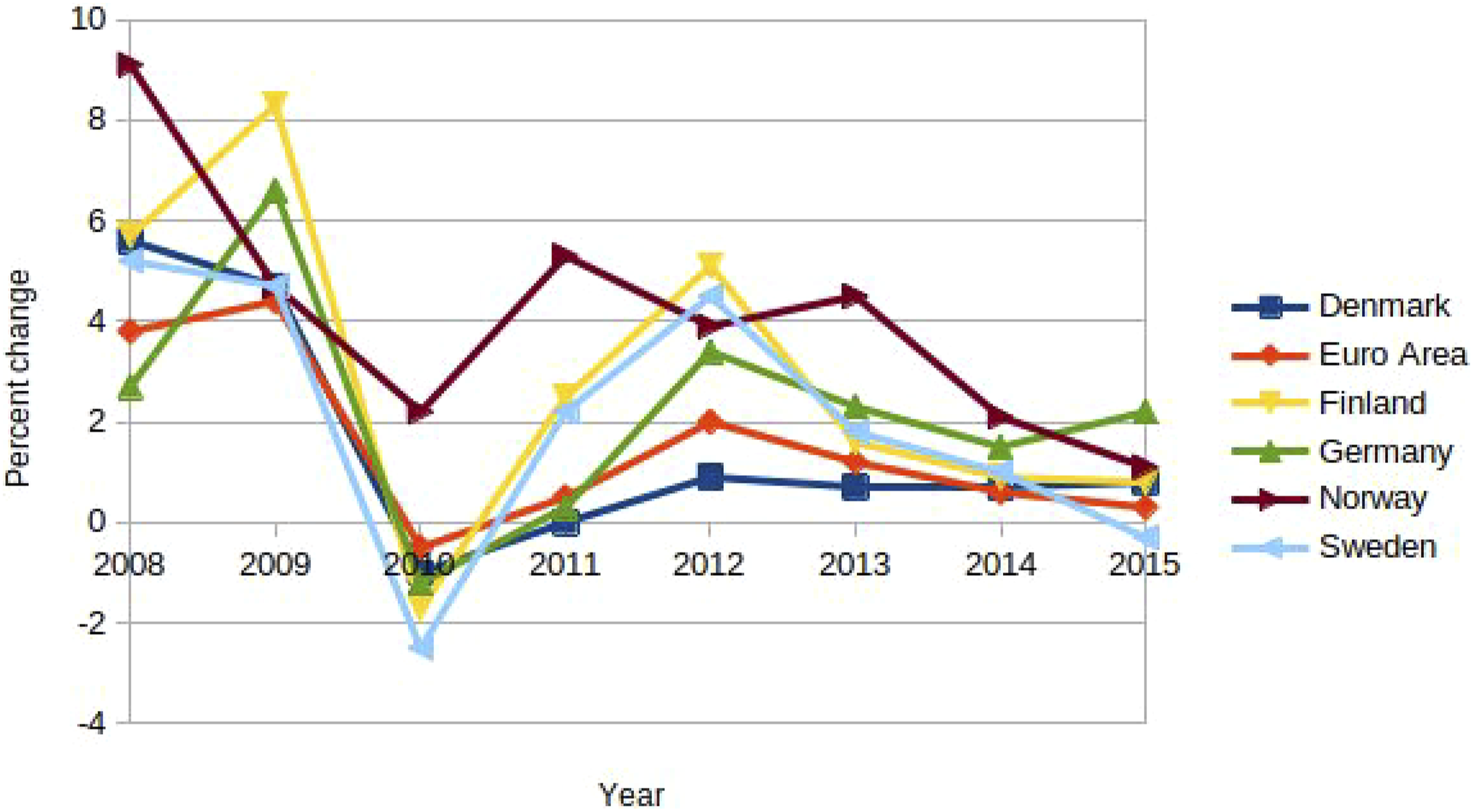
The second idea constitutive of the EO was the ‘sustainability gap’ (kestävyysvaje in Finnish). The idea was introduced by the Ministry of Finance around 2007, rapidly became a key heuristic for all public policies and was regarded widely in the early 2010s as an institutional fact by Finnish policymakers, civil servants and experts alike (Eskelinen and Sorsa, 2013). It suggested that Finland must close a looming fiscal sustainability gap to avoid future generational conflicts and prescribed austerity measures, including public sector wage moderation, while excluding public investment-led competitiveness strategies to solve the problem. The Sipilä government programme sought to radically reduce the sustainability gap during its term (VNK, 2015a). Next, we show how the EO’s use in negotiations explains the puzzles described in the previous section.
The government’s prioritization of central bargaining. The EO’s programmatic status in the Sipilä government coalition explains why the government advocated central bargaining, used coercive means and eventually dropped the demand for local bargaining reform. The ideas framing the establishment diagnosis of Finland’s problems were shared by all parties of the centre-right government coalition. The crisis consciousness embedded in the EO and the promise to ‘fix Finland’ over one government term provided a rationale for solving the cost competitiveness crisis via immediate ULC moderation first and longer-term bargaining reforms only second. When the leading government party CP (2015) vouched for a social pact featuring ‘exceptionally strong collaboration’ between the government and social partners, it used the competitiveness crisis as a frame for legitimizing centralized agreements against the more sceptical views amongst employers and NCP politicians. The NCP proposals to reform ‘corporatism-crippled’ Finnish politics would have an impact on a much longer timescale than one 4-year government term and risked a conflict in the labour markets that might compromise the ‘fix’. The government’s commitment to rapidly decrease net public expenditure further prioritized immediate large-scale and coercive actions over incremental change and the implementation of tax and expenditure cuts irrespective of the negotiation outcome.
Both ULC reductions and local bargaining were included in the government programme as a compromise between CP and the employers and NCP. This helped to tie the social partners to the process, but the prioritization of agendas was clear to the government. The employers supported the government agenda vocally until policy trade-offs endangering bargaining reforms and a centralized pact were adopted (HS, 2015l; 2015m). Having subscribed to the EO and after reaching two prior centralized agreements, employee organizations had little room to manoeuvre in public without being perceived as part of the problem. The negotiated ULC reduction meant income concessions for their members; however, the combination of a ULC reduction through legal and budgetary means and bargaining reforms reducing their capacity to influence future wage regulation was an even less desirable alternative. Therefore, the employees, and especially SAK, saw wage policy concessions as the realistic, lesser-evil option (HS, 2016n). In this sense, the EO was used to combine and compromise between wage regulation interests and wage policy interests.
Concessions to employees and employers’ return to the negotiation process. To unpack the puzzles concerning departures from and re-entries into negotiations, we turn to Swinkels’ (2020) discussion of ideas as heuristics in ideation. During the main negotiation phase, the EO served as a repeated heuristic tool for increasing crisis consciousness. The heuristic revolved around the diagnosis suggesting that lowering ULC would improve Finland’s economic performance substantially. PM Sipilä fortified this frame in public appearances, an exceptional speech on national television and public criticisms of the social partners’ lack of crisis consciousness (HS, 2015n; 2015o). This frame meant that disruptions to the negotiations risked both a major decline in legitimacy for deepening the perceived crisis and blame for unilateral legal measures and/or extra net expenditure cuts by the government in case the pact failed. As every party was aware that the others also knew this, the heuristic became ‘common knowledge’ (Culpepper, 2008) that committed all parties to the process. Accordingly, apart from the famously antagonistic AKT, no key party was ready to exit the negotiation process permanently before the provisional agreement.
The employee organizations utilized this ‘common knowledge’ effectively as a discursive weapon. They criticized the government for hindering, or even preventing, actual bargaining over potential solutions by setting precise and predetermined outcomes to achieve (HS, 2015p; 2015r). Here, the EO was used to demand ‘genuine’ negotiations and portray the government publicly as more a part of the problem than its solution. SAK’s proposal to pursue local bargaining reforms through the existing frameworks seized opportunities provided by shifts in media perceptions. Considering the policy priorities embedded in the EO, bringing the unions back to the ‘solution side’ of public perception by excluding the local bargaining agenda from negotiations was a very small concession from the government.
However, this concession also created a trade-off between the two agendas that had kept employers committed to the process. After SAK’s proposal was taken as the baseline for further negotiations, attitudes to the cost competitiveness initiatives within EK began to diverge. Although some domestically oriented employers could accept postponing local bargaining reforms if distributional concessions and tax decreases were adequate, the export-oriented employers opposed the centralized agreement and inclusion of wages in the pact (despite welcoming SAK’s industry norm proposal). An internal power struggle ensued after EK had withdrawn from CoPa negotiations to protest AKT’s withdrawal. The Finnish Forest Industries (FFI), the forestry sector federation, which had constantly demanded AKT’s involvement for supply chain stability reasons, voted against the provisional pact during the decisive EK board meeting (HS, 2016l). The EO and a large-scale perceived need for urgent measures enabled domestically oriented employers to win the power struggle over involvement in the CoPa, which further divided EK internally (HS, 2016m).
Federations and unions’ signing of the provisional agreement. Although many employers saw little relevance in the pact and would have preferred legal local bargaining reforms, growing numbers of employers and employer federations became willing to accept the provisional CoPa agreement owing to the substantial distributional gains from ULC reduction measures and potential fiscal compensations (HS, 2016l). The issue of labour market stability had become less relevant for the employer and union federations, as EK’s rule change would ensure that future bargaining would devolve from peak to sectoral or lower levels regardless of the outcomes of the pact. Even most export-sector employers could accept a one-off centralized agreement in these circumstances and enjoy being perceived as being on the ‘solution side’ of the pact within the EO frame.
Most unions perceived that high coverage would decrease the likelihood of further government interventions in the labour market. However, many SAK members, including the important metal and service unions, were especially reluctant to accept the pact, which would clearly worsen their members’ working conditions. The EO was mobilized in public by key federations and the government to persuade the metalworkers (HS, 2016o). As perceived internal divisions would risk the legitimacy of the peak organizations, they communicated actively to persuade unions to join the pact. PM Sipilä established dialogues with the reluctant unions and occasionally attended decisive union meetings to persuade them to overcome the crises.
Conclusions and discussion
Our case study of the CoPa policy process suggests that the set of ideas constituting the EO are critical for explaining the process and its outcome. The contribution of our analysis to the wider ideational scholarship in IR is threefold. First, we have shown that a meso-level analysis of ideas in policy processes can offer explanations for wage policy and regulation shifts that temporarily deviate from macro-level trends and institutional change processes. Specifically, we have shown that the EO prescribed and legitimized the use of exhausting institutional resources in wage regulation and enabled temporary consensus regarding wage policy between various economic and political interests. In this respect, our analysis may be fruitfully contrasted with Culpepper’s (2008) study on the role of ideas in bargaining reforms in Ireland and Italy. Culpepper shows that processes of ideation (‘common knowledge events’ in his vocabulary) about policy priorities between the social partners initiated lasting changes in the bargaining institutions. In the Irish case, the employers came to accept centralized social pacts, and in the Italian case, they accepted the codification of local bargaining in labour law. Our analysis suggests that ideation may enable policymakers to extend the use of institutional resources that are becoming exhausted. Further research is needed to confirm whether the same observation applies to the reactivation of older, fully abandoned institutional resources.
Despite the EO’s effective use as a frame for crafting a temporary agreement, it failed to foster a longer-term commitment to institutional resources and create elastic perceptions of shared interests. Anecdotal evidence suggests that the experiences of the CoPa process may have created a perception that accommodating divergent interests fruitfully in collective bargaining is laborious and perhaps even impossible. For example, the CoPa process increased the FFI’s doubts that the interests of EK members were permanently divided and EK membership was a source of instability, ultimately leading to its decision to resign from EK in June 2016 (Aitonurmi, 2019). In 2014–2016, SAK and STTK attempted to merge into a new ‘central union’ representing 1.7 million employees, but the initiative was abandoned during the CoPa process due to differing interests about ‘political’ involvement, organizational priorities and mistrust regarding the CoPa process (Suomen Kuvalehti, 2017).
Second, we have shown that ideas can foster commitments to highly uncertain wage regulation processes with divergent interests. In our case study, this occurred through the coupling of different types of interests under perceptions of an ongoing crisis. The EO was first used as a sense-giving frame for creating a shared perception of an urgent need for national-scale wage regulation measures but also for prescribing wage policy measures that served few interests among the negotiating parties. Later, the same framing was used as a discursive weapon for making compromises between wage policy and regulation interests, and thus affirming the commitment to the process even when its potential outcomes were perceived as unfavourable.
Third, previous comparative scholarship has emphasized that although Northern European IR regimes have faced similar institutional and economic pressures in the 2000s, there is limited evidence for convergence towards a single model (e.g. cf. Baccaro and Howell, 2017; Dølvik et al., 2018; Dølvik and Marginson, 2018; ). Our study contributes to this literature by showing that, like institutions, national policy ideas can drive diverging IR change patterns within the Nordic context. As exemplified by the CoPa process, the policymakers’ adoption of the EO rendered resolving a perceived competitiveness crisis a ‘necessity’ and helps to explain Finland’s unique readoption of centralized bargaining in 2010s.
The role of policy ideas can be further elucidated with reference to Finland’s IR developments after centralized bargaining. Prima facie, one might expect Finland to converge towards the ideal-typical ‘Nordic model’, which would require strengthening the institutions that coordinate wage-setting in decentralized bargaining. However, there has been no widespread ideational consensus that would portray this task as ‘necessary’ amongst policymakers and IR actors. Consequently, institutionalizing a Swedish-inspired ‘Finnish model’ of export industry-led wage setting failed shortly after CoPa process. Second, having left the EK, in 2020 FFI unilaterally jettisoned industry-level bargaining and devolved wage-setting to the company level. The Technology Industries of Finland also probed this option in 2021. Third, the Ministry of Finance’s tripartite Information Committee on Cost and Income Developments, which had a role in creating shared economic outlooks and aiding information-based IR coordination, was discontinued in 2020 per EK’s initiative. Together these developments make the formation and application of an export-norm more challenging in the coordination of wage policy. Convergence remains a longer-term prospect, but in the medium term it would likely require that the social partners and policymakers can reach consensus about the economic necessity of enhancing, rather than weakening, salient IR coordination measures.
Footnotes
Declaration of conflicting interests
The author(s) declared no potential conflicts of interest with respect to the research, authorship, and/or publication of this article.
Funding
The author(s) disclosed receipt of the following financial support for the research, authorship, and/or publication of this article: This work was supported by the Suomen Kulttuurirahasto and Emil Aaltosen Säätiö (190279 P).
