




Abstract
This article contributes to debates about trade unions and conflict by studying how individuals’ perceptions of conflicts between management and workers relate to trade union membership, country-level trade union density and institutionalization (collective bargaining coverage, centralization and policy concertation). Hierarchical multi-level models are fitted to data from the International Social Survey Programme from 2009. The results show that union members tend to be more likely than non-members to perceive management–worker conflicts and that this appears not to vary substantially between countries. However, regardless of union membership, individuals in countries with higher trade union density and with policy concertation tend to be significantly less likely to perceive conflicts. These findings highlight the risk of atomic fallacies in research limited to the individual-level effects of union membership. Contrary to an argument often raised by pluralists, neither bargaining coverage nor centralization has significant effects. Overall, the results question depictions of trade unions as divisive organizations.
Introduction
A long-standing debate in politics, economics and sociology concerns the influence of trade unions on employment relations; do unions fundamentally tend to foster or reduce management–worker conflicts? This article illuminates an aspect of this debate by studying individuals’ perceptions of conflicts between management and workers, and how these relate to union membership, union density and the institutionalization of employment relations. Two main competing hypotheses are put to empirical testing in a multi-level analysis (MLA) of data from the 2009 International Social Survey Programme (ISSP, 2017) covering 31 countries.
According to the first hypothesis, unions increase conflict perceptions. The second hypothesis suggests the opposite pattern, emphasizing the socially integrating role of unions and the institutionalization of conflicts. A third hypothesis suggests that unions neither foster nor moderate conflict perceptions.
The two main hypotheses are each structured into three sub-hypotheses, utilizing the possibilities of the multi-level framework, reflecting the notion that perceptions are influenced by both individual- and contextual-level factors. First of all, the article analyses whether union members tend to be more or less likely than non-members to perceive conflicts between management and workers, controlling for the possibility that this association varies between occupational groups. 1
Second, the article analyses whether the association between union membership and conflict perceptions varies between national IR-contexts. Contextual variation is measured via union density, the degree of institutionalization of management–worker relations – reflected in collective bargaining coverage, bargaining centralization and policy concertation – and income inequality (Bengtsson, 2014; Traxler et al., 2001; Visser, 2013). Finally, the article also explores whether the contextual-level variables have effects that apply to non-members as well.
The results of the analyses highlight the contradictory nature of trade unionism (Hyman, 1989): whereas union members tend to be slightly more likely than non-members to perceive conflicts between management and workers, individuals – regardless of being members or not – in countries with higher union density tend to be significantly less likely to perceive such conflicts. The fact that union density tends to be associated with lower levels of perceived conflicts is speculated to relate to variation in job autonomy and wider working conditions. The results go beyond these initial findings, which are in line with a large part of the previous literature (e.g. Korpi and Shalev, 1979; Lipset, 1981; Przeworski and Wallerstein, 1982; Streeck, 2016: 58–60), by showing that two of the institutionalization measures – collective bargaining coverage and centralization – are not positively or negatively associated with conflict perceptions. The heavy emphasis usually laid by pluralists on collective bargaining as the main IR-mechanism of conflict containment thus finds no support in the data. Equally, the unitarist argument that collective bargaining (as an institutionalization of competing interests) increases conflict is not supported either. Policy concertation, however, is strongly associated with conflict perceptions: individuals in countries where unions are routinely involved in the formulation of social and economic policy are significantly less likely to perceive management–worker conflicts. Interestingly, the findings are not attributable to a mediating effect of distributive justice, as income inequality is found not to be associated with conflict perceptions. Instead, the fact that conflicts are less widely perceived in countries where unions are regularly involved in policy decisions may relate more to decommodification and aspects of procedural justice afforded by mechanisms of voice and representation at the national level (Freeman and Medoff, 1984; Kaine, 2014).
The findings can be read as support for either a pluralist (Clegg, 1975) or a radical perspective (Hyman, 1989) on unions’ influence on employment relations, while strongly questioning unitarist notions of trade unions as divisive and subversive institutions. Indeed, the results suggest the further hypothesis that continual deunionization and declining political influence of unions may lead to the emergence of more overt management–worker conflicts.
The following section presents previous literature in relation to each hypothesis. After that follows a discussion on data and methods. Next, the results of the analyses are presented, before being discussed in a concluding section.
Trade unions fostering conflicts
The claim that unions increase conflicts is found among both union critics (Hanson and Mather, 1988) and within a more radical framework of class formation (e.g. Wright, 1985).
Critics hold that trade unions instigate conflict in an otherwise harmonious employment relationship. The implications of these arguments are such that without organized representatives, such as unions, conflicts should be less widely perceived. Pakulski and Waters (1996), for example, argue that there are ‘[ . . . ] no visible class divisions [ . . . ]’ in the USA and that this in large is attributable to ‘[ . . . ] the absence of organizational articulation and the corporatist reinforcement of class’ (p. 100). This position is also found among unitarists and conservative political elements, portraying unions as ‘[ . . . ] dangerous, disruptive and subversive’ (Hyman, 1989: 225).
Others hold that unions do represent the true collective interests of their members and that these often are in conflict with those of their employers. One of the functions attributed to unions is thus as ‘Schools of War’ (Hyman, 2001: 17), articulating class issues (Svallfors, 2006) and raising individuals’ ‘awareness’ of conflicts between management and workers (D’Art and Turner, 2002; Wright, 1985). This view is reflected in mobilization theory, in which the role of union leadership is emphasized, and conflicts of interest between workers and management constitute the core of union activity (Kelly, 1997: 406).
Some previous empirical findings point in this general direction. For example, Wright (1985) finds that union members tend to score higher than non-members on what he refers to as ‘class consciousness’. Furthermore, in accordance with frustration-aggression theory, in which unionization is seen as an outcome of ‘[ . . . ] individuals’ frustration, dissatisfaction or alienation in their work situation [ . . . ]’, dissatisfaction with the way things are handled at work tends partly to determine union membership (Schnabel and Wagner, 2007: 10). It is reasonable to assume that such attitudes are related to perceptions of conflicts between management and workers. Union members also tend have lower job satisfaction than non-members (e.g. Van Der Meer, 2018), famously interpreted by Freeman and Medoff (1984) as a form of ‘[ . . . ] “voiced” dissatisfaction which results from critical attitudes towards the workplace and a willingness to complain about problems’ (p. 139), although it should be emphasized that the same study stresses that a central function of unions is to voice such discontent, channelling it in institutionalized forms, thus potentially in turn reducing conflict perceptions (a mechanism thus more in line with H2, see below). Nevertheless, the critical attitudes of union members fit with categorizations of unions as participating in the politicization of the work force (Borjas, 1979). The often reported negative association between union membership and job satisfaction (as well as job characteristics such as autonomy) is sometimes seen as a reflection of the fact that employees with worse working conditions are more inclined to unionize in order to improve these conditions (Gallie et al., 2004; Laroche, 2016; Oesch, 2006). Such a selection effect in turn implies the likelihood of an overrepresentation of dissatisfied employees with worse working conditions among union members, and it is possible that the same individuals are more likely to perceive conflicts. Given the lack of data on working conditions in the ISSP-data, a positive membership-effect may partly be attributable to such a mechanism.
Next, pertaining to the contextual level, Wright (1985) shows that the difference in ‘class consciousness’ is smaller between Swedish and American non-unionized workers than between unionized workers. He argues that ‘[t]his suggests that it is not simply the fact of unionization that acts as a mediating process in consciousness-formation, but the strength and social weight of the labour movement’ (p. 274). According to Wright (1985: 278), these results are at odds with theories stressing the integrative role of strong labour movements. Furthermore, while less substantial than that between union members, the same study also finds a difference between non-members in USA and Sweden, implying that the argument may also apply to non-members. This raises the question of whether Wright’s logic is valid beyond the Swedish case. 2 As a means of comparison, union density is often used as an indicator of the strength and influence of labour movements (e.g. Bengtsson, 2014; Korpi and Shalev, 1979; Traxler et al., 2001) and therefore arguably constitutes a fitting measure with which to test the broader validity of the above arguments. Higher union density should thus imply that conflicts are more widely perceived among union members (i.e. density positively moderating the union-effect) and (while less so) among non-members as well. The following hypotheses are thus proposed:
H1a: There is a positive association between union membership and perceived management–worker conflicts.
H1b: The association between union membership and perceived management–worker conflicts is positively moderated by trade union density.
H1c: Regardless of union membership, trade union density is positively associated with perceived management–worker conflicts.
The institutionalization of conflict
On the basis of the preceding section, there are reasons to expect trade unions to reinforce division and conflict. However, a large field of literature suggests the opposite pattern (e.g. Clegg, 1975; Lipset, 1981; Przeworski and Wallerstein, 1982; Streeck, 2016: 58).
This argument is found in quite diverse theoretical traditions (see, for example, Therborn, 1992). With intellectual roots in Durkheim and Parsonian functionalism, pluralists hold that strong regulatory IR institutions, particularly unions, reduce conflicts. As summarized by Clegg (1975): ‘[ . . . ] men associate together to further their common interests and desires; their associations exert pressure on each other and on the government; the concessions which follow help to bind society together [ . . . ]’ (p. 310).
Returning to Freeman and Medoff (1984), although individual union members may be more critical, the institutionalization of collective voice-mechanisms provides a means of articulating workplace grievances and thus potentially ameliorating perceptions of conflict. Analogous outcomes of IR institutions are recognized by radical institutionalists and others, often rooted in Marxism, who argue that unions represent a form of resistance to power-imbalances inherent in the employment relationship but are restricted to ameliorating its surface-level manifestations (such as issues of distribution or even control) and therefore tend to inhibit the growth of more radical forms of oppositional consciousness questioning the underlying social relations of capitalism (Hyman, 1989: 230; Tronti, 2019).
The emphasis on institutionalization motivates the inclusion of wider factors characterizing the IR-system. Two commonly applied measures of conflict institutionalization are collective bargaining coverage and centralization, which tend to correlate strongly with union density (Baccaro and Howell, 2017: 44; see also Elvander, 2002; Wright, 2015: 185). Particularly pluralists often emphasize the conflict-reducing effects of collective bargaining, stressing its similarities with ‘[ . . . ] the political process of compromise and concession’ (Clegg, 1975: 311). In evaluating the effects of collective bargaining, its degree of coverage arguably qualifies as a key measure; if the suggested pressure mediation has an effect on conflict perceptions, the share of the workforce covered by collective bargaining agreements should tend to be negatively associated with perceived conflicts. The regulatory effects of bargaining coverage, however, are also argued to vary substantially between countries. According to Vernon (2006), ‘[t]here seems to be a general tendency for such agreements to be of more substance the higher is union density’, suggesting that bargaining coverage particularly should decrease conflict perceptions in countries with higher union density (p. 200).
Aside from its coverage, the extent to which bargaining takes place at a lower level (e.g. firm) or is highly centralized is also likely to have an effect on individuals’ perceptions of conflicts. Centralized bargaining implies that distribution conflicts are lifted out of the immediate context of the workplace and thus potentially becoming more abstract for the individual employee; more centralized bargaining should therefore imply that management–worker conflicts are less widely perceived (e.g. Lane, 1989: 209–211; Tüselmann and Heise, 2000).
Finally, a third aspect of institutionalization concerns union participation in the formulation of social and economic policy, that is, the degree of corporatism/policy concertation (Baccaro and Howell, 2017: 39; Berger, 2002: 351; Compston, 2002; Korpi, 1983; Korpi and Shalev, 1979; Traxler et al., 2001: 10). Policy concertation potentially ameliorates conflict perceptions by refocusing industrial conflict towards the political sphere. Furthermore, concertation provides procedural justice through mechanisms of employee voice at the national level (Kaine, 2014). Union participation in policy formulation may also result in higher degrees of decommodification (Esping-Andersen, 1990) and employee-friendly labour legislation. There are also suggested distributive effects of concertation in terms of the reduction of income inequality, which echo the influence of density and other forms of institutionalization, motivating exploration of the potentially mediating role of income inequality (Edlund and Lindh, 2015; Hertel and Schöneck, 2019; Pontusson, 2013; Tridico, 2018).
It follows from the emphasis on institutional variation that the implications of union membership should vary between countries; union members should be less likely to perceive management–worker conflicts in countries with higher degrees of union density and institutionalization. The same processes may however also apply to non-members.
There are empirical findings in support of some of the above arguments. Edlund and Lindh (2015) show that perceptions of broader class conflicts tend to be less prominent in countries with more encompassing welfare systems, which also have less income inequality, and claim that ‘[ . . . ] the size and redistributive capacity of the welfare state vary positively with the strength of working-class organization’ (Edlund and Lindh, 2015: 313). Given this supposed covariation, union density should tend to reduce conflict perceptions, partly as a result of lower income inequality.
A further aspect pointing towards a negative association between density and conflict perceptions pertains to working conditions, such as autonomy and job security, which tend to be more favourable in high-density countries (Esser and Olsen, 2012). The mechanism is an inversion of the selection issue raised in relation to H1, reflecting the collective nature of unionism; whereas individuals with worse working conditions may be more likely to select into unions, their collective strength, manifested in union density, may lead to the amelioration of some of the same conditions and hence reduce conflict perceptions. This argument builds on the assumption that working conditions are associated with conflict perceptions, which (due to lack of relevant data) is not assessed empirically.
To conclude, the preceding arguments suggest that unions decrease conflict perceptions, partly by contributing to the institutionalization of conflicts and lower levels of income inequality. Thus,
H2a: There is a negative association between union membership and perceived management–worker conflicts.
H2b: The association between union membership and perceived manager–worker conflicts is negatively moderated by trade union density.
H2c: Regardless of union membership, trade union density is negatively associated with perceived management–worker conflicts.
The non-significance of unions
Finally, this section briefly theorizes a potential null-association. Arguments in this direction can be found among those who hold that unions are not conflict-based organizations and those arguing that institutions play a minor role in shaping perceptions.
The first argument points to an ‘[ . . . ] increased instrumentality and individualism of potential members’ (Waddington, 2015: 217) to which unions are claimed to respond by focusing more on providing financial services rather than organizing members on the basis of conflicts with employers. Another argument holds that individuals’ perceptions reflect ‘[ . . . ] the objective, albeit remote and impersonal, reality of social groups’ opposed interests and the conflicts they generate [ . . . ]’ (Kelley and Evans, 1995: 160). Individuals’ perceptions here are thought to correspond to their rational understanding of their own interests and conflicts tied to these; perceptions are therefore not expected to be significantly altered in a top-down fashion by unions. Previous research lends some support to such claims. For example, Palm (2017) finds that class identity and ideology to a decreasing extent predicts union membership in Sweden.
Based on these arguments, H3 suggests,
H3: Neither trade union membership nor trade union density is associated with perceived management–worker conflicts.
Data and methods
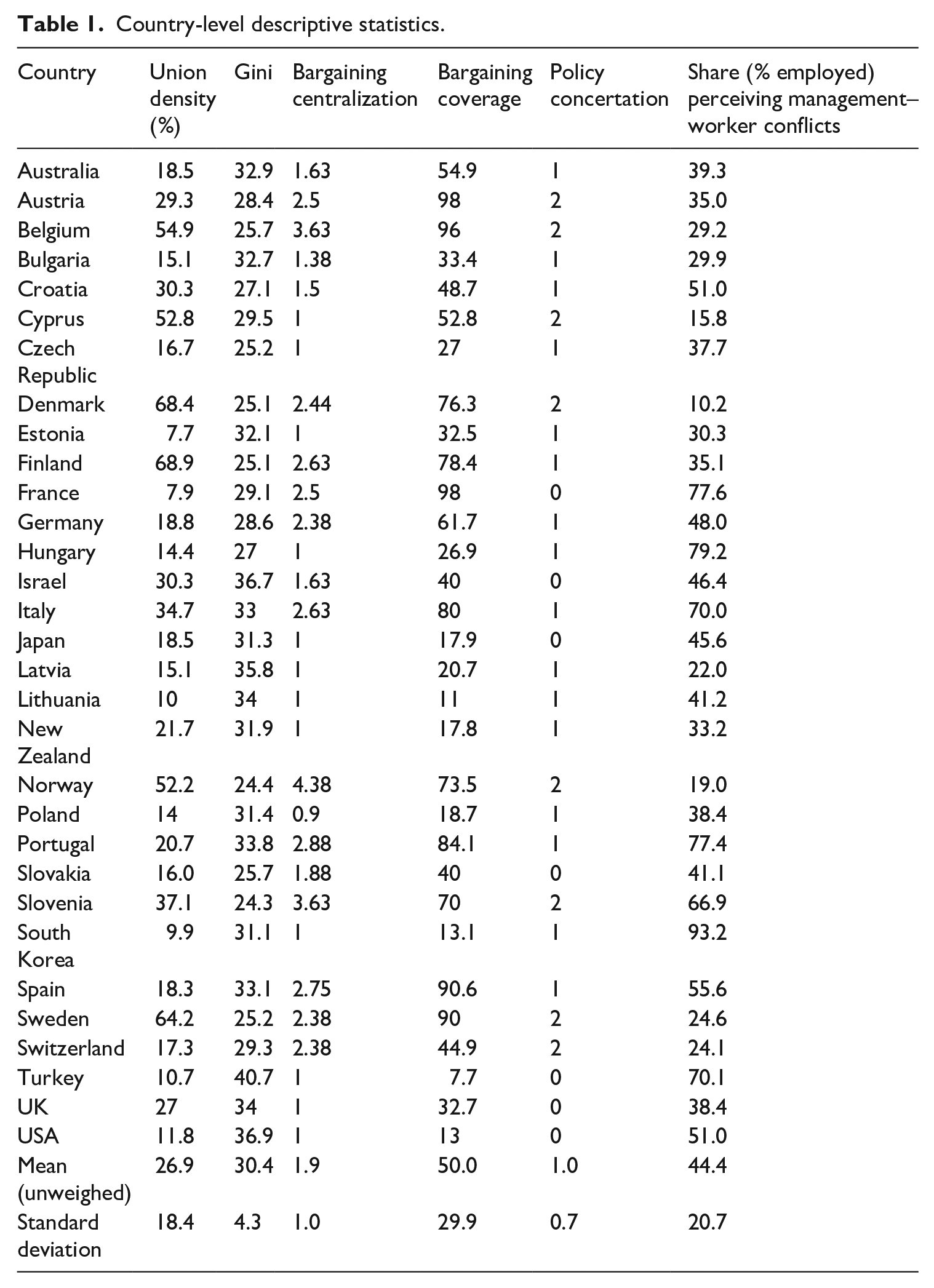
Data come from the ISSP 2009 module ‘Social inequality’, previously used in similar studies (e.g. Edlund and Lindh, 2015). The sample is limited to those currently employed. After listwise deletion, the sample includes 16,822 individuals nested in 31 countries (listed in Table 1).
Country-level descriptive statistics.
MLA
In order to explore the hypotheses, distinguishing between individual- and contextual-level mechanisms, the method employed is random effects/ MLA (Hox et al., 2017). MLA accounts for the clustered data structure (individuals nested in countries) and hence the possibility that observations are not independent by allowing for a random intercept, in short accounting for the fact that the probability of perceiving management–worker conflicts may systematically vary between countries. The degree to which this is the case is expressed as the intraclass correlation (ICC), derived on the basis of an empty model showing variance at the individual and country levels. The ICC refers to ‘[ . . . ] the proportion of the total variance explained by the grouping structure in the population’ (Hox et al., 2017: 13) which in the present case is the country level. Furthermore, MLA makes it possible to assess whether the effects of individual-level variables differ between countries by allowing a random slope, and further to explain such variation via cross-level interactions, in the present case the degree to which the association between union membership and perceived management–worker conflicts is moderated by union density, as suggested by H1b and H2b.
The data (binary dependent variable) are fitted to Linear Probability Models. Tests (not shown) reveal that in terms of sign and significance, the results of the Linear Probability Models are the same as those generated by Logistic Regression Models.
Analyses are run using R (R Core Team, 2020) and the lme4 package (Bates et al., 2015).
Dependent variable
The outcome variable with which the hypotheses are explored is based on the following question in the ISSP questionnaire: ‘In all countries, there are differences or even conflicts between different social groups. In your opinion, in [country] how much conflict is there between management and workers?’. Respondents choose one of the following alternatives: (1) ‘Very strong conflicts’, (2) ‘Strong conflicts’, (3) ‘Not very strong conflicts’, (4) ‘There are no conflicts’. The variable is dichotomized, distinguishing between those who perceive very strong or strong conflicts (1 + 2) and those who perceive not very strong or no conflicts (3 + 4). Tests are run in which only those perceiving very strong conflicts are coded as 1, largely producing the same results.
Furthermore, following previous research (Edlund and Lindh, 2015), another set of models (not shown) use a composite measure of broader social conflicts 3 as outcome variable, producing similar but not identical results. Most importantly, in contrast to the models shown below, individual union membership has no effect on this measure. This suggests that social conflict is a multi-dimensional concept in which union membership tends to relate more strongly to work-related conflicts than broader ones. Consequently, in order to assess whether the results apply to individuals with similar outlooks on general social conflicts, a further set of tests (not shown) with worker–management conflict as outcome variable, control for a broader measure. 4 In terms of sign and significance, the outcomes of these models are the same as the results shown below. In other words, the results are not simply reflections of union members’ perceptions of social conflicts in general.
Individual-level independent variables
In order to explore the hypotheses, the main individual-level independent variable is union membership. Unfortunately, there are no data on union type, meaning that the study for example does not distinguish between the role of blue-collar unions as opposed to that of white-collar unions, or socialist compared to catholic unions. This relates to a potential risk that a moderating effect of density on union membership is affected by the composition of union members, most likely that larger union movements (particularly the Ghent countries) organize larger shares of white-collar workers. This has potential consequences given the fact that white-collar workers tend to be less likely to perceive conflicts (Edlund and Lindh, 2015). However, by controlling for occupational status and a professional/manager-dummy, the models seek to isolate the compositional effects. To account for the lack of more detailed data on union type, initial tests are performed for interactions between occupational status and union membership as well as between the professional/manager-dummy and union membership. These give an indication on whether the implications of union membership differ between professionals/managers and workers.
The professional/manager-dummy is based on a highly collapsed version of the Oesch (2006) class schema. Models control for occupational status using The International Socio-Economic Index of Occupational Status (ISEI), which ranks occupations based on occupation, education and income on a continuous scale, specifically constructed for cross-country comparisons (Ganzeboom et al., 1992). The ISEI scale also reflects the skill-levels embedded in the ISCO88 classification on which the current version derives occupational groups (Ganzeboom and Treiman, 1996: 213). For these reasons, the ISEI-variable should pick up some of the variation in working conditions left unobserved due to lack of more detailed variables. However, it should be acknowledged that working conditions also do vary across countries within jobs (Dobbin and Boychuk, 1999).
Furthermore, the data contain a variable on supervisory function, which however is not available for Spain, and given that listwise deletion is employed, the number of individual-level variables is kept to a minimum in order to keep as many higher-level units as possible. Nevertheless, including the supervisor-variable in the models (not shown), with the added consequence of testing for the omission of Spain, the union membership of which is often regarded as particularly radical (e.g. Lipset, 1981: 73), does not alter the reported findings.
The models also control for age, gender and sector (public or private).
Contextual-level independent variables
In order to explore the contextual hypotheses, relating to the ‘[ . . . ] strength and social weight of the labour movement’ (Wright, 1985: 278), the main country-level independent variable is net trade union density (Visser, 2019), which compared to gross density is often argued to be a more adequate measure of union power (Traxler et al., 2001: 80). All contextual-level data refer to 2009 or closest year with available data, preferably 2008.
Three other variables from the Visser (2019) database are included to explore the effects of institutionalization introduced in relation to H2: collective bargaining coverage, bargaining centralization and policy concertation. Bargaining coverage is the share of employees covered by valid collective bargaining agreements as a proportion of all wage and salary earners in employment with right to bargaining, adjusted for the possibility that some sectors or occupations are excluded from the right to bargain. The centralization variable (Level-M in the Visser database) is an index seeking to capture the actual level of wage bargaining in a multi-level bargaining system based on the predominant level at which bargaining takes place (ranging from central or cross-industry (5) to local or company level (1)), adjusted for a number of factors such as opening clauses and derogation possibilities. The policy concertation variable indicates whether there is routine involvement of unions and employers in government decisions on social and economic policy and has three values: 2 = full concertation, regular and frequent involvement; 1 = partial concertation, irregular and infrequent involvement; 0 = no concertation, involvement is rare or absent.
H2 also points to the role of distributive justice. A Gini-measure (Solt, 2019) is included to measure income inequality, referring to household disposable income (post-tax, post-transfer), thus accounting for the effects of social and economic policy argued to follow from institutionalization. 5
Finally, models initially also control for GDP/capita (World Bank, 2019). However, GDP does not have a significant effect and is thus not included in the models shown below.
Descriptive statistics
Table 1 shows descriptive statistics for the contextual-level variables and the dependent variable aggregated by country. Variation between countries is generally high. In terms of the aggregated share who perceive conflicts between management and workers, there is a substantial range, Denmark being the country with the lowest share (10 percent), compared to South Korea, in which 93 percent of the employed perceive strong or very strong conflicts between management and workers. 6 The Ghent countries (Denmark, Sweden, Belgium and Finland) are the four countries with the highest density levels, and all have comparatively low levels of perceived conflicts. The Ghent system refers to union administration of unemployment insurance, which may imply that the reasons for and hence implications of union membership in terms of conflict perceptions are quite different. Robustness checks are therefore performed in which the Ghent countries are omitted from the data, producing largely similar results. In the case of minor differences, these are reported in relation to the findings below.
Results
Table 2 presents the results of the MLA. The null-model ICC is 0.18, indicating that close to 20 percent of the variation is attributable to contextual-level factors (or compositional effects). This is a fairly large amount, motivating the contextual focus. Correlation analyses (not shown) reveal that the contextual variables tend to be highly correlated (Pearson’s r ranging between 0.5 and 0.74). This, in combination with the relatively low number of higher-level units, supports a modelling strategy in which they are assessed in separate models. Furthermore, a full model with the significant contextual variables does not improve fit when compared to models assessing them individually and is thus not shown.
Perceptions of management–worker conflicts: Random intercept linear probability models.
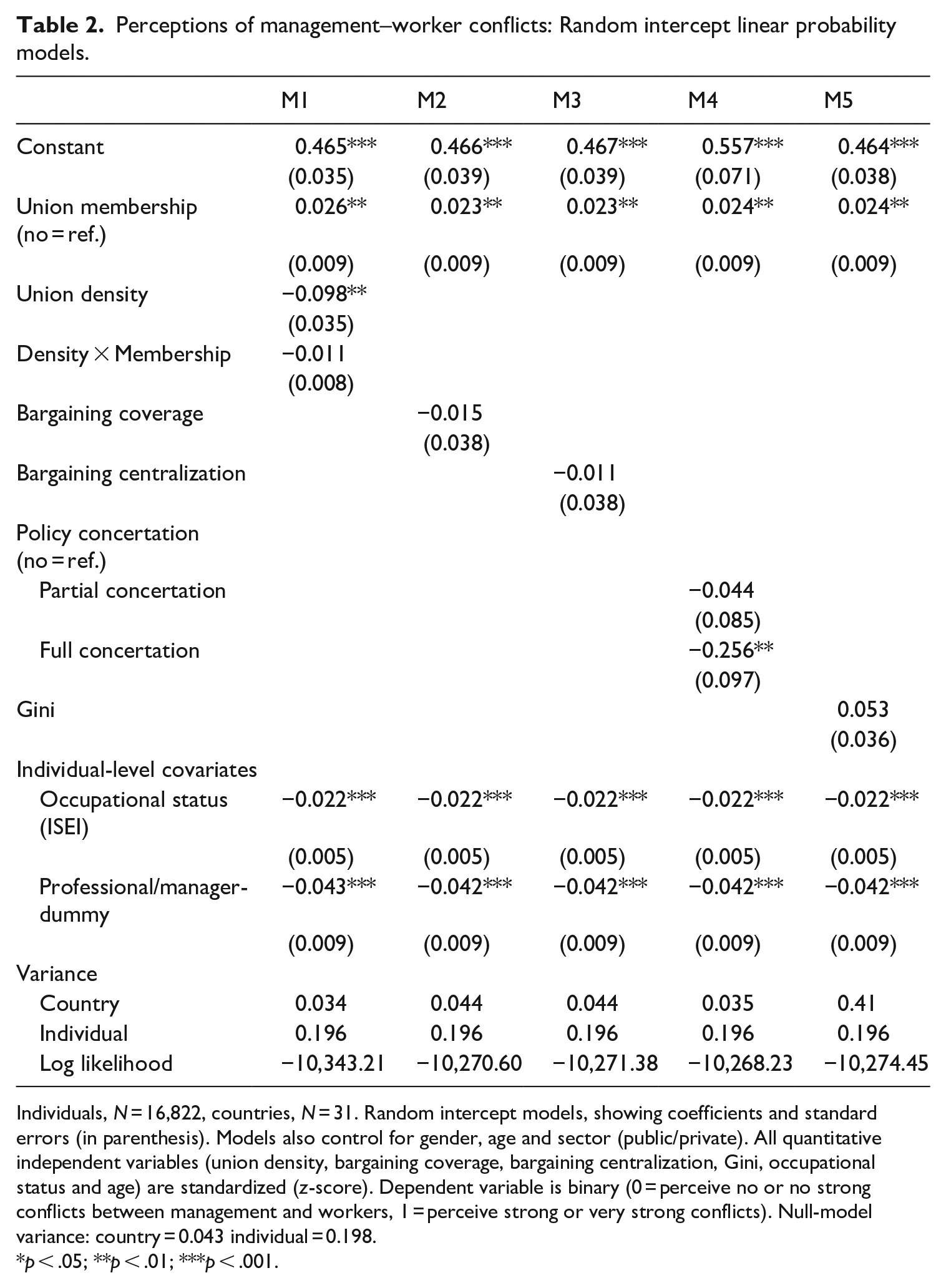
Individuals, N = 16,822, countries, N = 31. Random intercept models, showing coefficients and standard errors (in parenthesis). Models also control for gender, age and sector (public/private). All quantitative independent variables (union density, bargaining coverage, bargaining centralization, Gini, occupational status and age) are standardized (z-score). Dependent variable is binary (0 = perceive no or no strong conflicts between management and workers, 1 = perceive strong or very strong conflicts). Null-model variance: country = 0.043 individual = 0.198.
p < .05; **p < .01; ***p < .001.
As seen in M1, union members have a higher probability than non-members to perceive manager–worker conflicts. This association holds while also controlling for occupational status and the professional/manager-dummy, which are both positively associated with conflict perceptions. Furthermore, no interaction effects are found between union membership and occupational status or the professional/manager-dummy (not shown). The link between union membership and conflict perceptions is thus consistent across different positions on the labour market; independent of occupational status, union members are more likely to perceive management–worker conflicts. It should be stressed that the membership-effect is relatively weak, nevertheless supporting H1a.
Tests including a random slope for union membership (not shown) are performed in order to assess whether the effect of union membership varies between countries. However, the random slope does not improve the fit of the model, which is noteworthy: the effect of union membership does not seem to vary substantially between countries, at least not to the extent that it improves the model fit. This is further reflected in the fact that the effect of membership is not moderated by union density (M1, Density × Membership), or the other institutionalization variables (not shown), meaning that union members are neither less nor more likely to perceive conflicts in countries with higher density or degrees of institutionalization. Neither H1b nor H2b is thus supported.
Next, as also seen in M1, the probability of perceiving management–worker conflicts is lower in countries with higher density, applying to both union members and non-members. A one standard deviation increase in union density decreases the probability of perceiving conflicts by 10 percent. 7 These results support H2c: trade union density is negatively associated with perceived management–worker conflicts.
M2 and M3 show the effects of collective bargaining coverage and bargaining centralization (strongly correlated, Pearson’s r = 0.74), neither of which is significantly associated with conflict perceptions. The effect of bargaining coverage is not moderated by union density (not shown).
As seen in M4, there is a strong association between the extent of policy concertation and perceptions of management–worker conflicts. In countries where unions are routinely involved in economic and social policy formulation, the probability to perceive worker–management conflict is around 25 percent lower. 8 The main difference in terms of the degree of union involvement is between countries in which there is no or partial concertation on one hand, and those with full concertation on the other. Policy concertation mainly has an effect if union involvement is regular and frequent, not if it is irregular and partial.
Finally, M5 shows the effect of income inequality, which is negatively correlated with the institutionalization measures (strongest with density, Pearson’s r = −0.57) and thus may explain why (some of) these tend to be associated with lower probabilities of perceiving management–worker conflicts. However, income inequality, interestingly, is shown not to be significantly associated with perceived management–worker conflicts.
Concluding discussion
The results of the preceding analyses lend some support to both H1 and H2, a finding which arguably reflects the inherently contradictory nature of trade unionism. Whereas union members are more likely than non-members to perceive management–worker conflicts (H1a), a finding which appears consistent across countries (thus supporting neither H1b nor H2b), both members and non-members in countries with higher union density are less likely to perceive such conflicts (H2c). This speaks to Hyman’s (1989) characterization of unions as being ‘[ . . . ] at one and the same time [ . . . ] a form of resistance to capitalism and a form of integration within capitalism’ (p. 251).
While union members tend to be slightly more likely than non-members to perceive conflicts, differences between countries depending on the level of trade union density are quite substantial; individuals – regardless of whether being union members or not – in countries with higher union density tend to be significantly less likely to perceive management–worker conflicts.
Unobserved variation in working conditions may serve to explain parts of both these findings. Regarding the individual level, a selection effect may tilt the composition of union membership towards dissatisfied groups with worse working conditions (Laroche, 2016), who might be more likely to perceive conflicts. In a somewhat similar but inverse fashion, this may also account for some of the contextual-level effects of union density; working conditions such as job autonomy and job security tend to be more favourable in countries with higher density levels (Esser and Olsen, 2012). While individual workers with worse working conditions thus can be expected to select into unions, their collective capacity – reflected in union density – tends to ameliorate some of the very same potential sources of discontent and may hence for these reasons reduce conflict perceptions (for both members and non-members). Due to lack of data on working conditions, these claims are not substantiated empirically. For this reason, and given the cross-sectional structure of the data explored, it should be emphasized that causal inference should be done with caution. Consequentially, further research may aim at disentangling causal processes, for example, by analysing individual-level panel-data (see, for example, Hadziabdic and Baccaro, 2020).
Further arguments laid out in support for H2 – whether pluralist or radical – point to broader characteristics of the IR-system, reflecting the institutionalization of conflict, as contributing to decreasing perceptions of management–worker conflict. However, two out of three of the institutionalization measures are not associated with conflict perceptions; neither bargaining coverage nor bargaining centralization has significant effects. Given the common emphasis, particularly by pluralists (Clegg, 1975), on collective bargaining as a form of conflict resolution (Elvander, 2002; Visser, 2013), this is noteworthy. It can be argued that institutions with similar external characteristics (such as formal bargaining centralization levels) have different meanings and implications in different contexts (Baccaro and Howell, 2017; Vernon, 2006). As a result, it is difficult to generalize on their effects. According to Vernon (2006), the regulatory effects of collective bargaining agreements tend to be more substantive in countries with higher union density. While this may be the case, it is not reflected in differing effects on conflict perceptions; no significant interaction between density and bargaining coverage is found.
The extent of policy concertation, however, has a strong negative effect of conflict perceptions which appears more consistent; in countries where trade unions are routinely involved in economic and social policy, individuals are much less likely to perceive management–worker conflicts. This is in line with Korpi and Shalev’s (1979) argument that decreasing industrial conflict tends to follow from an increasing political influence of labour. Contrary to expectations, the effect is not attributable to concertation reducing income inequality (Berger, 2002), since income inequality, interestingly, is found not to have any effect on conflict perceptions. Distributive justice would thus not seem to be the main mediating explanatory factor to the above reported findings, as neither income inequality nor collective bargaining coverage has significant effects on conflict perceptions. A further possible explanation, while admittedly speculative, points to the procedural justice effects related to mechanisms of union voice at the national level (Freeman and Medoff, 1984; Kaine, 2014). Concertation may also have implications relating to its potential outcomes in terms of higher degrees decommodification and employee-friendly labour legislation (Edlund and Lindh, 2015; Esping-Andersen, 1990).
When it comes to conflict perceptions, some elements of institutionalization (density and concertation) thus matter more than others (bargaining coverage and centralization). Despite the high levels of correlation between the institutionalization variables, this points to the risks involved in constructing composite measures to capture complex institutional configurations (see also Traxler et al., 2001: 24).
A second methodological implication points to the errors involved in drawing far reaching (contextual) conclusions from research limited to the individual-level effects of union membership, what is sometimes referred to as the atomistic fallacy. If restricted to the individual-level findings of the present article, it would be easy to assume that since union members tend to be more likely than non-members to perceive management–worker conflicts, this has the further implication of more people in countries with higher union density perceiving conflicts. As shown, such conclusions would not only be wrong, but actually get the contextual-effects backwards, evoking Durkheim’s (2006) assertion that ‘[ . . . ] it is no longer acceptable to believe that a social fact is merely an individual fact generalized’ (p. 143).
The results also question demand-side explanatory factors emphasizing the importance of attitudes and perceptions when it comes to variations in union density, in a way similar to the findings of D’Art and Turner (2008), who report that: ‘[ . . . ] the countries with the highest proportion of employees agreeing with the need for unions were those with the lowest levels of union density’ (p. 184) (see also Frangi et al., 2017). Assuming (as such models typically do) that union organizing to a certain extent revolves around conflicts and is conditioned upon individuals’ perceptions relating to these, the findings show that in many countries in which these conditions are met (i.e. work-related conflicts are widely perceived), membership rates remain comparatively low. This in turn suggests that union strength is less contingent upon subjective demand-side factors and more on factors such as structural conditions or political and management opposition (Brady, 2007; Western, 1997).
Finally, the contextual results challenge depictions of unions as divisive and subversive organizations (see Hyman, 1989; Pakulski and Waters, 1996), instead suggesting the further hypothesis that weakening labour movements may result in more overt conflicts. While the analyses are country-comparative and longitudinal interpretations thus are to be made with caution – the results do not establish a direct causal link between density and conflict perceptions – the results suggest that continual deunionization (Waddington, 2015) and deinstitutionalization (Baccaro and Howell, 2017) indeed has the potential effect of increasing conflict perceptions. In the extent to which conflict perceptions reflect actual management–worker relations, this in turn might imply that destabilized labour relations at the institutional level are also concretely manifested in increasing micro-level management–worker conflicts.
Footnotes
Acknowledgements
The author would like to thank Robert MacKenzie, the editor and the anonymous reviewers for many helpful comments and suggestions. A previous version of the paper was presented at the 2019 International Industrial Relations Association (ILERA) European Congress in Düsseldorf. Thanks to those participating in the seminar, particularly to Patrik Nüß for valuable insights. The author is also grateful to Henrietta Huzell and Daniel Larsson.
Funding
The author(s) received no financial support for the research, authorship and/or publication of this article.
