




Abstract
Labour courts in many European countries have a tripartite structure, with a professional judge sitting with employer and employee lay judges. This article focuses on employee judges, who face a potential conflict between their partisan role defending workers and their role as an impartial judge. Using cognitive dissonance as our theoretical framework and drawing on over a 100 interviews in three European countries, we found that many British and German interviewees said that they had not experienced any conflict of interests. Others, however, reported such conflict, especially initially, and demonstrated adaptation strategies that appeared consistent with cognitive dissonance theory. Moreover, there were national variations: conflict in France appeared more pervasive and enduring than in Britain or Germany.
Keywords
Introduction
Since the 1970s, there has been increasing legal intervention in the employment relationship and consequently a significant role for the courts in resolving employment disputes. Many countries use labour courts rather than general civil courts, and often such labour courts have a ‘mixed’ composition: a legally trained professional judge sits with, and is outnumbered by, lay judges drawn equally from those with experience as employees and those with experience as employers or managers.
We examine mixed labour courts in France, Germany and Britain, where employee judges are drawn from the working population and are not required to be specialists. They are often trade union representatives or works councillors, mandated to defend and represent employee interests. Yet their role changes when they become labour court judges: they then have a duty to weigh the facts impartially and apply the law. This might, for instance, mean upholding a dismissal. Hence, moving from the industrial relations field to the judicial field could create a conflict between partisan affiliation and neutrality (Burgess et al., 2020). Indeed, when British lay judges were recruited in 2019, one criterion was ‘the ability to recognise potential conflicts of interests between the judicial role and outside interests’ (Tribunals Judiciary, 2019: 12). Accordingly, we explore whether employee judges experience such conflict and how they resolve it. Employer judges doubtless experience a comparable conflict, but different considerations apply that are beyond the scope of our study.
This article aims to explore whether, and in what respects, cognitive dissonance theory throws light on how employee judges navigate such conflicts and to that end we adopt three research questions. First, do employee judges experience such conflict? Second, is there any variation between countries? Third, what strategies do employee judges adopt to avoid or minimize any tensions between their two roles and whether cognitive dissonance theories shed light on this. Our findings are based on 112 interviews in Britain, Germany and France and are part of a wider study that also included interviews with almost 50 professional and employer judges (Burgess et al., 2017).
Our structure is as follows: we begin by looking at previous relevant research. We then consider the institutional and legal context in the three countries. Next, we consider cognitive dissonance theory and examine whether they might be helpful in explaining the experiences and responses of actors, such as employee judges, who might be exposed to tensions arising from requirements at variance from their previously held values and beliefs. After setting out our methodology, we review our findings, looking at whether employee judges reported any conflict between their role as judges and trade unionists and how this was resolved. We conclude by discussing our findings in the light of our three research questions and offering some observations about the applicability of cognitive dissonance theory.
Previous research
Previous research identifies, but does not explore the conflict or tension experienced by employees who serve as both workplace representatives and labour court judges. Willemez (2013), focusing on French employee judges, refers to their ‘double-bind’ of ‘judging as jurists and belonging to a trade union at the same time’, especially where trade unions make ‘efforts to control [lay judges] and make them reflect upon the tactical and strategic applications of the law’ (p. 77). Michel (2008) also notes that French lay judges, both employee and employer, face ‘contradictory demands’ between ‘judging in the law’ and ‘defending the interests of employees and employers’ (p. 161). She suggests that in practice ‘lay judges themselves do not dwell on this dimension and the concrete role it can play in their work as judges as if they were anxious to erase their origins to better integrate themselves into the judicial field’ (our emphasis).
In Germany, Höland et al. (2007: 224) asked professional judges whether they had noticed any group affiliation on the part of lay judges in dismissal cases and a small majority said they had, although 44 percent of the sample had ‘seldom or never’ noticed such affiliation; around the same proportion answered ‘sometimes’; and 10 percent said ‘frequently or always’. This research, however, did not survey lay judges themselves.
We also considered proximate situations. German works councillors are required to ‘walk the tightrope between effective representation of employee interests and cooperation with the employer’ (Kißler et al., 2011: 64), and are under a statutory injunction to work for the ‘good of the establishment’. The tensions arising from this situation have been explored, for example, by Stracke and Nerdinger (2009), drawing on theories of role conflict.
Employee representatives on company boards in European countries are exposed to a similar ‘tightrope’. In a survey that secured 4665 responses in 17 countries, Waddington and Conchon (2016) asked employee representatives: ‘if restructuring to improve economic performance should entail job losses, when the final decision has to be made what are your priorities?’ (p. 218). The overwhelming majority (90.4 percent) said that employees were the top priority. Other priorities listed were, second, the company (72 percent), and third the local labour market (11.1 percent). Importantly, employee representatives on works councils and on company boards are not expected to be impartial, so any read-across is limited.
Contexts
Against that background, we review briefly the context of the three countries where we carried out research: the industrial relations and legal regimes, the labour courts and the process of lay judge appointment and training.
The industrial relations and legal regimes
Details of the industrial relations context are summarized in Table 1, but some key points to emphasize are first, that in France (unlike Germany and Britain) there are several rival union confederations differentiated by ideology, politics and membership (Gumbrell-McCormick and Hyman, 2013).
Industrial relations contexts.
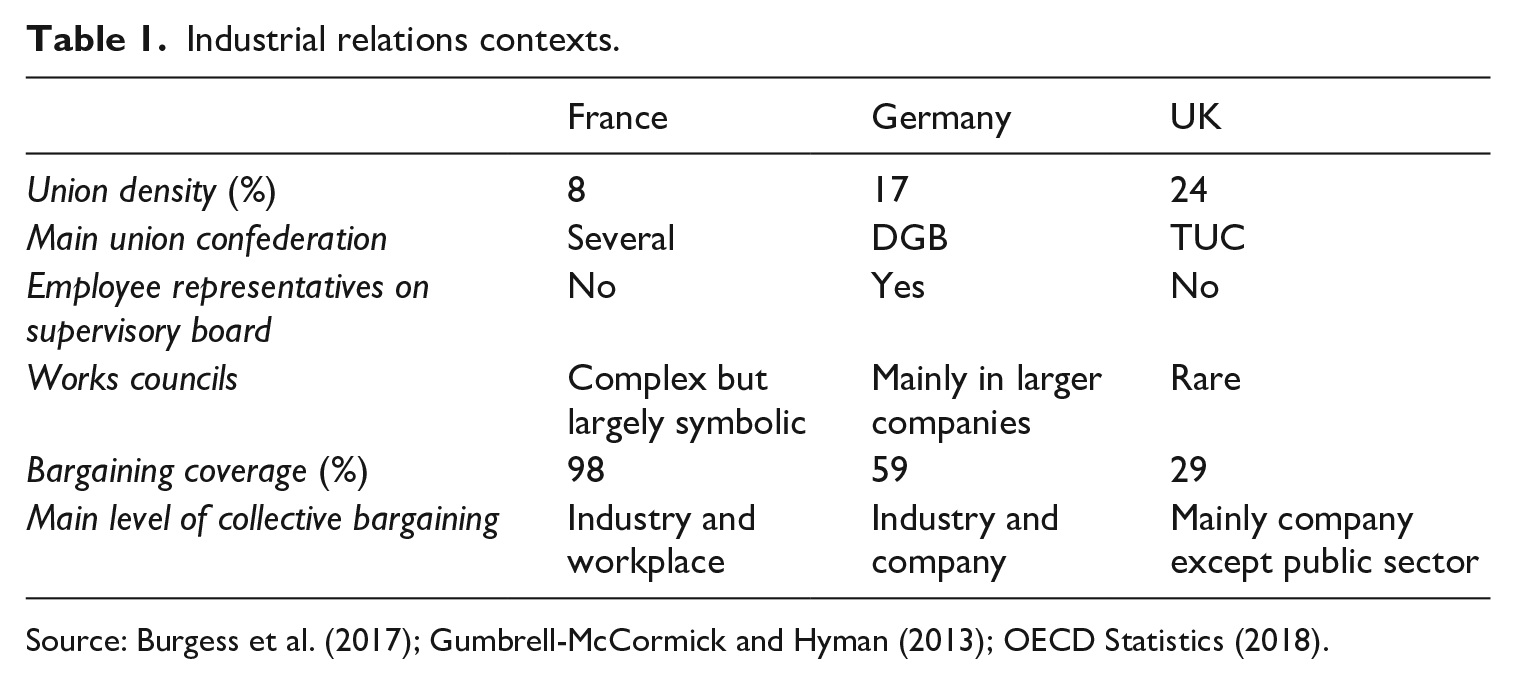
There are many differences in the legal context: in particular France and Germany have civil law systems and Britain has a common law system, but of particular relevance is the fact that in contrast to French and German courts, there is cross-examination in British labour courts. This can result in lengthy cases ranging from 2 days to sometimes over 20 days, whereas in German and French labour courts, cases normally last half a day at most. Accordingly, British employee judges have a more intense exposure to juridical norms than most of their French and German counterparts, but may sit less frequently.
Labour courts in the three countries
Labour courts are termed employment tribunals in Great Britain, Arbeitsgerichte in Germany and conseils de prud’hommes in France. We use the generic term here. We also use the generic words ‘lay judge’: the local designations are lay members or non-legal members in Great Britain, ehrenamtliche Richter in Germany and conseillers or prud’hommes in France. Alternatively, we use the terms employee judge, employer judge and professional judge. We use the term ‘union activist’ to encompass both a lay workplace representative and a trade union official.
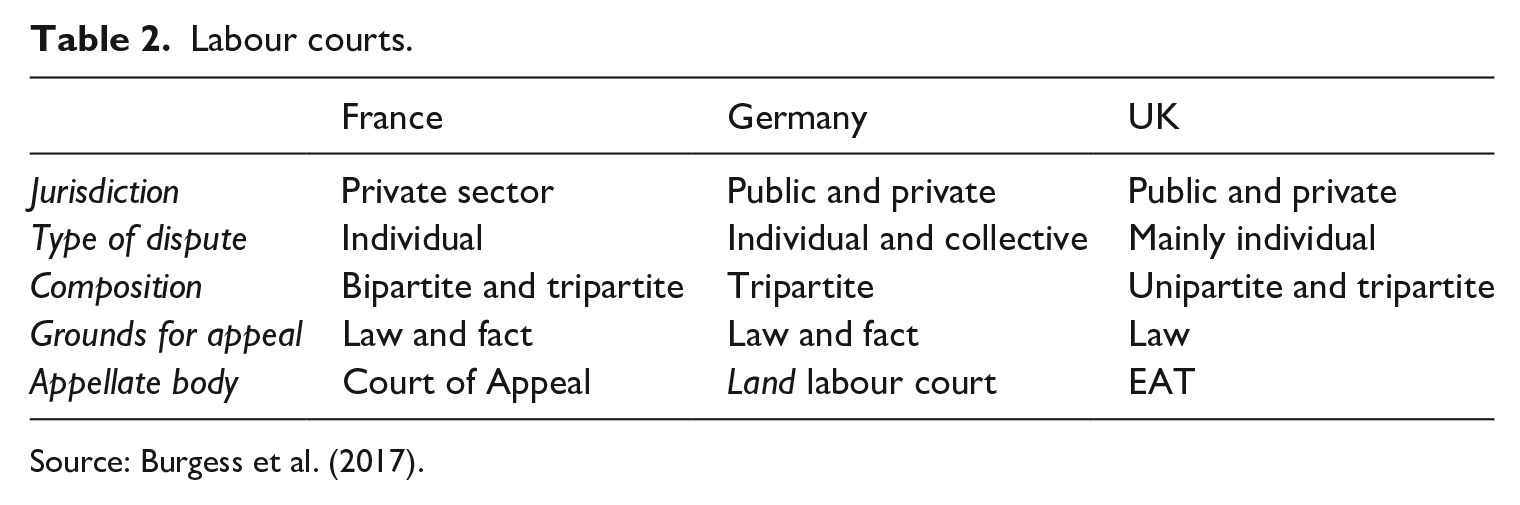
Labour courts in France are bipartite: cases are heard by two employee and two employer judges. One of the four lay judges presides and writes the judgment (perhaps helped by the legally qualified court clerk). If there is no agreement, which occurs in a fifth of cases (Ministère de la Justice, 2016), the court becomes tripartite and the case is reheard before a professional judge acting as a ‘tie-breaker’ (juge départiteur), normally with the four original lay judges.
German labour courts are always tripartite, with one professional judge, one employee judge and one employer judge. British labour courts are sometimes tripartite as in Germany, and sometimes unipartite, with the professional judge sitting alone. British lay judges predominantly handle discrimination cases, although they adjudicate on other claims if brought by the same claimant simultaneously. Although professional judges have discretion to adopt a tripartite format in non-discrimination cases, they rarely do so (Burgess et al., 2017).
Each of the 210 French labour courts has 5 divisions: industry, commerce, miscellaneous activities, agriculture and management. There are no sectoral divisions in Britain, while in Germany, separate chambers divided by occupation or sector are found only in Berlin and Frankfurt. Arguably, employee judges may experience a heightened conflict between their trade union role and their judicial role where they adjudicate on cases arising in their own sector.
The type of case heard in the three systems differs. In France, some 90 percent of cases cover termination of employment (Serverin et al., 2000), with most complaints about workplace discrimination successfully mediated (Defender of Rights, 2014). In Germany, roughly half the cases concern contested dismissals (Burgess et al., 2017), while British lay judges now rarely sit on dismissal cases, which in any event comprise only a fifth of all cases (Ministry of Justice, 2018). Table 2 summarizes the three systems.
Labour courts.
Source: Burgess et al. (2017).
Appointment and training
In Germany, employee candidates are usually nominated by a trade union and formally appointed by the Land (regional) authorities after some checks (e.g. to ensure that there is a balance between large and small unions). Germany has no requirement for lay judge training, either before or during office. Nevertheless, albeit unsystematically, some labour courts provide some training, as do some individual unions and the Deutscher Gewerkschaftsbund (DGB).
In France at the time of our fieldwork, employee judges were elected every 5 years by employees under a system of proportional representation on the basis of lists drawn up by the unions. Since 2018, elections have been replaced by nomination by trade unions under a procedure akin to the German model. There is extensive training, reflecting French lay judges’ role in deliberating without a professional judge and writing the judgment. A lay judge is entitled to 6 weeks of training during the 5-year period of office, provided separately for employee and employer judges. For employees, training is provided by trade unions, universities and lawyers’ associations, who use their own syllabi but are reimbursed by the state. The largest confederations, the Confédération française démocratique du travail (CFDT) and the Confédération générale du travail (CGT), have their own training facilities. Training therefore provides learners with a sense of the values and culture that the union represents and defends (Ethuin and Yon, 2014). In future, this training will be supplemented by joint training at the Ecole Nationale de la Magistrature.
In Britain, employee judges were originally appointed following nomination by employee organizations, principally the Trades Union Congress (TUC). In 1999, however, as part of wider official moves to curtail nepotism in public appointments, self-nomination and selection by the judicial authorities after open competition was introduced. There is a 3-day induction programme for all lay judges, delivered by professional judges at a labour court venue, which also includes observation of a case and the subsequent deliberations. In addition, there is 1 day of lectures annually (2 in Scotland), delivered by a professional judge on legal developments and an aspect of judgecraft, supplemented by case studies.
Cognitive dissonance
We have already argued that employee judges might experience a conflict between their commitment to advance employee interests and their duties as a judge. How do individuals respond when required to participate in a field that has different norms from those that govern other significant areas of their lives?
One approach to understanding how groups and individuals deal with potentially contradictory knowledge, norms, and expectations is cognitive dissonance theory, originally propounded by Festinger (1957) and still provoking research and reflection today (Cooper, 2019). It has spawned a large literature and been explored through numerous experiments, with criticisms of some of the flaws in the original approach (Brehm, 2007; Cooper, 2007; Harmon-Jones and Harmon-Jones, 2007).
In its original version, Festinger (1957) grounded the theory in the notion of ‘cognition’, which served as an umbrella term for ‘psychological representations’: knowledge and beliefs or, seemingly, anything that could be categorized as ‘mental’, together with individuals’ reflective knowledge of these. While some accounts have deemed these to be ‘conscious’, others have regarded them as mental processes of which we are ‘at least dimly aware’ (Cooper and Goren, 2007: 150), illustrating some of the problems encountered with this approach.
Cognitive dissonance occurs when people experience inconsistency (‘dissonance’) between ‘incompatible’ psychological representations. This is experienced as an unpleasant emotion that motivates individuals to achieve ‘cognitive consistency’ between their attitudes and beliefs. Studies using this approach suggest that, when forced to choose between two equally valid items (typically in a controlled experiment), individuals will rationalize by rating the item they choose more highly than the unchosen alternative (Brehm, 1956). The degree of dissonance will vary, depending on both the magnitude of the dissonance subjectively experienced, and an individual’s ability to tolerate it, and will be a function of the ‘importance of the elements’ as valued by the individual. In turn, the ‘strength of the pressures to reduce dissonance is a function of the magnitude of the dissonance’ (Festinger, 1957: 16–18). In a nod to a more sociological approach, more recent researchers have added that ‘these facets should be congruent with how individuals see themselves and their subsequent behaviours’ (Marelich, 2007: 148). Aronson (1992: 204) refers to this as a form of ‘sense-making’.
The essence of inconsistency for Festinger (1957) was when one cognition constituted in some way the ‘obverse’ of the other (p. 13). This raised the problem of whether there had to be a third ‘cognition’ that perceives the other two as incompatible, leading to the risk of infinite regress. Aronson (1992) identified this as a weakness and addressed it through the notion of ‘self-concept’, relaxing Festinger’s implicit assumption that individuals generally had a ‘high self-concept’ (p. 305). For Aronson (1992), an individual’s self-concept would shape their experience of dissonance. ‘Dissonance is greatest and clearest when it involves not just any two cognitions but, rather, a cognition about the self and a piece of behaviour that violates that self-concept’ (p. 305). Accordingly, dissonance-reducing strategies might include not only rationalization (attributing a higher value to the chosen alternative), but also adaptation and self-justification, to which Gosling et al. (2006) add denial of responsibility. In this sense, and in contrast to approaches that allow individuals to embrace a variety of roles in differing settings (Goffman, 1959 [1956], 1961), cognitive dissonance theory rests on the notion that individuals represent a ‘single self’ that is driven to maintain its consistency or integrity.
What forms of dissonance-reducing behaviour might, in theory, be available to employee judges? Festinger himself suggested several strategies for reducing dissonance to which we have added hypothetical judicial examples. For instance, strategies for an employee lay judge might include engagement in rationalization (‘someone has to do this, otherwise it’ll be run by the lawyers and judges’); or the introduction of qualifying cognitions (‘some of the employees here have behaved much worse than I’ve experienced’); or by the denial of responsibility (‘I have to judge according to the law, whatever my personal feelings about the rights or wrongs of a case’); or, classically, the ascription of a higher value to the chosen option, such as venerating the court and its rituals or identifying with the law as a distinctive and legitimate power.
Although cognitive dissonance theory has responded to some criticisms through extending or qualifying the initial model, a number of issues remain. Significantly, the inferential nature of dissonance and the postulation, originating with Festinger, that dissonance can possess quantitative characteristics, such as ‘magnitude’ and ‘proportions’, which are hard to operationalize outside of tightly controlled experiments, create problems of testability, making the approach hard to refute. The existence of dissonance is also necessarily inferred from the reported words and behaviour of test subjects, presupposing that cognitive dissonance exists. Where no mitigating behaviour is observed, the theory implies that dissonance was simply not sufficiently strong, rather than questioning the underlying model. Furthermore, there are inherent problems with the definition and separation of terms, for example, ‘cognition’ understood as independent of ‘attitude’; conscious versus unconscious processes; the idea of the ‘obverse’ of a feeling, which is difficult to specify, as opposed to the obverse of a proposition, from which it arguably borrows.
Brehm (2007: 383) claims that of the four basic paradigms for research in cognitive dissonance theory (effects of decisions, effects of ‘forced compliance’, voluntary versus involuntary exposure to information, role of social support in group influence processes), only the first two lend themselves to laboratory experiments, yet cognitive dissonance has predominantly been tested and developed in this way. The latter two are closer to real-world situations and lend themselves to evaluation by means of semi-structured interviews, such as those conducted in this research. Other criticisms include that proposed by Chapanis and Chapanis (1964), who argued that the theory’s simplicity is also its limitation, as the essentials of a social situation cannot be reduced to just two variables. In addition, the theory struggles with the issue of differences between individuals in the same (test) group, as this would require an understanding of the disposition of the actors involved. This is also a problem for our study, mitigated to some degree by the opportunity to interview subjects from different countries and therefore exposed to different processes of ‘self-concept’ formation.
Cognitive dissonance theory was innovative in that previous work on motivation was based on the assumption that behaviour was ‘caused’ by ‘attitudes’ (motivations driven by reward and reinforcement). By contrast, cognitive dissonance theory argued that it was behaviours (such as those induced in controlled experiments) that prompted dissonance, which then led to revisions in attitudes to reduce the discomfort experienced by subjects unable to reverse or alter their conduct. It also had the consequence that changes in behaviour (even if compelled) could lead to changed attitudes. So despite its shortcomings, cognitive dissonance theory retains an intuitive attraction in the light of our findings which we set out below, after outlining our methodology.
Methodology
Empirical research was carried out in Metropolitan France, Germany and Great Britain (which covers England, Scotland and Wales, but excludes Northern Ireland). Labour courts in Northern Ireland differ in several respects and merit separate comparison. We did not undertake this because of our limited resources and the relatively small size of the working age population in Northern Ireland.
Because judicial deliberations are confidential, we could not directly observe these. Data were therefore collected through semi-structured interviews, which enabled us to explore employee judges’ experience and sense-making. In Britain, invitations were sent out by the regional employment judges and the Scottish vice-president. In Germany, judges were contacted by the relevant labour courts, while in France a snowball process was adopted after first interviewing the president or vice-president of the labour court. Interviewees were not therefore randomly selected. Although this creates scope for bias, this seems to have been limited as we encountered a wide variety of views and there were opportunities for triangulation between interviewees.
Interview guides were drafted in the light of the literature review, first in English and then translated, and piloted to ensure reliability. In the event, 112 interviews were conducted with employee judges in 4 or 5 locations in each of the 3 countries. They were conducted by the project’s researchers whose mother tongue was the same as that of the interviewees.
For this article, we draw principally on the following question: ‘Many people consider that you can’t be neutral as an employee lay judge, especially when you start sitting. Do you agree?’
To ensure consistency, researchers from one country sat in on some interviews conducted in another. As part of the initial analysis, appropriate extracts were agreed by the original research team and those in French and German were translated by the second author of this article, with translations then checked by the in-country researchers. Interviews were transcribed and coded using MaxQDA on themes from the interview guides and those that emerged from the interviews. This entailed reading and rereading the transcripts. The codes we principally drew on for this article were ‘neutrality and difference’, sub-divided into ‘difference in perspective from the lay judge on the “other” side’ and ‘impartiality’. This was further sub-divided into ‘at start’ and ‘now’. We have referred in places to the frequency, or otherwise, of certain responses but without claiming statistical precision (dubbed ‘quantizing’ by Tashakkori and Teddlie, 1998 cited in Driscoll et al., 2007). We use ‘many’ to refer to the majority, ‘several’ to refer to the minority and ‘few’ to refer to a small minority. Primary data collection was supplemented by desk research on national contexts, interviews with experts and some observations of labour court hearings in the three countries.
Findings
At the labour court: Britain
In Britain, we compared the experiences of employee judges appointed through union nomination and those who applied after 1999 in open competition, to see if there was a difference. Unsurprisingly, those appointed under the open competition procedure varied in the strength of their trade union link: although many were union activists, others were not and several had even been managers or human resources consultants for an appreciable time. Occasionally, the selectors, anxious to fill their quotas in each region, directed a successful applicant to whichever side had a vacancy. One interviewee said that she knew at least three people who were asked which side they wanted to sit on. In her view, this was ‘bizarre. I mean you’re either one or the other’. Indeed, of our 41 British employee judge interviewees, only 66 percent were union members at the time of the interview. This compares with all employee judges interviewed in France and 93 percent in Germany (Burgess et al., 2017).
Nevertheless, despite differences in the backgrounds of those recruited before and after 1999, we did not discern other differences. Many of our interviewees, however appointed, stressed their impartiality from the start. Comments from those appointed before 1999 (as a result of union nomination) included, ‘you’ve got to be impartial. This isn’t a trade union arena’. ‘Totally unfair to have been on the side of the employee, just because they are an employee’. ‘I can be completely impartial’. Those appointed by open competition made similar comments: ‘I certainly try to be impartial’. ‘I think we are almost tougher on our own side than we are on the other’. ‘I’m fairly objective. There was never a conflict for me at all’. ‘I am very impartial and you know if my mother was there, or my wife or my daughter, I would make exactly the same you know, and that’s how it has to be’. Another British employee judge similarly did not find being on a labour court problematic, adding that in his workplace, his duty was to ‘represent’ any employee, but not necessarily to support their conduct.
Moreover, some appointed through open competition expressed surprise about the differences between the workplace and the court: ‘[I thought] oh well, it’s going to be adversarial, but it isn’t actually. It’s very collegiate’. ‘It hasn’t been one side or the other, kind of wrestling the other side across the line’. Also, a few employee judges appointed through open competition, but in trade union roles, reported that their capacity to be neutral flowed from their need to be objective when assessing members’ grievances. ‘[Not] everybody who comes through the door is a victim of a management jackboot’. ‘You come with a healthy dose of scepticism about whoever approaches you and tells you they’ve been badly treated’. One inference is that this is a dissonance mitigation strategy, stressing the consistency between the union role and the judicial role.
Nevertheless, although many British employee judges, however appointed, said that they were impartial from the start, virtually all the remainder did not and found that it took a little time to adjust to their new role. Yet again, we emphasize, this was not related to the route of appointment.
We look first at those appointed through their union: ‘When I first started I thought I was there to look after the employee thing, but I found out very fast . . . Now it’s completely impartial’. ‘Lack of experience in the early years . . . I thought there were more people hard done by than I would these days’. ‘I was a little bit confused to start with, but you’ve got to accept this impartiality’.
When you first start, then you’ve obviously been nominated by and put there for your industrial experience based on working people. But you realise after a while that that really isn’t your role. You bring the experience, but you've also got to apply the law . . . You adapt, you adapt to the requirements of the law basically.
Another said, There’s a temptation to put your cloth cap on and your union banner behind you, saying ‘I’m here for the claimant’, but you find that doesn’t work for very long . . . because you realise that this isn’t a workplace anymore. It’s a court.
Similarly, like their counterparts appointed as a result of union nomination, some employee judges appointed by open competition said that their new role as an adjudicator was problematic at first as the following comments illustrate: ‘When I first started sitting, I may have been more looking towards the employee side of things. That’s certainly not the case today. I’m very balanced now’. ‘When you first start, yeah, you can’t be impartial but that gets, I won’t say kicked out, but you get corrected straightaway’. ‘You sort of find yourself putting aside any previous role [as a union representative], but using your experience, not your bias’. This could be seen as a cognitive dissonance strategy of rationalization or sense-making as a path through which judicial norms are internalized.
Only one British interviewee, who interestingly was appointed through open competition and had stopped being a union representative some years before she became a judge, suggested a more prolonged sense of conflict and cognitive dissonance and a strategy to resolve it by denial of responsibility (Gosling et al., 2006). She said, At the start I don’t think you can be impartial because I felt if they were morally right they should win their case. But [a professional judge] said ‘we’re not here to be fair. We’re here to say what the law is on it’. And I thought, yeah, he’s right really. But I still find it difficult to deal with it.
A few British employee judges explicitly referred to the status and agency of the lay judge role. ‘I see it as quite an honour’. ‘I’m taking part in it – an actor!’ Several interviewees referred to ‘credibility’ and a greater sense of power at the workplace: ‘Some managers are a bit wary of me’. ‘You could drop the magic words: “well, in my experience sitting on the tribunal” and then they kind of perk up a little bit more’. A few also expressed discovering a love of the law. ‘I look forward to when I’m doing it’. ‘I love doing the big cases’. This positive evaluation might be read as exemplifying the higher valuation of their choice as a means of minimizing dissonance, in line with experimental ‘free choice’ and ‘induced compliance’ research noted earlier: see Cooper (2007: 10–27) for a summary. Alternatively, some of these responses could be construed as an instrumental appraisal of the benefits of the lay judge role. The language adopted, however (‘an honour’, ‘love of the law’), suggests responses that go beyond the instrumental and arguably place these reactions in the realm of the emotional.
The fact that many British employee judges, irrespective of the appointment route, indicated their impartiality from the start might be related to the fact that there is joint employee/employer judge induction and training delivered by a professional judge, underlining the neutrality of the court and the authority of the professional judge. A few interviewees suggested that the initial training had played a significant part in their socialization. ‘We were advised to behave in a certain way’; ‘not to sort of give the idea that you were serving one side or the other’.
At the labour court: Germany
Some 70 percent of German interviewees were or had been works councillors and a few indicated that their labour court role was not dissimilar to their works councillor role and their experiences of workplace partnership. ‘We’ve never had any sort of differences. We always basically have the same opinion [as the employer judges]’. Furthermore, many German employee judges, like their British counterparts, also claimed they were neutral from the start and did not experience dissonance. ‘Naturally, my everyday working life is the employee standpoint . . . But you have to be able to switch your perspective, yes. And I can do that’. On occasions there was a role reversal, with the employer judge supporting the claimant’s case and the employee judge supporting the respondent. ‘That is the two sides change places’. ‘People might say they have different interests, but you would not be able to tell really’. Perhaps this was because many German employee judges considered that there was little difference between the two environments of workplace and court and their ‘self-concept’ in the two, albeit different places, remained essentially consensual (see Aronson, 1992).
A few employee judges, however, said that it took some time to adjust to their judicial role. According to one, ‘yes, perhaps you can delude yourself into thinking that you can help other people, but you can’t . . . You can’t bend the law’; while another said that ‘at the start there’s a type of helper syndrome . . . but with time you learn to say that you can’t help’. Yet another said, ‘At the start you perhaps look at things more emotionally, but later you get more objective and more structured in how you think about dealing with a case’. This recognition of the ‘unbendable’ force of the law and the positive evaluation of ‘objectivity’ over ‘emotion’ or ‘delusion’ also possibly represents a type of rationalization or denial of responsibility, consistent with cognitive dissonance theory in which socialization to judicial norms takes the form of ‘sense making’ in which behavioural change is virtually impossible.
A few employee judges also reported that being a lay judge led to greater recognition and status than their role as a trade unionist, a positive evaluation, which could be classed as a rationalization to deal with dissonance or alternatively again it could be a realistic view of the benefits of being a lay judge. ‘Because in the union, there is a different status, whether you’re just a simple member or have an office; as a lay judge . . . I’ve noticed that there is much more acceptance’. Like their British counterparts, however, German employee judges expressed a delight in the law, which suggests their responses go beyond the instrumental. For instance, one said, ‘[the law] is much more fascinating than I thought it would be’ and another said, ‘it definitely broadens the mind’.
At the labour court: France
France is unique in that conciliation, and often adjudication and writing the judgment, are undertaken by lay judges alone, as noted earlier. French law forbids a nominating organization from subjecting its lay judges to an ‘imperative mandate’: that is, to instruct them on how to vote in a particular case, and interviewees insisted that this was never breached. Many interviewees, however, reported a conflict of interests. ‘When you start, in your head, you’re there to defend employees . . . But in the end, people calm down relatively quickly’. ‘The newly elected, they are much more oppositionist’. ‘People have a need to assert themselves at the beginning of their term of office, to play up the side they’re on, to get on their high horse’. ‘What’s noticeable about the first year is that you have a very high rate of non-agreement [between the employer and employee judges], of ties’.
This suggests that some French employee judges were receptive to judicial norms and learned to adapt to this role within a relatively short time. Other interviewees, however, alluded to the ongoing tension between being a trade unionist and judge. One said, ‘you have to be neutral. You’re not there specifically to represent the employee. That’s the difficulty’. Another said, ‘neutrality is complicated because there is always a bias . . . well not bias, but you put yourself in the shoes of the employee’. Yet another said, Being neutral is very difficult, especially when you already have a union history behind you and you have seen what employers do; some employers at least, not all. So it’s impossible to be neutral, if only by virtue of our experience.
One interviewee said, however, ‘you can’t serve as an advocate for employees’ but then added, ‘we were put forward by a trade union and we also represent it and this trade union aspect means that we lean towards defending the employee’. Another said, ‘law isn’t something handed down by God. It’s a balance of power. We have different assessments’. A further interviewee seemed to consider that neutrality was not absolute, but ‘you have to maintain a certain neutrality’. ‘I always defend the same thing, but in a different way’, said another. In contrast to German and British employee judges, many French respondents were of the view that there was a ‘trade union’ reading of the law.
This conflict was reported as persisting in deliberations. Unlike in Germany and Britain, deliberations in French labour courts were reported as sometimes resembling negotiations between the employer and employee sides (see also Willemez, 2013). ‘Even in deliberations, there is an employee camp and an employer camp’. ‘The assessment of the facts . . . can differ as between the four of us and so then we’ll see through the force of the arguments made, whether we can reach a consensus’. This reference to deliberations as ‘negotiations’ might be read, in line with Aronson (1992), as a form of rationalization that enables trade unionists to achieve some consistency between their judicial and representative ‘selves’.
Nevertheless, there was a distinction between chambers and according to union affiliation. Interviewees said that employee judges in the industry chamber were more confrontational than those in the chamber for managers, and that those from the CGT, to which just under a third of employee judges belong, were more confrontational than those from other union confederations. Moreover, one employee judge recounted that once in the industry chamber ‘I found an employee [ judge] up against an employer [judge], both on their feet. It’s the only time I’ve seen that. That doesn’t mean we don’t have arguments and they can be very heated too’.
This reported enduring conflict between partisanship in the workplace and the court’s requirement for impartiality in adjudication may in part be due to the fact that training is not only carried out by trade unions but also by unions with differing ideological stances: One of the first training sessions was with a union activist and it was trade union tinted. But we also have training with a lawyer . . . Of course, there is more of an inclination to defend the interests of employees than those of employers, that’s for sure.
Discussion and conclusions
We have argued that employee judges face a potential conflict between their partisan affiliation and their role as an impartial adjudicator. Although relevant literature refers to double binds and tension, the frequency and duration of any such conflicts, and how these might be resolved or mitigated, have not been explored previously. Nor has there been research addressing this issue comparatively or seeking to apply cognitive dissonance theory to employee judges.
To recapitulate our three research questions, we first asked whether or not employee judges experienced any conflict between their roles as a defender of employees and as a neutral adjudicator. Looking at our sample overall, taking the three countries together, we found evidence of such conflict in some, but not many cases, and for the most part this occurred only initially.
Second, we asked whether there was variation between countries. Bearing in mind the problems of generalizing from limited and qualitative empirical evidence, we suggest that such differences can indeed be found. In Germany, those who seemed to experience a conflict mostly said that they adjusted to the judicial role after a short time. This may be because the majority of our interviewees were, or had previously been, a member of a works council or the public sector equivalent and were used to a consensual relationship. In France, trying to straddle the roles of trade unionist and judge appeared to present greater difficulties, with the problem of adopting a neutral stance extending beyond the first few hearings. In Britain, we distinguished two groups of employee judges: those appointed as a result of union nomination and those appointed through open competition. The latter group included interviewees who had become managers at the time of the research or had not been union activists for some time and said they could have sat on either side. Nevertheless, we were not able to distinguish between the two groups. Many, however appointed, said that they were neutral from the start and this might be attributable to the joint employee/employer induction training led by a professional judge. Furthermore, virtually all the remainder from both groups reported that, after a few cases, they realized that their role in the labour court was not interest representation.
At first sight, our finding that the conflict of interests appeared to be stronger and more persistent in France than in Britain and Germany is surprising, given that employment law in France is more favourable to employees than in Britain and Germany. For instance, the OECD index for the protection of employees against dismissal was 2.6 in France, 2.5 in Germany and 1.2 in the United Kingdom (OECD, 2019). There are a number of possible explanations, which are not mutually exclusive: the adversarial tone of French industrial relations; the fragmentation of the French union movement; (it was remarked that those in the CGT were particularly partisan); the fact that there is union-provided training in France (unlike Britain); and the composition of the caseload. Arguably, employee judges are more likely to experience a conflict between their roles in the workplace and in the court if the bulk of the caseload concerns issues relating to managerial prerogatives, such as dismissal (as in French labour courts), rather than in claims of discrimination, where issues of managerial prerogative rarely arise. As noted earlier, dismissal cases comprise the overwhelming bulk of claims in French labour courts, as against roughly half of the caseload in German labour courts and even less in Britain. Another explanation may be that French labour courts are divided by sector, that is into five chambers, unlike in Britain and only very occasionally in Germany. Arguably, employee judges experience more tension between the workplace and the court when the context of their adjudication is close to their workplace context.
We now turn to our third research question: the strategies employee judges adopt to assuage any conflict between their employee representative and their adjudicator roles, and the theoretical approaches that might elucidate this. Although ‘socialization’ might be invoked to explain why (but not necessarily how) conflict diminishes over time, socialization is not a passive process through which norms are ‘absorbed’ but can involve a range of processes, including the rationalization and other forms of adaptation highlighted by the cognitive dissonance approach.
Cognitive dissonance theory offers a potentially fruitful approach to understanding how socialization might occur by offering an active account of how individuals engage in ‘sense-making’ and retain a ‘consistent self-concept’ (Aronson, 1992) in new and challenging environments. Our interviews provided some evidence of dissonance, particularly on the part of French employee judges, and some attitude change or behaviour that could be classed as a dissonance-reducing strategy. For instance, some French employee judges rationalized their choice when they said that they had to tailor their decisions to the exigencies of the law or denied responsibility. There was also evidence of a search for self-consistency, in that some French interviewees reported that the roles of lay judge and employee representative were not all that different, as both entailed negotiation with employers.
In addition, a few British employee judges who were active trade unionists praised the culture of the courts and their modus operandi in ways that indicated a positive evaluation of their choice, while another explicitly denied responsibility for her judgment. However, cognitive dissonance theory appeared to have little or no bearing on many of our interviewees’ comments, as they said that they did not experience any conflict even when they first became employee judges. Although proponents of cognitive dissonance would say that these are instances of dissonance not being sufficiently strong, others might question the theory itself.
Our article has focused on micro-level interactions that occur when individuals cross between fields and negotiate the implications of this. Cognitive dissonance theory, as exemplified by Festinger and his successors, was based on inferences which are hard to test or refute and were often drawn from the behaviour of university students in experimental settings. We also drew inferences, albeit not from experiments but from our interviewees’ responses, and they too must be treated with caution. Bearing in mind the limitations of our study, we would however submit that cognitive dissonance theory, especially in its modified variants, sheds some light on our findings. There is an evident need for further research in this area, extending to other countries with mixed labour courts.
Footnotes
Acknowledgements
The authors thank a reviewer for helpful comments which enabled them to improve this article considerably.
Funding
The author(s) disclosed receipt of the following financial support for the research, authorship, and/or publication of this article: This article is based on research funded by the Hans-Böckler-Stiftung.