




Abstract
Afrofuturism is a speculative art and theoretical movement that transports us through Black and Afrodiasporic gazes and imaginaries. It is introduced as a site of Black iteration, an oppositional thematic universe, and as continuing a legacy of resistance and oppositional postures where, often through self-reflexivity and self-revelation, Black people theorize Black subjectivities. This paper argues that Afrofuturism holds untapped psychological relevance, underscored by its potential to provide new frameworks for understanding and addressing Black subjectivity and mental health, challenging traditional narratives, and advancing innovative and liberatory perspectives. By creating worlds that decenter whiteness and imagining Black people not only existing in but actively creating the future, Afrofuturism offers a transformative lens for understanding Black experiences and possibilities. The concept of “Postapocalyptic People,” inspired by sci-fi narratives of futures with echoes from the past, is introduced to theorize the subjectivities of those shaped by the Maafa—an historical and ongoing apocalypse—and is distinguished from terms such as marginalized, minoritized, or subaltern as we explore how Afrofuturism navigates and transcends worlds shaped by a cataclysmic event. These themes are explored in the context of psychology’s historical and ongoing interactions with Black subjectivity, with an emphasis on Afrofuturism’s potential to inform theory and practical applications, such as interventions and methodologies that center Black cultural creativity, self-authoring, and liberation.
There is nothing new under the sun . . . but there are new suns. To be black in a world that is structured by violent antiblackness is to be a cyborg.
Preamble
(Inspired by Audre Lorde (1934–1992), self-described “Black, lesbian, mother, warrior, poet.”)
You must first know that you are in the house. While inside the house, you may be able to reimagine the house, but only within the structure of the house. You may reimagine the size of the living room. Maybe you divide it into two rooms. You may reimagine where the kitchen can be and move it just so. Of course, then, there is the plumbing to think of. But just because the work is substantial does not mean it is meaningful.
Either way, the kitchen, and the living room, now re-imagined, are still inside the house.
The house limits imagination to the structure of its bones. The house has crippled your imagination, just as it has crippled your body, your constitution. You walk with your back bent, your head bowed, and pain everywhere. If it is freedom you seek, you must first understand that you are inside the house. You must be able to imagine a world outside of that house.
Then you must consider the unthinkable: that only until you leave the house or burn it to the ground will you be able to imagine life and the world and yourself beyond it.
Only then can you truly be free.
Historical context and key concepts
Black life and subjectivities have historically been pathologized, erased, or distorted within psychology (American Psychological Association [APA], 2021; Lane, 2010; Teo, 2008). Organized psychology evolved within systems that privileged whiteness as the standard for humankind, constructing research and practices that marginalized and dehumanized Blackness. Roberts and Mortenson (2022) describe this as a “White = neutral” framework, which positions White realities and cosmologies as universal while rendering Blackness simultaneously hypervisible as “Other” and invisible as a legitimate site of knowledge. Psychology’s complicity in sustaining systemic racism has left an enduring legacy, as acknowledged in the APA’s 2021 apology for its role in perpetuating racism and racial hierarchy.
In response to this history, Black Psychology emerged in the late 1960s as a revolutionary discipline, grounded in the lived experiences, cultural knowledge, and spiritual traditions of Black people. Dr. Joseph White’s seminal article, “Toward a Black Psychology” (White, 1970), marked a turning point in challenging the deficit-based frameworks of Eurocentric Psychology. White advocated for a strength-based approach to understanding Black life, countering the overwhelmingly pathologizing narratives that dominated the field. His work inspired generations of scholars to develop theories rooted in African-centered epistemologies, including Wade Nobles, Kobi Kambon, and Linda James Myers.
These foundational thinkers advanced transformative frameworks that emphasized cultural reclamation, spiritual alignment, and liberation, offering paths to theorizing Black subjectivities. However, neither mainstream nor Black Psychology have systematically researched the specific relevance of Black creativity, speculative thinking, and radical imaginaries, as they emerge out of Afrofuturist works, in shaping (and being shaped by) Black subjectivity, and how this process may be connected to psychological well-being and liberation.
Teo’s (2017, 2023) framework of subjectivity emphasizes the inextricable interconnectedness of sociosubjectivity (historical, cultural, and societal dimensions), intersubjectivity (relational processes), and intra-subjectivity (inner life). This framework which, while not specifically focused on Black experiences but rather suggested as a general human framework overall, provides useful analytical dimensions for understanding how subjectivity is shaped by historical, relational, and internal factors. Black Psychology aligns with this conceptualization, highlighting how Black subjectivity is at least partially shaped by the historical traumas of slavery, colonialism, and systemic racism. Nobles’ concept of re-membering, for example, addresses the fractures caused by such historical traumas, and emphasizes the restoration of cultural memory and spiritual essence as critical to psychological well-being (see Nobles, 2013). Similarly, Kambon’s concept of cultural misorientation recognizes the psychological disorientation that occurs when African-descended individuals internalize Eurocentric values and beliefs, advocating for African-centered ways of knowing as a pathway to liberation (see Jamison, 2016; Kambon & Rackley, 2005). Myers’ optimal conceptual theory (OCT) defines mental health as a process of alignment with principles of harmony, balance, and interconnectedness, centering African epistemologies as essential to psychological thriving (L. J. Myers et al., 2018).
Afrofuturism is proposed as a natural evolution that builds upon and extends these theoretical traditions. It shifts the focus from trauma and coping to centering Black radical imaginaries and futurity, incorporating speculative thought and creativity dimensions into our research and understanding of Black subjectivity.
The introduction of Afrofuturism as framework and the concepts of postapocalyptic subjectivities as relevant yet underexplored themes in psychology are my humble contribution to the ongoing work of theorizing Blackness begun centuries ago by Black thinkers across disciplines. I aim to explore how Afrofuturism, Black speculative and fantasy work, and access to Black imaginaries can contribute to the psydisciplines and the psychological well-being of Black, African, and Afrodiasporic people. Can Afrofuturism play a useful role in and offer a lens through which to theorize and study various forms of Black subjectivities, mental health, and liberation?
Afrofuturism and psychology
What is Afrofuturism?
Afrofuturism is a genre- and gender-bending growing body of counter-hegemonic artistic and intellectual work embedded in the future and the past, from a people (Black, African, and Afrodiasporic) whose past was (and present continues to be) brutally interrupted, colonized, erased, and destabilized. It is an evolving phenomenon and movement and consequently is difficult (and can feel counterintuitive) to define absolutely. Afrofuturism’s earliest iterations are in literature and music, with musician Sun Ra (1914–1993)—a jazz composer who claimed he came from Saturn and was sent to Earth to unite people with music—and his Arkestra, and Afrofuturism / speculative fiction writer Octavia Butler (1947–2006), considered the mother of Afrofuturism, as some of its iconic pioneers.
Contemporary Afrofuturist authors and artists include Dr. Nnedi Okorafor (b.1974), a Nigerian-American writer who coined the terms Africanfuturism and Jujuism (Okorafor, 2019a); African-American science fiction and fantasy writer N. K Jemisin (b. 1972), whose work challenges traditional tropes of the science fiction and fantasy genre; Jamaican-born Canadian speculative fiction writer Nalo Hopkinson (b. 1960), who infuses her writing with multiple patois; Wangechi Mutu (b. 1972), a Kenyan-born American Afrofuturist visual artist; and various contemporary musicians such as Janelle Monáe (b. 1985), Outkast (1992–2007), and Missy Elliott (b. 1971). Finally, Toronto finds its own contemporary Afrofuturist artist in Adeyemi Adegbesan (b. 1982), also known as Yung Yemi, a photographer and multimedia artist (see Figure 1).
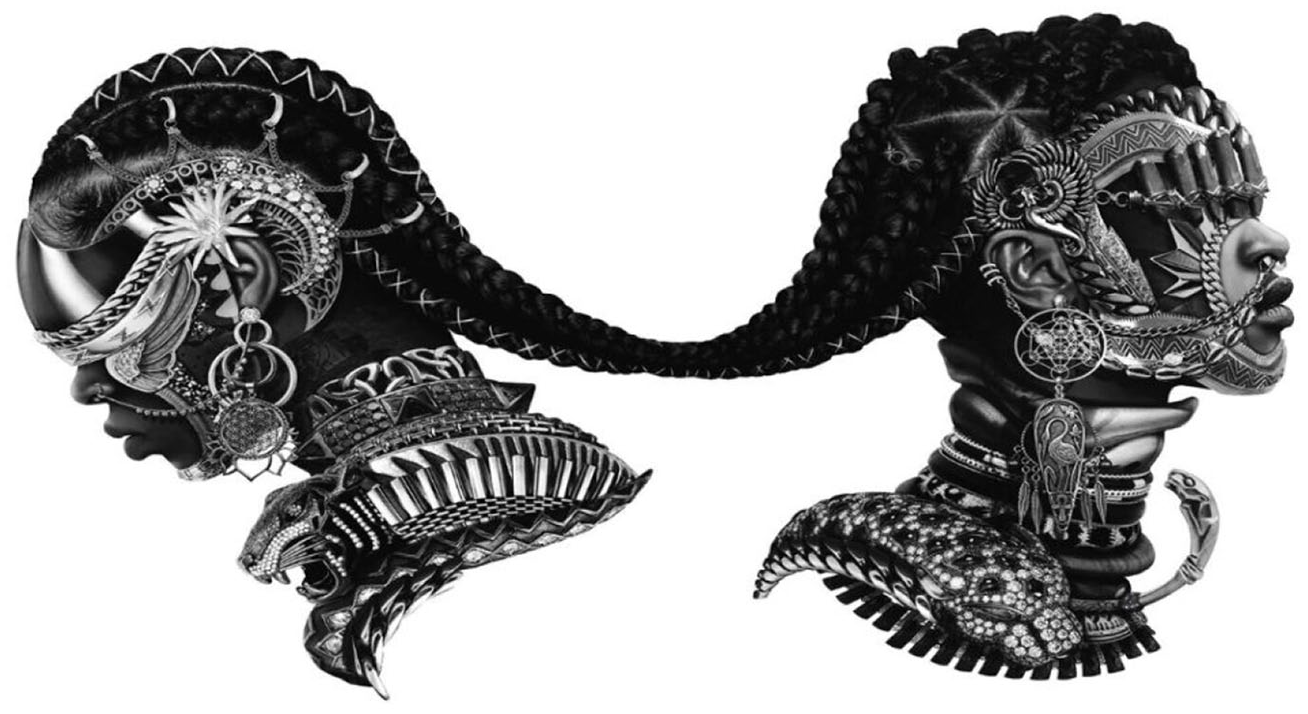
“When the fam lose faith hold them up,” By Yung Yemi (2020). Used with permission of the artist (Adegbesan, n.d.).
The past few decades have also seen a growing number of scholars of Afrofuturism deliberating its themes and possibilities. In all its iterations (music, literature, theory, film, and other arts), Afrofuturism explores the intersection of race, art, science, and technology using Black and African themes, ideas, and cosmologies. Theorist and filmmaker Kodwo Eshun (2003) writes that Afrofuturism “uses extraterrestriality as a hyperbolic trope to explore the historical terms, the everyday implication of forcibly imposed dislocation, and the constitution of Black Atlantic subjectivities” (pp. 298–299). Afrofuturist scholar Womack (2013) adds that “[b]oth as an artistic aesthetic and a framework for critical theory, Afrofuturism combines elements of science fiction, historical fiction, speculative fiction, fantasy, Afrocentricity, and magic realism with non-Western beliefs” (p. 9). She explains that “Afrofuturists redefine culture and notions of blackness for today and the future” (Womack, 2013, p. 9) and highlights that it can be a method of self-liberation and healing.
The term Afrofuturism was coined by cultural critic Dery (1994) in his “Black to the Future” interview with Afrofuturist writers and literary critics Samuel R. Delany and Greg Tate, and African-American sociologist Tricia Rose. Dery (1994) stated that Afrofuturism is speculative fiction “that treats African-American themes and addresses African-American concerns in the context of twentieth-century technoculture—and, more generally, African-American signification that appropriates images of technology and a prosthetically enhanced future” (p. 180). He added that “African Americans, in a very real sense, are the descendants of alien abductees” (Dery, 1994, p. 180).
Afrofuturism finds geographical expansion in the Black Atlantic (see Gilroy, 1993) and an inclusion of cultural aesthetic and technology-integrated discursive philosophies and imagination of futures through the lens of Africans and Afrodiasporic peoples (e.g., Africanfuturism, a term coined by writer Okorafor, 2019a). Although the term Afrofuturism has only existed for a few decades, scholars have proposed that the phenomenon precedes this nomenclature by, ostensibly, centuries. Du Bois’s (1920) short fiction “The Comet,” for example, has been called “Postapocalyptic, speculative and proto-Afrofuturist” (Elia, 2016, pp. 177–178), if only for its main protagonist being a working-class Black man and the setting being a speculative future in which he (the Black man) and a wealthy White woman seem to be the only survivors after a comet hits New York, forcing them into an unlikely alliance (especially as this was written during Jim Crow-era America). 1
Locating Afrofuturism further back in time, history scholar Broyld (2019) proposed an interpretation of the Underground Railroad as an instance of Afrofuturism. Finally, Phillis Wheatley (1753–1784), an enslaved woman in the 18th century, who became the first Black author to publish a book of poems, has been proposed as an early Afrofuturist, especially because of her poem “On Imagination” (Wheatley, 1773/1989).
These propositions suggest that one of the key elements of Afrofuturism is the very act of daring to imagine an impossible future, such as freedom or even humanity for an enslaved African. The imagining of liberation in itself, then, this act of fugitivity and rebellion in thought, is the beginning of Afrofuturist thought.
Afrofuturism is not confined to the future, however: it is sometimes a (re)writing of an interrupted Black history and imagining of alternative histories, 2 a recovery and reconstruction process, a sort of Sankofa (see Temple, 2010; Toliver & Files, 2025) that bends or perhaps even eliminates time. For example, in the intergalactic Afrofuturist trilogy Binti, author Okorafor (2019b) converges the ancient and the new, old traditions and new technologies, to create an uncompromisingly African aesthetic within a faraway technofuture, as if to say that the future would not erase the (Black/African) culture but is made of it. The story’s combination of the seemingly ancient (tribal Himba customs) and the futuristic (traveling to school on a homemade spaceship) invites a (re)imagining of the self through an African self-authoring outside of the White paternalistic constraints that too often form Blackness and African-ness in static primitivity. Okorafor offers her readers a stunning alternative that (re)instates pride, dignity, and humanity and a world in which African traditions and Blackness are made compatible with modernity and futurity. In the book, as is traditional with the real-life Himba people of Namibia (Havenga et al., 2022), her homeland on earth, heroine Binti’s hair and body are covered in otjize, a red mixture paste used for protection against the elements. The young, dark-skinned female Himba protagonist’s otjize is found to have healing properties for an enemy alien force that spares her life to share in her tribe’s knowledge and medicine, suggesting a reconciliation brought from a traditional African (and female) heritage to heal the future. Another example of an African aesthetic and culture blending with technofuture are the Afrofuturistic films Black Panther and its sequel (Coogler, 2018, 2022), which ignited a social media and cultural “frenzy” (Wallace, 2018) and brought to the fore the deep longing for Black stories rooted in Black worlds led by Black storytellers and characters in the future.
Afrofuturism and psychology—Disciplinary integrations
Afrofuturism has been used as framework and pedagogy in various disciplines. This includes discourses concerning law (e.g., Capers, 2022; Center for Ethics, 2022; ONYX Pages, 2018), critical constructionist design (e.g., Holbert et al., 2020), and STEM design pedagogies situated in Afrofuturist aesthetics (see Bosley et al., 2022). Bosley et al.’s 2022 study, for example, used Afrofuturism as part of a multiframework approach to safety, exploring ways to reimagine and design around community safety. They suggest that “Afrofuturism and Black Feminism allow marginalized communities to think critically about the past, present, and future in designing for wicked problems like policing” (Bosley et al., 2022, p. 474). They note that their study adds to the work human–computer interaction scholars have been doing, using Afrofuturism to imagine a better and safer future for marginalized people. Worth noting is Bosley et al.’s (2022) emphasis on intersectional technologies that incorporate both Afrofuturism and Black feminism, termed as Feminist Afrofuturism or Afrofuturist Feminism, as they add that “Methods of Afrofuturist Feminism consist of creating parallel feminist universes, remixing dominant future discourse, and are not utopias but shaped by feminist principles and actions” (p. 472).
While Afrofuturism has been widely explored in literature, art, and cultural studies, and, more recently, is being explored and implemented in various disciplines as discussed above, its integration into psychological research remains scarce. Emerging work, such as Tynes et al.’s (2023) Afrofuturist Development Theory, represents a promising step toward bridging this gap. Tynes et al.’s (2023) theory integrates Afrofuturism with developmental science to create interventions that address systemic racism, foster Black thriving, and envision liberated futures. The theory emphasizes leveraging the cultural strengths, creativity, and technological ingenuity of Black youths to design equitable systems that support the holistic development of Black children, adolescents, and emerging adults. This sort of work remains in its infancy, underscoring the need for further exploration of Afrofuturism’s potential to inform psychological theory, research, and practice.
The principles and themes of Afrofuturism align closely with the goals of Black Psychology (i.e., highlighting the unique psychological experiences and possibilities of Blackness). Both defy the implausible and carve out space where there was none offered, claiming agency over both time and space. Baldwin (1986) noted that Black Psychology “derives naturally from the ‘worldview’ of philosophical premises underlying African culture itself (as does Western Psychology relative to the worldview of European culture)” (p. 237). He further remarked that African/Black Psychology’s “independence from Western Psychology inheres in the fundamental distinctness between and independence of African and European Cosmologies” (p. 237). Black Psychology, the birth of which was galvanized by activism and oppositional intellectual activities as a response to the distortion of Blackness by psychology, refused the confinement of a Eurocentric world—epistemological and otherwise, and imagined better ways, centered in Black knowledge and experience.
Afrofuturism extends the discourse and work initiated by Black Psychology by integrating speculative and imaginative dimensions beyond the confines of our understanding of worlds as a necessary step toward a more expansive understanding of Black being and becoming. While traditional frameworks focus on the historical traumas and resilience of Black people, Afrofuturism invites a reimagining of these narratives through the lens of creativity and futurity. In line with Teo’s (2024) emphasis on the potentialities of subjectivity, this framework emphasizes that Black subjectivity is not only shaped by past experiences but also through its active construction of alternative futures. The incorporation of imagination and cultural memory in Afrofuturism serves as a critical tool for psychological liberation, allowing for the exploration of identities that transcend the limitations imposed by historical oppression.
Thinking of practical applications of Afrofuturism in psychological research and practice
While the theoretical intersections between Afrofuturism and psychology offer a transformative lens for understanding Black subjectivities, it is equally vital to explore how this framework can be applied in practice. Examples like Tynes et al.’s (2023) Afrofuturist development theory in developmental science have started to illuminate some potential avenues for integrating Afrofuturist ideas and ways of doing and thinking into psychological work.
Afrofuturism’s speculative and imaginative dimensions provide a unique opportunity to create interventions and methodologies that facilitate the ability to both envision and construct liberated futures in research and in collaboration with Black people. Its potential application to other marginalized groups should also be studied.
If we start with methodology, an Afrofuturist methodology for psychological research can be conceptualized as a transformative, imaginative, and culturally grounded approach that centers Black experiences, histories, and futures. This method would integrate speculative imagination, cultural reclamation, and liberation-oriented practices to challenge Eurocentric paradigms and create new possibilities for understanding and addressing psychological phenomena. It would center Black epistemologies and ontologies, embrace speculative imagination, integrate historical and cultural context, focus on liberation and thriving, and utilize participatory and creative methods. In practice, as an example, researchers could facilitate workshops where participants create speculative narratives about their lives in a liberated future. These stories could be analyzed to understand how participants conceptualize freedom, agency, and well-being. Researchers could also develop interventions that draw on Afrofuturist aesthetics and practices, such as using music, visual art, or virtual reality to help participants imagine and rehearse alternative futures. We could learn from emerging collaborative participatory design ideas that incorporate Afrofuturist thoughts, principles, and aesthetics in the design of culturally relevant tools for mental health.
Imagine a study exploring the impact of speculative imagination on Black youth’s mental health. The study could involve three phases: (a) storytelling workshops, in which participants create speculative stories about their lives in a future where systemic racism has been dismantled; (b) participatory design, in which participants codesign interventions, such as games or apps, that help them rehearse these imagined futures; and (c) evaluation, in which researchers assess how engaging in speculative imagination impacts participants’ sense of agency, hope, and psychological well-being.
An Afrofuturist framework, as proposed in this paper, is employed first as an orienting lens—a thought—which then guides each subsequent step (the questions, the designs, the analysis, the next question, etc.). It can be used to critique and reimagine psychological constructs, such as resilience or identity, to better reflect Black experiences, expansive subjectivities, and possibilities in both research methodologies and therapeutic practice.
While the practical applications of Afrofuturism in psychology explore how speculative imagination can empower individuals and communities, it is essential to return to the origins of Afrofuturism as an artistic movement. Afrofuturism began as a creative and oppositional response to the exclusionary narratives of mainstream art and media, making art a crucial site for resistance and reimagining Black subjectivities. The next section examines the historical role of art in shaping and challenging thematic universes, particularly within the context of White supremacy, and how Afrofuturism subverts these narratives to reclaim Black future.
The power in/of art: Thematic of the (White) universe
When most black people in the United States first had the opportunity to look at film and television, they did so fully aware that the mass media was a system of knowledge and power reproducing and maintaining white supremacy. (hooks, 2014, p. 117)
Art has long been a powerful medium for self-expression, cultural preservation, and resistance. It “is both a way of representing experience and, as hermeneutic thinkers have illuminated so clearly, a form of knowledge” (Slaney, 2020, p. 25). However, art, like knowledge, is historically situated and has often been used to reinforce White supremacist ideologies. Hall (1990/2021) observed that Black people were constructed as “Other” within Western categories of knowledge, shaping how they were perceived and how they saw themselves. This dynamic is evident in mainstream art and media, which have historically excluded or distorted Black people and contributions, as well as minoritized genders and other social groups. Mainstream art and media have historically been used, whether deliberately or not, as propaganda, reinforcing White supremacist heteropatriarchal agendas, and reproducing political, religious, and gendered ideologies promoted by colonial imaginations (see Carrington, 2016; Gayed, 2022). For instance, museums have often showcased paintings of naked White women while rarely featuring female or non-White artists (see Guerilla Girls, 1989; Topaz et al., 2019). Another example is found in the beloved character of Superman, the quintessential great, humble, righteous, and good immigrant and hero, who is American, male, heterosexual and White-presenting (see Brown, 2016). He is the American dream and, arguably, the world’s. 3
Mainstream speculative and science fiction have also failed to imagine racial futures, often presenting color-blind utopias that erase the salience of race in sociopolitical realities (Bould, 2007). A rare exception is raised by African-American Studies scholar Alexander (2016), who notes that Star Trek: Deep Space Nine (Berman et al., 1993–1999) featured Benjamin Sisko, a Black character with explicit ties to his racial identity. Sisko’s presence challenged the utopian vision of Star Trek, which equated the end of racism with the erasure of racial identity (Alexander, 2016).
This failure to imagine Blackness beyond sporadic inclusion in White-dominated narratives parallels the epistemological violence critiqued in psychology (see Held, 2020; Teo, 2008), where White universalism often erases non-White perspectives. Afrofuturism, in contrast, unapologetically centers Black cosmologies, histories, and imaginaries, offering a framework to critique and reconstruct these narratives.
The world we inhabit is shaped by the imagination of a privileged few, often ignoring or distorting Black futures. Afrofuturism defies this erasure. As an artistic endeavor spanning literature, music, film, and beyond, it critiques mainstream art and reclaims Black culture, history, and imagination. It offers a lens to challenge White-dominated narratives and provides tools to reimagine psychological frameworks, centering Black experiences and possibilities.
Art, as a site of both oppression and resistance, shapes the thematic universes we inhabit, influencing how people navigate and make meaning of their worlds. This interplay between imposed narratives and self-authored realities becomes especially significant when considering the psychological and cultural implications of living within and across multiple, often conflicting, worlds, an important dimension to consider in psychology.
Multiple worlds in one
Just as the house confines imagination, traditional psychological frameworks have similarly constrained our understanding of Black subjectivities and Black “worlds.” My personal experiences navigating a White-dominated world as a refugee-turned-citizen and African/Black woman in Canada reveal the sometimes emphatic disconnect between shared physical spaces and divergent lived realities. Subjectivities are shaped by our unique contexts—our bodies, histories, cultures, and the societal meaning imposed upon them. These factors inform the arts, politics, and education systems that, in turn, perpetuate or challenge dominant worldviews. This raises a critical question: What world does psychology assume we all inhabit, and where does Afrofuturism invite us to envision the world from and toward?
Freire’s (1968/2018) concept of “thematic universes” describes the composite of themes that shape how individuals make meaning of their worlds. Within the thematic universe of an imperialist White cis-heteropatriarchy, for example, generative themes such as hierarchy generate subthemes and, we can argue, subjectivities that both form and are in/formed by it, and power dynamics that generatively reinforce systems of oppression. Importantly, he defined themes both as containing and being contained in limit-situations, a concept characterized by the exclusion of transformative possibilities. Limit-situations are therefore normative. However, the notion of limit-situations paradoxically also suggests the possibility for imagination. Recognizing these limitations reveals what Freire called untested feasibility: the exploration and potential of possibilities not yet tried—in other words, the incongruity inherent to limit-situations, once faced, reveals the potential for (re)imagining and creating alternative futures. Afrofuturism embodies this spirit of untapped potential, providing tools to transcend thematic boundaries and reimagine Black subjectivities beyond current epistemic and spatio-temporal constraints.
Freire’s work here aligns with theories of subjectivity, which emphasize that people are inseparable from their contexts. Some people reinforce the structures of their thematic universe, while others resist them in pursuit of becoming “more fully human.” For Black populations, and indeed in Black Psychology, this resistance can take the form of cultural reclamation and self-re/authoring. Afrofuturism offers a thematic universe intentionally centered on Black experiences, histories, possibilities, and futures, providing a means to engage with “untested feasibility” toward liberation and transformation.
This paper highlights the incongruities that arise when Black bodies navigate White worlds, and their impact on health and sense of self/identity. These collisions of thematic universes underscore the creativity of Black resistance expressed through art, literature, and other forms of self-authoring. Afrofuturism transcends these collisions by offering tools to imagine life beyond the limits of oppressive thematic universes. It transforms the rules of engagement, centering Blackness as a source of possibility and joy rather than a problem to be solved. The collision of thematic universes for Black peoples is deeply tied to the historical rupture of the Maafa, which continues to shape Black subjectivities and resistance.
The Maafa and legacy of resistance of postapocalyptic people
The saliency of Black/African identity and the potential for Blackness to be deployed as a decolonizing framework, through a discursive analysis of Black resistance and activism, point to significant lessons for anti-racist, anti-colonial theorizing and political activism. (Dei, 2018, p. 58)
Black, African, and Afrodiasporic people share the memory of a common historical narrative on the background of which Afrofuturism is shaped. This shared memory found a naming through the work of various Black studies scholars: The Maafa (sometimes stylized as MAAFA) is a Kiswahili word which means “the great disaster” (Cook, 2019). Dr. Marimba Ani (born Dona Richards, 1964), an anthropologist and African studies scholar, is credited with inaugurating its use to describe a Black Holocaust, a naming from the other side of the transatlantic trafficking and enslavement of over 15 million African people (United Nations, n.d.), including children, and the process of dehumanization and dislocation therein (see Cook, 2019). It is used here in the same way, extended to include the brutal invasion of Africa by European empires, the world from where Black Americans’ ancestors were stolen, the human, spiritual, and ecological destruction this carried, and the alien thematic universe it imposed and normalized. The term Maafa has been popularized by Black studies scholars and used by Black psychologists such as Wade Nobles, who noted the shattered consciousness and fractured identity that can result from historical trauma like slavery and colonialism. He emphasized the need for “re-membering”—restoring cultural memory and spiritual essence as essential to Black wholeness, and Sakhu Sheti (deep search for meaning) and Serudja Ta (reciprocal rebirthing) as pathways to healing. The term has even been part of discourse and practice by religious leaders. For example, in a review of a Community Baptist Church in Brooklyn, New York, R. S. Myers (2014) describes the church’s introduction to a psychodrama titled The Maafa Suite in 1995, which, recognizing the waves of trauma occurring in the Black community it served, created a pedagogy and theatrical event to help name and address it.
Mainstream psychology does not make use of a framework that reflects the reality of the apocalypse to theorize the subjectivity of its people. I suggest that a framework is necessary to recognize the thematic universe engendered by the apocalypse, and to support analysis and understanding of the subjectivities of those who were born of and descend from the apocalypse, in collaboration with the people and from the standpoint of this provenance, that is, the framework of Postapocalyptic People.
Of course, the realities of Blackness have been theorized into categories or frameworks before, though perhaps only through their variously identified disadvantages. Three concepts or terms may be most relevant to raise and distinguish from that of Postapocalyptic People (described further below): marginalized, minorities, and the subaltern.
Marginalization refers to social exclusion. It applies to a people being relegated to the margins of society, which affects access to power, dignity, and security. In the history of psychology, Black people have been marginalized through being othered, victimized or neglected, misinterpreted, as well as disproportionately labeled by being over- or underdiagnosed (APA, 2021). Minorities refer to groups who, by their skin color, religion, language, sexuality, or other identities fall into a smaller number of people than the rest of the population in a space or territory. 4 In reality, however, a region’s “minorities” can constitute a global majority (such as people of color), problematizing the term. The subaltern, a term coined by Antonio Gramsci (1891–1937), is used in postcolonial studies to refer to groups that live within a hegemonic society without being able to be a part of it nor have a say in it. This sociopolitical phenomenon is reinforced in psychology, for example through the demonstrated lack of representation (and voices) of racialized groups at every level of research, from the investigators and the recruited participants to the publishing editors (see Roberts et al., 2020).
The term Postapocalyptic People is developed from the model of the apocalypse, otherwise relegated to future-bound science fiction. The speculation of the apocalypse’s placement in the future is problematized through its emphatic epochal distortion, given its present application to Black (and Indigenous) histories and truths (i.e., the Maafa). The concept of Postapocalyptic People recognizes the people and the reality of a cataclysmic event with continuous social, political, and psychological effects, which make vulnerable, make invisible, and/or distort Black people and Blackness by way of an imposed and incongruent logic that either refutes or reframes both the people and the events. The concept of Postapocalyptic People is formed in reverence to the Maafa (which names a disconnection from cultural, spiritual, and thematic origins), and accurately suggests a people that have survived a world-ending event and have a worldview shaped by this apocalypse.
Beyond pointing to present sociopolitical realities of neglect and rejection, as proposed through the concepts of marginalized, minorities, and the subaltern, I propose that the concept of Postapocalyptic People be rooted in and speak to a fundamentally and violently altered historical course, of dislocated humanity and fractured social, spiritual, and other ecosystems, beyond the EuroAmerican time-stamped economics of racial slavery. It reclaims time outside of Western signatures (i.e., eras as defined by Western timelines and [hi]stories) and places the fracture of the world in time and space defined by and relevant to Black people, in a way that marginalized, minority, and the subaltern, all extremely important frameworks for different reasons, do not. These concepts also converge as they give salience to the reality of multiple worlds and simultaneous ontologies. However, an important distinction within the concept of Postapocalyptic People exists in that one can be marginalized or be a minority/minoritized but not have lived through an apocalypse. For example, White women are marginalized in White patriarchal societies, but they may not have lived through an apocalypse. Their experiences are shaped by systemic gender inequality, but, arguably, not by a catastrophic event. A person of Asian descent living in a predominantly White country may face discrimination or prejudice due to their race, and their experiences are shaped by being part of a racial minority. However, like the marginalized person, they have not necessarily lived through an apocalypse. The concept of Postapocalyptic People differentiates between groups who are socially disadvantaged or underrepresented (marginalized/minority) and those who have undergone a catastrophic event (postapocalyptic), though they share similarities. It is worth considering if this engenders particular psychologies, and postapocalyptic psychologies may find relevance in studies on generational and epigenetic trauma. Postapocalyptic People can be considered a subset of subaltern groups. But again, the emphasis of the concept is on the apocalypse. Class, religion, and psychological disability could place someone in a subaltern group, but this may not indicate that they fit in the category of Postapocalyptic People. On the other hand, some indigenous peoples or groups likely fit the subaltern framework and may have also lived through an apocalypse (for example, in Canada and the US). Postapocalyptic People are not defined by economic status, religion, or disability (although all these are present), but by a shared and ongoing experience brought by a cataclysmic event.
While concepts of marginalization and subaltern states, rooted in minority designation logics, are established and framed within discourse and politics of racialized (and/or gendered, etc.) power relations, the concept of Postapocalyptic People finds heritage in the stories of pain and loss, certainly, but does not root itself in deficiency and disadvantage. Rather, it deemphasizes (but does not disappear) discourses of loss of power, and rather speaks to forgotten and/or displaced/dislocated (and therefore recoverable/re-locatable 5 ) wealth—of knowledge, culture, inheritance, and possibilities—and recognizes that this possibility of both recovery and futurity cannot accept a narrative that fails to acknowledge the Maafa, and (instead) perhaps brings with it the (pre-Maafa) past which can and does in/form its thematic universe. While the apocalypse suggests an end, the enduring survival and dynamic legacy of resistance manifest in the imagination of Postapocalyptic People offer pathways to possibilities and rebirth. This resilience is rooted in historical acts of defiance, resistance, and cultural protection, which continue to inspire transformative futures. Afrofuturism, in a real way, is an archive of the future, projected by and protected through the work, resistance, and cultures preserved by Black and Afrodiasporic people.
The concept of Postapocalyptic People speaks to and from a historical perspective that instantiates an (unspoken) world and the multiplicity of worlds: There are those who live(d) the apocalypse and those who create(d) it. Modernity was born out of the apocalypse and lives alongside it. There is a postapocalyptic world inside/concurrent with a pre- or nonapocalyptic one. Both concepts of Maafa and Postapocalyptic People make visible and articulable a people and a potential generative thematic universe. It also proposes the existence of a postapocalyptic subjectivity.
Towards a postural r/evolution of Black subjectivities
Theories of Blackness and Black subjectivity through the work of various Black scholars and thinkers can support and find relevance in the themes of Afrofuturism and Postapocalyptic subjectivities. Works from Maynard, hooks, Du Bois, as well as the work of many Black anticolonial and decolonial scholars such as Frantz Fanon, Achille Mbembe, Saidiya Hartman, Ngũgĩ wa Thiong’o, and others, continue to significantly contribute to challenging Western hegemony and advocating for the recognition of different onto-epistemological standpoints. They exemplify a multigenerational and transnational Black experience that illustrates complex subjectivities in persistent psychological battle and negotiation with the oppressive world they find themselves in. They are, after all, Postapocalyptic People.
Canadian Black feminist activist-scholar Maynard (2018) compared the state of Blackness (which can be extrapolated to Black subjectivity) to that of being a cyborg 6 “figured at once as machine, fungible commodity and monster” (p. 29), adding that despite the apocalyptic violence endured, Black people have found ways to subvert and resist. Yet, “only science fiction adequately captures and describes what it means to live with the knowledge that one is, in fact, human in a world that continues to negate or question this fact” (Maynard, 2018, p. 32). Maynard’s observation evokes W. E. B. Du Bois’ concept of double consciousness (Du Bois et al., 1903/2004). It hints to a subjectivity and a critical gaze that develops by virtue of a unique experience, a distinct awareness and state of multiple-ness, and the necessary ability and agility to move (or thematically teletransport) between worlds. Maynard proposed Blackness as Postapocalyptic rebellion and Afrofuturism as resistance. To offer further analysis to this idea, I propose Afrofuturism as self-authoring and self-projection, as an extension and conceptual evolution from various concepts brought forth by Black thinkers (it would be impossible to name them all here); an evolution that suggests a praxis of oppositional posture in Postapocalyptic People. I have selected W. E. B. Du Bois’s concept of double consciousness (Du Bois et al., 1903/2004) and bell hooks’ (2014) concept of oppositional gaze to illustrate this point.
William Edward Burghardt (W. E. B.) Du Bois (1868–1963) famously wrote that being a problem (being Black) was a strange experience (Du Bois et al., 1903/2004). Calling it a peculiar sensation, he introduced the concept of double consciousness to designate a subjective doubleness experienced by Black folks navigating White worlds, describing it as a sense of always looking at one’s self through the eyes of others, of measuring one’s soul by the tape of a world that looks on in amused contempt and pity. One feels [their] twoness—an American, a Negro; two souls, two thoughts, two unreconciled strivings; two warring ideals in one dark body. (p. 2)
Du Bois (1903/2004) suggested that the history of the “American Negro” is the history of this conflict, a longing to “merge [their] double self into a better and truer self” (p. 2).
Jamison (2009) connects W. E. B. Du Bois’ double consciousness to Kambon’s concept of cultural misorientation, emphasizing the notion of “two unreconciled strivings” within the Black psyche. While Du Bois envisioned the possibility of merging the “double self” into a “better and truer self,” Jamison (2009) notes Kambon’s critique of this synthesis as inherently unworkable, in that the internal conflict between an African-centered and Eurocentric worldview is irreconcilable (see also Kambon & Rackley, 2005).
Nonetheless, this doubleness, these fractures or taxing disorientations, brought on by existing within multiple simultaneous realms—of being within one world but not of it, and simultaneously part of a discounted other, of conflicting thematic universes—finds cohesion and/or relief (again) in Black scholarship and art. Afrofuturism, for example, can be said to offer a world that dislodges Black people from a state of despondency, disorientation, or near-constant hypervigilance and hyperawareness of the oppressive intensity of the White world. It offers an adjustment from psychologically anxious trajectories through a subversion of dominant repressive narratives, and instead centers Black existence, possibilities, and joy, and even offers an escape, however temporary—perhaps long enough, however, to imagine life outside the limit-situation of the house. Afrofuturist thought releases us from being a problem by changing the rules of the equation.
Black feminist, activist, and critic of what she called the “imperialist white-supremacist capitalist patriarchy” hooks (1952–2021, 2010, p. 24) introduced the concept of “oppositional gaze” (2014) in her analysis of black spectatorship. Using one’s gaze as a Black person was, for a very long time, punishable, sometimes by death (e.g., Emmett Till, 1941–1955). hooks pointed out, however, that the ability to use one’s gaze did not stop simply because it was forbidden. Calling on and quoting Foucault’s (1926–1984) work, hooks (2014) emphasized that in all relations of power “there is necessarily the possibility of resistance’” (p. 116). She called on the critical analysis of the body as a site of agency and suggested that the repression and control of Black people’s bodies and capacity to look produced in Black people “an overwhelming longing to look, a rebellious desire, an oppositional gaze” (2014, p. 166). Even if in secret, Black people would defy power by looking. Her analysis of spectatorship, at a time when media was even less representative of the population that consumed it, finds evolution in speculative Black art. No longer held covertly, the rebellious act of looking has been supplemented by speaking and creating, by voice and critique. The refusal to accept that all heroes are male, all humans are White, and all spaces must be set in a Western plane (physical, epistemological, or ontological) finds evolution not only in looking unreservedly and critically, but also both looking elsewhere and creating where others can look and what others can see. Art as rebellion and refusal, and the potential of release from the doubleness we / Black people embody when we exist both as ourselves and as the Other (or as a problem), holds a potential for liberatory and therefore psychological well-being for Black people.
Conclusion
The preamble presents the house as a metaphor for oppressive systems, including Eurocentric frameworks in psychology, that constrain imagination and limit the possibilities for liberation. This metaphor sets the stage for the paper’s argument that existing psychological frameworks are insufficient for understanding Black subjectivities and necessitate the development of alternative approaches, such as Afrofuturism.
Afrofuturism has been proposed as a site of knowledge, of resistance, of theoretical and pedagogical possibilities, and as survival and antidote to psychological (intellectual/spiritual/emotional and onto-epistemic) oppression.
This paper has explored Afrofuturism and the concept of Postapocalyptic People as transformative frameworks for understanding Black subjectivities and reimagining the future beyond the existing framework. Afrofuturism, as a theory, and a speculative and artistic movement, offers a powerful lens to critique the thematic universes imposed by White supremacy while simultaneously constructing new worlds centered on Black creativity, cultural memory, cosmologies, and futurity. By weaving together historical traumas and speculative imaginaries, Afrofuturism provides a transformation lens for psychological research and tools for psychological liberation, self-authoring, and the reclamation of Blackness in full.
The concept of Postapocalyptic People was introduced as a critical framework to theorize the subjectivities of those shaped by the Maafa—a cataclysmic and ongoing apocalypse that disrupted African lives, histories, and possibilities. Unlike terms such as marginalized or subaltern, Postapocalyptic People emphasizes the unique historical rupture of the Maafa while foregrounding the power of resistance, the cultural wealth, and the creativity that have emerged from it. This framework reclaims time and space from Eurocentric narratives, situating Black experiences within a continuum of resistance and cultural recovery. It recognizes that Blackness is not defined by trauma alone but by the dynamic interplay of historical memory and the construction of liberatory futures.
Afrofuturism challenges dominant epistemologies by centering Black cosmologies, histories, and aesthetics. It disrupts the erasure and distortion of Black imaginaries within mainstream art, psychology, and cultural narratives, creating space for Black subjectivities to thrive outside the confines of dominant paradigms. Its speculative dimensions offer more than escapism; they provide a methodology for imagining, critiquing, and constructing alternative realities.
At its core, Afrofuturism is both an act of resistance and a pedagogy of liberation. It resists the erasure of Black histories and truths by reclaiming the past and projecting it into the future. This reclamation process, often captured in the concept of Sankofa—the act of looking back to retrieve what we need to move forward—underscores the importance of cultural memory in building liberatory futures. The creative dimensions of Afrofuturism, from speculative storytelling to visual art, demonstrate its potential as a therapeutic and educational tool. This paper proposes Black imaginaries as pathways to healing, agency, and self-determination.
The urgency of Afrofuturism’s contributions is underscored by recent political and cultural attacks on Black history and epistemologies. Efforts to erase or distort Black experiences threaten not only cultural memory but also the possibility of imagining liberated futures. Afrofuturism responds to this call by offering a counter-framework that centers Black voices, histories, and futures. It reminds us that imagination is not merely a creative exercise but a critical tool for survival and thriving. Through imagination, Black people and communities can envision life beyond the constraints of an oppressive thematic universe and reclaim space, time, and authoring their humanity in all its fullness.
This paper has aimed to establish Afrofuturism as a vital framework for theorizing Black subjectivities and promoting psychological well-being. It has advocated for the integration of Afrofuturism into psychological research and practice, emphasizing its potential to foster critical self-authorship, cultural reclamation, and collective healing. By introducing the concept of Postapocalyptic People, this paper has also sought to expand the conceptual tools available for understanding the multiplicity of Black experiences and subjectivities. These frameworks do not replace existing concepts but rather add critical dimensions that honor the unique histories and futures of Black, African, and Afrodiasporic people.
Ultimately, this work is both a theoretical contribution and a call to action, for scholars, practitioners, and artists to engage with Afrofuturism as a framework for psychological and cultural liberation. It invites interdisciplinary exploration and collaboration to expand our understanding of Black subjectivities and create tools for intervention that honor the complexity of Black lives.
Footnotes
Acknowledgements
I want to extend my sincerest and deepest thanks to the peer reviewers and editor for their thorough and critical feedback on this manuscript. I also want to thank my supervisors, who provided great support and important feedback on earlier drafts of this manuscript.
Funding
The author received no financial support for the research, authorship, and/or publication of this article.
