




Abstract
In the present paper, I enlarge William Stern’s value theory and link it to his teachings about signs and symbols. People come with dynamic self-value (which is derived from their needs and goal hierarchies), which they radiate into different action spheres, within which they make use of specific signs and tools. Therefore, by altering their psychic systems, the action spheres and tools combine to create a specific service value for each person. In the second part, I criticize Stern’s value theory for not emphasizing social-historical features in his general theoretical framework. This is compared to Vygotsky, for example, who emphasized that action spheres come with a particular cultural-historical situation, so that we get a glimpse not only into a person’s self-value but also into the social conditions under which they act.
William Stern is best known for his works about intelligence (Tschechne, 2010), which is a limited view of the scientific heritage that he left behind. Researchers such as Bühring (1996), Lamiell (2003, 2010, 2012), and von Fircks (2024a) argue that Stern should also be known for his philosophical magnum opus, centered around the notion of critical personalism, where he lays the foundation for a complex psycho-philosophical metatheory, through which researchers and practitioners can be guided in their daily work (von Fircks, 2024b; Valsiner, 2024).
As well as those two pillars, he is also known for his famous linguistic theories (based on his observations of his own children), and his developmental psychology (Stern, 1914; Stern & Stern, 1907). But including even these scientific approaches does not fully describe or explain Stern’s scientific oeuvre, of which a large portion has not been elaborated on by the scientific research community. His perception of time and space (Stern, 1935), for example, often goes unnoticed by the research community, in sharp contrast to Lewin’s (1936) topology of hodological space.
For this inquiry, I want to shed light on the elements of Stern’s work that were not properly received by the research community—his work on signs and symbols, first published in his Allgemeine Psychologie auf personalistischer Grundlage (General Psychology within Critical Personalism; Stern, 1935).
First, I want to explain Stern’s perspective on values, and link it to his complex theory of signs and symbols, which, surprisingly, was never integrated with his previous writings. As will be seen later in this article, this integration is a fruitful synthesis.
Second, I want to compare Stern’s work with that of Lev Vygotsky, one of the founding fathers of a semiotic psychology (Valsiner, 2014), and to point out a general synergy between them—which, according to Vygotsky (2003a, 2003c, 2018), was almost impossible.
Before I shed light on Stern’s writings on signs and symbols, I need to define his theory of critical personalism. For this, I need to rely on his value theory as pointed out by Hermans (2000).
I chose to compare Stern and Vygotsky for two main reasons: Firstly, there is an internal purpose, namely, that Vygotsky relies a great deal on Stern’s theory, and critiques him in many of his manuscripts (see for example Vygotsky, 1972). In fact, in Vygotsky’s major works, it becomes apparent that Stern is the most prominent figure featured. And on close analysis of the manuscripts, Vygotsky is in constant dialogue with Stern. But because Vygotsky died before Stern published his ideas about signs and symbols, his dialogue did not incorporate many of Stern’s ideas, including his teachings about signs and tools. Here, I would like to create space for that dialogue.
Secondly, there has been some recent interest in Stern (Lamiell, 2024; von Fircks, 2023a, 2024a, 2024b), which centers around either the theoretical clarity of his concepts, or applying critical personalism to social issues. If we expand our theoretical notion of critical personalism, it might assist researchers in adjusting their applied personological methods or interventions.
Selbstwert (self-value) as the causa primaris of the human teleological activity
Stern describes three different kinds of values that are interrelated. First, the self-value of the given person followed by what Stern calls radiating values (the person radiates their self-value in specific world spheres) and terminated by the service values—those instruments/means that help the person to fulfil their self-value. Starting with the most important value, we need to shed light onto the definition of the self-value. Stern (1924) describes the importance of the self-value with the following sentence: “I value, therefore I am” (p. 35). In other words, a person brings value into the world, and with that changes the world, personologicaly:
From the subject, objectified meaning is released, which previously did not exist in the world. This holds true even when the action is directed at the subject itself, such as when the individual seeks to educate or morally perfect themselves; for it is not merely about generating arbitrary feelings or ideas within themselves, but rather, their personality gains a higher self-worth and thereby contributes more to the objective value content of the world. (Stern, 1924, p. 38, author’s translation)
From this quote, it becomes obvious that the person incorporates the function of autotelism (Stern, 1923). This means that the person is capable of setting goals and fulfilling needs that are meaningful for themselves. And with that sense of meaningfulness, which only comes into being because they value goals and needs, persons create a shift in the outer world. So, except in relation to the person who values it within their particular need and goal hierarchy (Stern, 1906, 1935), the thing has no value. Therefore, autotelism is the decisive component, and shows that the world begins to be colored by specific values. There are no values without persons. Stern describes this in the following way:
The I determines how something is evaluated in relation to a reference object. Whether I deem something artistically, ethically, or economically valuable depends not only on the object itself but on its connection to a primarily valued entity. Only because I consider something intrinsically valuable can other things gain specific value nuances. (Stern, 1924, p. 38, author’s translation)
If Husserl (1901) described his phenomenology with the famous sentence “Zurück zu den Dingen” (p. 7; “Back to the things themselves”), then Stern’s imperative is “Zurück zur wertenden Person” (“Back to the valuing person”). In Stern’s (1924) treatise about the foundations of critical personalism, he asks himself the very important question: How can we determine if someone possesses these self-valuing features?
He explains that only the person as such has self-value and values things, and it is through their self-determination tendency that they bring value into this world. In other words, in order to change the world in some meaningful personological manner, they act on both the outer world, as well as their own. For example, in their related need hierarchy, Stern (1935) perceives the birth of personality. In short, through their tendency to self-determination, a person consolidates their position in the world by assigning values to objects within it:
These immanent events, when viewed causally, can only be the action of a being upon itself. Nowhere do we come closer to true being than here: where something is not just a whole (in a state) but constantly affects itself as a whole (functionally). Self-determination is thus the philosophical criterion of personhood and self-worth. (Stern, 1924, p. 76, author’s translation)
Despite this important elaboration on the relationship between self-value and the self-determination tendency, Stern (1924) establishes a difference between real and ideal self-values, and explains that living (or life) is the dialectical relationship between the two. This he explains with the convergence between the personal and the nonpersonal, or objective, world (see also Stern, 1911). That being said, the person as such is confronted with the nonpersonal world, which is not yet personally appropriated, and therefore needs to make use of it for their purposes. These purposes are grounded in their autotelism, which is to say, their complex hierarchy of needs and goals, which is founded on their desire for a sense of unity and singularity. The real world, therefore, always comes with the personal imperative to complete oneself and make the ideal real.
I need now to acknowledge that the person is not an isolated island in the sea. On the contrary, they find themself in a world with other people, and their respective self-determination tendencies. Here, Stern (1906, 1923, 1924) argues that people aren’t only juxtaposed together (simply living next door to one another, or coming together for specific purposes, which is synthesis), but participate in higher order structures, with higher order people, in which they take an equal part.
Different people are embedded, therefore, in different higher order personological structures (personoides Gebilde) in which other participants hold different self-values.
Family, for example, comes with a unique self-value that cannot be explained by the sum of the singular self-values of the respective family members. In the family, as higher order individuals, people strive for discipline and togetherness that the singular person does not.
Nonetheless, as a part of familial duty, the person introjects those values into their personal value system and tries to ensure the preservation of the family unit. And, performing their duties as family members doesn’t mean they give up their own self value.
Importantly, Stern argues that while the individual becomes an essential part of a higher order structure, they remain uniquely themselves. As such, they are both person and part (Stern, 1906). In order to achieve a functional, useful life, they are asked not only to introject other, alien purposes into their value system but to link them with their own purposes, thereby creating something new and higher (Stern, 1923, 1924).
The individual, therefore, is supposed to link the need for discipline (as a higher order family person) with their personal need to care for other people. Introception is therefore the art of linking foreign purposes with self-purposes (Lamiell, 2024; von Fircks, 2024a). Stern (1924) describes this with the term teleomechanic parallelism. This seems misleading, because one’s own and other purposes are not simply juxtaposed but combined into something qualitatively new. We should call that function teleomechanic dialectics, which is more about the mechanism of introception. So, we see that self-values are refracted by introception.
As such, there is no such thing as pure personality in the world, because the personality, in actuality, is refracted by the foreign purposes of higher order people, through which the person participates.
Strahlwert: The radiating value of the person
With the inquiry into introception, I touch on Strahlwert’s philosophy, which can be described as radiating values. The self-value of the person is causa primaris and causal finalis, as we have seen in the paragraphs above. The self-value of a person radiates into different spheres of action, by which it is colored (Stern, 1924). People make use of the world and its instruments in order to attain their goals and fulfil their needs. In the process, they can’t be separated from the world, because they interact with it for their system of purposes.
As such, the world incorporates the specific reflection of the person, and their relation towards it. This interaction then becomes visible in the material world, and a signal for the surrounding world. Through the lens of the radiating value, we get a glimpse into the depth of the person’s system of purposes, and so into their self-value. Radiating value bears a symbolic value for the person and their environment:
Through the radiating value we get a glimpse into a person’s self-value, which is symbolic value. This is when the relationship between value and being begins to bear new form. Not the immediate reality of the flag, the ritual, the painting, or the spoken word, but for its deeper self-value, which is behind all of that. . . . The symbol comes with a double sense: appearance and purpose, or unreality and prophecy of a deeper reality. This needs to be understood by Einfühlung. Through the double sense it will be possible that a given thing belongs to a specific sphere of existence (for instance the concrete-visual sphere), while the symbol belongs to another sphere. It is sufficient to think about the symbolic meaning of temples, holy pictures, and relics. By means of the double sense it becomes possible to get a glimpse into the pure meaningfulness of personal creation. (Stern, 1924, pp. 129–130, author’s translation)
It is important to underline that radiating values can become part of people’s different action spheres. For example, a person’s need to help the underprivileged can be fulfilled in many different ways and action spheres. This means they can radiate this value in a church, through charitable activities, or through a political career.
The concrete activity then begins to be refracted by a symbolic value and needs to be transferred to the person in their self-determination tendency. Importantly, radiating values cannot be hierarchized per se, except in relation to the person’s dynamics and their need hierarchy. For instance, they may radiate their being and self-value through charitable activities in the church, but when they go back to work they will radiate other purposes into the world. So, the person or subject is and remains unitas multiplex (Stern, 1906, 1923, 1924), and therefore—depending on the situation—different values may shift to the foreground. Values will only be placed in the foreground temporarily because the person, being unitas multiplex, is too complex to pursue just one set of needs or goals. During times of burnout or depression, however, we are confronted with a chronic self-value that denies the existence of other values (von Fircks, 2024a), where the person denies the existence of themself as unitas multiplex.
As far as Stern (1924) is concerned, radiating values occur in five different polar modalities, the most important of which is the inner<>outer dimension. Here, the person can make use of a value for their Lebnisse (which is, broadly speaking, living unconsciously), and therefore how they operate in the physical world, which is mostly their body, followed by what Stern calls Erlebnisse—the experience and reflection of the Lebnisse.
It is here that Stern presents his psycho-physical neutrality, namely, that the pursuit of needs and goals is always a function of the totality of the person, for which they need to make use of their body and psyche synchronously.
The other modalities through which radiating values can be analyzed are: (a) past<>future, (b) general<>particular, (c) self-preservation<>self-actualization, and (d) interoceptive<>noninteroceptive (Stern, 1924). So, any kind of radiating value has traces of introception, the tension between past and future, and some abstract or more empirical concepts, pointing to the person’s actions towards self-preservation and self-actualization.
Service value: Unraveling the notion of service value in critical personalism
We need now to contemplate what Stern calls service values (Sachwert). Importantly, he mentions that a person makes use of the world in order to pursue their goals or fulfil their needs (Stern, 1924). Here, we enter the sphere of means/tools with which the person wants to close their system of purposes and reach a kind of temporary equilibrium.
Service values have different characteristics. Firstly, I need to mention their horizon (future-wise features), meaning that the person uses certain stimuli in order to fulfil a pressing need in the nearby future. For instance, I use my football shoes in order to play football. Yet, the way I wear them and what I do with them demarcates a particular radiating value. The way David Beckham wore his shoes, for example, had a specific symbolic value regarding his self-values. This is why it is sometimes difficult to separate the different functions of values in Stern’s termini, as the person often makes use of them in a triadic relationship.
Secondly, the service value denotes that the things always have some kind of potential with which the person can successfully pursue their goals and satisfy their needs (Stern, 1924). And that potential remains present even without the person making use of it. For instance, a pair of shoes always has a certain usefulness for my personal ends despite me not using them.
Thirdly, Stern mentions that a service value gets colored with particular generalist features, meaning that the pair of shoes is useful not only for myself as a person but also for multiple situations and people, which opens up the potential for trading.
Lastly, Stern speaks of a given polarity of service values, which comes with the fact that certain means or tools distance me from my need fulfilment, while others help me get closer to it. This is closely associated with Lewin’s (1926) teachings about positive versus negative valences within the life space of an individual. So it is that a pair of football shoes helps me to move more closely towards my goal of playing football, while a pair of gloves distances me from that goal. Again, the person with their particular self-value—not to be understood ontologically because those values can change in space and time—might adorn the given service value with ornaments, for instance, and with that, the feature of exchange will be altered. The service value might increase (e.g., because a celebrity has signed the shoes) or decrease (e.g., because the shoes have been damaged).
David Beckham’s football shoes have risen in their monetary worth because he wore them. This means that the self-value of a person radiates in a specific action sphere and might alter its respective service value. A service value, as such, is always related to a person making use of it, but it also shows the historic features of people who previously used the specific thing with their given service value. Stern mentioned this feature briefly but never elaborated or expanded on it. And yet, he speaks of an ambivalence in the relationship between radiating value and service value, which can create a conflict:
Affective value brings an object closer to a person internally, stripping it of its strangeness and its character as an indifferent utility. While this process enriches and expands the individual’s personality, it simultaneously concretizes and binds it to specific, rigid objects. Consequently, these objects lose their flexible utility, which allows them to adapt to the changing purposes of the individual. (Stern, 1924, p. 308)
In Figure 1, I have depicted the triadic relationship between Stern’s different conceptualizations of values, and how they interact with a person’s given purposes. To the best of my knowledge, this is the first systematic, visual characterization of the interrelationship of Stern’s assets of critical personalism regarding his value theory and goes beyond the explanation of Hermans’ (2000) writings about Stern’s values. Now, importantly, I have built a complex model of Stern’s major notions and concepts, with which we can analyze his teachings about signs and symbols more thoroughly.
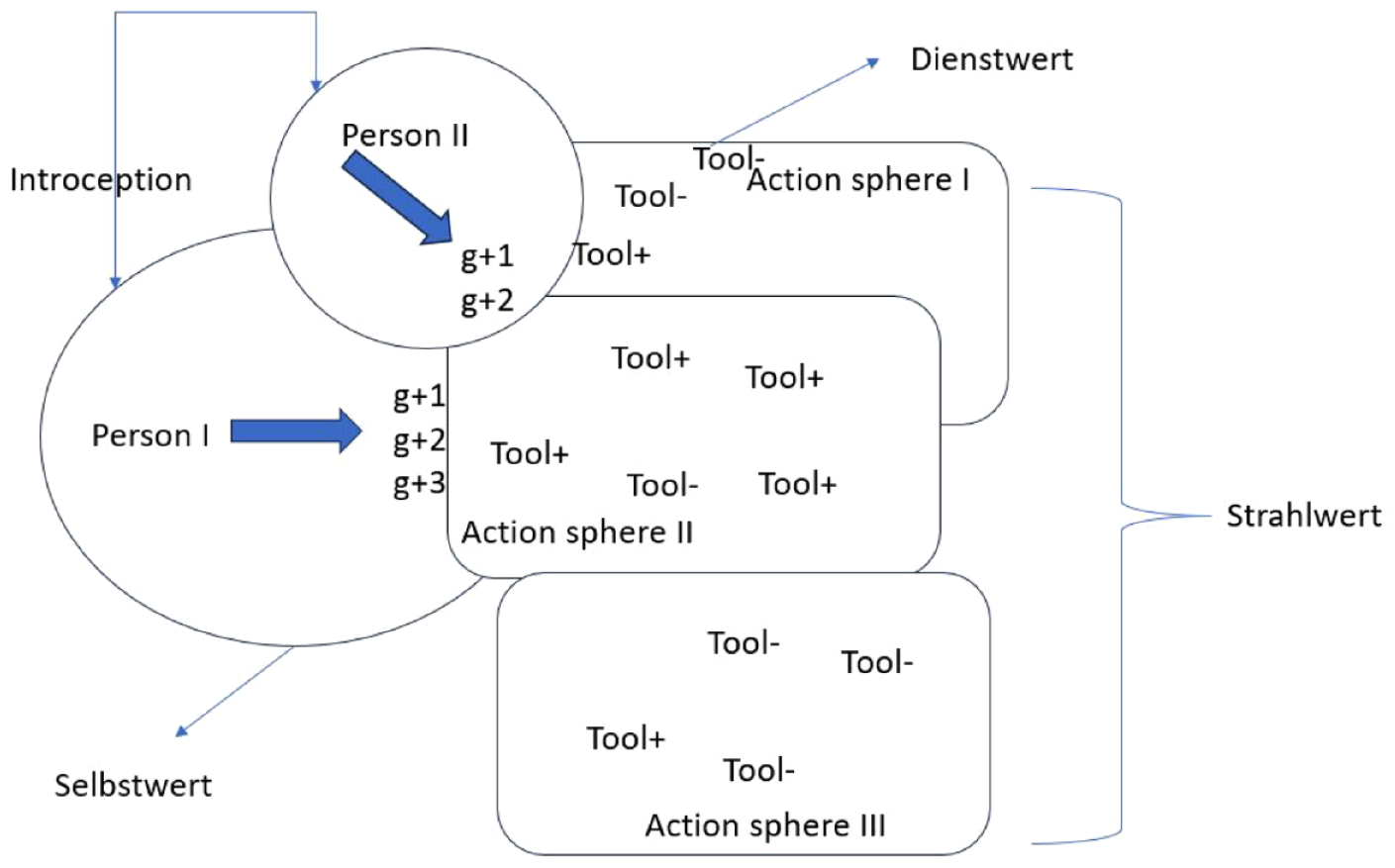
Triadic value interaction of Stern’s critical personalism.
Putting Figure 1 into practice, we might depict the following: David Beckham is not simply a person with his particular self-value, but he was also part of a football team, such as Manchester United (introception). Hence, if we look at the shoes, we do not simply look at the shoes he wore while playing, but the shoes he wore while playing for Manchester United, against, for example, Manchester City. Yet, the shoes showing some particular self-value belong to a particular service value area, namely, football clothes, where some of the clothes are of more value to reach a particular goal than others. Figure 1 shows us that we need to analyze the Sternian values in conjunction with introception, in order to make sense of a person’s actions. Unfortunately, Stern (1924), when laying the foundation of his value theory, separated them too much, which is not surprising given that he wanted to acquaint the reader with different concepts.
What is important for Stern (1935) is the hierarchical nature of his value theory, which means that any kind of psychological analysis needs to start with the power of the self-value): namely, how it radiates in specific action spheres, and how the person makes use of specific features of the environment in order to complete their self-value.
Situating Stern’s notions of signs within his theory of critical personalism
After Stern (1935), signs became an important means for the co-operative endeavor between people to solve things jointly. Here, thought can be fixed easily into conventional means (again signs) that can be used between people. Stern uses the German word Verkehr (exchange, traffic) to illustrate how human beings need to negotiate what they mean with the use of conventional signs, which can vary depending on the person using the sign. Signs are a means of communication, depending on the person and their system of purposes. As such, signs have the features of service value, as they are used for the purpose of moving more closely towards a goal, or the fulfilment of a need. In as much as speech helps a person make themselves understandable and initiate co-operation with other people in the same action sphere, speech has service value.
We have learned through Stern’s (1924) Critical Personalism that a service value is sometimes not the only value appearing when people initiate co-operation. On the contrary, the sign also belongs to the sphere of radiating values, and as such becomes—under specific circumstances—a symbol for the person using the sign. Therefore, the sign gets colored not only objectively, in the sense that it points to a specific thing with a given valence, but it also points back to the person and their system of purposes. The sign has a dual role, therefore, both service and radiating value, simultaneously.
In Figure 1, we can see that a tool (the sign is a specific tool) belongs to a given action sphere, which has been growing cultural-historically. Meanwhile, other people have made use of the tools belonging to the action sphere and have established specific conventions on how to use the sign and when to use it (see in particular Vygotsky, 1994a, 1994b).
This means that a person not only makes use of the tool for their own system of purposes, within their own system of knowledge, but also makes use of the culture and history of previous generations, having incorporated the sign/tool for their various purposes.
This is a feature that is missing in Stern’s (1924) Critical Personology, and something which even Vygotsky has not critiqued. So, when a person uses the tool, they do so for their self-purposes. And in the meantime, the tool has been growing culturally and historically, meaning that previous generations—of which a person is a part, by means of introception—have determined and over-determined the tool with a given function or service value, as well as with their self-value. Therefore, if a person uses speech, they use a sign, and so we get a glimpse into how the sign is a means to an end, as well as indicating for which person it is used, and towards which system of purposes it is linked, together with the over-determination of meaning by the cultural-historical field.
In my writing, inspired by Stern and complemented by Vygotsky’s perspective, I have put speech and the linguistic sign into my system of critical personalism, so that we can investigate differences concerning signs and their use. Linguistic signs, self-value, radiating value, and service value are all participating in a given purpose. It is important to mention that this triadic relationship can vary. For example, a feature of Stern’s terminology can shift temporarily to the foreground, which determines the nature of the sign. Stern illustrates this with what he calls the pure sign (reines Zeichen), in which the service value of the sign predominates the self-value and radiating values:
The symbol + serves no other function than to visually represent the concept of adding two numerical values together, allowing the same individual to repeatedly associate the identical idea with it and enabling many individuals to communicate this identical idea. Chemical symbols, traffic signs, written characters, and the words of Esperanto are other examples of this purely denotative function of schematic representations. (Stern, 1935, p. 376, author’s translation)
Mathematic signs are an example of these pure signs, in the sense that the features of the service value are fully shifted to the foreground, while the self-value and radiating values are only loosely present in the background of the person using the sign. That being said, the sign is fully used as a tool, and the other functions of the sign shift almost fully to the background. The reason I say almost is because there are various examples through which it becomes obvious that the pure signs are not as pure as we might think. It is sufficient to refer to Albert Einstein’s famous equation on relativity, which is undoubtedly connected to his life and his totality of purposes. As another example, a child having issues with mathematics but wanting to succeed might use mathematical signs in the wrong way and begin to cry. The mistaken use of the signs and them crying is more than the mere administration of a pure sign, because we get a glimpse into the child’s self-value. That is why it is often difficult to separate the different functions of the sign, even if one of them predominates the others, according to the writings of Stern (1935).
This brings us directly to the second category of signs that Stern uses for his critical personology. He explains that there is another kind of sign that is predominantly over-determined with concrete Anschauung, translated as illustration:
Simultaneously the words are meaningful in their graphicness; their sonic, motor, and optic features go beyond thought and give it vividness. With that, thought is placed back into the deeply personal and social life of the person. The thought that accompanies house is different from that which accompanies maison, despite meaning the same thing. . . . Through the word imagination, we get a glimpse into the roots of personal and cultural-historical conditions of the person who thinks. (Stern, 1935, pp. 376–377, author’s translation)
Here, we enter an important sphere of the (linguistic) sign, in which the self-value and radiating value overshadow the service value. The sign being used by a person—as understood by the Sternian quote—is more related to the expression of the person and its totality of purposes. A person uttering the sentence my house is beautiful and cozy (while showing the house to their friends) makes more use of the expressive function of speech, and as such the utterance is colored more with self-value and radiating value than with service value. “My house” used as a linguistic sign (in this example) is therefore suffused with all of the person’s purposes, so we get a glimpse into their dynamic system of purposes, for example their pride in their house.
Here, the utterance is fully over-determined with the personal use of the sign, rather than its objective use, and by uttering such a sentence we get a glimpse into the person as unitas multiplex. In other words, we can say that a sign being used solely for a person’s personal means (and their self-value) becomes a symbolic sign, whereas it remains a sign (for example a conversational gesture) when the service value remains at the foreground of its use.
The dialectics of Veranschaulichung (illustration) and Entanschaulichung (abstraction)
Stern (1935) goes further than the mere categorization of different signs, and reports that there is a division between the pure sign and the symbol—a dialectic in its purest form. Having said this, he argues that the linguistic sign is always operating at the intersection of pure sign and symbol, or in other words, Veranschaulichung, or illustration, and Entanschaulichung, or abstraction. This means that a person needs to make use of both functions of speech in order to operate in their everyday lives. In particular, science needs to use laws and rules from Anschauung in order to come up with knowledge that can be generalized, which—in order to test its validity, and to further develop scientific thought and expand or restructure the sign—needs to be applied again and again. This then flows into an actualization of the pure sign that can then be reapplied for scientific purposes. Personal and nonpersonal use of signs are therefore not only complementary but are in a tensive, dialectical relationship that gives rise to an altered sign.
The poet experiences life in its contradictory manner and might suffer, therefore, in particular ways. “Life is suffering” might be an important lesson they want to convey with a poem, and so revisit their experience and try to disclose that experience in a poetic fashion (von Fircks, 2022). Here, Anschauung not only helps to convey a general message (Ent-anschauung) for the poet’s reader, but when the poet writes and feels, they often transform an initial thought into something new and elevated, such as, “life is suffering, but that suffering is necessary to experience the depth of life.”
Anschauung helps them then to transform an initial thought based on Entanschauung, which has a variable, mutable quality, so the sign gets expanded and transformed and might incorporate new everyday experiences, on the basis of which it can be expanded again. Therefore, the (linguistic) sign operates at the division of personal and objective use, and creates a tension that needs to be overcome by the person using the sign.
That is valid not only for science but also for the inquiry into life philosophy, as well as therapy, for example. A person with a maladaptive life pattern (for example, that “the only reason for life is to work”) needs to experience altered ways of life (Veranschaulichung) so that they can reactualize their general life pattern (e.g., “life is work but also relaxation”), which is Entanschaulichung.
Therapy frames this in the words of rectifying experience. But therapy only becomes necessary when the person is stuck in a given maladaptive life pattern (Schneider, 2019; Schneider & Krug, 2010). A person who doesn’t need therapy is able to actualize the life pattern by themselves, or with the help of a partner. Stern deduces from this a particular lesson for pedagogy:
The growing individual must learn not only to fill abstract thoughts with life through visualization but also to gradually loosen and shed the constraints imposed by a very vivid visualization of the breadth and generality of thought. Those who always rely on tangible, countable objects in mathematics will never grasp the true essence of abstract mathematical principles and likewise in other fields. As higher forms of education are considered and as intellectual maturation delves deeper into abstract thinking, the pedagogy of visualization must be balanced by the pedagogy of de-visualization. (Stern, 1935, p. 381, author’s translation)
We have now contemplated the dynamics of a sign. Notably, I have shed light on the processes under which the sign gets structured and restructured, which we located in the specific dialectics of personal and nonpersonal use of a sign or, in Stern’s words, in the division of Veranschaulichung and Entanschaulichung. Now it is time to look at Stern’s system and our temporary expansion of it, from a more systematic perspective. Also, I want to compare it with the semiotic system of Lev S. Vygotsky. Before I do so, let us briefly explain what Vygotsky’s semiotic theory is about.
What Stern is missing in his critical personalism: Inspiration from Vygotsky
Vygotsky argues that the (linguistic) sign is an important means to master one’s own behavior (van der Veer & Valsiner, 1991). He refers to the axiom that humans master the world by means of tools (Vygotsky, 1985a, 1994a, 1994b), which shows that human beings don’t relate to the world by themselves, or with their senses alone. On the contrary, they make use of tools in order to change the environment in a particular way, which feeds back onto their psyche (von Fircks, 2024a). For instance, if a person decides to use a hammer instead of a stone, they will complete a given task more quickly and less tiringly, as well as save resources (understood from a psycho-physiologically neutral perspective).
Something similar applies to the use of signs. As far as Vygotsky is concerned, by using signs, humans alter their relationship towards themselves (Valsiner, 2014; van der Veer & Valsiner, 1991; Vygotsky, 1994a). This means that a sign is not only directed towards the outer world—for instance to initiate co-operation with other people—but becomes an intra-psychological tool to master one’s own behavior (Toomela, 2021). Yet, Vygotsky (1994a) argues that intra-psychologically used signs appear first in and through co-operation, and thus inter-psychologically, before they are turned inwards and used by a person for their specific purposes.
On the way towards interiorization, the sign, as a means, gets transformed and linked to other personal functions, and a particular psychic system emerges with interconnected psychologically higher processes (Vygotsky, 1985b). This, for Vygotsky, demarcates the emergence of the social personality, which is to be found in the specific connections of higher psychological processes. In and through these connections, something new emerges, and using Vygotsky’s terminology, something higher. So, the connection is not just the mere addition of higher psychological functions.
Therefore, the human being appropriates signs that are found in the outer world, which become conventionally established through co-operation, and uses them to master their own behavior. Here, every psychological utterance is a mediated function, either to address another person or to address oneself, because it is only through a sign that the utterance can be expressed (Valsiner, 2014).
Insofar as the signs (tools) have been grown in a specific culture and history, and are thus open to change, Vygotsky’s theory is called cultural-historical. What he wants to shed light on is the dynamic transformation of a concept’s meaning. This is in contrast to Stern (1911, 1914), who argues that the child discovering that everything comes with a name helps them to acquire the ability to find meaning in the world. Vygotsky argues differently. He (Vygotsky, 2003a, 2003c) makes the point that the meaning of a concept gets transformed according to age and the particular environmental demands a child or adolescent is confronted with. In other words, he has a more dynamic understanding of meaning, depending on the child’s environmental challenges (Vygotsky, 2003b, 2003d), as compared to Stern (Vygotsky, 2003a).
Further, Vygotsky argues that the person, when growing up, starts to anticipate and plan their further actions by means of signs (concepts). While in the first stage of linguistic development, the person performs actions while talking and later evaluates those actions by speech, speech is now transferred to the beginning of action or even before (Vygotsky, 1972). So, in order to plan action and to anticipate barriers, resistance, and hindrances, the person makes use of concepts (signs). Through speech, a person’s actions become ordered and targeted at specific things to be mastered in the outer world (Vygotsky, 1972). For that, they need to rely on cultural-historical tools (signs), through which they can plan, carry out, and evaluate the actions, and adjust their anticipation of the next moment.
Those concepts have been grown organically in co-operation with other people and are now turned inwards for the person’s own purposes, in their everyday life. They use the general concept for their daily lives, through which it gets restructured or expanded, but only if they look at the concept from a scientific perspective, analytically and scientifically (von Fircks, 2023c; Vygotsky, 1985b); in which case, “scientific” means that a person can become aware of the concept’s use and manipulate it with insight. For instance, they might ask themselves where to find the boundaries of a concept.
With the scientific perspective, analytically and intentionally (Vygotsky, 1972), a person can check whether or not the concept is appropriate for the action, or they can decide to rely on another one (von Fircks, 2023c). For example, they may have an important task to accomplish, for which they may need a hammer. If they fail to accomplish the task, they will then look at the hammer and the task more intently. They will look at the hammer from a closer, more scientific perspective, because they analyze—critically and insightfully—what is needed in the situation, and might come up with an adjusted concept or tool that can be used for the task.
This is a short summary of Vygotsky’s semiotics, which differs in some ways from Stern’s teachings about the sign. But first let me shed some light on the similarities.
What Stern reports regarding the process of Veranschaulichung and Entanschaulichung is strikingly similar to Vygotsky’s distinction between everyday and scientific concepts, and their dialectical interplay. Vygotsky (2003c) also mentions that school, in particular, helps the pupil to get a grasp of scientific concepts that transform everyday concepts, which in turn become important to navigate through life. Moreover, he mentions that signs become established in co-operation with other people (conventionality), and thus appear first on the interpsychological plane of development.
However, Stern does not argue that the sign turns inwards and becomes a function for the person mastering his or her own behavior. He argues that the sign is significant for attaining one’s goals and fulfilling one’s needs, and thus for the totality of self-purposes. But nowhere does he argue that the sign is interiorized and linked with other higher psychological functions (memory, attention, dispositions) which define the emergence of the social personality (Vygotsky, 2003a, 2003b, 2003c). In his theory, the social sign has no power to alter the person as such, but only to attain their goals and fulfil their needs. Therefore, the sign does not feed back onto the person’s psyche and does not alter it. Hence, Stern does not account for the fact that people alter themselves while using specific signs and tools. In other words, he ignores the vast feedback loops from when a person uses a sign, and how that sign alters their psychic system.
If the person constitutes themselves while using signs and tools, then the signs and tools become linked to the person’s psychic system as a whole, altering its dynamics.
Both Stern and Vygotsky have a point. Let us return to the David Beckham example, showing their potential unity. With Stern, we can argue that David Beckham tried to constitute himself in a particular way (self-value), to play elegant football, incorporating a few fashion ideals at the same time. On the other hand, with Vygotsky, we need to argue that through the interiorization of specific signs, Beckham has altered his own psychic system or personality. For example, he might pay attention differently, giving more attention perhaps to other players, such as Christiano Ronaldo, with a mission similar to his. Here, Vygotsky wants to analyze how the interiorization of signs makes a shift in the psychic system of the person as a whole; something which Stern did not see coming.
But what Stern accomplishes with his writing is that, because it points back to the person using it, the sign can become personally symbolic and physiognomic, and by that we can get a glimpse into their system of purposes. And so, language is not only objective but deeply personal, and we need to bear in mind that when a person expresses a thought through language, they also express their personality. In this regard, Stern urges us to be sensitive to the way a sign is used, either in a symbolic way, showing the self-value of the person, or for the means to an end, which is the service value.
Vygotsky, on the contrary, argues that when a person expresses themself, they express the interiorized social conventions of their cultural-historical field, and so we get a glimpse into the social-action field in which they are embedded.
The personal symbolism is somehow lost or under-represented in Vygotsky’s later writings (van der Veer & Valsiner, 1991). Stern tends to focus more on the enrichment of the world through self-values (von Fircks, 2024a), which is something Leont’ev (1978)—with the notion of personal senses that interact with shared social meaning patterns—wanted to restore. In this article, we have learned that the invention of personal senses might not have been necessary if Leont’ev—or other scholars—had been reading Stern and his complex value theory, including the notion of self-value.
Summary: Understanding the synergy between Stern and Vygotsky
For their Lebnisse and Erlebnisse, a person shows and makes use of a triad of values. This means that they come with a dynamic system of purposes, which can be described by a need or goal hierarchy, with which they act on the outer world and radiate self-value in specific action spheres (radiating values). Within this action sphere, in order to reach their goals and fulfil their deeply personal needs, they make use of signs and tools that are not neutral regarding their goals and needs, but have a particular valence, depending on whether or not they bring the person closer to the goal attainment or need fulfilment. In addition, they have interocepted foreign purposes into their own goal hierarchy, and therefore linked those purposes with self-purposes. Here, the person becomes part of a higher order, while remaining their own person.
Within the action sphere in which the person radiates their self-value, we have seen that the tools and signs are cultural-historically grown (which is the legacy of Vygotsky). So, when the person decides to make use of a given sign or tool within a particular action sphere, we get a glimpse both into their self-value (goal hierarchy) and into the wider social action field in which they are embedded, in which the tools have been co-operatively established.
What is missing in Stern’s writings is not that he doesn’t account for the social “other” being present in the region of the radiating value, but that he misses the fact that they incorporate a social sign, which, when it begins to relate to other higher psychological functions, turns inwards and alters their personality. This, to revise Stern’s critical personalism, may be a particularly important outlook, thereby accounting for the question of what happens when a person interiorizes a foreign value, and how it might change not only their own system of purposes but other connected psychological functions.
Vygotsky, on the other hand, has miscalculated the power of personal goals and needs (van der Veer & Valsiner, 1991) and how they motivate a person to move to a specific position, and appropriate a given tool for their self-purposes. So, when a person starts to make use of a given sign, they do so by way of a particular social and personal background that sometimes, but not always, can interact. Therefore, the linguistic sign is a personal and social symbol, as it mirrors the self-value of the person uttering the sign as well as the social conditions within that process, which reconciles Stern with Vygotsky.
This might have crucial implications, for instance, in the therapeutic domain, as the therapist might negotiate the etiology of the therapeutic issue in the personal or social domain, or in the interaction of both. For instance, an issue might belong more to a problem with a chronically fixed need hierarchy, while if the person has issues in their social interactions and feels a certain pressure from their action field, this might point more to the social realm of problems (systemic therapy; von Fircks, 2023b).
The present paper, in the end, is a first and humble effort to reestablish the notion of signs from a Sternian perspective within his, now systematized, value theory, while complementing that perspective with that of Vygotsky. Stern and Vygotsky can be reconciled, which Vygotsky (2018) never thought was possible. Yet, we have only understood the beginning of their dynamic synergy.
Footnotes
Acknowledgements
Ich danke meinem baltischen Freund Jaan Valsiner für seine bedingungslose Unterstützung meiner Ideen sowie der Korrektur einer vorherigen Version [I would like to express my deepest gratitude to Jaan Valsiner (my Baltic friend), who introduced me to Critical Personalism and supported me throughout the writing process].
Funding
The author received no financial support for the research, authorship, and/or publication of this article.
