




Abstract
Since the late 18th century, an organismic perspective has been contrasted with a mechanistic perspective. In the former, the whole dominates the parts, while in the latter, the parts dominate the whole. An organismic perspective further sees wholes as self-directed processes of progressive formation (Bildung) rather than as static configurations or forms (Gestalten). In sum, the organismic perspective focuses on living, developing, and interconnected wholes, in contrast to mechanical causality. This article explores the roots of the organismic perspective in Johann Wolfgang von Goethe’s scientific work (esp., his morphology), follows its influence through the 19th century, and highlights intersections within 20th-century psychology, particularly Heinz Werner’s organismic–developmental theory. Some key commonalities are a focus on the primacy of the whole, processes over products, the genetic method, (dis)continuities and transitions in development, the primordial unity of the senses, and the making of developmental comparisons. The organismic approach can be used today to revitalize our understanding of the dynamic constitution of culture and mind.
In his Physics, Aristotle (384–322 BC/1970) took living whole organisms as the exemplars for understanding nature as a whole. Nature was composed of form and purpose as well as matter and efficient causes. This was the dominant view in Europe through the Middle Ages but was upended with the Enlightenment. In contrast to a focus on purposeful wholes, many Enlightenment thinkers began to conceptualize the world as composed of elements in mechanical relationship to one another, like a complex machine or clock, where wholes could be understood through efficient causes at the level of their parts. This view grew out of the impressive advances in science and technology, offering new means of predicting and controlling nature. The notion of the living organism lost ground to the idea of discrete matter in motion. By the late 18th century, however, a Romantic 1 rebellion against the Enlightenment had begun, and with it a renewed emphasis on a more holistic and developmental vision of nature and human beings, particularly in German-speaking lands. This was not a return to theological explanations but a new beginning for a science of life.
This article picks up the intellectual history with Goethe’s (1749–1842) holistic scientific thought, at the very moment when the words “biology” and “organism” began to be used as they are today. Although Goethe is primarily remembered as a master poet and literary figure, he himself thought his greatest legacy was his scientific work (Eckermann, 1850, p. 145). Of particular importance here is his morphology, which Goethe coined from the Greek morphe (form) and -ology (study of). In his words, “Morphology may be said to include the principles of structured form [Gestalt] and the formation [Bildung] and transformation [Umbildung] of organic bodies” (Goethe, 1820/1988, p. 57). Thus, morphology for Goethe is the science of development itself, approached through possibilities latent in different kinds of forms and the forces that continuously shape their development. Although first worked out in the study of plants and then animals, it was not long before it was applied to the human personality, knowledge, culture, and society.
In two now-classic papers, Reese and Overton (1970; Overton & Reese, 1973) describe how the mechanistic (reactive organism) model and the organismic (active organism) model are the metaphysical foundations or paradigms through which specific theories are constructed, applied, and interpreted in psychology. From a mechanistic perspective, organisms are inherently at rest until pushed by something external, while an organismic perspective assumes organisms’ inherent activity pulling them forward. As paradigms, they are incommensurate with one another and are not directly testable in and of themselves (Kuhn, 1962). Following their origins in metaphor (i.e., of a machine or organism; Black, 1962), they function as the lenses through which scientists view their subject matter, guiding how data is conceptualized, collected, and analyzed. Given that much of psychology today follows a mechanistic approach, the organismic approach provides an alternative look at many central topics in psychology, such as development, perception, language, culture, and thought.
The present article is structured in two parts. The first part outlines Goethe’s key concepts that reveal his organismic thinking and then briefly considers their influence on 19th-century figures that provide an intermediary step into psychology. The second part then highlights the significance of these concepts for 20th-century organismic psychology, mainly through an analysis of Heinz Werner’s developmental theory. 2 Special attention is given to his study of perception and expression, on the one hand, and language and thought, on the other. Here, concepts from Goethe’s and Werner’s contemporaries are brought into play to fill out the approach’s psychological relevance. Of central interest is the analysis of holistic transformations of living beings from their undifferentiated origins to structured forms and the import of these ideas into psychology. The article ultimately aims to trace key concepts and methodology of an organismic approach in search of ideas to revitalize the study of culture and mind today.
Process over products: Bildung, the genetic method, and urphänomen
When Goethe took up the science of botany, it was dominated by Carl Linnaeus’s (1707–1778) scheme for classifying plant species (Linnaeus, 1758). Within his systema naturæ, nature was seen as a vast taxonomy of fixed and discrete plant species, each having its pigeonhole that in turn was organized under a genus, order, and class. Goethe believed this approach only grasped the static products, not the process of nature. Delineating one plant species from another, through the characteristics of their mature and discrete organs, requires artificially freezing their development (Wellmon, 2010). In contrast, Goethe (1817/1996) notes that
When we study forms, the organic ones in particular, nowhere do we find permanence, repose or termination. We find rather that everything is in ceaseless flux. This is why our language makes such frequent use of the term “Bildung” to designate what has been brought forth and likewise what is in the process of being brought forth. (p. 50)
The German notion of Bildung (formation) is a necessary complement to Gestalt (structured form) and will reappear as an important part of the broader story told in this article. It essentially means the progressive development towards an idea or image (Bild), and carries links to notions of “culture,” “cultivation,” and “education.” 3 This includes the development of the scientist’s own engagement with nature.
Although Linnaeus’s “analytic” approach provided a useful ars memoriae for recognizing diverse species, it offered no “synthesis” of the diverse and expanding findings from the field. For Goethe (1820/1988), analysis in science should lead to synthesis: “the sciences come to life only when the two exist side by side like exhaling and inhaling” (p. 49). The ultimate aim of science is to unify diverse sensory observations and grasp the living whole. To do this, Goethe (1820/1988, p. 74) employs what he calls the “genetic method,” viewing phenomena as they successively come-into-being. The method has two main steps: first, experience a diversity of phenomenal forms, and second, to discover the unity from which they emerge through their various relationships:
If I look at the created object, inquire into its creation, and follow this process back as far as I can, I will find a series of steps. Since these are not actually seen together before me, I must visualize them in my memory so that they form a certain ideal whole. At first I will tend to think in terms of steps, but nature leaves no gaps, and thus, in the end, I will have to see this progression of uninterrupted activity as a whole. I can do so by dissolving the particular without destroying the impression itself. (Goethe, 1820/1988, p. 75)
In Goethe’s “genetic method” the observation of spatial forms can be reconstructed in imagination as a temporal form. The scientist explores relationships between a series of sensory perceptions which are visualized in imagination as a continuous transformation. Goethe called his approach delicate empiricism (Wahl, 2005) in that it relies on appearances but goes beyond them to grasp their essence as a living whole. Goethe thus aimed to overcome Kant’s (1781/1997) distinction between understanding (Verstand) and reason (Vernunft), believing one can reach the creative forces of nature beyond the surface level of phenomena with the genetic method. In this, the scientist is not a neutral observer but must participate in the phenomenon through their own subjectivity, becoming a flexible instrument for comprehending nature. Goethe (1820/1988) describes this using organismic language: “Every object clearly seen opens up a new organ of perception in us” (p. 3). Thus, the “genetic method” implies not only studying phenomena as they successively come-into-being, but also implicates the scientist’s own self-discovery, their Bildung.
Through this process the scientist constructs a dynamic image or concept of nature that captures the relationship between part and whole, as an activity of coming-into-being rather than a static thing. Goethe calls this an Urphänomen (archetype), using the prefix Ur- to mean the primordial core of a phenomenon from which diversity emerges. Bortoft (1996) argues the Urphänomen concerns identifying the part that best reveals the whole, as a way of finding the universal in the concrete. It should not be understood as an abstraction of features common to already finished forms—such as the average of a variety of fully developed plants—but as a dynamic emergence from an embryonic beginning (Bortoft, 2012). When Goethe began his investigations on plants, he apparently believed he might find a real example of the primordial plant (Urflanze) on his Italian travels, but eventually realized he was in fact after an idea. In 1787, he enthusiastically wrote to his friend and mentor Johann Gottfried Herder (1744–1803):
The primordial plant would be the most wonderful creature of the world, for which even nature will envy me. With this pattern and the key to it, one can invent more plants into infinity, which have to be consistent, i.e., which, even though they do not exist, could exist. (Goethe, 1816–17/1970, pp. 310–311)
Goethe (1795/1977) identified the dynamic idea of a leaf as the Urphänomen from which all the parts of a plant develop: “All is leaf, and through this simplicity the greatest multiplicity is possible” (p. 58). Here the leaf is a symbol for the primordial unity of a plant, rather than as a fully formed foliage leaf. Plants begin as little differentiated seed leaves which go through various transformations to arrive at different organs—the scientist explores these multiple transformations both forward and backward. In addition to this, the leaf is a fitting Urphänomen in the visibility of its veins that transport fluids through the plant, which are essential to its dynamic unity from beginning to end. Again, “nature leaves no gaps” (Goethe, 1820/1988, p. 75)!
Polarity and intensification: Seeds of an idea in the Metamorphosis of Plants
Like the caterpillar becoming a butterfly, Goethe’s “metamorphosis” aimed to describe the no less dramatic transformations of plants in the course of their development and explain the formative forces at work. In the introduction, he sets out to identify “The laws of transformation according to which nature produces one part through another and achieves the most diversified forms through the modification of a single organ” (Goethe, 1790/2009, pp. 5–6). The key general forces at work in this transformation are what he calls polarity and intensification. Polarity is a term borrowed from Kant (1786) that refers to dynamic antagonism of material forces existing in nature, such as repulsion–attraction in magnetism or expansion–contraction in plant development. On their own, polarities create only simple (nonorganic) forms, but when combined with the spiritual force of intensification (Steigerung) they can generate the most complex forms. Intensification is the “ever-striving ascent” of organic forms to actualize themselves through a series of stages. The two forces together lead to progressive differentiation, articulation, and specialization.
This progressive process can be clearly seen in the development of a flowering plant, which goes through six alternating phases of expansion and contraction that lead to the formation of different organs (Figure 1). From a contracted undifferentiated seed (a), there is an expansion giving rise to seed-leaves (cotyledons; b). The stem then shoots up between them, continuing this expansion phase, with ever-more complex leaf forms jutting out from the stem on the ascent (c). The second contraction occurs at the top of the stem, when a set of cupping leaves form a calyx, which protects the petals as they grow within (d). The opening of the flower petals or corolla signals a second expansion (e). These can be seen as more delicate, colored leaves. This phase is followed by a contraction that forms the plant’s sexual organs within the corolla (f). In some plants, one can clearly identify intermediate forms of plant organs between petals and stamen (Figure 2), as well as sometimes between calyx leaves and flower petals. With pollination there is a new expansion of fruiting, which also contains within it the final contraction in the form of a seed (g). While these are described and drawn as phases, it is important to remember that the aim is to analyze them as a continuous transformation, focusing on intermediate forms.
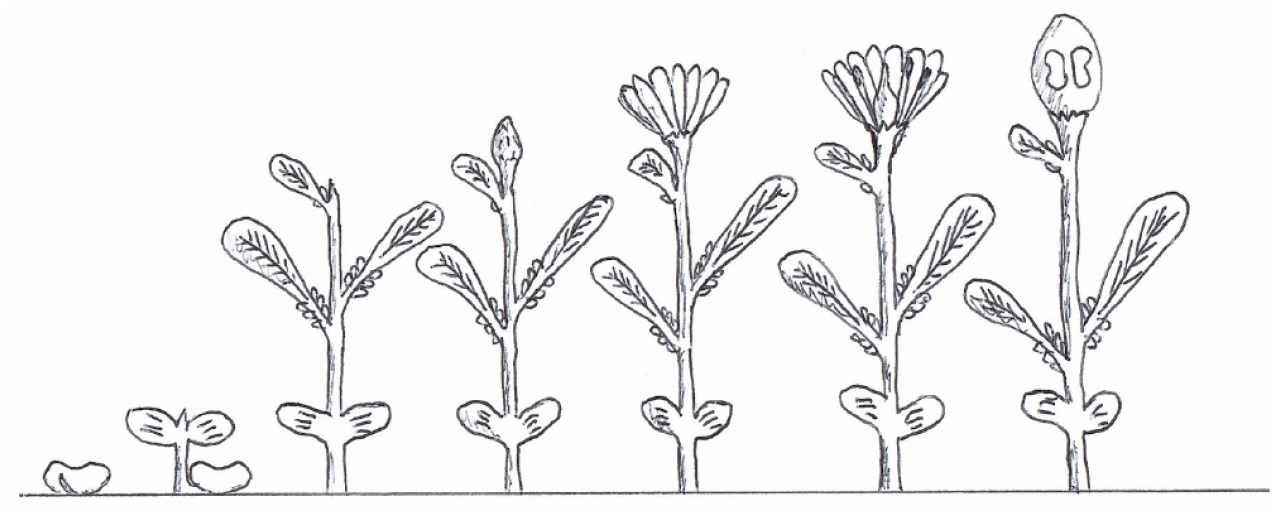
Steps in the development of flowering plants (drawn by author).
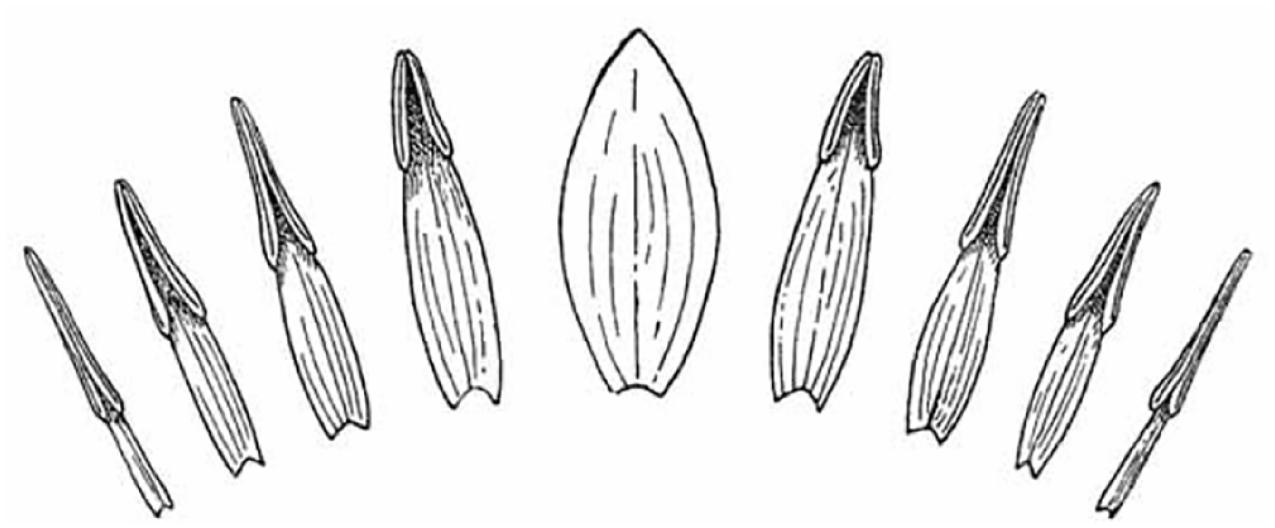
Successive transformation of petal into stamen in the water lily.
Throughout this unfolding process of expansion and contraction a single organ metamorphizes into a great variety of ever-more complex forms. This diversity is also partly generated from the plant’s “dialogue” with its environment. Development of a plant does not happen automatically; it is not simply an internal unfolding but is dependent on environmental conditions, which can lead to progressive, regressive, and accidental forms, as well as hampering or acceleration of development—for example, “frequent nourishment hampers the flowering of a plant, whereas scant nourishment accelerates it” (Goethe, 1790/2009, p. 23). In contemporary parlance, he was advocating an epigenetic rather than preformationist approach or, even better, a synthesis of the two. Thus, in contrast to standard readings of later organismic thinkers like Hegel (1770–1831), Goethe clearly recognized the contingent and open-ended nature of development whether one was speaking of plants or individual human lives (the latter can be clearly seen in his novels, such as Wilhelm Meister’s Apprenticeship 4 ; Goethe, 1795–1796). In both cases, we must speak of wholes embedded and developing within larger developing wholes.
Morphology as a general science
“Form is moving, a becoming, a passing thing. The doctrine of forms is the doctrine of transformation. The doctrine of metamorphosis is the key to all signs of nature.” (Goethe, as cited in Richards, 2002, p. 454)
In the case of organic forms, the whole determines the parts, whereas with inorganic forms the parts determine the whole. Should the unity of an organism be destroyed, it cannot be reconfigured, while minerals can be broken down and recollected to create the same form. This is because organic beings have a “formative impulse” 5 (Bildungstrieb) that holds them together in the face of external forces that would otherwise lead to the dispersion of their parts. Within organic forms, plants develop by transforming the same organ through successive stages (i.e., the symbolic leaf) while animals develop their organs simultaneously (Richards, 2002). Part of a plant can generate a whole new organism, but this is impossible with animals (except in early little-differentiated, embryonic stages). Thus, the Urphänomen of the animal would be a more complex idea than that of the plant. Goethe began to pursue the project not long after his work on plants, and employed the same genetic method of comparing a series of forms both within an organism’s development and across different species.
Although Goethe aimed to include insects in his Urtier and even did experiments on their metamorphosis, his main investigations were on the comparative study of the bone structures of various vertebrates. They are the hard foundations on which the soft tissues rest and thus a fitting Urphänomen. But we must be careful here to note that Goethe approached them as a series of forms in transformation rather than as static adult structures. Many of those who followed Goethe, by contrast, had a nondevelopmental interpretation of the idea. 6 Most notably, Richard Owen (1804–1892) saw the Urtier as an abstract spatial scheme for comparison that reduced all skeletons to their lowest common denominator (viz., a string of vertebra). Owen (1843) coined the notion of “homology” to describe how a similar part within the overall structure of the animal may come to serve a variety of different functions across species: the forelimb becomes a flipper for swimming in a Dugong (marine mammal), an instrument for burrowing in a mole, and a wing for flying in a bat (Figure 3). Similarly, different organs may serve an “analogous function,” such as how oxygen intake is accomplished through lungs in mammals and gills in fish.
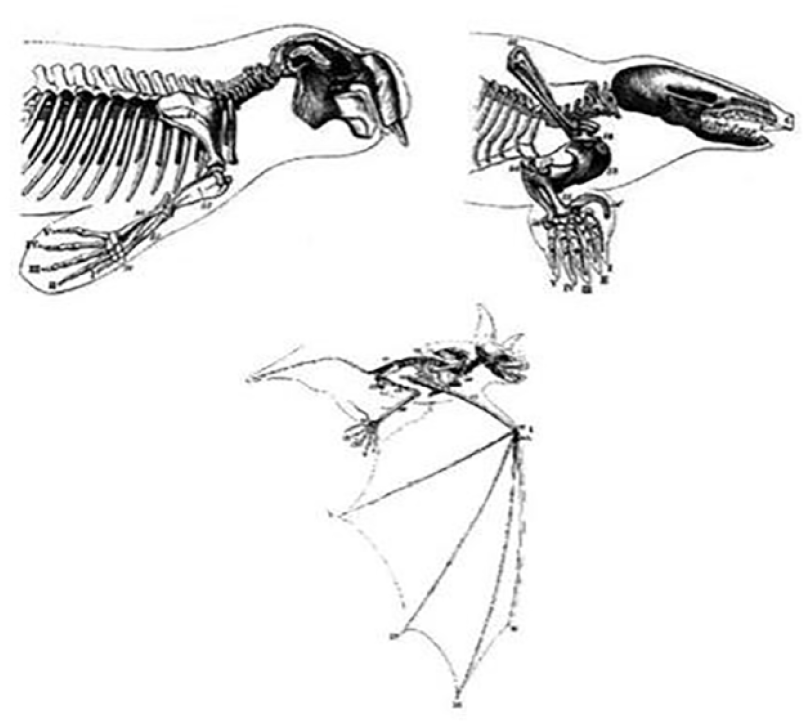
Homology of vertebrate limbs.
In contrast to Owen, Goethe’s focus was not on a spatial scheme to view mature skeletons but transformations of a series of forms within a living process (Brady, 1984). Starting from adult skeletons can lead to false conclusions, such as the belief that humans were distinct in not having an intermaxillary bone in the upper jaw—in fact, the bone simply becomes fused in human development. In 1784, Goethe had himself discovered the intermaxillary bone in humans (or the “Goethe bone”) and thus further affirmed continuity between humans and other animals. It is a good example of Goethe’s method of finding a part (like the leaf) that gives the scientist an experience of totality and triggers a transformation of themself (Safranski, 2017). The intermaxillary bone is also interesting in that it houses the teeth and thus expresses the dynamic life of the whole animal—for example, whether it chews on grass or other animals and how it catches them. There is a harmonious relationship between an animal’s form, its inner force, and its unique relationship to the environment, or external force. This can in part be seen as a precursor to Darwin’s theory of evolution.
From his morphological investigations, Goethe put forward a general principle of all development (as a progressive formation or Bildung) to compare forms across species and in how different species change from their embryotic beginnings to adult forms:
The less perfect the creation, the more its parts are alike or similar and the more they resemble the whole. The more perfect the creation the less similar its parts become. In the first instance the whole is like its parts to a degree, in the second instance the whole is unlike its parts. The more similar its parts, the less they will be subordinated to one another. Subordination of parts indicates a more perfect solution. (Goethe, 1820/1988, p. 64)
Development thus proceeds from an undivided whole towards increasing differentiation, dissimilarity among parts and centralized organization. The flowering plant grows from an undifferentiated seed into a form with increasingly distinct parts, organized around the stem. According to Goethe’s principle this would be a more developed organism than a fern, whose parts are more similar to each other and not integrated through another part like a stem. Animals can also be considered more developed than plants for their centralized structure and distinct organ systems, especially those with a complex central nervous system. Within animals, a beetle can be seen as more developed than a centipede in that its parts are more unlike each other—for example, its front, mid, and rear sections are quite distinct. The beetle itself develops from a larva, whose parts are similar. Below, we will see how this comparative concept of development was foundational for the psychologist Heinz Werner (1948, p. 39), who approvingly cites it in his magnum opus.
But before moving on to 20th century psychology, it is worth noting some examples of how Goethe’s morphology was already being applied to many areas outside of biology in the first half of the 19th century. Goethe himself understood the development of knowledge in terms of increasing differentiation and specialization of fields, which we should nevertheless aim to integrate at a higher level (Wellmon, 2010). His friends Carl Gustav Carus (1789–1869) and Wilhelm von Humboldt (1767–1835) similarly applied Goethe’s morphology to the mind and language, respectively. Carus (1831) used the genetic method to theorize the mind as a progressive differentiation within nature: “Mind (Geist) is not something apart from nature; it is only nature’s purest creation and therefore its symbol, its language” (p. 49). Against a psychology that splits the mind from the world and into separate faculties, he aimed to show its holistic emergence through a series of ascending levels that proceed from the unindividuated unconscious (Unbewussten) to a structured consciousness. He is often credited with being one of the first to give central importance to the concept of the unconscious, 7 beginning his book Psyche with the statement: “The key to understanding the conscious life of the soul lies in the realm of the unconscious” (Carus, 1846, p. 1). Likewise, Humboldt (1836/1988) famously argued that language “is no product (Ergon), but an activity (Energeia). Its true definition can therefore only be a genetic one” (p. 49). He approached language as a dynamic and interconnected whole that provided a “formative organ of thought” (p. 53) for human beings, thereby highlighting its relationship to culture and mind. Moreover, his studies aimed to understand languages completely different from Indo-European form—first Basque and at the end of his life, the Kawi language of Java—with the ultimate goal of arriving at unity in diversity of linguistic form. To this end, he identified pronouns (e.g., I, thou, s/he) as the Urphänomen, which indicate the speaker’s reflective position in language vis-à-vis others and the world (see below). Humboldt’s work was key in the later development of Völkerpsychologie and thereby the cultural branch of psychology (Jahoda, 1992).
Towards a holistic developmental psychology: The affective depths of experience
Neither things nor ourselves find full expression in our words. (Goethe, 1820/1988, p. 26)
In the early 20th century, there was a renewal of holistic thinking in German-speaking lands (Harrington, 1996). Goethe’s ideas were influential to many different schools of psychology here. Most are today familiar with the Berlin School of Gestalt (“form”) psychology (associated with Wertheimer, Köhler, and Koffka), which retains Goethe’s holistic and phenomenological focus (Ash, 1995). However, it was the second Leipzig School of Ganzheitspsychologie 8 (associated with Krueger, Sander, Volkelt, and Wellek) that incorporated Goethe’s developmental or genetic perspective, and was the main contemporaneous influence on Heinz Werner. 9 Furthermore, the Berlin School took their inspiration primarily from physics and thereby emphasized objectivity in perception, while for the Leipzig School, aesthetics was the key and as such they highlighted the central role of feelings in human experience (Diriwätchter & Valsiner, 2008; Wagoner, 2011). Ganzheit-psychologists theorized that unstructured feeling-based wholes are the ground upon which structured perceptions and concepts emerge—and as such included structured gestalts (of the Berlin School) within a wider theoretical framework. This idea of unstructured feeling wholes goes back to Herder, who described “the origin of language” in a sensorium commune: “Where did [humans] take the art to alter what is not sound into sound?. . . The words: smell, tone, sweet, sour etc. all sound as if one felt them; for what other than feeling are all senses originally” (as quoted in Van der Veer, 2005, p. 77). According to this idea, the most basic level of experience is characterized by a unity of the senses in embodied feeling, which only gradually differentiates into distinct modalities—an idea currently in fashion to explain synaesthesia and intermodal metaphors. Werner (1934/1978c) himself reviewed experimental evidence showing the close interconnection between sense modalities and concluded by saying that Herder’s concept of “the unity of organismic functioning” could now be confirmed against Condillac’s (1714–1780) reduction of psychological acts to “discrete sensations” (p. 167). Thus, for both Ganzheitspsychologie and Werner the aesthetic phenomena and the expressive dimension of the human psyche (the primordial “unity of the senses” in feeling) became an Urphänomen from which to understand a wide range of different psychological functions, such as perception, thought, language, and personality. 10
This is already visible in his first book, where Werner (1919) uses the idea of an unstructured felt-background to human experience as a means of understanding the origins of metaphor (i.e., its Urphänomen). He highlights the need for a psychological as opposed to a logical approach to metaphor, thereby bringing to the fore the concrete lived experience of metaphorical incongruity. This contrasts with a focus on how semantic categories overlap and interact in some virtual space of mind. The latter logical approach has become dominant today and is particularly evident in Lakoff and Johnson’s (1980) influential conceptual metaphor theory, which understands metaphors through their semantic content (e.g., “life is a journey”), but not in the concrete process and context of metaphorical use and comprehension (Cornejo et al., 2013). By contrast, Werner’s psychological approach conceived metaphor as arising within a concrete situation of avoiding a tabooed subject, such as sex or death. The taboo he speculated comes from people’s perception of a formless spirit that inheres in things, which he calls pneuma—going back to the stoics. Pneuma literarily means “breath” in ancient Greek and by analogy “spirit” or “soul” in a religious context. It thus highlights the felt-depth of experience that cannot be fully articulated in words, which is most clearly visible in metaphors. Werner (1919) used extensive ethnographic evidence to show that pneuma is perceived by so-called “primitive people” as a kind of invisible agent that permeates things, expands beyond them, determines their character, and can be passed on through contact and proximity. But by no means is it absent from so-called “advanced” societies: people touch statues with good pneuma for luck and avoid the number 13 because it carries bad pneuma and therefore is taboo.
In Werner’s mature work, the notion of pneuma is replaced by that of “physiognomic perception,” coming from the Greek word for face. Faces are primarily perceived in terms of their dynamic, emotional, and expressive qualities, such as being sad or happy, before we notice the particular shape of a nose, mouth, and chin. Werner (1927/1978b) argues that “There are . . . two ways of perceiving. First, an original physiognomic one and, second, an advanced one which is conceptual-objective-technical” (p. 150). The first is more holistic and global (i.e., a sensorium commune), while the second is analytic and differentiated. In Levy-Bruhl’s (1910/1926) terms, physiognomic perception is a mode of emotional participation with things. This is in contrast to understanding them in terms of objective conceptual relationships, where the world is seen in terms of matter-of-fact states of affairs, independent of perceiver and their state of mind. Perceived physiognomically, the color red, for example, is related to a person’s individual and unique associations; possesses dynamic qualities (e.g., is full of life, passionate); is expressive (e.g., of strength); and is a multimodal experience, involving one’s entire body (Werner, 1927/1978b). In contradistinction geometrical–technical perception is fixed, conceptual, and limited to a single sense modality. To take another example, consider the two lines in Figure 4. Most people would not have trouble perceiving them physiognomically: the left tends to be seen as “happy” or “joyful” and the right as “sad” or “depressed.” These qualities are perceived directly as belonging to the lines, rather than something derivatively assigned to them: they are simultaneously “out there” and “in us.” In this way, Werner (1948) argues that physiognomic perception is more basic than anthropomorphism and can help explain it: when children say that the sun is happy, a tree is sad, or a cup lying on its side is tired, they are not making secondary inferences but directly perceiving these qualities in the objects. According to Werner, this mode of perception with little differentiation between subject and object is dominant in children, people in so-called “primitive cultures” (in today’s terms, “traditional societies”), and those with psychopathology, which brings us to the comparative component of his theory.
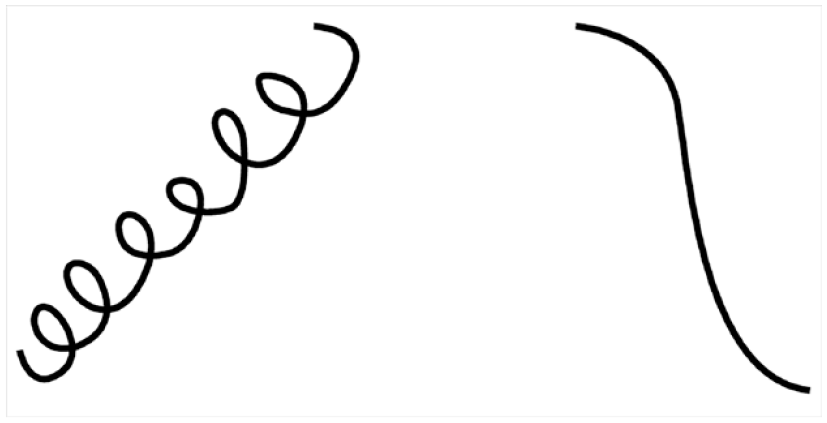
Expressive lines (inspired by Werner & Kaplan, 1963).
Differentiation and hierarchical integration as a framework for comparison
Every creature is in all its parts one living co-operating whole. (Herder, 1785/1966, p. 261)
Like Goethe’s (1790/2009) The Metamorphosis of Plants and Carus’s (1846) Psyche, Werner argued that the mind can be understood as a progressive formation of levels, in which higher levels develop out of less differentiated lower levels, while simultaneously continuing to depend on them. Werner and Kaplan (1963) quote Hegel’s Lectures on Philosophy of History approvingly on this point:
The life of mind is a totality of levels, which on the one hand exist side by side, but which on the other, appear transitorily one after the other. The moments which the mind seems to have left behind actually exist in it at the present time in full depth. (p. 8)
Similarly, Werner (1919) much earlier wrote: “There is a general developmental law that deeper levels of consciousness and culture are preforming certain mental forms [Gestaltungen] which are taken up again in higher stages of development when needed and used for higher purposes” (p. 3). For example, mental imagery comes to serve conceptual thought later in development, giving it a new function within the child’s psychological system. The notion of genetic levels is needed to consider some functions as “lower” and “higher” or “primitive” and “advanced” as well as to analyze how one level comes to regulate another.
In his article, “Process and Achievement,” Werner (1937/1978a) describes how the same psychological function can be fulfilled through different levels of organization—similar to the biological concept of analogous function (see above). This implies that development is not simply the gradual growth of a single function, such as abstraction, but that this activity develops through a series of qualitatively different and ascending levels: “development should be conceived as a transformation of one pattern or process into another” (p. 31), as in Goethe’s symbolic leaf. Werner gives the example of the ability to apprehend objects according to constant properties, such as shape, color, and size. This is first accomplished physiologically through the eye’s adaptation (e.g., to varying illuminations), which is followed by the emergence of a perceptual level (e.g., picking up Gibsonian environmental invariants), and then later a conceptual level (e.g., knowing that chalk is white) that most effectively fulfils the function. Moreover, the emergence of a new functional level typically leads to a temporary decrease of effectiveness or achievement in performing the function, as there is a process of de-differentiation before a re-organization and higher synthesis can occur (see Figure 5). Werner further argues that should functioning at lower levels breakdown, this will in turn disturb the function on higher levels. For example, when configuration of the sensory field is impaired due to a brain injury, this will hamper the person’s ability to make higher order abstractive judgments. The latter “higher” parts depend on the former “lower” parts, much like the petals of a flowering plant depend on the stem, leaves, and roots.
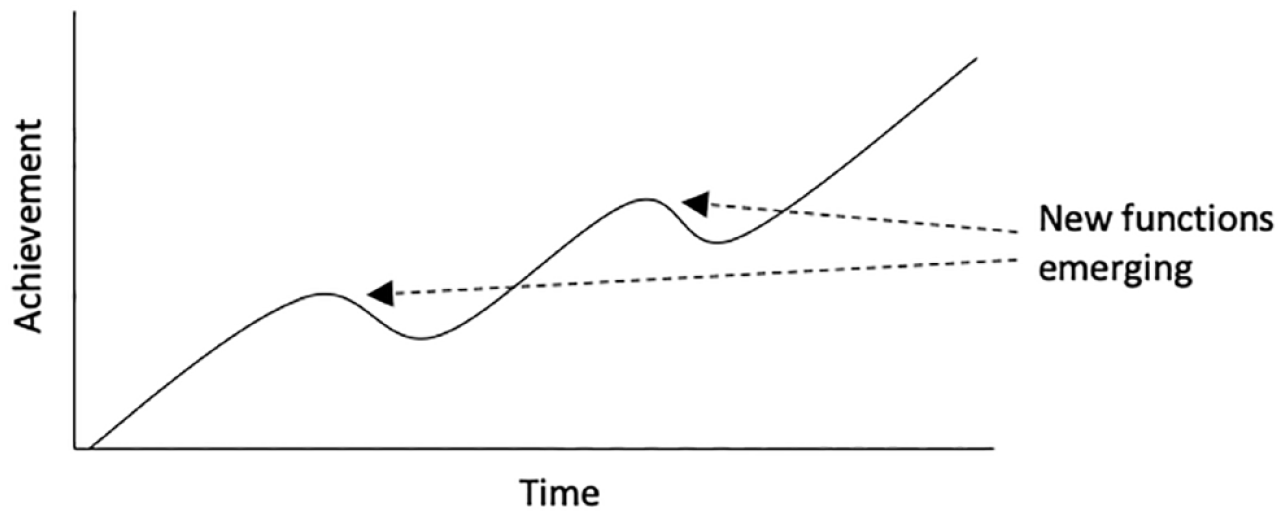
Relationship between process and achievement.
Following Goethe’s general idea of developmental comparison quoted above, Werner (1957) postulated the orthogenetic principle. It states that “wherever development occurs it proceeds from a state of relative globality and lack of differentiation to a state of increasing differentiation, articulation and hierarchical integration” (p. 126). The emphasis on differentiation and articulation implies that the whole divides and its parts become distinct from one another (e.g., cell types in the developing embryo), while hierarchical integration implies a centralizing organization such that one function comes to regulate another (e.g., one organ system—most notably, the nervous system—regulates others). Ortho- means right, implying a general and abstract norm of development, wherein we will discover a diversity of specific developmental trajectories. Werner is at pains to point out that the orthogenetic principle concerns formal types or patterns of mentality found at different mental levels and does not imply retracing an actual developmental sequence. Moreover, he is clear that “primitive” should not be understood in an evaluative sense and that these comparisons do not imply the notion that “ontogeny recapitulates phylogeny” (Haeckel, 1866) nor a unidimensional line of cultural development (e.g., Tylor, 1871). Rather the word is part of a framework for describing the level of differentiation between subject and object, and posing hypotheses about the conditions under which it will manifest (Werner & Kaplan, 1956). 11 In this way, magical thinking is categorically a primitive form of thought, which can be found in any society. The empirical task is to specify the conditions under which it appears.
The diversity of forms of thought found across the globe, at different mental ages, within the same person under different conditions and in mental pathology is an empirical fact that an inclusive psychology must grapple with. Werner (1948) transitioned seamlessly between these domains, identifying the “primitive” characteristics in all of them. His magnum opus proposed several polarities to situate phenomena in terms of developmental level, all pointing back to the general degree of differentiation. These include two polarities focused on the structure of the whole: global-articulate (diffus-gegliedert) concerns whether clearly formed parts are articulated or the whole remains diffuse in character, and vague-clear (verschwommen-prägnant) identifies if the whole is clearly seen or not. The Aktuelgenese experiments of Ganzheitspsychologie, for example, deliberately create unclear conditions for perceiving figures, so as to study participants’ affectively charged construction of them (Diriwätchter, 2009; Wagoner, 2009). Other polarities highlight the meaning and function of the whole, such as indefinite–definite (unbestimmt–bestimmt) and syncretic–discrete (komplex–abgesondert). Dreams combine two normally discrete images in one and are thus syncretic. The English edition also adds polarities concerning dynamic properties of the whole, such as rigid–flexible and labile–stable. These polarities were particularly important following Werner’s (1946) studies of mental retardation, while at the Wayne County Training School. Valsiner (2005) points out that Werner’s inclusion of these different six polarities in the different German and English editions of the book is itself unstable or labile. He also notes that while the polarities can be used to locate the developmental level of phenomenon, they do not reveal the process mechanisms of development. 12
Psychological distancing: The emergence of the symbolic function
We have never been human beings until we have lived to the end of our life; the bee, on the other hand, was a bee from the moment it built its first cell. (Herder, 1772/2002, pp. 84–85)
Compared to other animals, human beings are extremely weak and dependent creatures from birth, and even in their adult form they lack specialization in terms of sensory acuity and physical abilities. For Herder (1772/2002), human beings’ initial lack of differentiation was precisely their strength: first, because it made them inherently social beings, and second, because it created a developmental potential. Left unfinished by nature, humans must progressively form themselves in and through culture. This uniquely human space of development was, according to Herder, made possible by reflexive thought, which is coeval with speaking a language. His critique of earlier Enlightenment philosophers of language, especially Condillac, was that they had missed this essential difference between the vocal expressions of humans and other animals. Herder’s ideas initiated a revolution in the philosophy of language (what has been called the “expressivist tradition”; Taylor, 2016) that was further developed by Humboldt (1836/1988) and other German speaking notables (for an extensive review see Forster, 2010, 2011). 13 In contrast to the Aristotelian theory of language, the expressivists believed thought contents cannot ultimately be separated from the linguistic forms that express them, but rather the two mutually shape each other in the concrete activity of speaking. As such, different languages come to express communities’ distinctive “worldviews” (Humboldt, 1836/1988). Words are not neutral containers for the communication of already existing thoughts, but as Vygotsky (1986) would later put it: “The relation between thought and word is a living process” (p. 255). Werner’s work explicitly builds on this expressivist tradition and breathes new life into it through rich empirical studies on the interplay between cultural forms and human development (Müller et al., 2013).
In Werner’s last major work, Symbol Formation: An Organismic–Developmental Approach to the Psychology of Language and the Expression of Thought (Werner & Kaplan, 1963), he and Kaplan set out to extend the expressivist approach to not only consider vocal patterns (i.e., language in the typical sense) but also various other symbolic media, such as the expressive lines seen in Figure 4. Building on Herder’s distinction, they identify two forms of human–world functional relationships: “things of action” (signs) and “objects of contemplation” (symbols). The former is pragmatically oriented to elicit or inhibit action, while the latter is cognitively oriented to knowing. This new function emerges through the mediation of symbols that interrupt and delay immediate reactions, creating distance between person and environment. Werner’s Hamburg colleague Ernst Cassirer (1944) went so far as to argue that “Physical reality seems to recede in proportion as [human beings’] symbolic activity advances. Instead of dealing with the things themselves [humans are] in a sense constantly conversing with [themselves]” (pp. 24–25). Symbols are qualitatively distinct from signs, but they also come in forms more or less closely tied to the immediate situation. Human development could be conceptualized as achieving greater distancing from the environment through more abstract symbols (Zittoun & Gillespie, 2015). 14
The child begins in a presymbolic “primordial sharing situation” of child–mother–object (Werner & Kaplan, 1963, p. 42ff). This minimal social situation does not so much involve communication between two people but their mutual engagement in shared lived experience, where organismic qualities like facial expression, gaze direction, bodily posture, gestures, and prosodic sounds come to the fore (Cornejo, 2021). For example, when a bird flies in front of parent and child, both will be simultaneously caught up in the dynamic event as a felt experience. These sorts of expressive coexperiences are the ground upon which symbolic representations emerge. McCune (2010) describes how a child refers to her grandmother as “rockie-rock” because she would sit with the child in a rocking chair saying these words. This early symbolization refers less to the grandmother as such and more to the global situation that they share together, with its dynamic and expressive qualities felt in the body. The I–You–It relationship in symbol formation (an Urphänomen for Humboldt) is only minimally differentiated at this stage of development. Werner and Kaplan (1963) draw on previous studies of children’s development to show that their language tends to begin as a mimetic facsimile to the referent, using onomatopoetic sounds (e.g., a car is “vrooom vroom”). This is followed by symbols that are still externally “similar” to their referent, but through a different sense modality: in other words, “phonic properties may ‘synaesthetically’ represent shapes, sizes, or colors of figures (for example, ‘zig-zag’)” (p. 48). This level of symbolization points to Herder’s notion of the sensorium commune. Only at a late stage in development are conventional symbols used, in which there is an arbitrary connection between vehicle and referent, at least at a surface level. Since Saussure (1916/1959), language has been characterized by arbitrariness (between signified and signifier) and convention (where pairing is done on the basis of community consensus). Werner and Kaplan (1963) show that these are developmental achievements and only apply to the “outer form” of language, not its “inner form”—that is, how it is experienced. We do not “acquire” a language; we embody it! Thus, in contrast to starting from adult language, a developmental (or genetic) perspective brings the organismic matrix of meaning to the fore through an analysis of language’s early embodied and situated forms.
This organismic matrix is still active in adult language use but is no longer visible due to the distancing between inner and outer forms of language, a distinction that can be traced back to Humboldt (1836/1988). Inner form is interpreted by Werner as physiognomic. In addition to the above developmental observations, Werner and Kaplan give other evidence for the continuing inner vital connection between symbol and referent, for example: (a) experiments showing that words are perceived to have dynamic–vectorial qualities, such that upward connotating words (e.g., “rising”) require the participant to adjust their position downward to see them at eyelevel (Kaden et al., 1955); (b) there is a lapse of word meaning when the word is repeated continuously, severing the dynamic organismic link; (c) the widespread cross-cultural belief in “word magic,” where it is believed a word can be used to directly manipulate the thing it refers to; and (d) people can report the physiognomic qualities of words (see esp., Werner, 1932). All this points to what the authors call a “dynamic schematization” or “twin form building activities” in symbol formation, where form and content mutually shape each other in the act of speaking. The authors intentionally do not use the more common term “psychological set,” as it is overly static and only captures the overlap between fields, not their mutual transformation.
It could be asked at this point how are we able to effectively communicate with others, given the subjective grounding of symbol meaning in organismic processes. The answer is that language tends toward a more abstract and conventional form precisely to communication with others across greater distances. When language becomes an autonomous system (possessing its own organizational rules), it breaks out of the narrow interpersonal niche of communication. By contrast, inner speech (that is, communication with oneself) takes a very different, less distanced form that most effectively accomplishes the function of thinking for action. Following Vygotsky (1986), Werner and Kaplan (1963) describe how inner speech gradually differentiates from external speech toward a form characterized by silence (inaudible), condensation (abbreviation, ellipse, syntactic incompleteness, confluence of meanings), and sense domination (word connotations dominate denotations). Their model of symbol formation can thus be summarized as having three polarities: (a) symbols and referents, (b) inner and outer forms, and (c) addressor (agent) and addressee (other). Figure 6 is an early version of the model they develop to express the “dynamic schematizing” between these polarities. Psychological development implies increasing distancing between them—for example, as “the addressor matures, the addressees change from parents to peers to generalized others [see Mead, 1934], the referents [objects] become increasingly complex and abstract, and the symbolic vehicles [symbols] are of an increasingly conventional and communal nature” (Werner & Kaplan, 1963, p. 40). It is worth noting that triangular models are ubiquitous in sociocultural psychology, but that there are typically two triangles implicit in them: self–other–object and self–symbol–object (Zittoun et al., 2007). Werner and Kaplan’s (1963) four-sided figure brings these dimensions together and adds the dimension of inner–outer form (dynamically constructed between agent–symbol–object). The distinction between inner–outer form has been unduly neglected probably because of an automatic association of “inner” with Cartesian mind–body separation, which organismic theory is opposed to. Psychology needs a notion of subjective, lived experience that precedes and grounds cultural forms, including verbal language.
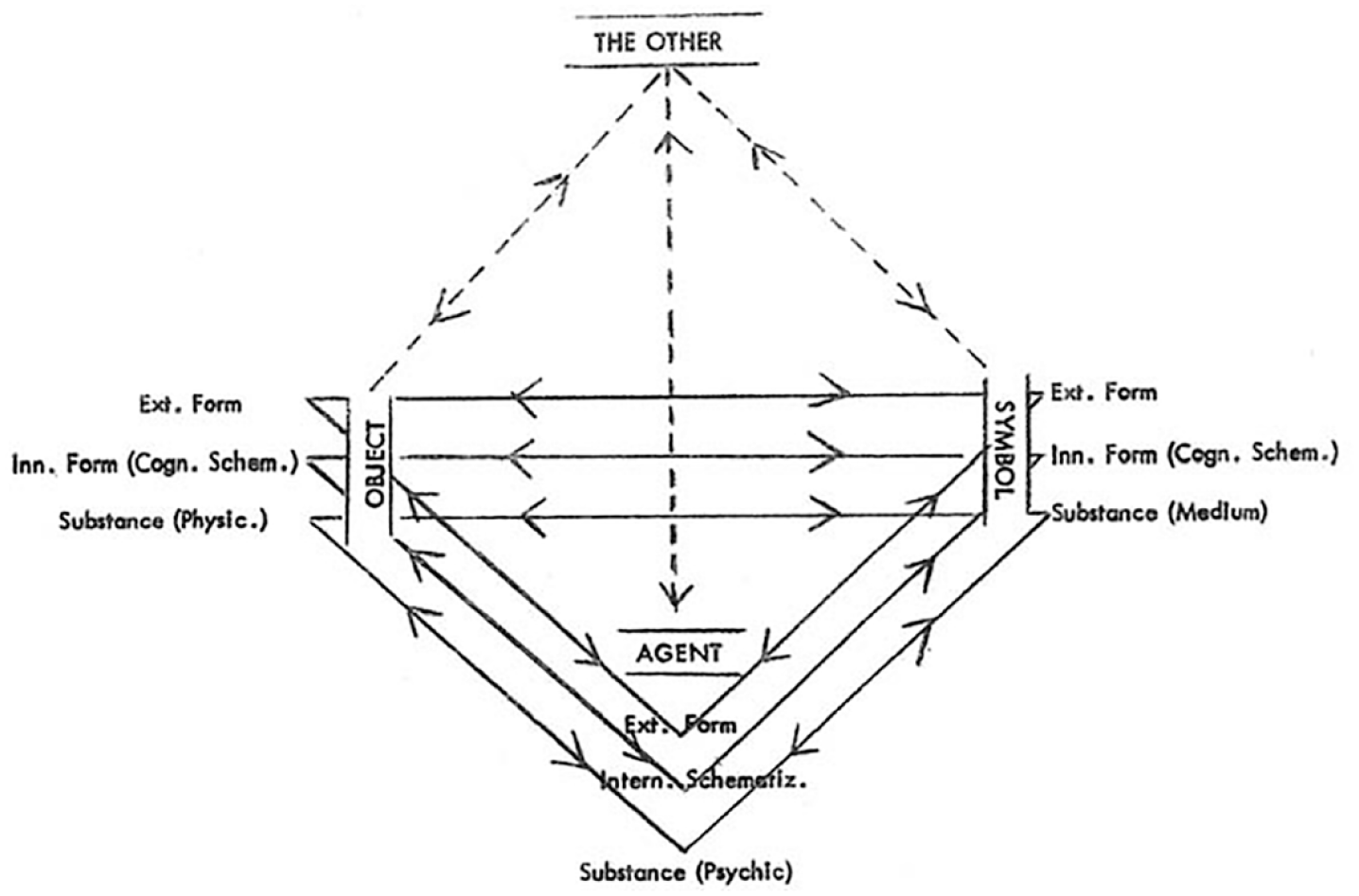
Model of psychological distancing in development.
Conclusion: Revitalizing the study of culture and mind
The person is not only a gestalt, but a non-gestalt as well. Vagueness, non-gestalt, equivocality are not to be evaluated in any negative sense. They are a positive characteristic of the person. Equivocality and vagueness constitute a fundamental condition, a field of potentiality, to be realized in the future. Person is not only defined according to what it is now in its present state of being, but also according to what it would become in the future. (Werner, 1938, p. 113)
The notion of Gestalt as something already structured and fully formed is an insufficient starting point for psychology. The organismic approach, by contrast, necessitates that we give primacy to a living, developing, and interconnected whole. This involves not only attending to the actual state of the organism but also the possible state it is striving for. Methodologically, we must follow development from its undifferentiated beginnings towards structured form, analyzing the qualitative jumps, emergence of new forms, and hierarchical integration with older forms along the way. The genetic method further implies comparing diverse forms to understand the dynamic unity of phenomena from which they emerge. In the case of psychology, this means attending to the inchoate lived and felt experience of the world, as the ground upon which new functions grow and spiral back to as development progresses to higher levels. It should be obvious that the organismic approach is incompatible with the bulk of current theories and methods in psychology that start from separate and static components of the person and environment to analyze causal or correlational relationships between them. From an organismic perspective, the organism itself and its relationship to the environment are dynamic, ongoing activities that begin as a diffuse whole and only gradually become differentiated and polarized through time. Finally, the concern with cognition and behavior has blinded psychologists to the less “objectively” visible, but no less real, basic felt and lived experience of the world, which is the central focus of organismic theory. As psychology begins to distance itself from computer models of mind, it can find new inspiration in earlier rebellions against mechanistic theories.
Within the social sciences more generally, there is a tendency to split the biological from the social and cultural and treat them as independent domains of both reality and research (Ingold, 2013). They are then reconnected through recourse to a psychological notion of “experience,” but this remains largely undeveloped as a construct in this research (Fletcher & Birk, 2022). By grounding social and psychological processes within organismic processes we can theorize body, mind, and culture as a dynamic unity. Organismic theory can be especially valuable to current approaches in psychology and other social sciences that aim to analyze the dialectical relationship between culture and mind. Cultural psychology, in particular, aims to analyze the mutual constitution of persons and social cultural worlds, treating culture and mind as dynamically interdependent forms (Shweder, 1990; Valsiner, 2014). Of central importance here is the idea that culture expresses itself twice: both publicly and personally. Shore (1991) has pointed to Werner and Kaplan’s (1963) notion of dynamic schematizing as crucial for connecting cultural analysis to the experience of living, striving human beings. Indeed, this concept and the theory it belongs to can fruitfully be used to explore people’s entanglement with a wide variety of cultural forms, not simply language. The internalization of culture is not a simple transposition from one plane to another, as Vygotsky’s law of cultural development is often interpreted, but rather involves an active transformation into a personal psychological system.
The link between cultural psychology and the Bildung tradition is clear here: it is precisely through an engagement with the diversity of cultural forms that engulf us that we begin to differentiate ourselves from society as unique sentient individuals, and to integrate into it at a higher level. This is very different from saying that culture causes minds to develop in a certain way (treating culture as an external, independent variable). In the place of a search for linear cause–effect relationships, an organismic approach can reconceive the notion of formative impulse (Bildungstrieb) as a person’s active agency in their own development (Harré & Moghaddam, 2016): people act through cultural forms they themselves have tailored to meet their unique, subjective goals as well as those of society. Rather than being pushed by external factors, their culturally guided imagination pulls them forward (Power et al., 2023). The experience of and engagement with a variety of social and cultural forms is human nourishment for becoming. To quote Humboldt (1903), each individual must:
absorb the great mass of material offered to [them] by the world around [them] and by [their] inner existence, using all the possibilities of [their] receptiveness; [they] must then reshape that material with all the energies of [their] own activity and appropriate it to [them]self so as to create an interaction between [their] own personality and nature in a most general, active and harmonious form. (p. 117, author’s translation)
Footnotes
Acknowledgements
A long list of people read and commented on drafts of this paper. It was discussed within AAU’s Psyche group, in which I am especially thankful to Alfred Sköld, Bo A. Christensen, Casper Feilberg, Jaan Valsiner, Sarah H. Awad, and Rasmus Birk. Further afield, I received productive feedback from David Carré, Lisa Herbig, Ivana Marková, Rainer Diriwächter, Seamus Power, Tania Zittoun, Thomas Teo, and Ulrich Müller.
Funding
The author received no financial support for the research, authorship, and/or publication of this article.
