




Abstract
In this article, we take the opportunity to elaborate on some aspects of our article “Squaring the Circle: From Latent Variables to Theory-Based Measurement” (Borgstede & Eggert, 2023) that gave rise to the concerns uttered by Hasselman (2023) and Slaney (2023), and to clarify why we think that theory-based measurement is indeed necessary and sufficient for the establishment of meaningful psychological measurement procedures. Moreover, we will illustrate how theory-based measurement might be accomplished in psychology by means of an example from behavioral selection theory.
Keywords
It’s hip to be square—Towards a metrology of psychology
In his comment, Hasselman (2023) generally seems to agree with our position in Borgstede and Eggert (2023) that substantive formal theory is necessary to justify meaningful measurement. However, he does not agree with our claim that substantive formal theory is also sufficient for meaningful measurement. Hasselman builds his position on a formal account of the measurement process, where measurement is construed as the identification of the state of a system by means of a measurement device. In classical physical measurement (ideal measurement), the value provided by the measurement device is identical to the state of the system. However, there are instances of measurement that involve a nonnegligible interaction between the system and the measurement device. A prominent example of such nonnegligible interaction is given by quantum measurement, but analogous examples can even be found in classical physics (e.g., using a thermometer that has been cooled down in a freezer prior to the measurement of temperature; Hasselman, 2023, pp. 147–148). Hasselman (2023) seems to think that we construe psychological measurement as ideal measurement whereas he himself argues that psychological measurement almost inevitably involves nonnegligible interactions between the system and the measurement device (p. 148). Hasselman (2023) claims that prior to substantive theory building in psychology, a general theory about these nonnegligible interactions is needed. Therefore, he concludes, substantive formal theory cannot be sufficient for measurement in psychology (p. 146).
In fact, we do not think that psychological measurement is restricted to ideal measurement. However, contrary to Hasselman (2023), we conceive the measurement device to be an integral part of the system one wishes to describe. For example, a beam scale only provides a measure of mass because the act of putting objects in the pans until an equilibrium is reached can be described using the theory of classical mechanics. In other words, measurement is not something external to the system. Therefore, our account of theory-based measurement naturally entails what Hasselman calls a “theory of measurement.” The same holds for Hasselman’s temperature example where the measurement device (the cooled down thermometer) and the system (water in a cup) interact with regard to the temperature during the act of measuring (i.e., the thermometer changes the temperature of the water and vice versa). In our framework, the thermometer and the water are both physical objects and their interaction is guided by the same theory (thermodynamics) that provides the semantics of the attribute of interest (temperature). Therefore, what Hasselman calls “theory of measurement” is only a special application of the kind of substantive formal theories that are required for theory-based measurement (cf. Holzhauser & Eggert, 2019).
Hasselman (2023) correctly points towards the problem that most psychological assessment procedures, such as rating scales or standardized tests, lack a substantive formal theory of the processes that generate the behavior of an individual in such contexts. In our view, most psychological assessment procedures are in fact interpersonal (mostly verbal) interactions. Consequently, if we attempt to measure anything with an ordinal rating scale, we would indeed need a theory of verbal interaction that covers the usage of rating scales. Although this may seem to imply a special measurement theory for psychology, we think that the usage of rating scales itself lies in the domain of psychology. Therefore, substantive formal theory is in fact not only necessary, but also sufficient for measurement in psychology. Explain behavior and eventually you will end up with a theory that (among many other phenomena) explains the interactions of humans with psychological assessment devices. Such a theory will certainly be very different from the formalisms employed in psychometrics, partly because these formalisms build on questionable assumptions—such as the ergodicity property, as pointed out by Hasselman (2023, p. 149). More importantly, however, we cannot expect latent variable modelling (LVM) to solve the problem of psychological measurement because latent variables neither account for the social interactions involved in psychological assessments, nor for the phenomena they seek to explain.
Going around in circles—Theory, folk psychology, and the meaning of “meaning”
In her commentary, Slaney (2023) proposes that scientific terms cannot be independent from common language terms because “A theory from which clear hypotheses can be derived and tested presupposes that the meanings of the concepts out of which the theory is built are already meaningful” (p. 140). Taking the position that the meaning of scientific terms depends on the meaning of the common language terms from which they are derived, Slaney argues that the framework of theory-based measurement cannot provide meaning to psychological concepts unless the corresponding common language terms are already meaningful. Building on this premise, Slaney (2023) points to several apparent problems in our article concerning the meaning of the word “meaning” (pp. 139–140). She references Wittgenstein’s account of meaning as the use of a concept in context (Wittgenstein, 1953/1989) as opposed to what she considers to be our position.
In fact, our account is totally in line with Wittgenstein’s account of meaning. In our view, scientific theories are just a special kind of language game, and as such, not unlike common language grammars. However, in contrast to the meaning of a term in common language, which is usually characterized by a collection of different contexts, each providing its own rules for the use of the word that may in part overlap with one another, a formal scientific theory has very clear boundaries. Within the theory, the grammar of the theoretical terms is in fact completely determined by the theoretical principles (i.e., by scientific laws). In other words, a formal theory is a language game with exceptionally strict rules. For example, in classical mechanics, force is exactly the product of mass and acceleration (and nothing else!). This is what we mean when we say that formal theory “provides meaning” to theoretical terms. It does so in the same way that common language grammars provide meaning—but in a more restrictive way. In other words, whereas common language concepts often have several meanings that only bear some degree of similarity (family resemblance, in Wittgenstein’s terminology), formal scientific concepts are unambiguous. We further argue that only concepts with an unambiguous meaning in this sense are measurable. Hence, we do not “conflate the meaningfulness of a (theoretical) concept with the measurability of the attribute” (Slaney, 2023, p. 140), we only point to the fact that measurement requires unambiguous grammars for the underlying theoretical terms.
What then is the relation between common language terms and scientific terms? According to Slaney (2023), scientific terms are defined on the grounds of common language terms (p. 140). This position clearly adheres to the syntactic view of scientific theories, which we explicitly reject. In the syntactic view, scientific terms are defined by means of correspondence rules that relate the abstract terms used in the theory to common language terms (Carnap, 1974). In this view, scientific terms are essentially reducible to common language terms. Consequently, it seems that scientific theory can never generate new concepts or provide meaning to theoretical terms that would be independent of common language concepts (Slaney, 2023, p. 143). We formalized such reduction relations between abstract concepts and common language terms in Buntins et al. (2016), with the result that, although they might justify psychological testing procedures on pragmatic grounds, they cannot provide a sound foundation for scientific theory construction. We further argued in Buntins et al. (2017) that the attempt to ground substantive psychological theory on formalized common language concepts introduces the (pseudo-)problem of validity, which stems from the unavoidable deviations between such formalized concepts and their common language counterparts.
In the semantic view, these problems dissolve because the semantics of the theoretical terms are given by the theory net of all scientific laws that are relevant to the use of the terms (Balzer et al., 1987) which themselves constitute a language game. Following the semantic view, the relation between theoretical terms and common language terms is mediated by the fact that different language games may be connected to the same empirical phenomena. For example, we may say that a car “quickly drives around a corner” (common language term), while a physicist may say that the same car’s movement is “subject to angular acceleration“ (scientific term). Both terms can be used to describe the same phenomenon, but they follow different grammars (i.e., they are part of different language games). The relation between the two, therefore, is not conceptual (or definitional), it is indeed empirical in that the usage of the terms is constrained by the phenomena they seek to describe. Moreover, the grammar of the term “angular acceleration” is so unambiguous that we can actually calculate the angular acceleration from the trajectory of the car—that is, because of the strict grammar imposed by the theory of classical mechanics, angular acceleration is a measurable attribute whereas “quickly around a corner” is not.
Having clarified these misunderstandings, the question remains: what kind of theory could possibly be the starting point for theory-based measurement in psychology? We think that our own theoretical developments in the context of behavioral selection theory (Borgstede, 2020; Borgstede & Eggert, 2021) may well illustrate how we envision the development of theory-based measurement in psychology. Behavioral selection theory applies to a domain of phenomena that involve context-dependent changes in individual behavior as a result of environmental consequences. In common language, we describe such phenomena using terms like learning, experience, or trial-and-error, each being part of a language game that imposes a certain grammar (i.e., a common language meaning) to the corresponding terms. Although the meaning of a term like learning is clear enough in many contexts, it is not well-defined in the sense that it allows one to identify, say, the amount or effectiveness of a learning in a specific context. In other words, the common language term does not allow for measurement.
In our own work, we provide a formal theory of behavioral selection that builds on the abstract Price equation (Price, 1970). The Price equation gives a formal definition of selection that is independent of the specific domain of application. Applying this definition to the domain of individual behavior, Borgstede and Eggert (2021) derive a fundamental principle of behavior, the covariance based law of effect (CLOE), within a substantive formal theory, the multilevel model of behavioral selection (MLBS). Figure 1 illustrates a simplified theory net that builds on the CLOE as a fundamental principle (cf. Borgstede & Luque, 2021). As the core of the theory, the CLOE specifies the grammar of the basic terminology that we apply to describe the phenomena involved in behavioral selection. Note that the CLOE is not a restatement of or an abstraction from common language terms like learning or trial-and-error. It provides a formal definition of selection ∆s in terms of a weighted covariance between behavior
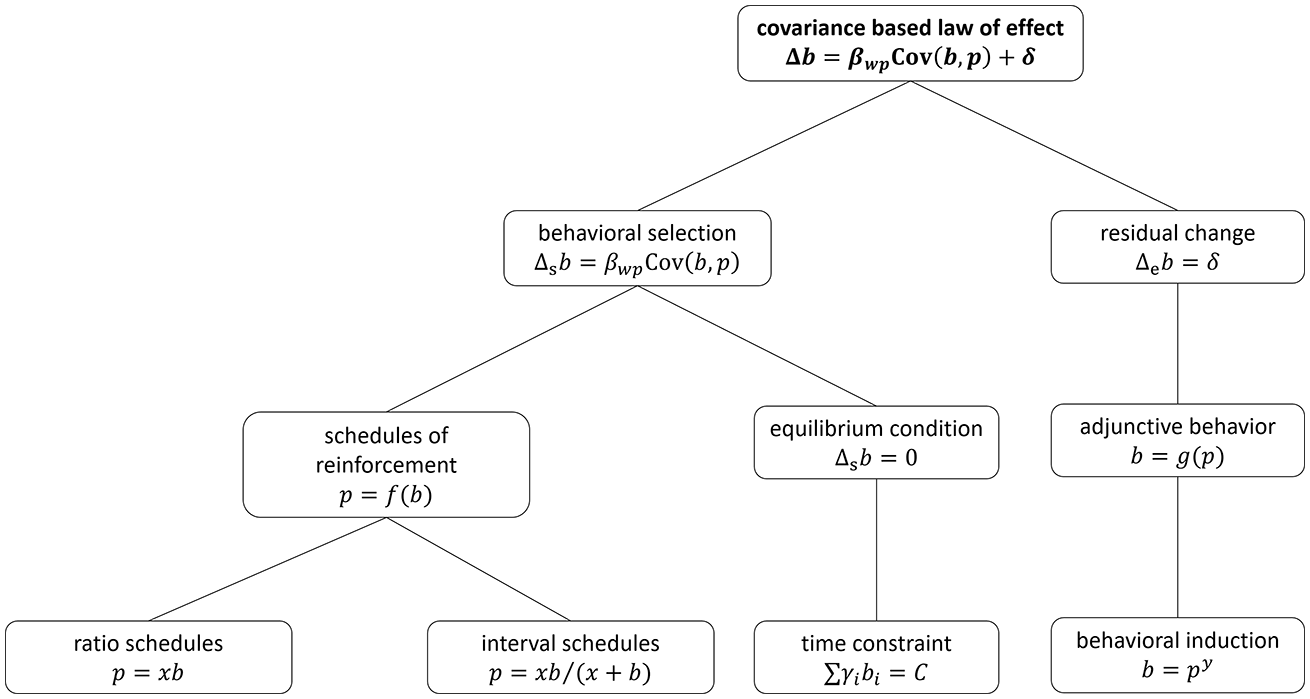
Simplified theory net for behavioral selection theory. At the top of the hierarchy stands the fundamental principle, the covariance based law of effect (CLOE). The subordinate laws are specializations of the CLOE that restrict the class of structures described by the abstract principle. For example, residual (i.e., non-selection) change is further speciated by the law of adjunctive behavior and the law of induction. Similarly, behavioral selection is further speciated by applying it to different schedules of reinforcement, such as the feedback obtained from ratio schedules or interval schedules. The combined application of these laws yields the formal framework for modeling a specific behavioral experiment (see Borgstede & Luque, 2021 for a detailed exposition).
Footnotes
Funding
The authors received no financial support for the research, authorship, and/or publication of this article.
