




Abstract
Coaching has expanded as a method of facilitating individual change, performance, and learning. It is generally described in terms of its functions, referring to cognitive and organisational psychology as well as theories of change, theoretical stances, and methodologies from psychotherapy. Theoretical concern for the body as part of the meaning-making process has been piecemeal in coaching, despite growing interest in embodiment in psychology and learning. There are widespread calls in relevant disciplines for stronger theorisation of embodiment. The Merleau-Pontian concept of “intervolvement” is adopted as a frame, which is tentatively operationalised and illustrated using an example study observing the interactions of a coaching dyad. The case study demonstrates how the coaching practice can be understood from an embodied perspective. A model is proposed, which conceptualises specific ways in which the interaction can be described.
This article investigates the potential contribution of a Merleau-Pontian concept of phenomenological embodiment to learning and change in the coaching relationship. A growing body of exploration of embodiment in social learning (e.g., Sadler-Smith, 2008; Zundel, 2013), and work practices (e.g., Simonsen, 2007; Willems, 2017), has demonstrated the practical significance of an embodied perspective on work tasks. In more clinical contexts, there is a long history of embodied psychotherapy (Totton, 2003), especially in the area of trauma (Rothschild, 2000; Staunton, 2002). However, specialist coaching typically takes place in an environment separate from work tasks and is based on a dialogic and reflective, rather than a practice model. At the same time, it relates to the performance of tasks and developing insight, rather than the repair of previous psychological injury, which is quite rightly the domain of psychotherapy. This context therefore brings forward different aspects of embodied knowing and learning from those described in the practice-based learning and psychotherapy literatures. In response to calls for more overt application of theories of embodiment, this article offers an example model of such nonclinical dialogic embodiment. The discussion and model are intended to demonstrate how such theory can contribute insight into the coaching process itself and potentially inform other dialogic forms of consultation. A tentative model is offered, but it is intended here to be illustrative of the theoretical perspective rather than definitive.
Coaching has become a significant intervention in organisations. The (UK) Chartered Institute of Personnel and Development reported in 2015 that 32% of surveyed organisations used coaching by managers and 12% used external coaching as one of their three most frequently used learning and development practices. Internal coaching was expected to increase by 65% of respondents at that time (Chartered Institute of Personnel and Development, 2015). PricewaterhouseCoopers estimated approximately 53,000 specialist practitioners worldwide (International Coach Federation, 2016). At the same time, Grant (2017) argues that the prevailing ethos of managerial coaching has shifted from performance management in the 1990s, through manager-as-coach models, to more holistic outlooks of the interdependency of performance and well-being. This holism indicates a greater role for deeper levels of dialogue alongside transactional problem solving.
Although the term coaching can have divergent definitions (Bachkirova et al., 2016, p. 5; Hamlin et al., 2008, p. 287), across the broad range of conceptualisation in the disciplinary literature, it can be consistently described as having the following characteristics: it is a form of helping that is oriented towards acting differently (Cavanagh & Grant, 2005); it is enacted through a formalised dialogic interaction between two people, with a focus on the current practical challenges in life and work of one of those people (the coaching client); strategies employed might variously include brute rehearsal, cognitive reframing, experiential learning, emotional support, and encouragement, forming the core of skills manuals such as Rogers (2016) or Van Nieuwerburgh (2017). While this conceptualisation of coaching does not necessarily exclude the body, Jackson (2016), in his review of embodiment in coaching practitioner literature, demonstrates that the role of the body is generally downplayed. This is echoed in descriptions of implied taxonomies of coaching activities and skills. de Haan and Nilsson (2017), for example, include only four items amongst 72 that may be interpreted as having an embodied element, generally through reference to feelings and emotions. Traces of an embodied perspective are broadly visible in various coaching practices, echoing their use in other helping practices, but where they occur they are not always overtly theorised. Consequently, texts describing these practices may limit the developing practitioner to the imitation of skills, rather than the constructive development of professional adaptability (Bachkirova et al., 2017). It would seem important to engage with this dimension of being at more than a superficial level and Jackson (2016) concludes that “engaging with [the] embodied perspective is the first step to developing a more coherent professional knowledge base” (p. 268). This engagement appears to be still slow in moving forward. Rebecca Jones’ (2021) very recent and comprehensive review of the field in general, for example, still has no reference to the body or embodiment in its index.
The apparent neglect of the body stands against an embodied turn in psychology, learning, and the philosophy of mind stretching back to the philosophy of Merleau-Ponty, which has started to find expression in fields related to coaching of management and organisation (Gallagher, 2005; Gärtner, 2013; Hindmarsh & Pilnick, 2007). The body’s inclusion in analysis reflects an attempt to heal the enlightenment rupture of body and mind (Claxton, 2015; Tanaka, 2015; Zundel, 2013) and in particular a growing interest in complexity in these disciplinary domains (Chia, 1998; Sadler-Smith, 2008; Tsoukas & Hatch, 2001). It is noted here that while embodied aspects of psychotherapy have shifted in prominence over its history, it has always been more or less present. This is discussed later in the paper.
With this in mind, this article is structured as follows: first, the concept of embodiment from a specifically Merleau-Pontian perspective is described briefly. This conceptualisation, while extensively considered in theoretical and philosophical discussion, represents a break with the tradition of Cartesian thought in psychological practice, particularly as related to emotion and learning interactions. As areas contributing more specifically to the understanding of coaching, examples of studies of embodied emotion and learning are explored. Embodiment in the coaching field itself is then outlined, demonstrating a general absence of embodied phenomenology in the analysis of coaching practice. The analysis of a sample case study of embodiment in coaching practice is then offered as an example of how a useful interpretation emerges from a more specifically embodied phenomenological perspective. The resulting four-type model of embodied coaching is offered as an example of the application of theory rather than as a conclusive description of embodied coaching.
The Merleau-Pontian conceptualisation of embodiment
Merleau-Ponty critiques rationalist and empiricist understandings of how humans interact with their surroundings, demonstrating that our engagement, feelings, and knowledge are conditioned by the very fact of being a body in the world (Tanaka, 2015, p. 462). From a Merleau-Pontian perspective, people deal with their environment in ways that are conditioned and informed not only by their cognitive sense-making of their experience, but by their embodied senses, habits, and memories of that experience. Merleau-Ponty argues not only that our experience is inherently embodied but also that our embodied consciousness is inherently intertwined with the world as we experience it. Colin Smith, in his translation of Merleau-Ponty (1945), uses the term intervolvement to express this interaction: “The body is the vehicle of being in the world, and having a body is, for a living creature, to be intervolved in a definite environment” (Merleau-Ponty, 1945/2002, p. 94). He explains further that our experience of objects is therefore part and parcel of our experience of moving in the world, “because each attitude of my body is for me, immediately, the power of achieving a certain spectacle, and because each spectacle is what it is for me in a certain kinaesthetic situation” (Merleau-Ponty, 1945/2002, p. 352).
From a culturally dominant Cartesian dualistic perspective, this is difficult to imagine. In a very everyday sense, though, this is reflected in such innate habits as our shifting perspective to understand visual stimuli, smelling food to test whether our disgust response is triggered, or babies putting objects in their mouth to understand them. Indeed, when these options are not available, we instinctively feel frustrated by there being a barrier to our grasp. In 2020, many people experienced the absence of this (tacit) sense-making very tangibly through the phenomenon of “Zoom fatigue” (Nadler, 2020). The world means more to us when we can reach out, grasp, move around, and through it. Or, to put it more starkly, the world lacks meaning when we cannot.
Further, Merleau-Ponty argues that embodied knowledge is both the ground of our awareness and is inseparable from its articulation. It follows that, “speech and thought . . . are intervolved, the sense being held within the word, and the word being the external existence of the sense” (Merleau-Ponty, 1945/2002, p. 211). Donald Landes translates this idea in this instance as “enveloped in each other” (Merleau-Ponty, 2012, p. 187). This sense of intervolvement or envelopment also extends to our experience of other consciousnesses. Merleau-Ponty highlights that we experience others not as objects, but as others like ourselves, and that although we cannot fully perceive ourselves, we can still identify with the appearance, situation, and affordances of the other: I experience my own body as the power of adopting certain forms of behaviour and a certain world, and I am given to myself merely as a certain hold upon the world; now, it is precisely my body which perceives the body of another, and discovers in that other body a miraculous prolongation of my own intentions, a familiar way of dealing with the world. (Merleau-Ponty, 1945/2002, p. 412)
In summary, Merleau-Ponty’s concept of embodiment encapsulates a reimagining of the individual’s bodily relationship with their environment, with particular relevance of the interrelationship of knowledge, feeling, and communication with the body. This reimagining of the body’s relationship to human experiencing allows for the development of new perspectives on communication, reflection, and interaction.
Disciplinary barriers to the study of embodiment
It is worth noting that such calls for progress in research face embedded barriers within disciplines. Some sense of these may illuminate the causes of the neglect of embodiment in the coaching field. Critics have noted in particular that the intellectual devalorisation of the body as an inherent part of human experience, knowledge, and understanding, is related to the persistence of dualistic thinking. For example, Csordas (2008) notes that a dominant “doctrine of mediacy” assumes that language represents experience. Casey (2000) argues that sociology’s history generally favours detachment and an intellectualism that leaves it demonstrating a “continuing objectification [of the body] in most contemporary social and cultural theorizing” (p. 53). Furthermore, this “limits its capacity to understand and analyse contemporary and imminent social and psychic conditions” (p. 54). Similarly, Cromby (2005) argues that psychology has historically taken an information-processing model, which leads to dualist and reductionist theorising. Dreyfus and Taylor (2015) argue that a mediation theory survives despite widespread modern rejection of Descartes’ substance dualism, while Sampson (1996) argues that “the phenomenological turn to corporeality provides a challenge to the dominant tradition’s otherwise hegemonic ocularcentric discourse” (p. 606). Sampson’s term, ocularcentric, prefigures, but reminds us of our physically isolated Zoom experiences! These dominant perspectives serve to maintain a greater interest across disciplines in the study of the “object body” in preference to the “felt body” (p. 603).
Investigating the body through current dominant ontological and epistemological assumptions may, then, be limited. In the following section, I will highlight some examples of theoretical and empirical extension of the concept of embodiment, not just as the felt body in Sampson’s terms, but extending to Merleau-Ponty’s intervolvement or envelopment. I have chosen examples from areas that may contribute to an understanding of the coaching interaction.
Extending embodiment: Examples from emotion and knowledge
Work reflecting this conceptualisation has emerged particularly in the area of emotion. I take as an example here Prinz (2004), who provides a useful synthesis of emotion theories and seeks to address underlying problems with existing strands of theorising, including behavioural and cognitive theories and, of particular interest here, somatic feeling theories (e.g., Damasio, 1994). Damasio’s (1994) theory, in a notable departure from more cognitive emotion theories of its time, proposed an interaction between physical feelings and the experience of emotion. Yet, Damasio posits a chain of events from perception to changes in bodily state to feelings of bodily change, where it is the latter that constitutes the emotion (Prinz, 2004, p. 5). In contrast, Prinz (2004) suggests a model where bodily state is more intertwined with cognition and together they make up the sense of experience: emotions, in this sense, “are not meanings, feelings, and action tendencies pasted together with mental glue. They are meaningful, feelable wholes that register action-enabling body changes” (p. 244). Burkitt (1999) also critiques Damasio’s model as a continuation of a dualistic conception of the self as divided between both subject and object and between reason and emotion: a dualism that is also present in conceptualisation of meaning and of reflexivity. In relation to meaning, Burkitt (2003) rejects a correspondence theory, based as it is on this dualism, preferring to understand meaning as “derived . . . from the embodied experience of humans in the world” (p. 325). Burkitt (2012) has further extended an embodied concept of emotion into a reconsideration of reflexivity: “emotion . . . is about the way we engage and interrelate with others and with ourselves, and cannot, therefore, be separated from reflexivity” (p. 460). This is key to the underlying process of the coaching interaction, which is expressed in many different ways in different practices—whether awareness and responsibility in Whitmore’s (1992) classic formulation, self-regulation, presence, and so forth—but often equates to the client gaining some grasp of their own process. But in Burkitt’s (2012) conceptualisation, theories of reflexivity fall down on the assumption of a knowing observer (p. 461); instead painting a picture of a shifting complex of embodied emotion and meanings. Importantly for Burkitt, it is through these embodied emotions and meanings, built through experience of engagement with the world, that we make sense of the world and the other consciousnesses that we experience within it.
Similarly, some writers on learning and knowledge have rejected a Cartesian separation of mind and body. Claxton (2015) explores in depth the role of the body in education and learning, and with a particular interest in intuition. For Claxton, thinking in terms of theories of input—for example, Clark’s (2008) theory of extended cognition and Prinz’s (2004) embodied emotion outlined above—and theories of output (such as rehearsal and learning) misses the complex intermingling of bodiliness that we experience as consciousness. Meanwhile Dreyfus (2005) argues that his theory of expert skill acquisition shows that an information-processing model of mind is unsustainable, preferring a view of expertise as something felt and beyond the coherent conceptual description of the expert themselves. As Alessandroni (2018) puts it, “cognitive processes and knowledge itself are inseparable from our corporeal experience in the world” (p. 228).
Despite disciplinary resistance to a more precisely Merleau-Pontian perspective on embodiment, then, forms of bodiliness are not absent from analyses of social interaction. The next section summarises the various ways in which embodiment is evidenced and conceptualised in the coaching field specifically. To what extent is the embodied turn reflected in coaching literature and practice.
The relative absence of embodiment in coaching literatures
Jackson (2016) has reviewed the representation of embodiment in coaching practitioner literature and in allied practices, concluding that generally the role of the body is downplayed, poorly theorised, or ignored in the coaching literature. Jackson’s review includes four categories of the presentation of embodiment in coaching practices: (a) proprietary and theoretically modelled practices, labelled by proponents as in some way embodied; (b) explorations of the embodied experience of the client and the relationship between client and practitioner; (c) typologies and techniques of reading physiological responses in the client; and (c) strategies focusing on routinising newly learned behaviours.
I have drawn on the structure of this review for this discussion and included some of the most relevant content in addition to expanding on two areas: mindfulness and Gestalt. I will focus on the first and second of the categories of literature outlined above, as those are most relevant to the particular conceptualisation of embodiment under discussion in this paper, while the third and fourth relate more to the object body and to the embodiment of practices respectively.
Examples of proprietary practices include integral coaching (Divine, 2009; Hunt, 2009), purportedly based on theoretical propositions of Ken Wilber. The sources on integral coaching are not clear on the specific role of the body, though it is generally posited as a medium through which both personal and cosmic energies can be made sensible. Jackson (2016) identifies only two evaluations of the method, consisting of a case report (Stoneham, 2009) and an evaluation of “use of self” amongst 15 graduates of an integral coaching training programme (Kennedy, 2013). Somatic coaching is proposed by Strozzi-Heckler (2014). From a background in athletics and aikido, Strozzi-Heckler specifically focuses on what he terms somatic awareness (becoming aware of sensations), somatic opening (challenging habitual somatic stances and attitudes), and somatic practice (rehearsal of different stances and attitudes). Strozzi-Heckler’s primary text is not explicit on how this is done, though there is a more formal assessment of somatic practices in the training of athletes (Strean & Strozzi-Heckler, 2009). Sieler (2018) explicitly credits Merleau-Ponty and describes in practice the “dynamic interplay” between emotion, language, and body. Madison’s (2012) model of practice draws on Gendlin’s (2003) focusing technique. As such, it explicitly acknowledges preconceptual, embodied, and inarticulate meaning, suggesting that we should resist the modernist urge to resolve the uncertainties that arise from it. Similarly, Silsbee’s (2008) “presence-based” model refers to Merleau-Ponty and highlights the importance of the body in carrying our individual histories and conditioning perception, as well as offering a source of meaning and a site of embedding new behaviours and relating with our environment. These practices have varying degrees of explicit theoretical basis. There is little formal empirical or theoretical work outside of the accounts of the proponents themselves to examine how these practices work, or where and how they might be most effective. A more recent paper by Attan et al. (2018) explores the use of correlations between particular movements and interaction styles, suggesting that both self-awareness and self-regulation can be achieved through rehearsal of key trigger actions. The paper acknowledges previous works on embodiment and other somatic practices, but is not explicit on how the correlations between movement styles and personality come about.
Jackson’s (2016) review does not consider mindfulness, which is often associated with embodiment for the tendency to focus attention on the body as part of quasimeditative exercise of attention on the here and now. Many of its techniques both overlap with techniques associated with the practices already mentioned, and have also extended into the practice of coaches who do not necessarily identify as “mindful” coaches; some consideration of practices that involve a somatic element is therefore warranted here. Mindfulness coaching practices are described comprehensively by Hall (2013). Many of the techniques have a somatic element, among them “body scan” (a progressive exercise of tensing and releasing muscles throughout the body “helping us develop our ability to be curious and to enquire without shutting down possibility and thinking we have to have an answer”; Hall, 2013, p. 50), “walking meditation” (consciously attending to the feelings that arise both physical and psychological as the person walks), and breath awareness (a light touch meditation, focusing on the breath). There is an implicit attention to emotion. Hall (2013) frames the client intervention through the “FEEL” model (pp. 109–111). The model guides a process of focus (grounding the client in the here and now, e.g., through breath awareness exercises); explore (“gently allowing ourselves to explore what is arising and emerging, with compassion, curiosity, non-judgment and openness to possibility”; p. 109); embrace (an acceptance of emotional responses); and let go (choosing whether to separate themselves from those feelings).
Hall (2013) highlights the benefits and characteristics of mindfulness. Similarly to approaches described previously, she does not explicitly theorise the function of the body. Virgili (2013) clearly locates mindfulness as an “anticognitive” practice, but concurrent with that, notes that there is an internal focus that may neglect consideration of external conditions, characterised by: a “distancing” from the stream of habitual or automatic cognitive activity, and a focus on changing the client’s relationship to psychological events rather than changing the form or frequency of those events. (Virgili, 2013, p. 42)
Hall’s (2013) volume focuses on resilience, well-being, and balance, suggesting that mindfulness may have less impact on goal achievement. Spence et al.’s (2008) study of combined mindfulness and cognitive-behavioural/solutions-focused approach to health coaching improved goal achievement, suggesting that mindfulness may be combined successfully with more goal-oriented approaches. These findings may reinforce as much as allay a concern that mindfulness in itself does not address itself to the practical changes in action and behaviour that are central to the coaching concept. However, in writings on Gestalt practice, such as Bluckert’s (2015), the focus on somatic experience is more explicit in its theorisation and does make the connection with such changes. Somatic experience forms part of two key principles of Gestalt practice: embracing “what is” (p. 7) and the “exploration of the here and now—direct felt experience” (p. 8). This focus on the present state is central to two foundational models in Gestalt: the paradoxical theory of change, which proposes that “the very act of fully exploring and embracing [our] truth leads to spontaneous self-organization” (p. 7); and the awareness stage of the cycle of experience (p. 13).
The second area of focus identifies the practitioner’s embodied response to the presence of the client and the interaction between client and practitioner. The concept of self as tool is broadly represented in coaching literature with authors making clear reference to the concept of counter-transference (e.g., Bachkirova, 2016). This is particularly the case with psychodynamic (Lee, 2014; Sandler, 2011) and Gestalt-inspired approaches (Bluckert, 2014; Leary-Joyce, 2014). Bluckert (2015) explains that the coach’s “presence” is an essential aspect of Gestalt practice, explaining that “the Gestalt field perspective reminds us that you cannot be neutral even if you’d like to be” (p. 118). It is on the foundation of field theory that the contact stage of the cycle of experience plays an important part of Gestalt practice. Simon (2009) explains that contact, achieved through rapport, acceptance, and a nonhierarchical attitude, creates the energy for learning and change. Furthermore, this being the case, resistance is both expected and healthy. Lewin’s field theory is not itself a theory of embodiment so much as a recognition of complexity in interaction. However, together with the emphasis on contact and presence, the engagement with the here and now of emotion, the picture in Gestalt becomes inherently embodied, resulting in an engagement with the client that may be physically felt. Leary-Joyce (2014) also refers to this as “somatic resonance” (p. 154). A small-scale phenomenological study by Matthews (2013) demonstrates that the embodied connection is experienced by practitioners.
Whether conceptualised as transference or resonance, the phenomenon is also widely recognised by practitioners. Turner (2010) reported that 90% of 235 coaches responding to a survey agreed that the handling of unconscious processes should form part of coach training. Shaw (2004) reported that psychotherapists tended to explore possible explanations in the client’s circumstances for their own physiological discomforts (such as muscle tightness suggesting tension or digestive and stomach discomfort reflecting issues with food and eating). Matthews (2013) described coaches using somatic techniques identified strongly with the approach and reported that it is “a core aspect of who I am,” that “I can use all of myself,” and that “we are relational beings” (p. 31).
The review also highlights in particular the contribution to coaching of different approaches to psychotherapy, particularly Reich (1972), Gendlin (1996), and Perls (1994). Indeed psychotherapy is widely considered a major influence on coaching practices (Garvey et al., 2014, pp. 258–259; Peltier, 2011, p. xxix). Yet, it is possible to see that a useful tradition of attention to the body has been, to some extent, lost in the practice of coaching, possibly reflecting a mid-20th century move away from the body in psychotherapy, just at the moment coaching emerges. Reich was expelled from the International Psychoanalytic Association in 1934. In the second half of the 20th century, therapies such as cognitive behavioural therapy (CBT) and rational emotive behavioural therapy, which intentionally de-emphasise the investigation of experience outside consciousness, have become popular, or even dominant in the field. Some recovery of body-oriented psychotherapies in more recent decades is evident, particularly in the area of trauma (Rothschild, 2000; Staunton, 2002). In addition, Gendlin’s (1996) attention to the psychotherapy client’s ability to engage with their felt experience as a predictor of psychotherapy outcomes continues to inform practice and practitioner education, as do concerns for the felt experience in relation to the therapeutic alliance (Macaskie et al., 2013).
In summary, first, embodiment appears significant in a number of coaching practices; yet, second, there is a paucity of explicit theorising of embodiment in coaching; while, third, some more overt theorisation as well as practice can be drawn from the field of psychotherapy, even if concern for the body has moved in and out of psychotherapy’s main stream over time.
A sample case study of embodied coaching
Against this background, I turn to a case study that was carried out to explore embodied practices occurring in the coaching interaction and discuss how they might be understood through the lens of embodiment.
This case is not intended to be empirically exhaustive. Rather it provides a series of vignettes that illustrate how coaching practice can be seen from a more overtly Merleau-Pontian perspective. It originally formed part of a wider study of three coach–coachee pairings. The case illustrates techniques used in a real-life situation that calls on the experience of the client’s and the practitioner’s engagement with the world and with one another to facilitate the exploration of meaning. It focuses on the work of a coach (here named Kate) who, at the time, was explicitly exploring the role her embodied experience played in her practice.
Participants and data collection
Practising coaches with postgraduate qualifications were invited to participate via professional social networks. Coaches were asked to video three sessions with a single client using compact video cameras provided by the researcher. They were asked to place the cameras in such a way that each participant was the focus of one or other of them. Coaches were asked to record successive sessions between (and not including) the initial contracting session and any final wrap-up session. The resulting data base for the case under consideration here included 363 minutes of video recorded coaching. In addition, the coach recorded reflections on the agenda and critical incidents arising in the session.
The approach to data analysis
Key narratives were extracted from the dialogue that describe the coaching intervention’s purpose and agenda. These served as the central focus, in relation to which three layers of data were analysed: observations (video); the coach’s reflections; and exploration of explanations with the participants (case review). Thus, it was possible to generate an interpretation of how physicality in the session had played its part in progressing or otherwise changing the narrative agenda. A thematic analysis was developed from the observational data (Braun & Clarke, 2006), with reflective data used to enrich the understanding of the sessions and the case review to understand the coach’s own explanation. Initially, a tentative classification of different embodied phenomena suggested by Jackson (2016) was used to focus attention on the embodied strategies and interactions. Themes reflecting aspects of the interaction that could be seen as intervolvement were developed abductively.
The analysis was highly interpretative in nature and there was a priori a particular interest in embodied meaning-making. Furthermore, the data of movement, gestures, intentions that may or may not be conscious, and the meaning of words are inherently ineffable and are inevitably interpreted from some kind of perspective. The following stands therefore as a perspective on practice, rather than a predictive theory.
The current discussion does not call for a full demonstration of this analysis, hence the outline above is only intended to be sufficient in setting a meaningful context. The intention here, rather, is to illustrate how the coach’s practice can be interpreted constructively from a frame inspired by Merleau-Ponty’s concept of embodiment.
Results: Examples of embodiment in Kate’s coaching work
A holistic overview of the case is considered helpful to contextualise the vignettes that will be presented here. Illustrative moments from Kate’s practice will then be set out within the frame of a four-part model that emerged abductively from the analysis. The model focuses attention on reflecting embodiment, embodied countertransference, engaging with the embodied state, and enacting embodiment.
In the case account, names and identifying features have been changed. Where extracts of transcripts are given, pauses in dialogue are expressed in tenths of seconds in parentheses, for example “1.2,” following Jefferson (see Atkinson & Heritage, 1984, pp. ix–xvi).
Case outline: Kate and Liz
Kate is partially retired and is older than Liz, who is in her early 50s and still in regular employment. The coaching is being undertaken to help Liz handle a career transition as she moves into a complex senior role in healthcare provision. The coaching is not sponsored by Liz’s employer. Kate shares some experience in Liz’s professional domain in her work history and they have also experienced the same coach training. The sessions take place in a meeting room equipped with lounge-like chairs and a coffee table. There is a strong rapport between the two of them. The conversations are sometimes animated, sometimes very quiet, often punctuated by humour, verbal outbursts, and laughter. There is a strong sense of a visceral experience. A major concern for Liz is the direction and management of her career. She has accepted a new, more senior job for an increase in pay, but she is also concerned about how long she must tolerate the additional stress before she can retire. Against that context, they also touch on how Liz manages her actual job role, how she resources herself emotionally, and how she can turn her immediate emotional responses into ways of handling interactions at work and in her personal life. Kate’s style and approach as a coach is noticeably open. She does not impose targets or agendas, she does not make suggestions—rather, she focuses on Liz’s process. She constantly offers Liz choices about which direction to take. This seems to contribute to the establishment of a highly accepting space for Liz. Kate and Liz are deeply engaged with each other during the sessions. Their interaction is deep and rich. Time is devoted to experiencing feelings and responses. With the unusual focus on process and particularly to Liz’s felt sense, it is as if the conversation is unencumbered by Kate’s opinions, expertise, or knowledge of the issues Liz faces.
Examples and discussion of four possible dimensions of embodied intervention
The following four dimensions emerged from the thematic analysis. Coded interactions were iteratively reviewed and revised until a structure was achieved that was both comprehensive and discriminating in relation to the data.
Reflecting embodiment
Kate often reflects back Liz’s physical presentation, sometimes observing it and sometimes even mimicking it as she asks Liz what emotion lies behind it. This seems to acknowledge the embodied nature of Liz’s affective states and encourages her self-awareness. It is clear that Kate does not expect the relationship between physical presentation and emotion to be isomorphic, rather that there is simply something there that could be explored. The act of playing it back highlights it and makes it available to Liz, who then has the opportunity to engage with an aspect of her own implicit knowing.
Example 1: In Session 1, Liz explains in an animated passage her frustration at not being able to arrange sufficient care through the health service for her disabled friend. She has intimate knowledge of health care, but at the same time feels deeply for her friend. Her speech is accompanied by dramatic gestures (throwing her hands to one side, finger wagging, chopping movements emphasising her points). Kate says: “So your feeling is what and I’m- I’m- I’m seeing much sort of (1) your hands are- are- are quite sort of pointy a:nd feels angular.” Liz pauses for a moment, then reflects that she simply cannot provide what her friend needs. The discussion moves onto Liz’s observation that she tries hard to please, then gets frustrated when people come to rely on her.
Example 2: Later Liz describes the difference between the response to upcoming inspections in her old organisation (where there was a sense of urgency) and her current one. After a long pause, Kate says: “wooo your faced changed” (her voice rises and falls as she says “wooo” conveying a sense of catching the immediacy—almost shock—of noticing something. Liz engages readily with what her own facial expression might be linked to at an implicit level:
you might have seen (pause) me thinking about the person who’s going to be my new boss
The interaction moves the discussion onto Liz’s key relationship with her boss and the realisation that they had as yet unstated differences in expectations of each other.
Reflective listening, stemming from Carl Rogers’ methods, is commonly recommended in coaching practice manuals (Rogers, 2012; Van Nieuwerburgh, 2017). It is generally argued that an engagement with the client’s meaning-making, as free as possible from the coach’s own needs, encourages further exploration. It also supports the building of trust, avoids defensiveness on the part of the client, and gives the client confidence that they are being taken seriously. This is explicitly contrasted with the destructive interaction of Berne’s “yes-but game” (Rogers, 2012, p. 52). Playing back the client’s sense-making also invites a reflective cycle.
Here, though, Kate in effect not only acknowledges Liz’s meaning-making, but the meaning-making that is implicit, intervolved thought, feelings, and memories that reside somatically and are reexperienced somatically. It is as if what coaching skills manuals acknowledge happens at a linguistic level, can (and does) also happen at the somatic level. Reflecting embodiment brings into play the complexity and richness of this experience that is holistically lived. In doing so, it brings Liz’s experience to her own attention. At the same time, Kate does not need to know what the meanings are. Her own empathic response as someone who might make the same gestures or expressions draws her attention to what is felt strongly but is as yet inchoate. This would be no surprise to the Gestalt practitioner, yet the coaching literature, as argued previously, generally does not theorise in this way.
Embodied countertransference or intersubjectivity
Kate reflects back her own feelings as information for Liz to work with. This is similar to the previous type, but the focus here is the practitioner’s embodied sense and not (the appearance of) the client’s.
Example 1: In Session 2, Liz explains how she feels when working in environments connected with addiction. She is mystified that while she is generally accepting of people who may be suffering forms of psychological distress, she feels an intolerance of people with addictions, expressing strong feelings about weakness and contributing to society. After 18 seconds of silence, Kate comments, “I’m getting a knot in my gut.” Liz connects this first with a moral sense of greater good:
(inbreath; sigh) yeah I was just thinking about umm (pause) that thing I’ve got about- sometimes (pause) whatever it- sometimes it’s bigger than you (pause) it’s more important than you (pause) whatever’s happening to you (pause) forget it
This exchange then allows the conversation to move onto how Liz handles her heavy sense of her own responsibilities.
Example 2: On occasion, Kate makes an association with her feelings and reflects that back to Liz. At one point, Liz talks about a highly paid colleague who she feels is now coasting in his job. Kate interjects “I just caught myself doing a boss thing,” associating with a previous job role of her own. She wonders, “what was going on in you that invoked that in me?” Again, there is no expectation that Kate knows what it means or where it comes from. It is characteristic of Kate’s practice that she does not attempt to interpret for herself these feelings, though other practitioners might hypothesise more overtly.
This category of interaction was originally coded simply as counter-transference, but I agree with an anonymous reviewer that the sense of the first example is more of intersubjectivity. If counter-transference is more strictly the projection of unconscious expectations onto the client, informed by previous significant relationships (Sandler, 2011, p. 27), this may be a strong form of intersubjectivity. In the second example, Kate’s “doing my boss thing” can be seen as reflecting that process. However, in both cases, the roots are common: the coach experiences a complex of responses that are bound up in their own embodied history. The psychodynamic psychotherapist may notice this and formulate hypotheses about the interaction, Kate here just makes her own feelings available, whether reactive or empathic. Matthews’ (2013) research participants valued this sense of full engagement in their work.
This sort of interaction also carries an important implication of relatedness. Burkitt (2003, p. 331) explicitly connects our ability to relate to others’ experience to our parallel embodied experience: we have moved in the same way in the same world of which we are both part. If we except this ontology, the playing back of empathic/reactive feelings goes much deeper than an engagement with the client’s languaged articulation of their world. It is as if the coach is starting to touch, feel, and even join with rich depth of the client’s experience.
In the coaching literature, this is normally subsumed into the area of listening skills. Rogers (2012) is typical in her exposition of three levels of listening. At level 3, “You feel connected with the client at an emotional as well as an intellectual level, even if no emotion has been named” (pp. 66–69). This is somewhat more explicit in the Gestalt coaching literature where, for example, Bluckert (2015) explains, “your presence emanates from your way of being and acting in the world and can be captured in the phrases ‘bringing who you are to what you do’ and ‘how you show up’” (p. 118). The intentional use of this presence is founded on self-awareness and an emotional repertoire which “provides valuable data to better understand your emotions in the moment and how they are shaping your thinking, decision making and contact with others” (p. 120).
Engaging with embodied state
This consists of asking the client to notice or inhabit the felt experience. In her participant review, Kate emphasises that her intention is to amplify the experience: “you get it as big as you possibly can . . . and experiencing what it might be like to have that strength of feeling.” Where the previous types rely on the coach to provide a sounding board, either reflecting their perception of the other, or their felt experiences, this intervention leads the client to experience their own embodied being/knowing directly.
Example: In an early part of the conversation about addiction noted previously, Liz tentatively works towards the nature of her feelings:
d’you know (pause) cause I’ve got a judgment about it (pause) and I’m gonna have to really figure how not to be judgment- judgmental about it (.4)
[is it ]
[it’s a] part of my head (pause) that wants to say pull yourself together
Kate encourages the full engagement with her feeling:
okay (long pause) do you want to do that bigger (pause) (loudly) PULL YOURSELF TOGETHER
The effect is cathartic; Liz talks more openly about her attitude and the shame that she feels for holding it.
Here the coach is encouraging the client to more fully connect with their emotional response. Burkitt (1999) traces the shift of social positioning of the body from an open and public expression during the Middle Ages to an internalised and private thing during the Renaissance. Bodily needs and functions become hidden in specified locales. This is a history that sits parallel to Descartes’ philosophical pushing away of the physical and in due course to the devalorisation of the body discussed earlier. This method counters that norm, bringing the coaching client back into greater contact with their inner experience. Bluckert (2014) describes focusing the client on the here and now, “to become curious, interested in, and aware of their own process” (p. 87). It also seems consistent that Gendlin’s (2003) technique of “focusing” was originally formulated as he had noted that clients with somatic self-awareness made better progress in psychotherapy. This may be a similar opportunity for mindfulness exercises, though as noted previously, Hall (2013) emphasises direct benefits in terms of stress reduction and well-being rather than theorising a facilitative role of immersion in the intervolved.
Enacting embodiment
On a number of occasions, Kate invites Liz to engage with the embodied experience of others, even anthropomorphised inanimate objects, or with her own experience in other situations. This is a form of role-play, though it is conceptually different from learning through repetition or learning through action, which often lie behind this form of rehearsal. This intervention highlights how the client can be given the opportunity to inhabit the (imagined) felt experience of the other, or themselves in imagined scenarios.
Example 1: Kate uses a character from one of Liz’s stories of her workplace to embody an attitude set: an irascible and forthright, but rather admired, older service user. In relation to Liz’s frustrations at the lack of appropriate action in her organisation, Kate asks, “so what would that old lady do (pause) walking into your job on Monday?” It is not a rhetorical question; Liz is asked to inhabit the persona and speak her words:
she’d call it (pause) I think (pause) as she- I mean she- she was bonkers (pause) she was great (pause) she (long pause) I think what I’m going to have to do (pause) is I’m going to have to say this is what I’m finding
Example 2: Sometimes the persona is a particular aspect of Liz herself. In one example, Kate invites “the Liz that has just come back from holiday: who’s protecting and- and- wanting to- to make it precious.” These aspects of Liz’s feelings can also be represented by external objects. In the discussion about addiction, Liz has described the image of a heavy, ornate door representing a safe barrier beyond which is addiction. Kate asks Liz to approach the door of the meeting room to explore her feelings about the metaphorical doorway. Kate asks her to “stand where the door is and speak from the door (pause) what’s the door saying back to Liz?” Liz has an immediate response: “that you’re a control freak.” In the context of the session this revelation is dramatic.
Now the client is not only inhabiting their own emotional landscape, but extending this to inhabiting an intersubjective world shared with others. This is more than reflection or reflective learning, which is widely acknowledged in the coaching literature as fundamental (e.g., Cox, 2013; Cox et al., 2014). Typically, Kolb’s (1984) experiential learning theory is picked up by coaching texts as a pragmatic connection between the reflective dialogue and the world of action. But Burkitt (2012) notes that “theories of reflexivity foster the view that this is a process in which a subjective agent monitors their objective actions or deliberates on the choices presented to them by an objective social order” (p. 464). The critique is a serious one. The texture of the world is made up not of perspectives but enmeshed emotion, experience, and a dynamically shifting and renewing social structure. It is as if Liz steps through the looking glass.
Conclusions
Observing practice through the lens of these four types potentially contributes to an understanding of embodiment theory in dialogic practices on three levels. First, it starts to respond to calls to apply an overtly embodied perspective into practice contexts. Second, it focuses on the (neglected) “felt body” as opposed to the “object body” (Sampson, 1996, p. 603). In doing so, third, it offers a starting point into the development of more extensive modelling of embodied practices. I will explain these points in more detail.
The model reflects and responds to the concerns for the development of embodied theory discussed earlier, primarily because it addresses the physical experience rather than the physical appearance. Each of the four types can be seen to work, not because the coach uses physical manifestations in order to illustrate or reinforce an argument, but because it enriches the client’s experience of herself. Hence, for example, when the coach reflects the client’s embodiment, this operates not as a depiction of the object body, but as a way for the client to access her own felt experience. The sense of intersubjectivity is even greater when the coach expresses her own felt experience of the countertransference. Here the exchange becomes about how each of the participants’ bodies responds to the conversation, and the meaning-making becomes more intercorporeal than interlocutory or linguistic. As Tanaka (2015) describes, “Merleau-Ponty aimed to reformulate intersubjectivity as a problem of communication not between two Cartesian minds, but between two minded bodies” (p. 462). Engaging with the embodied state serves to amplify the client’s awareness of her own embodiment, as enacting embodiment puts her in the shoes of others. These experiences are still applied to real-world problems that are expressed through verbal exchanges, yet now, in Cromby’s (2005) terms, “feelings and discourse . . . co-constitute subjectivity” (p. 144).
The four types can be further synthesised. Each type describes the experience of the subject-body. As such, each type represents one of four relations with felt experience: (a) reflecting on one’s own felt experience as its outward manifestation is reflected back by the other; (b) reflecting on one’s own felt experience as it is manifested through the felt experience of the other; (c) reflecting on one’s own felt experience by amplifying that felt experience; and (d) reflecting on another’s felt experience through inhabiting it, as it were, in their shoes. These relations are depicted graphically in Figure 1. Other relations could be constructed that have not emerged from this analysis. I reiterate that there is no claim that this model is definitive, more that it should coherently reflect how the Merleau-Pontian concept of embodiment can be applied to practice.
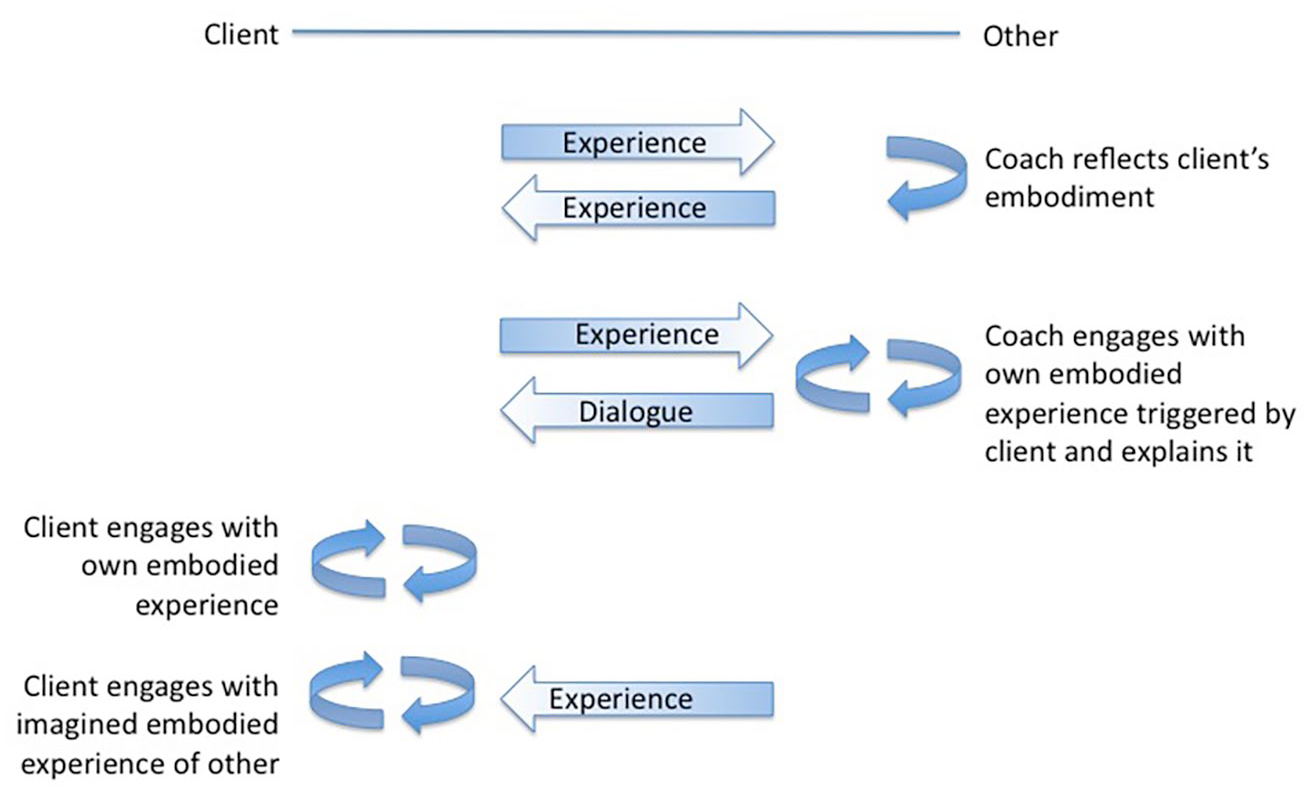
Four types of embodied meaning used in coaching showing interactions.
This article has set out to demonstrate that, while the development of coherent models of embodied practice for the exploration of developmental dialogues between individuals is in its infancy, there is merit in taking a clearly embodied perspective. Critics such as Casey (2000) and Sampson (1996, 1998) have highlighted some disciplinary root causes of a neglect, which appears to sit in a modernist frame with some lingering Cartesian dualist assumptions. The application of theory is called for that centres more around the body-subject or felt body, Merleau-Pontian intervolvement, as opposed to cognition, abstraction, and objectification (Cromby, 2005; Csordas, 2008; Dreyfus & Taylor, 2015). Coaching serves as an example of where this type of enquiry may add value: a constructive dyadic interaction where the discipline has considered the body-subject in only piecemeal manner. The development of the field study itself parallels a more generalised situation in contributory disciplines where the term embodiment may be used very differently in different contexts. It describes the progression from a framework derived from a categorisation of contributions from practitioner and academic literatures in coaching towards the overt application of embodiment theory to produce a model grounded in practice.
That model has potential application in coaching theory and practice. Most importantly, it provides a way of discussing and exploring a significant ontological layer of practice that is currently hidden, which consequently could be more overtly included in practitioner development through formal learning or supervision and form part of practitioners’ reflective practice. These would be useful areas of experimentation and further development. It could also enable more extensive and elaborate theory development and empirical investigation of questions such as coaching effectiveness and accreditation processes where appropriate.
Extension, elaboration, and revision in further research are welcomed. It would be of great interest, for example, to discover if different profiles of embodied practice may be best suited to different coaching approaches. In relation to the theoretical challenge set out in the introduction to this article, however, the model serves as an exemplum of what embodied theories might look like when derived from a Merleau-Pontian stance, and how they might be developed, both in coaching or in similar fields of application.
Footnotes
Declaration of conflicting interests
The author declared no potential conflicts of interest with respect to the research, authorship, and/or publication of this article.
Funding
The author received no financial support for the research, authorship, and/or publication of this article.
