




Abstract
Transgender and/or nonbinary (TNB) students are amongst the most marginalised and vulnerable in schools, with little known about their experiences in single-sex schools (SSS). This research explored the experiences of six TNB young adults (18–25 years old) who previously attended SSS, aiming to contribute to a greater understanding of their lived experiences and guide the support provided in schools. A two-phase research approach was used. In Phase 1, three TNB participants coproduced the research design and interview schedule. In Phase 2, five TNB young adults participated in either individual interviews or a focus group. Feminist relational discourse analysis was used to explore structures of power and normativity in SSS and the participants’ relationship with these. The participants navigated school structures where there was seldom physical or philosophical space for them. Their mental health suffered as they were made to feel invalidated and that they did not fit or belong. Particular problems existed in participants’ all-boys schools. This research contributes by highlighting TNB people’s nuanced experiences of SSS, with implications for school counsellors working with these students to ensure they feel heard and seen by taking a gender-affirming approach and proactively advocating for gender-inclusive school environments.
Child development is typically viewed through a linear, cisheteronormative lens; babies are assigned a sex at birth, and they develop following a discursively constructed pathway whereby cisgenderism produces an expectation of gender identity aligning with the sex assigned at birth (Butler, 2004; Nagoshi et al., 2014; Ward & Lucas, 2023). However, gender identity is increasingly seen as an individual's internal sense of self, as female, male, or an identity between or outside of this binary (Nagoshi et al., 2014). Gender identity is both socially constructed and an embodied experience (Johnson, 2017; Monro, 2007; Nagoshi et al., 2014), with children having a sense of their gender identity from a young age (Horton, 2020; Rankin & Beemyn, 2012; Riggs, 2019; Ward & Lucas, 2023). Despite there being “no generally accepted scientific evidence for a biological explanation for either gender identity or sexual orientation” (Johnson, 2017, p. 30), transgender and/or nonbinary (TNB) people are often pathologised, and cisgender identities are positioned as the norm (Frohard-Dourlent, 2018; O’Dell et al., 2017; Schmitt, 2022).
TNB Students and School Experiences
One aspect of the rationale for single-sex schools (SSS) is based on an assumption that individuals are attracted to members of the “opposite” sex, and the segregation of genders therefore avoids sexual distractions (Hickey & Mooney, 2018; Jackson, 2010; Love & Tosolt, 2013; Nanney, 2020). Students at SSS have been found to be more gender-salient (Wong et al., 2018) and are likely to view gender in a more stereotypical light (Wong et al., 2018). Gender atypicality has been found to be associated with victimisation in SSS, where there is significant pressure to conform to gender norms (Drury et al., 2013). Cisgenderist policies restrict admissions to SSS; the United Kingdom's (UK) Equality Act 2010 allows SSS to admit and reject students based on sex assigned at birth (Department for Education, 2023). Students who transition their gender challenge the notion of an SSS and may experience tension around recognition, for example, wanting to fight forced invisibility whilst simultaneously accepting it for ease and privacy (Frohard-Dourlent, 2018; Goldberg & Kuvalanka, 2018; Jackson, 2010).
Mental health issues amongst TNB youth are higher than amongst their cisgender peers (Day et al., 2018; Hatchel et al., 2019; Mackie et al., 2023) because of minority stress (Meyer, 2003) and increasing transphobia (Pearce et al., 2020; Todd, 2022). In schools, TNB students experience bullying and gender policing (Bower-Brown et al., 2021; Davy & Cordoba, 2020; Jones et al., 2016), and resultant mental health concerns are common (Allen et al., 2020; Day et al., 2018; Parodi et al., 2022). School environments may exacerbate such difficulties given, for example, the absence of TNB representation in curricula, insufficient knowledge amongst staff on supporting TNB youth, lack of gender-affirming care and spaces, and weakly enforced antibullying policies which rarely specifically address antitrans discrimination (Frohard-Dourlent, 2018; Mackie et al., 2023; Riggs & Bartholomaeus, 2015; Schmitt, 2022). Additionally, concerns may be heightened due to the current lack of ban against conversion therapy in the UK, leaving TNB particularly vulnerable (British Psychological Society [BPS], 2022). Any changes needed to bring about a more gender-inclusive school environment and to enhance understanding are often initiated by and the responsibility of TNB students or their caregivers (Davy & Cordoba, 2020; Frohard-Dourlent, 2018; Jones et al., 2016).
Whilst TNB youth should not only be seen as victims (Nicolazzo, 2021) and will not inherently present with difficulties or deficits (BPS, 2024), support may be needed for those TNB students whose mental health may be suffering because of transphobic bullying and systemic discrimination (Bower-Brown et al., 2021; Davy & Cordoba, 2020; Mackie et al., 2023). Furthermore, TNB students may also seek support for their mental health because of the heaviness of being “gender educators” (Bower-Brown et al., 2021, p. 3), or the mental and emotional efforts involved in hiding their gender identity (Jones et al., 2016; Love & Tosolt, 2013). Mental health support for school-aged students has become a growing area of concern for policymakers, and a recent report found that only 48% of teachers work in schools where students have access to on-site counselling services (Public First, 2024). As well as providing support within the counselling room, school counsellors may find themselves joining their TNB clients in the position of advocates (Bettman & Digiacomo, 2022; Horton, 2020; Riggs, 2019), given that systemic changes are needed to support TNB students (Bartholomaeus & Riggs, 2017; Bower-Brown et al., 2021; Frohard-Dourlent, 2018; Horton, 2020).
In women's colleges in the United States (US), transphobic and transmisogynistic attitudes have been reported among individuals, which are maintained through institutional policies and practices, such as gender policing and forcing trans students to leave the college, incorrect pronoun usage, and a disregard for gender diversity and nonbinary identities in classroom communication and discussions, impacting the students’ mental health (Farmer et al., 2020). Research from Boskey and Ganor (2020) found differing levels of acceptance and retention of TNB students at women's colleges across the US, and Marine (2011) similarly found inconsistency in the acceptance and affirmation of, and support for, TNB students. Both studies examined admission policies and spoke to student affairs administrators at women's colleges, missing the opportunity to raise the voices of the marginalised group at the centre of their research. These studies provide an insight into TNB students’ experiences of higher education institutions whilst also identifying gaps in the literature on (a) experiences at secondary school and (b) experiences at all-boys institutions. Therefore, the current research aimed to contribute to a greater understanding of TNB students’ lived experiences of SSS, and to help counsellors working in those schools deepen their understanding of how they can support their TNB clients through counselling and advocacy. To explore these aims, the following question guided the research: What are the experiences of TNB students at SSS?
Method
Design
Participatory qualitative research methods were used to help understand how individuals subjectively make meaning of their experiences as TNB at an SSS (Howitt, 2019; Langdridge & Hagger-Johnson, 2013; Leavy, 2017). This study adopts a critical realist approach that acknowledges the existence of both material and discursive dimensions of the participants’ experiences (Pilgrim, 2020), which is in line with trans theories that argue for the recognition of both socially constructed and embodied aspects of gender (Monro, 2007; Nagoshi et al., 2014). Critical realism offers a way to understand how individuals’ subjective experiences are shaped by social structures and discourses, while also recognising that these experiences are rooted in material phenomena. For example, mental health difficulties are not merely discursively constructed but are real issues that participants face, with significant impacts on their well-being. At the same time, the way participants understand and express their gender identities is shaped by the social and discursive contexts of SSS. These intersecting realities are explored through a feminist relational discourse analysis (FRDA; Thompson et al., 2018) that examines how discourses of gender, mental health, and power interact in the voiced experiences of TNB students. A feminist lens also underlies the study's aim to explore power relations, empower marginalised voices, and use these stories to enact change (Thompson et al., 2018).
Phase 1: Coproduction.
Purposive and snowball sampling recruited three TNB participants, 20–25 years old, who had attended an SSS. A focus group was planned to disrupt the power imbalance between the researcher and participants (Liamputtong, 2011; Wilkinson, 1998). However, due to participant availability, one dyadic interview with two of the participants and one individual interview with the third participant were held online. The participants coproduced the research design and interview guide (see Table 1) for Phase 2, which resulted in the decision to offer participants a choice between an online individual interview or an online focus group.
Interview Guide.
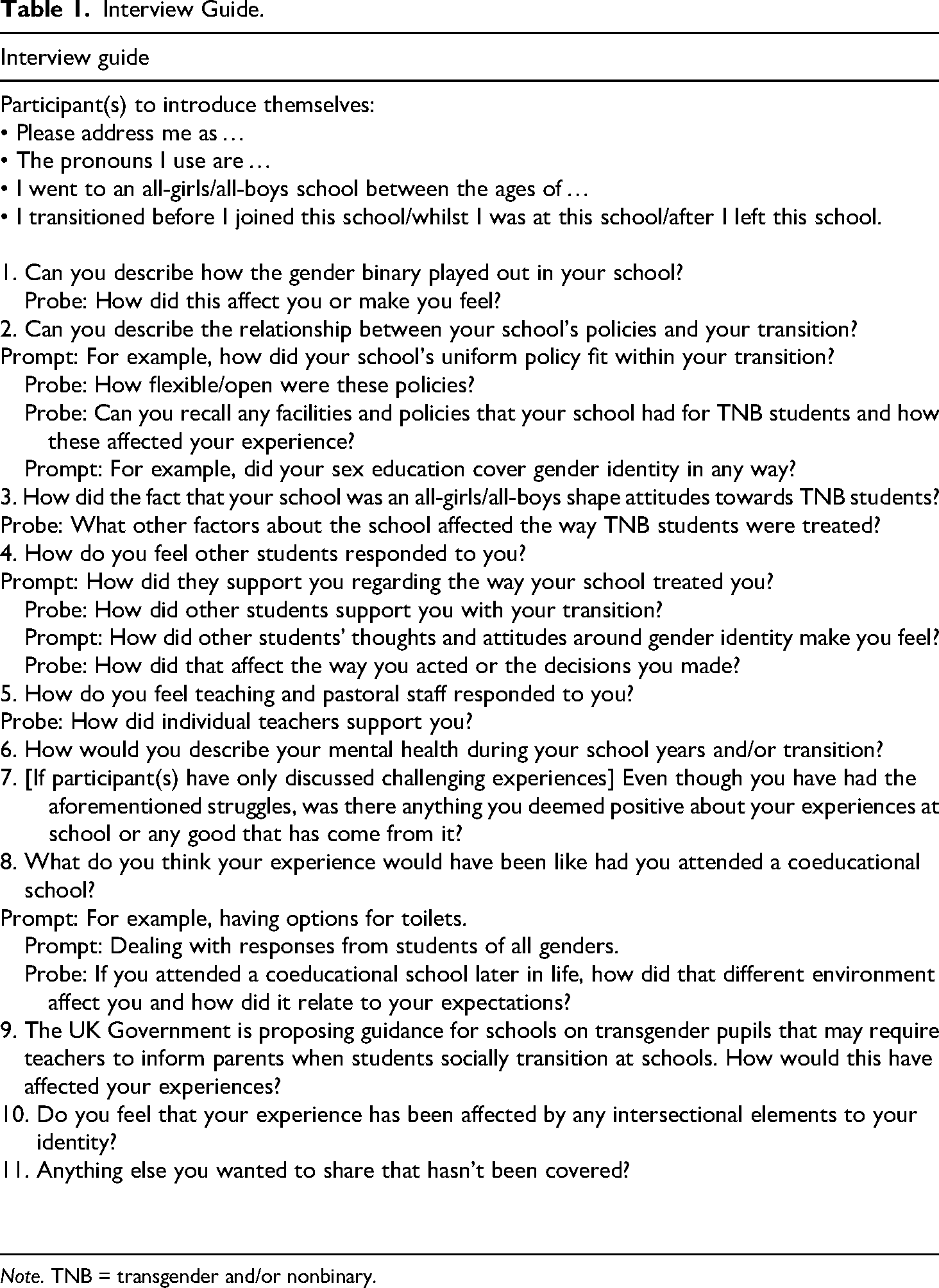
Note. TNB = transgender and/or nonbinary.
Phase 2: Interviews and Focus Groups.
Purposive sampling was used to recruit TNB participants, 18–25 years old, who had previously attended an SSS. Two participants from Phase 1 joined three new participants who were recruited through contacting multiple TNB and lesbian, gay, bisexual, trans, queer, and more (LGBTQ+) groups, as well as through snowball sampling. Four people chose to participate in a focus group, and one chose an individual interview, all of which were held online.
Participant Information
A retrospective approach was taken with six participants aged 18–25 who had previously attended an SSS. The youngest two were 18, and the oldest was 25. All participants were White. Two participants were disabled, including “assorted mental illnesses” and “autistic and am a wheelchair user due to physical disabilities.” Participants’ sexualities included asexual, lesbian, queer, and straight. Two participants identified as female, two as men, one as transmasculine, and one as nonbinary. Exclusion criterion was anyone currently in therapy at the request of the ethics panel due to potential increased risk.
Ethics
The research was approved by the University of Northampton's Faculty of Health, Education, and Society's Ethics Committee, and was guided by the British Psychological Society's (BPS) Guidelines for Psychologists Working With Gender, Sexuality and Relationship Diversity (BPS, 2019) and Code of Human Research Ethics (BPS, 2021). Historically, psychological and therapeutic professions have pathologised and discriminated against TNB people (Ashley, 2021; Butler, 2004; Horton, 2020). Therefore, a participatory research design was used, in line with recommendations for ethical trans research (Reed, 2023; Vincent, 2018) and due to the first author being mindful of her cisgender identity (Galupo, 2017). A participatory design allowed participants to coproduce the design and interview questions for Phase 2. Participants were given a pseudonym and were provided with blank boxes on the demographic form to use their own language to describe their identities and indicate their pronouns.
Analytical Framework
FRDA is a two-phased analytical approach designed to identify discursive realms and individuals’ embodied experiences within such realms by centring their voice (Thompson et al., 2018). The approach aims to address feminist concerns of purely discursive accounts “missing” voiced experiences (Saukko, 2010), particularly of those already marginalised, such as TNB students. FRDA does not seek to privilege certain accounts of experience as more “real,” for example, discourse over the personal, rather, it aims to recognise how both aspects are connected, producing a personal-political account that is voiced through multiple contrapuntal voices (Thompson et al., 2018). For example, the current study used FRDA to understand how gendered power relations are created and upheld by the language employed in SSS and how they are embedded in power relations for TNB students. By integrating FRDA with a critical realist perspective, this study explores how discourse constructs TNB students’ identities, and how these discursive constructions are constrained by material aspects such as school policies, legal frameworks, and an embodied experience of oneself. This approach ensures that the analysis captures both the power of discourse and the voiced experience of exclusionary school environments. FRDA aims to amplify the voiced experiences of those not typically heard in dominant narratives (Thompson et al., 2018), which is particularly important when mainstream media and political discourse is steeped in dangerous transphobic language (Bancroft, 2023; Dyson, 2023). FRDA provided a tool that could help unearth and magnify stories from TNB individuals regarding their relationships to cisnormativity, and utilise these to support counsellors working with these students to “promote collective change” (Thompson et al., 2018, p. 95).
There are two phases to FRDA. First, a Foucauldian-informed poststructuralist discourse analysis was applied to the transcripts produced from the individual interviews and the focus group. Following Willott and Griffin's (1997) approach, the first author identified in vivo codes, discourses, discursive patterns, and ultimately the discursive realms that the participants navigated. Phase 2 focused on how individual participants related to the discursive realms in varying ways, through the construction of I poems, following Gilligan et al.'s (2006) Listening Guide. These were informed by an iterative process of listening to the recordings and reading the transcripts, which helped to identify the plot underlying each participant's story. An individual's “I” statements within each discursive realm were then sequentially taken, identifying moments of first-person experience and the accompanying verbs they used. Each statement was placed on a new line to create an I poem. Contrapuntal voices within each I poem were explored to understand the multiple ways in which one person can relate to structures of power, both being shaped by and shaping discourse. Finally, theoretical accounts were presented. The findings will follow the two phases of FRDA, with the discursive realms being presented first and the I poems phase second, to allow for the voiced experiences to be located within the discursive.
Reflexivity
The first author, a White, cisgender, heterosexual, nondisabled, middle-class woman, recognised how her privileged position researching trans identities as a cisgender person may compound the power dynamics that exist between a researcher and participants (BPS, 2021; Galupo, 2017; Liamputtong, 2011; Wilkinson, 1998), and decided to take a two-phase participatory approach. Throughout the research, the first author critically reflected on her gender identity in regular team meetings with the second author, and was mindful of not imposing a cisgenderist perspective (Galupo, 2017; Gleisberg et al., 2022) and applied her counselling skills of nonjudgmental active listening. The second author, a White, nondisabled, genderqueer and gay person, supervised the research. The authors considered their personal and political positions regarding trans rights as inseparable, and both contributed to the consultation on the previous U.K. government's draft guidance for schools in England on “gender questioning children” (Department for Education, 2023), have attended Pride marches, and have undertaken specific trans awareness trainings as forms of activism.
Analysis and Discussion
In the first phase of FRDA, by focusing on discourse, the analysis explored how the language used by participants constructs the identities and roles of TNB students in SSS, and considered how these constructions are shaped by social norms and expectations (Thompson et al., 2018). Three intersecting discursive realms were constructed in the analysis: (1) “Hi girls, how are you girls?”: Navigating cisheteronormativity at school; (2) “You had to have parent permission”: The delegitimisation of TNB youth; and (3) “A very, very macho environment”: Escaping masculinity at all-boys schools.
“Hi Girls, How are You Girls?”: Navigating Cishetereonormativity at School
The language used by the participants constructed SSS as environments where no physical nor philosophical space existed for their identities. The genealogy of the participants’ stories is significant when considering which identities are constructed as acceptable (Foucault, 1984a). A legacy of the U.K.'s Section 28, which created an educational discourse around “unnatural” homosexuality (Gay and Lesbian Advocates and Defenders et al., 1988; Local Government Act, 1988), meant the participants never saw themselves represented in school curricula or teaching materials, making school a challenging space to construct and shape one's identity as TNB (Beemyn & Rankin, 2016; Frohard-Dourlent, 2018; Horton, 2020; Schmitt, 2022). This made it difficult for TNB students to explore their identity, with Jack stating: If there was more education around trans people, I think I would have realised sooner and I think that might have helped my mental health as well, because I think being so uncomfortable with myself but not understanding why, I think that was a big part of my mental health issues.
With an absence of gender-diverse education at school, participants turned to the internet. Lana, a trans girl at an all-boys school, only understood herself due to the “TikTok algorithm. I basically had to teach myself what being trans meant,” and wished she had more education at school. The internet plays a vital role for TNB youth in developing a sense of self and community (Beemyn & Rankin, 2016; Bragg et al., 2018; Cronesberry & Ward, 2024; Riggs, 2019), yet the U.K. government's draft guidance devalues this source of education, encouraging staff to consider “has the child been influenced by peers or social media?” (Department for Education, 2023, p. 10). In schools, certain understandings are positioned as truth (Foucault, 1980), and students are often not given opportunities to learn about anything other than the cisgender norm (Howell & Allen, 2021).
Participants described teachers as silencing nonconforming bodies and identities and adhering to the gender binary in other ways. Kit, who is nonbinary and attended an all-girls school, and Jack were repeatedly collectively addressed as “girls” despite Jack's headteacher knowing he was a trans man, which Jack found “really invalidating, kind of, and just uncomfortable.” Cisgenderist language and misgendering by teachers has been a common theme in previous research (Bower-Brown et al., 2021; Howell & Allen, 2021; Mackie et al., 2023; Schmitt, 2022) and is constructed as acceptable by those in power; in April 2023, the UK's then Education Secretary declared that “it's absolutely fine” for teachers to say “good morning, girls” at all-girls schools (Bullen, 2023).
The lack of teaching and awareness around TNB identities led to “gender policing” (Davy & Cordoba, 2020; Mizock & Hopwood, 2016; Nanney, 2020), as participants were expected to act in gender-stereotypical ways. Ben's disinterest in sports was met with “‘oh but you’re saying you’re a man’ and well yeah, but you know, not all men love sports, I don’t, I’d rather just read a book.” Similarly, the policing of Jack's gender expression throughout his secondary school life constructed an impossible situation for him: I got bullied a lot throughout my life, so a lot of people were like “oh you’re not a normal girl, you don’t act like a girl,” and then, when I came out, some people were like kind of turned the opposite, they were like “oh but you don’t act like a guy, you don’t look like a guy,” and I’m like, “you’ve been saying for years that I’m not like a girl and as soon as I tell you yeah I’m not a girl” then people were like … and with the sport thing as well, I don’t really do any sports. I have disabilities so I really struggle with sports and people were like “oh you don’t like sports, you always sit out of PE [physical education] so that's not like a very manly thing to do,” and I was like, “that has nothing to do with it.”
Participants recalled pockets of support from teachers, echoing findings in previous research (Bower-Brown et al., 2021; Davy & Cordoba, 2020; Mackie et al., 2023; Schmitt, 2022), and for some, the school offered “a trial run for how I was going to come out to my family” (Ben). However, finding safety meant hiding their identity for Kit and Abi, a trans girl at an all-boys school. And for Lana and Ben, this meant leaving an SSS at 16 and attending a coeducational sixth form (the final two years of secondary education for students ages 16–18). Lana spoke of leaving as “the best thing I’ve ever done for my mental health.” Ben, who had been diagnosed with anxiety and depression and sought treatment in the forms of medication and therapy during his time at his SSS, felt that: One of the things that did really help that seems kind of obvious to me now … was kind of just getting out of that environment because it felt like I was so stuck there, and now that I’m out of it and being treated as a man, like it just is so much nicer and easier to just live my daily life.
Ben challenges the pathologising discourse (Ashley, 2021; Butler, 2004; Horton, 2020) and evidences the importance of gender affirmation for one's mental health (Horton, 2020; Pollitt et al., 2021).
Participants drew on discourses of mental health to convey their struggle with the cisgenderist curricula, which functioned to silence their TNB identities and not support their gender exploration; a belonging discourse highlighted the invalidation by teachers and their sense of difference amongst peers. Counsellors working in SSS therefore have a crucial role to play in supporting TNB students with these challenges, both in the therapy room and also more widely in challenging the system that upholds these discourses.
“You Had to Have Parent Permission”: The Delegitimisation of TNB Youth
The second discursive realm reveals the wider systemic articulations of power that work together to disempower and delegitimise TNB youth (Ward, 2021; Ward & Lucas, 2023). Educational institutions are inherently regulatory for those working within them and the students receiving their education there (Thompson et al., 2018), and it is through education that children and youth are led in an “‘appropriate’ direction” (Burman, 2016, p. 76). As positions of authority in schools, teachers hold power and exert this in their determination of how “appropriate” a TNB identity is for a young person and therefore their subsequent treatment (Alldred & Burman, 2005; Ashley, 2021; Burman, 2016; Ward, 2021). The previous U.K. government published draft guidance for schools in England on “gender questioning children” at the end of 2023 (Department for Education, 2023). Whilst the current U.K. government is analysing the consultation feedback (their response is due to be published later in 2025; Department for Education, 2024), recommendations from the Cass Review (a review of children's gender services in England), which has been heavily criticised for its lack of methodological robustness (Grijseels, 2024; Horton, 2024), have started to be implemented. For example, in May 2024, the previous Conservative government enforced a ban on prescribing puberty blockers for treating gender dysphoria for those under 18 years old (Department of Health and Social Care, 2024), which was extended by the Labour government when elected in July 2024 despite the same medication being available for cisgender young people. These actions can be viewed as discursive practices aiming to sustain the ability of educational institutions, including SSS, to maintain a unilateral development trajectory for their students (Alldred & Burman, 2005).
Participants described needing “to have parent permission to get teachers to use your preferred name and pronouns” (Jack), and coming up against “gatekeepers … standing in the way” (Abi). Here, children and young people are positioned as needing protection from gender ideology (Bridgen, 2023; Pearce et al., 2020), which translates into delegitimisation. They are too young to know themselves and must have adult approval (Department for Education, 2023). Responding to this discourse, Kit felt: I wanted to eventually talk to my parents about it and for them to come with me on that journey, but I think it's really important for people to do that on their own terms, and I think that would have made me feel really quite withdrawn from the school, and they’re not supporting me.
Counsellors must therefore be aware of the implications this guidance will have for TNB students not being supported within educational environments. Indeed, the participants’ mental health was impacted by restrictions on socially transitioning (Horton, 2020; Pollitt et al., 2021; The Trevor Project, 2023). Many experienced microaggressions and minority stress as their gender was not affirmed (Horton, 2020; Meyer, 2003; Pollitt et al., 2021). Kit, for example, spoke of “having lots of suicidal thoughts” as they were forced into hiding their nonbinary identity at university.
At the same time as being positioned as incapable of knowing themselves, as TNB youth, the participants had to advocate for systemic changes around uniform and preferred names and pronouns, as well as educate their peers on gender identity, which was described as “exhausting” (Ben) and “frustrating” (Jack). This contradictory positioning echoes findings in previous research (Davy & Cordoba, 2020; Frohard-Dourlent, 2018; Jones et al., 2016; Ward, 2021). Given the pressures TNB students are subjected to in regard to resisting the cisheteronormative discursive realm and educating peers and staff, counsellors can become allies and advocate for changes on behalf of their clients.
“A Very, Very Macho Environment”: Escaping Masculinity at All-Boys Schools
Across the world, trans women are subjected to transphobic violence at higher rates than trans men (Transgender Europe, 2023). Trans women are delegitimised as an identity by politicians (Gutteridge, 2023; Mitchell, 2023), and are seen as predators by trans-exclusionary radical feminists (TERFs), who reduce gender to biological essentialism and position trans women as inherently violent (Nanney, 2020; Pearce et al., 2020; Solnit, 2020).
In this study, Lana “heard of experiences of those who went to the girls’ school who transitioned, although the girls’ school, I think, were a bit more supportive,” but she “knew it was not an option for me to transition in school. I didn’t consider it for a second.” Differing levels of felt safety at all-girls and all-boys schools have been noted in wider research (Gee & Cho, 2014). Abi attended an all-boys school between the ages of 3 and 18 and did not transition until after she had left. She chose not to transition until she was financially independent of her unsupportive parents, but also felt “The idea of making myself feel like very vulnerable and coming out to the school and saying ‘I’m a girl’ made it feel like, that never felt like the environment that was ever going to work for me.”
Nicolazzo (2021) reflects on the need for many TNB people to maintain invisibility in order be safe, and both Abi and Lana had to self-censor their female identity at schools in which hegemonic masculine norms were pushed. Abi spoke of “a very, very macho environment” with a “culture of misogyny … very much built in”; and Lana recalled that, “It was a very hard experience to either try and conform to that as some people did or have to kind of deal with that the way that is valued, especially as a trans person who wants to escape any kind of masculinity in any way at that point.”
Abi and Lana highlight findings from existing research on toxic constructs of hegemonic masculinity (Marasco, 2018; Marotti et al., 2020; Rozmarin, 2020), which is played out in homophobia, aggression, and an absence of vulnerability at all-boys schools (Hickey & Mooney, 2018). Deviating from the norm has dangerous repercussions, as “expressions of femininity” at all-boys schools are “disallowed and denigrated” (Howell & Allen, 2021, p. 417).
Abi reflected that this machismo meant “that mental health is not a thing that people would talk about in any, or take seriously in any way.” Masculinity discourses constructed mental health and help-seeking behaviour as unserious, resulting in significant mental health struggles for Abi during her time at school and her not accessing support for this, such as psychotherapy or medication. The discourse that directs boys to restrict emotional expression was so dominant at Abi's school that, despite identifying as female, she internalised help-seeking as nonnormative behaviour (Boerma et al., 2023; Marotti et al., 2020; Rozmarin, 2020). Furthermore, she did not want to compound her vulnerability by coming out as trans.
Patriarchal societies and institutions struggle with any form of masculinity that goes against the norm (Elliott, 2018; Hickey & Mooney, 2018; Randell et al., 2016). The constructed superiority and domination of men means that when someone who is assigned male at birth declares that they are not actually male, their existence is questioned more intensely and they are punished (Howell & Allen, 2021). There is something suspect about moving away from hegemonic masculinity; one must be gay and/or a predator (Thepsourinthone et al., 2020). Such discursive pressures invalidated Lana and Abi's identities and added to their vulnerability; they could only transition once they had escaped. Therefore, counselling provisions in all-boys schools should acknowledge TNB students’ struggles with transmisogyny (the intersection of transphobia and misogyny) and provide support to navigate it. More widely, counsellors should also challenge what is regarded as acceptable masculinity and reshape the discourse around boys and mental health at all-boys schools.
I Poems
Trans theories highlight that gender identity is both socially constructed and an embodied, internal sense of self (Nagoshi et al., 2014); the use of I poems in the second phase of FRDA therefore allowed a focus on the voiced experiences within the discursive realms constructed in Phase 1 (Thompson et al., 2018; Ward, 2021). Given that FRDA seeks to empower those voices often marginalised by society (Thompson et al., 2018) and that nonbinary young people's voices are seldom heard in research (Barbee & Schrock, 2019; Bull et al., 2022; Ward, 2021; Ward & Lucas, 2023), Kit's I poem from the discursive realm of “navigating cisheteronormativity at school” will be presented to highlight the contrapuntal nature of their relationship with their gender identity in the context of the SSS. The UK's cisgenderist society erases nonbinary identities through a lack of legal recognition (Fairbairn et al., 2022), and individuals are forced to choose either male or female on official documents such as passports (Maheshwari-Aplin, 2021). However, Kit voiced that attending an all-girls school actually meant “there was almost less emphasis on the gender binary.” As the first author listened to Kit speak of their experiences, she felt challenged by what she was hearing in relation to her own ideas of SSS: You’re never going to the girls’ toilets, you’re just going to the toilets. You’re never playing on the girls’ sports team, you’re just playing on the hockey team. I think I felt quite neutrally about it. [Nowadays] I definitely feel like a bigger worse feeling when I have to choose a toilet to go in and there's not a gender neutral option [whereas when] I was at school I don’t remember feeling that feeling as much I just kind of got on with it. I don’t think I’ll ever be able to come out to my teachers in school or the wider school community I don’t think it's worth it I don’t know how they’ll react I don’t think they’ll understand. I’ll just get on with it and finish school.
Kit initially voices a “neutral” experience of their time at an SSS; having only one set of toilets was less limiting and caused less dysphoria than if they had been presented with the choice, as they do at the coeducational school they now teach in. However, this ease of existence that Kit implied was contrasted by the second part of their I poem, focusing on their decision not to disclose their nonbinary identity beyond their partner and small circle of friends. This latter voice caused the first author to reflect further on the final line of the first part: “I just kind of got on with it.” Initially, the first author picked up a voice of nonchalance in this phrase. However, the author wondered if she was actually identifying a voice of coercion rather than choice relating to their experience, emphasised by the repetition of this phrase, but with a slight amendment in the second verse of their poem—“I’ll just get on with it”—voicing sadness and a reluctant acceptance. Foucault spoke of the “panoptic modality of power” (Foucault, 1984b, p. 211) in disciplinary institutions; in schools, there is a sense of constant monitoring from teachers, a hierarchical act that maintains their positions of power. A student's performance of their gender is subject to this permanent observation. The panopticism led Kit to self-censor and limit their gender identity, and just “get on with” life at school. This echoes Goldberg and Kuvalanka's (2018) findings, where nonbinary students would often accept this invisibility for ease and privacy. Whilst schools do not have to follow the U.K. government's nonstatutory guidance (Department for Education, 2023), Kit's voice of uncertainty about how their teachers would react is a reminder that without schools being proactive with their own supportive guidance, TNB students may be left in Kit's position, unsure of how their teachers will respond; choosing to hide their gender identity, risking harm to their mental health.
In conclusion, the participants’ identities were discursively rendered invisible in their SSS through the absence of nonnormative gender identities in school curricula and teaching materials and further erased by teachers through the use of gendered language and regulation. These problems arose from systemic discourses that position cisgenderism and heterosexuality as the norm and shape teacher training courses and curriculum design. Teachers hold the power to determine who belongs and how one expresses one's gender identity, yet the power to educate others or enact change tends to be held by the TNB students themselves, at a cost to their mental health. In this research, stereotyping and gender policing by peers were problematic across SSS, and TNB students’ nonconforming gender identities resulted in them lacking a sense of belonging. In all-boys schools, discourses around masculinity positioned TNB pupils as particularly vulnerable and at risk, forcing them to either remain hidden or escape and move to a different educational environment. Safer discursive realms did exist, but these were contingent on the presence of supportive teachers and, significantly for this research, often the existence of pupils of all genders. The I poem presented shows the complex and contrapuntal relationship Kit had with the cisheteronormative and delegitimising realms that existed within their SSS. Voices of neutrality stood alongside sadness and reluctant acceptance of the need to self-censor whilst navigating such discursive pressures.
Implications
The current research contributes to trans and feminist literature by focusing on TNB people's experiences within an educational setting that is underresearched, that is, SSS. The findings have therefore extended and expanded broader trans literature that focuses on schools in general by highlighting the nuanced experiences of navigating SSS for TNB people, including how TNB people at all-boys schools may be particularly vulnerable due to discourses of hegemonic masculinity and misogyny.
Methodological contributions are made through the research design utilising participatory methods with TNB people to coproduce the design of the data collection phase, including what methods should be used and what questions should be asked. For example, for future TNB research, providing options for individual and/or group designs (such as interviews or focus groups) may increase comfort and be more accessible for these populations, as participants will likely be at various stages of their transition journeys or may not be “out.” The use of FRDA provides further contribution as there is only one other published study using this analytical approach for exploring gender diversity—notably, the participants were all nonbinary (Ward & Lucas, 2023). Therefore, the current research expands the use of FRDA by including trans and nonbinary participants and focusing on an experience that is a current gap in the literature.
Practical implications for counsellors and their role within SSS have been presented as conclusions to each discursive realm. The participants called for school counsellors to have an awareness of what it means to be TNB and a commitment to getting a client's name and pronouns correct, including not misgendering or deadnaming a client when referring to their life pretransition. Counsellors should also not expect to be educated by TNB clients but should listen to them, treat them as an individual, and not assume all TNB people have the same needs. Professional guidance for both counsellors (Barker, 2019) and psychologists (BPS, 2024) working with gender diversity, and texts on supporting trans people of colour in particular (Choudrey, 2022) may be useful practical resources to address the above points voiced by the participants to help foster more inclusive and gender-affirming school environments. In SSS, where TNB students can feel particularly invalidated by being surrounded by peers whose gender identity does not align with their own, and by not seeing themselves represented in staff or teaching materials, having a safe space where a counsellor can provide that validation is particularly important. Counsellors must be aware of the cisheteronormative environment in which they may find themselves working and how their clients’ presenting problems fit within this system (Frohard-Dourlent, 2018). This includes using their voice to ensure colleagues are also taking a gender-affirmative approach to students, considering TNB voices and role models in teaching materials, and proactively creating and promoting inclusive gender policies (Davy & Cordoba, 2020; Horton, 2020; Riggs & Bartholomaeus, 2015). Accessing specific therapeutic training for working with gender diverse people, for example, by Gendered Intelligence resource (https://genderedintelligence.co.uk/services) or Pink Therapy resource (https://pinktherapy.org/), would help equip school counsellors with more detailed knowledge of and confidence in how to be gender-affirming for TNB people. Future research may wish to reach out to current students or set specific criteria for when participants had transitioned, in order to more deeply understand idiographic experiences. Focusing on the perspectives of school teachers and counsellors on the challenges and opportunities in supporting TNB students is another area for future research. Finally, future research should aim to recruit more diverse samples, particularly in relation to race and ethnicity.
Limitations
In terms of limitations of the research, four of the six participants were assigned female at birth and all the participants identified as White, reflecting a lack of diversity within some of the participants’ demographics. Incidences of transphobic bullying were not a strong theme in this study, in contrast to what has been shared in previous research (Allen et al., 2020; Day et al., 2018; Parodi et al., 2022), perhaps due to a lack of diversity within the sample and the self-censoring amongst participants that resulted in two of them not transitioning until after they had left school, and one only coming out to close friends. The majority of participants acknowledged during the interviews that they were sharing experiences from several years ago and that language and awareness within the TNB community change relatively quickly. Therefore, some of the experiences shared may not be the case today as there is more education and awareness has risen. However, the two participants aged 18 asserted that there was still not enough education on gender identity within schools. Furthermore, this research did not hear from any participants who had transitioned prior to joining the school. Such individuals may have unique experiences and perspectives which would be particularly important to learn from, in light of SSS being allowed to reject applications from students based on sex assigned at birth, as confirmed in the government's draft guidance on gender in schools (Department for Education, 2023; Forrest, 2023). The exclusion of participants currently in therapy may have limited the scope of insights gained, particularly regarding the psychological and emotional impacts of attending an SSS, which could explain the underrepresentation of trauma-related experiences and coping strategies. Whilst the authors suggest that transmisogyny may have resulted in self-censoring amongst the transfeminine participants, in-school experiences of transmisogyny are not fully understood. To more effectively support this vulnerable group, future research could seek to recruit and safeguard transfeminine youth currently in SSS by having a more diverse research team with lived experience. Whilst this research attempted to be participatory in design, it may be that the most vulnerable group of participants, trans women, and particularly those of colour, may not have been ready to share their experiences with researchers holding cisgender privilege.
Conclusion
The research explored the experiences of TNB students at SSS and aimed to help counsellors better understand how they can support TNB clients. The findings show how nonnormative gender identities can simultaneously be regulated by and challenge the curricula, teaching staff, and other students in SSS, which all act to silence nonconformity and construct an acceptable truth of cisheteronormativity. Teachers hold the power to determine who belongs and how one expresses one's gender identity, yet the power to educate others or enact change tends to be held by the TNB students themselves, at a cost to their mental health. Participants navigated discursive realms including education structured around biological essentialism, being held to normative standards of gender expression, and experiencing a sense of not belonging and feeling invalidated. For the participants who had attended all-boys schools, navigating cisheteronormativity was particularly limiting and risky, reflective of wider societal problems of transmisogyny. Opportunities for future research include focusing on recruiting diverse samples of TNB people as well as exploring how safe spaces within schools can be created and maintained and how counsellors can facilitate these for gender-diverse students.
Footnotes

Ethical Approval
Ethical approval was granted by the University of Northampton's Faculty of Health and Society Research Ethics Committee. Written and verbal informed consent was gained from all participants.
Funding
The authors received no financial support for the research, authorship, and/or publication of this article.
Declaration of Conflicting Interests
The authors declared no potential conflicts of interest with respect to the research, authorship, and/or publication of this article.
Data Availability Statement
Rights Retention Statement
For the purpose of open access, the authors have applied a Creative Commons Attribution (CC BY 4.0) licence to any author accepted manuscript version arising.