




Abstract
#GentleParenting presents a novel trend in networked parenting communities. Its rise correlates with the COVID-19 pandemic, during which parents’ access to medical professionals decreased significantly. In this vacuum, a group of lay parenting experts arose and continues to gain influence. Through a mixed-method study that combines critical discourse analysis and contextual visual discourse analysis, this article analyzes a dataset and sample of posts compiled from TikTok and Instagram. My findings suggest that an epochal shift in parenting culture is taking place, involving a break with some of the fundamental tenets of the previously dominant parenting trend of intensive mothering. Informed by feminist critiques, my analysis of #GentleParenting explicates a concept I call the “fifth shift” to describe the additional burdens involved in online parenting. While #GentleParenting can be understood as positive in its efforts to allow parents to regain control over childrearing, it also poses some challenges, including its propagation of wealthy, White feminist presentations in digital networks, as well as its insistence on adding additional parenting labor. While empathy is resonant in #GentleParenting via satire, questions remain regarding the political effects of this community.
Keywords
“Networked parenting” refers to the way parents have turned to digital networks for advice and support in the age of social media. The most recent and noteworthy trend in networked parenting is “#GentleParenting,” the social media analogue to the offline movement known as “gentle parenting”—a cluster of positive parenting practices that focalize the development of children's emotional self-awareness. Positive parenting is represented by as many as 70 different iterations (Holden et al., 2016, p. 208), all of which include (a) a nonpunitive approach and (b) a commitment to the parent–child relationship. Some positive parenting strategies can be traced back to Adler's (1930) positive discipline and Bowlby's (1969) attachment theory; more recently, positive parenting approaches stem from advances in children's rights (Ehrenreich & English, 1975) and psychological studies demonstrating the harmful impact punitive parenting models can have on children (Gershoff, 2013).
While gentle parenting has psychological roots in positive parenting, it also arises out of feminist mothering philosophies that seek to reject the long-reigning cultural parenting forms of “patriarchal motherhood,” “intensive mothering,” and “scientific parenting” that strive to keep parents, but especially mothers, subsumed to the misogynistic values upholding capitalist society (Federici, 2014, p. 17). Rich (1986) defines “patriarchal motherhood” as the regulation of women's reproductive power by the dominant (male) society. Under patriarchal motherhood, parenting is relegated to second-class labor, and, since those who mother (often) stayed in the domestic sphere, their authority is undermined as soon as a patriarch is present. With the advent of expertise-driven parenting (known under the umbrella term of “scientific parenting”; Litt, 2000, p. 32) in the 1930s, those mothers were forced to adhere to the dictates established by credentialed authorities like the family doctor or Dr Spock (a U.S. American pediatrician). Many positive developments emerged from this movement, including widespread vaccination programs, efforts to make literacy development more equitable, and early screening for behavioral asymmetries in children through knowledge-sharing about milestones (Piaget, 1964). However, scientific parenting often had an oppressive effect on folx outside the strict normative social codes this movement reflected and reinscribed.
Hays (1996) defines “intensive mothering” as a model of childrearing originating in the later years of the Second World War and coming to fruition in the 1980s and 1990s. Intensive mothering encourages (some) women in the North American context to believe they are perfectly capable of running both their workplaces and their homes. Though it is often described as “having it all” (Slaughter, 2012), in practice, intensive mothering means that mothers continue to bear the brunt of domestic and childrearing labor, inhibiting their growth in the workforce and placing undue pressures on their well-being (Fry et al., 2023). The COVID-19 pandemic threw this gendered imbalance into stark relief (Taub, 2020). It is important to note that all three of these movements—patriarchal motherhood, scientific parenting, and intensive mothering—have been disseminated by credentialed experts, utilized by the state, and weaponized against poor, immigrant, differently abled, and neurodiverse parents (Hays, 1996; Litt, 2000).
Given this context, it is noteworthy that a lay person originally theorized gentle parenting, Sarah Ockwell-Smith, who introduced the concept in her 2016 The Gentle Parenting Book and attributes her expertise to her lived experiences as a mother. The concept has largely spread via social media platforms, especially during the onset of lockdowns in the early stages of the COVID-19 pandemic. Ockwell-Smith (2016) provides the following definition of “gentle parents”: “Their choices are informed, educated and made out of respect and empathy for their children, as well as themselves” (p. 2). “Informed” pertains to experiential knowledge rather than information an outside expert prescribes. Lay expertise has long been a defining feature of social media communications; creators in these spaces marshal affective strategies of “reassurance, motivation, and feelings of connection” (Maslen & Lupton, 2019, p. 1645) instead of scientific claims. Yet, within parenting culture in the West, appeals to accredited expertise have remained standard despite the widespread uptake of social media platforms as a venue for parenting discussions (Astudillo-Mendoza & Cifuentes-Zunino, 2022, p. 377). #GentleParenting presents a marked shift in this regard.
As COVID-19 anxiety and protocols have waned in subsequent years, #GentleParenting content has only increased in popularity. My original premise was that #GentleParenting presented an inflection point for the parenting culture of the Anglophone West: a shift that began during the pandemic has taken hold and become a pervasive cultural trend. This premise was based not only on the rapidity and volume of #GentleParenting content in the networked parenting sphere but also on the way this movement has been taken up multimodally (in journalism, comedy specials, etc.).
To investigate this phenomenon, I undertook a mixed-method, cross-platform analysis of two dominant sites of #GentleParenting culture, Instagram and TikTok. Through programmatic analysis of a larger dataset (212 posts) in conjunction with a combination of critical discourse analysis (CDA) and contextual visual discourse analysis (CVDA), as applied to a smaller sample from the larger dataset (21 posts), my findings not only supported my original hypothesis but indicated that the inflection point was, in fact, an epochal shift. This shift involves a break with some of the capstone tenets of intensive mothering, the previously dominant parenting trend—most notably through #GentleParenting's insistence on being led by community rather than experts, and its commitment to empathy for parents. Such tenets suggest the movement is embracing the foundational aims of feminist mothering 1 as outlined by key scholars such as Rich (1986), Ruddick (1989), and O’Reilly (2010). These scholars highlight that systematic and overarching cultural barriers continue to undermine the import of parental knowledge and further perpetuate an imbalance in the domestic and affective labors of childrearing.
To understand the full ramifications of the shift #GentleParenting represents, my analysis relies on a concept I call the “fifth shift.” Hochschild (1989) coined the term “the second shift” to refer to the domestic and affective labor mothers in dual-earner nuclear families enact once they finish their day jobs. More recently, O’Reilly and Green (2021) named “the emotional and intellectual labor of motherwork and the homeschooling of children” under pandemic circumstances as the “third and fourth shifts” (p. 20). In addition to the previously outlined “shifts,” there is, for networked parents, a “fifth shift” in which they are required to perform their parental identities on social media through tropes conversant with postfeminist neoliberalism, such as heterosexual femininity and beauty (styled hair, clothes, makeup, etc.), thoughtfully created image and video production, and parenting performances that continue to uphold the intensive mothering's “good mother” figure (Bowles-Eagle, 2019, p. 767), who is always composed and never complains.
My analysis finds that some #GentleParenting content has started to acknowledge and lampoon the onerous burden of the fifth shift, making visible the unyielding pressures on parents, especially mothers, in this era. This speaks to a developing awareness of the harried experiences of mothering under the pressures of social media performance matrices. But whether one is creating online parenting content or simply scrolling through it, such content is indicative of heightened competition in networked parenting and is itself a key factor contributing to parental stress in our current milieu (De Benedictis, 2012, p. 3; Lazard, 2022, p. 543). The fifth shift speaks to the constantly transforming digital sphere. As new trends emerge, they are almost instantaneously satirized through remixing strategies. Theorizing the fifth shift also brings up an enduring analytical problematic in Internet culture: ascertaining the intention behind posts and determining whether a message of critique can be guaranteed to be understood within/by a given audience and/or content consumer (Sharma & Brooker, 2017, p. 466).
Despite the potential of self-reflexive critique within/of the fifth shift, #GentleParenting content continues replicating intractable concerns of feminist mothering studies. Specifically, it constantly runs the risk of reifying a preferred typology of parent practitioner as accorded to White, middle-to-upper class, heterosexual femininity within the context of a two-parent family, wherein the mother figure must take on even more labor in their childrearing to meet the demands of gentle parenting.
Key contexts
Data collection for this study was conducted in the latter part of 2023, during what I dub a time of “pandemic afterlives”: a period marked by lingering practices, habits, and problematics that surfaced during the most intensive period of the COVID-19 pandemic. This is what Grose (2024) calls the continuing “fallout from the pandemic,” which, she argues, speaks to transformative social shifts that have continued in the shadows of the outbreak. To elucidate this concept, I first discuss the dominant parenting culture preceding the COVID-19 pandemic and then explain the pandemic's role in shaping subsequent parenting cultures and the advent of #GentleParenting.
Postfeminist neoliberalism and the rise of #GentleParenting
Before the COVID-19 pandemic, parents, and especially mothers, were subject to the widespread comingling of postfeminist and neoliberal ideologies (Banet-Weiser, 2018; Gill & Scharff, 2011), which has led to a surge in unchecked individualism. The confluence of parenting culture and postfeminist neoliberalism imposes significant demands. First, individual parenting responsibilities are heightened due to clawbacks of welfare-state initiatives in conjunction with reduced childrearing support as people increasingly move away (geographically) from their families of origin. Second, parenting has become more competitive as parents vie to create idealized parental identities for themselves to perform (De Benedictis, 2012, p. 3), which they increasingly do online.
Competition centers on the neoliberal impetus towards “a good time” (Dean, 2008, p. 62), which can be understood as the impetus toward performative enjoyment of one's life, and which is marked by what Berlant (2011) called “cruel optimism,” or the way “the object that draws your attachment actively impedes the aim that brought you to it initially” (p. 1). The insistence upon “having it all” (Slaughter, 2012) under postfeminist neoliberalism is hindered by the lack of societal support for parents, especially working mothers, due to the undergirding scripts of “good parenting,” which “continue to silently presume a two-parent family, with unwaged carework and reproductive labor still under the remit of mothers” (Jensen, 2018, p. 170).
In historical terms, the advent of intensive mothering coincided with the rise of postfeminist neoliberalism. But Bowles-Eagle (2019) and Basden Arnold (2016) argue that the prescribed demands of intensive mothering remain pervasive on social media, due to its connections with performances of “unattainable standards” (Bowles-Eagle, 2019, p. 767), including so-called “good mothers” who never complain. In this regard, Hays (1996) writes of a “cultural contradiction” wherein women are required to be “warm” and “unselfish” in their parenting, but where many work outside the home in paid environments where “individualist competition for private gain [is] valued above all else” (p. 50). Thus, across parenting expressions of intensive mothering and their intertwining with postfeminist neoliberalism, parents are subject to the infiltration of competitive market values into their childrearing predicaments.
The established neoliberal parenting context meant that parents were already beset by increased stressors that were only exacerbated by the COVID-19 pandemic (Pedersen & Burnett, 2022, p. 246). The pandemic led to parents reporting “heightened stress or distress” (J. P. Wolf et al., 2021, p. 2) at almost double the rate of adults without children, with those who were pregnant and postpartum disproportionately affected (Firestein et al., 2022). This context led parents towards social media (Johnson & Quinlan, 2019, p. 141), especially when access to in-person medical advice was more limited.
The overwhelming demands postfeminist neoliberal parenting and intensive mothering placed on parents reached a tipping point, and #GentleParenting arose as a response. Hence, the notion of “pandemic afterlives” points to the presiding theories of postfeminist neoliberalism, including that of intensive mothering. These, in conjunction with pandemic conditions, complicate any easy understanding of parental performativity around self, child, and/or community care in this period.
Unpacking the “gentle” in gentle parenting
My study highlights a key issue in #GentleParenting discourses: they reinforce the dominance of specific parental archetypes. The term “gentle” derives from the Latin “gentils” (of the same clan) and Old French “gentil” (high-born or noble), evolving in Middle English to mean mild and moderate while still hinting at its classist roots, as in “gentleman.” Drawing on critiques in digital mothering studies that denounce the dominance of Whiteness and upper-middle class norms (Daniels, 2016; Friedman, 2010; Nakamura, 2008), I emphasize the encoded class dimension of “gentle.” Winter (2022) notes that gentle parenting portrays a mother solely as a caregiver who must set aside all tasks to transform into a calm, self-renouncing presence. This echoes the racialized “Virgin Mary” trope (Dyer, 1997), confining White women to their prescribed roles within Western hetero-patriarchal norms. Given these implications, my project also asks: Who practices #GentleParenting, and who qualifies as “gentle”? As pandemic afterlives reveal, a renewed focus on the self in feminist narratives marks a retreat from intersectional 2 community concerns, reinforcing upper-class, White-feminist social media performances.
Methodology
Following feminist data approaches in new media sociology (Borah et al., 2023; De Choudhury et al., 2013; Paulsen Mulvey & Keller, 2023), I conduct a cross-platform analysis of Instagram and TikTok—key venues for #GentleParenting posting. In this article, I explore #GentleParenting communities as hashtag-activist networks through the theoretical frame of Papacharissi's “affective public” (2014) and Berlant's “intimate public” (Berlant & Prosser, 2011). An affective public is formed by viral emotive expressions that foster solidarity, though it requires a shared sensibility (Khoja-Moolji, 2015, as cited in Marwick, 2019). I employ an auto-netnographic, feminist-psychology approach, reflecting my dual role as both researcher and parent/user. Autoethnography, melding personal narrative with immersive ethnographic methods (Hine, 2017), and netnography, which demands deep engagement and persistent interaction (Kurikko & Tuominen, 2012), allow me to study these communities from within. Although my embedded perspective introduces limitations, collaborative engagements with scholars and practitioners (Smith, 2013) help balance these.
I examine emotive expressions—reassurance, motivation, connection—(Maslen & Lupton, 2019) through my own affective responses as a cis mother, who prefers they/them pronouns and navigates the world from a nonbinary lens. My experiences of White privilege, growing up near poverty with a single mother, and personal challenges during the pandemic (including postpartum depression) inform my Marxist feminist and intersectional critiques. These reflections guide my effort to “turn feelings … into generative action” (Zarzycka & Olivieri, 2017, p. 528) and to ground knowledge through positioned analysis (Haraway, 1991), all while maintaining a critical yet curious feminist-psychology stance (Macleod et al., 2014).
Data collection
Data collection occurred in two stages. First, open-source web scrapers gathered quantitative data (comment counts, emojis, follower numbers, text, images, and video details for TikTok) and tagged comments, guided by my long-term familiarity with popular hashtags in online mothering communities. Using a snowball method, I identified relevant hashtags based on my situated knowledge in online mothering communities, including #GentleParenting, #ConsciousParenting, #IntentionalParenting, along with broader tags like #MomLife, #MotherhoodJourney, #YoungMom, #PostPartumDepression, and #PostPartumJourney. 3 I ensured each post contained tags from at least two groups. Next, scraping was performed on TikTok and Instagram on two dates (November 9 and December 7, 2023) to address data volatility (i.e., the transient nature of posts on these platforms); posts not recurring were removed, resulting in a dataset of 212 posts. A systematic random sampling of every 10th post produced a final corpus of 21 posts.
Data analysis
My work upholds the need to attend to “small data” (Holtz-Schramek, 2024, p. 136). “Big data” methodologies (i.e., approaches that analyze large-scale datasets through automated techniques) reveal overall trends but miss individual nuance, “trading large scale for reduced depth” (Puschmann & Burgess, 2014, p. 2). Therefore, I combined programmatic analysis with CDA and CVDA. This approach balances identifying broader trends with a detailed examination of individual interactions, addressing limitations of “big data” methods (Puschmann & Burgess, 2014).
After collecting the data with programmatic scrapers, I open-coded the larger dataset (Stage 1) using CDA (Van Dijk, 2003), chosen for its ability to view text as a “social practice.” Given the White supremacist, neoliberal context of the internet (Cohen, 2008; Daniels, 2016), CDA is crucial for examining how discourse transmits power and privileges the dominant group (Machin & Mayr, 2012; Van Dijk, 2003). It also helps uncover competitive mothering performances, where some women secure social positions by oppressing others (DiQuinzio, 1999, as cited in Jensen, 2018). After multiple rounds of coding and theme development, I analyzed the smaller sample (Stage 2) using both CDA and CVDA (Tiidenberg, 2017). This combined approach considers text as a “social practice” (Van Dijk, 2003) while also interpreting visual and hypertextual elements (Tiidenberg, 2017).
Ethical considerations
I sought ethics clearance from McMaster University's Research Ethics Board, aligning with current social media research practices that prioritize the well-being of individuals “behind” the data (Warfield et al., 2019). Ethical considerations remain ongoing (Markham et al., 2018), and I continue to reflect on how sharing my findings might affect community members (Bailey, 2015; Cowan & Rault, 2018). To ensure participants’ privacy (Tiidenberg, 2017; Warfield et al., 2019), no account names or handles were collected, and all identifying details were removed. Quotations are paraphrased and kept brief, in line with Instagram and TikTok conventions. Emotive expressions in the data are understood as “biographical talk” (Taylor, 2012), linking to concepts of automediality (Kennedy & Maguire, 2018) and “self-life-inscription” (Poletti, 2020).
I use representative examples to illustrate emerging themes generated from my analysis of patterns in topics, language, and sentiment across captions and comments. However, no single quotation can encapsulate the diversity of experiences among users connected by hashtags (Brock, 2012; Taylor, 2012). As I did not conduct interviews and remain cautious about using harvested data for personal gain (Cowan & Rault, 2018), this work adheres to “contextual integrity,” 4 ensuring that participants’ shared experiences remain confidential.
Findings
I produced four themes in the Stage 1 of analysis. These themes were then contextualized through my analysis of the smaller dataset (Stage 2, see Table 1).
Themes and explication.
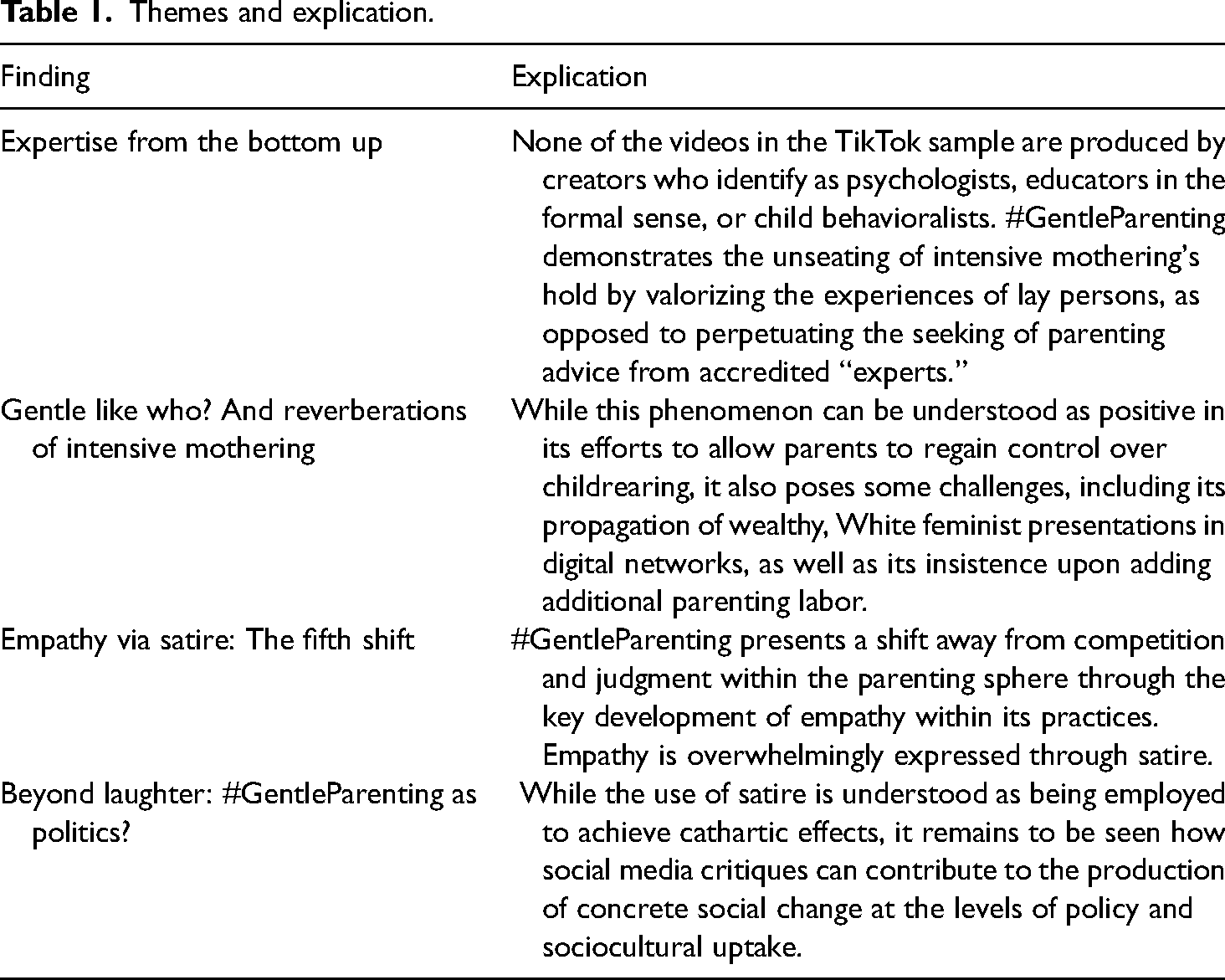
Expertise from the bottom up
My analysis suggests that there is resistance or challenges to dominant parenting discourse. Rather than perpetuating the seeking of parenting advice from accredited “experts,” content creators are challenging intensive mothering's hold on parenting discourse by valorizing the experiences and insights of lay persons. On TikTok, outside of humorous #GentleParenting videos (I discuss the analysis of the humorous content further below), most videos in my sample feature lay parents describing their #GentleParenting strategies. One of the most popular TikTok creators in this vein, who identifies as a young mother via the #YoungMom hashtag and links to their talent agency's contact info, boasts 400,000 followers. The majority of the almost 1,500 comments on one of their most popular posts express adoration for this creator's work, and request more content: “Have you thought of creating an e-book with everything you’ve gathered from your experience on gentle parenting?” “Do you have any resources you used to create the right environment at home?” In the Instagram samples, the primary communicative modes are posts depicting decorative text. These messages emphasize how gentle parents need to be, and why. They also refute common critiques of #GentleParenting, such as “the world isn’t gentle,” with phrases like “It's not our job to toughen our children up to face a cruel world.” Comments on posts such as these often include fire emojis, the praying/gratitude emoji, or general encouragement (“Yes to this!” etc.).
On these two platforms, most comments across both the dataset and sample focusing on nonhumorous #GentleParenting content demonstrate the insatiable hunger for this content. Commentors want a YouTube channel, they want more materials, they want more posts—quite simply, they urgently need to know what to do! Overwhelmingly, I observe positive affects (such as thumbs up emojis or comments such as “Yes!”) swirling around the serious and/or nonsatirical #GentleParenting posts on both Instagram and TikTok. It doesn’t seem to matter what the content is, the dominant reactions to nonhumorous #GentleParenting posts express validation of the creator and demand for more content.
Parents’ experiential knowledge of their children has long been undermined (N. Wolf, 2001). What Cohen (2018) calls “medicine's sexism” (as cited in Klein, 2023, p. 176) has long prevented female-identifying and coded parents from having control over their own narratives and directives about their bodies and their children. #GentleParenting is, instead, the rallying-cry of a feminist whisper network that is insistent upon “soft expertise” (Hulbert, 2003, as cited in Jensen, 2018, p. 29), as opposed to “hard expertise.” 5 For over a century, those who mother have been sidelined in their knowledge of their children; yet they have longed to be the authorities over their own bodies and childrearing practices.
The #GentleParenting community thus demonstrates a transformative shift in parenting culture, revealing a network where information is derived from on-the-ground practices shared by seemingly real parents in a digital space that allows them to circumvent the barriers often posed by private, expensive, and/or outsourced expertise as accorded to that of accredited childrearing professionals. However, the narratives filling the expertise vacuum still need to be tested and reflected on, particularly since—as my findings highlight—the individualizing effects of postfeminist neoliberalism continue to exert a strong pull. My findings show how postfeminist neoliberal ideology infiltrates #GentleParenting, narrowing constructions of good parenting to align with the dominant, White, middle-class norm of intensive parenting, and shaming those who cannot attain the ideal. As parenting content creators on social media platforms gain large followings, and as demand for their content increases, public health clinicians, researchers, and early-childhood educators practitioners need to continue to query their messaging. However, given the engrained nature of White supremacist patriarchy in social medicine domains, we need to be aware of how these forces influence virality and online discourse.
Gentle like who? and reverberations of intensive mothering
My 6 analysis highlights the propagation of wealthy, White, feminist presentations in digital networks, as well as their insistence on adding additional parenting labor. As noted, there is a consistent demand within #GentleParenting for content that upholds conservative and retro-sexist feminist precepts, such as the clean home; the White, middle-to-upper class, stay-at-home mother with endless frequencies of childrearing bandwidth (not to mention perfectly styled hair, make-up, and clothing); and the wielding of untested lay expertise. For instance, a popular poster in my dataset (with hot-ironed blonde ringlets, a coordinated pastel jumpsuit, and full make-up) demonstrates their strategy for de-escalating tantrums. In a TikTok video, the creator showcases their redirection of their son's tantrum by taking him outside and “developing his fine-motor skills.” Comments on their post include sentiments that range from the supportive, such as a commentor offering that the poster deserves “the Nobel prize” for their parenting, to the incredulous “How do you maintain this calm?” As Jensen (2013) observes, “in online environments in the Western contexts, mothers weave more traditional and conservative notions of the family with those of neoliberal individualism” (as cited in Zhao & Bouvier, 2022, p. 2). In terms of the animating question of my study, “Who gets to be gentle?” the answer is White, able, thin women with both class and beauty privilege, not to mention the leisure time and/or resources requisite to create and maintain #GentleParenting audiences with content that is well-styled, edited, and produced.
Given the impossible standards upheld by intensive mothering ideology, it is worth noting that almost every comment section in every TikTok post in my dataset invokes some reference to shame; for instance, comments shaming parents who are “not gentle” for ruining their children's lives by inflicting on them the negative outcomes associated with authoritarian parenting styles (Gershoff, 2013; Holden et al., 2016). Gentle parenting, as Ockwell-Smith (2016) explains, corresponds to parents making “choices made out of respect and empathy for their children, as well as themselves” (p. 2). Such an open-ended definition stokes parenting's competitive flame, emboldening parents to critique others even within a supposedly grassroots community driven by a nonhierarchical ethos.
It is imperative to point out that while this “affective public” (Papacharissi, 2014) is guided by lay expertise, moral judgments, driven by a discourse of healthism, reverberate in these online spaces. Shotwell explains that healthism “names the idea that we are each responsible for maintaining our own individual well-being” (2016, p. 24). In conjunction with postfeminist neoliberalism, healthism suggests that individuals must take responsibility for the totality of their circumstances, without taking into consideration broader systemic injustices that can cause some families to struggle more than others.
Adding to the antagonistic affect and shaming evident in these online spaces, the posts in my sample also point to the effects increased attention has had on #GentleParenting, namely, social judgment for getting it wrong. This is illustrated by the comment: “I like the psychology behind gentle parenting. I don’t like all the TikTok moms who do it wrong but refuse constructive feedback.” This new parenting discourse, along with its growing social critiques, have led some who profess to practice gentle parenting to report going into hiding. For example: “I gentle parent but the majority of the gentle parent community shames the imperfect moments so harshly I choose not to be a part of it socially.” Within the pandemic afterlives, individuals are less likely to query the systemic concerns that might dissuade parents from practicing #GentleParenting techniques. Despite this community's investment in empathy, an affect marked by care and self-reflexivity, this leads to the transmission of antagonistic affects.
Finally, while it is my opinion that gentle parenting and its correlate #GentleParenting present an optimistic turn in parenting culture more broadly—insofar as it empowers parents to listen to themselves and each other, and focalizes empathy and mindfulness in its approaches—one of the core attributes of intensive mothering, its propensity to be “labor-intensive” (Hays, 1996), is not dismantled with the advent of gentle parenting. With parenting stress being named a public health issue (U.S. Surgeon General, 2024), and many parents coming out of pandemic circumstances that heightened parental labors in the forms of the “third and fourth shifts” (O’Reilly & Green, 2021, p. 20), it must be said that gentle parenting adds labor.
Empathy via satire: Revealing the burden of the fifth shift
The next discursive pattern I identified is a shift away from competition and judgment through posts conveying empathy. Empathy is overwhelmingly expressed through satire. When delimiting #GentleParenting posts to those that correspond to the additional inputs outlined in the methodological section, of the 212 posts in my larger dataset, 37% used an additional hashtag, that of #humor or #humour. This widespread use suggests that humor/humour is a dominant trend in this networked community.
On TikTok, humorous #GentleParenting videos are highly viral, travelling to Facebook, Reddit, and beyond. The videos use satire to critique the #GentleParenting trend. These videos include such trends as “#GentleParenting my boyfriend,” “but my kids aren’t gentle,” “when you’re trying to gentle parent but …” (see Figure 1 for an example of this type of humor7). Humorous #GentleParenting videos usually portray kids/boyfriends chaotically running around, with parental/girlfriend reaction shots thereof. These are usually stylized videos, with creators filming themselves in presentable outfits, and often with makeup and blow-dried hair, against interiors with made beds and clean counters, and sound design and editing that demonstrate time and care.
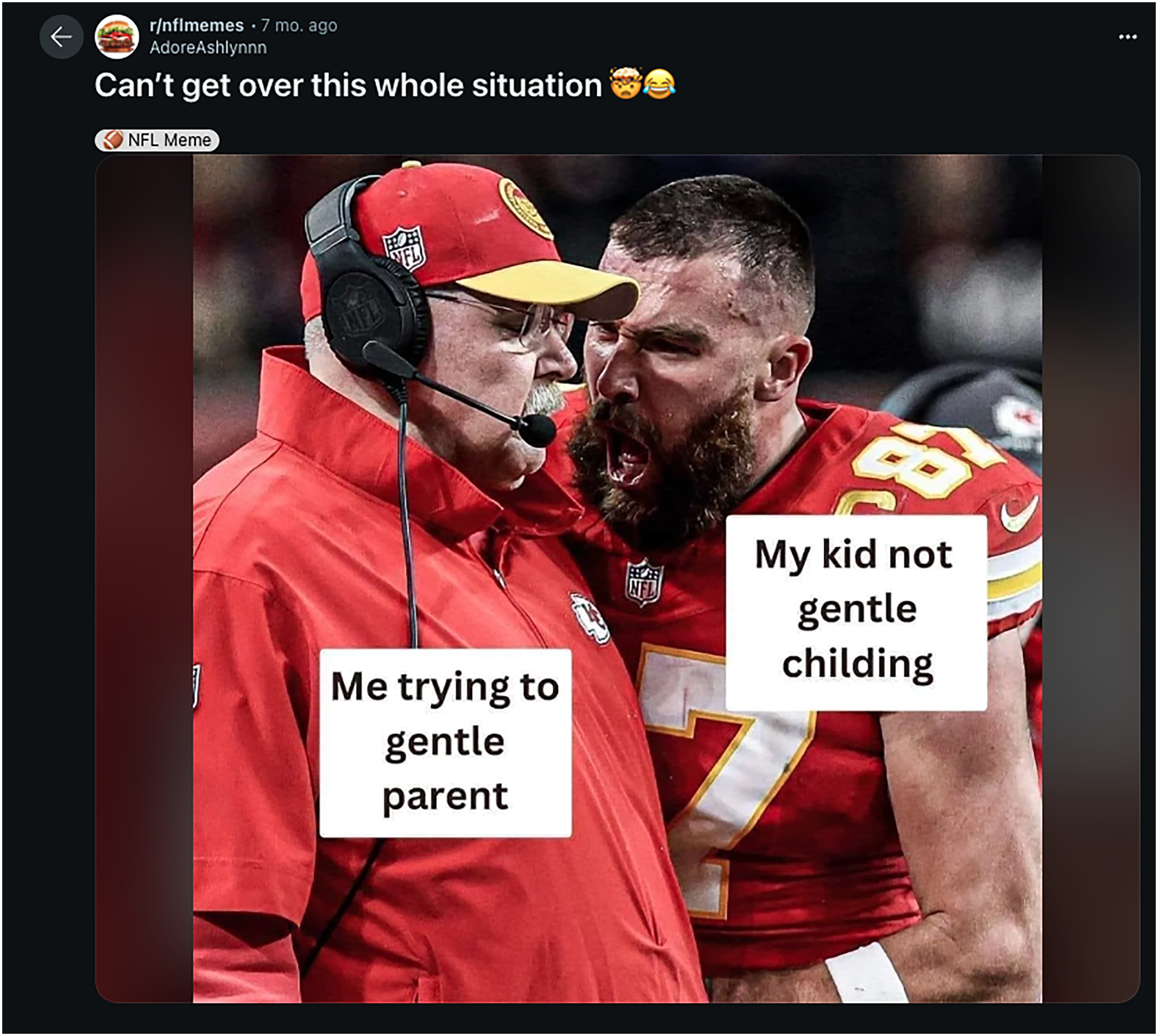
This meme depicts the coach of the Kansas City Chiefs, Andy Reid, speaking calmly to the team’s tight end, Travis Kelce, during Superbowl LVIII. Kelce is shown to be yelling directly at his coach's face. The caption overlaid on Reid is “Me trying to gentle parent,” while the caption overlaid on Kelce is “My kid not gentle childing.”
In my dataset, the posts of two TikTok creators garnered more “likes” and comments than any other posters across the two datasets. Their posts suggest an awareness that #GentleParenting is the dominant trend in networked parenting, and they reincorporate prevalent tropes of this hashtag community in subversive but also highly likeable forms. Their content does not shame parents but works discursively to poke fun at the difficulty of parenting, and how #GentleParenting adds to an already immeasurable “mother load” (“The Mother Load,” 2017). While they receive some derogatory comments, most comments speak to how their videos make them feel seen for their “good enough” (Winnicott, 1953) mothering.
In this vein, the dominant style of TikTok posts uses the epithet: “what I thought gentle parenting was.” These videos showcase the creator engaging in a satire akin to the broader #GentleParenting humor culture. Figure 1 speaks to the difficulty of implementing gentle parenting strategies in real life, given (some) children's inability to cooperate. Another strand of critique in #GentleParenting satirizes parents who are seen to “go too far” in giving in to children's seemingly irrational demands. However, after the posting of a clip with satiric content, the text on the videos changes from “what I thought gentle parenting was” to “what gentle parenting is to me,” which usually involves the same creator replaying the previous scene but with a more authoritative voice and articulating a logic or reasoned position on a given childrearing task. In these replays, creators recognize the value in using gentle language towards their children, but also underscore that children need their parents to explain things to them in age-appropriate ways, and to set boundaries. Gentle parenting is not wholly rejected, therefore, but modified in ways that seem more reasonable to posters. These “what I thought” TikTok videos receive high engagement, with the comments sections filled with parents thanking the creators for understanding the challenges parents face when trying to incorporate this trend into their own lives.
The “what I thought” TikTok creators often share more realistic locations and aesthetic decisions in their videos, such as untidy domestic scenes and unpolished outfits. These videos are also hastily created: the lighting imperfect, the editing sloppy. The subversive dimension of humorous and authentic #GentleParenting content possesses the potential to rework and revitalize the previously utopian potential of online feminist communities (Plant, 1992, as cited in Spender, 1996, p. 229) through a public performance of shirking dictates associated with patriarchal motherhood and intensive mothering. With their use of unkempt appearances and untidy living rooms, these videos also challenge the class-dimension buried within the adjective “gentle,” while still demonstrating performances of parenting practices that reflect the reality of balancing multiple responsibilities within the home and workforce. These types of TikTok videos hold great promise for the realization of radical online mothering communities, especially through their use of satire, which can contribute to communities of care (Eromosele, 2020).
While creators making this style of video are ostensibly attempting to grow their influencer profiles (Duffy, 2017), they are also enacting something subversive. Unpolished rawness in feminist culture is often shadow-banned or diminished on high-profile platforms (Are & Gerrard, 2023). Given the hetero-patriarchal control of social media platforms, content moderation practices are often programmed to remove “undesirable” feminist expressions, such as positive posts about breastfeeding (Gillespie, 2018, pp. 166–167), as well as limit their posters’ broader visibility to algorithms in the wake of their posting such “banned” content—all the while promoting content that presents women's bodies as highly sexualized. However, these “what I thought” TikTok videos bypass such potential banning. An image of an untidy living room demonstrates the optimistic potential of online communities as spaces where people can express themselves authentically. An authentic aesthetic can be seen as radical within an online parenting post since the stylistic choice most commonly consistent with networked parenting content is polished and highly curated (Zhao & Bouvier, 2022)—for instance, polished sections of a home. Zhao and Bouvier (2022) note how images in their dataset (posts and images collected in China) “tend to foreground the luxury of space, smiling children, having good taste, and style” (p. 10). These authors argue that the decontextualization of domestic spaces in mothering content mirrors the neoliberal discourse's insistence that “social problems [are] personal ones, matters of self-motivation, and making the correct choices” (Zhao & Bouvier, 2022, p. 10). The presumed take-away message of these highly curated performances is that, with enough effort, anyone could (and should) have a beautiful room, a well-behaved child, and parental well-being.
Collectively, these performances form “patterns” of what good parenting looks like, which work discursively to generate an idealized benchmark: “You expect to see [these patterns] unfold in your own life, and you aspire to [them], even if you know [they are] bad for you” (Lagerwey, 2020, as cited in Petersen, 2023, p. 267). These patterns are indicative of what I have identified as fifth-shift pressures: the injunction to be beautiful according to the norms of heterosexual femininity, and to showcase a gorgeous home and well-behaved children. These satirical videos seemingly defy restrictive prescribed patterns, instead evoking a return to an ethics based on the personal-is-political radicality of original mommy blogging communities (Van Cleaf, 2015, p. 255).
I see these videos enacting an emerging critique of what I understand as the fifth shift of mothering, one that is delivered through a deliberately unkempt, nonchalant aesthetic. The posts demonstrate an insider understanding of the aesthetics and tropes of online #GentleParenting as they connect to broader networked parenting cultures but subvert them masterfully through their laissez-faire approach to locations, grooming, production design, and their authentic approach to #GentleParenting dogmas. The videos call attention to online mothering as work, whether it leads to more followers or endorsements, and this work is just another task required in our era: it isn’t enough to parent anymore, now you have to present parenting in a manicured form online for all to see. With their overflowing laundry bins and their roughshod video editing, these videos reject this fifth shift of mothering. At the same time, the cult-like aspect of #GentleParenting is defused through performances showing how the movement's dictates have been reinscribed in ways that are meaningful for their families. Furthermore, because this content appears at first glance to be satire, these videos are connected to a broader spectrum of viewers via platform algorithms.
However, the videos go beyond laughing and instead towards the enactment of supportive feminist humor as theorized by Sundén and Paasonen (2020), who probe us to engage with the fact that “a laugh is not necessarily happy” (p. 13), and encourage consideration of “what grows within laughter?” (p. 17). What is growing within the laughter presented by these subversive #GentleParenting accounts is a key commentary regarding the refusal of the tropes of online mothering—the polish, the seamlessness, the figure of the gentle parent as endlessly, intractably calm (Winter, 2022) and supportive in a way that appears impossible to reenact. This critique of what I am calling the fifth shift evident in #GentleParenting content simultaneously reproduces (Sundén & Paasonen, 2020, p. 14) and critiques power structures, while also making space for insightful feminist commentary on online mothering as labor.
Discussion: Beyond laughter, #GentleParenting as politics?
This outline of #GentleParenting content creators who critique the repressive regimes of parenting culture is indicative of an overwhelmingly positive trend. Yet, I wonder about the reach of this work as a politics of feminist mothering. Can a TikTok post with a visible pile of laundry and a female-presenting parent calling out the pressure of gentle parenting demonstrate what Fraser (2013) calls a “runaway need” (p. 64) that can institute actual social change? This provocation is embedded within the concept of the fifth shift. In my initial theorizing, I noted Sharma and Brooker's (2017, p. 466) caution regarding analysis of social media posts, namely that without a corresponding interview to corroborate any given post, the intention behind it can never be known with certainty. Additionally, while there are many consumers of online mothering content who seek support, especially within the fraught postfeminist networked parenting landscape of the pandemic afterlives, one's ability to ascertain the difference between a seemingly performative parenting post versus one that intends to critique the endless pressures of online parenting in our era cannot be guaranteed. This is in keeping with Hall's (1973) encoding/decoding theory, in which communicative messages are not “behavioural input[s], like a tap on the kneecap” (as cited in Thornham et al., 2009, p. 32). While the fifth shift as a mode of digital feminist critique of the escalating pressures of online parenting holds great potential, its messages can be muddled by the complexities of the platform environment and its heterogeneous user base.
Furthermore, while many who perform networked parenting do so to educate others and achieve catharsis, when a parent posts about their parenting on a social media platform, they may simply be doing so to reach followers in the attention economy (Goldhaber, 1997, as cited in Abidin, 2021). Authenticity in postfeminist neoliberal social media environments remains quixotic since online creators/users inhabit a fraught landscape “between labor and leisure, between the internal self and external publics, between authenticity and self-promotion, and between creativity and commerce” (Duffy, 2017, p. 219). Within #GentleParenting, performances of self-care must be scrutinized in terms of what outcomes such creative and cathartic work intends to achieve.
Networked parenting has a demonstrative role to play in articulating parental stress and needs. The creators in these spaces can work to evince the complexities of parenting, as well as the corresponding dearth of social support for this work. As Nelson (2021) describes it: Parenting poses a special challenge … the job begins as raw protection [and] then must transform along the way into a more spacious and complex form of care, without clear markers as to when and how such a transition might be made, or instructions as to how to bear it. (p. 123)
Conclusion
My analysis suggests that #GentleParenting challenges traditional reliance on accredited experts by valuing the lived experiences of lay parents. As digital spaces become the primary venues for parenting discourse, #GentleParenting signals a new chapter that undermines intensive mothering, promoting empathetic, experiential, and feminist approaches. Yet, this community remains dominated by a homogenous group (Daniels, 2016; Friedman, 2010; Nakamura, 2008). #GentleParenting is still entangled in Western, postfeminist, neoliberal, and intensive mothering discourses that demand “more work for mothers” (Schwartz, 1983). Thus, even while #GentleParenting challenges established norms and empowers parents to reclaim authority in childrearing, it also reinforces a narrow, affluent, White representation of feminism, and increases parenting labor (Pezalla & Davidson, 2024)—the so-called “fifth shift.” Notably, however, some content indicates a shift toward empathy-driven practices and employs satire to critique competitive parenting norms. Future research, including interviews with community members (Warfield et al., 2016), could further explore the political potential of this emerging discourse.
Footnotes
Acknowledgements
With gratitude to my doctoral dissertation supervisor, Dr. Faiza Hirji, and readers, Drs. Sarah Brophy and Andrea Zeffiro. Thank you to Danica Evering at the Sherman Centre for Digital Scholarship for research design support, André Forget for editorial support, and to Sky Fairchild-Waller and Milan Schramek for sharing content with me. With recognition to the editor, Tracy Morison, and the insightful and supportive peer reviewers at Feminism & Psychology.
Declaration of conflicting interests
The author declared no potential conflicts of interest with respect to the research, authorship, and/or publication of this article.
Funding
The author disclosed receipt of the following financial support for the research, authorship, and/or publication of this article: This work was supported by a Social Sciences and Humanities Research Council of Canada CGS Fellowship (Grant No. 767-2022-1324).
