




Abstract
The maternal transition is a key concept for studying first-time motherhood. Whilst qualitative research in this space has contributed much to understanding the psychological and sociocultural shifts in this transition, a broad adoption of conventional humanistic qualitative methodologies has produced linear and rather homogenous knowledges. In this article, we interrogate the onto-epistemological repercussions of such inquiry and cut into this work by plugging into feminist/new materialisms and critical posthumanism. We trace the trail of qualitative maternal transition literature by examining methodologies and methods to think through the limits and potentialities of their knowledge-production capacity. We read across the research practices of 56 maternal transition articles spanning the past 5 decades. We found most reside within a liberal humanist framework, which inevitably positions mothers as rational, agentic, disembodied, and responsible actors. We explore what is in-between, missing, or could be in future becoming-mother research assemblages. Through thinking with feminist/new materialist and critical posthuman theories as inquiry pathways, we open up the maternal transition as a constantly evolving and fluctuating process of becoming-mother. Findings underscore the importance of diversifying theory and methodologies in studying first-time motherhood and paying greater attention to the relations between human and non-human agencies.
Motherhood is a well-studied field in feminist scholarship and has transdisciplinary interest. Though motherhood scholarship has proliferated, the emphasis on mothers as “placental containers” (Raphael-Leff, 1991) has persisted (Athan & Reel, 2015). Key arguments in Feminism & Psychology highlight that dominant understandings of motherhood are produced within the “phallic logic of the patriarchal enlightenment tradition” (Hollway, 2012, p. 22), evidently shaping how researchers engage with and reproduce their research. Such a motherhood discourse, contained within self-perpetuating boundaries, has thus contributed to conceptual saturation/fatigue in first-time motherhood studies. There is a need to theorize (first-time) motherhood in ways that do not ascribe to (neo)liberal feminism and aspire to the rhetoric of equality within a patriarchal society (Hollway, 2016). Here, we are interested in looking back at the onto-epistemological development of first-time motherhood to explore new openings for inquiry.
The maternal transition is a concept that was created to understand the experiences and needs of becoming a new mother (Rubin, 1967a, 1967b). The transition to motherhood theory emerged in an era of developmental theory dominance and was situated as claiming expertise over the psychosocial changes in motherhood within a woman-owned field of nursing/midwifery (Parratt & Fahy, 2011). The maternal transition theory contends that women 1 “achieve” this transformation through cognitive changes, developmental tasks, and role acquisition (Rubin, 1967a). This theorizing helped to more openly acknowledge the psychological changes that women experience beyond the physiological focus in dominant biomedical knowledge.
In a feminist poststructural critique of Rubin’s (1967a, 1967b) and Mercer's (1981a, 1981b) foundational studies, Parratt and Fahy (2011) illustrate how this work was informed by humanist philosophies and the dominant logico-empiricist theorizing of the time, with an emphasis on generalizable knowing (what it means to become a mother), reductive empirical data (observable and measurable characteristics of motherhood), and separation of the “knower” and the “known” (experts on motherhood). Parratt and Fahy expose how this line of inquiry eroded diversity of maternal demographics (e.g., age, ethnicity), detached knowledge from situated mothering contexts (e.g., extraction of expertise), and contributed to the disappearance of difference from the metanarrative. Preexisting assumptions and narrow cognitive frameworks thus limited the interpretation and complexity of theory generation.
Research inquiry on the maternal transition
The tendency of qualitative social science to prioritize voice is visible across much maternal transition research, which has particular implications for understanding maternities (Hollway, 2015). An often-made research assumption is that voice is stable, authentic, and self-reflective; the participant's voice is “there to search for, retrieve and liberate” (Jackson & Mazzei, 2008, p. 2). Such a conception of voice actualizes the humanistic thought of a universal autonomous human (mother) essence. Consequently, rational thought, and particularly retrospective recall, has informed much of what is known of maternal transitions. We were interested in exploring these research practices to examine how this knowledge was produced, and to reimagine theorizing and empirical inquiry on first-time motherhood.
Hollway (2016) has produced an extensive psychoanalytic work that pushes the boundaries of voice-centred research on motherhood. She points to similar criticisms of reliance on “conscious, surface, available-to-language aspects of identity” (p. 140), and engages with the relational, affective, practical, and embodied facets of becoming a mother. Notably, she shows that much of the (early) mothering experience defies the liberal humanist notions of the autonomous human experience. Hollway (2015) seeks the stories of subjectivity that are not utterable, to grasp the “non-symbolic, non-cognitive, non-conscious elements” (p. 22) that are enmeshed and coemerge with language, bodies, and the more-than-human.
In this article, we extend existing critiques by tracing research practices in maternal transition articles and plugging into critical posthumanism and feminist/new materialisms to explore what relational ontologies can do for maternal subjectivities. We seek to redress the maternal transition toward mother-baby-assemblages (assemblages where parts are joined together and act on each other to do things; Neely, 2023) that are oriented toward entangled multiplicities of human and nonhuman encounters. Through this shift, we move away from the maternal as defined by noncorporeal autonomy, agency, and freedom, and challenge the privilege afforded to rationality.
Feminist/new materialism and critical posthumanism
We suggest that feminist/new materialist and critical posthuman (FNMCPH) inquiry (Braidotti, 2022; Coole & Frost, 2010) can de-centre (not erase) humanistic perspectives to gain learnings from trans-subjective and more-than-human emergent becoming-mother assemblages that invite relationality and difference. FNMCPH theories are entwined with the ontological and affective turn and embrace relational ontologies, affirmative difference, critique of dualisms/binaries, and engagements with matter and the nonhuman (Murris, 2021). As we read and engaged with critical posthuman theorizing, alongside reading on the maternal transition, we encountered generative opportunities to question and examine the knowledge-making practices from this vantage point.
Affect is often central to this, viewed as a vibrant force across human and nonhuman actants. Following Braidotti (2019), we maintain that “affects need to be de-psychologized, and … de-linked from individualism in order to match the complexity of our human and non-human relational universe” (p. 45). Braidotti (2019) argues for a posthuman subjectivity not defined by “inhumanism” but conceptualized as “materially embedded and embodied, differential, affective and relational” (p. 11). She challenges the human as a binary category of “Man,” the humanistic, Eurocentric, and masculinist subject to whom intelligence comes via rationality. Instead, she argues that what “defines us as an autonomous capacity is not rationality … but rather the autonomy of affect as a virtual force that gets actualized through relational bonds” (Braidotti, 2019, p. 45) through which “we” are a collective subject. This notion of difference as affirmative, relationality as focal, and change as constant engages productively with the turbulent and diverse experiences of becoming a mother. Through broadening what Eurocentric philosophy has awarded with “human status” in the past (and what is more likely embedded within Indigenous epistemologies; see e.g., Todd, 2016), we seek to ignite the unsettling of common understandings of maternal onto-epistemologies by emphasizing affectivity and relationality as an alternative to individual autonomy.
Reading–writing–thinking: A postqualitative process
In line with a postqualitative orientation that seeks to “experiment and create new forms of thought and life” (St. Pierre, 2020, p. 163), we interrogate the onto-epistemological repercussions of maternal transition inquiry by plugging into feminist/new materialisms and critical posthumanism. Postqualitative inquiry “reorients thinking around relational questions about the material-discursive forces that are co-implicated in what bodies can ‘do’ and how matter ‘acts,’” avoiding the trend to “unknowingly reiterate, normative assumptions that negate or ignore different embodied practices of living and thinking” (Fullagar, 2017, p. 248). We, therefore, do not attempt to represent the “best” or “most common” ways to study the maternal transition nor do we claim to be stating a more valid truth than those whose articles we read. Instead, through our reading–writing of this work, we trace how research practices are murky, nontransparent, and may have unintentionally given rise to the “stable, unified, rational, coherent, knowing, autonomous, and ahistoric” (St. Pierre, 2008, p. 221) maternal subject. We move away from the notion that “voice can speak the truth of consciousness and experience” (Jackson & Mazzei, 2008, p. 1), to problematize the onto-epistemological implications of prioritizing voice and ask some questions as posed below by Jackson and Mazzei (2008): Who decides what “exact words” should be used in the accounts? Who was listened to, and how were they listened to? How might voices be distorted and fictionalized in the process of reinscription? And indeed, how are those voices necessarily distorted and fictionalized in the process of reinscription? (p. 1)
Rather than aiming to map the field, a common review aspiration, here, we explore how “what we know” has come about through the shared study of a particular concept: the maternal transition. We start with this knowledge field as necessarily reductive and selective, but in doing so, we are able to productively enter into a space where motherhood, politics, and knowledge production are entangled. In unsettling contemporary norms, meanings, and truths of maternal transitions, we disturb formerly secure epistemologies to produce an “awareness of the complexity, contingency, and fragility of historical forms” (Smart, 1983, p. 76). By tracing such a concept's origins and development, we can dispute the totalizing assumptions of identity and reconceptualize human science knowledge production (Bowman, 2007). As we started reading the maternal transition literature, we asked ourselves what effect does research method/ology have on the knowledge produced? Which human and nonhuman agencies repeatedly perform as essential and, through this repetition, emerge as agentic components that stabilize or disrupt the knowledge field?
We read texts for the methodologies and methods used to study maternal transitions. Our aim was to withhold from criticizing the knowledges this research has produced; instead, we examined what this knowledge does in developing understandings of becoming a mother, and sought new possibilities for researching maternities beyond binaries such as mother/nonmother, human/nonhuman, or nature/culture (Hollway, 2016; Stephens, 2004).
In postqualitative inquiry, researchers are considered entangled with the phenomenon under study, alongside other human and nonhuman agents. My (EN) starting point for this work was my observed and felt gap between my experiences of motherhood and the prevailing societal and academic discourses emerging from this area. I became confounded with the repetition in motherhood narratives; the inaction on matters across more than half a decade of scholarship; and the numbed version of the embodied, visceral, and affect-intensive experiences of motherhood I was reading. This discrepancy, between what I felt and what I read, led to this critical examination of knowledge production. The wonderful coauthors joined along this journey, helped dialogue about what it was we were trying to do. In joining this project, EH brought with her two fundamental facets of her own intellectual work: her experience as a transgender woman, and her expertise as researcher of embodied and multimodal social interaction and identity. These came together in scepticism toward the maternal transition literature that ties the process of becoming a mother to the biological process of pregnancy; constrains maternity and maternal identity to individualized, psychologized, rational agents; and ignores the transition to motherhood as one embedded in and shaped by a fundamentally material and social context in which being a mother is a recognizable and accountable identity accomplished in the living and doing. MP joined the project after much developmental thinking had been done. MP offered a fierce passion for challenging inequities, such as some of the assumptions underlying maternal transition research. As a childless Indigenous woman, MP provided an outsider and novel perspective when critiquing a collection of research within the field. Although we could have gone broader, steered differently, or been more procedural in this journey, we made calls to focus on methodologies in the maternal transition because it provided us with a line to follow. Early in the process, we accepted that any line of inquiry is limited and incomplete. Given the cross-disciplinary and time-stable use of the maternal transition, we saw use in drawing ideas from this connected yet also disparate area of work on first-time motherhood.
Findings
The “fieldwork” for this article included finding and reading articles that studied the maternal transition, to follow this concept across the literature. EH and EN started by searching “maternal transition,” “transition to motherhood,” and “becoming a mother” in Scopus, and filtered through the results by looking for empirical qualitative articles. All authors further snowballed from identified articles by looking at reference trails. From an initial 211, our reading came to 56 articles for our analysis/exploration, published between 1967 and 2020, all of which studied the maternal transition using a qualitative methodology (see the Appendix). We excluded quantitative studies as well as commentaries. We focused on qualitative research to distil different onto-epistemological orientations and how these manifested in methodological choices. We do not seek to represent the findings in the collection of articles; as such, we explicitly avoided a scoping or thematic review.
Articles in the collection studied the maternal transition generically but also included narrowly defined groups of mothers such as those with preterm births; balancing mothering and paid employment; and subcultures defined by ethnicity, age, or urban/rural living. Authors understood the period of the maternal transition in varying ways (from taking the physical birth event to symbolize the moment of becoming a mother to a broader time frame of psychological adjustment across pregnancy and early motherhood). The articles spanned broad disciplinary areas (see Table 1). Most of the studies were conducted in high-income countries, and thereof the highest proportion in English-speaking countries, with only two studies emanating from low-income countries.
Overview of methodologies, methods, and disciplines.
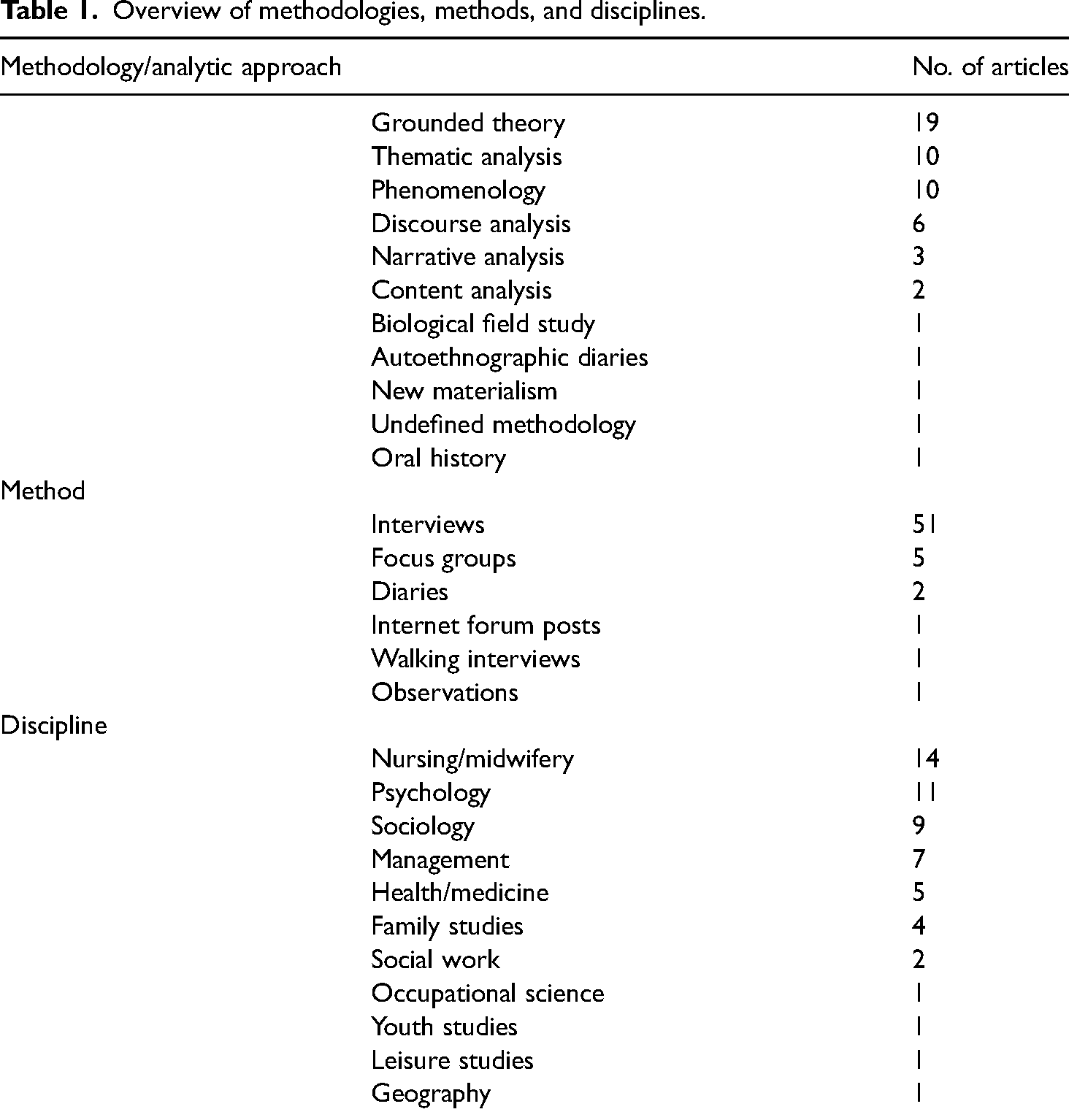
By seeking maternal transition literature, we realize that we observed only specific agential cuts (Barad, 2007), and recognize that we were not able to review the entirety of motherhood literature. Nevertheless, maternal transition research spans decades and disciplines and is one of the most dominant collective strands of inquiry that concerns itself with changes across the perinatal period. Table 1 presents an overview of the methodologies, methods, and disciplinary origins of the articles included (more details can be found in the Appendix).
Anthropocentric methodologies
The observed literature largely stems from a humanist qualitative research tradition (St. Pierre, 2016) that seeks to produce results that are close to the human experiences that informed them, “to tell it like it really is” (p. 115). St. Pierre (2016) alludes to the trend of qualitative research in adhering to principles of logical empiricism through a methods-driven approach of systematizing research steps. She writes that there is often an assumption that words can “contain and close off meaning (essences) that can be identified and subsumed into categories” (p. 118). Further, incrementalism, the idea that “knowledge steadily accumulates” (St. Pierre, 2016, p. 117), often invites researchers to drill down into the minutiae of phenomena with particular methodologies, meaning that modern research “zooms in” to explore topics much more than it “zooms out” to question issues philosophically. Research entanglements can therewith become somewhat unintentionally narrow and human-centric. Rather than further reifying the concept of the maternal transition, we thus hope to rupture and open opportunities for inquiry.
It is evident how early papers (Rubin, 1967a, 1967b) that introduced maternal transition theorizing maintain the postpositivist turn of keeping qualitative research close to the chest of quantitative research parameters (logical empiricism). This is seen in the use of words like “measures” or “variance,” which are used to verify that these experiential-driven data are worthy of shaping knowledge (e.g., Miller, 2003; Smith, 1994). Such research can be seen as small q qualitative research (Braun & Clarke, 2008) and was more common in the 1980s in its emergence from positivism. The literature that followed in the 1990s–2000s broadly reflects the interpretive turn in honouring lived experience as valid knowledge, and was adopted heavily (e.g., Afflerback et al., 2014; Carolan, 2005; Sethi, 1995). As such, much of what has been constructed on the maternal transition is born from interpreting lived experiences. There is some limited engagement with critical and poststructuralist inquiry. This summary is necessarily reductive and appears more linear than what it is. We seek to observe broad trends but acknowledge the linearity is somewhat simplifying. In the following sections, we discuss the various methodologies used, think through potential limitations thereof, and explore emerging opportunities to multiply human and nonhuman voices in maternal transition scholarship.
Ten articles used thematic analytic (TA) approaches. These studies tended to explore particular niche aspects of the maternal transition, frequently with a pragmatic focus, such as maternal age (Mulherin & Johnstone, 2015), prolonged labour (Nystedt et al., 2008), childbirth (Etowa, 2012), preterm birth (Spinelli et al., 2016), social support (Gjesfjeld et al., 2012), or health-related issues (Daly et al., 2022); subsumed within a maternal transition framework. Within these articles, there is varied adherence to onto-epistemological positionings. A range of articles loosely defined their approach as qualitative interview studies in which this positioning was not precise and could span anything from postpositivism to postmodernism, and relativism to realism, respectively. Researchers often adopted an atheoretical thematic analysis approach without further definition of theory or methodology (e.g., Mulherin & Johnstone, 2015; Nystedt et al., 2008). This lack of theory gives voice to “habitual normative readings” (e.g., coding; Mazzei, 2014, p. 742), where the “codes” become the essence of the lived experience, contributing to amalgamated hegemonic knowledges (such as similar, chronologically arranged themes). As with most theories/approaches that become popularized, there is inherent misuse and misinterpretation. Braun and Clarke (2021) themselves point out there is often “little to no engagement with the theoretical and philosophical assumptions that underlie procedures” (p. 328) in TA.
Ten articles used variations of phenomenology. In much of the phenomenological research examining maternal transitions, researchers sought to go through “description, reduction, search for essence, and intentionality” (Herishanu-Gilutz et al., 2009, p. 969), to make sense of the experiences. Philosophically, phenomenology aimed to “capture the essential essence of what is being said” (Millward, 2006, p. 321). Asking questions about what a phenomenon “means” and how people make sense of it signals that there are some essential maternal qualities to be uncovered. Phenomenologically driven articles searched for this essence by looking “for the invariant and unchangeable characteristics of the particular phenomenon under study” and sought intentionality as “related to the human consciousness, which means that consciousness is always consciousness to something” (Herishanu-Gilutz et al., 2009, p. 969). Such perusal hardens the lines of knowledge generation about maternal characteristics through its explicit focus on essence seeking. Vagle and Hofsess (2016) brought forward “post” phenomenologies using poststructural philosophy to amplify how phenomenology can break free from stable, essentialist notions of lived experiences towards multiplicity, difference, and partiality with and through bodies. A posthuman phenomenological approach further initiates a radical reorientation of the body and includes nonhuman affects that bring forth embodied entanglements (Lewis & Owen, 2020). These disruptions to traditional phenomenology move from predetermined subjectivities towards intra-active phenomena that emerge in research assemblages and can open up difference and being-with-the-world, co-constituted with the material-discursive (McGregor, 2020). Postphenomenologies hold ample opportunities for distributing maternal subjectivity as a dynamic, multidirectional force, where human and nonhuman affects come together to produce difference.
Grounded theory (GT) was the most applied methodology within this literature (19 out of 56 articles). GT articles drew on interpretive paradigms, often aiming to gain an “in-depth understanding of women's experiences of pregnancy from their own perspective” (Greenberg et al., 2016, p. 38) or “to generate a substantive theory to explain the basic social psychological problem and process encountered by the women during their first three months postpartum” (Keating-Lefler & Wilson, 2004, p. 23), and many aimed to “reveal new perspectives, by exploring women's experiences and emotional needs in the first few weeks after childbirth” (Wilkins, 2006, p. 171). Many articles did not adhere to a complete GT approach and instead took “inspiration” or “guidance” from GT. In practice, this means that many drew on GT for coding interview data and presenting extracts representative of themes or other conceptual objects while providing a minimal description of the rest of their methodology. As a result, it is unclear to what degree these researchers were engaged with GT tenets or procedures (a problem described by Suddaby, 2006), while the analysis presents conceptual categories rather than a bottom-up theoretical framework of the maternal transition. These underspecified methodologies are thus a route through which uninspected biases, intentions, and interpretations can enter the analyses and shape knowledge construction.
Further, from a postqualitative lens, GT produces theorizing that rests too heavily on the lived human experience, akin to the critiques we raised early in this section. A posthuman engagement instead seeks embedded and embodied heterogenous subjectivities (Braidotti, 2022). We encourage moving from closed internal systems of meaning toward an open, “external system of difference through chance and unstable conditions” (St. Pierre, 2016, p. 119). Ultimately, we see great potential in departing from a focus on identity in knowledge production to take up onto-epistemologies of inexhaustible, affirmative difference.
Six articles applied discourse analysis (DA), exploring how the language of mothering ideals in society is drawn upon, used, and resisted. DA explored topics such as workplace-mothering discourses (Bailey, 2000); discrepancies between societal expectations and personal experience (Miller, 2003); or the changing discourse around embodiment, subjectivity, and the medicalization of antenatal care across generations (Nicolson et al., 2010). One DA paper included reference to epistemological positioning, in this case, poststructuralism (Lupton, 2000). Cronin-Fisher and Parcell (2019) did not specifically use DA but explored motherhood discourses by drawing on relational dialectic theory to identify how dominant and marginalized motherhood discourses intersect.
This small body of discursive literature linked maternal transitions to the sociocultural milieu more explicitly than interpretive research. DA also made more space for contradictions in opposing and fluctuating discourses across individual accounts. An exploration into Foucauldian discourse analysis across motherhood in particular shows that attention to power and internalized disciplinary practices can reveal counter-normative knowledges across domains of motherhood, such as birthing (Chadwick & Foster, 2013), breastfeeding (Williams et al., 2013) or bodies (Johnson, 2018).
However, emphasizing language use and linking it to dominant discourses can risk reifying experiences and placing them into specific categories, drawing artificial boundaries around different mothering practices. A discursive approach can limit understanding of difference and “judgement” of potentially divergent mothering practices. While these studies reveal how women engage with prominent ideals, they are still limited in their ability to offer material, trans-corporeal, and affective notions of becoming-mother assemblages. Affective discursive practice might offer discursively minded researchers a means to avoid such “discourse determinism” (Wetherell, 2012), and orient them towards fleeting, in-the-moment affects entangled with the “material world of objects, sounds, smells, places, and spirit” (Calder-Dawe & Martinussen, 2021, p. 130). For instance, drawing on affective discursive practice, Calder-Dawe and Martinussen (2021) illustrate how affective environments and embodied senses impact the way participants talk about their maternal identities, and how such an orientation gives rise to the “stuff” of motherhood that can emerge as productive coparent across assemblages, such as “unwashed laundry, uncooked food, housecleaning, unfolded laundry, dirty house, mess” (p. 137).
Three articles drew on narrative analysis, aiming to explore “women's experiences of becoming mothers” (Miller, 2003, p. 142), “how first-time mothers make sense of the couple relationship” through cultural narratives (Sevón, 2011, p. 61), and to “examine the ways in which the transition to motherhood is embodied and enacted through policy experiences” (Paterson et al., 2019, p. 401). Narrative research gravitated towards conducting multiple interviews longitudinally compared to other methodologies (e.g., interpretive phenomenological analysis). This literature produced accounts of mothers as they progress through the first months of motherhood, hence the focus on contrasting expectations and reality or on a shifting sense of relationships. However, these studies remain heavily focused on thematic interpretation and still produce performative and generalizing notions of nuanced events and experiences in mothering, likely feeding a linear understanding of maternal transitions. Cirell and Sweet (2020) refer to such an effect as narrative smoothing, a process of rendering “messy, complex, and disjointed anecdotal material/artefacts into a relatively logical, coherent, and engaging account” (p. 1185). Posthuman, polyvocal approaches to narrative maternal transition inquiries could seek to trouble taken-for-granted linearities, dismantle deficit-based ways of understanding, and open up new sociopolitical justices (Rosiek & Snyder, 2020). Troubling such taken-for-granted linearities holds opportunity to illuminate the complexities of maternal transitions.
Huopalainen and Satama (2019) used autoethnographic diaries and pair interviews to capture their “shifting, multiple and sometimes contradictory subjectivities as mothers and researchers” (p. 100). The methodology enabled rich and nuanced accounts of early mothering, revealing how the maternal transition is imbued with complexity and embodied sensations, often fleeting and hard to capture. Whilst still human-centred in focus, such autoethnographic richness is a welcome addition in generating raw and messy accounts that hint at affective and embodied nuances in motherhood.
The musings over the methodological choices and justifications thus far resemble anthropocentric ontologies (Gullion, 2018) and contribute towards an essentializing of the subject (Mazzei, 2013) with a quest to understand the true meaning and lived experience of motherhood. Applying these methodologies leads to the prioritization of women's voices whilst obscuring the sociomaterial entanglements of the transition.
As an exception to this humanistic lens, one article in our collection used new materialism to explore “the entanglements or mutually affecting engagements with the material world that occur in the course of trying to become mobile with a small baby” (Boyer & Spinney, 2016, p. 1114). The authors take a more-than-human approach to engage the agency of matter in how it shapes maternal subjectivity. The orientation towards matter was achieved through the interview questions that explore dimensions such as domestic spaces, practices, parenting materialities, physical environments, and mobility. The research explored how the “felt-feelings of others feed into processes by which new mothers come to understand themselves as such” (Boyer & Spinney, 2016, p. 1126). Although interviews were still the primary data source, even a more-than-human attendance to subjectivity was able to generate more nuanced understandings of transpersonal intensities between mothers and the public, compared to other methodological/analytical orientations. Boyer and Spinney present some ways in which less human-centred research may start to orient away from the pure inner workings of maternal subjectivity.
The lived experience interview: Data collection contexts
For most studies we read (51 out of 56 articles), semistructured interviews were the primary data collection method. A reliance on formal conversational approaches privileges participant voice (St. Pierre, 2008) and represents data as ontologically separate from theory (Springgay & Truman, 2018). Further, how an interviewee tells their story is impacted by where, how, and who is eliciting the information, and as readers, we often do not know this level of detail (Potter & Hepburn, 2005). This results in prioritizing participants’ post hoc descriptions for theorizing maternal identities. This restriction to primarily backwards-facing representations only provides information that is amenable to verbal communication. This lack of detail is particularly evident in the a priori assumptions made by authors concerning what is or is not relevant information within the interview context.
In much social science research, it is not common to include specifics of interview questions or the local interactional contingencies at play. It was, therefore, no surprise to find little evidence of what the interview questions were. Some articles provided more detailed accounts of the interview questions. For example, Cronin-Fisher and Parcell (2019) detail: “what was going on in life when you found you were pregnant? Who was in the room during the birth?” (p. 160). Including detailed questions offers readers understanding of responses and how the researchers arrived at their interpretations.
Information about when and how questions were asked was also afforded little space. Presenting participants’ words treats words as the main method by which meaning is made available to another person, neglecting that people also rely on nonlexical elements (e.g., silences, overlapping speech, tempo, false starts, and hesitations) as well as corporeal, environmental, and material elements (Chadwick, 2021; Goodwin, 2000) as co-constitutive of research assemblages. Including information about how interview questions were delivered and when in relation to other elements of the interview would also help analysts and readers to see sense being produced through the laminating (or using on top of each other) of all semiotic resources available to participants at the time (Goodwin, 2000; Park & Hepburn, 2022).
Affective, material, and embodied interview entanglements are often invisible in their contribution to knowledge generation (Kuntz & Presnall, 2012). Some articles specified the place, such as home or workplace. Others include information such as “no differences were identified between the in-person and telephone interviews” (Neiterman, 2013, p. 118). Such accounts are reported pragmatically but conceal the interview assemblages. Anderson and Jones (2009) write about the methodological significance of place in how it enables researchers “to witness an array of embodied and emotional practices as they are experienced and performed by those involved” (p. 299). Paying attention to methodological emplacement generates knowledge through dialectic relations that shape embodied, emotional, and material entanglements as they unfold in situ (Pink, 2011).
Interviews can be embedded within an environment where mothering takes place. For instance, Gullino et al. (2017) drew on walking interviews to examine how mothers of preterm babies experience the city in early motherhood. Their methods of a prolonged diary about outings and walking interviews have the most active engagement with the physical environment across the selected literature. The findings present an expansive list of places in which women were mobile and geographically mapped their movements.
Two articles include the voice or active participation from someone other than women, such as the inclusion of partners (Boyer & Spinney, 2016; Lupton, 2000). Researchers could ask who or what else is intelligible in mothering assemblages and how such accounts and intra-actions may provide different agential cuts of becoming-mother. Rather than abandoning method altogether (Springgay & Truman, 2018), Chadwick (2021) proposes embodied listening, multivocality tools, and tracing viscous voices as analytic strategies to work against the overdetermination of voices. Further, given posthuman subjectivity is structured by ontological relationality (Braidotti, 2022), intelligibility goes beyond self-centred individualism to include a broad repertoire of human and nonhuman forces and actors towards more blurred boundaries and distributed agencies of mothering.
There is also little description of other people present during the interviews. Most notably, the infant, whose presence is assumedly very likely yet hardly taken note of in many instances. The becoming-mother can be conceived as holding the capacity to affect or be affected through a vast array of encounters—the baby's stark and baffling absence as a crucial agential force in mothering assemblages is surprising. Babies were often seen as passive, nonagentic, separate beings rather than brought in as a relationally entangled, affective force in the interview, but equally, and astonishingly, brought in very sporadically and peripherally as agents within the maternal experience (e.g., we noted very little emphasis on variance in experience based on the babies’ behaviour, yet it crucially shapes the journey). However, it is much more helpful to think of this intra-active mother–infant relationship as embedded and embodied, and crucial in shaping onto-epistemologies by drawing on trans-subjectivity and interembodiment (Hollway, 2012; Holt, 2013; Lupton, 2013). Inclusion of nonverbal actors, such as infants, in research could help contribute to “ongoing methodological attempts to move away from the idea of the speaking, sovereign, rationally reflective agent that continues to implicitly frame much social science research” (Holt, 2013, p. 654).
Articles conceptualized time chronologically (e.g., how was the birth, what was challenging in the first weeks of mothering). Gullino et al. (2017) drew on diary entries from women and captured some less curated experiences as they unfolded; however, we cannot witness much of what these accounts generated through the published articles. A crucial point to consider is how time and space change during early mothering; strong emotions are fleeting, ambiguous, and constantly evolving. What a mother may recall from her early mothering experience will evolve rapidly. Much of the nuance that shaped her experience will merge into some amalgamated, reflexively curated account (Hollway, 2015). Over half of the articles (34 out of 56) interviewed women solely in the postpartum period and sought retrospective accounts (29 out of 56) of the early mothering experience. For example, Paterson et al. (2019) sought women's “stories of a high point, low point, and turning point in their transition to motherhood” (p. 406). Do we know that these distinctive points are those pivotal to their journeys, or does this miss capturing how life events play out? As readers, we are presented with a linear trajectory, which can be reported as truth weeks or months after the distinctive point. However, post hoc descriptions and explanations of events are produced within currently ongoing interactional contexts (Edward, 1997). They are, by nature, limited in scope and selective regarding what features are given focus. Edwards (1997) calls this “their could-have-been-otherwise quality” (p. 8). Descriptions are designed as versions to attend to what is locally relevant within the current social interactional context of the interview. As such, descriptions of events after the fact can be designed with attention to possible normative motherhood discourses available to participants.
The chronological emphasis has produced a linear visual of how a maternal transition may unfold. However, what if, rather than focusing on collective experiences organized by homogenous time, researchers look at how “life and time bleeds into itself, not belonging entirely to an individual, but time as a process of the individuation and change occurring before the personal” (Koro-Ljungberg & Hendricks, 2020, p. 1199)? Motherhood is relational and multiple; time passes fast, time passes slow, waste no time, they grow so fast. Lavelle (2020) writes of the chrono-normativity that saturates the discourses of motherhood; for example, the right time to have a baby, or the quality time spent with children. She draws on Deleuze's (2004), Aiôn and Barad's (2007) intra-action to illustrate how hindsight is not a simple “looking back” but a past entangled with the present. Early mothering, in particular, is a past that marks heavily, “with little time to consider time than to live it” (Lavelle, 2020, p. 8). Suppose time could be conceived of differently. In that case, time can become a “multiplicity, a set of connections that cannot be traced back to a particular individual, subject or point in time” (Koro-Ljungberg & Hendricks, 2020, p. 1199), to open up new possibilities for understanding becoming-mother.
Beyond transitions: Posthuman maternal subjectivities
Residing in a liberal humanist framework, in the maternal transition literature, mothers are still mainly constructed as rational, agentic, and disembodied actors. A posthuman subjectivity as “embodied, embedded, assembled of agentic sub-materials within; and through encounters with the material and more-than-human world” (Braidotti, 2002, p. 62) offers an alternative route to thinking about maternities. In this sense, researchers may be able to move toward understanding leaky and fluid maternal subjectivities as what resides beyond or “otherwise” in the emerging intersections of gender, class, and race (Baraister, 2009). Baraister likens becoming a mother to a changing viscosity, where past experiences, object relations (e.g., buckling shoes), and daily tasks (e.g., putting away toys) “can feel like wading through treacle” (p. 111). The changing viscosity offers an alternative description of the dyadic reciprocity of mother–infant that produces an evolving and unpredictable tension of new heightened sensations and kinetic encounters. The change is thus less a magical, unseen transformation towards the “new” maternal self and instead involves ongoing encounters as a “subject-in-process/on trial” (Kristeva, 1975, p. 103) with unpleasant yet creative potentialities. Extending this psychoanalytic notion into the posthuman, researchers can further replace human agency with the capacity to affect and be affected through human and nonhuman forces.
Hequembourg (2013) departs from the humanistic maternal subject, defying any beginning or endpoint of a transition; as such, the birth of a child is a rupture in an ongoing process of reinscription, making any notion of success or achievement obsolete. Researchers may start exploring the “tiny explosions” (Hequembourg, 2013, p. 60) that reterritorialize mother-baby-assemblages. Birth, for instance, signals a significant de- and reterritorialization in which the body can do more and different things than it could before. Becoming-mother then spans significant life-changing and insignificant minute trajectories and reterritorializations that open up into “unimagined realms of possibility and ‘nomadic’ becoming-other” (Deleuze & Guattari, 2004, p. 24). A posthuman orientation enables researchers to adopt analytic and nonrepresentational strategies that “preserve contradiction, heterogeneity, performativity, dialogicality and fleshy embodiment” (Chadwick, 2021, p. 76). How might researchers embark on such new pathways in maternal transitions?
We want to encourage speculative lines of flight through nonrepresentational and more-than-human methodologies for the generative study of mother-baby-assemblages. Whilst such research, broadly sitting within the realm of postqualitative inquiry (Lather & St. Pierre, 2013), can hold no promise of set procedures or approaches, existing work invites with exciting opportunities for what might be possible. For instance, attuning to smells and sounds may act as entry points for critical analysis of resonances between human and nonhuman beyond the immediacy of sensory perception (Flint, 2021). Cottingham and Erickson (2020) use audio diaries in an attempt to capture the discrete, ephemeral, ineffable, and spontaneity of emotions and how these emerge as unfinished selves. Approaches that attune to the sensory and fleeting nature of affect seem promising for the study of motherhood that is imbued with ineffable encounters (Willis & Cromby, 2020). Greater use of arts-based methods is a further promising avenue for motherhood scholars, such as zine making and creative writing prompts (Lupton & Watson, 2021), or silhouette analysis (Höppner, 2021). Further, new hybrid imaginings of research tools offer exciting opportunities, such as combining phenomenology with multimodal perspectives (Boden & Eatough, 2014). Through causing ruptures to past maternal transition scholarship and exploring future unfoldings, we hope to ignite “research-creation” (Springgay & Truman, 2018) in the mainstream sphere of first-time motherhood scholarship. Growing such work across various disciplines may also enable traversing gendered and racial binaries that have been upheld through past scholarship on mothers.
In-conclusions
The maternal transition has been studied as a phenomenon over the past decades. What unites much of this research is the paramount focus on the inner workings of the mother, within predominantly qualitative humanistic paradigms. While this has provided important insights, it only forms a limited perspective of mother-baby-assemblages. In talking about the maternal transition from a heavily subjective position, researchers may take rationally curated accounts as the meaning of motherhood that is “out there.” There has been a preoccupation with asking “what does motherhood mean?” rather than asking “what does motherhood do?”
In this article, we sought to trouble the onto-epistemological implications of prioritizing voice as speaking the “truth of consciousness and experience” (Jackson & Mazzei, 2008, p. 1). We explored the “empirical entanglement” in our intra-actions with the texts, to create an enactment among “research–data–participants–theory–analysis” (Mazzei, 2013, p. 732). Going forward, researchers can examine how becoming Other opens up difference and creativity to go beyond what is (Masny, 2009). We position maternal transitions as having potentialities in “constantly becoming, indeterminate and not fixed” (Masny, 2009, p. 13), with opportunity for continual difference beyond paradigmatic homogeneity. The discussions we engaged were intentionally ambiguous and broad to encourage readers to think in multiplicities and rupture the status quo of maternal transition scholarship. We concur with de Lauretis (2004) that “it is a time to break the piggy bank of saved conceptual schemata and reinstall uncertainty in all theoretical applications” (p. 368).
We invite readers to reconsider the maternal transition as a constantly evolving and fluctuating process of becoming-mother. It is exciting to think about the learnings that might be taken from studying mother-baby-assemblages as “raw, embodied and messy speech, moments of silence, hesitation, whispers, laughter, undecipherable utterances, body language, crying and interactional dynamics” (Chadwick, 2021, p. 77) that can grasp trans-subjective processes (Hollway, 2015). As we, as researchers, journey into unknown pathways of posthuman mothering, we need to ensure that we do not throw the baby out with the bathwater and simply substitute terminology to reinvent humanist maternal theory under disguise. As St. Pierre (2013) alludes to, it is important to remain cautious when delving into the “posts” to avoid “wrongly insert[ing] them into a humanist ontology” (p. 652). Equally, we do not seek to invisibilize the “human” (Brinkmann, 2017) in the maternal, but open up concealed sources of maternal subjectivity that have gone unnoticed in past qualitative inquiry. We invite continued scholarly engagement and collaboration with human and nonhuman encounters to learn as we, as researchers, go and be open to possibilities we did not anticipate. We treat this work not as a deficit-seeking criticism but as a generative opportunity to explore what maternal transitions might become when researchers plug motherhoods into posthuman and feminist/new materialist theories.
Supplemental Material
sj-docx-1-fap-10.1177_09593535231196654 - Supplemental material for Beyond voice: An onto-epistemological analysis of maternal transition inquiry
Supplemental material, sj-docx-1-fap-10.1177_09593535231196654 for Beyond voice: An onto-epistemological analysis of maternal transition inquiry by Eva Neely, Michaela Pettie and Elle Henderson in Feminism & Psychology
Footnotes
Declaration of conflicting interests
The authors declared no potential conflicts of interest with respect to the research, authorship, and/or publication of this article.
Funding
The authors disclosed receipt of the following financial support for the research, authorship, and/or publication of this article: This work was supported by a Research Establishment Grant from Victoria University of Wellington (224392/3987).

Supplemental Material
Supplemental material for this article is available online.
Notes
Author Biographies
References
Supplementary Material
Please find the following supplemental material available below.
For Open Access articles published under a Creative Commons License, all supplemental material carries the same license as the article it is associated with.
For non-Open Access articles published, all supplemental material carries a non-exclusive license, and permission requests for re-use of supplemental material or any part of supplemental material shall be sent directly to the copyright owner as specified in the copyright notice associated with the article.
