




Abstract
Affirmative sexual subjectivity and agency are fostered by positive understandings of sexual desire and pleasure. Yet, research shows that print media circulate problematic discourses, including constructing women's desire as passive, linked to objectification, or as a form of (postfeminist) empowerment enacted through pleasing men. Developing this work with a specific focus on digital media and the subject positions offered there, a Foucauldian-informed discourse analysis was performed on 75 online articles, identified through a systematic search intending to replicate the information young women are exposed to during everyday internet use. The analysis produced three subject positions: the “Made through the male gaze” woman whose experience of sexual desire was contingent on men's desire; the “Working on it woman” who employed self-help methods to improve her libido and match a socially acceptable male standard; and the “Sexual connoisseur,” a postfeminist subject position who is sexually knowledgeable and confident yet still prioritises men's pleasure. The analysis demonstrates a hetero-gendered discursive framework operating within mainstream media accounts, wherein men's sexual agency and desire are prioritised over women's even in apparently sex-positive and feminist-oriented articles.
Sexual desire is typically considered a natural, presocial essence that resides within the individual. Yet, feminist scholars have highlighted its inextricable connection to hetero-gendered discourses and hierarchical social relations (Fine & McClelland, 2006; MacKinnon, 1987). Desire is disciplined by the politics of sexuality, including an array of norms underpinning determinations of degeneracy, pathology, immorality, and so on (Foucault, 1984). These norms are re/produced and circulated through mediated sex advice. For example, psychologists’ and sexologists’ advice feature ubiquitously in online publications’ health and lifestyle sections and aim to help readers solve various problems in their sex lives (Barker et al., 2018). In Foucauldian terms, such psy-experts form part of a “dispositif”; a range of actors and institutions that support forms of sense-making (Foucault, 1980, p. 194).
Mediated sex advice, accordingly, has the power to shape sexual subjectivities (i.e., an experience of oneself and one’s identity as a sexual being; Tolman, 2002). In this way, desire, as “sexual and pleasurable feelings in and of the body … constitutes a form of knowledge about the self, one's relationships and one's cultural contexts or social worlds” (Tolman, 2012, p. 749). Tolman (2002) argues, therefore, that sexual desire is central to sexual subjectivity, shaping one's experiences with others, sense of self, and the ability to explore and seek pleasure. In this article, we examine the gendered constructions of sexual desire in online media aimed at women, which provide an important arena for exploring cultural concepts of ideal sexual subjectivities as they shape understandings of desire, including what and who is desirable.
Media discourses of female sexual desire have been structured by a postfeminist sensibility for over a decade, producing a range of sexual subjectivities. Women have been positioned primarily as empowered, agentic, sexually knowledgeable, heterosexual pleasure pursuers (e.g., Evans & Riley, 2014; Gill, 2007, 2017). Scholars of postfeminism have raised concerns regarding this empowerment rhetoric. Their critiques show how postfeminist sexual subjectivities are underpinned by essentialist hetero-gendered discourses that, paradoxically, result in the retraditionalisation of gender and create new disciplinary and contradictory demands on women in heterosex (Evans & Riley, 2014; Gavey, 2012; Gill, 2007, 2009, 2017; Riley et al., 2017; Riley, Evans, & Robson, 2019). These critiques underscore the necessity for nuanced analyses of the idealised sexual subjectivities represented in media aimed at women.
Importantly, in technologically mediated cultures, where the digital is present in practically every aspect of daily life, digital media play an integral part in creating and circulating a pedagogy of sexual desire, authoritatively instructing readers to think and act in certain ways. As women's media engagement increasingly shifts from print-based to digital, women encounter an unprecedented, potentially limitless range of representations of feminine sexual desire (Attwood et al., 2015). This makes online media an important site for investigating the pedagogies of desire. Yet, compared to research analysing print media, this remains a largely unexplored terrain (cf. Farvid & Braun, 2014).
To advance the body of work on media constructions of female sexual desire, we present a Foucauldian-informed analysis of the subject positions available in online texts offering sexual advice or commentary that are generated in Western contexts for heterosexual (cisgender) women 1 readers. To locate our study within the broader literature, and indicate our contribution, we begin with an overview of existing knowledge on print (and digital) media.
Media constructions of female desire and postfeminism
Feminist media analyses have identified postfeminism as a dominant Western discourse, circulating interconnected, although potentially contradictory, notions of ideal femininity (Gill, 2007, 2017; Riley et al., 2017; Riley, Evans, & Robson, 2019). These newer ideals cohere around notions of empowerment, individualism, and choice regarding working on the self and the body. In contrast, traditional ideals of femininity silenced female sexual desire (Fine, 1988), and sexual subjectivities were orientated towards heterosexuality, emotional intimacy, and motherhood (Hollway, 1984). The media is a key place of circulation for these ideals.
Feminist analyses of print magazine sex and relationship advice across a range of Western contexts show these new ideals in a common positioning of women as liberated and striving for great sex (Farvid & Braun, 2006; Gill, 2009; Gupta et al., 2008). For example, Ménard and Kleinplatz’s (2008) analysis of print magazines available in Canada highlighted that women who have great sex are presented as skilful, kinky, adventurous, and sometimes willing to engage in rough sexual experiences. As part of this incitement to sexual competence and adventurousness, magazine texts reproduce a broader pattern of working on the self and self-improvement within neoliberalism, underpinned by the postfeminist construction of women as flawed yet fixable (Riley, Evans, Anderson, & Robson, 2019; Riley, Evans, & Robson, 2019).
From a Foucauldian perspective, magazines can be understood to “operate as pedagogical devices” (Frith, 2015b, p. 323), providing readers with the information and tools for self-improvement. For example, Gill’s (2009) discourse analysis demonstrated that sex advice in Glamour (a best-selling UK women's magazine) constructed sexual competency as achieved through significant consumption and work on the self. For instance, to produce a desirable sexual subjectivity, readers were prescribed a range of consumption practices (e.g., buying lingerie and sex toys), and interpellated to retrain their psyche by making potentially fundamental shifts in how they thought about themselves and sex.
The language of choice and individualism, indicative of a postfeminist sensibility that frames contemporary magazine sex advice, has been shown to cohere with essentialist, binary constructions of gender and heterosexuality. This allows the distinction between an active, desiring man and a passive woman to be maintained in more nuanced ways than in traditional hetero-gendered discourses, through recourse to the “reality” of biology (Tolman, 2002). In this vein, magazine sex advice has been shown to link testosterone to an insatiable male sex drive, reducing desire to biological functioning (Gill, 2007) and thereby rendering women's libidos as being “naturally” lower than men's (Farvid & Braun, 2006; Gupta et al., 2008; Ménard & Kleinplatz, 2008; Moran & Lee, 2011). This, in turn, ostensibly justifies women's prioritisation of men's sexual needs and gratification in heterosex.
While empowerment and choice rhetoric are prominent in mainstream magazine sex advice, feminist analyses have shown that male sexual desire remains prioritised (Gill, 2009). Women are often instructed to put men's needs before their own, as shown in Gupta et al.'s (2008) analysis of sex advice from Cosmopolitan magazine. This analysis highlights the positioning of women as responsible for competently pleasing their male partners while simultaneously giving guidance and encouraging compliments, thereby managing both sexual partners’ experience. Magazine readers, presumed to be heterosexual women, are thus enjoined to become proficient in what Gill (2009) calls “men-ology,” that is, “to learn to please men” (p. 345) and to expertly “read men's minds” (p. 356). No similar expectation is placed on men. Indeed, Ménard and Kleinplatz noted “an absence of sexual advice in men's magazines” (2008, p. 17), while Farvid and Braun (2014) demonstrate that advice in men's magazines mainly focuses on obtaining sex from women. Men's magazines, therefore, reflect hetero-gendered scripts of men having a high sex drive and women needing to be persuaded to have sex.
Together, the analyses discussed show that magazine sex advice not only directs women to prioritise men's needs, but also links women's sexual subjectivities, and their sense of self-worth, to their effectiveness as sexual partners. Relatedly, feminist media research shows that, for women, being a competent (hetero)sexual subject has become imperative to relationship success, allowing them to “snap up” a male partner (Gill, 2009, p. 352) and “keep your man” (Farvid & Braun, 2006, p. 301). This scholarship also highlights how the emotional labour prescribed by magazine sex advice and the positioning of women vis-à-vis men map onto traditional hetero-gendered power relations, with women expected to be the ones working on maintaining relationships, including meeting their male partners’ emotional and sexual needs (Farvid & Braun, 2006; Gill, 2009; Gupta et al., 2008).
This positioning of women is reinforced by a discourse of healthism, which dovetails with neoliberal and postfeminist sensibilities (Riley, Evans, & Robson, 2019), conflating health with normalcy and, in this case, linking optimal health with a desiring and functional libido. For example, Ménard and Kleinplatz (2008) note that to improve their sexual performance, readers of women's magazines are told to take up diets and increase exercise. Likewise, Frith (2015a) reports that women are advised to extend exercise workouts to “down-there” (p. 90; i.e., their genitalia). These “simple” changes can be read as imperative for sexual health and success.
Another key finding in this scholarship concerns women's performance of desire. For instance, in their analysis of two popular Australian women's magazines, Moran and Lee (2011) demonstrate that to boost a male sexual partner's ego, women were instructed to either visibly indicate pleasure or fake it. This is echoed by Frith's (2015b, p. 322) findings in an analysis of sex advice in Cosmopolitan. She notes that women are advised to engage in the spectacle of (real or fake) orgasm as part of various “embodied performances” during sex. Thus, as these analyses indicate, women's performance of desire is ultimately constructed as less for themselves and more for the role they play in men's satisfaction (Farvid & Braun, 2006; Gill, 2009; Moran & Lee, 2011).
As the preceding review of feminist media scholarship shows, print media aimed at women have consistently offered a limited pedagogy of desire. The constructions of female desire in the sex advice offered are underpinned by a hetero-gendered binary. Same-sex desire, if recognised at all, is either invalidated by being construed as a phase to grow out of (Jackson, 2005) or acceptable only as experimentation or to fulfil heterosexual men's fantasies (Diamond, 2005; Gill, 2008). The shift to online media consumption has the potential to radically expand what is available, yet the opposite is also possible given concerns about algorithmic reinforcement of racism and sexism (Noble, 2018). It is therefore timely and important to advance existing work by exploring subject positions produced in mainstream digital media aimed at women offering advice or commentary on sexual desire. Accordingly, the following research questions guide our analysis of such texts:
How is women's desire constructed and what wider discourses support these constructions? What subject positions are made available within these texts? What possibilities for subjectivity and practice are enabled (or diminished) from the vantage point offered by these subject positions?
Material and method
Online texts about women's sexual desire were collected by the first author via a series of keyword searches in Google using five keyword search terms (viz., sexual desire, sexual attraction, sex advice, female libido, sexual pleasure). The search strategy was to locate the most prominent English-language articles available through searches from anglophone Western locations, namely, North America, the UK, and Australasia. We kept the search location relatively wide because we sought to locate popular articles delivered to large audiences and wanted to avoid local websites with limited readership. We used Google, which holds the market share of search engine use, and took into consideration its content delivery algorithm.
We selected articles appearing in the first 10 results, which receive approximately 95% of web traffic, and are prioritised by the algorithm (Bradley, 2015; Chaffey & Ellis-Chadwick, 2019). We sampled texts over 3 years (2018–2020), using a targeted specific time frame search query falling on either side of Valentine's Day (9–16 February), which is a time of increased discussion of sex, desire, relationships, and dating. We retained the first five relevant results from each keyword per year and excluded texts that were unrelated or not relevant to the research questions (i.e., articles aimed at/about men, scientific articles, dictionary/thesaurus results, media reviews, advertisements) or nontextual formats (i.e., videos or images). The articles were associated with a broad range of over 30 media companies; Vice, Buzzfeed, and Condé Nast are among the most well-known (see supplemental dataset for full details).
The dataset thus represents the default algorithmic choice, which aligns with dominant or normative content. This was achieved by using Google's Incognito mode to mask search history, thereby generating generic results not specific to the first author's online profile. We tested this by conducting region-specific searches (as if the query were from the UK, North America, and Australasia), which yielded very similar outputs to our Google Incognito results. Therefore, although the search was conducted by a specific person in Aotearoa/New Zealand, we consider our dataset to represent similar results to those that would be obtained in comparable searches conducted from other Western anglophone countries. However, it is possibly more the case for those in Australasia, and without very specific search histories or demographic data.
Dataset
The dataset of 75 texts represents a focused snapshot of mainstream media aimed at women over a 3-year period. These texts were categorised by a range of characteristics, including the type of text and the country of origin, as summarised in Table 1 and Table 2. See also the Appendix for a list of article extracts used, and the supplementary file for a detailed dataset spreadsheet.
Type of text.
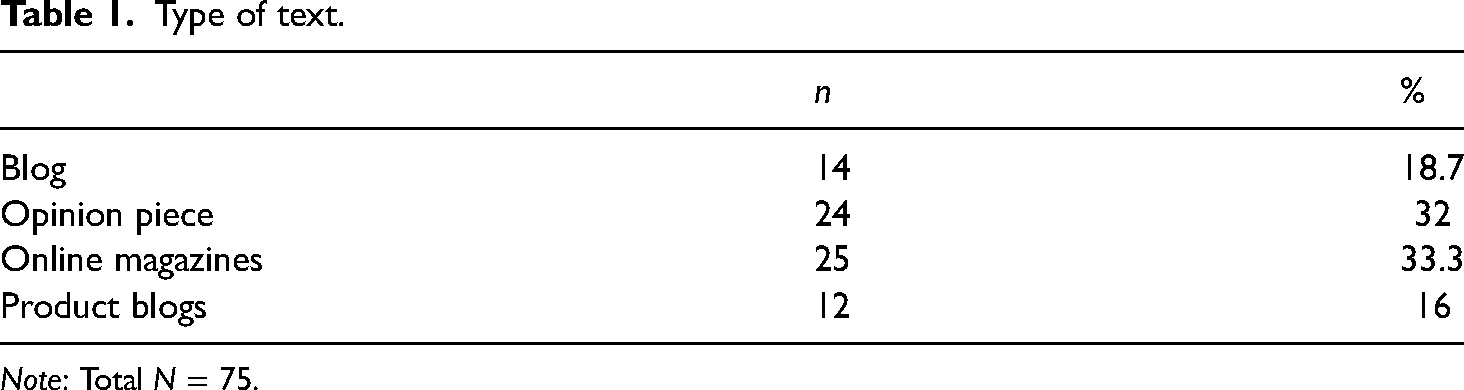
Note: Total N = 75.
Country of origin.
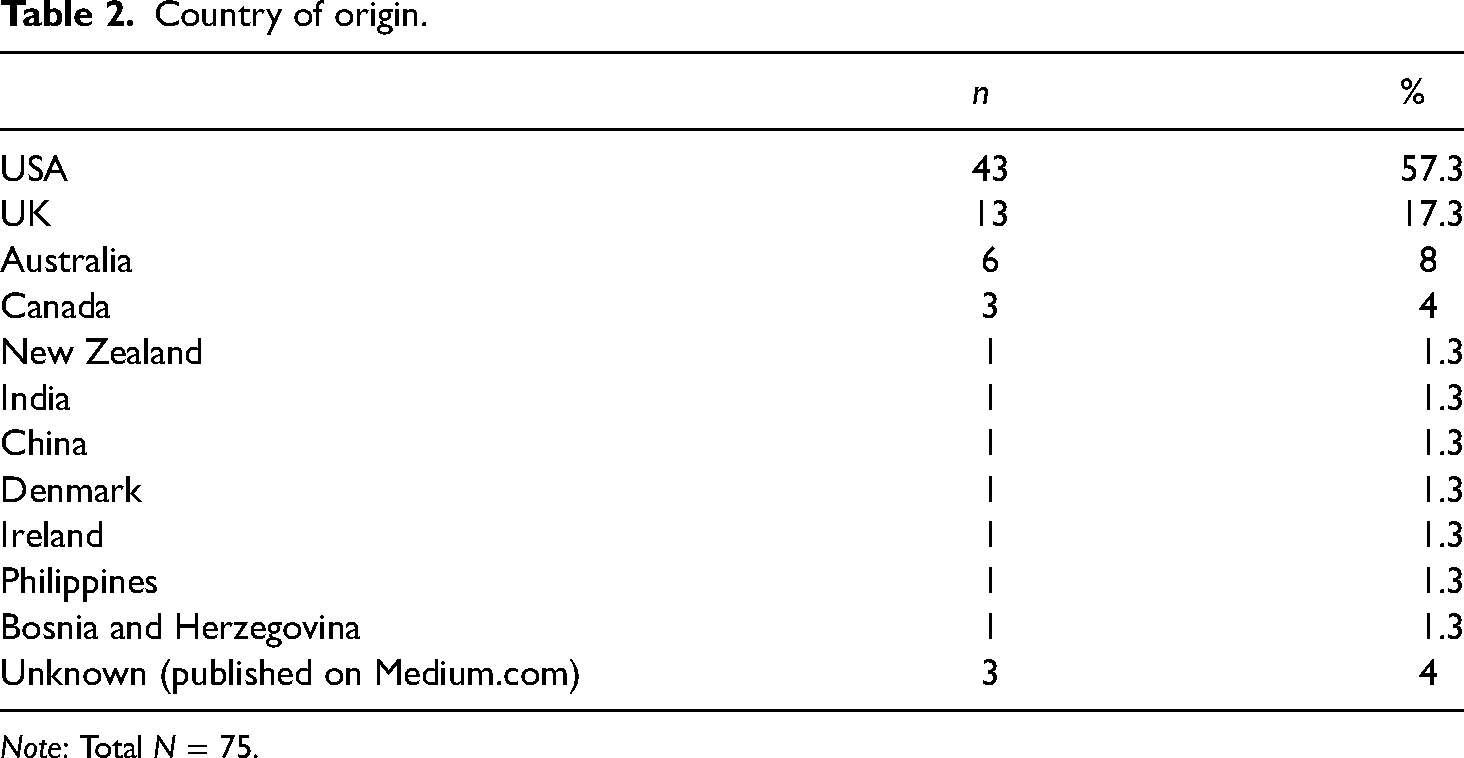
Note: Total N = 75.
Data analysis
The data were analysed using Foucauldian-informed discourse analysis, which illuminates how talk or texts construct different versions of reality and how these delimit what people can say, think, feel, and do (Riley et al., 2021; Willig, 2013). Each text was coded for the ways that desire was constructed, adhering to the method set out by Riley et al. (2021). This included noting mentions of keywords that referenced the topic of study or related topics, including desire, sexual pleasure, and sexuality. As lay media often use the terms sexual desire, libido, pleasure, and experience interchangeably, and so too sexual identity and sexuality, we sometimes use these terms in the analysis in corresponding ways, although our focus is on sexual desire.
To attend to our first research question, we asked, regarding women's desire: “what is being constructed?” (i.e., the nature of reality produced in the text), “how is it being constructed?” (paying attention to rhetorical strategies such as use of extreme case formulations), and “why is it being constructed in this way?” (which includes considering wider discourses that “enable these ideas to be thinkable”; Riley et al., 2021, p. 293). In this study, for example, such discourses included postfeminism, neoliberalism, and healthism. Once this work was done, we examined any conflicting constructions of desire to identify variation in the discourses within texts and across the dataset.
Regarding our second research question, we identified common subject positions by reviewing the above codes and asking, “who is being talked about” (Riley et al., 2021, p. 297)? We drew on Davies and Harré’s (1990) conceptualisation of subject positions as types of culturally recognisable persons or roles produced within a discourse and available for individuals to inhabit (e.g., the sexually confident woman). Subject positions have associated ways of speaking and acting, and come with a set of rights, obligations, and vantage points from which the subject can view themselves and the world (e.g., visibly enjoying sex).
Finally, to attend to research question 3, we considered what was made possible for subjectivity construction (how the reader could view themselves; e.g., sexually confident) and practice (what the reader could do/imagine doing; e.g., appropriate frequency of sex). Foucault’s (1980) concept of the “dispositif” (discussed earlier) helped us consider how expert positions were mobilised, giving us further analytic insight into the rhetorical power of the talk.
Analysis and discussion
We identified three common subject positions, which we entitled: (a) “Made through the male gaze,” (b) the “Working on it woman,” and (c) the “Sexual connoisseur.” These subject positions were produced through material that reinforced both heteronormativity and gendered heterosexuality in ways that consistently foreground men's sexual desires, needs, and interests. The following analysis uses exemplary extracts from relevant texts to illustrate analytic points; each quote is labelled with the number of the article from which it originates. The full references are listed in the Appendix.
Made through the male gaze
In the “Made through the male gaze” subject position, sexual desire is predicated on being sexually alluring and desirable to men. For example, readers are told that “in women, sexual desire is often responsive, so allowing your partner to initiate sex is the only way to ensure that it happens” (Article 19-M). This quote starts with a normative statement about women's sexual desire as “often” in response to another, but the claim is cemented with an extreme case formulation (“the only way”), which significantly limits what women's desire might look like.
The construction of women's sexual desire as responsive to an instigator who is opposite (i.e., male) reinforces the norm in media aimed at women to assume a male partner, despite commonly using gender-neutral language. Accordingly, women must expect their male partners to initiate sex, and their own feelings of desire will follow. Women are therefore not entirely without desire (given that they are reading advice on “how to have great sex”), but an agentic desiring female subject position is excluded from the data. Fine (1988) contemplated what it might look like to “release females from a position of receptivity” (p. 33), but as we can see in this article 31 years later, women are still rendered as “responsive” recipients of male desire.
The “Made through the male gaze” subject position conflates desire with being a “turn on for the man” (Article 18-C). For example: “Many women don’t just want sex. They want to feel desired first. If a woman doesn’t feel desired, then the sex itself may not seem so appealing” (Article 19-B). This subject position is sustained by a heterosexual script (Kim et al., 2007) that constructs women and men as complementary opposites, invoking a passive-female/active-male binary based on biology (Tolman, 2002). Gender difference is thus attributed to a one-way interactional dynamic in which male desire is directed toward female recipients. Accordingly, women must ensure they are sexually desirable to men, by being physically attractive and/or pleasing them sexually.
Thus, although men are positioned as both sex-needy and sex-ready, a contradiction is evoked whereby women must work hard to be sexually desirable to men. For example, making “sure your lipstick is blue-based, not yellow based” (Article 18-G) is recommended because research shows men's preference for these colours. Women are also instructed on how to covertly detect men's sexual attraction to them, such as: “If he is changing his body position to replicate one of yours (like crossing his legs), it's usually a sign of attraction” (Article 18-I)—echoing the “men-ology” identified by Gill (2009). Such advice can be understood as reinforcement of the “male in the head”: internalisation of the male gaze and self-regulation to be appealing to men (Holland et al., 1998). Thus, over 20 years after groundbreaking feminist research identifying this tendency, we find that in the context of widespread postfeminism—with its associated agentic sexual subjectivities—women are still being directed to understand that his desire is their own.
In a similar vein, women's desire was portrayed as reliant on penetrative sexual intercourse. Men were typically depicted as “preheated” (Article 20-A), whereas women were lacking sexual desire and needing to have their own embodied desire aroused. For instance: Portuguese sex researcher Ana Carvalheira found that women who said that sex preceded desire outnumbered those who reported desire first by a margin of 2 to 1. Today, sex therapists increasingly accept [a psychiatrist]'s view that for many (if not most) women, desire is not the cause of sex, but its result. (Article 20-A)
As shown in the extract above, articles generally referred to sex in ways that were synonymous with coitus, based upon the taken-for-granted view of penile–vaginal penetration as the key element of “real” sex (McPhillips et al., 2001). Penetrative sexual practices were constantly referenced or implied within the data, constructing penetration as the normative route through which women can participate in and enjoy sex. For example, “Have you ever noticed that your partner's penis seems to ‘fit’ better in your vagina once things get going?” (Article 20-S). Not only is the heteronormative coital imperative normalised, but it also constructs women's desire as being the result of penetrative sex, rather than preceding it. Thus, while previous research has indicated that penetrative sex is constructed as the only kind of sex (Gupta et al., 2008; Jackson, 2005; McPhillips et al., 2001; Moran & Lee, 2011), here, we show it is also being constructed as the only kind of turn-on.
The construction renders sexual desire as something that happens to women rather than embodied and originating in or from themselves. Accordingly, the “Made through the male gaze” subject position works in the interests of heteropatriarchal practices, providing a vantage point from which women can understand themselves as sexual objects (rather than subjects) whose own desire is a product of being an object of men's desires, including engaging in penetrative sex even when not “warmed up.” Such advice enjoins women to submit to heterosex regardless of their own feelings, and men to disregard their female partners’ arousal, desire, or even refusal. These constructions of sexual desire potentially support rape myths and groom female readers into accepting sexual coercion.
Working on it woman
In contrast, the “Working on it woman” has sexual desire but needs to work on maintaining or increasing her sex drive. Women's sex drives were repeatedly depicted as not just distinct from men's, but also not sufficiently high. The “Working on it woman” is thus interpellated to continually work to boost her libido.
Women are portrayed as able to “go for a long time without feeling desire” (Article 19-B), unlike men (their assumed sexual partners), who are positioned in the male sex-drive discourse (Hollway, 1984) and are understood to “think about sex all the time” (Article 18-M). It is women's bodies, however, that are rendered problematic, and their fluctuating sex drive is routinely troubled as they are commanded to “find out what the problem is and do your best to address it” (Article 18-L). Thus, rather than problematising a needy male sex drive, the measure of “normal” and appropriate desire is modelled on men, with women being blamed when those standards are not met.
This construction of problematic low and fluctuating female desire was supported by drawing on science and expert authority. Psychologists or medical professionals were often authors or quoted as expert commentators, and readers were usually advised to seek their help, as shown in the example below: If your sex drive is lacking, it is likely that there is a medical reason for that. You should speak to your doctor about the problem. If they are able to identify the reason for your low sex drive, they will be able to work with you to find a solution. (Article 20-N) Women are always on, but is this stopping us from getting turned on? If we’re not actually doing something we’re thinking about doing it (washing up or filing our tax return or any of those 3,000 things on our to-do list that aren’t sex). (Article 20-M)
Locating women's low libido within the social, provides potential for critiques of gender inequality, but this potential is not met. Instead, the suggested solutions are for women to work on themselves—reframing a social issue as a personal one and aligning with the neoliberal trope of individualising social problems. In the data, women's fluctuating desire is rendered as both problematic and their responsibility to fix, usually through monitoring and disciplining their bodies. For example, readers are told that their “sexual desire flourishes” when they “eat well, exercise, control blood pressure, and don’t eat sugar” (Article 18-B). Thus, the “Working on it woman” needs to maintain control over multiple aspects of her life.
Other examples of individualist solutions include meditation to manage stress. For example, in an article entitled “Live Better: Ladies, Meet the Hidden Force Behind Your Sex Drive,” readers are instructed to “Rewire your brain's stress response through a daily meditation practice and try to become more conscious about how you handle your stress in general” (Article 20-Y). Relating women's lack of desire to a faulty body (a brain that needs “rewiring”) renders women individually responsible for addressing the problem through stress management. Accordingly, a prevalent postfeminist trope of linking regular sexual activity with normative, desirable health is reproduced (Frith, 2015a; Riley, Evans, & Robson, 2019). This becomes explicit as readers are told, for example, that “Most people are happier when they have a satisfactory sex life” (Article 20-N) and an active libido is “a positive force for health” (Article 18-A). This conflation of health, sex, and happiness is underpinned by wider postfeminist discourses of optimal living and expectations for happiness through self-reflexive work (Riley, Evans, Anderson, & Robson, 2019).
The incitement to self-regulate and engage in associated self-help practices also intersects with neoliberal discourses of good citizenship and healthism (Crawford, 1980; Gill, 2007; Riley, Evans, & Robson, 2019). Within healthism, health is an expectation and outcome of lifestyle choices. Thus, a call to health intersects with normalcy and the discourses of individual responsibility evident in the “Working on it woman” subject position. This expectation was not similarly extended to men. The gendered asymmetry is consistent with other broader postfeminist analyses showing how contemporary self-help advice is focused largely on women's flaws, and often correcting feminine behaviours to be more like men (Riley, Evans, Anderson, & Robson, 2019).
Not only is the “Working on it woman” commonly positioned in the data as responsible for their own desire but, consistent with analyses of women's print media (e.g., Gill, 2009; Gupta et al., 2008), they are also tasked with maintaining their relationship by taking care of their (usually) male partner's sexual needs. Frequent sex, for example, is rendered a “pretty accurate barometer of the state of a relationship” (Article 18-L), and differences in sexual desire, cause for therapy. The potential relationship repercussions of failing to match a male partner's desire are depicted in the extract below. This is also an example of how women's lower desire is constructed as a medical problem resolved by medical experts: This is what wrecked [name]'s relationship with her boyfriend. She was experiencing vaginal dryness and super low libido, which made sex painful and also lead to decline in the frequency to have sex. This took a direct hit on her relationship, ending her 2-year-old relationship with her partner. Finally, after a couple of visits to gynaecologists, she got her sex life back on track, and rekindled her relationship with her boyfriend. (Article 20-D)
Overall, the “Working on it woman” subject position constructs women as a sexually desiring agent, rather than a sexual object, but still lacking compared to men and thus required to remedy this. Consequently, the “Working on it woman” can view herself as flawed, yet fixable. All she needs to do is engage in self-health practices and seek expert medical advice to “fix” her desire and be normal and happy.
Sexual connoisseur
The “Sexual connoisseur” is also interpellated to work on their sex life, not in response to dysfunction but to optimise the quality of sex, as well as their experiences of both sexual desire and sexual pleasure in the context of heterosex. In contrast to the “Working on it woman,” who is working primarily to match their level of desire to their male partner’s, the “Sexual connoisseur,” a subject position initially described by Evans and Riley (2014), is a pleasure pursuer; they are sexually confident, knowledgeable, desiring, and want to develop new sexual skills to maximise their pleasure. In the extract below, for example, boring sex is construed as problematic (whereas a lack of sex is the “Working on it woman's” problem): Bored in the bedroom? That's no excuse for giving up on your sex life. If you find that you’re too sexually complacent with your spouse, mix it up! Bring toys into your sexual activity, act out fantasies, roleplay, and tease and entice each other with dirty text messages throughout the day, or focus on different nights of pleasure. (Article 18-H)
In particular, the “Sexual connoisseur” is encouraged to work on increasing the quantity and quality of orgasms she experiences. Orgasms were consistently closely linked with desire and pleasure, and often described using esoteric language: “life-force,” “mystical,” “euphoric,” “powerful” (Article 19-S), amid claims of health benefits (e.g., Articles 18-U, 19-S, and 20-K). This is similar to analyses of print media that show how the female orgasm is represented as both the performance of desire and pinnacle of pleasure (Frith, 2015b; Riley, Evans, & Robson, 2019), constructing what Potts (2000, p. 56) calls the “orgasmic imperative.” This imperative, to understand your own desire as linked inexorably with orgasms, is evident in the following extract from an article entitled “I Orgasm Every Single Time I Have Sex”: I’m not some anomaly. I’m not some magical creature. I simply know what I like, know how to ask for it, and don’t settle for anything less. Life is too short not to have an orgasm. Here's how I get the job done during sex, every single time. (Article 18-V)
In a similar vein, orgasms, sexual desire, and good sex are also generally related to psychological work, such as meditation and mindfulness to become “more attentive and aware of my own senses and desires” (Article 20-B). The implication is that women may be disconnected from their own sexual desire, but able to reconnect through increased self-knowledge, echoing the injunction to “know thyself” central to the construction of modern subjectivity (Foucault, 1994). The call to increased self-knowledge invokes the ideal psychological, reflexive self, engaged in the project of self-improvement as it relates to sex (Riley, Evans, & Robson, 2019). Accordingly, the labour involved in having good sex and, by association, enhancing a sense of desire, is linked not just to regulating behaviours but also effecting inner change such as “increasing the number of sexual thoughts that you have” (Article 18-A). This imperative for emotional transformation is common in the data and has also been noted in previous analyses of magazine articles (e.g., Barker et al., 2018; Gill, 2009).
Given the focus on psychological labour and personal development, many of the texts were instructional in which experts like sex therapists and sexologists identified areas of sexual selfhood and performance to be worked on to improve one's sex life and ultimately become “sexually enlightened” (Article 18-S). Such work has been called a “technology of sexiness” in which women work on themselves in order to produce themselves into the desired, and desirable, sexual subjectivity of an agentic, up-for-it, sexually savvy pleasure pursuer (Evans & Riley, 2014; Gill, 2009; Radner, 2008). These technologies are often profoundly heteronormative and consumerist (Evans & Riley, 2014; Harvey & Gill, 2011), as evidenced in our data in instances where, as part of the labour of the sexual connoisseur, women are tasked with buying sex toys, lingerie, or novelty lubricants to enhance sex with male partners. Such products were constructed as widening one's sexual repertoire and, implicitly, keeping male partners satisfied, as shown in the extract below: I was recently talking to a wife about how her husband is constantly trying to put her legs over his shoulders. For years, it wasn’t her favourite position because, well, everybody ain’t a gymnast, ya know? But once she invested into a sex pillow that supported her back while elevating her body, it became an instant go-to for her as well. (Article 20-E)
In sum, this subject position allows for female desire in and of itself, as women are enjoined to learn how to increase the quality of their sex, maximise their pleasure, and connect with their inner selves to unlock their sexual expertise (Ménard & Kleinplatz, 2008; Moran & Lee, 2011). The “Sexual connoisseur” subject position we identify in mainstream mediated sex advice contrasts somewhat with Harvey and Gill’s (2011) “Sexual entrepreneur” in that the subject already views herself as desirable but requires skills and resources to maintain her desirability. As Evans and Riley (2014) argued, the sexual connoisseur is the quintessential neoliberal subject perpetually labouring to be, do, and have more in the face of the threat that one will never be good enough or able to obtain sexual contentment. Thus, the compulsory performance of sexual expertise reflects the requirement to constantly work on oneself that is central to the postfeminist sensibility pervading these texts (Evans & Riley, 2014; Gill, 2007). The “Sexual connoisseur” subject position interpellates women to meet ever-increasing demands and expectations placed upon them and simultaneously creates the possibility for readers to understand themselves as failures if they do not successfully, continuously engage in this labour on the sexual self.
Concluding discussion
Our Foucauldian-informed analysis of mediated sexual subjectivities focused on the largely unexplored area of online media (a notable exception being Farvid and Braun’s, 2014, analysis of online casual sex advice). Our focus on subject positions is relatively novel to this area of scholarship and allowed us to clearly see what kind of subject is constructed and interpellated in mediated sex advice circulating online. An analysis of this nature gives a unique perspective on how readers might see themselves reflected in and through these positions. We can understand not only how desire is constructed, but how women might adopt particular subject positions to make sense of themselves and their sexual subjectivities, and consider the potential implications for the readers of these texts.
Our analysis indicates that a discourse of women's desire may not be missing, as shown in earlier analyses of women's sexual subjectivities (Fine, 1988), but it is certainly stifled. All the subject positions we identified allow female sexual desire and agency, since each expects women to want to enjoy sex. This gives the advice we analysed a broadly sex-positive, feminist orientation. Yet, as we showed, even within such an orientation, women's pleasure is consistently rendered secondary to that of men, with some accounts “grooming” women into accepting sexual coercion, and reinforcing rape myths. Sex and desire were bound tightly in binary logic, perpetuating a relentlessly hetero-gendered narrative that is supported by discourses appearing in media analyses for over 20 years (Farvid & Braun, 2006, 2014; Gill, 2009; Potts, 1998). Therefore, rather than the internet broadening possible sexual subjectivities for women, we show an intensification of a particular narrative of female desire as constructed through, and in inescapable reference to, male pleasure. This strictly limits possibilities for sexuality and desire.
Importantly, our findings add to the scholarship by highlighting how the re/production of this narrow framing of female desire in mainstream online media is enabled and achieved within an overarching postfeminist sensibility. The discursive reappropriation of feminist rhetoric of female empowerment, gender norms, and sexual liberation in mainstream media, postfeminist scholars have argued, enables sexist constructions of women's desire, sexual subjectivity, and practice. It is the seemingly feminist framing that allows such advice to be given, and heard, in our contemporary moment (Gill, 2009; Riley, Evans, & Robson, 2019). Established discourses of sexuality (e.g., medicalisation, biological essentialism) are reproduced and made over as they interconnect with newer, contemporary discourses (e.g., postfeminism, neoliberalism, healthism). These accounts were further supported with reference to expert authorities, who often reproduce dated popular psychology such as Mars/Venus male and female sexuality.
The resultant subject positions bid female-identified readers to work on themselves in the pursuit of gendered normalcy. The embedding of men's pleasure as an innate priority negates women's desire, limiting sexual agency, expression, and subjectivity. And just as McRobbie (2007) argued that the postfeminist sexual contract allows women public participation only if existing within nonthreatening parameters, our work demonstrates that women can hold agentic sexual subjectivities if they still focus on pleasing men. In much the same way as heterosexuality was assumed in the articles, race or ethnicity were rarely mentioned. Our interpretation of this is that failing to mention ethnicity created a White norm, rendering racialised women as Other (Hines, 2019, 2020). This highlights the need for future research on the racialised constructions of online sex advice.
The promise of online media to expand the range of available representations and choices for women has, therefore, not been delivered in mainstream digital media. The widely circulated content aimed at women, mostly generated in the United States, simply repackages many of the ideas evident in print media for decades, reproducing a limited set of Western (specifically North American) discourses and subject positions.
What is different in the new media landscape is content delivery algorithms and personalised advertising; clicks beget clicks and amplify these limited cis-centric, hetero-gendered accounts of female desire. Given that what ultimately drives the dissemination of ideas and discourse online is the popularity of content, as clicks are tied to advertising revenue and product sales, we must infer that this well-worn narrative is commercially beneficial for media companies (Bradley, 2015; Chaffey & Ellis-Chadwick, 2019).
The question, then, is how the largely unchanging narrative, with its relentlessly heteronormative focus on male desire, might be disrupted and resisted. To address this question, it would be fruitful to explore alternative online media that often resist dominant discourses and incorporate diverse representations of sexuality, as well as gender, race, and other social locations that rarely feature in our data. This would be a significant next step in this underresearched area of online media, potentially identifying new and more empowering ways for women (broadly understood) to construct agentic sexual subjectivities. Such content is largely produced by independent or smaller scale online writers, and is therefore pushed outside the default algorithmic choice, hence its absence from our data corpus. Analysis of nonmainstream or alternative media could identify possible resistant discourses with more liberatory sexual subjectivities and determine how to amplify these. It might be here, for example, where discussions of how power intersects with hetero-sex in response to the #MeToo movement would be circulated, which was absent in our corpus.
It would also be useful to expand research beyond text-based analysis and consider other online platforms where sex advice circulates through image, video, and text (e.g., TikTok, Instagram, and YouTube). Doing so is important for the underresearched area of online media given rapidly changing online engagement trends, especially in relation to young people. At the same time, we must also find ways to challenge and persuade mainstream media outlets to move away from the limiting, relentlessly normative discourses of heterosex.
Supplemental Material
sj-xlsx-1-fap-10.1177_09593535231195957 - Supplemental material for How to have great sex: Exploring sexual subjectivities and discourses of desire in mainstream online media aimed at women
Supplemental material, sj-xlsx-1-fap-10.1177_09593535231195957 for How to have great sex: Exploring sexual subjectivities and discourses of desire in mainstream online media aimed at women by Jessica Tappin, Sarah Riley and Tracy Morison in Feminism & Psychology
Supplemental Material
sj-docx-2-fap-10.1177_09593535231195957 - Supplemental material for How to have great sex: Exploring sexual subjectivities and discourses of desire in mainstream online media aimed at women
Supplemental material, sj-docx-2-fap-10.1177_09593535231195957 for How to have great sex: Exploring sexual subjectivities and discourses of desire in mainstream online media aimed at women by Jessica Tappin, Sarah Riley and Tracy Morison in Feminism & Psychology
Footnotes
Declaration of conflicting interests
The authors declared no potential conflicts of interest with respect to the research, authorship, and/or publication of this article.
Funding
The authors received no financial support for the research, authorship, and/or publication of this article.

Supplemental material
Supplemental material for this article is available online.
Notes
Author Biographies
Appendix
Full references for included extracts.
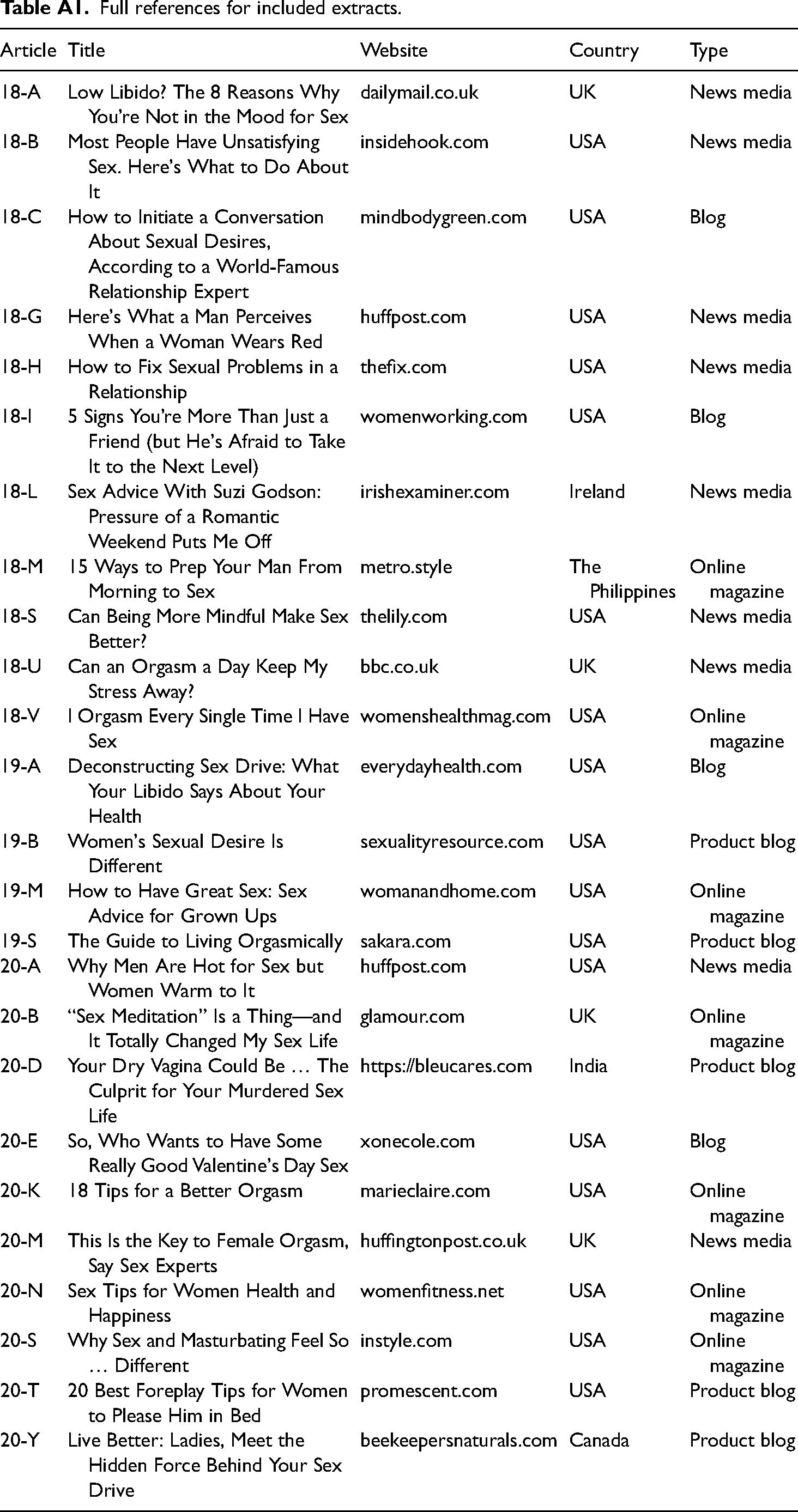
| Article | Title | Website | Country | Type |
|---|---|---|---|---|
| 18-A | Low Libido? The 8 Reasons Why You’re Not in the Mood for Sex | dailymail.co.uk | UK | News media |
| 18-B | Most People Have Unsatisfying Sex. Here's What to Do About It | insidehook.com | USA | News media |
| 18-C | How to Initiate a Conversation About Sexual Desires, According to a World-Famous Relationship Expert | mindbodygreen.com | USA | Blog |
| 18-G | Here's What a Man Perceives When a Woman Wears Red | huffpost.com | USA | News media |
| 18-H | How to Fix Sexual Problems in a Relationship | thefix.com | USA | News media |
| 18-I | 5 Signs You’re More Than Just a Friend (but He's Afraid to Take It to the Next Level) | womenworking.com | USA | Blog |
| 18-L | Sex Advice With Suzi Godson: Pressure of a Romantic Weekend Puts Me Off | irishexaminer.com | Ireland | News media |
| 18-M | 15 Ways to Prep Your Man From Morning to Sex | metro.style | The Philippines | Online magazine |
| 18-S | Can Being More Mindful Make Sex Better? | thelily.com | USA | News media |
| 18-U | Can an Orgasm a Day Keep My Stress Away? | bbc.co.uk | UK | News media |
| 18-V | I Orgasm Every Single Time I Have Sex | womenshealthmag.com | USA | Online magazine |
| 19-A | Deconstructing Sex Drive: What Your Libido Says About Your Health | everydayhealth.com | USA | Blog |
| 19-B | Women's Sexual Desire Is Different | sexualityresource.com | USA | Product blog |
| 19-M | How to Have Great Sex: Sex Advice for Grown Ups | womanandhome.com | USA | Online magazine |
| 19-S | The Guide to Living Orgasmically | sakara.com | USA | Product blog |
| 20-A | Why Men Are Hot for Sex but Women Warm to It | huffpost.com | USA | News media |
| 20-B | “Sex Meditation” Is a Thing—and It Totally Changed My Sex Life | glamour.com | UK | Online magazine |
| 20-D | Your Dry Vagina Could Be … The Culprit for Your Murdered Sex Life | https://bleucares.com | India | Product blog |
| 20-E | So, Who Wants to Have Some Really Good Valentine's Day Sex | xonecole.com | USA | Blog |
| 20-K | 18 Tips for a Better Orgasm | marieclaire.com | USA | Online magazine |
| 20-M | This Is the Key to Female Orgasm, Say Sex Experts | huffingtonpost.co.uk | UK | News media |
| 20-N | Sex Tips for Women Health and Happiness | womenfitness.net | USA | Online magazine |
| 20-S | Why Sex and Masturbating Feel So … Different | instyle.com | USA | Online magazine |
| 20-T | 20 Best Foreplay Tips for Women to Please Him in Bed | promescent.com | USA | Product blog |
| 20-Y | Live Better: Ladies, Meet the Hidden Force Behind Your Sex Drive | beekeepersnaturals.com | Canada | Product blog |
References
Supplementary Material
Please find the following supplemental material available below.
For Open Access articles published under a Creative Commons License, all supplemental material carries the same license as the article it is associated with.
For non-Open Access articles published, all supplemental material carries a non-exclusive license, and permission requests for re-use of supplemental material or any part of supplemental material shall be sent directly to the copyright owner as specified in the copyright notice associated with the article.
