




Abstract
The aim of this study was to analyze identity construction regarding caregiving amongst Senegalese women in diaspora, and to identify what challenges and negotiations they face in their caregiving practices. We conducted semistructured interviews with seven women of Senegalese origin who live in Andalusia, southern Spain. We conducted voice and I-position analysis, which highlighted power inequalities and was sensitive to the dynamic and dialogical acculturation process. The findings showed an identity reconstruction process from caregiving in the cultural context of their home country—where caregiving has a strong collectivist component with mutual support networks, especially in child raising and motherhood, as well as intergenerational respect and caregiving relationships—to a more individualistic host cultural context, where motherhood is more isolated and solitary. Diasporic Senegalese women have also lost their support networks and are overburdened by caregiving work, problems of conciliation between paid work and childcare needs, loss of social status as mothers and as adults, and racism. In such situations, their resilience strategies position them as responsible mothers, maintaining the values of their home culture and developing new strategies for searching information and support.
Caregiving, understood as all actions directed at sustaining life, is an essential daily practice that accompanies human beings throughout the developmental stages of life, and is the basis of all communal life. Care practices, which are socially and economically undervalued, have mainly been provided by women. Feminist theories have focused on caregiving as a subject of study, questioning and debating the role of women as universal caregivers, and the social, political, and economic value of caregiving (Herd & Meyer, 2002).
This study explored the role of caregiving in the identity construction of migrant women, analyzing identity changes throughout their migratory experience. This analysis was applied within the theoretical model of the dialogical self. This model is sensitive to migrant women's experiences of oppression. The approach enables an explanation of the negotiations and confrontations between the culture of origin and that of the host country in care work (Bhatia, 2002; Hermans, 2001).
Senegalese migration in Spain
Senegalese migration to Spain began in the 1970s, mostly by the Wolof ethnic group, and specifically by the Mouride Brotherhood (Sufi Islamic order), an association system based on mutual support. This style of brotherhood is hegemonic in the Senegalese diaspora and also includes people who do not belong to the Wolof ethnic group (Jabardo Velasco, 2011). Senegal does not have a direct historical colonial relationship with Spain like Morocco or Equatorial Guinea, as it was colonized by the French.
The arrival of Senegalese women has been documented since the mid-1980s. The main legal way they could enter Spain was by family reunification (Vickstrom & González-Ferrer, 2016). They reproduced their own participatory and mutual support systems, such as tontine, a system of collective savings directed by women (Sene, 2017). They also created new business models in diasporic communities, such as hair braiding and specialized Afro hair styling, applying the self-organization skills they learned in their homes and in youth associations (Jabardo Velasco & Ródenas Cerezo, 2017).
Migrant women are represented in Western social discourse as prisoners of their patriarchal society, victims of their own culture who have to be guided and assisted in their insertion into the host society, omitting how the inequalities already present in the new context affect them (Valderrama & Yufra, 2016).
Collectivism and individualism
Caregiving, albeit an essential part of humans’ social relations, depends on the cultural scenario where it is carried out. It is therefore indispensable to explore cultural values as they relate to social relations and identity construction.
In the literature, there are two widely used constructs defining cultural differences in how individuals relate to others: collectivism and individualism (Triandis, 1995). Collectivism is the social pattern in which individuals feel strongly bound to each other and see themselves as part of a group, prioritizing group goals and motivations over individual ones. Individualism, conversely, refers to the view of the individual as separate from others, a preference for following one's own motivations and goals, and an emphasis on rational analysis over the advisability of associating or separating from others (Triandis, 1995).
Applying this conceptual line of study to the self, Markus and Kitayama (1991, 2003) differentiated the independent self—constructed separate from others—from the interdependent self, constructed by fitting in with others. The first is associated with Western individualist cultures, where the self is construed as autonomous, and the second predominates in Oriental cultures, where the self is construed referentially. This hermeneutic of the construction of the self has been applied to explain cultural differences in psychological processes such as decision-making (Kitayama et al., 2004), cooperation as a response to social dilemmas (Utz, 2004), memory (Petterson & Paterson, 2012), perceived friendship and romantic relationships (Day & Impett, 2018), stress response (He et al., 2021), and others.
However, some criticisms of the explanatory models for the differences in conceptualizations of the self and social relations between cultural groups must also be considered. The independent/interdependent self scales have validity and consistency problems in different cultural groups (Levine, Bresnahan, Park, Lapinski, Lee, & Lee, 2003; Levine, Bresnahan, Park, Lapinski, Wittenbaum, et al., 2003). Furthermore, criticisms of the differentiation between collectivist and individualist cultures include that there is a lack of clarity and coherence in the concepts, that cultural differences at their foundation are small, and that the differentiation reproduces cultural stereotypes and is not based on empirical evidence (Wong et al., 2018). Our position in this respect is that the differentiation between the independent and interdependent self has current validity and provides a consistent conceptual framework, as shown by the recent studies mentioned as examples. However, the mentioned criticisms in relation to the consistency and clarity of the cultural differences in the construction of the self led us to adopt a dynamic, interactive perspective on the relationship between self and culture. Thus, we do not interpret cultural differences based on clearly differentiated monolithic constructs. Having a perspective that appreciates the nuances and flow between different cultural identities is especially relevant in a study such as this one. This means that identities are not analyzed as immersed in a single homogeneous cultural context (if there is such a thing; Haye & González, 2021), but as those of people who have experienced a migratory process between different cultures.
Acculturation and the dialogical self theory
Acculturation theory (Berry, 2008) studies the process the individual goes through when moving from “Culture A” to “Culture B,” with four possible strategies depending on the level of preservation of their native culture the individual chooses: assimilation, integration, separation, and marginalization. This model, although dominant in acculturation studies in the field of psychology, has been widely criticized.
The dialogical self theory (DST; Hermans, 2001) is based on some of the criticisms of the mainstream acculturation model (Berry, 2008). This theory proposes a conception of the self as a set of I-positions and voices that are in dialogue with the cultural context, mutually influencing each other. This dialogue, in which both self and culture are dynamic elements, is fluid, in contrast to other theories which conceive the self as an atomized element, separate from the context. It is a plural self, constantly changing. DST problematizes Berry's (2008) acculturation model, questioning the universalization of relationships between cultures and the possibility of choosing acculturation strategies (Bhatia, 2012; Bhatia & Ram, 2001, 2009). Furthermore, by its definition, culture is treated as a static element that neither changes nor is transformed (Gamsakhurdia, 2019), and only the individuals who are immersed in it undergo changes when they come into contact with a new culture.
Bhatia (2012) describes acculturation as a dialogical and postcolonial process. Instead of assuming bicultural identities where separate entities from two different cultures meet, he proposes the use of the term diaspora applied to migrant collectives, which describes the complexity, diversity, and flexibility of their identities. The diasporic identity is positioned against the relationship of colonial subordination between the homeland culture and the mainstream culture, which conditions acculturation (Bhatia & Ram, 2009). Therefore, there is no free choice of acculturation strategies (Berry, 2008). Dialogical acculturation does not attempt to find a harmonious identity, but emphasizes conflict, negotiation, and hybridization in a permanent dialogue. The diasporic identity produces a dialogue between the mainstream culture and the homeland culture that is marked by an inequality of power, and this dialogue can be analyzed through the I-positions (Bhatia & Ram, 2001).
Gamsakhurdia (2019, 2021), based on DST's interactive and transforming relationship between self and culture, proposed the use of the term “proculturation” instead of acculturation. Proculturation describes the transformation that occurs when the self comes into contact with new elements, without necessarily implying physically moving, but, for example, through media communication. The contact between the self and new elements, as differentiated from Berry's (2008) acculturation model, assumes a mutual transformation, both of the self and of the culture, thus creating a new element. Gamsakhurdia (2019) rejects the mechanistic conception of the acculturation model as delimited in time, in which at a given point in time, “Culture A” comes into contact with “Culture B.” He argues for a dynamic intersubjective continuity through contact with new ideas that generate emotional and cognitive changes, that is, the contact between different cultural elements is constant and results in the hybridization of a new cultural element.
Analysis of I-positions and voices has been applied to acculturation studies (Andreoli, 2013), diasporic identities (Bhatia, 2012), proculturation (Gamsakhurdia, 2021), frontier identities (Español et al., 2021), and the construction of identity in migrant women (De la Mata et al., 2023). All of these studies emphasize the usefulness of analyzing positions as tools sensitive to power inequalities and the complexity implied by the dynamic nature of the self.
Just as DST is sensitive to the complexity of diasporic identity, so are the experiences described by postcolonial feminism in the meeting of different cultures. This approach criticizes both the androcentrism of postcolonial studies and the Western feminist view that homogenizes and universalizes the problems of women. It also proposes to analyze women's problems from a cross-sectional perspective, making the practices of colonized women visible and denouncing patriarchal colonialist action (Mishra, 2013). Postcolonial feminist analyses of identity construction consider the historical, social, and material contexts in which the person is immersed, fundamental (Barcinski & Kalia, 2005). For example, Anzaldúa (1987) described the mestiza identity, defining it as a fusion breaking up the border—in this case, between the US and Latin America—not only as a separation between territories, but also identities. The mestiza identity describes a unique plural identity since it travels between different cultures and interacts with a diversity of sources, and cannot be reduced to the different elements of which it is composed.
Caregiving and motherhood from a feminist perspective
This study gives special attention to childcare and motherhood, as the participants are migrant mothers. Motherhood has historically been viewed by psychology (mainly evolutionary) from a utilitarian perspective focused on its role in child development, while Western White mainstream feminism has focused on motherhood as oppressive (Athan & Reel, 2015). However, recent empirical studies have tabled the diversity of motherhood experiences, for example, the experiences of lesbian, migrant, adoptive, or imprisoned mothers. These studies complicate and widen the concept of motherhood, which may be experienced in different ways, and even as empowering (Athan & Reel, 2015).
Motherhood experiences in northern countries have been called intensive motherhood. Hays (1996) criticized this motherhood experience as demanding in terms of time and resources; focused on the well-being of children, in which the mother is the only or main caregiver; and where care is given alone, enclosed in the home environment. This concept has led to interesting feminist debates on the responsibility and demands in a diversity of motherhood experiences, which question this ideal of motherhood as overburdening the mother and as lacking social support in child raising (Budds, 2021). Recent studies also show that lack of attention to the relational needs of mothers during the postpartum period increases the likelihood of distress (Enlander et al., 2022). How intensive motherhood impacts on the idea of motherhood as self-sacrificing among single, racialized, and low-income mothers, who find it even harder to meet the expectations of “a good mother,” has also been analyzed (Elliott et al., 2015). In contrast to these discourses of hyper-demanding motherhood, there are feminist alternatives that advocate a liberated maternity based on coresponsibility for care and collective child raising (Green, 2015). In addition, Senegalese feminist sociologist Thiam (1982) pointed out the relevance of collective actions and intersectional approaches to the struggle for gender equality in African societies, especially in regard to the inequalities caused by the unbalanced distribution of care work.
This study analyzes who Senegalese migrant women are when they give care, that is, how they construe their identity in regard to care and the challenges they face in this identity construction. The analysis was conducted from the perspective of the dialogical self, as it understands identity as a changing element in constant dialogue with the surroundings. This provides a dynamic, interactive perspective on how migrant Senegalese women identify themselves in relation to their surroundings and how they perceive changes during the migratory process. Through analysis of how they position themselves in regard to caregiving, and how they position others, the power relations are inferred from caregiving practices. This study contributes to research on caregiving by providing an intersectional description of gender, race, culture, and motherhood. For our approach to these matters, the following study objectives were proposed:
To describe the identity self-construction of Senegalese migrant women as related to caregiving. To analyze the conflicts and negotiation in the process of identity construction that Senegalese women cope with in caregiving.
Methodology
Participants
The three participants in this study were heterosexual cisgender Senegalese women living in Seville. The selection process was intentional through a local non-governmental organization (NGO). They participated voluntarily and anonymously and received a small economic compensation for their time. To ensure anonymity, participants used a pseudonym. The three participants knew each other and knew the first author of this article beforehand. The first author and the participants have participated together in projects and training activities related to feminism and migrants’ rights run by several local NGOs. These previous contacts promoted closeness between the author and participants, the recognition of similar values, and the sharing of common spaces in the neighbourhood and local associations. This favoured trust and rapport during the interviews. The interview with Awa lasted 71 minutes; the one with Marifaye, 97 minutes; and the one with Silvia, 67 minutes. All interviews were in Spanish as the participants had a sufficiently good linguistic competence to express themselves clearly in this language.
Awa is 40 years old, originally from Dakar; she is Muslim and identifies herself as a Wolof, 1 although her mother was from the Sereer ethnic group. Her mother tongues are Wolof and Sereer, and she also speaks French and Spanish. She has primary education, has lived in Spain for 15 years, and has a valid residence permit. She is married and has three daughters—11, 7, and 6 years old, and a 3-year-old son. Her husband has a temporary job in another city. She works as domestic help.
Marifaye is 32 years old and was born in a rural area in the south of Senegal. She is Muslim and identifies as from the Sereer ethnic group. Her native language is Sereer. She speaks Wolof, French, and Spanish and has primary education. She has lived in Spain for 10 years. She was recently granted a residence permit. She is married and has a 4-year-old daughter and a 1-year-old son. She lives with her husband and children. At present, she is unemployed but had worked before as a temporary agricultural laborer and as a cleaner.
Silvia is 34 years old; she is from Dakar, Muslim, and identifies as from the Fula ethnic group. Her mother tongue is Fula. She also speaks Wolof, French, and Spanish. She has a university education. She has lived in Spain for 2 years. She is married; her husband is also Senegalese and emigrated to Spain before her to look for work so they both could settle there. She has a 1-year-old son and lives with him and her husband. At present, she is unemployed and hoping to legalize her status in Spain.
Instrument
Ad hoc semistructured interviews were conducted. The interviews were part of the first author PhD thesis and were designed to collect information on the caregiving practices of African migrant women. First, a pilot interview was carried out. An outline of the questions was drafted following a timeline from infancy to the present day, divided into three parts:
Preliminary questions and information on the study. This first part collected participants’ demographic data and presented the objectives and conditions of the study. It also included basic questions on the concept of caregiving (e.g., “What does caregiving mean to you?”). Caregiving in their home context. This part included questions on care practices, starting from their personal experience as a child (e.g., “Who took care of you?”) to more abstract questions (e.g., “Do you think people take care of themselves?”). Caregiving in their present context. Following the model above, these questions were related to their daily experience (e.g., “Whom do you take care of?”) and their reflections on it (e.g., “Has the way in which you take care of them changed?”).
Procedure
The interviews were conducted in Spanish, recorded, and transcribed for later analysis. The transcripts were analyzed entirely in Spanish and only the extracts that appear in this paper have been translated to English. The translation of these excerpts as well as the rest of the article was done by a professional native English translator. Before the interviews, the participants received a consent form informing them of data treatment, and any questions were answered. The interviews with Marifaye and Silvia were held at their homes, and the interview with Awa was held at the neighborhood association center near her children's school. This study was part of the first author PhD thesis research project whose design was approved by the Ethics Committee of the Virgen del Rocío Hospital (Seville, Spain).
Analysis
The first step in the analysis was to select extracts from the interviews pertaining to the caregiving theme, references to support networks as well as care-related social organizations and institutions. Later, the voices and positions in the extracts were analyzed and adapted to the three steps proposed by Aveling et al. (2015), adding a fourth step:
Identification of I-positions. We distinguished between auto-positions (AP), where the narrator positions herself (e.g., “I worked very hard, from 7 a.m. to 7 p.m. 6 days per week”; labeled as AP I-hard worker), and hetero-positions (HP), where she positions other persons in the narrative (e.g., “My brother loves to ride bikes, he has a huge collection of mountain bikes”; labeled as HP Brother-bike lover) (Lucius-Hoene & Deppermann, 2002). Identification of others’ voices. Voices that have an explicit source in the narration (e.g., “my mother said…”) were identified, and other voices that had no explicit source but a more subtle voice style, were categorized as cultural echoes. These echoes are appropriations of established social discourses, ideas, beliefs, and expressions of others, like unreferenced quotes. Analysis of how the different voices and positions are related to each other. Location/situation of the voices and positions of the participants in different cultural scenarios that appear in their narratives. The cultural scenario is understood as the set of cultural, historical, and institutional elements that make up the context of interaction between individuals and their setting (Wertsch, 1991).
To ensure the validity of results, we created a review group in which the authors of this study reviewed the analysis, discussing each step of the analysis of the three interviews in detail, emphasizing our capacity to listen among authors and ensuring reflexivity during the process (Cornejo et al., 2017). The validity of results was also tested by using the member checking method, which consists in returning the research results to the participants for them to validate the findings as true and pertinent (Caretta, 2016). Thus, the summary of analysis was returned to the participants and readjusted according to their comments so the final version was validated. This member checking process was also carried out in Spanish.
Findings
The findings of the interviews are summarized in the figures below. In each figure, positions are coded as follows: AP = auto-positions; HP = hetero-positions; V = voices; E = cultural echoes. These codes were followed by a number according to their order of appearance in the interview and a label that summarizes their content.
Participant voices and positions are located in three scenarios. First, homeland scenario, related to their home culture, the people who live there, and their “I” before migration. Second, diaspora scenario, referring to the description of the diasporic identity proposed by Bhatia (2012), linked to the present “I” and others in their diasporic community. Finally, mainstream scenario, linked to the hegemonic culture of the host place and its natives that participants mention in their narratives.
Awa
In the interview with Awa, voices and positions that refer to childcare and motherhood were found. As observed in Figure 1, Awa distinguishes between motherhood in Senegal, in the diaspora, and in Spain.
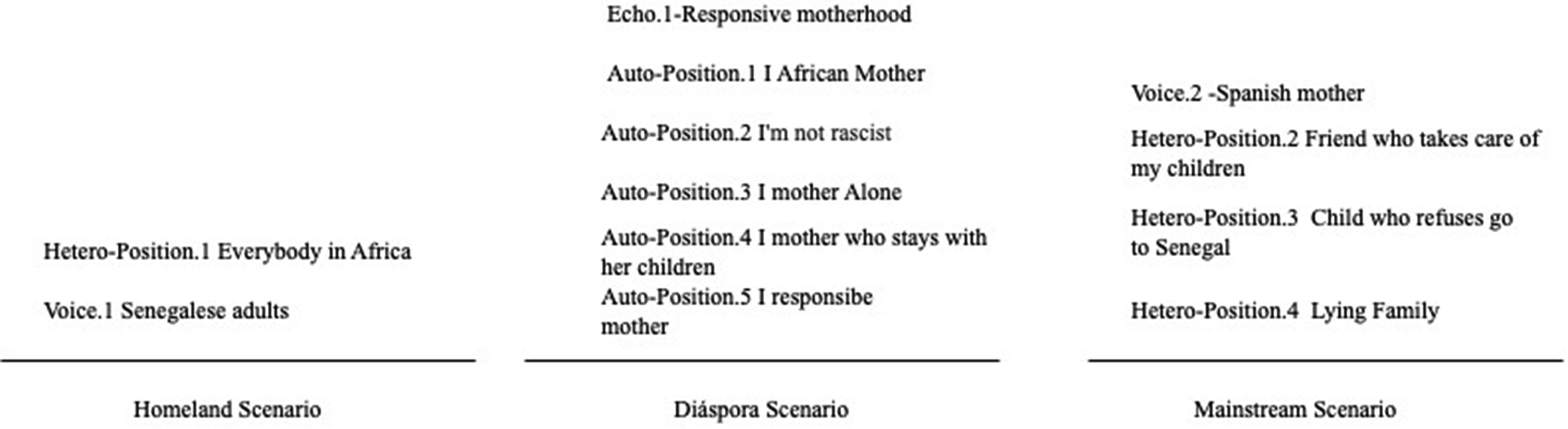
Diagram of main I-positions and voices identified in Awa's interview, separated into different scenarios. First, the voices and positions that she places in her culture of origin, followed by those that she places in diasporic life, and lastly, those that she places in mainstream culture in the host society.
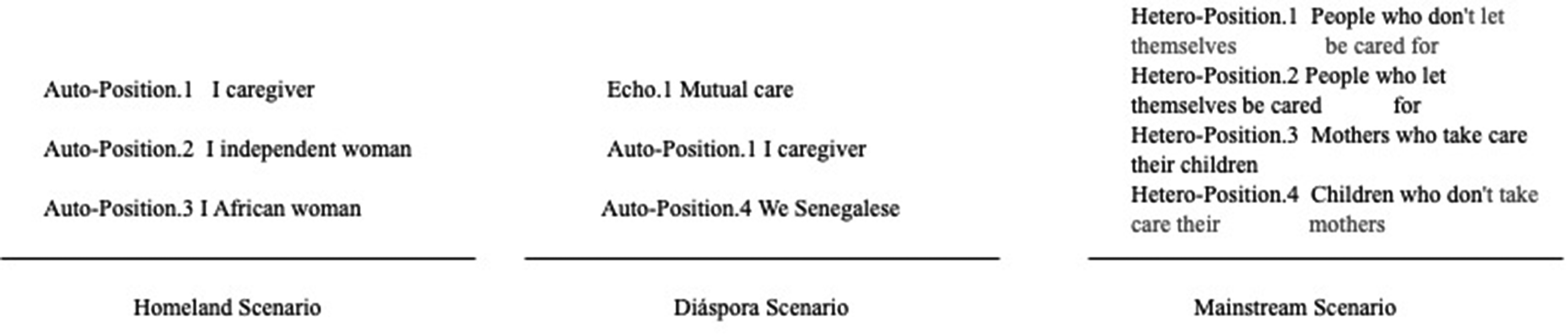
List of main I-positions and voices identified in Marifaye's interview, separated into different scenarios. First, the voices and positions that she places in her culture of origin, followed by those that she places in diasporic life, and lastly, those that she places in mainstream culture in the host society.
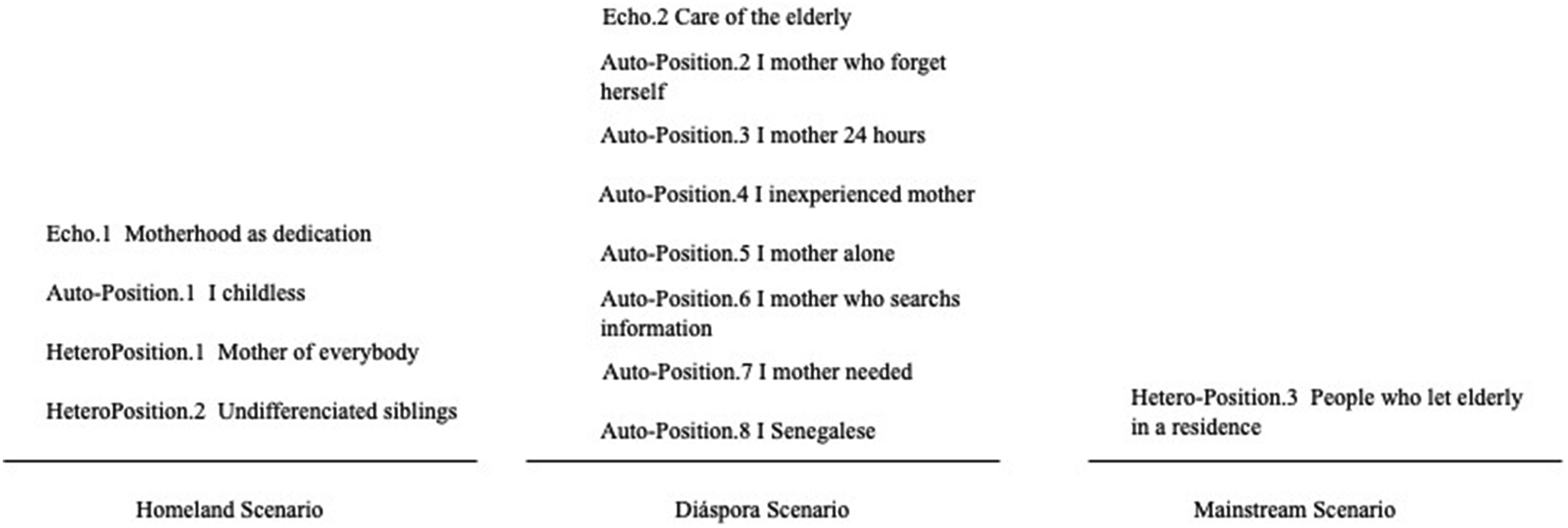
List of main I-positions and voices identified in Silvia's interview, separated into different scenarios. First, the voices and positions that she places in her culture of origin, followed by those that she places in diasporic life, and lastly, those that she places in mainstream culture in the host society.
Awa positions herself as an African mother (AP1), who finds herself in conflict between the community child-raising style that she experienced in Senegal, where all adults could participate in educating a child (HP1, everyone in Africa; V1, adult voices), and the more individualistic child-raising style found in Spain (V2, Spanish mother). Her positioning identifies her as a diasporic African mother who does not share the individualistic education style where only the mother or father can correct their children, but who cannot behave as she would in Senegal. A.1: No, but … in Senegal for example, I … perhaps my neighbour sees my son is doing something. She can tell him something, she can tell him, she must scold him, and reprimand him. I don’t get involved, if my son comes and tells me about it, I say “Very good, that's very well done, you were wrong, she corrected you.” I don’t interfere. And my brother can do it, and my nephew, or anyone who sees a child who does something wrong. You tell him “Look, you shouldn’t do this or that, but this is fine.” Maybe I can see a child complaining to his mother, and the mother will say “It’s none of your business, why are you interfering?” Or something like that, so, in Africa, everybody lets you know.
In addition to community values, in the diaspora, Awa does not have the support networks for raising her children that she would have had in her home country, positioning her as a mother alone (AP3). Awa positions herself as a responsible mother (AP4), which, in the diaspora, means self-sacrifice, rejecting jobs that she cannot conciliate with the care of her children. She positions herself as nonracist (AP2), that is, she does not reject close relationships with locals, despite cultural differences (HP2). A.2: No, no … I say, I … I’m not a racist. My daughter for example, I have friends whom she can stay with … Because now I can’t do much work, I can’t do much I’m not saying that I don’t need someone who can help me, if my children want to be with someone I know for a day, to spend the day. Nothing wrong with that. But to let them go there so I can be lazy … I can’t see that happening.
However, there is a latent fear of relating to the local population and establishing support networks for raising children because she knows of several cases where Senegalese women lost custody of their children. Awa tells the story of someone she knows in this situation, a single mother who left her child in temporary care with a Spanish family while she was working away. She continues positioning herself as a responsible mother who keeps her children with her (AP4 and AP5), but also criticizes the abuse of power of that Spanish family. Awa positions this family as liars (HP4). First, they did not help her friend but reported her, and then they told lies to her daughter based on racist stereotypes about what life is like for girls in Senegal. From her point of view, that little girl was not only separated from her mother but from the whole Senegalese community (HP3). A.3: Let it be, because I’m sure that child won’t want to go to Senegal when she grows up. Because she's been told a lot. That's wrong. I always say, don’t leave your child with someone if you love him … And you can’t take them with you in the pram when you are selling, running around and all that. That's why I stopped selling, because I say I don’t want to take my child with me, because he might see me running from the police. I used to sell, but when my children were born, I said “I’ll get rid of this problem.”
Figure 1 shows Awa's complicated caregiving situation, in which she has had to face the loss of social support networks, the imposition of an institutionalized care system, and the responsibilities that this meant without the support of her extended family. Awa insisted on her positions as a mother alone (AP4), but she did not waver in her responsibilities as a caregiver and mother. We interpret this conjunction of I-positions as reflecting a care work overload. In the member checking stage, Awa explained that, for her, it was not a sacrifice to stop working as a street seller because she had made the decision to have children and knew that they had to be cared for. She even left a job in a restaurant because she could not reconcile it with the care of her first child, and she did not consider getting another full-time job despite her low income. What she considered threatening was the possibility that people who supposedly offered their help could try to take custody of her son and “put ideas in the child's head.”
Marifaye
During Marifaye's interview, two caregiving experiences highlighting the most important voices and positions in her narrative were found. One was a significant event marking a before and after in her life: when Marifaye was 14, she dropped out of school and moved in with her older sister to take care of her niece. The other experience that Marifaye emphasized was the culture shock of caregiving in Spain, including both intergenerational and interpersonal relations in public spaces.
As observed in Figure 2, when Marifaye told her story, she positioned herself as a caregiver (AP1), putting emphasis on the years she spent caring for her niece and helping her sister with housework. Despite how hard this work was, and her determined decision to stop studying, she positions herself as an independent and normal African woman (AP2 and AP3) as a consequence of this decision. MF.1: I don’t “regrete” … I speak French … I have no regrets because I know that it has helped me to be an independent woman, to know how to do many things as an African woman, and as a normal woman. It helped me a lot.
Marifaye continues positioning herself as a caregiver in the diaspora (AP1). However, this positioning is problematic because she cannot always find people who allow themselves to be cared for (HP1 and HP2), which prevents her from being what she would like to be. She does not find the same reciprocity and interdependence with which she identified when she was younger and lived with her family in Senegal. MF.2: Here, I look after anyone who lets me, yes, because there in my country, it is a bit different … The customs, they are not the same. For example, here, someone may be in need. That happens a lot. Sometimes I get on the bus, I see a person who needs the seat more than me, I get up to give it to her, “No, no, no.” Then that person is not letting you take care of her. Yes, but there are people who do let you take care of them. Here, I also take care of people a lot, people who also take care of me a lot.
She talks about the lack of reciprocity in caregiving (E1) that she detects in the local population, which results in the lack of care experienced by the elderly. For example, she talks about how mothers have raised their children (HP3) but those children do not return that care to their mothers when they are old (HP4), something that she thinks is morally wrong. MF.3: Here? Here, I say no. Because here, with our culture and mindset, they are very different. I don’t like what I see of caregiving here, for example.
I: What things don’t you like?
MF: Because here … only mothers look after their children here, children don’t look after their mothers, and if you don’t look after your own mother, you’re not going to look after someone else.
Marifaye makes a negative moral assessment in HP4 “Children who do not take care of their mothers,” in the mainstream scenario. This position is in direct conflict with SP4 (Figure 2), since it does not comply with the E1 mandate of reciprocity of care. This position illustrates Marifaye's view that caregiving should be a duty, not as a woman in this case, but as a question that transcends gender, spanning moral matters such as gratitude for the life and care received. The continuity of AP1 “Caregiver” in the homeland and diaspora scenarios exemplifies, on the one hand, the strong impact that Marifaye's experience as a caregiver in her early years had on her identity, and, on the other hand, her present identity conflict, where she is in contact with people who do not allow her to be who she is, or do not share her values of caregiving reciprocity. During the member checking stage, Marifaye clarified her opinion that people leave their elders in care residences not because they want to, but because they do not comply with their duty to care for a person who has contributed to the community and now needs care.
Silvia
Silvia is the participant who had been in Spain for the shortest time, so her I-positions mainly correspond to the homeland and diaspora scenarios.
As seen in Figure 3, Silvia positions herself with respect to her experience with motherhood as a mother who is willing to forgo her own needs (AP2) and who has no time to take care of herself, as opposed to when she had no children and lived in Senegal (AP1). In the extract below, she describes her lack of time for caring for herself as the result of her choice of investing that time in taking care of her child. S.1: In general, the mother takes care of everyone, but she forgets about herself. Here too. For example, I used to take care of myself a lot. I took time to remove everything from my … skin, and all that, every week and everything, but now I don’t have time, with the child and everything, many things, so now I have a … I don’t have much time to do that, I don’t feel like it either, I prefer to be with my child than … do anything else.
During the interview, Silvia compares her motherhood experience with her mother's. She positions herself as a 24-hour mother (AP3) who has to be with her child. In the example above, she mentions her decision to devote her time to caring for her child, but she also talks about how that care, with no other support, is overburdening. When she describes what motherhood is like in Senegal, she says her mother (HP1), who had cared for nieces and nephews as if they were her own, would also have helped her care for her child (HP2). S.2: That, that wasn’t my responsibility [her nephews and nieces in Senegal]. I wasn’t with them 24 hours a day, and I’m always with this child, you see? … For her [talking about her mother in Senegal], it makes no difference whether it's her nephew or her own child, always. For her … For me, it is not the same, because it is, I am here [Spain], they are there [Senegal], but yes, the child was in the same house as them, at the same time [refers to family life in Senegal], of course. There is no difference. They are all children in my line, my sisters’ children are my children too, that is what they say. For example, they are cousins, they don’t say they are cousins, they say they are brothers, that he is my sister's son and all that, so for me there is no difference.
Silvia, in addition to mentioning her lack of support networks, spoke about how she coped with this problem. In her case, as a new mother (AP4) and alone (AP5), she found the information that she needed on how to care for a baby, and that she would have received from her mother, on the internet (AP6). S.3: [T]he first bath has to be given by me. I didn’t know all that, imagine, on my own there, without my mother, without anything, so very hard, eh like me, I use my mobile phone a lot, I look up everything on the internet, how to give the first bath, how to breastfeed, all that, and little by little, it's going along well.
Throughout the interview, Silvia repeatedly mentions her feelings of loneliness and lack of support, especially because her mother is so far away. When she positions her mother as being a mother to everyone, she is introducing a latent discourse of motherhood as dedication (E1). Such dedicated motherhood would not be as overburdening as what she is experiencing if she lived in Senegal, because she is alone and, therefore, there is no other choice to care for her child (AP7). S.4: No, things would be different if it were in my country (Senegal), I’m not going to be with him 24 hours a day. Of course, my mother could help me in many ways, I would be calmer at night if he punished me (talking about her son), because I could leave him with my mother, but here (Spain) I can’t. Because my mother always takes care of the children. Because my mother always looks after the children, my sister's children, it's my mother who looks after them, she always does, even though she is older, but she likes looking after the children, so if I were there with my child, she would look after him more, of course, that's what she does.
Finally, Silvia positions herself as a Senegalese (AP8) who, like Marifaye, is influenced by the cultural echo of the value of taking care of elderly family members (E2), and she does not understand how Spaniards can leave their family elders in care residences (HP3). This confrontation shows the conflicts between the diaspora and mainstream scenarios, as in the following example: S.5: Here, elderly people are in a residence, although there are some who are with their children, but most of them go to … the residence, but I can’t understand it. It is not like that in my country, the older ones are always with their family, which is not that easy, but we try.
Like Awa and Marifaye, Silvia positions herself as a Senegalese woman in regard to the current period of her life away from Senegal and how she perceives Spanish caregiving practices regarding children's education or care of the elderly. For Silvia, dealing with motherhood in the diaspora scenario means loneliness, as well as a different way of relating to her child compared to how she related to her mother, brothers, sisters, and cousins growing up in an extended family in Senegal. The relationship with her son is much more intense and demanding in Spain than it would be in Senegal.
Discussion
Based on the findings, we elaborate a discussion along two argument lines. The first focuses on how participants deal with the difficulties they face in relation to care and motherhood. The second discusses how interaction with a culture that the participants see as individualistic affects their care practices, and its implications for their identity. The discussion ends with a paragraph referencing other studies with similar results.
Diasporic Senegalese mothers at the crossroads
Regarding the challenges and negotiations with which Senegalese migrant women must cope in relation to care practices, the findings highlight (a) their lack of support networks in caring practices (mainly in child raising); (b) their perceived loss of social value as adults and as mothers; (c) the difficulty in reconciling work with care practices in terms of time, a situation aggravated by precarious employment characterized by unstable working hours; and (d) the threat of structural racism present in institutions that deal with the protection of minors. Despite these difficulties, diasporic Senegalese women develop resilience strategies, such as positioning themselves as responsible mothers, maintaining the values of their home culture, and developing new strategies to search for information and support.
Being a mother, identifying oneself as a mother, is not reduced to childbearing or to the relationship with one's biological children. Motherhood is also a phenomenon influenced by the social and cultural context. Therefore, identifying oneself as a mother in Senegal is different from identifying oneself as a diasporic Senegalese mother. Participants in their homeland context position themselves as mothers, as a figure of authority and of caregiving. Awa positions adults in Senegal as persons with the authority to correct and instruct any child in a public space; Silvia defines her mother as the mother of all her nephews and nieces; Marifaye describes the moment when she took over the care of her niece (as a second mother) as a step toward adulthood. The identities of the participants and of other women in their families are conditioned by who they are and what they do in an extended family caregiving network. Diasporic motherhood is identified with the loss of support networks, but also involves a loss of identity and of social status.
Mothers, caregivers, and the elderly are perceived as less valued in the diaspora scenario. It is not the same to be recognized as a mother by their own children as well as by nieces, nephews, and other children in their care, with the authority status that it implies, than just by their biological children. Participants perceive the outsourcing of care of the elderly as immoral, as not complying with the duty of reciprocity of care, and as devaluing the elderly. In the diaspora, Senegalese women face a dual conflict. One is material, as they are overburdened by caregiving tasks and precarious employment, and the other is symbolic, represented by the loss of social recognition of motherhood and by the threat of still losing social value in their old age. Colonialism, in addition to the exploitation and subjugation of African societies, led to a loss of social status for women (Oyěwùmí, 1997). This loss of status is replicated in the diaspora as a forced change in identity, from a maternal identity linked to collective care practices to a maternal identity defined by isolation.
The identity of migrant mothers is shaped by historical and colonial relations, economic inequalities, and discrimination and racism in their homeland and in the host contexts (Mattar & Pestana, 2015). In Awa's case, the impact of racism on her identity as a mother and her care practices is apparent. She positions herself as a mother alone, something that is not different from the reality of other local mothers. Nevertheless, in her case, the attempt to establish new support networks with local people is conditioned by negative experiences in this setting. To her, this means the risk of being considered a bad mother and having the custody of her children taken from her. Migrant women are in a vulnerable legal position to fight for the custody of their children if they are reported. Their situation of precarious employment along with racism (Briones-Vozmediano et al., 2020) causes mothers to feel under threat. Racism and otherness mark the identity of migrant women (Bhatia, 2012). To analyze these inequalities, intersectional feminism posits that there are different sources of oppression that affect multiple identities (Crenshaw, 2017). In the diasporic scenario, Senegalese migrant women experience oppression as women, as migrants, and as Africans. This intersectional perspective makes visible what cannot be seen when gender and race are conceptualized as separate sources of oppression (Tamale, 2020).
Challenging the colonial representation of women as a subordinated category, African women design strategies for resisting the oppression they undergo in the diaspora. Awa positions herself as a responsible mother, a resilient position from which she can enunciate her capacity to seek stability in a precarious employment and sustain her family. Marifaye reaffirms herself as a caregiver, despite finding resistance from the social setting. Silvia positions herself as an overburdened mother, but, at the same time, as a mother with resources for coping with her loss of networks. In all three cases, participants’ agency is present in their identifying as Senegalese in a setting that discriminates and rejects them. Afro-feminist approaches emphasize African women's agency as an active part of their communities and their families (Duru, 2012). The capacity for agency of African women appears as a major factor of resilience to discrimination and racism in diasporic communities.
Tensions between individualism and interdependence
Participants’ identity changed during their interaction with a new culture perceived as more individualistic. Furthermore, the changes they have undergone in their motherhood experience show a complex juxtaposition of elements that involve both interdependence and autonomy. The findings showed that migrant Senegalese women's construction of their selves as migrant Senegalese caregiving women includes elements related to interdependence, merging the self with others, but also elements of agency, autonomy, and independence.
Kagitçibasi (1996) questions the distinction between an independent and an interdependent self, where the first implies a preference for autonomy. On one hand, she suggests that psychology is a product of Western origin. As such, it reflects the individualistic ethos of the Western world and exports itself to the rest of the world as the ideal model of human behaviour. On the other hand, all societies promote the satisfaction of people's needs for relatedness and autonomy to a greater or lesser extent; thus, feeling connected to others does not necessarily imply a lack of autonomy. Therefore, Kagitçibasi argues for an autonomous–related self that recognizes and satisfies the needs for relatedness and autonomy. This model fits with the position of Marifaye as caregiver, an interdependent position in itself. Although the act of caregiving cannot be conceived without others, since attention is focused on the other, she positions herself as an independent woman based on her capacity for caring for others. This includes the dimensions of autonomy, in the form of self-agency, and relatedness at the same time.
The importance of the family caring for its elders as an ethical and moral question has a strong relational character that forms part of the participants’ socialization process. However, the definition of the interdependent self (Markus & Kitayama, 1991) does not include the possibility that relatedness and autonomy are both promoted at the same time in one cultural context. The complexity of the relationship between these two dimensions is stronger in the case of Silvia, “The mother [who] takes care of everyone, but [she] forgets about herself.” The fusion of self with others is evident, but is it an unequivocal indicator of less autonomy attributed to the interdependent self? From a Western perspective, it probably is. However, recent studies on postcolonial African feminism advocate the decision of motherhood and reproductive autonomy as a matter that can be understood collectively (Telo, 2019). From this point of view, the answer to this question is not so evident, since the line of what we consider autonomy may be blurred.
The results of this study replicate and extend other studies’ results on caregiving practices. For example, a recent study by Olasunkanmi-Alimi et al. (2022) argues that everyday racism shapes the caregiving practices of diasporic African women, in their case, caring for the elderly. This study offers similar findings applied to child raising and women’s identities as mother and caregiver. It also replicates recent findings showing that the discourses of intensive motherhood harm the well-being of mothers and do not serve their relational needs (Budds, 2021; Enlander et al., 2022; Kestler-Peleg & Lavenda, 2018), contributing an intersectional analysis of motherhood in Western societies.
Among the limitations of this study, we acknowledge that participants were interviewed in a language (Spanish) that is not their mother tongue, which could imply the loss of nuances in their narratives. Furthermore, the sample size does not allow generalizability of results to all Senegalese migrant women. However, the type of analysis (I-positions and voices) in this study did not attempt to produce generalizable knowledge, but to offer contextualized knowledge that explains how this reality is perceived from a specific perspective. Finally, the interpretation of results was framed in feminist and postcolonial criticism, although this view provides a specific insight that broadens mainstream perspectives.
Conclusions
In conclusion, there is a series of cross-cutting types of oppression on who, how, where, and in exchange for what care is given, in which gender is a determinant but not the only factor. Migrant women who come from settings with socially and culturally rooted community support networks face both the loss of support itself and the identity cost of being outside of those networks. The challenge in facing racism and discrimination determines their caregiving practices and how they define themselves and their motherhood identity.
Liberal feminism, which focuses on promoting individual changes as a strategy for achieving gender equality, is a major contribution to women's empowerment and freedom. Nevertheless, care as an object of feminist study shows the undeniable interdependence of human beings. This interdependence highlights the limitations and privileges of the perspectives that emphasize individual empowerment. That is, the proposals of liberal feminism for individual empowerment do not include the experiences of women who live on the margins of society, at the intersection of different types of oppression. However, there are feminist proposals from the margins of society, such as bell hooks’s (1984, 2000), who posits that the construction of collective support networks can have a major liberating impact on the lives of women (Green, 2015). Participants’ voices urge us to address the issue of care and motherhood from a collective point of view. The current work system is a hindrance to the well-being and dignity of caregivers, particularly those from the most vulnerable groups. Consequently, the feminist movement must involve a reexamination of the productive–reproductive work paradigm, incorporating an intersectional approach.
Based on the matters analyzed here, other possible research questions could include whether there is a relationship between the trend to institutionalize caregiving and the progressive individualization of society; or what is the role of aunts, daughters-in-law, and nieces in transnational caregiving chains. The knowledge generated in this study has implications for social interventions aimed at Senegalese migrant caregiving women, which should focus on their relational needs. This study highlights the need for an intercultural dialogue on different child-raising styles, especially between diasporic communities and child protection services.
Footnotes
Declaration of conflicting interests
The author(s) declared no potential conflicts of interest with respect to the research, authorship, and/or publication of this article.
Funding
The author(s) disclosed receipt of the following financial support for the research, authorship, and/or publication of this article: This work was supported by the Spanish Government, the Ministry of Science and Innovation, the State Research Agency, and the European Regional Development Fund-ERDF (Gobierno de España, Ministerio de Ciencia e Innovación, Agencia Estatal de Investigación y Fondo Europeo para el Desarrollo Regional-FEDER) under the broader project “Challenges of the Self: Identity Reconstruction in Situations of Inequality and Social Exclusion” (Grant No. PSI2016–80112–P).
